注:本文为 "代数基础" 相关合辑。
英文引文,机翻未校。
图片清晰度受引文原图所限。
如有内容异常,请看原文。
The Ultimate Variable Guide in Algebra
代数变量终极指南
Sarah Lee AI generated o3-mini · May 16, 2025
Introduction
引言
Algebra is a cornerstone in the world of mathematics, often serving as the gateway to more advanced topics and strategies across STEM disciplines. At the foundation of Algebra I is the concept of variables. Variables are not just symbols on a page---they represent unknown quantities, enable the formulation of equations, and are instrumental in solving real-world problems.
代数是数学世界的基石,常作为通往 STEM 各学科更高级主题与策略的门户。Algebra I 的基础是变量概念。变量不仅仅是纸上的符号------它们代表未知量,使方程的构建成为可能,并在解决现实问题中发挥关键作用。
In this guide, we will explore variables in depth, beginning with their definition and moving through essential techniques such as substitution, combining like terms, and simplifying expressions. We will then examine how these methods lead to solving both simple and complex equations, and finally, discuss practical applications ranging from word problems to graphical representations. With practical examples, step-by-step explanations, and interactive diagrams, this article is designed to equip educators and learners alike with strategies and insights into mastering the art of manipulating variables.
在本指南中,我们将深入探索变量,从其定义开始,逐步介绍代换、合并同类项、化简表达式等基本技巧。随后,我们将探讨这些方法如何用于求解简单与复杂的方程,最后讨论从文字题到图形表示等实际应用。通过实例、分步讲解和交互式图表,本文旨在为教育工作者和学习者提供掌握变量操作艺术的策略与见解。
Whether you are a teacher seeking new ways to present algebra, or a student working to overcome common stumbling blocks, this comprehensive guide offers clear, evidence-based strategies and resources to facilitate your understanding. Drawing on research and expert advice from reputable sources 1, 2, 3, we ensure that the content you're reading is not only accurate but also practical for real-life applications.
无论您是寻求代数教学新方法的教师,还是努力克服常见障碍的学生,本综合指南都提供清晰、基于证据的策略与资源,以促进您的理解。本文借鉴了来自权威来源的研究与专家建议,确保您阅读的内容不仅准确,而且对实际应用具有实用性。
Let's embark on our journey to unravel the mystery behind variables and discover how they unlock the door to solving problems in algebra and beyond.
让我们踏上揭开变量奥秘的旅程,探索它们如何打开解决代数及更广泛问题的大门。
Understanding Variables
理解变量
Definition of a Variable
变量的定义
A variable is a symbol, often a letter, that represents an unknown or changing value. In algebra, variables stand in the place of numbers within equations and expressions. Their use allows us to generalize patterns and relationships without being restricted by specific numerical values. For example, in the algebraic expression:
变量是一个符号,通常为字母,代表未知或变化的值。在代数中,变量在方程和表达式中代替数字。它们的使用使我们能够概括模式与关系,而不受特定数值的限制。例如,在代数表达式中:
x + 5 = 10 , x + 5 = 10, x+5=10,
x x x is a variable that we solve for.
x x x 是我们要解的变量。
Variables are essential because they provide a way to describe general laws, solve for unknowns, and develop formulas that are adaptable to various scenarios.
变量至关重要,因为它们提供了一种描述普遍规律、求解未知量以及开发适用于各种场景公式的方法。
Types of Variables (Constants vs Variables)
变量的类型(常数与变量)
It is important to distinguish between constants and variables .
区分常数 与变量非常重要。
-
Constants are fixed values that do not change. For example, in the equation:
常数是不变的固定值。例如,在方程中:3 x + 5 = 11 , 3x + 5 = 11, 3x+5=11,
the numbers 3, 5, and 11 are constants.
数字 3、5 和 11 是常数。
-
Variables , as mentioned, are symbols used to represent unknown values. In the same equation, x x x is a variable.
变量 ,如前所述,是用于表示未知值的符号。在同一方程中, x x x 是变量。
This distinction is crucial since misidentifying a constant as a variable (or vice versa) can lead to algebraic errors and misinterpretations of a problem's intent.
这一区分至关重要,因为将常数误认为变量(或反之)可能导致代数错误和对问题意图的误解。
Role of Variables in Equations
变量在方程中的作用
Variables play a pivotal role in forming relationships within equations. They do so by allowing us to:
变量在建立方程内部关系方面发挥着关键作用。它们通过以下方式实现:
- Represent unknown quantities in a manner that can later be determined through solving.
以可通过求解后续确定的方式表示未知量。 - Express general formulas that apply to a wide range of situations.
表达适用于广泛情境的通用公式。 - Create models to reflect real-world phenomena where conditions are not fixed.
创建模型以反映条件不固定的现实现象。
For instance, consider the formula for the area of a rectangle:
例如,考虑矩形面积公式:
A = l w , A = lw, A=lw,
where A A A is the area, and l l l (length) and w w w (width) are variables representing the dimensions of the rectangle. This formula is universally applicable regardless of the specific measurements.
其中 A A A 是面积, l l l(长度)和 w w w(宽度)是表示矩形尺寸的变量。无论具体测量值如何,此公式普遍适用。
Mermaid Diagram: Variables in an Equation
图表:方程中的变量
Below is a Mermaid diagram visualizing the relationship between constants and variables in a typical linear equation:
以下是可视化典型线性方程中常数与变量之间的关系图表:
Start with Equation
Identify Constants
Identify Variables
Set up Equation: ax + b = c
Solve for x
Determine values for Constants
Find Unknown variable x
This flowchart outlines the logical process involved in understanding and manipulating variables in an algebraic equation, ensuring that both constants and variables are correctly identified and utilized.
此流程图概述了理解和操作代数方程中变量的逻辑过程,确保正确识别和使用常数与变量。
Basic Operations with Variables
变量的基本运算
Substitution Techniques
代换技巧
Substitution is one of the most fundamental techniques in algebra. It involves replacing a variable with a value or another expression. This method simplifies the process of solving equations, especially when dealing with systems of equations. Consider the following example:
代换是代数中最基本的技巧之一。它涉及用值或另一个表达式替换变量。此方法简化了求解方程的过程,尤其在处理方程组时。考虑以下示例:
y = 2 x + 3 and x = 4. y = 2x + 3 \quad \text{and} \quad x = 4. y=2x+3andx=4.
By substituting x x x with 4, we find:
通过将 x x x 代换为 4,我们得到:
y = 2 ( 4 ) + 3 = 11. y = 2(4) + 3 = 11. y=2(4)+3=11.
Substitution techniques are especially useful when:
代换技巧在以下情况特别有用:
- Evaluating functions.
求函数值。 - Simplifying expressions.
化简表达式。 - Solving multi-step equations.
求解多步方程。
Combining Like Terms
合并同类项
Combining like terms is a method used to simplify mathematical expressions. Like terms are terms that contain the same variable raised to the same power. For example, in the expression:
合并同类项是用于化简数学表达式的方法。同类项是包含相同变量且该变量指数相同的项。例如,在表达式中:
3 x + 5 x − 2 , 3x + 5x - 2, 3x+5x−2,
the terms 3 x 3x 3x and 5 x 5x 5x are like terms and can be combined to form:
3 x 3x 3x 和 5 x 5x 5x 是同类项,可以合并形成:
8 x − 2. 8x - 2. 8x−2.
This simplification is vital since it leads to more manageable expressions and clearer pathways to solving equations.
这一化简至关重要,因为它使表达式更易于处理,并为求解方程提供更清晰的路径。
Simplifying Expressions
化简表达式
Simplification is the process of transforming an expression into its simplest form. It involves:
化简是将表达式转化为其最简形式的过程。它涉及:
- Combining like terms.
合并同类项 - Applying distributive properties.
应用分配律 - Reducing fractions.
约分
Consider the expression:
考虑表达式:
2 ( 3 x + 4 ) − x . 2(3x + 4) - x. 2(3x+4)−x.
By applying the distributive property, we get:
通过应用分配律,我们得到:
6 x + 8 − x = 5 x + 8. 6x + 8 - x = 5x + 8. 6x+8−x=5x+8.
Simplification reduces the complexity of expressions and prepares them for further operations, such as solving equations or factoring.
化简降低了表达式的复杂性,并为进一步运算(如求解方程或因式分解)做好准备。
Solving Equations
求解方程
Understanding how to manipulate variables lays the groundwork for solving equations. There are various types of equations, each requiring different techniques and methodologies.
理解如何操作变量为求解方程奠定基础。存在各种类型的方程,每种都需要不同的技巧和方法。
One-step Equations
一步方程
A one-step equation involves a single operation to isolate the variable. For instance:
一步方程涉及通过单一运算分离变量。例如:
x + 5 = 10. x + 5 = 10. x+5=10.
To solve for x x x, subtract 5 from both sides:
为求解 x x x,两边同时减去 5:
x = 10 − 5 = 5. x = 10 - 5 = 5. x=10−5=5.
One-step equations illustrate the foundational logic of equilibrium: whatever operation is performed on one side must be performed on the other to maintain balance.
一步方程说明了平衡的基本逻辑:对一边进行的任何运算必须在另一边同样进行,以保持平衡。
Multi-step Strategies
多步策略
Multi-step equations involve several operations in sequence. Consider the equation:
多步方程涉及按顺序进行若干运算。考虑方程:
2 x + 3 = 11. 2x + 3 = 11. 2x+3=11.
Step 1: Isolate the variable term by subtracting 3 from both sides:
步骤 1: 通过两边同时减去 3 分离变量项:
2 x = 11 − 3 = 8. 2x = 11 - 3 = 8. 2x=11−3=8.
Step 2: Divide both sides by 2:
步骤 2: 两边同时除以 2:
x = 8 2 = 4. x = \frac{8}{2} = 4. x=28=4.
For more complex equations, strategies might include:
对于更复杂的方程,策略可能包括:
- Distributive property: a ( b + c ) = a b + a c a(b + c) = ab + ac a(b+c)=ab+ac.
分配律: a ( b + c ) = a b + a c a(b + c) = ab + ac a(b+c)=ab+ac。 - Combining like terms: Simplifying before isolating the variable.
合并同类项: 在分离变量之前先化简。 - Inverse operations: Applying operations that cancel opposite effects, such as addition with subtraction or multiplication with division.
逆运算: 应用相互抵消的运算,如加法与减法或乘法与除法。
Checking Solutions
验证解
Verifying that a solution is correct is a crucial step in the problem-solving process. After determining a value for the variable, substitute it back into the original equation to ensure the equality holds. For example, for the equation:
验证解的正确性是解题过程中的关键步骤。在确定变量的值后,将其代回原方程以确保等式成立。例如,对于方程:
3 x − 4 = 11 , 3x - 4 = 11, 3x−4=11,
if we find x = 5 x = 5 x=5, substituting back gives:
如果我们求得 x = 5 x = 5 x=5,代回得到:
3 ( 5 ) − 4 = 15 − 4 = 11 , 3(5) - 4 = 15 - 4 = 11, 3(5)−4=15−4=11,
confirming that x = 5 x = 5 x=5 is indeed the correct solution.
确认 x = 5 x = 5 x=5 确实是正确的解。
If the solution does not satisfy the equation, this is a signal to review and correct the steps taken. Systematic checking reduces errors and enhances confidence in the solution provided.
如果解不满足方程,这是审查和纠正所采取步骤的信号。系统性检查可减少错误并增强对所提供解的信心。
Applications of Variables
变量的应用
Algebra's strength lies not only in its abstraction but also in its ability to describe real-world scenarios. Variables are essential in translating everyday problems into a mathematical framework that can be analyzed and solved.
代数的优势不仅在于其抽象性,还在于其描述现实场景的能力。变量在将日常问题转化为可分析和求解的数学框架方面至关重要。
Word Problems
文字题
Word problems convert real-life situations into algebraic expressions. For instance:
文字题将现实情境转化为代数表达式。例如:
"John has three times as many apples as Mary. Together, they have 48 apples. How many apples does each have?"
"John 拥有的苹果是 Mary 的三倍。他们共有 48 个苹果。每人各有多少个苹果?"
Let M M M represent the number of apples Mary has, and 3 M 3M 3M represent the number John has. The equation becomes:
设 M M M 表示 Mary 拥有的苹果数, 3 M 3M 3M 表示 John 拥有的苹果数。方程变为:
M + 3 M = 48 , M + 3M = 48, M+3M=48,
which simplifies to:
化简为:
4 M = 48 ⇒ M = 12. 4M = 48 \quad \Rightarrow \quad M = 12. 4M=48⇒M=12.
Thus, Mary has 12 apples, and John has 36. Such problems encourage critical thinking by requiring readers to form equations based on context clues.
因此,Mary 有 12 个苹果,John 有 36 个。这类问题要求读者根据上下文线索建立方程,从而鼓励批判性思维。
Real-world Modeling
现实建模
Algebraic models are vital in fields ranging from economics to engineering. Consider the modeling of population growth using the simple linear model:
代数模型在从经济学到工程学的各个领域都至关重要。考虑使用简单线性模型对人口增长进行建模:
P ( t ) = P 0 + r t , P(t) = P_0 + rt, P(t)=P0+rt,
where:
其中:
- P ( t ) P(t) P(t) is the population at time t t t.
P ( t ) P(t) P(t) 是时刻 t t t 的人口 - P 0 P_0 P0 is the initial population.
P 0 P_0 P0 是初始人口 - r r r is the rate of growth per unit time.
r r r 是单位时间的增长率
Here, the variables serve as placeholders for quantities that can change over time, allowing researchers to predict future trends based on current data. This kind of modeling is widely employed in disciplines like biology, ecology, and economics, ensuring robust predictions based on a sound mathematical framework.
这里,变量作为随时间变化的量的占位符,使研究人员能够基于当前数据预测未来趋势。这种建模广泛应用于生物学、生态学和经济学等学科,确保基于坚实数学框架的稳健预测。
Graphical Representation
图形表示
Graphing variables is another powerful way to understand their behavior. In algebra, the graph of a linear equation such as:
绘制变量图形是理解其行为的另一种有力方式。在代数中,线性方程(如)的图形:
y = 2 x + 1 y = 2x + 1 y=2x+1
is a straight line with a slope of 2 and a y-intercept of 1. Visual tools like graphs help in:
是一条斜率为 2、y 轴截距为 1 的直线。图形等可视化工具有助于:
- Recognizing patterns or trends.
识别模式或趋势。 - Identifying key features such as the intercepts and slopes.
识别截距和斜率等关键特征。 - Providing a visual confirmation of analytic work.
为分析工作提供可视化确认。
Below is a Mermaid diagram representing a simple linear equation graph:
以下是表示简单线性方程图形的图表:
Start: Linear Equation y = 2x + 1
Identify Slope = 2
Identify y-intercept = 1
Plot y-intercept (0, 1)
Use slope to determine next point
Draw straight line
This diagram demonstrates how systematically identifying elements of an equation can contribute to accurate graphical representation.
此图表展示了系统识别方程元素如何有助于准确的图形表示。
Practice and Extensions
练习与拓展
Practice is the key to mastery in algebra. Engaging with sample problems and exploring step-by-step solutions helps in cementing the understanding of variables and equations.
练习是掌握代数的关键。通过练习题和探索分步解答,有助于巩固对变量和方程的理解。
Sample Problems
练习题
Below are a few sample problems designed to test your understanding:
以下是旨在测试您理解程度的练习题:
-
Solve the equation:
求解方程:
4 x − 7 = 9. 4x - 7 = 9. 4x−7=9. -
Simplify the expression:
化简表达式:
3 ( 2 x + 4 ) − 5 x . 3(2x + 4) - 5x. 3(2x+4)−5x. -
Solve the word problem:
求解文字题:
"A number increased by 6 equals 20. What is the number?"
"某数增加 6 等于 20。该数是多少?"
These problems incorporate various aspects covered in this guide: basic operations, substitution, and real-world application.
这些问题涵盖了本指南的各个方面:基本运算、代换和现实应用。
Step-by-step Solutions
分步解答
Let's walk through the solution for each sample problem.
让我们逐步讲解每个练习题的解答。
Problem 1: Solve 4 x − 7 = 9 4x - 7 = 9 4x−7=9
问题 1:求解 4 x − 7 = 9 4x - 7 = 9 4x−7=9
- Step 1: Add 7 to both sides to isolate the term with x x x:
步骤 1: 两边同时加 7 以分离含 x x x 的项:
4 x − 7 + 7 = 9 + 7 ⇒ 4 x = 16. 4x - 7 + 7 = 9 + 7 \quad \Rightarrow \quad 4x = 16. 4x−7+7=9+7⇒4x=16.
- Step 2: Divide both sides by 4:
步骤 2: 两边同时除以 4:
x = 16 4 = 4. x = \frac{16}{4} = 4. x=416=4.
Problem 2: Simplify 3 ( 2 x + 4 ) − 5 x 3(2x + 4) - 5x 3(2x+4)−5x
问题 2:化简 3 ( 2 x + 4 ) − 5 x 3(2x + 4) - 5x 3(2x+4)−5x
- Step 1: Apply the distributive property:
步骤 1: 应用分配律:
3 × 2 x + 3 × 4 = 6 x + 12. 3 \times 2x + 3 \times 4 = 6x + 12. 3×2x+3×4=6x+12.
- Step 2: Subtract 5 x 5x 5x:
步骤 2: 减去 5 x 5x 5x:
6 x + 12 − 5 x = x + 12. 6x + 12 - 5x = x + 12. 6x+12−5x=x+12.
Problem 3: Solve the word problem "A number increased by 6 equals 20"
问题 3:求解文字题"某数增加 6 等于 20"
-
Step 1: Let the unknown number be n n n.
步骤 1: 设未知数为 n n n。 -
Step 2: Create the equation:
步骤 2: 建立方程:
n + 6 = 20. n + 6 = 20. n+6=20.
- Step 3: Subtract 6 from both sides:
步骤 3: 两边同时减去 6:
n = 20 − 6 = 14. n = 20 - 6 = 14. n=20−6=14.
Conclusion
结论
Variables are the heartbeat of algebra. They transform the static world of numbers into dynamic models that reflect both theoretical concepts and real-world situations. By understanding the definition, types, and roles of variables; mastering basic operational techniques such as substitution and combining like terms; and applying these skills to solve equations and model real-world phenomena, learners and educators alike can unlock the true potential of algebra.
变量是代数的命脉。它们将静态的数字世界转化为反映理论概念和现实情境的动态模型。通过理解变量的定义、类型和作用;掌握代换和合并同类项等基本操作技巧;并将这些技能应用于求解方程和建模现实现象,学习者和教育工作者都能释放代数的真正潜力。
Throughout this guide, we have explored:
在本指南中,我们探讨了:
-
The foundational aspects of variables and their importance.
变量的基础方面及其重要性
-
Fundamental operations that simplify the manipulation of variables.
简化变量操作的基本运算
-
Strategic methods for solving both simple and complex equations.
求解简单和复杂方程的策略方法
-
Practical applications that demonstrate the relevance of algebra in everyday scenarios.
展示代数在日常情境中相关性的实际应用
-
Step-by-step problem-solving approaches with sample problems and additional learning resources.
包含练习题和补充学习资源的分步解题方法。
Armed with this knowledge, you are well-equipped to tackle algebraic challenges with confidence and clarity. Remember, as with any mathematical discipline, practice is essential---engage regularly with problems, revisit these concepts, and explore additional resources to deepen your understanding.
掌握这些知识后,您已做好充分准备,能够自信而清晰地应对代数挑战。请记住,与任何数学学科一样,练习至关重要------定期解题、重温这些概念,并探索补充资源以深化理解。
By integrating these insights and methods into classrooms or study sessions, educators and students can foster an environment where algebra is not seen as a set of abstract symbols, but as a vibrant language that describes the world around us.
通过将这些见解和方法融入课堂或学习环节,教育工作者和学生可以营造一个环境,使代数不被视为一组抽象符号,而是描述我们周围世界的生动语言。
For further insights into algebraic strategies and to stay updated with the latest educational methodologies, continue exploring trusted resources and participate in community discussions. As you progress in your algebraic journey, remember that every equation solved is a step toward unlocking the powerful, transformative potential of mathematics.
为获得关于代数策略的进一步见解并了解最新教育方法,请继续探索可信资源并参与社区讨论。在您的代数学习之旅中,请记住,每解一个方程都是迈向释放数学强大变革潜力的一步。
References:
参考文献:
- Khan Academy - Algebra
Khan Academy - 代数 - Math is Fun - Algebra Variables
Math is Fun - 代数变量 - Purplemath - How to Solve Equations
Purplemath - 如何求解方程
Each of these platforms offers interactive lessons, additional practice questions, and further explanations on topics related to variables and algebra in general. Leveraging multiple resources can provide a more rounded and robust understanding.
这些平台均提供交互式课程、额外练习题以及关于变量和代数主题的进一步讲解。利用多种资源可提供更全面和扎实的理解。
Embrace the world of algebra, and let variables lead you to a deeper understanding of mathematics and its endless applications in our everyday lives!
拥抱代数世界,让变量引领您更深入地理解数学及其在我们日常生活中的无穷应用!
Sarah Lee2025-05-16 00:20:56
Understanding Variable Use in Algebra
代数中变量的用法解析
Key Terms
关键词
- Variable
变量 - Algebraic relation
代数关系 - Independent variable
自变量 - Dependent variable
- 因变量
- Equation
方程
Objectives
学习目标
- Understand what a variable is
理解变量的定义 - Differentiate between a dependent and independent variable
区分因变量与自变量 - Evaluate simple algebraic relations given a particular value of the dependent variable
给定因变量的特定取值时,求解简单的代数关系
We should already be familiar with the use of symbols (such as letters) in place of numbers. For instance, we expressed the relationship between a radical and an exponent as follows.
我们应当已经熟悉用符号(如字母)代替数字的用法。例如,我们用如下形式表示根式与指数的关系。
a = a 1 2 \sqrt{a}=a^{\frac{1}{2}} a =a21
The use of a letter (or any other symbol) allows us to write a general expression that applies to all numbers (or to some specific set of numbers, such as integers, depending on the situation). We wrote the expression above using the letter a a a; the unspecified nature of a a a allows us to say that the expression applies to all positive numbers. Without such symbols, we would have to write the expression for every positive number (an impossible task) to show that it applies universally. Our increasing use of symbols sets up our present study of variables and algebraic relations.
字母(或任意符号)的使用,让我们可以写出适用于所有数(或特定数集,如整数,依具体场景而定)的通用表达式。上述表达式使用字母 a a a 表示; a a a 的未指定特性,使该式可适用于所有正数。若没有这类符号,我们必须为每个正数单独书写表达式(这无法实现),才能证明其普适性。符号使用的逐步增多,为我们当前学习变量与代数关系奠定了基础。
Introduction to Variables and Algebraic Relations
变量与代数关系入门
A variable is essentially just a symbol that can take on any of a range of values. Thus, a variable is almost identical to the symbols representing unspecified numbers (some differences may exist, but these differences are subtle). Let's say we had a variable x x x that can be any number, whether positive, negative, or zero.
变量本质上是一个可在一定范围内取任意值的符号。因此,变量与表示未指定数的符号几乎完全相同(二者可能存在细微差异)。假设存在变量 x x x,它可取任意数,包括正数、负数或 0。
x 2 x^2 x2
The expression above could be 1 1 1, 5 5 5, − 2 -2 −2, − 1 2 -\frac{1}{2} −21, − 0.476 -0.476 −0.476, 108.2 108.2 108.2, or any other number. As the name indicates, a variable can be "varied" in the sense that it can take on different values. To better understand variables, however, we must also understand algebraic relations.
上式的结果可以是 1 1 1、 5 5 5、 − 2 -2 −2、 − 1 2 -\frac{1}{2} −21、 − 0.476 -0.476 −0.476、 108.2 108.2 108.2 或其他任意数。顾名思义,变量可以"变化",即可取不同的值。但要更好地理解变量,我们还必须理解代数关系。
An algebraic relation is an expression that relates two or more variables. We might view an algebraic relation as a machine (such as a computer) that takes an input value and returns one or more output values according to some formula.
代数关系是表示两个或多个变量之间关联的表达式。我们可以把代数关系看作一台机器(如计算机),它接收输入值,并按某一公式返回一个或多个输出值。
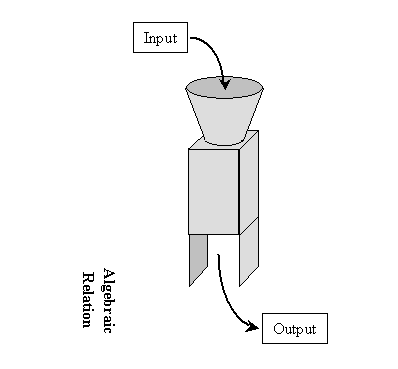
Input / 输入 | Output / 输出
The input to an algebraic relation is a variable that can take on any value from a given set of numbers (such as integers, positive numbers, or negative numbers) without further restrictions. This input variable is called the independent variable, because it does not depend on other variables. The output of the algebraic relation is likewise a variable, but its value is dependent on the input (the independent variable) that is entered in the algebraic relation. Thus, the output is called the dependent variable.
代数关系的输入是一个变量,它可在给定数集(如整数、正数、负数)中不受额外限制地取任意值。这个输入变量称为自变量 ,因为它不依赖于其他变量。代数关系的输出同样是一个变量,但其取值依赖于代入代数关系的输入(即自变量)。因此,输出变量称为因变量。
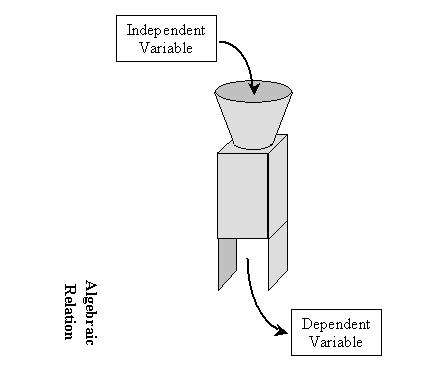
Independent Variable / 自变量 | Dependent Variable / 因变量
The next question is how these concepts can be employed mathematically. The algebraic relation machine shown above takes the independent variable, performs some operation or series of operations on it, and then outputs the dependent variable. In other words, the dependent variable is related somehow (perhaps by way of equality, in which case we use the equal sign) to a series of operations on the independent variable. For the purpose of illustration, let's say that the independent variable is x x x and the dependent variable is y y y.
接下来的问题是如何用数学方式运用这些概念。上述代数关系机器接收自变量,对其进行一次或一系列运算,然后输出因变量。换言之,因变量与对自变量的一系列运算之间存在某种关联(可能是相等关系,此时使用等号)。为便于说明,设自变量为 x x x,因变量为 y y y。
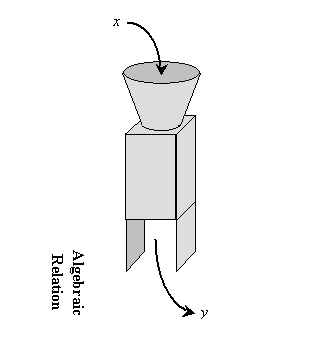
Let's also assume that the algebraic relation machine takes the independent variable input x x x and produces a dependent variable output y y y that is equal to some series of operations on x x x. Mathematically, we can write this as an equality (or equation):
再假设该代数关系机器接收自变量输入 x x x,生成的因变量输出 y y y 等于对 x x x 进行一系列运算的结果。在数学上,我们可将其写成等式(即方程):
y = y = y= (some series of operations on x x x)
y = y = y=(对 x x x 进行的一系列运算)
Let's try to illustrate this by way of some simple examples. Let's say the algebraic relation machine simply takes the input (independent) variable, adds 1 1 1 to it, and then outputs the (dependent) variable result. Thus, the series of operations in this case is simply addition of 1 1 1. The machine illustration and corresponding mathematical expression (equation) for this example are shown below.
我们用几个简单例子说明。假设该代数关系机器只对输入(自)变量加 1 1 1,然后输出结果(因)变量。此时的运算仅为加 1 1 1。该例的机器示意与对应数学表达式(方程)如下。
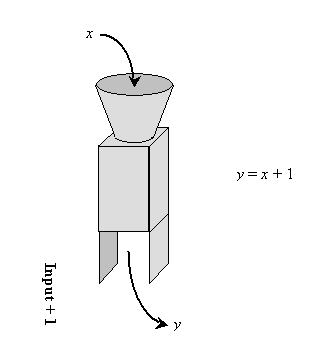
y = x + 1 y=x+1 y=x+1, Input + 1 +1 +1
输入 + 1 +1 +1
The mathematical expression allows us to easily calculate y y y (the dependent variable) given a particular value of x x x (the independent variable). For instance, if x x x is 1 1 1, then y y y is 2 2 2. Likewise, if x x x is − 5 -5 −5, y y y is − 4 -4 −4. The table below shows a few additional results.
给定自变量 x x x 的特定值时,该数学表达式可方便计算因变量 y y y。例如, x = 1 x=1 x=1 时 y = 2 y=2 y=2;同理, x = − 5 x=-5 x=−5 时 y = − 4 y=-4 y=−4。下表列出更多结果。
| x x x | y y y |
|---|---|
| − 1 -1 −1 | 0 0 0 |
| 0 0 0 | 1 1 1 |
| 1 1 1 | 2 2 2 |
| 0.5 0.5 0.5 | 1.5 1.5 1.5 |
| 10 10 10 | 11 11 11 |
An even simpler example of an algebraic relation is y = x y=x y=x. To be sure, this case is not all that interesting, but it is nonetheless a legitimate relation. Algebraic relations can also involve multiple operations, as is shown in the example below.
更简单的代数关系示例是 y = x y=x y=x。诚然,这个例子并不复杂,但仍是合法的代数关系。代数关系也可包含多种运算,如下例所示。
y = 3 x − 2 y=3x-2 y=3x−2
Note that when considering such a relation, we must apply the order of operations to get correct results. In addition, we omit the multiplication symbol for conciseness, but we could also write the relation as shown below. (Be careful to distinguish the independent variable x x x from the multiplication symbol.)
注意,计算此类关系时,必须遵循运算顺序以得到正确结果。此外,为简洁我们省略乘号,也可按如下形式书写。(注意区分自变量 x x x 与乘号。)
y = 3 × x − 2 y=3 × x-2 y=3×x−2
As a relation gets more complicated, it becomes more difficult to evaluate it by inspection for particular values of the independent variable. In the case of y = x + 1 y=x+1 y=x+1, we can easily see that the values of y y y is simply one more than the value of x x x. In more complicated cases, we often must write out the expression and evaluate it on paper. For instance, consider y = 3 x − 2 y=3x-2 y=3x−2 for the case of x = 5 x=5 x=5. To find y y y, we simply substitute the given value ( 5 5 5) for the independent variable ( x x x).
当关系变得更复杂时,直接观察求解自变量特定值的结果会更困难。在 y = x + 1 y=x+1 y=x+1 中,我们能轻易看出 y y y 比 x x x 大 1 1 1。在更复杂的情形下,通常需要写出表达式并笔算求解。例如,取 x = 5 x=5 x=5 计算 y = 3 x − 2 y=3x-2 y=3x−2。求 y y y 只需将给定值 5 5 5 代入自变量 x x x。
y = 3 ( 5 ) − 2 = 15 − 2 = 13 y = 13 \begin{align*} y & = 3(5) - 2 \\ & = 15 - 2 \\ & = 13 \\ y & = 13 \end{align*} yy=3(5)−2=15−2=13=13
Thus, for x = 5 x=5 x=5, y = 13 y=13 y=13. We can construct algebraic relations that are as complex as one can imagine. An even more complicated relation is shown below.
因此, x = 5 x=5 x=5 时 y = 13 y=13 y=13。我们可以构造任意复杂程度的代数关系。更复杂的例子如下。
y = 2 x + 3 x y=\sqrt{2x}+3x y=2x +3x
Let's determine the value of the dependent variable ( y y y) when the independent variable ( x x x) is 2 2 2. Again, we simply substitute 2 2 2 for x x x; this time, we must do so in more than one instance.
求自变量 x = 2 x=2 x=2 时因变量 y y y 的值。同样只需将 2 2 2 代入 x x x;此次需要在多处代入。
以下是对您提供的公式进行按等号换行列对齐的重新格式化:
y = 2 ( 2 ) + 3 ( 2 ) = 4 + 6 = 2 + 6 = 8 y = 8 \begin{align*} y & = \sqrt{2(2)} + 3(2) \\ & = \sqrt{4} + 6 \\ & = 2 + 6 \\ & = 8 \\ y & = 8 \end{align*} yy=2(2) +3(2)=4 +6=2+6=8=8
To review, then, an algebraic relation takes an input (the independent variable), performs a series of operations, and yields the output (the dependent variable). We can evaluate an algebraic relation for a given value of the independent variable by substituting that value in the expression. When an algebraic relation involves equality ( = = =), then it is called an equation. The following practice problem gives you the opportunity to see different algebraic relations and evaluate them for certain values of the independent variable.
总结:代数关系接收输入(自变量),进行一系列运算,得到输出(因变量)。给定自变量取值时,可通过代入表达式求解代数关系。包含等号( = = =)的代数关系称为方程。以下练习题帮助你熟悉不同代数关系,并在自变量取特定值时求解。
Practice Problem : In each case, identify the dependent and independent variable, then evaluate the expression under the specified conditions.
练习题:在各题中,先识别因变量与自变量,再按给定条件求解表达式。
a. z = t − 5 z=t-5 z=t−5, where t = 2 t=2 t=2
a. z = t − 5 z=t-5 z=t−5,其中 t = 2 t=2 t=2
b. r = 2 d r=2d r=2d, where d = 3 5 d=\frac{3}{5} d=53
b. r = 2 d r=2d r=2d,其中 d = 3 5 d=\frac{3}{5} d=53
c. α = − λ + 3 \alpha=-\lambda+3 α=−λ+3, where λ = 6 \lambda=6 λ=6
c. α = − λ + 3 \alpha=-\lambda+3 α=−λ+3,其中 λ = 6 \lambda=6 λ=6
d. w = g 2 w=g^2 w=g2, where g = 4 g=4 g=4
d. w = g 2 w=g^2 w=g2,其中 g = 4 g=4 g=4
Solution: In each case, the dependent variable is the lone variable defined as an expression containing the other (independent) variable. To evaluate the expression to find the value of the dependent variable, simply substitute the given value of the independent variable and evaluate the expression.
解答:在各题中,因变量是被定义为包含另一变量(自变量)的表达式的单独变量。求解表达式得到因变量的值,只需将自变量的给定值代入并计算。
a. independent variable = t t t, dependent variable = z z z
a. 自变量 = t t t,因变量 = z z z
z = ( 2 ) − 5 = − 3 z=(2)-5=-3 z=(2)−5=−3
b. independent variable = d d d, dependent variable = r r r
b. 自变量 = d d d,因变量 = r r r
r = 2 ( 3 5 ) = 6 5 r=2\left(\frac{3}{5}\right)=\frac{6}{5} r=2(53)=56
c. independent variable = λ \lambda λ, dependent variable = α \alpha α
c. 自变量 = λ \lambda λ,因变量 = α \alpha α
α = − ( 6 ) + 3 = − 6 + 3 = − 3 \begin{align*} \alpha & = - (6) + 3 \\ & = -6 + 3 \\ & = -3 \end{align*} α=−(6)+3=−6+3=−3
d. independent variable = g g g, dependent variable = w w w
d. 自变量 = g g g,因变量 = w w w
w = ( 4 ) 2 = 16 w=(4)^2=16 w=(4)2=16
Algebra 101: A Beginner's Guide to Understanding Variables and Equations
代数入门:变量与方程基础解析指南
Posted byBy DBCooP
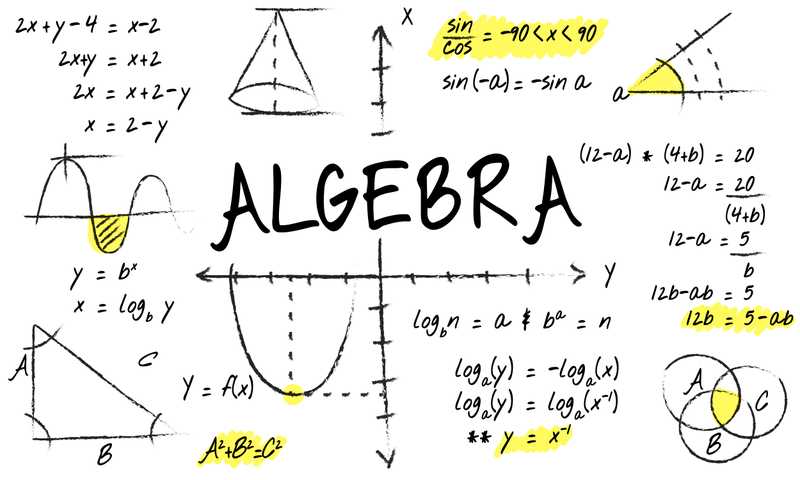
Algebra is a branch of mathematics that uses symbols, letters, and numbers to solve problems. It's like a puzzle, where each piece fits into place to help you figure out the unknown. If you're new to algebra, this guide will walk you through the basics, making it simple to understand concepts like variables, constants, and equations. So, let's dive in step-by-step!
代数是数学的一个分支,通过符号、字母与数字求解问题。其形式类似拼图,各部分相互组合以求解未知量。对于代数初学者,本文将逐步讲解基础内容,简化变量、常数与方程等概念的理解过程。
What is Algebra?
什么是代数
Algebra is all about finding unknown values using mathematical operations like addition, subtraction, multiplication, and division. It helps us solve problems where we don't know everything but can figure it out using what we do know.
代数依托加、减、乘、除等数学运算求解未知量。当问题中存在未知信息,可依托已知条件完成推导,代数即为实现该过程的工具。
Real-Life Example
现实场景示例
Imagine you're saving money to buy a video game. You already have 10, and each week you save 5 more. How many weeks will it take you to have $40 in total? Algebra can help solve this!
假设为购买一款电子游戏存钱,现有存款 10 美元,每周可再存入 5 美元。需要多少周才能存够 40 美元?代数可求解该问题。
In algebra, you can represent the unknown (in this case, the number of weeks) using a symbol, such as "x." By setting up an equation and solving for x, you can find the answer.
在代数体系中,可使用符号(如 x x x)表示未知量,本例中即为周数。构建方程并求解 x x x 即可得到结果。
1. Variables: The Building Blocks of Algebra
1. 变量:代数的构成单元
The variable is one of the most important concepts in algebra. A variable is a symbol, usually a letter, that represents an unknown value. Think of it like a blank space that needs to be filled with a number.
变量是代数中的基础概念。变量通常为字母形式的符号,用于表示未知量,可理解为待填入数字的空位。
Example of a Variable
变量示例
Let's say you have the equation:
设有方程:
x + 3 = 7 x + 3 = 7 x+3=7
In this equation, x x x is the variable. It represents a number that we don't know yet, but we'll figure it out by solving the equation.
该方程中, x x x 为变量,代表待求解的未知数字,可通过方程运算确定其取值。
Why Use Variables?
变量的作用
Variables are useful because they allow us to write equations that apply to many situations, not just one specific problem. They help generalize mathematical ideas.
变量可构建适用于多类场景的方程,而非仅针对单一问题,能够实现数学规律的一般化表达。
For example, if you're buying multiple items at a store, you can use a variable to represent the cost of one item and multiply it by how many you buy.
例如在商店购买多件商品时,可用变量表示单件商品价格,再与购买数量相乘计算总费用。
Practice Example
练习示例
If you have y + 4 = 9 y + 4 = 9 y+4=9, what is y y y? (Hint: What number do you add to 4 to get 9?)
若方程为 y + 4 = 9 y + 4 = 9 y+4=9,求 y y y 的取值。(提示:与 4 相加等于 9 的数字是多少)
Solution: In this case, y y y is the variable, and you can find its value by subtracting 4 from 9. So, y = 5 y = 5 y=5.
解 :本例中 y y y 为变量,用 9 减去 4 即可得到其取值,即 y = 5 y = 5 y=5。
2. Constants: The Unchanging Numbers
2. 常数:固定不变的数值
A constant is a number that doesn't change. It stays the same throughout the equation. In the equation x + 3 = 7 x + 3 = 7 x+3=7, the numbers 3 and 7 are constants because they don't change their value.
常数 为方程中取值固定、不发生变化的数字。方程 x + 3 = 7 x + 3 = 7 x+3=7 中,3 与 7 均为常数。
Example of a Constant
常数示例
Let's revisit our earlier example:
回顾前述示例:
x + 3 = 7 x + 3 = 7 x+3=7
Here, x x x is the variable (which can change), but 3 and 7 are constants. No matter how we solve the equation, these numbers will remain the same.
该式中 x x x 为可变化的变量,3 与 7 为常数,无论采用何种求解方式,二者取值均保持不变。
Why Are Constants Important?
常数的意义
Constants give structure to equations. They provide the "fixed" parts that help us solve for variables. Without constants, equations wouldn't make sense because we wouldn't have any known values to work with.
常数为方程提供固定结构,依托已知数值辅助变量求解。缺少常数则方程无已知参考量,无法完成运算。
Practice Example
练习示例
In the equation z -- 5 = 10 z -- 5 = 10 z--5=10, what are the constants?
方程 z -- 5 = 10 z -- 5 = 10 z--5=10 中的常数为哪些?
Answer: The constants are 5 and 10.
答:常数为 5 与 10。
3. Simple Equations: Solving for the Unknown
3. 简易方程:未知量求解
An equation is like a statement that says two things are equal. It has two sides, usually separated by an equal sign ( = = =). The goal of algebra is often to solve equations, which means finding the value of the variable.
方程 表示两侧表达式相等的数学关系,由等号 = = = 分隔左右两部分。代数运算的常见目标为解方程,即确定变量的取值。
Basic Equation Example
基础方程示例
Let's go back to our earlier equation:
回顾前述方程:
x + 3 = 7 x + 3 = 7 x+3=7
This equation says that x x x plus 3 equals 7. To solve for x x x, we need to figure out what number, when added to 3, gives us 7.
该方程表示 x x x 与 3 相加等于 7,求解 x x x 即确定与 3 相加得 7 的数字。
Steps to Solve a Simple Equation
简易方程求解步骤
-
Identify the variable : In this case, x x x is the variable.
确定变量 :本例中变量为 x x x。 -
Isolate the variable : We want to get x x x by itself on one side of the equation. To do that, we subtract 3 from both sides:
分离变量 :使 x x x 单独位于方程一侧,需在方程两侧同时减去 3:
x + 3 -- 3 = 7 -- 3 x + 3 -- 3 = 7 -- 3 x+3--3=7--3This simplifies to:
化简后得:
x = 4 x = 4 x=4So, x x x is equal to 4.
即 x x x 的取值为 4。
Practice Example
练习示例
Solve the equation y -- 2 = 5 y -- 2 = 5 y--2=5.
求解方程 y -- 2 = 5 y -- 2 = 5 y--2=5。
Solution: To isolate y y y, add 2 to both sides:
解 :为分离变量 y y y,在方程两侧同时加 2:
y -- 2 + 2 = 5 + 2 y -- 2 + 2 = 5 + 2 y--2+2=5+2, which simplifies to y = 7 y = 7 y=7.
化简后得 y = 7 y = 7 y=7。
4. Understanding Addition and Subtraction in Algebra
4. 代数中的加法与减法运算
In algebra, addition and subtraction work the same way as they do in regular arithmetic. However, when dealing with equations, we use them to move terms from one side of the equation to the other.
代数中加法与减法的运算规则与常规算术一致,方程运算中可通过该类运算实现项在方程两侧的移动。
Solving an Addition Equation
加法方程求解
Example: x + 6 = 11 x + 6 = 11 x+6=11
示例 : x + 6 = 11 x + 6 = 11 x+6=11
To solve for x x x, subtract 6 from both sides:
求解 x x x 需在两侧同时减去 6:
x + 6 -- 6 = 11 -- 6 x + 6 -- 6 = 11 -- 6 x+6--6=11--6
x = 5 x = 5 x=5
Solving a Subtraction Equation
减法方程求解
Example: y -- 4 = 3 y -- 4 = 3 y--4=3
示例 : y -- 4 = 3 y -- 4 = 3 y--4=3
To solve for y y y, add 4 to both sides:
求解 y y y 需在两侧同时加上 4:
y -- 4 + 4 = 3 + 4 y -- 4 + 4 = 3 + 4 y--4+4=3+4
y = 7 y = 7 y=7
5. Multiplication and Division in Algebra
5. 代数中的乘法与除法运算
Just like addition and subtraction, multiplication and division are essential for solving algebraic equations. The goal is still to isolate the variable.
与加减法类似,乘除法为代数方程求解的基础运算,运算目标仍为分离变量。
Solving a Multiplication Equation
乘法方程求解
Example: 3 x = 9 3x = 9 3x=9
示例 : 3 x = 9 3x = 9 3x=9
To solve for x x x, divide both sides by 3:
求解 x x x 需在两侧同时除以 3:
3 x ÷ 3 = 9 ÷ 3 3x \div 3 = 9 \div 3 3x÷3=9÷3
x = 3 x = 3 x=3
Solving a Division Equation
除法方程求解
Example: y ÷ 2 = 8 y \div 2 = 8 y÷2=8
示例 : y ÷ 2 = 8 y \div 2 = 8 y÷2=8
To solve for y y y, multiply both sides by 2:
求解 y y y 需在两侧同时乘以 2:
y ÷ 2 × 2 = 8 × 2 y \div 2 \times 2 = 8 \times 2 y÷2×2=8×2
y = 16 y = 16 y=16
6. Balancing Equations: The Golden Rule of Algebra
6. 方程平衡:代数运算的基本规则
One of the most important rules in algebra is that whatever you do to one side of the equation, you must do to the other side . This keeps the equation balanced, just like a seesaw. If you add, subtract, multiply, or divide on one side, you have to do the same on the other side.
代数运算的一条规则为,方程一侧执行的运算需同步应用于另一侧。该规则可维持方程平衡,类似跷跷板的平衡状态。单侧进行加、减、乘、除运算时,另一侧需执行相同操作。
Example of Balancing an Equation
方程平衡运算示例
Let's solve this equation step-by-step:
分步求解下述方程:
2 x + 5 = 13 2x + 5 = 13 2x+5=13
- Subtract 5 from both sides :
两侧同时减去 5 *:
2 x + 5 -- 5 = 13 -- 5 2x + 5 -- 5 = 13 -- 5 2x+5--5=13--5, which simplifies to 2 x = 8 2x = 8 2x=8.
2 x + 5 -- 5 = 13 -- 5 2x + 5 -- 5 = 13 -- 5 2x+5--5=13--5,化简得 2 x = 8 2x = 8 2x=8。 - Divide both sides by 2 :
两侧同时除以 2 :
2 x ÷ 2 = 8 ÷ 2 2x \div 2 = 8 \div 2 2x÷2=8÷2, which simplifies to x = 4 x = 4 x=4.
2 x ÷ 2 = 8 ÷ 2 2x \div 2 = 8 \div 2 2x÷2=8÷2,化简得 x = 4 x = 4 x=4。
Practice Example
练习示例
Solve the equation 3 y -- 7 = 14 3y -- 7 = 14 3y--7=14.
求解方程 3 y -- 7 = 14 3y -- 7 = 14 3y--7=14。
- Add 7 to both sides: 3 y -- 7 + 7 = 14 + 7 3y -- 7 + 7 = 14 + 7 3y--7+7=14+7, so 3 y = 21 3y = 21 3y=21.
两侧同时加 7: 3 y -- 7 + 7 = 14 + 7 3y -- 7 + 7 = 14 + 7 3y--7+7=14+7,得 3 y = 21 3y = 21 3y=21。 - Divide by 3: y = 21 ÷ 3 y = 21 \div 3 y=21÷3, so y = 7 y = 7 y=7.
两侧同时除以 3: y = 21 ÷ 3 y = 21 \div 3 y=21÷3,得 y = 7 y = 7 y=7。
7. Combining Like Terms: Simplifying Equations
7. 同类项合并:方程化简
When you have multiple terms that involve the same variable, you can combine them. This makes the equation simpler and easier to solve.
方程中存在多个含相同变量的项时,可对其进行合并,简化方程形式以方便求解。
Example of Combining Like Terms
同类项合并示例
3 x + 2 x = 10 3x + 2x = 10 3x+2x=10
To combine like terms, add the coefficients (the numbers in front of the variables):
合并同类项时,将变量前的系数相加:
( 3 + 2 ) x = 10 (3 + 2)x = 10 (3+2)x=10, which simplifies to 5 x = 10 5x = 10 5x=10.
( 3 + 2 ) x = 10 (3 + 2)x = 10 (3+2)x=10,化简得 5 x = 10 5x = 10 5x=10。
Now, divide by 5 to get x = 2 x = 2 x=2.
两侧同时除以 5,得 x = 2 x = 2 x=2。
Practice Example
练习示例
Simplify and solve the equation 4 y + 3 y = 21 4y + 3y = 21 4y+3y=21.
化简并求解方程 4 y + 3 y = 21 4y + 3y = 21 4y+3y=21。
- Combine like terms: ( 4 + 3 ) y = 21 (4 + 3)y = 21 (4+3)y=21, so 7 y = 21 7y = 21 7y=21.
合并同类项: ( 4 + 3 ) y = 21 (4 + 3)y = 21 (4+3)y=21,得 7 y = 21 7y = 21 7y=21。 - Divide by 7: y = 21 ÷ 7 y = 21 \div 7 y=21÷7, so y = 3 y = 3 y=3.
两侧同时除以 7: y = 21 ÷ 7 y = 21 \div 7 y=21÷7,得 y = 3 y = 3 y=3。
8. Solving Two-Step Equations
8. 两步方程求解
Sometimes, solving equations involves more than one step. You might need to combine addition or subtraction with multiplication or division.
部分方程的求解需多步运算,通常需结合加减法与乘除法完成变量分离。
Example of a Two-Step Equation
两步方程示例
2 x + 3 = 11 2x + 3 = 11 2x+3=11
- Subtract 3 from both sides:
两侧同时减去 3:
2 x + 3 -- 3 = 11 -- 3 2x + 3 -- 3 = 11 -- 3 2x+3--3=11--3, which simplifies to 2 x = 8 2x = 8 2x=8.
2 x + 3 -- 3 = 11 -- 3 2x + 3 -- 3 = 11 -- 3 2x+3--3=11--3,化简得 2 x = 8 2x = 8 2x=8。 - Divide by 2:
两侧同时除以 2:
x = 8 ÷ 2 x = 8 \div 2 x=8÷2, so x = 4 x = 4 x=4.
x = 8 ÷ 2 x = 8 \div 2 x=8÷2,得 x = 4 x = 4 x=4。
Practice Example
练习示例
Solve the equation 5 y -- 2 = 13 5y -- 2 = 13 5y--2=13.
求解方程 5 y -- 2 = 13 5y -- 2 = 13 5y--2=13。
- Add 2 to both sides: 5 y -- 2 + 2 = 13 + 2 5y -- 2 + 2 = 13 + 2 5y--2+2=13+2, so 5 y = 15 5y = 15 5y=15.
两侧同时加 2: 5 y -- 2 + 2 = 13 + 2 5y -- 2 + 2 = 13 + 2 5y--2+2=13+2,得 5 y = 15 5y = 15 5y=15。 - Divide by 5: y = 15 ÷ 5 y = 15 \div 5 y=15÷5, so y = 3 y = 3 y=3.
两侧同时除以 5: y = 15 ÷ 5 y = 15 \div 5 y=15÷5,得 y = 3 y = 3 y=3。
9. Word Problems: Applying Algebra to Real Life
9. 文字应用题:代数的现实应用
Word problems are a great way to apply algebra to everyday situations. Let's go back to the video game example from earlier:
文字应用题是将代数应用于日常场景的典型形式,回顾前述电子游戏存钱示例:
Problem : You already have 10, and you save 5 per week. How many weeks will it take to save $40?
问题:现有存款 10 美元,每周存入 5 美元,存够 40 美元需要多少周?
Step-by-Step Solution
分步求解
-
Set up the equation : Let x x x represent the number of weeks. Each week you save 5, so after x x x weeks, you will have saved 5 x 5x 5x dollars. Since you already have 10, your total savings after x x x weeks is 10 + 5 x 10 + 5x 10+5x. You want this to equal $ 40, so the equation becomes:
构建方程 :设 x x x 为周数,每周存入 5 美元, x x x 周后存款为 5 x 5x 5x 美元。叠加初始 10 美元,总存款为 10 + 5 x 10 + 5x 10+5x 美元。目标存款为 40 美元,方程为:
10 + 5 x = 40 10 + 5x = 40 10+5x=40 -
Subtract 10 from both sides : To isolate the term with the variable x x x, subtract 10 from both sides:
两侧同时减去 10 :分离含变量 x x x 的项,运算后:
10 + 5 x -- 10 = 40 -- 10 10 + 5x -- 10 = 40 -- 10 10+5x--10=40--10This simplifies to:
化简得:
5 x = 30 5x = 30 5x=30 -
Divide by 5 : Now divide both sides by 5 to find the value of x x x:
两侧同时除以 5 :求解 x x x 取值:
5 x ÷ 5 = 30 ÷ 5 5x \div 5 = 30 \div 5 5x÷5=30÷5This simplifies to:
化简得:
x = 6 x = 6 x=6
So, it will take you 6 weeks to save $ 40.
即存够 40 美元需要 6 周。
10. Understanding the Distributive Property
10. 分配律解析
Another important concept in algebra is the distributive property . This property allows you to multiply a number outside the parentheses by each term inside the parentheses. It's useful when you need to simplify or solve equations.
代数中的另一重要概念为分配律。该运算规则允许括号外数字与括号内每一项分别相乘,适用于方程化简与求解场景。
Example of the Distributive Property
分配律示例
3 ( x + 2 ) = 12 3(x + 2) = 12 3(x+2)=12
To solve this equation, use the distributive property to multiply 3 by each term inside the parentheses:
应用分配律,将 3 与括号内各项分别相乘:
3 ( x ) + 3 ( 2 ) = 12 3(x) + 3(2) = 12 3(x)+3(2)=12, which simplifies to:
3 ( x ) + 3 ( 2 ) = 12 3(x) + 3(2) = 12 3(x)+3(2)=12,化简得:
3 x + 6 = 12 3x + 6 = 12 3x+6=12
Now, solve for x x x by following the steps you've learned:
依托已学步骤求解 x x x:
- Subtract 6 from both sides:
两侧同时减去 6:
3 x + 6 -- 6 = 12 -- 6 3x + 6 -- 6 = 12 -- 6 3x+6--6=12--6, so 3 x = 6 3x = 6 3x=6. - Divide by 3:
两侧同时除以 3:
x = 6 ÷ 3 x = 6 \div 3 x=6÷3, so x = 2 x = 2 x=2.
Practice Example
练习示例
Solve the equation 4 ( 2 y + 1 ) = 20 4(2y + 1) = 20 4(2y+1)=20.
求解方程 4 ( 2 y + 1 ) = 20 4(2y + 1) = 20 4(2y+1)=20。
- Apply the distributive property: 应用分配律:
4 ( 2 y ) + 4 ( 1 ) = 20 4(2y) + 4(1) = 20 4(2y)+4(1)=20, so 8 y + 4 = 20 8y + 4 = 20 8y+4=20. - Subtract 4 from both sides: 两侧同时减去 4:
8 y + 4 -- 4 = 20 -- 4 8y + 4 -- 4 = 20 -- 4 8y+4--4=20--4, so 8 y = 16 8y = 16 8y=16. - Divide by 8: 两侧同时除以 8
y = 16 ÷ 8 y = 16 \div 8 y=16÷8, so y = 2 y = 2 y=2.
11. Solving Equations with Fractions
11. 含分数方程求解
Fractions can look intimidating, but they follow the same rules as regular numbers. Let's work through a basic example.
分数形式看似复杂,但其运算规则与常规整数一致,通过基础示例说明求解过程。
Example of Solving an Equation with Fractions
含分数方程示例
1 2 x = 4 \frac{1}{2}x = 4 21x=4
To solve for x x x, multiply both sides of the equation by 2 (the denominator of the fraction) to cancel out the fraction:
求解 x x x 时,在两侧同时乘以分数分母 2 以消去分数:
1 2 x × 2 = 4 × 2 \frac{1}{2}x \times 2 = 4 \times 2 21x×2=4×2
This simplifies to:
化简后得:
x = 8 x = 8 x=8
Practice Example
练习示例
Solve the equation 1 3 y = 5 \frac{1}{3}y = 5 31y=5.
求解方程 1 3 y = 5 \frac{1}{3}y = 5 31y=5。
- Multiply both sides by 3 to get rid of the fraction:
1 3 y × 3 = 5 × 3 \frac{1}{3}y \times 3 = 5 \times 3 31y×3=5×3, so y = 15 y = 15 y=15. - 两侧同时乘以分母 3 消去分数:
1 3 y × 3 = 5 × 3 \frac{1}{3}y \times 3 = 5 \times 3 31y×3=5×3,得 y = 15 y = 15 y=15。
12. Introducing Inequalities
12. 不等式初步
In addition to equations, algebra also involves inequalities . Inequalities show that one side of the expression is greater than, less than, or equal to the other side. The symbols used in inequalities are:
代数体系除方程外,还包含不等式。不等式表示两侧表达式存在大于、小于或大于等于、小于等于的关系,所用符号如下:
- > > > (greater than 大于)
- < < < (less than 小于)
- ≥ \geq ≥ (greater than or equal to 大于或等于)
- ≤ \leq ≤ (less than or equal to 小于或等于)
Example of an Inequality
不等式示例
x + 3 > 7 x + 3 > 7 x+3>7
This inequality tells us that x + 3 x + 3 x+3 is greater than 7. To solve for x x x, subtract 3 from both sides:
该不等式表示 x + 3 x + 3 x+3 的值大于 7,求解 x x x 需两侧同时减去 3:
x + 3 -- 3 > 7 -- 3 x + 3 -- 3 > 7 -- 3 x+3--3>7--3, which simplifies to:
x + 3 -- 3 > 7 -- 3 x + 3 -- 3 > 7 -- 3 x+3--3>7--3,化简得:
x > 4 x > 4 x>4
This means that x x x can be any number greater than 4, like 5, 6, 7, and so on.
即 x x x 可取任意大于 4 的数字,如 5、6、7 等。
Practice Example
练习示例
Solve the inequality 2 y -- 1 < 9 2y -- 1 < 9 2y--1<9.
求解不等式 2 y -- 1 < 9 2y -- 1 < 9 2y--1<9。
-
Add 1 to both sides: 2 y -- 1 + 1 < 9 + 1 2y -- 1 + 1 < 9 + 1 2y--1+1<9+1, so 2 y < 10 2y < 10 2y<10.
两侧同时加 1: 2 y -- 1 + 1 < 9 + 1 2y -- 1 + 1 < 9 + 1 2y--1+1<9+1,得 2 y < 10 2y < 10 2y<10。
-
Divide by 2: y < 10 ÷ 2 y < 10 \div 2 y<10÷2, so y < 5 y < 5 y<5.
两侧同时除以 2: y < 10 ÷ 2 y < 10 \div 2 y<10÷2,得 y < 5 y < 5 y<5。
13. Graphing Simple Equations
13. 简易方程的图像绘制
Algebra often involves graphing equations on a coordinate plane. The coordinate plane has two axes: the x-axis (horizontal) and the y-axis (vertical). Every point on the plane is represented by a pair of numbers, called coordinates ( x , y ) (x, y) (x,y).
代数运算常涉及在坐标平面绘制方程图像。坐标平面包含两条坐标轴,水平方向为 x 轴 ,竖直方向为 y 轴 。平面内任意点由坐标 ( x , y ) (x, y) (x,y) 表示。
Plotting Points
坐标点绘制
To plot points on a coordinate plane, find the x x x value on the horizontal axis and the y y y value on the vertical axis. For example, the point ( 3 , 2 ) (3, 2) (3,2) means you move 3 units to the right on the x-axis and 2 units up on the y-axis.
在坐标平面绘制点时,沿 x 轴确定 x x x 取值,沿 y 轴确定 y y y 取值。例如点 ( 3 , 2 ) (3, 2) (3,2) 表示沿 x 轴向右移动 3 个单位,沿 y 轴向上移动 2 个单位。
Graphing a Simple Equation
简易方程图像绘制
Let's graph the equation y = x + 1 y = x + 1 y=x+1. To do this, you'll find several points that satisfy the equation, then plot them on the coordinate plane.
绘制方程 y = x + 1 y = x + 1 y=x+1 的图像,需先确定满足方程的多个坐标点,再在平面内完成绘制。
- Choose a value for x x x: Let's start with x = 0 x = 0 x=0.
选取 x x x 取值:以 x = 0 x = 0 x=0 为例。
When x = 0 x = 0 x=0, y = 0 + 1 = 1 y = 0 + 1 = 1 y=0+1=1. So, the point is ( 0 , 1 ) (0, 1) (0,1).
x = 0 x = 0 x=0 时, y = 0 + 1 = 1 y = 0 + 1 = 1 y=0+1=1,对应点为 ( 0 , 1 ) (0, 1) (0,1)。 - Choose another value for x x x: Let's use x = 2 x = 2 x=2.
选取另一 x x x 取值:以 x = 2 x = 2 x=2 为例。
When x = 2 x = 2 x=2, y = 2 + 1 = 3 y = 2 + 1 = 3 y=2+1=3. So, the point is ( 2 , 3 ) (2, 3) (2,3).
x = 2 x = 2 x=2 时, y = 2 + 1 = 3 y = 2 + 1 = 3 y=2+1=3,对应点为 ( 2 , 3 ) (2, 3) (2,3)。
Now you can plot these points on the graph and draw a straight line through them. This line represents the equation y = x + 1 y = x + 1 y=x+1.
在坐标平面绘制上述点并连线,所得直线即为方程 y = x + 1 y = x + 1 y=x+1 的图像。
Practice Example
练习示例
Graph the equation y = 2 x -- 1 y = 2x -- 1 y=2x--1 by finding points for x = 0 x = 0 x=0, x = 1 x = 1 x=1, and x = 2 x = 2 x=2.
分别取 x = 0 x = 0 x=0、 x = 1 x = 1 x=1、 x = 2 x = 2 x=2,绘制方程 y = 2 x -- 1 y = 2x -- 1 y=2x--1 的图像。
- When x = 0 x = 0 x=0, y = 2 ( 0 ) -- 1 = − 1 y = 2(0) -- 1 = -1 y=2(0)--1=−1, so the point is ( 0 , − 1 ) (0, -1) (0,−1).
x = 0 x = 0 x=0 时, y = 2 ( 0 ) -- 1 = − 1 y = 2(0) -- 1 = -1 y=2(0)--1=−1,对应点为 ( 0 , − 1 ) (0, -1) (0,−1) - When x = 1 x = 1 x=1, y = 2 ( 1 ) -- 1 = 1 y = 2(1) -- 1 = 1 y=2(1)--1=1, so the point is ( 1 , 1 ) (1, 1) (1,1).
x = 1 x = 1 x=1 时, y = 2 ( 1 ) -- 1 = 1 y = 2(1) -- 1 = 1 y=2(1)--1=1,对应点为 ( 1 , 1 ) (1, 1) (1,1) - When x = 2 x = 2 x=2, y = 2 ( 2 ) -- 1 = 3 y = 2(2) -- 1 = 3 y=2(2)--1=3, so the point is ( 2 , 3 ) (2, 3) (2,3).
x = 2 x = 2 x=2 时, y = 2 ( 2 ) -- 1 = 3 y = 2(2) -- 1 = 3 y=2(2)--1=3,对应点为 ( 2 , 3 ) (2, 3) (2,3)
Plot these points and connect them to form the graph of the equation.
绘制上述点并连线,得到方程的图像。
14. Real-World Application: Using Algebra in Everyday Life
14. 现实应用:日常生活中的代数
Algebra isn't just for the classroom---it's used in everyday situations without us even realizing it. Let's look at a few real-life examples where algebra comes in handy.
代数并非仅应用于课堂场景,日常诸多场景均会无意识使用代数思维,以下为典型示例。
1. Budgeting Your Money
1. 个人预算管理
If you have a monthly allowance of 100 and spend 20 each week, you can use algebra to figure out how much money you'll have left after a certain number of weeks. The equation might look like this:
月零花钱为 100 美元,每周花费 20 美元,可通过代数计算若干周后的剩余金额,方程形式为:
100 -- 20 x = remaining money 100 -- 20x = \text{remaining money} 100--20x=remaining money
Where x x x is the number of weeks.
式中 x x x 为周数。
2. Cooking with Recipes
2. 食谱配比调整
When doubling or halving a recipe, you're using algebra to adjust the quantities of ingredients. For example, if a recipe calls for 3 cups of flour and you want to double it, the equation would be:
食谱分量加倍或减半时,需通过代数调整食材用量。例如食谱需 3 杯面粉,分量加倍时方程为:
Flour needed = 3 × 2 = 6 cups \text{Flour needed} = 3 \times 2 = 6 \text{ cups} Flour needed=3×2=6 cups
3. Travel Time
3. 行程时间计算
If you're driving at 60 miles per hour and you need to travel 180 miles, algebra can help you figure out how long the trip will take. The equation is:
驾车速度为 60 英里/小时,行驶路程 180 英里,可通过代数计算行程时长,方程为:
Distance = Rate × Time \text{Distance} = \text{Rate} \times \text{Time} Distance=Rate×Time, or 180 = 60 × Time 180 = 60 \times \text{Time} 180=60×Time
路程 = 速度 × 时间 路程 = 速度 \times 时间 路程=速度×时间,即 180 = 60 × 时间 180 = 60 \times 时间 180=60×时间
Solve for Time to get:
求解时间得:
Time = 180 ÷ 60 = 3 hours 时间 = 180 ÷ 60 = 3 小时 \text{Time} = 180 \div 60 = 3 \text{ hours}\\时间 = 180 \div 60 = 3 \text{ 小时} Time=180÷60=3 hours时间=180÷60=3 小时
Conclusion: You Can Do Algebra!
结语:代数学习并不复杂
Algebra is all about solving problems by finding unknown values. By understanding concepts like variables, constants, and equations, you can tackle even the trickiest math problems. Whether you're solving simple equations or applying algebra to real-life situations, the key is to practice and take it step by step.
代数围绕求解未知量、解决问题展开。掌握变量、常数与方程等概念,即可应对各类数学运算问题。无论是简易方程求解还是现实场景应用,持续练习、分步运算即可掌握。
With the basic building blocks you've learned---variables, constants, equations, and the properties of algebra---you now have the tools to approach more complex math with confidence. Keep practicing, and soon algebra will feel like second nature!
依托本文讲解的变量、常数、方程与代数运算规则,可逐步应对更复杂的数学内容。持续练习后,代数运算将形成熟练的思维习惯。
Reference
- The Ultimate Variable Guide in Algebra
https://www.numberanalytics.com/blog/ultimate-variable-guide-algebra-1 - Understanding Variable Use in Algebra
https://www.universalclass.com/articles/math/pre-algebra/variable-use-in-algebra.htm - Algebra 101: A Beginner's Guide to Understanding Variables and Equations
https://learnwithexamples.org/algebra-101-variables-and-equations/ - What is the variable in mathematics? - California Learning Resource Network
https://www.clrn.org/what-is-the-variable-in-mathematics/