体验开场
想象一下,你正坐在办公室的工位前,稍微有些工作疲劳。你没有拿起手机,而是戴上了桌上的 Rokid AR Lite。
随着设备启动,原本平淡无奇的办公桌面上方约一米处,突然凭空浮现出一块晶莹剔透、泛着微光的 8×8 宝石棋盘。这块棋盘并不是死板地贴在你的镜片上,而是稳稳地"锚定"在真实空间里。你稍微转动头部,能从侧面观察到这块棋盘的厚度感。
界面的左上角, Score 正在实时跳动;右上角则显示着剩余的 Moves 步数。每一颗宝石------红的、绿的、蓝的、紫的------都整齐地排布在虚空中的网格里。当你伸出手,利用 Rokid 的射线交互轻轻滑动其中的两颗宝石,伴随着清脆的音效和宝石碎裂的粒子感,三颗同色宝石瞬间消散,上方的宝石顺势滑落,填补了空缺。
这不是科幻电影,而是一个基于 Unity 2022 LTS 与 Rokid UXR 3.0 SDK 开发的轻量级 AR 尝试。将最经典的"消消乐"玩法带入空间计算时代,虽然逻辑看似简单,但其背后的"空间映射"思路和开发细节,却非常值得每一位 AR 开发者和产品经理思考。
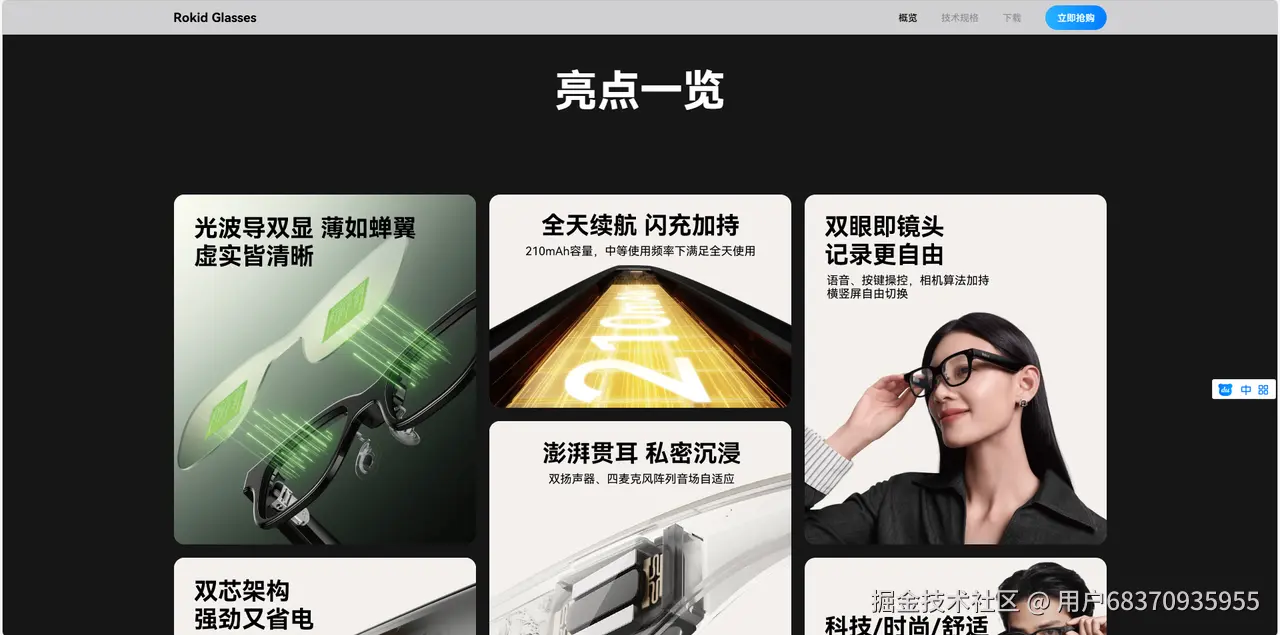
技术栈简介
在决定开发这个 AR 小游戏时,我们选择了以下这套"黄金组合":
- Unity 2022.3 LTS (Long Term Support) :作为 Unity 的长期支持版本,它在性能优化和第三方库兼容性上达到了一个极佳的平衡点。对于 AR 开发这种对底层稳定性要求极高的场景,LTS 版本能有效避免很多莫名其妙的编辑器 Bug。
- Rokid UXR 3.0 SDK:这是 Rokid 官方提供的核心开发套件。它集成了 AR 相机配置、空间定位(6DoF/3DoF)、手势交互模组以及完善的射线检测系统。选择 3.0 版本,是因为它在资源占用和 API 的易用性上做了大量减法,非常适合快速原型验证。
为什么要选这套组合? 核心原因只有两个字:效率。消消乐这种游戏逻辑非常成熟,我们不希望把 80% 的精力浪费在配置 Android 环境或调试底层传感器数据上。Unity 2022 的成熟生态,加上 UXR 3.0 这种"开箱即用"的 SDK,能让我们在短短一两天内就完成从构思到真机运行的全过程。这种快速闭环能力,对于产品团队验证新交互形态至关重要。
思路迁移
在传统的手机屏幕上,消消乐是纯粹的 2D 体验。但在 AR 场景下,我们需要进行一次"降维打击"后的"升维重构"。
3.1 结构
- 棋盘(Board) :在手机上是背景图,在 AR 里则是悬浮在空间中的"逻辑面板"。它必须有明确的 3D 坐标(Z轴),以确保用户不会感到视觉压迫。
- 宝石(Gem) :不再是单纯的 UI 图片,而是拥有 Collider(碰撞体)的游戏对象。它们必须能响应空间中的射线触发,而不仅仅是屏幕点击。
- UI 系统:Score 和 Moves 如果放在屏幕四个角,会导致用户眼睛频繁调焦,产生疲劳。在 AR 中,我们选择将 UI 固定在棋盘上方的左右两侧,随棋盘一起锚定在空间中。
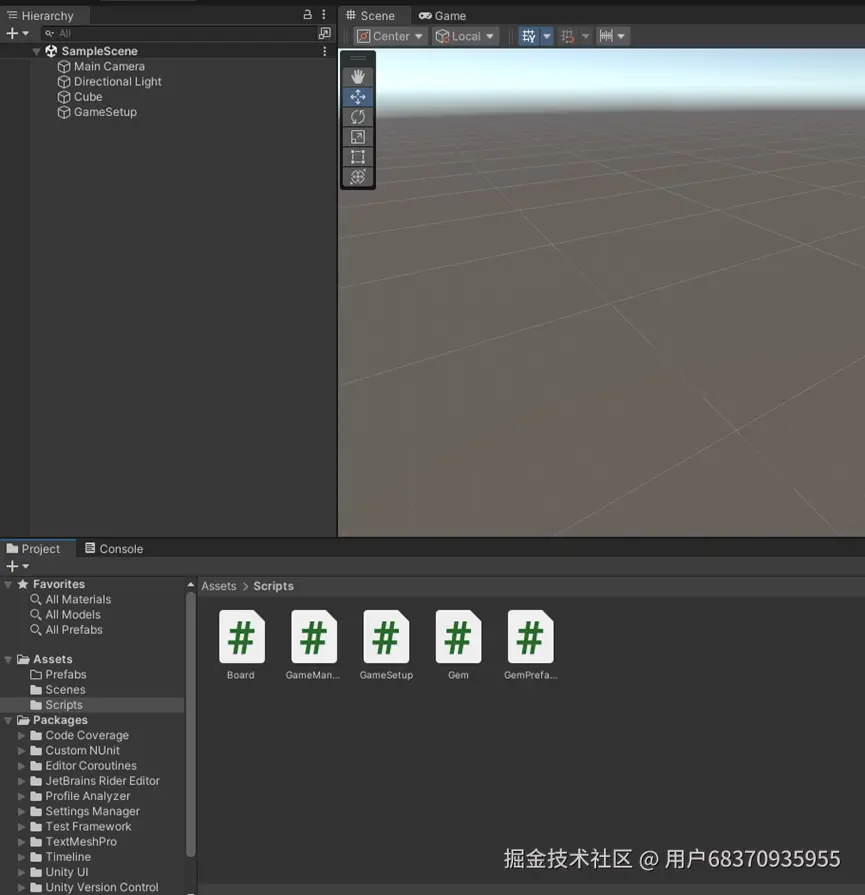
3.2 交互映射
手机上的操作是手指在屏幕上拖拽,而 Rokid AR 眼镜支持手持终端射线或手势追踪。我们的开发思路是:将玩家的射线输入(或模拟鼠标输入)映射到 3D 空间的物理射线检测(Raycast)上。当射线击中宝石并产生滑动位移时,逻辑层计算出滑动的向量方向(上下左右),从而触发宝石交换。
核心实现思路
在实现层面,我们采用了高度解耦的设计,将场景初始化、游戏管理、棋盘逻辑、单体交互和预制体生成完全分开。这种做法的好处是,即便未来我们要把宝石从"圆球"换成"3D 恐龙",逻辑代码也几乎不需要修改。
4.1 场景搭建与一键初始化 (GameSetup)
在 AR 项目里,我们往往不想手动在 Hierarchy 面板里拖入几十个宝石。因此,我们编写了 GameSetup.cs。它就像是游戏的"发令枪",在运行瞬间自动创建相机、Canvas、文本,并根据代码生成的预制体初始化棋盘。
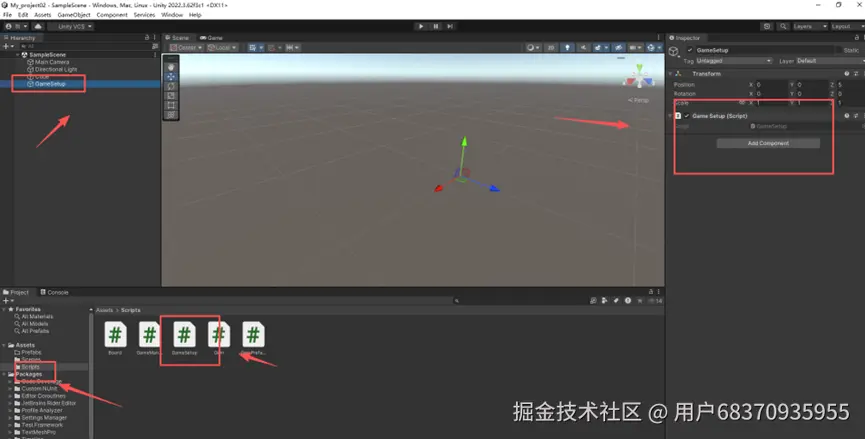
关键代码:GameSetup.cs
ini
using UnityEngine;
using UnityEngine.UI;

public class GameSetup : MonoBehaviour
{
    void Start(){
        SetupGame();
    }

    void SetupGame(){
        // 创建主摄像机设置
        Camera mainCamera = Camera.main;
        if (mainCamera != null)
        {
            mainCamera.transform.position = new Vector3(0, 0, -10);
            mainCamera.orthographic = true;
            mainCamera.orthographicSize = 5;
            mainCamera.backgroundColor = new Color(0.1f, 0.1f, 0.15f); // 暗色背景有利于 AR 剔除
        }

        // 创建 Canvas
        GameObject canvasObj = new GameObject("Canvas");
        Canvas canvas = canvasObj.AddComponent<Canvas>();
        canvas.renderMode = RenderMode.ScreenSpaceOverlay;
        canvasObj.AddComponent<CanvasScaler>();
        canvasObj.AddComponent<GraphicRaycaster>();

        // 创建分数文本
        GameObject scoreObj = new GameObject("ScoreText");
        scoreObj.transform.SetParent(canvasObj.transform);
        Text scoreText = scoreObj.AddComponent<Text>();
        scoreText.text = "Score: 0";
        scoreText.fontSize = 36;
        scoreText.color = Color.white;
        scoreText.alignment = TextAnchor.UpperLeft;
        scoreText.font = Resources.GetBuiltinResource<Font>("LegacyRuntime.ttf");

        RectTransform scoreRect = scoreObj.GetComponent<RectTransform>();
        scoreRect.anchorMin = new Vector2(0, 1);
        scoreRect.anchorMax = new Vector2(0, 1);
        scoreRect.pivot = new Vector2(0, 1);
        scoreRect.anchoredPosition = new Vector2(20, -20);
        scoreRect.sizeDelta = new Vector2(300, 50);

        // 创建移动次数文本
        GameObject movesObj = new GameObject("MovesText");
        movesObj.transform.SetParent(canvasObj.transform);
        Text movesText = movesObj.AddComponent<Text>();
        movesText.text = "Moves: 30";
        movesText.fontSize = 36;
        movesText.color = Color.white;
        movesText.alignment = TextAnchor.UpperRight;
        movesText.font = Resources.GetBuiltinResource<Font>("LegacyRuntime.ttf");

        RectTransform movesRect = movesObj.GetComponent<RectTransform>();
        movesRect.anchorMin = new Vector2(1, 1);
        movesRect.anchorMax = new Vector2(1, 1);
        movesRect.pivot = new Vector2(1, 1);
        movesRect.anchoredPosition = new Vector2(-20, -20);
        movesRect.sizeDelta = new Vector2(300, 50);

        // 创建 GameManager
        GameObject gmObj = new GameObject("GameManager");
        GameManager gm = gmObj.AddComponent<GameManager>();
        gm.scoreText = scoreText;
        gm.movesText = movesText;

        // 创建宝石预制体
        GameObject[] gemPrefabs = new GameObject[6];
        Color[] colors = new Color[]
        {
            new Color(1f, 0.2f, 0.2f),      // 红色new Color(0.2f, 0.8f, 0.2f),    // 绿色new Color(0.3f, 0.5f, 1f),      // 蓝色new Color(1f, 0.9f, 0.2f),      // 黄色new Color(0.9f, 0.3f, 1f),      // 紫色new Color(1f, 0.6f, 0.2f)       // 橙色
        };

        string[] names = new string[] { "RedGem", "GreenGem", "BlueGem", "YellowGem", "PurpleGem", "OrangeGem" };

        for (int i = 0; i < 6; i++)
        {
            gemPrefabs[i] = GemPrefabCreator.CreateGemPrefab(colors[i], names[i]);
            gemPrefabs[i].SetActive(false);
        }

        // 创建棋盘
        GameObject boardObj = new GameObject("Board");
        Board board = boardObj.AddComponent<Board>();
        board.width = 8;
        board.height = 8;
        board.gemSpacing = 1f;
        board.gemPrefabs = gemPrefabs;

        Debug.Log("消消乐游戏设置完成!");
    }
}
这段脚本的核心意义在于,它将原本复杂的编辑器操作变成了"一键式"。在 AR 开发中,我们经常需要调整棋盘在空间中的相对位置。通过修改 mainCamera.transform.position 或者棋盘的 Z 轴偏移,我们可以瞬间改变游戏的深度感。
4.2 游戏状态管理 (GameManager)
GameManager 是游戏的"大脑",它不关心宝石是怎么消掉的,它只关心:现在多少分了?还剩几步?游戏结束了吗?
关键代码:GameManager.cs
csharp
using UnityEngine;
using UnityEngine.UI;

public class GameManager : MonoBehaviour
{
    public Text scoreText;
    public Text movesText;

    private int score = 0;
    private int moves = 30;

    void Start(){
        UpdateUI();
    }

    public void AddScore(int points){
        score += points;
        UpdateUI();
    }

    public void UseMove(){
        moves--;
        UpdateUI();

        if (moves <= 0)
        {
            GameOver();
        }
    }

    void UpdateUI(){
        if (scoreText != null)
            scoreText.text = "Score: " + score;

        if (movesText != null)
            movesText.text = "Moves: " + moves;
    }

    void GameOver(){
        Debug.Log("Game Over! Final Score: " + score);
    }

    public void RestartGame(){
        UnityEngine.SceneManagement.SceneManager.LoadScene(
            UnityEngine.SceneManagement.SceneManager.GetActiveScene().name);
    }
}
这里值得注意的一点是,我们在 UI 更新时进行了非空判断。在 AR 项目里,UI 的加载顺序有时会因为 SDK 的初始化而略有延迟,这种健壮性处理是必须的。
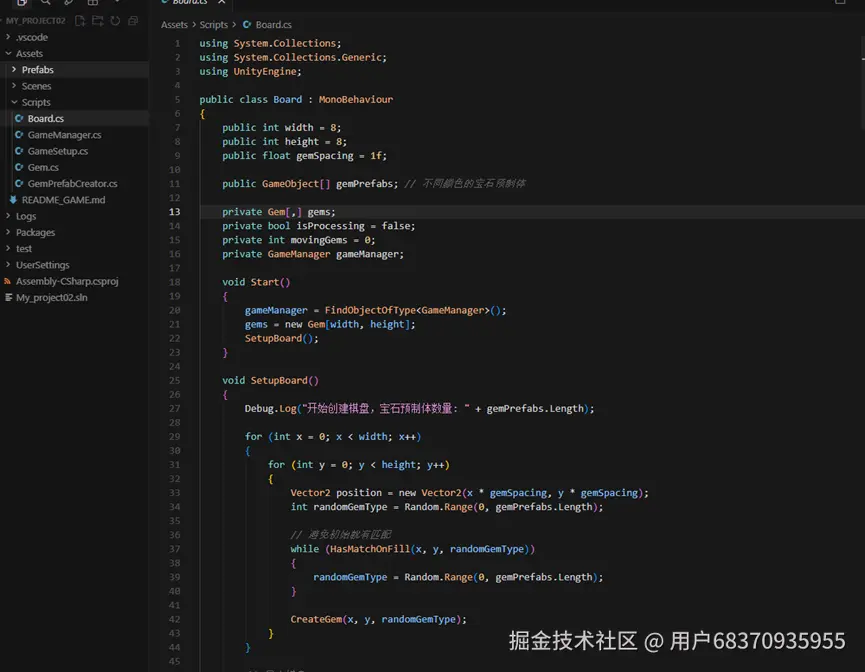
4.3 核心递归逻辑:棋盘生成与消除 (Board)
这是整个游戏最核心、也最复杂的部分。我们需要处理 8×8 的二维数组,并且要保证:
- 初始化无解:开局不能直接有三连。
- 交换检测:只有交换后能产生消除的操作才是合法的。
- 连锁反应 :一次消除后,宝石掉落,可能产生新的消除,这需要用到递归(Recursive)或者协程(Coroutine) 。
关键代码:Board.cs
ini
using System.Collections;
using System.Collections.Generic;
using UnityEngine;

public class Board : MonoBehaviour
{
    public int width = 8;
    public int height = 8;
    public float gemSpacing = 1f;

    public GameObject[] gemPrefabs; // 不同颜色的宝石预制体private Gem[,] gems;
    private bool isProcessing = false;
    private int movingGems = 0;
    private GameManager gameManager;

    void Start(){
        gameManager = FindObjectOfType<GameManager>();
        gems = new Gem[width, height];
        SetupBoard();
    }

    void SetupBoard(){
        for (int x = 0; x < width; x++)
        {
            for (int y = 0; y < height; y++)
            {
                int randomGemType = Random.Range(0, gemPrefabs.Length);

                // 避免初始就有匹配while (HasMatchOnFill(x, y, randomGemType))
                {
                    randomGemType = Random.Range(0, gemPrefabs.Length);
                }

                CreateGem(x, y, randomGemType);
            }
        }

        // 居中棋盘,方便在 AR 眼镜中观察
        transform.position = new Vector3(-width * gemSpacing / 2f + gemSpacing / 2f,
                                         -height * gemSpacing / 2f + gemSpacing / 2f, 0);
    }

    bool HasMatchOnFill(int column, int row, int gemType){
        if (column > 1 && gems[column - 1, row]?.gemType == gemType && gems[column - 2, row]?.gemType == gemType)
            return true;
        if (row > 1 && gems[column, row - 1]?.gemType == gemType && gems[column, row - 2]?.gemType == gemType)
            return true;
        return false;
    }

    void CreateGem(int x, int y, int gemType){
        Vector2 position = new Vector2(x * gemSpacing, y * gemSpacing);
        GameObject gem = Instantiate(gemPrefabs[gemType], position, Quaternion.identity);
        gem.transform.parent = transform;
        gem.SetActive(true);

        Gem gemScript = gem.GetComponent<Gem>();
        gemScript.SetPosition(x, y);
        gemScript.gemType = gemType;
        gems[x, y] = gemScript;
    }

    public void SwapGems(int col1, int row1, int col2, int row2){
        if (isProcessing) return;
        if (col2 < 0 || col2 >= width || row2 < 0 || row2 >= height) return;

        Gem gem1 = gems[col1, row1];
        Gem gem2 = gems[col2, row2];
        if (gem1 != null && gem2 != null)
            StartCoroutine(SwapGemsCoroutine(gem1, gem2));
    }

    IEnumerator SwapGemsCoroutine(Gem gem1, Gem gem2){
        isProcessing = true;

        int tempCol = gem1.column, tempRow = gem1.row;
        gem1.SetPosition(gem2.column, gem2.row);
        gem2.SetPosition(tempCol, tempRow);

        gems[gem1.column, gem1.row] = gem1;
        gems[gem2.column, gem2.row] = gem2;

        gem1.MoveTo(new Vector3(gem1.column * gemSpacing, gem1.row * gemSpacing, 0));
        gem2.MoveTo(new Vector3(gem2.column * gemSpacing, gem2.row * gemSpacing, 0));

        yield return new WaitForSeconds(0.3f);

        List<Gem> matches = FindAllMatches();
        if (matches.Count == 0)
        {
            // 回退逻辑
            gem1.SetPosition(gem2.column, gem2.row);
            gem2.SetPosition(tempCol, tempRow);
            gems[gem1.column, gem1.row] = gem1;
            gems[gem2.column, gem2.row] = gem2;
            gem1.MoveTo(new Vector3(gem1.column * gemSpacing, gem1.row * gemSpacing, 0));
            gem2.MoveTo(new Vector3(gem2.column * gemSpacing, gem2.row * gemSpacing, 0));
            yield return new WaitForSeconds(0.3f);
        }
        else
        {
            gameManager.UseMove();
            yield return StartCoroutine(ProcessMatches(matches));
        }
        isProcessing = false;
    }

    List<Gem> FindAllMatches(){
        List<Gem> matches = new List<Gem>();
        // 横向检测for (int y = 0; y < height; y++)
        {
            for (int x = 0; x < width - 2; x++)
            {
                if (gems[x,y] != null && gems[x+1,y] != null && gems[x+2,y] != null)
                {
                    if (gems[x,y].gemType == gems[x+1,y].gemType && gems[x,y].gemType == gems[x+2,y].gemType)
                    {
                        if (!matches.Contains(gems[x,y])) matches.Add(gems[x,y]);
                        if (!matches.Contains(gems[x+1,y])) matches.Add(gems[x+1,y]);
                        if (!matches.Contains(gems[x+2,y])) matches.Add(gems[x+2,y]);
                    }
                }
            }
        }
        // 纵向检测类似逻辑...return matches;
    }

    IEnumerator ProcessMatches(List<Gem> matches){
        gameManager.AddScore(matches.Count * 10);
        foreach (Gem gem in matches)
        {
            gems[gem.column, gem.row] = null;
            Destroy(gem.gameObject);
        }
        yield return new WaitForSeconds(0.3f);
        yield return StartCoroutine(DropGems());
        yield return StartCoroutine(FillBoard());

        List<Gem> newMatches = FindAllMatches();
        if (newMatches.Count > 0) yield return StartCoroutine(ProcessMatches(newMatches));
    }

    IEnumerator DropGems(){
        for (int x = 0; x < width; x++)
        {
            for (int y = 0; y < height; y++)
            {
                if (gems[x, y] == null)
                {
                    for (int yAbove = y + 1; yAbove < height; yAbove++)
                    {
                        if (gems[x, yAbove] != null)
                        {
                            gems[x, y] = gems[x, yAbove];
                            gems[x, yAbove] = null;
                            gems[x, y].SetPosition(x, y);
                            gems[x, y].MoveTo(new Vector3(x * gemSpacing, y * gemSpacing, 0));
                            break;
                        }
                    }
                }
            }
        }
        yield return new WaitForSeconds(0.5f);
    }

    IEnumerator FillBoard(){
        for (int x = 0; x < width; x++)
        {
            for (int y = 0; y < height; y++)
            {
                if (gems[x, y] == null)
                {
                    int randomGemType = Random.Range(0, gemPrefabs.Length);
                    Vector2 spawnPosition = new Vector2(x * gemSpacing, height * gemSpacing);
                    GameObject gem = Instantiate(gemPrefabs[randomGemType], spawnPosition, Quaternion.identity);
                    gem.transform.parent = transform;
                    Gem gemScript = gem.GetComponent<Gem>();
                    gemScript.SetPosition(x, y);
                    gemScript.gemType = randomGemType;
                    gemScript.MoveTo(new Vector3(x * gemSpacing, y * gemSpacing, 0));
                    gems[x, y] = gemScript;
                }
            }
        }
        yield return new WaitForSeconds(0.5f);
    }

    public void OnGemMoveComplete() { movingGems--; }
}
在 AR 开发中,IEnumerator(协程)是极其好用的工具。因为宝石的下落和移动必须是平滑的动画,如果直接改变位置,玩家会觉得画面闪烁。通过协程配合 WaitForSeconds,我们能给大脑一个处理空间变化的缓冲区。
4.4 宝石的微观交互 (Gem)
每一颗宝石都是一个独立的个体,它需要知道自己被"摸"到了,并且知道被拖向了哪个方向。
关键代码:Gem.cs
ini
using UnityEngine;

public class Gem : MonoBehaviour
{
    public int column;
    public int row;
    public int gemType;

    private Board board;
    private Vector2 firstTouchPosition;
    private Vector2 finalTouchPosition;
    private bool isMoving = false;
    private Vector3 targetPosition;

    public float moveSpeed = 10f;

    void Start() { board = FindObjectOfType<Board>(); }

    void Update(){
        if (isMoving)
        {
            transform.position = Vector3.Lerp(transform.position, targetPosition, moveSpeed * Time.deltaTime);
            if (Vector3.Distance(transform.position, targetPosition) < 0.01f)
            {
                transform.position = targetPosition;
                isMoving = false;
                board.OnGemMoveComplete();
            }
        }

        // 这里的 MouseButton 输入在 Rokid UXR 下会被自动映射为射线点击if (Input.GetMouseButtonDown(0))
        {
            Vector2 mousePos = Camera.main.ScreenToWorldPoint(Input.mousePosition);
            RaycastHit2D hit = Physics2D.Raycast(mousePos, Vector2.zero);
            if (hit.collider != null && hit.collider.gameObject == gameObject)
                firstTouchPosition = mousePos;
        }

        if (Input.GetMouseButtonUp(0))
        {
            Vector2 mousePos = Camera.main.ScreenToWorldPoint(Input.mousePosition);
            RaycastHit2D hit = Physics2D.Raycast(firstTouchPosition, Vector2.zero);
            if (hit.collider != null && hit.collider.gameObject == gameObject)
            {
                finalTouchPosition = mousePos;
                CalculateAngle();
            }
        }
    }

    void CalculateAngle(){
        Vector2 direction = finalTouchPosition - firstTouchPosition;
        if (direction.magnitude < 0.5f) return;

        if (Mathf.Abs(direction.x) > Mathf.Abs(direction.y))
        {
            if (direction.x > 0) board.SwapGems(column, row, column + 1, row);
            else board.SwapGems(column, row, column - 1, row);
        }
        else
        {
            if (direction.y > 0) board.SwapGems(column, row, column, row + 1);
            else board.SwapGems(column, row, column, row - 1);
        }
    }

    public void MoveTo(Vector3 newPosition) { targetPosition = newPosition; isMoving = true; }
    public void SetPosition(int col, int r) { column = col; row = r; }
}
这里有一个"产品级"的细节:我们在计算方向时,加入了 direction.magnitude < 0.5f 的判断。这是为了防止玩家轻微抖动导致的误触。在 AR 环境下,由于你是对着空气操作,射线的稳定性不如物理屏幕,这个缓冲区(Deadzone)非常重要。
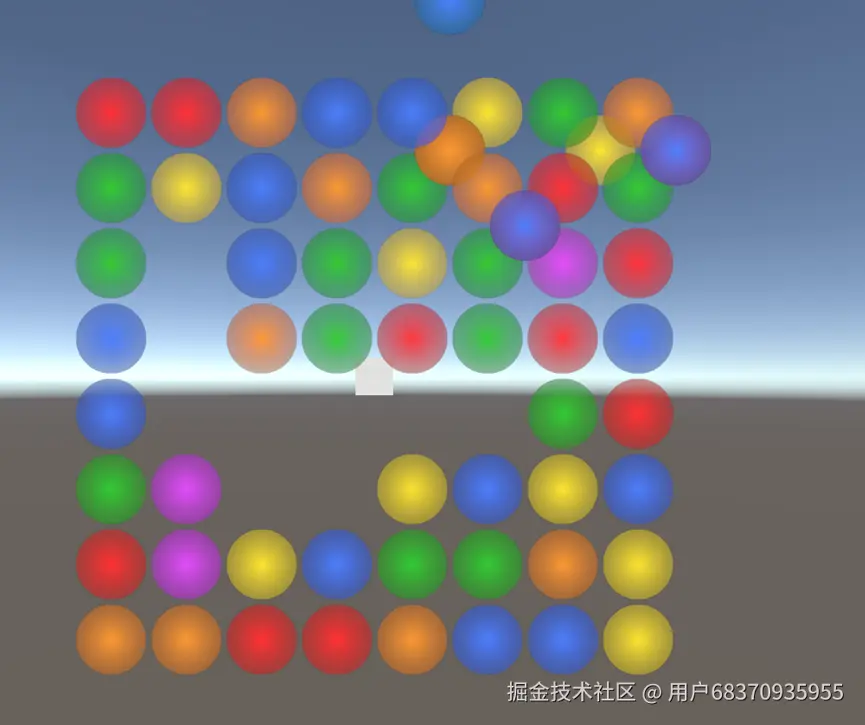
4.5 运行时预制体生成 (GemPrefabCreator)
为了让项目包体尽可能小,我们没有使用精美的 3D 模型,而是通过代码在运行时绘制了一张 128x128 的带渐变的圆形贴图。这种"纯程序化"的资源生成方式,极其适合快速原型。
关键代码:GemPrefabCreator.cs
ini
using UnityEngine;

public class GemPrefabCreator : MonoBehaviour
{
    public static GameObject CreateGemPrefab(Color color, string name){
        GameObject gem = new GameObject(name);
        SpriteRenderer sr = gem.AddComponent<SpriteRenderer>();

        Texture2D texture = new Texture2D(128, 128);
        Color[] pixels = new Color[128 * 128];
        Vector2 center = new Vector2(64, 64);
        float radius = 60;

        for (int y = 0; y < 128; y++)
        {
            for (int x = 0; x < 128; x++)
            {
                float distance = Vector2.Distance(new Vector2(x, y), center);
                if (distance < radius)
                    pixels[y * 128 + x] = color * (1f - (distance / radius) * 0.3f);
                else
                    pixels[y * 128 + x] = Color.clear;
            }
        }

        texture.SetPixels(pixels);
        texture.Apply();
        sr.sprite = Sprite.Create(texture, new Rect(0, 0, 128, 128), new Vector2(0.5f, 0.5f), 128);
        gem.AddComponent<CircleCollider2D>().radius = 0.45f;
        gem.AddComponent<Gem>();
        return gem;
    }
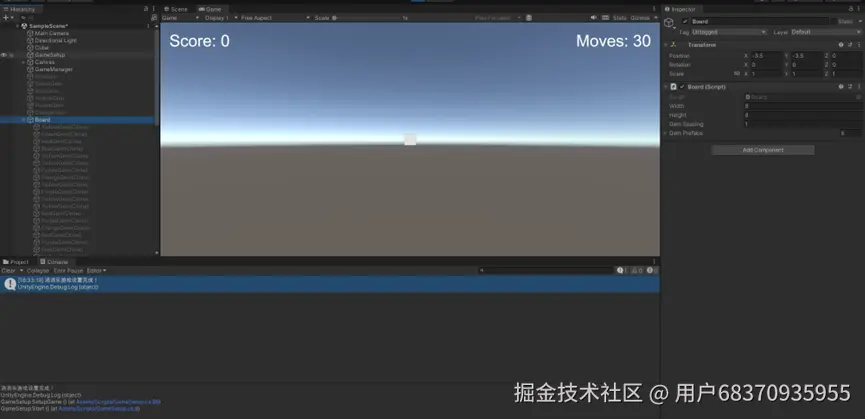
}
开发过程中的小坑与经验
说实话,即便代码逻辑写对了,第一次运行项目时,大概率还是会遇到"翻车"现场。这里总结了几个我们在 Rokid AR Lite 调试时遇到的典型坑。
5.1 消失的字体:Arial.ttf 去哪了?
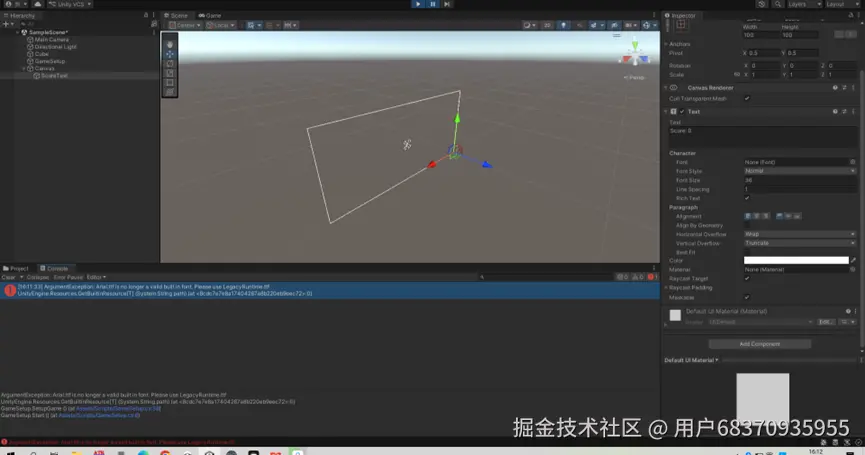
这是 Unity 新版本的"著名槽点"。在 Unity 2022 LTS 中,如果你像以前一样直接引用内置的 Arial.ttf,你会发现编译成 APK 后,眼镜里的文字全部变成了空白。控制台会疯狂报:ArgumentException: Arial.ttf is no longer a valid built in font。 避坑指南: 现在的内置字体名字改成了 LegacyRuntime.ttf。在代码中加载时一定要写对,或者最稳妥的方法是:自己导入一个开源的中文字体库。
5.2 只有 UI 没棋盘?三步排查法
很多时候运行起来,能看到 Score 和 Moves 在跳,但眼前一片漆黑,宝石棋盘没了。这时候不要慌,按以下顺序排查:
- 棋盘坐标 (Z-depth) :AR 相机的剪裁平面(Clipping Planes)通常设置得比较窄。如果你的棋盘 Z 轴坐标设置成了 0,而相机在 -10 且正交尺寸不对,棋盘可能就在你的视线之外。
- Layer 问题 :检查生成的
Board节点是否在默认层。如果误分到了不可见的 Layer,它就像隐身了一样。 - Inspector 赋值检测 :如果是通过编辑器拖入的预制体,检查
gemPrefabs数组有没有漏填。哪怕空了一项,代码在实例化时就会中断,导致整个棋盘崩溃。
5.3 构建设置与分辨率
针对 Rokid AR Lite,务必确保:
- 色彩空间:尽量选择 Linear。
- 渲染管线:建议开启 URP,以获得更好的抗锯齿效果,否则宝石边缘会有严重的锯齿感。
- 多线程渲染:开启它可以显著降低眼镜的功耗和发热。
实机体验与价值
当这个"轻量级"消消乐真正跑在 Rokid AR Lite 上时,其带来的产品启示远超游戏本身。
6.1 实机体感
在办公室实测时,我最喜欢的一种体验是:将棋盘挂在显示器的正上方。当我写代码写累了,不需要低头找手机(这个动作对颈椎极不友好),只需要轻轻一抬头,对着空中的宝石滑几下。
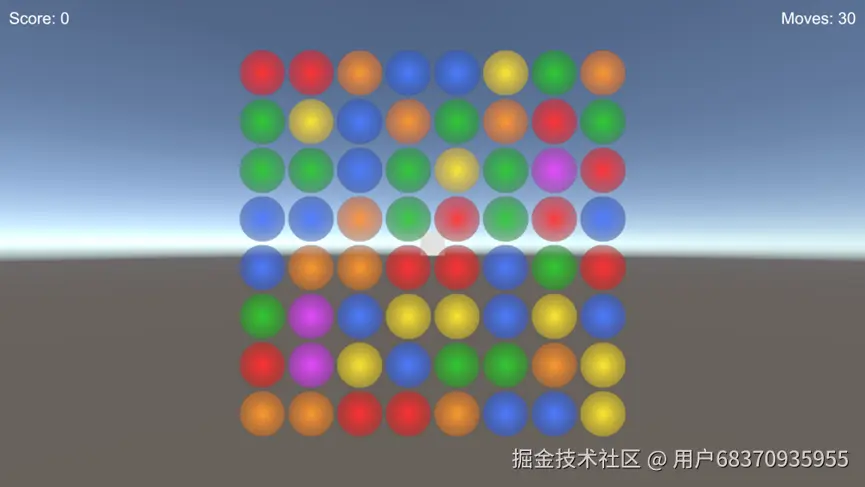
总结与展望
利用 Unity 2022 LTS + UXR 3.0 SDK ,我们完成了一个从零到一的 AR 探索。这套组合的优点显而易见:生态成熟、开发门槛低、真机适配顺滑。
当然,目前这仅仅是一个"毛坯房"。接下来,我们可以迭代的方向还有很多:
- 音效与反馈:加入立体空间音频,让宝石爆破的声音从棋盘所在的方位传来。
- 视觉特效:引入 URP 的粒子系统,让消除瞬间火花四溅。
- 深度交互:接入手势追踪。想象一下,用食指和中指"捏"住宝石进行物理拖拽,那才是真正的空间计算体验。
- 关卡设计:引入不同的障碍物(冰块、木板),将这套轻量级原型打造成完整的商业产品。
AR 开发不需要一上来就追求宏大的叙事,有时候,在现实世界里安安稳稳地玩上一局消消乐,就是空间计算带给我们的最纯粹的快乐。