摘要 :阅读理解是英语学习的核心技能之一,也是获取信息、拓展知识的重要途径。然而,许多学习者在英语阅读中面临词汇障碍、长难句理解困难、阅读速度慢、理解深度不足等问题,严重影响了阅读效率和学习效果。GPT-5.4凭借其强大的自然语言处理能力,可以为学习者提供文本解读、难点解析、问题解答、背景知识补充等多方面的支持,成为英语阅读学习的得力助手。本文将系统介绍如何利用GPT-5.4提升英语阅读理解能力,涵盖阅读策略训练、文本分析方法、不同文体阅读技巧等内容。由于国内无法直接访问OpenAI官网,使用国内镜像站是合法便捷的选择。
1 英语阅读理解的核心要素
英语阅读理解是一项复杂的认知活动,涉及多个层面的能力协同运作。从最基础的层面来看,阅读理解需要读者具备足够的词汇量和语法知识,能够识别单词、理解句子结构。但仅有这些基础能力是远远不够的,真正的阅读理解还需要读者具备推理判断、信息整合、批判性思维等高级认知能力。
词汇层面的挑战是阅读理解的第一道关卡。在阅读英文文本时,学习者经常会遇到生词,这些生词可能阻碍对句子甚至段落意思的理解。传统的做法是查阅词典,但频繁查词会打断阅读的流畅性,影响阅读体验和效率。更重要的是,很多词汇在特定语境中有着特殊的含义,简单的词典释义可能无法准确传达其在文中的意思。
句子层面的挑战主要体现在长难句的理解上。英语中存在大量的复合句、长句,这些句子结构复杂、信息量大,对于不熟悉英语句法结构的学习者来说,理解起来相当困难。特别是当句子中嵌套了多个从句、使用了倒装、省略等特殊结构时,学习者往往感到无从下手。
篇章层面的挑战则更为复杂。理解一篇文章不仅需要理解每个句子,还需要把握句子之间的逻辑关系,理解段落的组织结构,把握文章的主旨大意,进行推理和判断。这些高级阅读技能的培养需要系统的训练和大量的实践。
2 GPT-5.4阅读辅助功能详解
2.1 文本解读与难点解析
GPT-5.4最实用的阅读辅助功能之一是对文本进行解读和难点解析。学习者可以将阅读中遇到的困难段落输入GPT-5.4,请求其进行详细解读,包括词汇解释、句法分析、意思阐释等。
文本解读的提示词示例:
text
请帮我解读以下英文段落:

The air, once thick with summer's languid breath, has thinned, sharpened. A crispness now insinuates itself, a subtle herald of change. It's a scent I know intimately, a fragrance woven from fallen leaves, damp earth, and a distant woodsmoke that, this year, seems to carry a particular weight. Autumn has arrived, not with a fanfare, but with a quiet, persistent whisper that stirs a familiar ache within me.

The world outside my window is transforming into a tapestry of amber and russet. Maple leaves, once a vibrant emerald, now blush with fiery intensity, surrendering their green to the inevitable cycle. They drift, slow and deliberate, like forgotten letters carried on the breeze, each descent a poignant reminder of time's relentless passage. I watch them, these transient jewels, and a phantom chill, unrelated to the season, prickles my skin.

It is in these moments, when the light slants low and golden, bathing everything in a melancholic glow, that the heart turns homeward. The city, with its ceaseless hum and anonymous faces, suddenly feels vast and alien. I find myself tracing the contours of a memory, a landscape etched deep into my soul. I see the gnarled branches of the old persimmon tree in my grandmother's courtyard, heavy with ripening fruit, its skin a burnished orange against the deepening blue of the sky. I can almost taste the sweet, slightly astringent flesh, a flavour that has no parallel in this foreign soil.

The sounds, too, become amplified in their absence. The chirping of crickets, once a ubiquitous lullaby, is now a faint echo. I recall the rustling of dry leaves underfoot as I walked the familiar paths, the distant laughter of neighbours, the comforting rhythm of life that pulsed in my hometown. Here, the silence is different, a hollow space that amplifies the unspoken longing.

Homesickness, in autumn, is a particularly potent vintage. It's not the sharp, desperate pang of immediate separation, but a slow, deepening intoxication, savoured with each falling leaf, each lengthening shadow. It's a gentle sorrow, laced with the sweetness of cherished memories. The vibrant colours of the season, so often celebrated for their beauty, become a stark contrast to the muted hues of my inner landscape. They are a vibrant exhibition of a world that is alive and flourishing, while a part of me remains tethered to a distant, perhaps idealized, past.

I know this feeling is ephemeral, a seasonal companion. But for now, I let it wash over me, this tide of amber hues and whispered memories. I allow myself to be enveloped by the quiet melancholy, to acknowledge the persistent tug of belonging. For in the heart of autumn, amidst the rustling leaves and the fading light, the most profound journeys are often those that lead us back to where we began.

请提供以下内容:
1. 段落大意总结(用中文)
2. 重点词汇解释(包括在本文中的具体含义)
3. 长难句分析(指出句子结构,解释语法难点)
4. 关键表达和搭配说明
5. 背景知识补充(如有必要)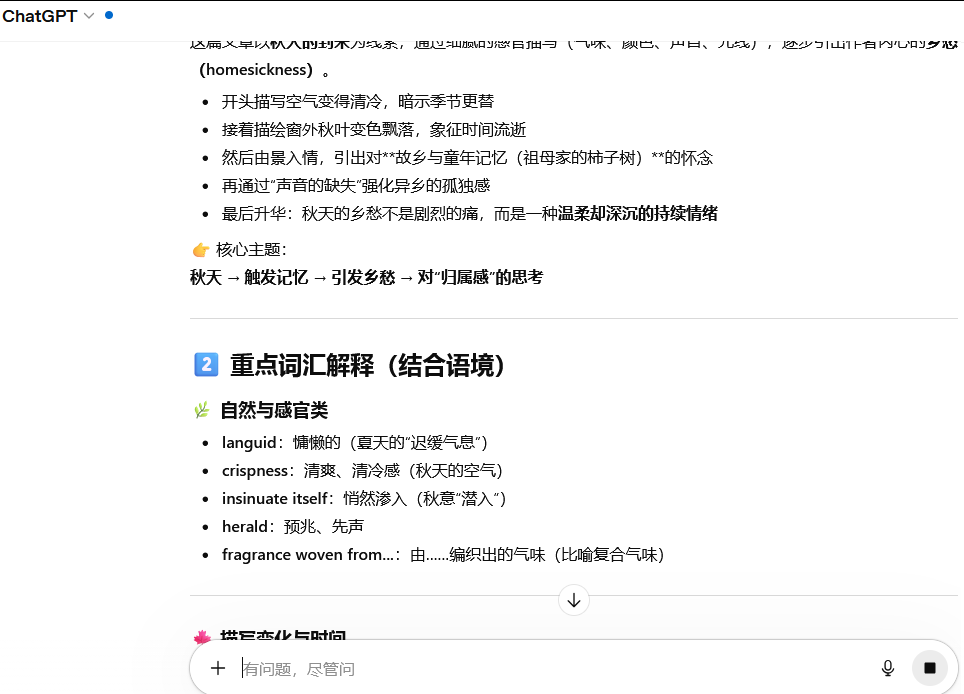
这种解读方式的优势在于其针对性和深度。与简单的翻译不同,GPT-5.4会详细解释文本中的难点,帮助学习者真正理解文本,而不是仅仅获得一个翻译结果。通过反复使用这种解读功能,学习者可以逐步积累词汇、熟悉句法结构、提高阅读理解能力。
2.2 阅读问题设计与解答
阅读理解训练的一个重要环节是回答问题。GPT-5.4可以根据文本设计各种类型的阅读理解问题,帮助学习者检验和提升理解能力。同时,学习者也可以就阅读中产生的疑问向GPT-5.4提问,获得详细的解答。
阅读问题设计的提示词示例:
text
请根据以下英文文本设计5道阅读理解问题:

The pervasive issue of unlicensed driving presents a formidable threat to public safety, necessitating stringent enforcement and heightened societal awareness. Individuals who operate vehicles without a valid license often lack the requisite training, understanding of traffic laws, and demonstrated competence, thereby escalating the probability of accidents. This deficiency directly translates into an increased risk for all road users, as the unpredictability of an unqualified driver can have catastrophic consequences.

Furthermore, the act of driving without a license often signifies a disregard for established legal frameworks and a broader pattern of irresponsibility. Such individuals may also be more prone to engaging in other hazardous behaviors, such as speeding or driving under the influence, further compounding the danger. The repercussions of these actions extend beyond immediate physical harm, encompassing significant financial burdens for victims and strained emergency services.

In conclusion, the multifaceted dangers associated with unlicensed driving underscore the imperative for robust legal deterrents and comprehensive public education campaigns. Only through a concerted effort can we hope to mitigate this persistent threat and ensure safer roadways for everyone.

问题类型要求:
1. 主旨大意题1道
2. 细节理解题2道
3. 推理判断题1道
4. 词义猜测题1道

请提供:
1. 问题及选项(如有)
2. 正确答案
3. 解题思路说明
4. 干扰项分析(如有选项)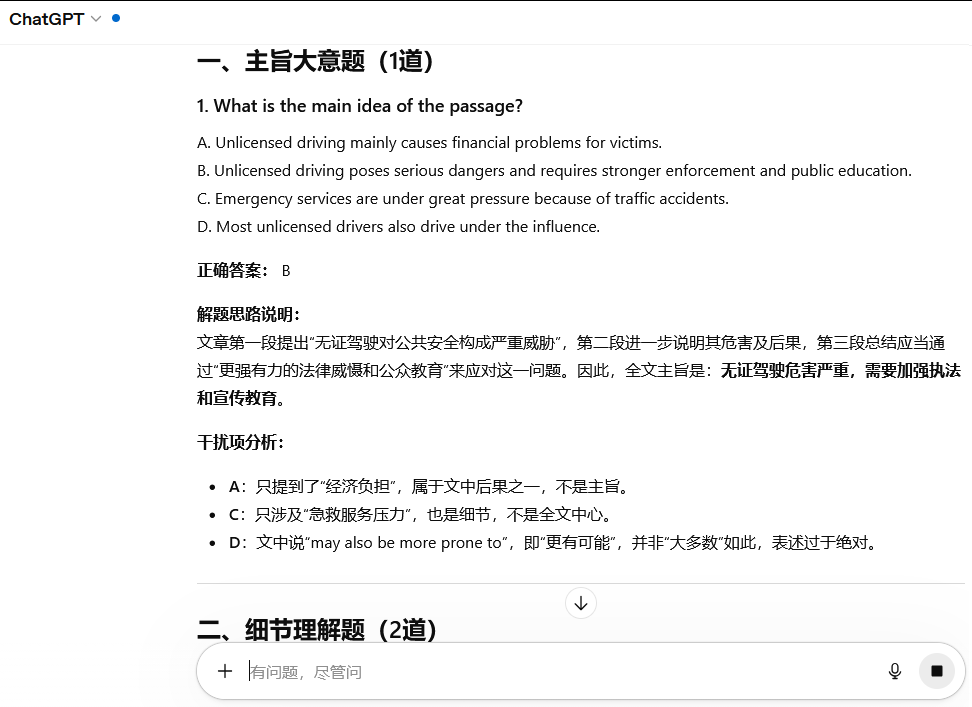
2.3 阅读策略指导
GPT-5.4不仅可以解答具体的阅读问题,还可以提供阅读策略方面的指导。学习者可以询问如何提高阅读速度、如何处理生词、如何把握文章结构等问题,GPT-5.4会根据学习者的具体情况提供建议。
3 不同思考模式在阅读学习中的应用
GPT-5.4的不同思考模式在阅读学习中各有其适用场景,合理选择可以更高效地获得阅读支持。
| 思考模式 | 阅读学习适用场景 | 功能特点 | 推荐使用频率 |
|---|---|---|---|
| Auto模式 | 快速查词、简单问题解答、文本大意概括 | 响应快,适合日常阅读辅助 | 高频使用 |
| Thinking标准思考 | 文本深度分析、阅读策略讲解、问题解析 | 展示分析过程,便于学习理解 | 中频使用 |
| Thinking进阶思考 | 复杂文本解读、学术阅读指导、批判性阅读 | 深度分析,提供专业见解 | 低频使用 |
对于日常的阅读练习,建议主要使用Auto模式进行快速辅助,如查词、概括大意等。当遇到理解困难或需要深入分析时,切换到Thinking标准思考模式。对于学术论文、文学作品等复杂文本的阅读,可以使用Thinking进阶思考模式获得更深入的分析。
4 阅读策略系统训练
4.1 略读与寻读技巧训练
略读(Skimming)和寻读(Scanning)是两种重要的快速阅读技巧。略读用于快速获取文章大意,寻读用于快速定位特定信息。这两种技巧对于提高阅读效率、应对考试中的时间压力非常重要。
略读训练的提示词示例:
text
请帮我训练略读技巧。我会提供一篇英文文章,请你:

1. 首先指出我应该关注哪些部分来快速把握文章大意(如标题、首段、各段首句等)
2. 用3-5句话概括文章大意
3. 说明你是如何通过略读获得这些信息的
4. 给出略读这篇文章的建议步骤

文章:
The Unyielding Sentence: Understanding Life Imprisonment and its Prerequisites

Life imprisonment, a penal sanction of profound gravity, signifies a sentence of incarceration for the remainder of an individual's natural life. Unlike fixed-term sentences, its definitive nature marks it as one of the most severe punishments available within many legal systems, often reserved for egregious offenses that shock the collective conscience. The rationale underpinning this unyielding sentence typically revolves around incapacitation, retribution, and deterrence, aiming to permanently remove dangerous offenders from society and serve as a stark warning against heinous crimes.

The conditions that precipitate a life sentence are invariably tied to the severity and nature of the criminal act. While specific legal frameworks vary across jurisdictions, certain categories of offenses commonly attract this ultimate penalty. These typically encompass the most violent and depraved crimes, such as premeditated murder, particularly when accompanied by aggravating factors like multiple victims, torture, or sexual violence. Crimes against humanity, treason, and exceptionally severe instances of terrorism also frequently fall under the purview of life imprisonment. Furthermore, some legal systems may impose life sentences for repeat offenders who have committed a series of serious crimes, demonstrating a persistent disregard for the law and public safety.

In conclusion, life imprisonment represents a legal mechanism for permanently segregating individuals deemed irredeemable threats to society. Its imposition is a deliberate judicial act, predicated on the commission of the most heinous offenses or a pattern of persistent criminal behavior. While the debate regarding its efficacy and ethical implications continues, its role as a severe deterrent and a means of societal protection remains a cornerstone of penal justice in numerous nations.
寻读训练的提示词示例:
text
请帮我训练寻读技巧。我需要在以下文章中找到特定信息:

文章:
DONGGUAN --- A routine descent into the early hours of Friday morning transformed into a harrowing nightmare at Hongfu Plaza, as an overloaded passenger elevator plummeted from the 19th floor to the basement, leaving a trail of chaos and injuring 20 people. The catastrophic incident, which occurred at approximately 12:40 a.m. on September 9, 2011, has ignited a fierce debate regarding elevator safety protocols and the perils of negligence in high-rise infrastructure.

The ill-fated journey began in the Hongfu Business Building, where employees of a local building materials company had just concluded a late-night training session. Eager to return home, a crowd of roughly 150 people swarmed the elevator lobby. The tragedy struck with the second batch of passengers. While the elevator---an "Otis" brand model manufactured in 2005---had a rated capacity of merely 1,000 kilograms (13 persons), at least 21 people squeezed into the car. Witnesses later described the scene as being packed like "sardines," with the slender frames of many female colleagues creating a deceptive sense of space that masked the dangerous overload.

What followed was a terrifying freefall. As the doors closed, the elevator did not issue the standard overload warning. Instead, it began to descend with a violent shudder. According to survivor accounts, the car shook violently, lights flickered and died, and a deafening metallic snapping sound echoed through the shaft as the suspension cables failed under the excessive strain.

"It was like a scene from a horror movie," recalled Lu Huimei, a terrified survivor. "We felt a strong sense of weightlessness, followed by screams and panic."

The elevator did not crash directly to the bottom. It plummeted from the 19th floor, stopping briefly at the 8th floor---a momentary reprieve that offered false hope---before accelerating again. It finally crashed into the pit at Basement Level 1 (B1). The impact was so severe that the counterweight frame was dislodged from the top of the car, smashing through the ceiling and showering passengers with debris and white dust. Male passengers instinctively braced their hands against the collapsing roof to protect others, a desperate act of heroism amid the wreckage.

Rescue operations were frantic. Colleagues waiting downstairs heard the crash and rushed to the scene. With the elevator doors jammed shut, they used iron rods to pry them open, revealing a scene of devastation. Passengers were covered in gray dust, many unable to move, groaning in pain on the floor. Of the 20 injured, 12 were hospitalized at Nancheng Hospital, primarily suffering from lower limb fractures and head trauma, while eight others with minor injuries were treated and released.

Official investigations by the Dongguan Quality and Technical Supervision Bureau revealed a damning verdict: the elevator's overload protection system had failed, and the braking mechanism was unable to arrest the runaway descent despite the limiter engaging momentarily at the 8th floor. The brake failed to hold, allowing the car to continue its fatal plunge.

Disturbingly, the elevator had passed its most recent maintenance check just four days prior on September 5, and its next scheduled inspection was not due until May 2012. This raises alarming questions about the efficacy of routine maintenance and the reliability of safety sensors. Furthermore, this was not the first time an Otis elevator in this specific complex had malfunctioned, suggesting a systemic issue with either the equipment or its upkeep.

As the injured recover and authorities scrutinize the maintenance records of the property management company, this incident serves as a grim reminder that in the vertical cities of modern China, the margin for error is zero. The silence of the alarm bells and the snap of the steel cables have left a scar on the city's conscience, demanding not just repairs, but a total overhaul of safety vigilance.


需要寻找的信息:
1. [具体信息1,如某个数据]
2. [具体信息2,如某个日期]
3. [具体信息3,如某个人名]

请告诉我:
1. 每个信息在文中的位置
2. 你是如何快速定位到这些信息的
3. 寻读的技巧要点
4.2 推理判断能力训练
推理判断是高级阅读技能,要求读者根据文本信息进行逻辑推理,得出文中没有直接陈述的结论。这种能力对于深度阅读和学术阅读尤为重要。
推理判断训练的提示词示例:
text
请根据以下文本进行推理判断训练:

DONGGUAN --- A routine descent into the early hours of Friday morning transformed into a harrowing nightmare at Hongfu Plaza, as an overloaded passenger elevator plummeted from the 19th floor to the basement, leaving a trail of chaos and injuring 20 people. The catastrophic incident, which occurred at approximately 12:40 a.m. on September 9, 2011, has ignited a fierce debate regarding elevator safety protocols and the perils of negligence in high-rise infrastructure.

The ill-fated journey began in the Hongfu Business Building, where employees of a local building materials company had just concluded a late-night training session. Eager to return home, a crowd of roughly 150 people swarmed the elevator lobby. The tragedy struck with the second batch of passengers. While the elevator---an "Otis" brand model manufactured in 2005---had a rated capacity of merely 1,000 kilograms (13 persons), at least 21 people squeezed into the car. Witnesses later described the scene as being packed like "sardines," with the slender frames of many female colleagues creating a deceptive sense of space that masked the dangerous overload.

What followed was a terrifying freefall. As the doors closed, the elevator did not issue the standard overload warning. Instead, it began to descend with a violent shudder. According to survivor accounts, the car shook violently, lights flickered and died, and a deafening metallic snapping sound echoed through the shaft as the suspension cables failed under the excessive strain.

"It was like a scene from a horror movie," recalled Lu Huimei, a terrified survivor. "We felt a strong sense of weightlessness, followed by screams and panic."

The elevator did not crash directly to the bottom. It plummeted from the 19th floor, stopping briefly at the 8th floor---a momentary reprieve that offered false hope---before accelerating again. It finally crashed into the pit at Basement Level 1 (B1). The impact was so severe that the counterweight frame was dislodged from the top of the car, smashing through the ceiling and showering passengers with debris and white dust. Male passengers instinctively braced their hands against the collapsing roof to protect others, a desperate act of heroism amid the wreckage.

Rescue operations were frantic. Colleagues waiting downstairs heard the crash and rushed to the scene. With the elevator doors jammed shut, they used iron rods to pry them open, revealing a scene of devastation. Passengers were covered in gray dust, many unable to move, groaning in pain on the floor. Of the 20 injured, 12 were hospitalized at Nancheng Hospital, primarily suffering from lower limb fractures and head trauma, while eight others with minor injuries were treated and released.

Official investigations by the Dongguan Quality and Technical Supervision Bureau revealed a damning verdict: the elevator's overload protection system had failed, and the braking mechanism was unable to arrest the runaway descent despite the limiter engaging momentarily at the 8th floor. The brake failed to hold, allowing the car to continue its fatal plunge.

Disturbingly, the elevator had passed its most recent maintenance check just four days prior on September 5, and its next scheduled inspection was not due until May 2012. This raises alarming questions about the efficacy of routine maintenance and the reliability of safety sensors. Furthermore, this was not the first time an Otis elevator in this specific complex had malfunctioned, suggesting a systemic issue with either the equipment or its upkeep.

As the injured recover and authorities scrutinize the maintenance records of the property management company, this incident serves as a grim reminder that in the vertical cities of modern China, the margin for error is zero. The silence of the alarm bells and the snap of the steel cables have left a scar on the city's conscience, demanding not just repairs, but a total overhaul of safety vigilance.

请设计3道推理判断题,每道题要求:
1. 提出问题
2. 说明推理依据(文中哪些信息支持这个推理)
3. 解释推理过程
4. 指出常见的推理错误
4.3 批判性阅读训练
批判性阅读要求读者不只是被动接受文本信息,而是对文本进行分析、评估和质疑。这种能力对于学术研究和信息时代的信息筛选非常重要。
批判性阅读训练的提示词示例:
text
请帮我进行批判性阅读分析。文本如下:

The vertical metropolis of the 21st century relies heavily on the elevator as its circulatory system. However, the harrowing incident at Dongguan's Hongfu Plaza in 2011 serves as a grim reminder that this convenience has a precarious threshold. While laypeople often perceive elevator accidents as random acts of fate, the mechanics behind a freefall are rooted in fundamental physics and exacerbated by systemic negligence. Understanding why overloading leads to a precipitous descent requires a dissection of mechanical equilibrium, safety redundancy, and the erosion of maintenance protocols.

Fundamentally, an elevator is a system of counterbalances governed by Newtonian physics. A standard elevator car is suspended by steel cables and counterweighted by a mass roughly equivalent to the car's weight plus 40-50% of its rated load. This design ensures that the motor does not need to lift the entire dead weight of the car, but rather the difference between the load and the counterweight. When an elevator is overloaded---as was the case in Dongguan, where nearly double the rated capacity squeezed into the car---the equilibrium is shattered. The total mass exceeds the traction capacity of the friction between the drive sheave and the cables. Once the gravitational force surpasses the traction limit, the car ceases to be a controlled vessel and becomes a dead weight sliding down a shaft.

However, physics alone does not sentence a crowded elevator to crash; the failure of safety redundancies is the true culprit. Modern elevators are equipped with a multi-layered defense system: the overspeed governor and the safety gear. The governor is a centrifugal device that detects if the car exceeds its rated speed. In a properly functioning system, if the car accelerates dangerously, the governor triggers a mechanism that clamps the safety gear onto the guide rails, arresting the fall. In the Dongguan tragedy, the sheer magnitude of the overload caused the cables to slip on the traction sheave, creating a "freefall" scenario that overwhelmed the braking system. Crucially, the primary brake---designed to hold the car stationary---failed due to thermal recession or mechanical fatigue. When the brake pads overheat from excessive friction or are poorly maintained, their coefficient of friction drops precipitously, rendering them incapable of counteracting the immense kinetic energy of a plummeting car.

Furthermore, the "overload" itself is often a symptom of a deeper malaise: the bypassing of safety sensors. Most elevators are fitted with load-weighing devices that prevent the doors from closing or the car from moving if the weight limit is exceeded. Yet, in high-traffic commercial buildings, this feature is frequently disabled by impatient users or negligent management to expedite flow. When these electronic sentinels are silenced, the elevator operates blindly, unaware that it is carrying a lethal burden. The Dongguan accident vividly illustrated this; the elevator did not issue a warning because the overload protection system was either defective or ignored, allowing the car to embark on its fatal journey without a mechanical "conscience."

Ultimately, the correlation between overloading and freefalls is not merely technical but ethical. It exposes a dangerous complacency where efficiency is prioritized over safety. The structural integrity of steel cables has a limit; the braking capacity of a motor has a threshold. Pushing beyond these limits is not just a violation of regulations but a defiance of physics. When an elevator plummets, it is rarely the cables that snap first---it is the safety culture that has already fractured.

In conclusion, an elevator does not simply "fall" because it is heavy; it falls because the delicate balance between gravity and traction is disrupted by human avarice and administrative laxity. To prevent future catastrophes, we must recognize that the weight limit is not a suggestion but a physical boundary. Strict enforcement of capacity limits, rigorous maintenance of braking systems, and the installation of intelligent, tamper-proof overload sensors are imperative. Until we treat the laws of physics with the requisite reverence, the elevator shaft will remain a potential tomb rather than a conduit of progress.

请从以下角度分析:
1. 作者的主要论点是什么?
2. 作者使用了哪些论据支持论点?论据是否充分、可靠?
3. 文中是否存在逻辑谬误或偏见?
4. 作者的立场和可能的利益相关是什么?
5. 这篇文章的局限性在哪里?
6. 你对作者观点的看法是什么?为什么?
5 不同文体阅读技巧
5.1 新闻报道阅读
新闻报道有其特定的结构和语言特点。了解这些特点可以帮助学习者更高效地阅读新闻类文本。新闻报道通常采用"倒金字塔"结构,最重要的信息放在开头,细节信息依次展开。
新闻报道阅读要点对比:
| 新闻要素 | 阅读关注点 | 常见表达特点 | 阅读策略 |
|---|---|---|---|
| 标题 | 核心事件概括 | 省略冠词、使用缩写、时态特殊 | 仔细阅读,把握核心信息 |
| 导语 | 5W1H信息 | 信息密集、句式紧凑 | 重点阅读,获取关键信息 |
| 正文 | 事件详情 | 引用、数据、背景信息 | 根据需要选择性阅读 |
| 背景 | 事件背景 | 补充说明、历史回顾 | 了解背景,加深理解 |
新闻报道阅读训练的提示词示例:
text
请帮我分析这篇新闻报道的结构和内容:

Plummet to Perdition: Systemic Negligence Unveiled in Deadly Maitreya Elevator Freefall

HONGHE, Yunnan --- A bustling market day in the city of Maitreya descended into a nightmare of screaming metal and crushing debris on October 18, 2023, as a freight elevator carrying twenty people transformed from a vertical transport into a lethal drop cage. The catastrophe at Focheng Shopping Mall resulted in a harrowing toll: four lives extinguished, sixteen individuals maimed, and a direct economic loss of 7.84 million yuan. An official investigation report released in May 2024 has now laid bare the chilling truth: this was not a mere mechanical failure, but a preventable tragedy born of egregious maintenance fraud, administrative apathy, and regulatory blindness.

The Final Descent

The sequence of events, reconstructed from surveillance footage, reads like a chronicle of inevitable doom. At 11:49:52, the elevator, ostensibly a cargo lift but routinely used by shoppers and deliverymen alike, idled on the fourth floor. Within seconds, nineteen passengers and an operator crowded into the car, pushing it well beyond its designated capacity. As the doors sealed and the car began its descent at 11:50:31, a palpable tension filled the shaft.

Just twelve seconds into the journey, the car shuddered violently---a fatal tremor that repeated a second later. At 11:50:48, the suspension system surrendered. The car did not merely drop; it plummeted in a near-freefall, crashing into the pit with kinetic force that obliterated the safety buffer. Survivors recounted a sensation of weightlessness followed by a bone-jarring impact that left the car a mangled tomb of twisted steel and dust.

The Mechanical Autopsy

The technical investigation reveals a cascade of component failures that stripped the elevator of its safety redundancies. The proximate cause was the catastrophic failure of the counterweight deflection pulley. A rolling bearing within the pulley succumbed to fatigue spalling, seizing the axle and generating immense torque. This force sheared the bolts securing the axle's stop plates, causing the counterweight---a massive block of concrete designed to balance the car---to violently dislodge from its frame.

With the counterweight severed, the car lost its tether to the traction system. As it accelerated toward the bottom of the shaft, the final line of defense---the overspeed governor and safety gear---failed to engage. The governor, rusted and neglected, was mechanically incapable of triggering the safety clamps that should have gripped the guide rails. Consequently, the car struck the pit at near-terminal velocity.

The Triad of Negligence

While metal fatigue initiated the crash, it was human negligence that removed the brakes. The investigation indicts three distinct entities in a chain of culpability:

The Maintenance Charade: The maintenance contractor, Shanghai Aidebao Elevator Installation Engineering Co., engaged in systemic falsification. Technicians never visited the site for annual inspections, instead fabricating data in logbooks. They failed to lubricate the governor, ignored a deformed spring in the braking mechanism, and---most critically---never reinstalled the trigger device for the upward overspeed protection after a previous calibration. Training was non-existent; some technicians received less than a minute of online safety instruction.
The Management Vacuum: The operating entity, Maitreya Jisheng Commercial Management Co., abdicated its oversight responsibilities. Management not only failed to supervise the maintenance contractor but actively participated in the deception by signing off on falsified inspection reports. The company lacked a designated safety director, had no functional safety accountability system, and allowed the elevator to operate with known defects.
The Regulatory Farce: The inspection agency, Zhejiang Chengji Special Equipment Testing Co., conducted a "phantom" inspection. Inspectors spent merely one day on-site but backdated reports to cover a two-day period. They certified the elevator as "qualified" despite the upward overspeed protection device being completely uninstalled---a failure so blatant it constitutes criminal negligence.
Justice and Aftermath

The fallout has been swift and severe. Eight individuals, including the maintenance manager, the site captain, the legal representative of the management company, and the head of the inspection project, have been referred to judicial authorities for criminal prosecution. Furthermore, a cascade of administrative penalties has been leveled against local market supervision bureaus, forcing government officials to issue deep self-criticisms and face disciplinary review.

The Maitreya elevator disaster serves as a grim epitaph for the principle that safety is not a suggestion but a physical imperative. When maintenance becomes a paperwork exercise, when management prioritizes convenience over caution, and when inspections are reduced to rubber-stamping, the laws of physics ensure that gravity will eventually claim its due. For the families of the four deceased and the sixteen injured, the investigation offers accountability, but it can never reverse the irreversible descent of that October afternoon.

请提供:
1. 标题分析:标题传达了什么核心信息?
2. 导语分析:导语包含了哪些5W1H信息?
3. 信息层次:文章是如何组织信息的?
4. 语言特点:有哪些新闻英语的特点?
5. 阅读建议:如何高效阅读这类新闻?
5.2 学术论文阅读
学术论文是学术研究的主要载体,阅读学术论文是学术研究和专业学习的重要技能。学术论文通常遵循IMRaD结构(Introduction, Methods, Results, and Discussion),了解这一结构有助于高效阅读。
学术论文阅读训练的提示词示例:
text
请帮我阅读和分析这篇学术论文摘要:

Generative Artificial Intelligence (GenAI) constitutes a transformative technological wave that reconfigures industries through its unparalleled capabilities for content creation, reasoning, planning, and multimodal understanding. This revolutionary force offers the most promising path yet toward solving one of engineering's grandest challenges: achieving reliable, fully autonomous driving, particularly the pursuit of Level 5 autonomy. This survey delivers a comprehensive and critical synthesis of the emerging role of GenAI across the autonomous driving stack. We begin by distilling the principles and trade-offs of modern generative modeling, encompassing VAEs, GANs, Diffusion Models, and Large Language Models (LLMs). We then map their frontier applications in image, LiDAR, trajectory, occupancy and video generation as well as LLM-guided reasoning and decision making. We categorize practical applications, such as synthetic data workflows, end-to-end driving strategies, high-fidelity digital twin systems, smart transportation networks, and cross-domain transfer to embodied AI. We identify key obstacles and possibilities such as comprehensive generalization across rare cases, evaluation and safety checks, budget-limited implementation, regulatory compliance, ethical concerns, and environmental effects, while proposing research plans across theoretical assurances, trust metrics, transport integration, and socio-technical influence. By unifying these threads, the survey provides a forward-looking reference for researchers, engineers, and policymakers navigating the convergence of generative AI and advanced autonomous mobility. An actively maintained repository of cited works is available at https://github.com/taco-group/GenAI4AD.

请提供:
1. 研究背景和目的
2. 研究方法概述
3. 主要发现
4. 研究意义
5. 关键术语解释
6. 阅读全文的建议顺序
5.3 文学作品阅读
文学作品阅读需要关注语言的美感、人物的塑造、情节的发展、主题的表达等多个层面。GPT-5.4可以帮助学习者深入理解文学作品的内涵和艺术特色。
文学作品阅读训练的提示词示例:
text
请帮我分析以下文学片段:

Every April I am beset by the same fear: that spring may not come at all. The landscape lies forsaken, with hills, sky, and forest blended into a single wash of gray, like the first layer an artist spreads across a canvas before the true painting begins. My spirits sink, just as they did during an April snowfall when I first came to Maine fifteen years ago. "Just wait," a neighbor told me then. "One morning you'll wake up, and spring will simply be here."
And so it was. On May 3 of that year, I awoke to a green so vivid it seemed almost electric, as though spring had arrived with the flip of a switch. The hills, the sky, and the forest suddenly revealed their purples, blues, and greens. Leaves unfurled. Goldfinches appeared at the feeder. Daffodils pushed their way upward toward the light.
Then there was the old apple tree. It stands on an undeveloped lot in my neighborhood, belonging to no one and therefore, in a sense, to everyone. Its dark, twisted branches sprawl with the wild freedom of neglect. Every spring it blooms so lavishly that the air grows heavy with the scent of apple blossoms. Whenever I drive past with the windows down, I feel as though I have entered another element, like a child rushing down a water slide.
Until last year, I believed I was the only one who truly noticed that tree. Then one day, in a burst of springtime impulse, I set out with pruner and lopper in hand to trim away a few errant branches. No sooner had I stepped beneath its boughs than neighbors began opening windows and coming out onto their porches. These were people I barely knew and seldom spoke with, yet it felt as if I had wandered, uninvited, into their private gardens.
My neighbor from the mobile home was the first to call out. "You're not cutting it down, are you?" Another winced as I lopped off a branch. "Don't kill it now," he warned. Before long, half the neighborhood had gathered with me beneath the apple arbor.
It struck me then that I had lived there for five years and was only now learning these people's names, what they did for a living, and how they had passed the winter. It seemed as though the old apple tree had drawn us together under its branches for two purposes at once: to make us acquainted, and to let us share in wonder. I could not help recalling Robert Frost's words:
The trees that have it in their pent-up buds
To darken nature and be summer woods.
One thaw led to another. Just the other day, I met one of those neighbors at the local store. He remarked on how especially long the recent winter had been and lamented how little we had seen or spoken to one another in the neighborhood. Then, after a moment's thought, he looked at me and said, "We need to prune that apple tree again."

请从以下角度分析:
1. 这段文字描写了什么场景或情感?
2. 作者使用了哪些修辞手法?效果如何?
3. 这段文字在整部作品中的作用是什么?
4. 语言风格特点是什么?
5. 有什么值得学习的表达方式?
6 阅读材料选择与学习规划
6.1 分级阅读材料推荐
选择适合自己水平的阅读材料是提高阅读能力的关键。材料太难会打击信心,太简单则无法有效提升。GPT-5.4可以根据学习者的水平推荐合适的阅读材料。
分级阅读推荐的提示词示例:
text
请根据我的英语水平推荐阅读材料:

我的情况:
- 词汇量:约[数字]词
- 目前阅读水平:[描述,如能阅读简单的新闻,学术论文困难]
- 阅读目的:[如考试备考/专业学习/兴趣阅读]
- 感兴趣的领域:[如科技/商业/文学]

请推荐:
1. 适合我水平的阅读材料类型和来源
2. 具体的网站、杂志或书籍推荐
3. 阅读材料难度递进的建议
4. 每天阅读量建议
6.2 阅读学习计划制定
系统的阅读学习需要有计划地进行。GPT-5.4可以帮助学习者制定个性化的阅读学习计划,包括阅读目标、材料选择、时间安排、进度跟踪等。
阅读学习计划的提示词示例:
text
请帮我制定一个3个月的英语阅读提升计划:

我的情况:
- 当前水平:[描述]
- 目标:[描述]
- 每天可用于阅读的时间:[时间]
- 感兴趣的领域:[领域]

请提供:
1. 分阶段目标设定
2. 每个阶段的阅读材料建议
3. 每周阅读任务安排
4. 阅读技能训练重点
5. 进度评估方法
7 阅读学习效果评估
7.1 阅读能力自测
定期进行阅读能力自测可以帮助学习者了解自己的进步和不足。GPT-5.4可以设计阅读测试题,帮助学习者评估自己的阅读水平。
阅读能力自测的提示词示例:
text
请设计一套阅读理解测试题来评估我的阅读水平:

测试要求:
1. 包含1篇约300词的文章
2. 设计5道不同类型的题目(主旨、细节、推理、词义、态度)
3. 难度适中(大学英语六级水平)
4. 提供答案和解析

在我完成答题后,请评估我的阅读能力水平,指出优势和不足。
7.2 阅读笔记与积累
有效的阅读学习需要做好笔记和积累。建议学习者在阅读过程中记录生词、好句、难点、感想等,形成自己的阅读笔记。GPT-5.4可以帮助整理和归纳这些笔记。
阅读笔记整理的提示词示例:
text
请帮我整理今天的阅读笔记:

阅读材料:[材料名称]
阅读内容摘要:[摘要]

我记录的生词:
[列出生词]

我记录的好句:
[列出好句]

我的疑问:
[列出疑问]

请帮我:
1. 整理生词,提供释义、例句和记忆方法
2. 分析好句的结构和表达特点
3. 解答我的疑问
4. 总结今天阅读的收获
8 阅读学习常见问题与解决方案
在英语阅读学习中,学习者可能会遇到各种问题。以下是一些常见问题及其解决方案:
问题一:阅读速度太慢,总是逐词阅读。这是许多学习者的问题,解决方案是进行意群阅读训练,学会以意群为单位进行阅读,而不是逐词阅读。可以通过GPT-5.4进行意群划分练习,逐步培养意群阅读的习惯。
问题二:遇到生词就卡住,无法继续阅读。解决方案是学会猜测词义,根据上下文、词根词缀等信息推测生词的大致意思,不要一遇到生词就查词典。GPT-5.4可以提供词义猜测的训练,帮助学习者掌握这一技能。
问题三:读完就忘,无法记住内容。解决方案是做好阅读笔记,读后进行总结和复述。可以要求GPT-5.4在阅读后提问,检验理解程度,帮助加深记忆。
问题四:无法理解作者的隐含意思。这需要培养推理判断能力,学会"读出言外之意"。可以通过GPT-5.4的推理判断训练来提升这一能力。