注:英文引文,机翻未校。
如有内容异常,请看原文。
continue......
IS MATHEMATICAL HISTORY WRITTEN BY THE VICTORS?
数学史是由胜利者书写的吗?
ÉRIE HENRY, VLADIMIR KANOVEI, KARIN U. KATZ, MIKHAIL G. KATZ, SEMEN S. KUTATELADZE, THOMAS MCGAFFEY, DAVID M. SCHAPS, DAVID SHERRY, AND STEVEN SHNIDER
From: Mikhail G. Katz
v1 Tue, 25 Jun 2013 14:10:04 UTC
Abstract
We examine prevailing philosophical and historical views about the origin of infinitesimal mathematics in light of modern infinitesimal theories, and show the works of Fermat, Leibniz, Euler, Cauchy and other giants of infinitesimal mathematics in a new light. We also detail several procedures of the historical infinitesimal calculus that were only clarified and formalized with the advent of modern infinitesimals. These procedures include Fermat's adequality; Leibniz's law of continuity and the transcendental law of homogeneity; Euler's principle of cancellation and infinite integers with the associated infinite products; Cauchy's infinitesimal-based definition of continuity and "Dirac" delta function. Such procedures were interpreted and formalized in Robinson's framework in terms of concepts like microcontinuity (S-continuity), the standard part principle, the transfer principle, and hyperfinite products. We evaluate the critiques of historical and modern infinitesimals by their foes from Berkeley and Cantor to Bishop and Connes. We analyze the issue of the consistency, as distinct from the issue of the rigor, of historical infinitesimals, and contrast the methodologies of Leibniz and Nieuwentijt in this connection.
摘要
本文以现代无穷小理论为参照,考察关于无穷小数学起源的主流哲学与历史观点,重新诠释费马、莱布尼茨、欧拉、柯西等无穷小数学巨匠的工作。本文还详述历史无穷小演算中若干仅在现代无穷小理论出现后才得以澄清与形式化的操作,包括费马的拟等式、莱布尼茨的连续性定律与齐次性超越定律、欧拉的消去原理与无穷整数及相伴的无穷乘积、柯西基于无穷小的连续性定义与"狄拉克"δ函数。上述操作在鲁宾逊的框架中,借助微连续性(S-连续性)、标准部分原理、转移原理、超有限乘积等概念得到解释与形式化。本文评析从贝克莱、康托尔到毕晓普、孔涅等反对者对历史与现代无穷小的批判,区分历史无穷小的相容性 与严格性问题,并对比莱布尼茨与尼乌文泰特在此问题上的方法论差异。
Contents
- The ABC's of the history of infinitesimal mathematics
无穷小数学史入门 - Adequality to Chimeras
从拟等式到幻造物
2.1. Adequality
拟等式
2.2. Archimedean axiom
阿基米德公理
2.3. Berkeley, George
乔治·贝克莱
2.4. Berkeley's logical criticism
贝克莱的逻辑批判
2.5. Bernoulli, Johann
约翰·伯努利
2.6. Bishop, Errett
埃雷特·毕晓普
2.7. Cantor, Georg
格奥尔格·康托尔
2.8. Cauchy, Augustin-Louis
奥古斯丁-路易·柯西
2.9. Chimeras
幻造物 - Continuity to indivisibles
从连续性到不可分量
3.1. Continuity
连续性
3.2. Diophantus
丢番图
3.3. Euclid's definition V.4
欧几里得《原本》第五卷定义4
3.4. Euler, Leonhard
莱昂哈德·欧拉
3.5. Euler's infinite product formula for sine
欧拉正弦无穷乘积公式
3.6. Euler's sine factorisation formalized
欧拉正弦因式分解的形式化
3.7. Fermat, Pierre
皮埃尔·德·费马
3.8. Heyting, Arend
阿伦·海廷
3.9. Indivisibles versus Infinitesimals
不可分量与无穷小 - Leibniz to Nieuwentijt
从莱布尼茨到尼乌文泰特
4.1. Leibniz, Gottfried
戈特弗里德·莱布尼茨
4.2. Leibniz's De Quadratura
莱布尼茨《论算术求积》
4.3. Lex continuitatis
连续性定律
4.4. Lex homogeneorum transcendentalis
齐次性超越定律
4.5. Mathematical rigor
数学严格性
4.6. Modern implementations
现代实现
4.7. Nieuwentijt, Bernard
贝尔纳·尼乌文泰特 - Product rule to Zeno
从乘积法则到芝诺
5.1. Product rule
乘积法则
5.2. Relation ≈ \approx ≈
无限接近关系 ≈ \approx ≈
5.3. Standard part principle
标准部分原理
5.4. Variable quantity
变量
5.5. Zeno's paradox of extension
芝诺广延悖论
Acknowledgments
致谢
References
参考文献
1. The ABC's of the history of infinitesimal mathematics
1. 无穷小数学史入门
The ABCs of the history of infinitesimal mathematics are in need of clarification. To what extent does the famous dictum "history is always written by the victors" apply to the history of mathematics, as well? A convenient starting point is a remark made by Felix Klein in his book Elementary mathematics from an advanced standpoint (Klein 1908 77, p. 214). Klein wrote that there are not one but two separate tracks for the development of analysis:
(A) the Weierstrassian approach (in the context of an Archimedean continuum); and
(B) the approach with indivisibles and/or infinitesimals (in the context of what we will refer to as a Bernoullian continuum). 1 ^1 1
无穷小数学史的基础脉络亟待厘清。"历史总是由胜利者书写"这一名言,在多大程度上也适用于数学史?一个便捷的切入点是菲利克斯·克莱因在《高观点下的初等数学》(克莱因 1908 77,第 214 页)中的论述。克莱因指出,分析学的发展并非只有一条路径,而是两条并行脉络:
(A)魏尔斯特拉斯式路径(基于阿基米德连续统);
(B)基于不可分量与/或无穷小的路径(基于后文所称的伯努利连续统)。 1 ^1 1
Klein's sentiment was echoed by the philosopher G. Granger, in the context of a discussion of Leibniz, in the following terms:
哲学家 G·格朗热在讨论莱布尼茨时,呼应了克莱因的观点:
Aux yeux des détracteurs de la nouvelle Analyse, l'insurmontable difficulté vient de ce que de telles pratiques font violence aux règles ordinaires de l'Algèbre, tout en conduisant à des résultats, exprimables en termes finis, dont on ne saurait contester l'exactitude. Nous savons aujourd'hui que deux voies devaient s'offrir pour la solution du problème:
在新分析学的反对者眼中,此类方法无法克服的困难在于:它们违背了常规代数规则,却能得到可用有限量表达且不容置疑的精确结果。如今我们知道,解决这一问题有两条路径:
A Ou bien l'on élimine du langage mathématique le terme d'infiniment petit, et l'on établit, en termes finis, le sens à donner à la notion intuitive de 'valeur limite'. . .
要么从数学语言中剔除"无穷小"术语,以有限量严格定义"极限值"这一直观概念......
B Ou bien l'on accepte de maintenir, tout au long du Calcul, la présence d'objets portant ouvertement la marque de l'infini, mais en leur conférant un statut propre qui les insère dans un système dont font aussi partie les grandeurs finies. . .
要么在整个演算中保留带有无穷印记的对象,同时赋予其合法地位,将其纳入包含有限量的统一系统之中......
C'est dans cette seconde voie que les vues philosophiques de Leibniz l'ont orienté (Granger 1981 44, pp. 27--28). 2 ^2 2
Thus we have two parallel tracks for conceptualizing infinitesimal calculus, as shown in Figure 1.
莱布尼茨的哲学思想正是导向第二条路径(格朗热 1981 44,第 27--28 页)。 2 ^2 2
由此,无穷小演算存在两条并行的概念化路径,如图 1 所示。
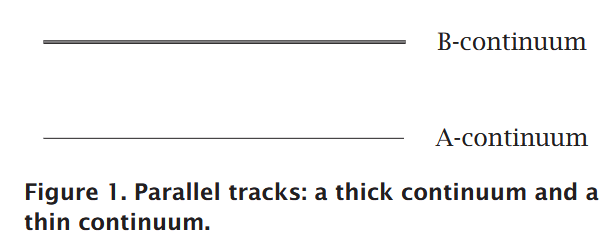
At variance with Granger's appraisal, some of the literature on the history of mathematics tends to assume that the A-approach is the ineluctably "true" one, while the infinitesimal B-approach was, at best, a kind of evolutionary dead-end or, at worst, altogether inconsistent. To say that infinitesimals provoked passions would be an understatement. Parkhurst and Kingsland, writing in The Monist, proposed applying a saline solution (if we may be allowed a pun) to the problem of the infinitesimal:
Since these two words infinity and infinitesimal have sown nearly as much faulty logic in the fields of mathematics and metaphysics as all other fields put together, they should be rooted out of both the fields which they have contaminated. And not only should they be rooted out, lest more errors be propagated by them: a due amount of salt should be ploughed under the infected territory, that the damage be mitigated as well as arrested (Parkhurst and Kingsland 1925 98, pp. 633--634) emphasis added--the authors.
与格朗热的判断不同,部分数学史文献默认路径 A 是唯一"正确"的路径,而无穷小路径 B 充其量是进化死胡同,甚至完全不相容。说无穷小引发激烈争议实属轻描淡写。帕克赫斯特与金斯兰在《一元论者》中提议用"盐溶液"(允许我们一语双关)解决无穷小问题:
"无穷"与"无穷小"这两个词在数学与形而上学领域播下的错误逻辑,几乎超过其他所有领域的总和,应当将它们从被污染的领域彻底根除;不仅要根除以避免更多谬误滋生,还应向受侵染的区域施加足量的"盐",以遏制并减轻损害(帕克赫斯特、金斯兰 1925 98,第 633--634 页)【作者强调】。
Writes P. Vickers:
P·维克斯写道:
So entrenched is the understanding that the early calculus was inconsistent that many authors don't provide a reference to support the claim, and don't present the set of inconsistent propositions they have in mind. (Vickers 2013 116, section 6.1)
Such an assumption of inconsistency can influence one's appreciation of historical mathematics, make a scholar myopic to certain significant developments due to their automatic placement in an "evolutionary dead-end" track, and inhibit potential fruitful applications in numerous fields ranging from physics to economics (see Herzberg 2013 55).
早期微积分不相容的观念根深蒂固,许多作者甚至不给出参考文献支撑该论断,也不明确列出他们所指的不相容命题组(维克斯 2013 116,第 6.1 节)。
这种"不相容"预设会扭曲对历史数学的理解,使学者因将某些重要成果归入"进化死胡同"而视而不见,还会阻碍其在物理、经济等诸多领域的潜在应用(参见赫茨贝格 2013 55)。
One example is the visionary work of Enriques exploiting infinitesimals, recently analyzed in an article by David Mumford, who wrote:
一个典型例子是恩里克斯利用无穷小的开创性工作,戴维·芒福德在近期文章中分析道:
In my own education, I had assumed that Enriques and the Italians were irrevocably stuck. . . As I see it now, Enriques must be credited with a nearly complete geometric proof using, as did Grothendieck, higher order infinitesimal deformations. . . Let's be careful: he certainly had the correct ideas about infinitesimal geometry, though he had no idea at all how to make precise definitions (Mumford 2011 95).
在我的学习经历中,我曾以为【恩里克斯与意大利学派】陷入了无法挽回的困境......如今我认为,恩里克斯与格罗滕迪克一样,借助高阶无穷小形变给出了近乎完整的几何证明......需要明确:他对无穷小几何的理解完全正确,只是不知如何给出严格定义(芒福德 2011 95)。
Another example is important work by Cauchy (see entry 2.8 below) on singular integrals and Fourier series using infinitesimals and infinitesimally defined "Dirac" delta functions (these precede Dirac by a century), which was forgotten for a number of decades because of shifting foundational biases. The presence of Dirac delta functions in Cauchy's oeuvre was noted in (Freudenthal 1971 41) and analyzed by Laugwitz (1989 80), (1992a 81); see also (Katz & Tall 2012 74) and (Tall & Katz 2013 114).
另一例是柯西的重要工作(见下文 2.8 节):他用无穷小与无穷小定义的"狄拉克"δ函数研究奇异积分与傅里叶级数(比狄拉克早一个世纪),却因基础立场的转向被遗忘数十年。弗罗伊登塔尔(1971 41)最早指出柯西著作中存在狄拉克δ函数,劳格维茨(1989 80、1992a 81)对此展开分析;另见卡茨与托尔(2012 74)、托尔与卡茨(2013 114)。
Recent papers on Leibniz (Katz & Sherry 73, 72; Sherry & Katz 107) argue that, contrary to widespread perceptions, Leibniz's system for infinitesimal calculus was not inconsistent (see entry 4.5 on mathematical rigor for a discussion of the term). The significance and coherence of Berkeley's critique of infinitesimal calculus have been routinely exaggerated. Berkeley's sarcastic tirades against infinitesimals fit well with the ontological limitations imposed by the A-approach favored by many historians, even though Berkeley's opposition, on empiricist grounds, to an infinitely divisible continuum is profoundly at odds with the A-approach.
关于莱布尼茨的近期论文(卡茨、谢里 73、72;谢里、卡茨 107)指出,与普遍看法相反,莱布尼茨的无穷小微积分体系并非不相容(术语解释见 4.5 节数学严格性)。贝克莱对无穷小演算批判的意义与逻辑一致性被长期夸大。贝克莱对无穷小的讽刺抨击,恰好契合许多史家推崇的路径 A 的本体论局限,尽管贝克莱基于经验主义反对连续统无限可分的立场,与路径 A 根本冲突。
A recent study of Fermat (Katz, Schaps & Shnider 2013 71) shows how the nature of his contribution to the calculus was distorted in recent Fermat scholarship, similarly due to an "evolutionary dead-end" bias (see entry 3.7).
关于费马的近期研究(卡茨、沙普斯、施奈德 2013 71)表明,近年费马研究对其微积分贡献的定性存在扭曲,同样源于"进化死胡同"偏见(见 3.7 节)。
The Marburg school of Hermann Cohen, Cassirer, Natorp, and others explored the philosophical foundations of the infinitesimal method underpinning the mathematized natural sciences. Their versatile, and insufficiently known, contribution is analyzed in (Mormann & Katz 2013 94).
A number of recent articles have pioneered a re-evaluation of the history and philosophy of mathematics, analyzing the shortcomings of received views, and shedding new light on the deleterious effect of the latter on the philosophy, the practice, and the applications of mathematics. Some of the conclusions of such a re-evaluation are presented below.
赫尔曼·柯亨、卡西尔、纳托尔普等马堡学派学者,探究了支撑数学化自然科学的无穷小方法的哲学基础。其丰富却鲜为人知的贡献见莫曼、卡茨(2013 94)。
近期多篇论文率先重新评估数学史与数学哲学,剖析主流观点的缺陷,揭示其对数学哲学、研究实践与应用的负面影响。下文呈现此类重估的部分结论。
2. Adequality to Chimeras
2. 从拟等式到幻造物
Some topics from the history of infinitesimals illustrating our approach appear below in alphabetical order.
下文按字母顺序列出无穷小史中若干体现本文研究思路的主题。
2.1. Adequality
2.1 拟等式
Adequality is a technique used by Fermat to solve problems of tangents, problems of maxima and minima, and other variational problems. The term adequality derives from the π α ρ ι σ ο ˊ τ η ς \pi\alpha\rho\iota\sigma\acute{\omicron}\tau\eta\varsigma παρισοˊτης of Diophantus (see entry 3.2). The technique involves an element of approximation and "smallness", represented by a small variation E E E, as in the familiar difference f ( A + E ) − f ( A ) f(A+E)-f(A) f(A+E)−f(A). Fermat used adequality in particular to find the tangents of transcendental curves like the cycloid, that were considered to be "mechanical" curves off-limits to geometry, by Descartes. Fermat also used it to solve the variational problem of the refraction of light so as to obtain Snell's law. Adequality incorporated a procedure of discarding higher-order terms in E E E (without setting them equal to zero). Such a heuristic procedure was ultimately formalized mathematically in terms of the standard part principle (entry 5.3) in A. Robinson's theory of infinitesimals starting with (Robinson 1961 101). Fermat's adequality is comparable to Leibniz's transcendental law of homogeneity; see entry 4.4 and 71.
拟等式是费马用于求解切线、极值与其他变分问题的方法。该术语源自丢番图的 π α ρ ι σ ο ˊ τ η ς \pi\alpha\rho\iota\sigma\acute{\omicron}\tau\eta\varsigma παρισοˊτης(近似相等,见 3.2 节)。该方法包含近似与"微小性"要素,用微小增量 E E E 表示,即常见的差商 f ( A + E ) − f ( A ) f(A+E)-f(A) f(A+E)−f(A)。费马尤其用拟等式求摆线等超越曲线的切线,此类曲线被笛卡尔视为"力学曲线"而排除在几何之外;他还借此解决光的折射变分问题,推导出斯涅尔定律。拟等式包含舍弃 E E E 的高阶项(不令其为零)的操作。这一启发式方法最终在鲁宾逊的无穷小理论中(鲁宾逊 1961 101),通过标准部分原理(5.3 节)得到严格数学形式化。费马的拟等式可与莱布尼茨的齐次性超越定律类比;见 4.4 节与 71。
2.2. Archimedean axiom
2.2 阿基米德公理
What is known today as the Archimedean axiom first appears in Euclid's Elements, Book V, as Definition 4 (Euclid 35, definition V.4). It is exploited in (Euclid 35, Proposition V.8). We include bracketed symbolic notation so as to clarify the definition:
Magnitudes a , b a, b a,b are said to have a ratio with respect to one another which, being multiplied n a n a na are capable of exceeding one another n a \> b n a\>b na\>b
It can be formalized as follows: 3 ^3 3
( ∀ a , b ) ( ∃ n ∈ N ) n a \> b , w h e r e n a = a + . . . + a ⏟ n t i m e s . (2.1) (\forall a, b)(\exists n \in \mathbb{N})n a\>b, where n a=\underbrace{a+...+a}_{n\; times}. \tag{2.1} (∀a,b)(∃n∈N)na\>b,wherena=ntimes a+...+a.(2.1)
今日所称的阿基米德公理最早见于欧几里得《原本》第五卷定义 4(欧几里得 35,定义 V.4),并用于命题 V.8(欧几里得 35)。为清晰起见,附上括号内的符号表示:
两个量 a , b a, b a,b 称为可公度,若其一经若干倍乘 n a n a na 后能超过另一量 n a \> b n a\>b na\>b。
其形式化表达如下: 3 ^3 3
( ∀ a , b ) ( ∃ n ∈ N ) n a \> b , 其中 n a = a + . . . + a ⏟ n 次 . (2.1) (\forall a, b)(\exists n \in \mathbb{N})n a\>b, 其中 n a=\underbrace{a+...+a}_{n\; 次}. \tag{2.1} (∀a,b)(∃n∈N)na\>b,其中na=n次 a+...+a.(2.1)
Next, it appears in the papers of Archimedes as the following lemma (see Archimedes 2, I, Lamb. 5):
随后,该公理以引理形式出现在阿基米德著作中(阿基米德 2,第一卷,引理 5):
Of unequal lines, unequal surfaces, and unequal solids a , b , c a, b, c a,b,c, the greater exceeds the lesser a \< b a\
对于不相等的线、面、体 a , b , c a, b, c a,b,c,较大量 a \< b a\
This can be formalized as follows:
其形式化表达如下:
( ∀ a , b , c ) ( ∃ n ∈ N ) a \< b → n ( b − a ) \> c . (2.2) (\forall a, b, c)(\exists n \in \mathbb{N})a\c. \tag{2.2} (∀a,b,c)(∃n∈N)a\
Note that Euclid's definition V.4 and the lemma of Archimedes are not logically equivalent (see entry 3.3, footnote 11).
注意:欧几里得定义 V.4 与阿基米德引理逻辑不等价(见 3.3 节脚注 11)。
The Archimedean axiom plays no role in the plane geometry as developed in Books I--IV of The Elements. 4 ^4 4 Interpreting geometry in ordered fields, or in geometry over fields for short, one knows that F 2 \mathbb{F}^{2} F2 is a model of Euclid's plane, where ( F , + , ⋅ , 0 , 1 , < ) (\mathbb{F},+, \cdot, 0,1,<) (F,+,⋅,0,1,<) is a Euclidean field, i.e., an ordered field closed under the square root operation. Consequently, R ∗ × R ∗ \mathbb{R}^{*} \times \mathbb{R}^{*} R∗×R∗ (where R ∗ \mathbb{R}^{*} R∗ is a hyperreal field) is a model of Euclid's plane, as well (see entry 4.6 on modern implementations). Euclid's definition V.4 is discussed in more detail in entry 3.3.
阿基米德公理在《原本》第一至四卷的平面几何中并未发挥作用。 4 ^4 4 若在有序域上解释几何(简称域上几何),则 F 2 \mathbb{F}^{2} F2 是欧氏平面的模型,其中 ( F , + , ⋅ , 0 , 1 , < ) (\mathbb{F},+, \cdot, 0,1,<) (F,+,⋅,0,1,<) 为欧几里得域,即对开方运算封闭的有序域。因此, R ∗ × R ∗ \mathbb{R}^{*} \times \mathbb{R}^{*} R∗×R∗( R ∗ \mathbb{R}^{*} R∗ 为超实数域)也是欧氏平面的模型(见 4.6 节现代实现)。3.3 节将更详细讨论欧几里得定义 V.4。
Otto Stolz rediscovered the Archimedean axiom for mathematicians, making it one of his axioms for magnitudes and giving it the following form: if a > b a>b a>b, then there is a multiple of b such that n b > a n b>a nb>a (Stolz 1885 113, p. 69). 5 ^5 5 At the same time, in his development of the integers Stolz implicitly used the Archimedean axiom. Stolz's visionary realisation of the importance of the Archimedean axiom, and his work on nonArchimedean systems, stand in sharp contrast with Cantor's remarks on infinitesimals (see entry 4.5 on mathematical rigor).
奥托·斯托尔兹重新向数学界揭示阿基米德公理,并将其作为量的公理之一,表述为:若 a > b a>b a>b,则存在 b b b 的倍量 n b n b nb 使得 n b > a n b>a nb>a(斯托尔兹 1885 113,第 69 页)。 5 ^5 5 同时,斯托尔兹在整数理论中隐含使用了该公理。斯托尔兹前瞻性地认识到阿基米德公理的重要性,并开展非阿基米德系统研究,与康托尔对无穷小的评论形成鲜明对比(见 4.5 节数学严格性)。
In modern mathematics, the theory of ordered fields employs the following form of the Archimedean axiom (see e.g., Hilbert 1899 56, p. 27):
现代数学中,有序域理论采用以下形式的阿基米德公理(例如希尔伯特 1899 56,第 27 页):
( ∀ x > 0 ) ( ∀ ϵ > 0 ) ( ∃ n ∈ N ) n ϵ \> x , (\forall x>0)(\forall \epsilon>0)(\exists n \in \mathbb{N})n \\epsilon\>x, (∀x>0)(∀ϵ>0)(∃n∈N)nϵ\>x,
or equivalently
或等价形式
( ∀ ϵ > 0 ) ( ∃ n ∈ N ) n ϵ \> 1 . (2.3) (\forall \epsilon>0)(\exists n\in \mathbb {N}) \quadn \\epsilon\>1. \tag{2.3} (∀ϵ>0)(∃n∈N)nϵ\>1.(2.3)
A number system satisfying (2.3) will be referred to as an Archimedean continuum. In the contrary case, there is an element ϵ > 0 \epsilon>0 ϵ>0 called an infinitesimal such that no finite sum ϵ + ϵ + . . . + ϵ \epsilon+\epsilon+...+\epsilon ϵ+ϵ+...+ϵ will ever reach 1; in other words,
A number system satisfying (2.4) is referred to as a Bernoullian continuum (i.e., a non-Archimedean continuum); see entry 2.5.
满足式 (2.3) 的数系称为阿基米德连续统 。反之,若存在 ϵ > 0 \epsilon>0 ϵ>0(称为无穷小 ),使得任意有限和 ϵ + ϵ + . . . + ϵ \epsilon+\epsilon+...+\epsilon ϵ+ϵ+...+ϵ 均无法达到 1,则该数系满足
称为伯努利连续统(即非阿基米德连续统);见 2.5 节。
2.3. Berkeley, George
2.3 乔治·贝克莱
George Berkeley (1685--1753) was a cleric whose empiricist (i.e., based on sensations, or sensationalist) metaphysics tolerated no conceptual innovations, like infinitesimals, without an empirical counterpart or referent. Berkeley was similarly opposed, on metaphysical grounds, to infinite divisibility of the continuum (which he referred to as extension), an idea widely taken for granted today. In addition to his outdated metaphysical criticism of the infinitesimal calculus of Newton and Leibniz, Berkeley also formulated a logical criticism. 6 ^6 6 Berkeley claimed to have detected a logical fallacy at the basis of the method. In terms of Fermat's E E E occuring in his adequality (entry 2.1), Berkeley's objection can be formulated as follows:
The increment E E E is assumed to be nonzero at the beginning of the calculation, but zero at its conclusion, an apparent logical fallacy.
However, E E E is not assumed to be zero at the end of the calculation, but rather is discarded at the end of the calculation (see entry 2.4 for more details). Such a technique was the content of Fermat's adequality (see entry 2.1) and Leibniz's transcendental law of homogeneity (see entry 4.4), where the relation of equality has to be suitably interpreted (see entry 5.2 on relation ≈ \approx ≈). The technique is closely related to taking the limit (of a typical expression such as f ( A + E ) − f ( A ) E \frac{f(A+E)-f(A)}{E} Ef(A+E)−f(A) for example) in Weierstrass's approach, and to taking the standard part (see entry 5.3) in Robinson's approach.
乔治·贝克莱(1685--1753)是一位神职人员,其经验主义(基于感知)形而上学不接受无经验对应物的概念创新,例如无穷小。贝克莱同样基于形而上学立场,反对连续统的无限可分性(他称之为广延),而这一观念在今日被普遍接受。除了对牛顿与莱布尼茨无穷小微积分的过时形而上学批判外,贝克莱还提出了逻辑批判 。 6 ^6 6 贝克莱宣称发现了该方法基础中的逻辑谬误。用费马拟等式中的增量 E E E(见 2.1 节)表述,贝克莱的质疑可概括为:
增量 E E E 在计算开始时被假定非零,在计算结束时又被视为零,这是明显的逻辑矛盾。
但事实上, E E E 在计算末尾并未被设为零,而是被舍弃 (详见 2.4 节)。这一操作正是费马拟等式(2.1 节)与莱布尼茨齐次性超越定律(4.4 节)的核心,其中等号需做恰当解释(见 5.2 节无限接近关系 ≈ \approx ≈)。该操作与魏尔斯特拉斯路径中取极限(如对 f ( A + E ) − f ( A ) E \frac{f(A+E)-f(A)}{E} Ef(A+E)−f(A) 取极限)、鲁宾逊路径中取标准部分(5.3 节)密切相关。
Meanwhile, Berkeley's own attempt to explain the calculation of the derivative of x 2 x^{2} x2 in The Analyst contains a logical circularity. Namely, Berkeley's argument relies on the determination of the tangents of a parabola by Apollonius (which is equivalent to the calculation of the derivative). This circularity in Berkeley's argument was analyzed in (Andersen 2011 1).
与此同时,贝克莱在《分析者》中自行解释 x 2 x^2 x2 导数的推导时,存在逻辑循环:其论证依赖于阿波罗尼奥斯对抛物线切线的求解(而这等价于导数计算)。贝克莱论证中的循环性见安德森(2011 1)。
2.4. Berkeley's logical criticism
2.4 贝克莱的逻辑批判
Berkeley's logical criticism of the calculus amounts to the contention that the evanescent increment is first assumed to be non-zero to set up an algebraic expression, and then treated as zero in discarding the terms that contained that increment when the increment is said to vanish. In modern terms, Berkeley was claiming that the calculus was based on an inconsistency of type
贝克莱对微积分的逻辑批判可概括为:消逝量在开头被假定非零以建立代数表达式,在末尾称其消逝并舍弃含该增量的项时又被视为零。用现代语言说,贝克莱认为微积分基于如下矛盾:
( d x ≠ 0 ) ∧ ( d x = 0 ) (d x \neq 0) \wedge (d x=0) (dx=0)∧(dx=0)
The criticism, however, involves a misunderstanding of Leibniz's method. The rebuttal of Berkeley's criticism is that the evanescent increment need not be "treated as zero", but, rather, is merely discarded through an application of the transcendental law of homogeneity by Leibniz, as illustrated in entry 5.1 in the case of the product rule.
但这一批判误解了莱布尼茨的方法。对贝克莱的反驳是:消逝增量并非"被视为零",而是通过莱布尼茨齐次性超越定律被舍弃,如 5.1 节乘积法则的例子所示。
While consistent (in the sense of level (2) of entry 4.5), Leibniz's system unquestionably relied on heuristic principles such as the laws of continuity and homogeneity, and thus fell short of a standard of rigor if measured by today's criteria (see entry 4.5 on mathematical rigor). On the other hand, the consistency and resilience of Leibniz's system is confirmed through the development of modern implementations of Leibniz's heuristic principles (see entry 4.6).
尽管莱布尼茨体系是相容的(按 4.5 节第 2 层意义),但它无疑依赖连续性、齐次性等启发式原理,以今日标准衡量严格性不足(见 4.5 节数学严格性)。另一方面,莱布尼茨启发式原理的现代实现(见 4.6 节),证实了其体系的相容性与稳健性。
2.5. Bernoulli, Johann
2.5 约翰·伯努利
Johann Bernoulli (1667--1747) was a disciple of Leibniz's who, having learned an infinitesimal methodology for the calculus from the master, never wavered from it. This is in contrast to Leibniz himself, who, throughout his career, used both
约翰·伯努利(1667--1747)是莱布尼茨的弟子,他从莱布尼茨处习得无穷小微积分方法后终身坚守。这与莱布尼茨本人形成对比:莱布尼茨在整个学术生涯中并行使用两种方法:
(A) an Archimedean methodology (proof by exhaustion), and
阿基米德方法(穷竭法证明);
(B) an infinitesimal methodology,
无穷小方法。
in a symbiotic fashion. Thus, Leibniz relied on the A-methodology to underwrite and justify the B-methodology, and he exploited the B-methodology to shorten the path to discovery (Ars Inveniendi). Historians often name Bernoulli as the first mathematician to have adhered systematically to the infinitesimal approach as the basis for the calculus. We refer to an infinitesimal-enriched number system as a B-continuum, as opposed to an Archimedean A-continuum, i.e., a continuum satisfying the Archimedean axiom (see entry 2.2).
莱布尼茨用方法 A 为方法 B 奠基与辩护,用方法 B 简化发现路径(发明术)。史家通常将伯努利视为首位系统以无穷小方法作为微积分基础 的数学家。我们将包含无穷小的数系称为B-连续统 ,以区别于满足阿基米德公理的A-连续统(见 2.2 节)。
2.6. Bishop, Errett
2.6 埃雷特·毕晓普
Errett Bishop (1928--1983) was a mathematical constructivist who, unlike his fellow intuitionist 7 ^7 7 Arend Heyting (see entry 3.8), held a dim view of classical mathematics in general and Robinson's infinitesimals in particular. Discouraged by the apparent non-constructivity of his early work in functional analysis (notably 10), he believed to have found the culprit in the law of excluded middle (LEM), the key logical ingredient in every proof by contradiction. He spent the remaining 18 years of his life in an effort to expunge the reliance on LEM (which he dubbed "the principle of omniscience" in 12) from analysis, and sought to define meaning itself in mathematics in terms of such LEM-extirpation.
埃雷特·毕晓普(1928--1983)是数学构造主义者。与同为直觉主义者 7 ^7 7的阿伦·海廷不同(见 3.8 节),他对经典数学整体、尤其对鲁宾逊的无穷小持否定态度。早期泛函分析工作的非构造性(尤其 10)令他不满,他认为排中律是根源------反证法的核心逻辑工具。他余生 18 年致力于从分析中剔除排中律(他在 12 中称之为"全知原理"),并试图以剔除排中律的方式定义数学的意义。
Accordingly, he described classical mathematics as both a debasement of meaning (Bishop 1973 14, p. 1) and sawdust (Bishop 1973 14, p. 14), and did not hesitate to speak of both crisis (Bishop 1975 12) and schizophrenia (Bishop 1973 14) in contemporary mathematics, predicting an imminent demise of classical mathematics in the following terms:
Very possibly classical mathematics will cease to exist as an independent discipline (Bishop 1968 11, p. 54).
据此,他将经典数学称为"意义的堕落"(毕晓普 1973 14,第 1 页)与"木屑"(毕晓普 1973 14,第 14 页),直言当代数学存在"危机"(毕晓普 1975 12)与"精神分裂"(毕晓普 1973 14),并预言经典数学即将消亡:
经典数学极有可能不再作为独立学科存在(毕晓普 1968 11,第 54 页)。
His attack in (Bishop 1977 13) on calculus pedagogy based on Robinson's infinitesimals was a natural outgrowth of his general opposition to the logical underpinnings of classical mathematics, as analyzed in (Katz & Katz 2011 68). Robinson formulated a brief but penetrating appraisal of Bishop's ventures into the history and philosophy of mathematics as follows:
The sections of Bishop's book that attempt to describe the philosophical and historical background of the remarkable endeavor of Intuitionism are more vigorous than accurate and tend to belittle or ignore the efforts of others who have worked in the same general direction (Robinson 1968 102, p. 921).
See entry 2.9 for a related criticism by Alain Connes.
他在(毕晓普 1977 13)中对基于鲁宾逊无穷小的微积分教学的攻击,是其反对经典数学逻辑基础的自然结果,分析见卡茨、卡茨(2011 68)。鲁宾逊对毕晓普涉足数学史与数学哲学的工作给出简短而犀利的评价:
毕晓普书中试图描述直觉主义哲学与历史背景的部分,言辞激烈而失准,贬低或忽视了同方向其他学者的工作(鲁宾逊 1968 102,第 921 页)。
阿兰·孔涅的相关批判见 2.9 节。
2.7. Cantor, Georg
2.7 格奥尔格·康托尔
Georg Cantor (1845--1918) is familiar to the modern reader as the underappreciated creator of the "Cantorian paradise" which David Hilbert would not be expelled out of, as well as the tragic hero, allegedly persecuted by Kronecker, who ended his days in a lunatic asylum. Cantor historian J. Dauben notes, however, an underappreciated aspect of Cantor's scientific activity, namely his principled persecution of infinitesimalists:
格奥尔格·康托尔(1845--1918)为现代读者熟知的形象是:被低估的"康托尔乐园"缔造者(戴维·希尔伯特称无人能将我们从此乐园驱逐),以及被克罗内克迫害、最终在精神病院离世的悲剧英雄。然而,康托尔研究者 J·道本指出其学术活动中易被忽视的一面:他有组织地打压无穷小研究者:
Cantor devoted some of his most vituperative correspondence, as well as a portion of the Beiträge, to attacking what he described at one point as the 'infinitesimal Cholera bacillus of mathematics', which had spread from Germany through the work of Thomae, du Bois Reymond and Stolz, to infect Italian mathematics . . . Any acceptance of infinitesimals necessarily meant that his own theory of number was incomplete. Thus to accept the work of Thomae, du Bois-Reymond, Stolz and Veronese was to deny the perfection of Cantor's own creation. Understandably, Cantor launched a thorough campaign to discredit Veronese's work in every way possible (Dauben 1980 28, pp. 216--217).
A discussion of Cantor's flawed investigation of the Archimedean axiom (see entry 2.2) may be found in entry 4.5 on mathematical rigor. 8 ^8 8
康托尔在其措辞最刻薄的通信与《基础文集》部分章节中,攻击无穷小为"数学中的霍乱杆菌",称其经托马、杜·波依斯·雷蒙德、斯托尔兹的工作从德国蔓延,侵染意大利数学......承认无穷小的存在,必然意味着他的数论不完备。因此,接受托马、杜·波依斯·雷蒙德、斯托尔兹与韦罗内塞的工作,等于否定康托尔理论的完备性。不难理解,康托尔发起全面运动,极尽所能诋毁韦罗内塞的工作(道本 1980 28,第 216--217 页)。
康托尔对阿基米德公理的错误研究见 4.5 节数学严格性。 8 ^8 8
2.8. Cauchy, Augustin-Louis
2.8 奥古斯丁-路易·柯西
Augustin-Louis Cauchy (1789--1857) is often viewed in the history of mathematics literature as a precursor of Weierstrass. Note, however, that contrary to a common misconception, Cauchy never gave an ϵ , δ \epsilon, \delta ϵ,δ definition of either limit or continuity (see entry 5.4 on variable quantity for Cauchy's definition of limit). Rather, his approach to continuity was via what is known today as microcontinuity al. 15; Borovik & Katz 17; Bråting 21; Katz & Katz 67, 69; Katz & Tall 74; Tall & Katz 114), have argued that a proto-Weierstrassian reading of Cauchy is one-sided and obscures Cauchy's important contributions, including not only his infinitesimal definition of continuity but also such innovations as his infinitesimally defined ("Dirac") delta function, with applications in Fourier analysis and evaluation of singular integrals, and his study of orders of growth of infinitesimals that anticipated the work of Paul du Bois-Reymond, Borel, Hardy, and ultimately Skolem (109, 110, 111) and Robinson.
奥古斯丁-路易·柯西(1789--1857)在数学史文献中常被视为魏尔斯特拉斯的先驱。但需纠正普遍误解:柯西从未给出极限或连续性的 ϵ , δ \boldsymbol{\epsilon,\delta} ϵ,δ 定义 (柯西的极限定义见 5.4 节变量)。相反,他的连续性定义基于今日所称的微连续性。多项研究(布拉什奇克等 15;博罗维克、卡茨 17;布拉廷 21;卡茨、卡茨 67、69;卡茨、托尔 74;托尔、卡茨 114)指出,将柯西解读为前魏尔斯特拉斯主义是片面的,掩盖了其重要贡献:不仅包括基于无穷小的连续性定义,还包括无穷小定义的"狄拉克"δ函数(应用于傅里叶分析与奇异积分),以及对无穷小阶的研究------该工作预见了杜·波依斯·雷蒙德、博雷尔、哈代,最终斯科勒姆(109、110、111)与鲁宾逊的工作。
To elaborate on Cauchy's "Dirac" delta function, note the following formula from (Cauchy 1827 24, p. 188) in terms of an infinitesimal α \alpha α:
关于柯西"狄拉克"δ函数的具体形式,见柯西(1827 24,第 188 页)以无穷小 α \alpha α 表示的公式:
1 2 ∫ a − ϵ a + ϵ F ( μ ) α d μ α 2 + ( μ − a ) 2 = π 2 F ( a ) . \frac{1}{2} \int_{a-\epsilon}^{a+\epsilon} F(\mu) \frac{\alpha d \mu}{\alpha^{2}+(\mu-a)^{2}}=\frac{\pi}{2} F(a). 21∫a−ϵa+ϵF(μ)α2+(μ−a)2αdμ=2πF(a).
Replacing Cauchy's expression α α 2 + ( μ − a ) 2 \frac{\alpha}{\alpha^{2}+(\mu-a)^{2}} α2+(μ−a)2α by δ a ( μ ) \delta_{a}(\mu) δa(μ), one obtains Dirac's formula up to trivial modifications (see Dirac 31, p. 59):
将柯西表达式 α α 2 + ( μ − a ) 2 \frac{\alpha}{\alpha^{2}+(\mu-a)^{2}} α2+(μ−a)2α 替换为 δ a ( μ ) \delta_{a}(\mu) δa(μ),经平凡调整即得狄拉克公式(见狄拉克 31,第 59 页):
∫ − ∞ ∞ f ( x ) δ ( x ) = f ( 0 ) . \int_{-\infty}^{\infty} f(x) \delta(x)=f(0). ∫−∞∞f(x)δ(x)=f(0).
Cauchy's 1853 paper on a notion closely related to uniform convergence was recently examined in (Katz & Katz 2011 (67)) and (Blaszczyk et al. 2012 15). Cauchy handles the said notion using infinitesimals, including one generated by the null sequence ( 1 n ) (\frac{1}{n}) (n1)
柯西 1853 年关于一致收敛相关概念的论文,近期由卡茨、卡茨(2011 67)与布拉什奇克等(2012 15)重新考察。柯西用无穷小处理该概念 ,包括由零序列 ( 1 n ) (\frac{1}{n}) (n1) 生成的无穷小。
Meanwhile, Núñez et al. (1999 97, p. 54) coined the term 'Cauchy--Weierstrass definition of continuity'. Since Cauchy gave an infinitesimal definition and Weierstrass, an δ \delta δ one, such a coinage is an oxymoron. J. Gray (2008a 46, p. 62) lists continuity among concepts Cauchy allegedly defined using 'limiting arguments', but Gray unfortunately confuses the term 'limit' as bound with 'limit' as in variable tending to a quantity, since the term 'limits' appear in Cauchy's definition only in the sense of endpoints (bounds) of an interval. Not to be outdone, Kline (1980 78, p. 273) claims that "Cauchy's work not only banished infinitesimals but disposed of any need for them." Hawking (2007 49, p. 639) does reproduce Cauchy's infinitesimal definition, yet on the same page 639 claims that Cauchy "was particularly concerned to banish infinitesimals," apparently unaware of a comical non-sequitur he committed.
努涅斯等(1999 97,第 54 页)创造"柯西--魏尔斯特拉斯连续性定义"一词。然而柯西用无穷小定义,魏尔斯特拉斯用 ϵ , δ \epsilon,\delta ϵ,δ 定义,该术语本身矛盾。J·格雷(2008a 46,第 62 页)将连续性列为柯西用"极限论证"定义的概念,但他混淆了作为"边界"的 limit 与作为"变量趋近"的极限:柯西定义中的 limits 仅指区间端点(边界)。克莱因(1980 78,第 273 页)声称"柯西的工作不仅摒弃了无穷小,还消除了对它的需求"。霍金(2007 49,第 639 页)虽转录了柯西的无穷小定义,却在同一页称柯西"致力于摒弃无穷小",显然未意识到自己的荒谬矛盾。
2.9. Chimeras
2.9 幻造物
Alain Connes (1947--) formulated criticisms of Robinson's infinitesimals between the years 1995 and 2007, on at least seven separate occasions (see Kanovei et al. (2012) 62, Section 3.1, Table 1). These range from pejorative epithets such as "inadequate", "disappointing", "chimera", and "irremediable defect", to "the end of the rope for being 'explicit' ".
阿兰·孔涅(1947--)在 1995 至 2007 年间至少七次批判鲁宾逊的无穷小(见卡诺维奇等 2012 62,第 3.1 节,表 1)。批判言辞从贬损性称谓("不恰当""令人失望""幻造物""无可救药的缺陷")到"'显明性'走到尽头"。
Connes sought to exploit the Solovay model S S S (Solovay 1970 112) as ammunition against non-standard analysis, but the model tends to boomerang, undercutting Connes' own earlier work in functional analysis. Connes described the hyperreals as both a "virtual theory" and a "chimera", yet acknowledged that his argument relies on the transfer principle (see entry 4.6). In S S S, all definable sets of reals are Lebesgue measurable, suggesting that Connes views a theory as being "virtual" if it is not definable in a suitable model of ZFC. If so, Connes' claim that a theory of the hyperreals is "virtual" is refuted by the existence of a definable model of the hyperreal field (Kanovei & Shelah 64). Free ultrafilters aren't definable, yet Connes exploited such ultrafilters both in his own earlier work on the classification of factors in the 1970s and 80s, and in his magnum opus Noncommutative Geometry (Connes 1994 27, ch. V, sect. 6. δ \\delta δ, Def. 11), raising the question whether the latter may not be vulnerable to Connes' criticism of virtuality. The article 62 analyzed the philosophical underpinnings of Connes' argument based on Gödel's incompleteness theorem, and detected an apparent circularity in Connes' logic. The article 62 also documented the reliance on non-constructive foundational material, and specifically on the Dixmier trace f f f (featured on the front cover of Connes' magnum opus) and the Hahn--Banach theorem, in Connes' own framework; see also 70.
孔涅试图用索洛维模型 S S S(索洛维 1970 112)攻击非标准分析,但该模型反而反噬,削弱其早期泛函分析工作。孔涅将超实数称为"虚拟理论"与"幻造物",却承认其论证依赖转移原理 (见 4.6 节)。在模型 S S S 中,所有可定义实数集均勒贝格可测,这表明孔涅认为:若一个理论不能在合适的 ZFC 模型中定义,则是"虚拟的"。若如此,超实数域可定义模型 的存在性(卡诺维奇、谢拉赫 64)已反驳孔涅的论断。自由超滤不可定义,但孔涅在 1970--80 年代因子分类工作与巨著《非交换几何》(孔涅 1994 27,第五章,第 6.δ 节,定义 11)中均使用此类超滤,这使其理论同样面临"虚拟性"指责。文献 62 分析了孔涅基于哥德尔不完备定理的论证哲学基础,发现其逻辑存在明显循环。该文还记录了孔涅自身框架对非构造性基础工具的依赖,尤其对迪西埃迹 (其著作封面标识)与哈恩--巴拿赫定理的依赖;另见 70。
3. Continuity to indivisibles
3. 从连续性到不可分量
3.1. Continuity
3.1 连续性
Of the two main definitions of continuity of a function, Definition A (see below) is operative in either a B-continuum or an A-continuum (satisfying the Archimedean axiom; see entry 2.2), while Definition B only works in a B-continuum (i.e., an infinitesimal-enriched or Bernoullian continuum; see entry 2.5).
Definition A ( ϵ , δ \epsilon, \delta ϵ,δ approach): A real function f f f is continuous at a real point x x x if and only if
函数连续性有两种主流定义:定义 A(见下文)在 A-连续统(满足阿基米德公理,见 2.2 节)与 B-连续统中均成立;定义 B 仅在 B-连续统(即含无穷小的伯努利连续统,见 2.5 节)中成立。
定义 A( ϵ , δ \epsilon,\delta ϵ,δ 方法):实函数 f f f 在实点 x x x 连续当且仅当
( ∀ ϵ > 0 ) ( ∃ δ > 0 ) ( ∀ x ′ ) ∣ x − x ′ ∣ \< δ → ∣ f ( x ) − f ( x ′ ) ∣ \< ϵ . (\forall \epsilon>0)(\exists \delta>0)\left(\forall x'\right)\left\\left\|x-x'\\right\|\<\\delta \\to\\left\|f(x)-f\\left(x'\\right)\\right\|\<\\epsilon\\right. (∀ϵ>0)(∃δ>0)(∀x′)∣x−x′∣\<δ→∣f(x)−f(x′)∣\<ϵ.
Definition B (microcontinuity): A real function f f f is continuous at a real point x x x if and only if
定义 B(微连续性):实函数 f f f 在实点 x x x 连续当且仅当
( ∀ x ′ ) x ′ ≈ x → f ( x ′ ) ≈ f ( x ) . (3.1) \left(\forall x'\right)\leftx' \\approx x \\to f\\left(x'\\right) \\approx f(x)\\right. \tag{3.1} (∀x′)x′≈x→f(x′)≈f(x).(3.1)
In formula (3.1), the natural extension of f f f is still denoted f f f, and the symbol " ≈ \approx ≈" stands for the relation of being infinitely close; thus, x ′ ≈ x x' \approx x x′≈x if and only if x ′ − x x'-x x′−x is infinitesimal (see entry 5.2 on relation " ≈ \approx ≈").
式 (3.1) 中, f f f 的自然扩张仍记为 f f f;符号" ≈ \approx ≈"表示无限接近关系 : x ′ ≈ x x' \approx x x′≈x 当且仅当 x ′ − x x'-x x′−x 为无穷小(见 5.2 节无限接近关系 ≈ \approx ≈)。
3.2. Diophantus
3.2 丢番图
Diophantus of Alexandria (who lived about 1800 years ago) contributed indirectly to the development of infinitesimal calculus through the technique called π α ρ ι σ ο ˊ τ η ς \pi\alpha\rho\iota\sigma\acute{\omicron}\tau\eta\varsigma παρισοˊτης, developed in his work Arithmetica, Book Five, problems 12, 14, and 17. The term π α ρ ι σ ο ˊ τ η ς \pi\alpha\rho\iota\sigma\acute{\omicron}\tau\eta\varsigma παρισοˊτης can be literally translated as "approximate equality". This was rendered as adaequalitas in Bachet's Latin translation 4, and adégalité in French (see entry 2.1 on adequality). The term was used by Fermat to describe the comparison of values of an algebraic expression, or what would today be called a function f f f, at nearby points A A A and A + E A+E A+E, and to seek extrema by a technique that would be re-formulated today in terms of the vanishing of f ( A + E ) − f ( A ) E \frac{f(A+E)-f(A)}{E} Ef(A+E)−f(A) after discarding the remaining E E E-terms; see (Katz, Schaps & Shnider 2013 71).
亚历山大的丢番图(约 1800 年前)通过其《算术》第五卷问题 12、14、17 中提出的 π α ρ ι σ ο ˊ τ η ς \pi\alpha\rho\iota\sigma\acute{\omicron}\tau\eta\varsigma παρισοˊτης 方法,间接推动了无穷小微积分的发展。该术语字面意为"近似相等",在巴谢的拉丁文译本 4 中译为 adaequalitas,法文为 adégalité(见 2.1 节拟等式)。费马用该术语描述代数表达式(今日称为函数 f f f)在邻近点 A A A 与 A + E A+E A+E 处的取值比较,并通过舍弃剩余 E E E 项后令 f ( A + E ) − f ( A ) E \frac{f(A+E)-f(A)}{E} Ef(A+E)−f(A) 为零的方法求极值;见卡茨、沙普斯、施奈德(2013 71)。
3.3. Euclid's definition V.4
3.3 欧几里得《原本》第五卷定义 4
Euclid's definition V.4 was already mentioned in entry 2.2. In addition to Book V, it appears in Books X and XII and is used in the method of exhaustion (see Euclid 35, Propositions X.1, XII.2). The method of exhaustion was exploited intensively by both Archimedes and Leibniz (see entry 4.2 on Leibniz's work De Quadratura). It was revived in the 19th century in the theory of the Riemann integral.
欧几里得定义 V.4 已在 2.2 节提及。除第五卷外,该定义还出现在第十卷与第十二卷,并用于穷竭法(见欧几里得 35,命题 X.1、XII.2)。穷竭法被阿基米德与莱布尼茨广泛使用(见 4.2 节莱布尼茨《论算术求积》),并在 19 世纪重生于黎曼积分理论。
Euclid's Book V sets the basis for the theory of similar figures developed in Book VI. Great mathematicians of the 17th century like Descartes, Leibniz, and Newton exploited Euclid's theory of similar figures of Book VI while paying no attention to its axiomatic background. 9 ^9 9 Over time Euclid's Book V became a subject of interest for historians and editors alone.
欧几里得第五卷为第六卷相似形理论奠基。17 世纪笛卡尔、莱布尼茨、牛顿等大数学家使用第六卷相似形理论,却无视其公理基础。 9 ^9 9 久而久之,第五卷仅成为史家与校勘者的研究对象。
To formalize Definition V.4, one needed a formula for Euclid's notion of "multiple" and an idea of total order. Some progress in this direction was made by Robert Simson in 1762. 10 ^{10} 10 In 1876, Hermann Hankel provided a modern reconstruction of Book V. Combining his own historical studies with an idea of order compatible with addition developed by Hermann Grassmann (1861 45), he gave a formula that to this day is accepted as a formalisation of Euclid's definition of proportion in V.5 (Hankel 1876 50, pp. 389--398).
为形式化定义 V.4,需要严格表达欧几里得的"倍量"概念与全序思想。罗伯特·辛普森在 1762 年对此有所推进。 10 ^{10} 10 1876 年,赫尔曼·汉克尔对第五卷给出现代重构:结合自身史学研究与赫尔曼·格拉斯曼(1861 45)提出的加法相容序思想,给出至今仍被认可的欧几里得 V.5 比例定义形式化(汉克尔 1876 50,第 389--398 页)。
Euclid's proportion is a relation among four "magnitudes", such as
欧几里得的比例是四个"量"之间的关系,形如
Λ ( n A = m B → n C = m D ) Λ ( n A < 1 m B → n C < 2 m D ) ] , \left.\Lambda(n A=m B \to n C=m D) \Lambda\left(n A<{1} m B \to n C<{2} m D\right)\right], Λ(nA=mB→nC=mD)Λ(nA<1mB→nC<2mD)],
It was interpreted by Hankel as the relation where n n n, m m m are natural numbers. The indices on the inequalities emphasize the fact that the "magnitudes" A A A, B B B have to be of "the same kind", e.g., line segments, whereas C C C, D D D could be of another kind, e.g., triangles.
汉克尔将其解释为: n , m n,m n,m 为自然数;不等式下标强调量 A , B A,B A,B 必须"同类"(如线段),而 C , D C,D C,D 可为另一类(如三角形)。
In 1880, J. L. Heiberg in his edition of Archimedes' Opera omnia, in a comment on a lemma of Archimedes, cites Euclid's definition V.4, noting that these two are the same axioms (Heiberg 1880 53, p. 11). 11 ^{11} 11
1880 年,J·L·海伯格在其编订的《阿基米德全集》中,评注阿基米德引理时引用欧几里得定义 V.4,称二者为同一公理(海伯格 1880 53,第 11 页)。 11 ^{11} 11
This is the reason why Euclid's definition V.4 is commonly known as the Archimedean axiom. Today we formalize Euclid's definition V.4 as in (2.1), while the Archimedean lemma is rendered by formula (2.2).
这就是欧几里得定义 V.4 通常被称为阿基米德公理的原因。今日我们将欧几里得定义 V.4 形式化为式 (2.1),阿基米德引理形式化为式 (2.2)。
3.4. Euler, Leonhard
3.4 莱昂哈德·欧拉
Euler's Introductio in Analysin Infinitorum (1748 36) contains remarkable calculations carried out in an extended number system in which the basic algebraic operations are applied to infinitely small and infinitely large quantities. Thus, in Chapter 7, "Exponentials and Logarithms Expressed through Series", we find a derivation of the power series for a z a^{z} az starting from the formula a ω = 1 + k ω a^{\omega}=1+k \omega aω=1+kω, for ω \omega ω infinitely small and then raising the equation to the infinitely great power 12 ^{12} 12 j = z ω j=\frac{z}{\omega} j=ωz for a finite (appreciable) z z z to give
欧拉《无穷分析引论》(1748 36)包含在扩张数系 中完成的精彩计算:基本代数运算直接应用于无穷小与无穷大量。例如在第 7 章"指数与对数的级数表示"中,他从无穷小 ω \omega ω 满足 a ω = 1 + k ω a^{\omega}=1+k \omega aω=1+kω 出发,对有限(可观)量 z z z,将等式取无穷大幂次 12 ^{12} 12 j = z ω j=\frac{z}{\omega} j=ωz,得
a z = a j ω = ( 1 + k ω ) j a^{z}=a^{j \omega}=(1+k \omega)^{j} az=ajω=(1+kω)j
and finally expanding the right hand side as a power series by means of the binomial formula.
最终用二项式公式将右端展开为幂级数。
In the chapters following Euler finds infinite product expansions factoring the power series expansion for transcendental functions (see entry 3.5 for his infinite product formula for sine). By Chapter 10, he has the tools to sum the series for ζ ( 2 ) \zeta(2) ζ(2) where ζ ( s ) = ∑ n n − s \zeta(s)=\sum_{n} n^{-s} ζ(s)=∑nn−s. He explicitly calculates ζ ( 2 k ) \zeta(2 k) ζ(2k) for k = 1 , . . . , 13 k=1, ..., 13 k=1,...,13 as well as many other related infinite series.
在后续章节中,欧拉得到超越函数幂级数的无穷乘积展开(正弦无穷乘积公式见 3.5 节)。到第 10 章,他已掌握求和 ζ ( 2 ) \zeta(2) ζ(2) 的工具,其中 ζ ( s ) = ∑ n n − s \zeta(s)=\sum_{n} n^{-s} ζ(s)=∑nn−s。他显式计算了 k = 1 , ... , 13 k=1,\dots,13 k=1,...,13 时的 ζ ( 2 k ) \zeta(2k) ζ(2k) 以及众多相关无穷级数。
In Chapter 3 of his Institutiones Calculi Differentialis (1755 38), Euler deals with the methodology of the calculus, such as the nature of infinitesimal and infinitely large quantities. We will cite the English translation 39 of the Latin original 38. Here Euler writes that
even if someone denies that infinite numbers really exist in this world, still in mathematical speculations there arise questions to which answers cannot be given unless we admit an infinite number (ibid., § 82) emphasis added--the authors.
在《微分学原理》(1755 38)第 3 章中,欧拉阐述微积分方法论,包括无穷小与无穷大量的本性。此处引用拉丁文原著 38 的英译本 39:
即便有人否认无穷数在现实世界中真实存在,在数学研究中仍会出现唯有承认无穷数才能解答的问题(同上,第 82 节)【作者强调】。
Euler's approach, countenancing the possibility of denying that "infinite numbers really exist", is consonant with a Leibnizian view of infinitesimal and infinite quantities as "useful fictions" (see Katz & Sherry 73; Sherry & Katz 107). Euler then notes that "an infinitely small quantity is nothing but a vanishing quantity, and so it is really equal to 0" (ibid., § 83). The "equality" in question is an arithmetic one (see below).
欧拉的方法允许否认"无穷数真实存在",这与莱布尼茨将无穷小与无穷大视为"有用虚构"的观点一致(见卡茨、谢里 73;谢里、卡茨 107)。欧拉随后指出:"无穷小量不过是消逝量,因此它实则等于 0"(同上,第 83 节)。此处的"相等"是算术意义上的(见下文)。
Similarly, Leibniz combined a view of infinitesimals as "useful fictions" and inassignable quantities, with a generalized notion of "equality" which was an equality up to an incomparably negligible term. Leibniz sought to codify this idea in terms of his transcendental law of homogeneity (TLH); see entry 4.4. Thus, Euler's formulas like
同样,莱布尼茨将无穷小视为"有用虚构"与不可 assignable 量 ,并结合广义"相等"概念------差为不可比拟的可忽略项。莱布尼茨试图用齐次性超越定律(TLH) 系统化这一思想;见 4.4 节。因此,欧拉的公式
a + d x = a (3.2) a+d x=a \tag{3.2} a+dx=a(3.2)
(where a a a "is any finite quantity"; ibid., 86, 87) are consonant with a Leibnizian tradition (cf. formula (4.1) in entry 4.4).
(其中 a a a 为"任意有限量";同上,第 86、87 节)与莱布尼茨传统一致(参见 4.4 节公式 (4.1))。
To explain formulas like (3.2), Euler elaborated two distinct ways (arithmetic and geometric) of comparing quantities in the following terms:
为解释式 (3.2) 这类公式,欧拉详细区分了两种量的比较方式(算术比较与几何比较):
Since we are going to show that an infinitely small quantity is really zero, we must meet the objection of why we do not always use the same symbol 0 for infinitely small quantities, rather than some special ones. . . Since we have two ways to compare them, either arithmetic or geometric, let us look at the quotients of quantities to be compared in order to see the difference.
既然要证明无穷小量实则为零,就必须回应质疑:为何不用统一符号 0 表示无穷小,而用特殊符号......因为我们有两种比较方式:算术比较与几何比较。通过考察被比较量的商,可看清二者区别。
If we accept the notation used in the analysis of the infinite, then d x d x dx indicates a quantity that is infinitely small, so that both d x = 0 d x=0 dx=0 and a d x = 0 a d x=0 adx=0, where a a a is any finite quantity. Despite this, the geometric ratio a d x : d x a d x: d x adx:dx is finite, namely a : 1 a: 1 a:1. For this reason, these two infinitely small quantities, d x d x dx and a d x a d x adx, both being equal to 0, cannot be confused when we consider their ratio. In a similar way, we will deal with infinitely small quantities d x d x dx and d y d y dy (ibid., 86, p. 51--52) emphasis added--the authors.
若接受无穷分析的记号,则 d x d x dx 表示无穷小量,故 d x = 0 d x=0 dx=0 且 a d x = 0 a d x=0 adx=0( a a a 为任意有限量)。尽管如此,几何比 a d x : d x a d x: d x adx:dx 是有限的,即 a : 1 a:1 a:1。因此,这两个同为零的无穷小量 d x d x dx 与 a d x a d x adx,在考虑比值时不可混淆。同理处理无穷小量 d x d x dx 与 d y d y dy(同上,第 86 节,第 51--52 页)【作者强调】。
Euler proceeds to clarify the difference between the arithmetic and geometric comparisons as follows:
欧拉进一步澄清算术比较与几何比较的区别:
Let a a a be a finite quantity and let d x dx dx be infinitely small. The arithmetic ratio of equals is clear: Since n d x = 0 n dx=0 ndx=0, we have
设 a a a 为有限量, d x dx dx 为无穷小量。相等量的算术比 显而易见:由于 n d x = 0 n dx=0 ndx=0,故有
a ± n d x = a a \pm n dx = a a±ndx=a
On the other hand, the geometric ratio is clearly of equals, since
另一方面,相等量的几何比 同样显然成立,因为
a ± n d x a = 1. (3.3) \frac{a \pm n dx}{a}=1. \tag{3.3} aa±ndx=1.(3.3)
From this we obtain the well-known rule that the infinitely small vanishes in comparison with the finite and hence can be neglected (Euler 1755 39, §87) emphasis in the original--the authors.
由此我们得到熟知的法则:无穷小量与有限量相比可完全忽略(欧拉 1755 39, §87)【原文强调】。
Like Leibniz, Euler considers more than one way of comparing quantities. Euler's formula (3.3) indicates that his geometric comparison is procedurally identical with the Leibnizian TLH. Namely, Euler's geometric comparision of a pair of quantities amounts to their ratio being infinitely close to 1; the same is true for TLH. Thus, one has a + d x = a a+dx=a a+dx=a in this sense for an appreciable a ≠ 0 a \neq 0 a=0, but not d x = 0 dx=0 dx=0 (which is true only arithmetically in Euler's sense). Euler's "geometric" comparison was dubbed "the principle of cancellation" in (Ferraro 2004 40, p. 47).
与莱布尼茨一样,欧拉采用多种方式比较量。欧拉公式 (3.3) 表明,他的几何比较 在操作上与莱布尼茨齐次性超越定律(TLH)完全一致。具体来说,欧拉对两个量的几何比较等价于它们的比值无限接近 1;TLH 亦是如此。因此,对非零有限量 a a a,在该意义下有 a + d x = a a+dx=a a+dx=a,但并非 d x = 0 dx=0 dx=0(后者仅在欧拉的算术意义下成立)。欧拉的"几何比较"在费拉罗(2004 40, p. 47)中被称为消去原理。
Euler proceeds to present the usual rules of infinitesimal calculus, which go back to Leibniz, L'Hôpital, and the Bernoullis, such as
欧拉继而给出无穷小微积分的常规运算法则,这些法则可追溯至莱布尼茨、洛必达与伯努利家族,例如
a d x m + b d x n = a d x m (3.4) a\, dx^{m}+b\, dx^{n}=a\, dx^{m} \tag{3.4} adxm+bdxn=adxm(3.4)
provided m < n m<n m<n "since d x n dx^{n} dxn vanishes compared with d x m dx^{m} dxm" (ibid., §89), relying on his "geometric" equality. Euler introduces a distinction between infinitesimals of different order, and directly computes 13 ^{13} 13 a ratio of the form
其中要求 m < n m<n m<n,"因为 d x n dx^{n} dxn 相比于 d x m dx^{m} dxm 可忽略"(同上 §89),这依赖于他的"几何相等"。欧拉区分了不同阶的无穷小 ,并直接计算 13 ^{13} 13 如下形式的比值
d x ± d x 2 d x = 1 ± d x = 1 \frac{dx \pm dx^{2}}{dx}=1 \pm dx=1 dxdx±dx2=1±dx=1
of two particular infinitesimals, assigning the value 1 to it (ibid., §88). Euler concludes:
将其值定为 1(同上 §88)。欧拉总结道:
Although all of them infinitely small quantities are equal to 0, still they must be carefully distinguished one from the other if we are to pay attention to their mutual relationships, which has been explained through a geometric ratio (ibid., §89).
尽管所有无穷小量都等于 0,但如果要关注它们通过几何比所表达的相互关系,就必须仔细加以区分(同上 §89)。
The Eulerian hierarchy of orders of infinitesimals harks back to Leibniz's work (see entry 4.7 on Nieuwentijt for a historical dissenting view). The remarkable lucidity of Euler's procedures for dealing with infinitesimals has unfortunately not been appreciated by all commentators. Thus, J. Gray interrupts his biography of Euler by suddenly declaring: "At some point it should be admitted that Euler's attempts at explaining the foundations of calculus in terms of differentials, which are and are not zero, are dreadfully weak" (Gray 2008b 47, p. 6) but provides no evidence whatsoever for his dubious claim.
欧拉的无穷小阶次体系可追溯至莱布尼茨的工作(历史上的反对观点见 4.7 节尼乌文泰特)。遗憾的是,并非所有评注者都能理解欧拉处理无穷小的清晰思路。例如 J. Gray 在欧拉传记中突然断言:"必须承认,欧拉试图用既是零又不是零的微分阐释微积分基础的做法非常薄弱"(Gray 2008b 47, p. 6),却未给出任何证据。
3.5. Euler's infinite product formula for sine
3.5. 欧拉的正弦无穷乘积公式
The fruitfulness of Euler's infinitesimal approach can be illustrated by some of the remarkable applications he obtained. Thus, Euler derived an infinite product decomposition for the sine and sinh functions of the following form:
欧拉无穷小方法的丰硕成果可由其精彩应用体现。他给出正弦与双曲正弦函数的无穷乘积分解:
sinh x = x ( 1 + x 2 π 2 ) ( 1 + x 2 4 π 2 ) ( 1 + x 2 9 π 2 ) ( 1 + x 2 16 π 2 ) ... (3.5) \sinh x = x\left( 1+{\frac {x^{2}}{\pi ^{2}}}\right) \left( 1+{\frac {x^{2}}{4\pi ^{2}}}\right) \left( 1+{\frac {x^{2}}{9\pi ^{2}}}\right) \left( 1+{\frac {x^{2}}{16\pi ^{2}}}\right) \dots \tag{3.5} sinhx=x(1+π2x2)(1+4π2x2)(1+9π2x2)(1+16π2x2)...(3.5)
sin x = x ( 1 − x 2 π 2 ) ( 1 − x 2 4 π 2 ) ( 1 − x 2 9 π 2 ) ( 1 − x 2 16 π 2 ) ... (3.6) \sin x=x\left(1-\frac{x^{2}}{\pi^{2}}\right)\left(1-\frac{x^{2}}{4 \pi^{2}}\right)\left(1-\frac{x^{2}}{9 \pi^{2}}\right)\left(1-\frac{x^{2}}{16 \pi^{2}}\right) \dots \tag{3.6} sinx=x(1−π2x2)(1−4π2x2)(1−9π2x2)(1−16π2x2)...(3.6)
Decomposition (3.6) generalizes an infinite product formula for π 2 \frac{\pi}{2} 2π due to Wallis 117. Euler also summed the inverse square series: 1 + 1 4 + 1 9 + 1 16 + ⋯ = π 2 6 1+\frac{1}{4}+\frac{1}{9}+\frac{1}{16}+\dots=\frac{\pi^{2}}{6} 1+41+91+161+⋯=6π2 (see 92) and obtained additional identities. A common feature of these formulas is that Euler's computations involve not only infinitesimals but also infinitely large natural numbers, which Euler sometimes treats as if they were ordinary natural numbers. 14 ^{14} 14 Similarly, Euler treats infinite series as polynomials of a specific infinite degree.
分解式 (3.6) 推广了沃利斯 117 关于 π 2 \frac{\pi}{2} 2π 的无穷乘积公式。欧拉还求出了倒数平方和: 1 + 1 4 + 1 9 + 1 16 + ⋯ = π 2 6 1+\frac{1}{4}+\frac{1}{9}+\frac{1}{16}+\dots=\frac{\pi^{2}}{6} 1+41+91+161+⋯=6π2(见 92),并得到更多恒等式。这些公式的共同特点是:欧拉的计算既用到无穷小,也用到无穷大自然数 ,他有时将其当作普通自然数处理 14 ^{14} 14。同样,欧拉将无穷级数视为某个无穷次多项式。
The derivation of (3.5) and (3.6) in (Euler 1748 36, § 156) can be broken up into seven steps as follows.
欧拉在《无穷分析引论》(1748 36, §156)中对 (3.5)(3.6) 的推导可分为以下七步。
Step 1. Euler observes that
步骤 1. 欧拉指出
2 sinh x = e x − e − x = ( 1 + x j ) j − ( 1 − x j ) j , ( 3.7 ) 2 \sinh x=e^{x}-e^{-x}=\left(1+\frac{x}{j}\right)^{j}-\left(1-\frac{x}{j}\right)^{j}, \quad(3.7) 2sinhx=ex−e−x=(1+jx)j−(1−jx)j,(3.7)
where j j j (or " i i i" in Euler 36) is an infinitely large natural number. To motivate the next step, note that the expression x j − 1 = ( x − 1 ) ( 1 + x + x 2 + ⋯ + x j − 1 ) x^{j}-1=(x-1) (1+x+x^{2}+\dots+x^{j-1}) xj−1=(x−1)(1+x+x2+⋯+xj−1) can be factored further as ∏ k = 0 j − 1 ( x − ζ k ) \prod_{k=0}^{j-1}(x-\zeta^{k}) ∏k=0j−1(x−ζk), where ζ = e 2 π i / j \zeta=e^{2 \pi i / j} ζ=e2πi/j; conjugate factors can then be combined to yield a decomposition into real quadratic terms as below.
其中 j j j(欧拉原文用 i i i)是无穷大自然数 。为启发下一步,注意 x j − 1 = ( x − 1 ) ( 1 + x + ⋯ + x j − 1 ) x^{j}-1=(x-1)(1+x+\dots+x^{j-1}) xj−1=(x−1)(1+x+⋯+xj−1) 可进一步分解为 ∏ k = 0 j − 1 ( x − ζ k ) \prod_{k=0}^{j-1}(x-\zeta^{k}) ∏k=0j−1(x−ζk),其中 ζ = e 2 π i / j \zeta=e^{2 \pi i / j} ζ=e2πi/j;共轭因子可合并为实二次因式,如下。
Step 2. Euler uses the fact that a j − b j a^{j}-b^{j} aj−bj is the product of the factors
步骤 2. 欧拉利用 a j − b j a^{j}-b^{j} aj−bj 可分解为下列因子的乘积
a 2 + b 2 − 2 a b cos 2 k π j , w h e r e k ≥ 1 , (3.8) a^{2}+b^{2}-2 a b \cos \frac{2 k \pi}{j}, where k \geq 1,\tag{3.8} a2+b2−2abcosj2kπ,wherek≥1,(3.8)
together with the factor a − b a-b a−b and, if j j j is an even number, the factor a + b a+b a+b, as well.
再加上因子 a − b a-b a−b;若 j j j 为偶数,再加上 a + b a+b a+b。
Step 3. Setting a = 1 + x j a=1+\frac{x}{j} a=1+jx and b = 1 − x j b=1-\frac{x}{j} b=1−jx in (3.7), Euler transforms expression (3.8) into the form
步骤 3. 在 (3.7) 中令 a = 1 + x j a=1+\frac{x}{j} a=1+jx, b = 1 − x j b=1-\frac{x}{j} b=1−jx,欧拉将 (3.8) 化为
2 + 2 x 2 j 2 − 2 ( 1 − x 2 j 2 ) cos 2 k π j . (3.9) 2+2 \frac{x^{2}}{j^{2}}-2\left(1-\frac{x^{2}}{j^{2}}\right) \cos \frac{2 k \pi}{j}. \tag{3.9} 2+2j2x2−2(1−j2x2)cosj2kπ.(3.9)
Step 4. Euler then replaces (3.9) by the expression
步骤 4. 欧拉将 (3.9) 替换为
4 k 2 π 2 j 2 ( 1 + x 2 k 2 π 2 − x 2 j 2 ) , (3.10) \frac{4 k^{2} \pi^{2}}{j^{2}}\left(1+\frac{x^{2}}{k^{2} \pi^{2}}-\frac{x^{2}}{j^{2}}\right), \tag{3.10} j24k2π2(1+k2π2x2−j2x2),(3.10)
justifying this step by means of the formula
其依据是公式
cos 2 k π j = 1 − 2 k 2 π 2 j 2 . (3.11) \cos \frac{2 k \pi}{j}=1-\frac{2 k^{2} \pi^{2}}{j^{2}}. \tag{3.11} cosj2kπ=1−j22k2π2.(3.11)
Step 5. Next, Euler argues that the difference e x − e − x e^{x}-e^{-x} ex−e−x is divisible by the expression
步骤 5. 欧拉接着指出, e x − e − x e^{x}-e^{-x} ex−e−x 可被 (3.10) 中的式子
1 + x 2 k 2 π 2 − x 2 j 2 1+\frac{x^{2}}{k^{2} \pi^{2}}-\frac{x^{2}}{j^{2}} 1+k2π2x2−j2x2
from (3.10), where "we omit the term x 2 j 2 \frac{x^{2}}{j^{2}} j2x2 since even when multiplied by j j j, it remains infinitely small" (English translation from 37).
整除,"我们略去项 x 2 j 2 \frac{x^{2}}{j^{2}} j2x2,因为即便乘以 j j j,它依然是无穷小"(英译 37)。
Step 6. As there is still a factor of a − b = 2 x / j a-b=2 x / j a−b=2x/j, Euler obtains the final equality (3.5), arguing that then "the resulting first term will be x x x" (in order to conform to the Maclaurin series for sinh x \sinh x sinhx).
步骤 6. 由于仍有因子 a − b = 2 x / j a-b=2 x / j a−b=2x/j,欧拉得到最终等式 (3.5),并说明"所得首项为 x x x"(以匹配 sinh x \sinh x sinhx 的麦克劳林级数)。
Step 7. Finally, formula (3.6) is obtained from (3.5) by means of the substitution x ↦ i x x \mapsto i x x↦ix
□
步骤 7. 最后,在 (3.5) 中做代换 x ↦ i x x \mapsto i x x↦ix,即得公式 (3.6)。
□
3.6. Euler's sine factorisation formalized
Euler's argument in favor of (3.5) and (3.6) was formalized in terms of a "nonstandard" proof in (Luxemburg 1973 88). However, the formalisation in 88 deviates from Euler's argument beginning with steps 3 and 4, and thus circumvents the most problematic steps 5 and 6.
3.6. 欧拉正弦因式分解的形式化
欧拉对 (3.5)(3.6) 的论证在 Luxemburg(1973 88)中被给出非标准证明形式化。但该文从步骤 3、4 开始就偏离欧拉原文,从而绕过了最有争议的步骤 5、6。
A proof in the framework of modern nonstandard analysis, formalizing Euler's argument step-by-step throughout, appeared in (Kanovei 1988 61); see also (McKinzie & Tuckey 1997 92) and (Kanovei & Reeken 2004 63, Section 2.4a). This formalisation interprets problematic details of Euler's argument on the basis of general principles of modern nonstandard analysis, as well as general analytic facts that were known in Euler's time. Such principles and facts behind some early proofs in infinitesimal calculus are sometimes referred to as "hidden lemmas" in this context; see (Laugwitz 79, 80), (McKinzie & Tuckey 1997 92).
卡诺维奇(1988 61)给出了完全逐步复刻欧拉论证的现代非标准分析证明;另见 McKinzie & Tuckey(1997 92)与卡诺维奇、里肯(2004 63, 2.4a 节)。该形式化基于现代非标准分析的一般原理与欧拉时代已知的解析事实,解释了欧拉论证中看似可疑的细节。早期无穷小证明背后的这类原理与事实常被称为**"隐蔽引理"**;见劳格维茨 7980、麦金齐与塔基(1997 92)。
For instance, the "hidden lemma" behind Step 4 above is the fact that for a fixed x x x, the terms of the Maclaurin expansion of cos x \cos x cosx tend to 0 faster than a convergent geometric series, allowing one to infer that the effect of the transformation of step 4 on the product of the factors (3.9) is infinitesimal. Some "hidden lemmas" of a different kind, related to basic principles of nonstandard analysis, are discussed in 92, pp 43ff..
例如,步骤 4 背后的"隐蔽引理"是:对固定 x x x, cos x \cos x cosx 的麦克劳林展开项趋于 0 的速度快于收敛几何级数,由此可推出步骤 4 的变换对 (3.9) 乘积的影响是无穷小。另一类与非标准分析基本原理相关的隐蔽引理见 92, pp 43ff.。
What clearly stands out from Euler's argument is his explicit use of infinitesimal expressions such as (3.9) and (3.10), as well as the approximate formula (3.11) which holds "up to" an infinitesimal of higher order. Thus, Euler used infinitesimals par excellence, rather than merely ratios thereof, in a routine fashion in some of his best work.
欧拉论证最突出的一点是:他直接使用无穷小表达式(如 (3.9)(3.10))与近似公式 (3.11),该公式在"差为高阶无穷小"的意义下成立。因此,欧拉在其代表作中常规性地、真正地使用无穷小本身,而非仅仅使用无穷小的比值。
Euler's use of infinite integers and their associated infinite products (such as the decomposition of the sine function) were interpreted in Robinson's framework in terms of hyperfinite sets. Thus, Euler's product of j j j-infinitely many factors in (3.6) is interpreted as a hyperfinite product in 63, formula (9), p. 74. A hyperfinite formalisation of Euler's argument involving infinite integers and their associated products illustrates the successful remodeling of the arguments (and not merely the results) of classical infinitesimal mathematics, as discussed in entry 4.5.
欧拉对无穷整数及其相伴无穷乘积(如正弦分解)的使用,在鲁宾逊框架中被解释为超有限集 。例如,(3.6) 中 j j j 个无穷多因子的乘积在 63, 公式 (9), p.74 中被解释为超有限乘积 。对欧拉含无穷整数与无穷乘积论证的超有限形式化,成功重构了经典无穷小数学的证明过程(而非仅仅结果),如 4.5 节所论。
3.7. Fermat, Pierre
3.7. 皮埃尔·德·费马
Pierre de Fermat (1601--1665) developed a pioneering technique known as adequality (see entry 2.1) for finding tangents to curves and for solving problems of maxima and minima. (Katz, Schaps & Shnider 2013 71) analyze some of the main approaches in the literature to the method of adequality, as well as its source in the π α ρ ι σ ο ˊ τ η ς \pi\alpha\rho\iota\sigma\acute{\omicron}\tau\eta\varsigma παρισοˊτης of Diophantus (see entry 3.2). At least some of the manifestations of adequality, such as Fermat's treatment of transcendental curves and Snell's law, amount to variational techniques exploiting a small (alternatively, infinitesimal) variation E E E. Fermat's treatment of geometric and physical applications suggests that an aspect of approximation is inherent in adequality, as well as an aspect of smallness on the part of E E E.
皮埃尔·德·费马(1601--1665)创立了名为拟等式(adequality)的开创性方法,用于求曲线切线与极值问题(见 2.1 节)。卡茨、沙普斯、施奈德(2013 71)分析了文献中对拟等式方法的主要解读,及其源自丢番图 π α ρ ι σ ο ˊ τ η ς \pi\alpha\rho\iota\sigma\acute{\omicron}\tau\eta\varsigma παρισοˊτης 的思想源头(见 3.2 节)。至少在部分应用中(如费马对超越曲线与斯涅尔定律的处理),拟等式等价于利用微小(或无穷小)增量 E E E 的变分方法 。费马对几何与物理问题的应用表明,近似性与 E E E 的微小性是拟等式的固有属性。
Fermat's use of the term adequality relied on Bachet's rendering of Diophantus. Diophantus coined the term parisotes for mathematical purposes. Bachet performed a semantic calque in passing from parisoō to ad-aequo. A historically significant parallel is found in the similar role of, respectively, adequality and the transcendental law of homogeneity (see entry 4.4) in the work of, respectively, Fermat and Leibniz on the problems of maxima and minima.
费马所用术语"拟等式"承袭自巴谢对丢番图的译法。丢番图为数学目的创造了 parisotes 一词。巴谢做了语义仿译,将 parisoō 译为 ad-aequo。一个具有历史意义的对应是:拟等式与齐次性超越定律(见 4.4 节)分别在费马与莱布尼茨的极值问题研究中扮演相似角色。
Breger (1994 22) denies that the idea of "smallness" was relied upon by Fermat. However, a detailed analysis (see 71) of Fermat's treatment of the cycloid reveals that Fermat did rely on issues of "smallness" in his treatment of the cycloid, and reveals that Breger's interpretation thereof contains both mathematical errors and errors of textual analysis. Similarly, Fermat's proof of Snell's law, a variational principle, unmistakably relies on ideas of "smallness".
布雷格(1994 22)否认费马依赖"微小性"观念。但对费马摆线研究的详细分析(见 71)表明,费马明确依赖微小性;且布雷格的解读同时包含数学错误与文本解读错误。同理,费马对变分原理斯涅尔定律的证明,也无可辩驳地依赖微小性观念。
Cifoletti (1990 26) finds similarities between Fermat's adequality and some procedures used in smooth infinitesimal analysis of Lawvere and others. Meanwhile, (J. Bell 2009 9) seeks the historical sources of Lawvere's infinitesimals mainly in Nieuwentijt (see entry 4.7).
乔弗莱蒂(1990 26)发现费马拟等式与劳韦尔等人的光滑无穷小分析中的某些操作相似。而贝尔(2009 9)则将劳韦尔无穷小的历史源头主要归于尼乌文泰特(见 4.7 节)。
3.8. Heyting, Arend
3.8. 阿伦·海廷
Arend Heyting (1898--1980) was a mathematical Intuitionist whose lasting contribution was the formalisation of the Intuitionistic logic underpinning the Intuitionism of his teacher Brouwer. While Heyting never worked on any theory of infinitesimals, he had several opportunities to present an expert opinion on Robinson's theory. Thus, in 1961, Robinson made public his new idea of non-standard models for analysis, and "communicated this almost immediately to . . . Heyting" (see Dauben 29, p. 259). Robinson's first paper on the subject was subsequently published in Proceedings of the Netherlands Royal Academy of Sciences 101. Heyting praised nonstandard analysis as "a standard model of important mathematical research" (Heyting 1973 54, p. 136).
阿伦·海廷(1898--1980)是数学直觉主义者,其持久贡献是形式化直觉主义逻辑,为其老师布劳威尔的直觉主义奠基。尽管海廷从未研究过任何无穷小理论,但他多次对鲁宾逊的理论发表专家意见。1961 年,鲁宾逊公开分析的非标准模型新思想,并"几乎立刻将此告知......海廷"(道本 29, p.259)。鲁宾逊首篇相关论文随后发表于《荷兰皇家科学院院刊》101。海廷称赞非标准分析是"重要数学研究的典范"(海廷 1973 54, p.136)。
Addressing Robinson, he declared:
you connected this extremely abstract part of model theory with a theory apparently so far apart as the elementary calculus. In doing so you threw new light on the history of the calculus by giving a clear sense to Leibniz's notion of infinitesimals (ibid).
Intuitionist Heyting's admiration for the application of Robinson's infinitesimals to calculus pedagogy is in stark contrast with the views of his fellow constructivist E. Bishop (entry 2.6).
他对鲁宾逊说道:
你将模型论这一极为抽象的领域,与初等微积分这一看似遥远的理论联系起来。通过为莱布尼茨的无穷小概念赋予清晰意义,你为微积分史带来了全新解读(同上)。
直觉主义者海廷对鲁宾逊无穷小应用于微积分教学的赞赏,与同为构造主义者的 E. 毕晓普(见 2.6 节)的观点形成鲜明对比。
3.9. Indivisibles versus Infinitesimals
3.9. 不可分量与无穷小
Commentators use the term infinitesimal to refer to a variety of conceptions of the infinitely small, but the variety is not always acknowledged. It is important to distinguish the infinitesimal methods of Archimedes and Cavalieri from those employed by Leibniz and his successors. To emphasize this distinction, we will say that tradition prior to Leibniz employed indivisibles. For example, in his heuristic proof that the area of a parabolic segment is 4/3 the area of the inscribed triangle with the same base and vertex, Archimedes imagines both figures to consist of perpendiculars of various heights erected on the base. The perpendiculars are indivisibles in the sense that they are limits of division and so one dimension less than the area. In the same sense, the indivisibles of which a line consists are points, and the indivisibles of which a solid consists are planes.
评注者用"无穷小"一词指代多种"无限小"概念,但这种多样性常被忽视。必须区分阿基米德、卡瓦列里的无穷小方法 与莱布尼茨及其后继者的方法 。为强调这一区别,我们称莱布尼茨之前的传统使用不可分量(indivisibles) 。例如,阿基米德在抛物线弓形面积为同底同顶内接三角形 4/3 的启发式证明中,将两个图形视为由底边上不同高度的垂线构成。这些垂线是不可分量 :它们是分割的极限,比面积低一维。同理,直线的不可分量是点,立体的不可分量是平面。
Leibniz's infinitesimals are not indivisibles, for they have the same dimension as the figures they form. Thus, he treats curves as composed of infinitesimal line intervals rather than indivisible points. The strategy of treating infinitesimals as dimensionally homogeneous with the objects they compose seems to have originated with Roberval or Torricelli, Cavalieri's student, and to have been explicitly arithmetized in (Wallis 1656 117).
莱布尼茨的无穷小不是不可分量 ,因为它们与所构成图形同维。例如,他将曲线视为由无穷小线段构成,而非不可分点。将无穷小处理为与对象同维的思想,似乎起源于罗贝瓦尔或卡瓦列里的学生托里拆利,并由沃利斯(1656 117)明确算术化。
Zeno's paradox of extension admits of resolution in the framework of Leibnizian infinitesimals (see entry 5.5). Furthermore, only with the dimensionality retained is it possible to make sense of the fundamental theorem of calculus, where one must think about the rate of change of the area under a curve, another reason why indivisibles had to be abandoned in favor of infinitesimals so as to enable the development of the calculus (see Ely 2012 34).
芝诺广延悖论在莱布尼茨式无穷小框架下可被解决(见 5.5 节)。此外,只有保留维数,才能理解微积分基本定理------必须考虑曲线下面积的变化率。这也是不可分量必须被无穷小取代、以支撑微积分发展的另一原因(见伊利 2012 34)。
4. Leibniz to Nieuwentijt
4. 从莱布尼茨到尼乌文泰特
4.1. Leibniz, Gottfried
4.1 戈特弗里德·莱布尼茨
Gottfried Wilhelm Leibniz (1646--1716), the co-inventor of infinitesimal calculus, is a key player in the parallel infinitesimal track referred to by Felix Klein 77, p. 214 (see Section 1).
Leibniz's law of continuity (see entry 4.3) together with his transcendental law of homogeneity (which he already discussed in his response to Nieuwentijt in 1695 as noted by M. Parmentier 85, p. 38, and later in greater detail in a 1710 article 84 cited in the seminal study of Leibnizian methodology by H. Bos 18) form a basis for implementing the calculus in the context of a B-continuum.
戈特弗里德·威廉·莱布尼茨(1646--1716),无穷小微积分的共同发明者,是菲利克斯·克莱因 77, p. 214 所指的无穷小并行路径 的核心人物(见第 1 节)。
莱布尼茨的连续性定律 (见 4.3 节)与齐次性超越定律(1695 年回应尼乌文泰特时已提及,见帕芒蒂埃 85, p. 38,后在 1710 年文章 84 中详细阐述,博斯对莱布尼茨方法论的奠基性研究 18 曾引用),共同构成在 B-连续统下构建微积分的基础。
Many historians of the calculus deny significant continuity between infinitesimal calculus of the 17th century and 20th century developments such as Robinson's theory. Robinson's hyperreals require the resources of modern logic; thus many commentators are comfortable denying a historical continuity. A notable exception is Robinson himself, whose identification with the Leibnizian tradition inspired Lakatos, Laugwitz, and others to consider the history of the infinitesimal in a more favorable light. Many historians have overestimated the force of Berkeley's criticisms (see entry 2.3), by underestimating the mathematical and philosophical resources available to Leibniz.
许多微积分史家否认 17 世纪无穷小微积分与 20 世纪鲁宾逊理论等成果之间存在重要连续性。鲁宾逊的超实数依赖现代逻辑工具,因此许多评注者乐于否定历史延续性。一个显著的例外是鲁宾逊本人,他对莱布尼茨传统的认同,激励了拉卡托斯、劳格维茨等人以更积极的视角重审无穷小历史。许多史家高估了贝克莱批判的效力(见 2.3 节),同时低估了莱布尼茨所掌握的数学与哲学工具。
Leibniz's infinitesimals are fictions, not logical fictions, as (Ishiguro 1990 59) proposed, but rather pure fictions, like imaginaries, which are not eliminable by some syncategorematic paraphrase; see (Sherry & Katz 2013 107) and entry 4.2 below.
In fact, Leibniz's defense of infinitesimals is more firmly grounded than Berkeley's criticism thereof. Moreover, Leibniz's system for differential calculus was free of logical fallacies (see entry 2.4). This strengthens the conception of modern infinitesimals as a formalisation of Leibniz's strategy of relating inassignable to assignable quantities by means of his transcendental law of homogeneity (see entry 4.4).
莱布尼茨的无穷小是虚构 ,但并非石黑俊夫(1990 59)所主张的逻辑虚构,而是如同虚数那样的纯粹虚构 ,无法通过范畴伴生效用的转述消除;见谢里与卡茨(2013 107)及下文 4.2 节。
事实上,莱布尼茨对无穷小的辩护比贝克莱的批判更为坚实。此外,莱布尼茨的微分学体系不存在逻辑谬误(见 2.4 节)。这进一步支持现代无穷小是对莱布尼茨思路的形式化:通过齐次性超越定律将不可 assignable 量与可 assignable 量联系起来(见 4.4 节)。
4.2. Leibniz's De Quadratura
4.2 莱布尼茨《论算术求积》
In 1675 Leibniz wrote a treatise on his infinitesimal methods, On the Arithmetical Quadrature of the Circle, the Ellipse, and the Hyperbola , or De Quadratura, as it is widely known. However, the treatise appeared in print only in 1993 in a text edited by Knobloch (Leibniz 86).
1675 年,莱布尼茨写下关于无穷小方法的专著《论圆、椭圆与双曲线的算术求积》,即广为人知的《论算术求积》。但该书直到 1993 年才由克诺布洛赫编辑出版(莱布尼茨 86)。
De Quadratura was interpreted by R. Arthur 3 and others as supporting the thesis that Leibniz's infinitesimals are mere shortcuts, eliminable by long-winded paraphrase. This so-called syncategorematic interpretation of Leibniz's calculus has gained a number of adherents. We believe this interpretation to be in error. In the first place, Leibniz wrote the treatise at a time when infinitesimals were despised by the French Academy, a society whose approval and acceptance he eagerly sought. More importantly, as (Jesseph 2013 60) has shown, De Quadratura depends on infinitesimal resources in order to construct an approximation to a given curvilinear area less than any previously specified error.
R. 阿瑟 3 等人将《论算术求积》解读为支持如下论点:莱布尼茨的无穷小只是简化工具 ,可通过冗长转述完全消去。这种对莱布尼茨微积分的范畴伴生解读 拥有不少支持者。我们认为这一解读是错误的。首先,莱布尼茨写作此书时,无穷小正被法国科学院鄙夷,而他迫切希望获得该院认可。更重要的是,杰西普(2013 60)表明,《论算术求积》必须依赖无穷小工具,才能构造出误差小于任意给定值的曲边面积近似。
This problem is reminiscent of the difficulty that led to infinitesimal methods in the first place. Archimedes' method of exhaustion required one to determine a value for the quadrature in advance of showing, by reductio argument, that any departure from that value entails a contradiction. Archimedes possessed a heuristic, indivisible method for finding such values, and the results were justified by exhaustion, but only after the fact. By the same token, the use of infinitesimals is 'just' a shortcut only if it is entirely eliminable from quadratures, tangent constructions, etc. Jesseph's insight is that this is not the case.
这一问题正是当初催生无穷小方法的核心困难。阿基米德穷竭法要求先确定求积值,再用归谬法证明偏离该值必导致矛盾。阿基米德拥有启发式的不可分量方法寻找该值,再用穷竭法事后验证。同理,只有当无穷小在求积、切线构造等操作中完全可消去时,才能说它"只是简化工具"。杰西普的洞见正在于:它并不可消去。
Finally, the syncategorematic interpretation misrepresents a crucial aspect of Leibniz's mathematical philosophy. His conception of mathematical fiction includes imaginary numbers, and he often sought approbation for his infinitesimals by comparing them to imaginaries, which were largely uncontroversial. There is no suggestion by Leibniz that imaginaries are eliminable by long-winded paraphrase. Rather, he praises imaginaries for their capacity to achieve universal harmony by the greatest possible systematisation, and this characteristic is more central to Leibniz's conception of infinitesimals than the idea that they are mere shorthand.
最后,范畴伴生解读歪曲了莱布尼茨数学哲学的关键面向。他的数学虚构概念包含虚数,他常将无穷小与争议较小的虚数类比以争取认可。莱布尼茨从未主张虚数可被冗长转述消去。相反,他称赞虚数能以最大系统化实现普遍和谐,而这一特征对他的无穷小观念而言,比"只是简写"更为核心。
4.3. Lex continuitatis
4.3 连续性定律
A heuristic principle called The law of continuity (LC) was formulated by Leibniz and is a key to appreciating Leibniz's vision of infinitesimal calculus. The LC asserts that whatever succeeds in the finite, succeeds also in the infinite. This form of the principle appeared in a letter to Varignon (Leibniz 1702 83). A more detailed form of LC in terms of the concept of terminus appeared in his text Cum Prodiisset :
莱布尼茨提出的**连续性定律(LC)**是理解其无穷小微积分思想的关键启发原理。该定律断言:在有限中成立者,在无穷中亦成立。这一形式见于致瓦里尼翁的信(莱布尼茨 1702 83)。以"极限(terminus)"概念表述的更详细版本见于其著作《既已进展》:
In any supposed continuous transition, ending in any terminus, it is permissible to institute a general reasoning, in which the final terminus may also be included (Leibniz 1701 82, p. 40)
To elaborate, the LC postulates that whatever properties are satisfied by ordinary or assignable quantities, should also be satisfied by inassignable quantities (see entry 5.4) such as infinitesimals (see Figure 2). Thus, the trigonometric formula sin 2 x + cos 2 x = 1 \sin^2 x+\cos^2 x=1 sin2x+cos2x=1 should be satisfied for an inassignable (e.g., infinitesimal) input x x x, as well. In the 20th century this heuristic principle was formalized as the transfer principle .
在任何假定的连续过渡中,若以某极限为终点,则可建立一般推理,将最终极限包含在内(莱布尼茨 1701 82, p. 40)。
具体来说,连续性定律假定:普通可 assignable 量满足的一切性质,无穷小等不可 assignable 量亦应满足 (见图 2,见 5.4 节)。例如,三角公式 sin 2 x + cos 2 x = 1 \sin^2 x+\cos^2 x=1 sin2x+cos2x=1 对不可 assignable 量(如无穷小) x x x 同样成立。这一启发原理在 20 世纪被形式化为转移原理。
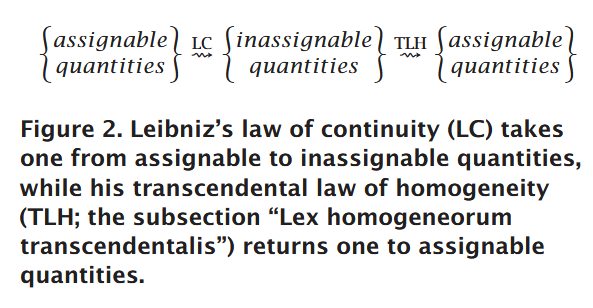
Figure 2. Leibniz's law of continuity (LC) takes one from assignable to inassignable quantities, while his transcendental law of homogeneity (TLH; entry 4.4) returns one to assignable quantities.
图 2. 莱布尼茨连续性定律(LC)从可 assignable 量通向不可 assignable 量,齐次性超越定律(TLH,4.4 节)则返回可 assignable 量。
The significance of LC can be illustrated by the fact that a failure to take note of the law of continuity often led scholars astray. Thus, Nieuwentijt (see entry 4.7) was led into something of a dead-end with his nilpotent infinitesimals (ruled out by LC) of the form 1 ∞ \frac{1}{\infty} ∞1. J. Bell's view of Nieuwentijt's approach as a precursor of nilsquare infinitesimals of Lawvere (see Bell 2009 9) is plausible, though it could be noted that Lawvere's nilsquare infinitesimals cannot be of the form 1 ∞ \frac{1}{\infty} ∞1.
忽视连续性定律常使学者误入歧途,这足以体现其重要性。例如,尼乌文泰特(见 4.7 节)提出形如 1 ∞ \frac{1}{\infty} ∞1 的幂零无穷小(被连续性定律排除),走入死胡同。贝尔将尼乌文泰特的方法视为劳韦尔幂零平方无穷小的前身(贝尔 2009 9)有一定道理,但需注意劳韦尔的幂零无穷小不能形如 1 ∞ \frac{1}{\infty} ∞1。
4.4. Lex homogeneorum transcendentalis
4.4 齐次性超越定律
Leibniz's transcendental law of homogeneity, or lex homogeneorum transcendentalis in the original Latin (Leibniz 1710 84), governs equations involving differentials. Leibniz historian H. Bos interprets it as follows:
莱布尼茨的齐次性超越定律 (拉丁文原名 lex homogeneorum transcendentalis,莱布尼茨 1710 84)支配含微分的等式。莱布尼茨研究专家 H. 博斯解释如下:
A quantity which is infinitely small with respect to another quantity can be neglected if compared with that quantity. Thus all terms in an equation except those of the highest order of infinity, or the lowest order of infinite smallness, can be discarded. For instance,
相对于某量为无穷小的量,与该量比较时可忽略。因此等式中除最高阶无穷大项或最低阶无穷小项外,其余均可舍弃。例如:
a + d x = a (4.1) a+dx=a \tag{4.1} a+dx=a(4.1)
d x + d d y = d x dx+ddy=dx dx+ddy=dx
etc. The resulting equations satisfy this... requirement of homogeneity (Bos 1974 18, p. 33).
所得等式满足齐次性要求(博斯 1974 18, p. 33)。
The TLH associates to an inassignable quantity (such as a + d x a+dx a+dx), an assignable one (such as a a a); see Figure 2 for a relation between LC and TLH.
齐次性超越定律将不可 assignable 量(如 a + d x a+dx a+dx)对应到可 assignable 量(如 a a a);LC 与 TLH 的关系见图 2。
4.5. Mathematical rigor
4.5 数学严格性
There is a certain lack of clarity in the historical literature with regard to issues of fruitfulness, consistency, and rigorousness of mathematical writing. As a rough guide, and so as to be able to formulate useful distinctions when it comes to evaluating mathematical writing from centuries past, we would like to consider three levels of judging mathematical writing:
历史文献在数学工作的有效性、相容性、严格性问题上常含混不清。为便于评价数百年前的数学工作,我们给出三个评判层次作为参考:
(1) potentially fruitful but (logically) inconsistent;
可能有效但(逻辑上)不相容;
(2) (potentially) consistent but informal;
(潜在)相容但非形式化;
(3) formally consistent and fully rigorous according to currently prevailing standards.
形式相容且符合当代严格标准。
As an example of level (1) we would cite the work of Nieuwentijt (entry 4.7; see there for a discussion of the inconsistency). Our prime example of level (2) is provided by the Leibnizian laws of continuity and homogeneity (entries 4.3 and 4.4), which found rigorous implementation at level (3) only centuries later (see entry 4.6 on modern implementations).
层次 (1) 的例子是尼乌文泰特的工作(4.7 节;不相容性见该节)。层次 (2) 的典型例子是莱布尼茨的连续性定律与齐次性定律(4.3、4.4 节),它们在数百年后才在层次 (3) 上得到严格实现(见 4.6 节现代实现)。
A foundation rock of the received history of mathematical analysis is the belief that mathematical rigor emerged starting in the 1870s through the efforts of Cantor, Dedekind, Weierstrass, and others, thereby replacing formerly unrigorous work of infinitesimalists from Leibniz onward. The philosophical underpinnings of such a belief were analyzed in (Katz & Katz 2012a 69) where it was pointed out that in mathematics, as in other sciences, former errors are eliminated through a process of improved conceptual understanding, evolving over time, of the key issues involved in that science.
数学分析主流史的基石是这一信念:数学严格性在 1870 年代经由康托尔、戴德金、魏尔斯特拉斯等人确立,取代了莱布尼茨以来无穷小学者的非严格工作。卡茨与卡茨(2012a 69)剖析了这一信念的哲学基础,指出数学与其他科学一样,旧错误是通过对核心问题概念理解的逐步深化而被消除的。
Thus, no scientific development can be claimed to have attained perfect clarity or rigor merely on the grounds of having eliminated earlier errors. Moreover, no such claim for a single scientific development is made either by the practitioners or by the historians of the natural sciences.
因此,不能仅因消除了早期错误就宣称某一科学发展达到绝对清晰与严格。自然科学家与科学史家也不会对单一进展做此断言。
In this context, it is interesting to compare the investigation of the Archimedean property as performed by the would-be rigorist Cantor, on the one hand, and the infinitesimalist Stolz, on the other. Cantor sought to derive the Archimedean property as a consequence of those of a linear continuum. Cantor's work in this area was not only unrigorous but actually erroneous, whereas Stolz's work was fully rigorous and even visionary. Namely, Cantor's arguments "proving" the inconsistency of infinitesimals were based on an implicit assumption of what is known today as the Kerry-Cantor axiom (see Proietti 2008 99). Meanwhile, Stolz was the first modern mathematician to realize the importance of the Archimedean axiom (see entry 2.2) as a separate axiom in its own right (see Ehrlich 2006 33), and moreover developed some non-Archimedean systems (Stolz 1885 113).
在此背景下,对比自诩严格的康托尔与无穷小学者斯托尔兹对阿基米德性质的研究颇为有趣。康托尔试图将阿基米德性质作为线性连续统的推论导出,其工作不仅不严格,甚至存在错误 ;而斯托尔兹的工作则完全严格且富有远见。具体来说,康托尔"证明"无穷小不相容的论证,基于今日所谓克里--康托尔公理的隐含假设(见普罗耶蒂 2008 99)。而斯托尔兹是首位现代数学家,认识到阿基米德公理(见 2.2 节)本身是独立公理(见埃利希 2006 33),并发展了若干非阿基米德系统(斯托尔兹 1885 113)。
In his Grundlagen der Geometrie (Hilbert 1899 56), Hilbert did not develop a new geometry, but rather remodeled Euclid's geometry. More specifically Hilbert brought rigor into Euclid's geometry, in the sense of formalizing both Euclid's propositions and Euclid's style of procedures and style of reasoning.
Note that Hilbert's system works for geometries built over a non-Archimedean field, as Hilbert was fully aware. Hilbert (1900 57, p. 207) cites Dehn's counterexamples to Legendre's theorem in the absence of the Archimedean axiom. Dehn planes built over a non-Archimedean field were used to prove certain cases of the independence of Hilbert's axioms (see Cerroni 2007 25).
希尔伯特在《几何基础》(1899 56)中并未创立新几何,而是重构欧几里得几何 ,即同时形式化欧几里得的命题、程序风格与推理风格,使之严格化。
注意希尔伯特完全清楚,其系统适用于非阿基米德域上的几何。希尔伯特(1900 57, p. 207)引用德恩对无阿基米德公理时勒让德定理的反例。基于非阿基米德域的德恩平面被用于证明希尔伯特公理的若干独立性命题(见切尔罗尼 2007 25)。
Robinson's theory similarly formalized 17th and 18th century analysis by remodeling both its propositions and its procedures and reasoning. Using Weierstrassian ϵ − δ \epsilon-\delta ϵ−δ techniques, one can recover only the propositions but not the proof procedures. Thus, Euler's result giving an infinite product formula for sine (entry 3.5) admits of numerous proofs in a Weierstrassian context, but Robinson's framework provides a suitable context in which Euler's proof, relying on infinite integers, can also be recovered. This is the crux of the historical debate concerning ϵ − δ \epsilon-\delta ϵ−δ versus infinitesimals. In short, Robinson did for Leibniz what Hilbert did for Euclid. Meanwhile, epsilontists failed to do for Leibniz what Robinson did for Leibniz, namely formalizing the procedures and reasoning of the historical infinitesimal calculus.
鲁宾逊的理论同样形式化了 17--18 世纪分析,重构其命题、程序与推理 。使用魏尔斯特拉斯 ϵ − δ \epsilon-\delta ϵ−δ 方法只能复原结果,无法复原证明过程。例如欧拉正弦无穷乘积公式(3.5 节)可用魏尔斯特拉斯方法给出多种证明,但只有鲁宾逊框架能复原欧拉依赖无穷整数的原证明 。这是 ϵ − δ \epsilon-\delta ϵ−δ 与无穷小历史争论的核心。简而言之:鲁宾逊对莱布尼茨,正如希尔伯特对欧几里得 。而 ϵ − δ \epsilon-\delta ϵ−δ 支持者未能像鲁宾逊那样,为莱布尼茨复原并形式化历史无穷小演算的证明过程。
4.6. Modern implementations
In the 1940s, Hewitt 52 developed a modern implementation of an infinitesimal-enriched continuum extending R \mathbb{R} R, by means of a technique referred to today as the ultrapower construction. We will denote such an infinitesimal-enriched continuum by the new symbol ∗ R ^*\mathbb{R} ∗R ("thick-R"). 16 ^{16} 16
In 1955, Łoś proved his celebrated theorem on ultraproducts, implying in particular that elementary (more generally, first-order) statements over R \mathbb{R} R are true if and only if they are true over ∗ R ^*\mathbb{R} ∗R, yielding a modern implementation of the Leibnizian law of continuity. Łoś's theorem is equivalent to what is known in the literature as the transfer principle; see Keisler 75.
4.6 现代实现
1940 年代,休伊特 52 借助今日所谓超幂构造 ,给出了扩张 R \mathbb{R} R 的无穷小连续统的现代实现。我们用记号 ∗ R ^*\mathbb{R} ∗R("厚实数")表示这类含无穷小的连续统。 16 ^{16} 16
1955 年,沃希证明了著名的超积定理,特别蕴含: R \mathbb{R} R 上的初等(一阶)语句为真,当且仅当它在 ∗ R ^*\mathbb{R} ∗R 上为真。这实现了莱布尼茨连续性定律的现代版本。沃希定理等价于文献中的转移原理;见凯斯勒 75。
Every finite element of ∗ R ^*\mathbb{R} ∗R is infinitely close to a unique real number; see entry 5.3 on the standard part principle. Such a principle is a mathematical implementation of Fermat's adequality (entry 2.1); of Leibniz's transcendental law of homogeneity (see entry 4.4); and of Euler's principle of cancellation (see discussion between formulas (3.2) and (3.4) in entry 3.4).
∗ R ^*\mathbb{R} ∗R 中每个有限元素都无限接近唯一实数;见 5.3 节标准部分原理。该原理正是费马拟等式(2.1 节)、莱布尼茨齐次性超越定律(4.4 节)、欧拉消去原理(3.4 节公式 (3.2)--(3.4) 讨论)的数学实现。
4.7. Nieuwentijt, Bernard
Nieuwentijt 17 ^{17} 17 (1654--1718) wrote a book Analysis Infinitorum (1695) proposing a system containing an infinite number, as well as infinitesimal quantities formed by dividing finite numbers by this infinite one. Nieuwentijt postulated that the product of two infinitesimals should be exactly equal to zero. In particular, an infinitesimal quantity is nilpotent.
4.7 贝尔纳·尼乌文泰特
尼乌文泰特 17 ^{17} 17(1654--1718)著《无穷分析》(1695),提出包含无穷数与由有限数除以无穷数得到的无穷小量的系统。尼乌文泰特假定两个无穷小的乘积严格等于零,即无穷小量是幂零的。
In an exchange of publications with Nieuwentijt on infinitesimals (see Mancosu 1996 90, p. 161), Leibniz and Hermann claimed that this system is consistent only if all infinitesimals are equal, rendering differential calculus useless. Leibniz instead advocated a system in which the product of two infinitesimals is incomparably smaller than either infinitesimal. Nieuwentijt's objections compelled Leibniz in 1696 to elaborate on the hierarchy of infinite and infinitesimal numbers entailed in a robust infinitesimal system.
在与尼乌文泰特关于无穷小的公开论战中(见曼科苏 1996 90, p. 161),莱布尼茨与赫尔曼指出:该系统仅当所有无穷小相等时才相容,而这会使微分学失效。莱布尼茨主张的系统中,两个无穷小的乘积远小于 任一无穷小。尼乌文泰特的质疑促使莱布尼茨在 1696 年详细阐释了健全无穷小系统所必需的无穷大与无穷小阶次体系。
Nieuwentijt's nilpotent infinitesimals of the form 1 ∞ \frac{1}{\infty} ∞1 are ruled out by Leibniz's law of continuity (entry 4.3). J. Bell's view of Nieuwentijt's approach as a precursor of nilsquare infinitesimals of Lawvere (see Bell 2009 9) is plausible, though it could be noted that Lawvere's nilsquare infinitesimals cannot be of the form 1 ∞ \frac{1}{\infty} ∞1.
尼乌文泰特形如 1 ∞ \frac{1}{\infty} ∞1 的幂零无穷小被莱布尼茨连续性定律排除(4.3 节)。贝尔将尼乌文泰特的方法视为劳韦尔幂零平方无穷小的前身(贝尔 2009 9)有一定道理,但劳韦尔的幂零无穷小不能形如 1 ∞ \frac{1}{\infty} ∞1。
5. Product rule to Zeno
5. 从乘积法则到芝诺
5.1. Product rule
In the area of Leibniz scholarship, the received view is that Leibniz's infinitesimal system was logically faulty and contained internal contradictions allegedly exposed by the cleric George Berkeley (entry 2.3). Such a view is fully compatible with the A-track-dominated outlook, bestowing supremacy upon the reconstruction of analysis accomplished through the efforts of Cantor, Dedekind, Weierstrass, and their rigorous followers (see entry 4.5 on mathematical rigor). Does such a view represent an accurate appraisal of Leibniz's system?
5.1 乘积法则
莱布尼茨研究的主流观点认为:其无穷小系统存在逻辑缺陷与内部矛盾,并被教士乔治·贝克莱所揭露(2.3 节)。这一观点完全契合 A 路径主导的立场,即推崇康托尔、戴德金、魏尔斯特拉斯及其追随者对分析的重构(见 4.5 节数学严格性)。但这一观点准确评价莱布尼茨体系了吗?
The articles (Katz & Sherry 2012 72; 2013 73; Sherry & Katz 107) building on the earlier work (Sherry 1987 105), argued that Leibniz's system was in fact consistent (in the sense of level (2) of entry 4.5), 18 ^{18} 18 and featured resilient heuristic principles such as the law of continuity (entry 4.3) and the transcendental law of homogeneity (TLH) (entry 4.4), which were implemented in the fullness of time as precise mathematical principles guiding the behavior of modern infinitesimals.
基于谢里早期工作(1987 105)的系列论文(卡茨与谢里 2012 72、2013 73;谢里与卡茨 107)论证:莱布尼茨体系实际上相容 (按 4.5 节层次 (2) 的意义) 18 ^{18} 18,并具备稳健的启发原理:连续性定律(4.3 节)与齐次性超越定律(TLH,4.4 节),这些原理最终被精确数学化为现代无穷小的行为准则。
How did Leibniz exploit the TLH in developing the calculus? We will now illustrate an application of the TLH in the particular example of the derivation of the product rule. The issue is the justification of the last step in the following calculation:
d ( u v ) = ( u + d u ) ( v + d v ) − u v = u d v + v d u + d u d v = u d v + v d u . \begin{aligned} d(uv) & = (u+du)(v+dv)-uv = udv+vdu+dudv \\ & = udv+vdu. \end{aligned} d(uv)=(u+du)(v+dv)−uv=udv+vdu+dudv=udv+vdu.
莱布尼茨如何运用 TLH 构建微积分?我们以乘积法则推导 为例说明 TLH 的应用。关键是证明最后一步:
d ( u v ) = ( u + d u ) ( v + d v ) − u v = u d v + v d u + d u d v = u d v + v d u . \begin{aligned} d(uv) & = (u+du)(v+dv)-uv = udv+vdu+dudv \\ & = udv+vdu. \end{aligned} d(uv)=(u+du)(v+dv)−uv=udv+vdu+dudv=udv+vdu.
The last step in the calculation (5.1), namely
u d v + v d u + d u d v = u d v + v d u udv+vdu+dudv=udv+vdu udv+vdu+dudv=udv+vdu
is an application of the TLH. 19 ^{19} 19
计算 (5.1) 的最后一步
u d v + v d u + d u d v = u d v + v d u udv+vdu+dudv=udv+vdu udv+vdu+dudv=udv+vdu
正是 TLH 的应用。 19 ^{19} 19
In his 1701 text Cum Prodiisset 82, p. 46--47, Leibniz presents an alternative justification of the product rule (see Bos 18, p. 58). Here he divides by d x dx dx and argues with differential quotients rather than differentials. Adjusting Leibniz's notation to fit with (5.1), we obtain an equivalent calculation 20 ^{20} 20
d ( u v ) d x = ( u + d u ) ( v + d v ) − u v d x = u d v + v d u + d u d v d x = u d v + v d u d x + d u d v d x = u d v + v d u d x \begin{aligned} \frac{d(uv)}{dx} & = \frac{(u+du)(v+dv)-uv}{dx} = \frac{udv+vdu+dudv}{dx} \\ & = \frac{udv+vdu}{dx}+\frac{dudv}{dx} = \frac{udv+vdu}{dx} \end{aligned} dxd(uv)=dx(u+du)(v+dv)−uv=dxudv+vdu+dudv=dxudv+vdu+dxdudv=dxudv+vdu
在 1701 年著作《既已进展》82, p. 46--47 中,莱布尼茨给出乘积法则的另一种证明(见博斯 18, p. 58)。他除以 d x dx dx,以微分商 而非微分推理。调整记号以匹配 (5.1),得到等价计算 20 ^{20} 20:
d ( u v ) d x = ( u + d u ) ( v + d v ) − u v d x = u d v + v d u + d u d v d x = u d v + v d u d x + d u d v d x = u d v + v d u d x \begin{aligned} \frac{d(uv)}{dx} & = \frac{(u+du)(v+dv)-uv}{dx} = \frac{udv+vdu+dudv}{dx} \\ & = \frac{udv+vdu}{dx}+\frac{dudv}{dx} = \frac{udv+vdu}{dx} \end{aligned} dxd(uv)=dx(u+du)(v+dv)−uv=dxudv+vdu+dudv=dxudv+vdu+dxdudv=dxudv+vdu
Under suitable conditions the term ( d u d v d x ) (\frac{dudv}{dx}) (dxdudv) is infinitesimal, and therefore the last step
u d v + v d u d x + d u d v d x = u d v d x + v d u d x \frac{udv+vdu}{dx}+\frac{dudv}{dx}=u\frac{dv}{dx}+v\frac{du}{dx} dxudv+vdu+dxdudv=udxdv+vdxdu
is legitimized as a special case of the TLH. The TLH interprets the equality sign in (5.2) and (4.1) as the relation of being infinitely close, i.e., an equality up to infinitesimal error.
在适当条件下,项 d u d v d x \frac{dudv}{dx} dxdudv 是无穷小,因此最后一步
u d v + v d u d x + d u d v d x = u d v d x + v d u d x \frac{udv+vdu}{dx}+\frac{dudv}{dx}=u\frac{dv}{dx}+v\frac{du}{dx} dxudv+vdu+dxdudv=udxdv+vdxdu
作为 TLH 的特例而合法。TLH 将 (5.2) 与 (4.1) 中的等号解释为无限接近关系,即差为无穷小的相等。
5.2. Relation ≈ \approx ≈
Leibniz did not use our equality symbol but rather the symbol " ≈ \approx ≈" (McClenon 1923 91, p. 371). Using such a symbol to denote the relation of being infinitely close, one could write the calculation of the derivative of y = f ( x ) y=f(x) y=f(x) where f ( x ) = x 2 f(x)=x^2 f(x)=x2 as follows:
5.2 无限接近关系 ≈ \approx ≈
莱布尼茨并未使用现代等号,而是使用符号" ≈ \approx ≈"(麦克莱农 1923 91, p. 371)。用该符号表示无限接近关系, f ( x ) = x 2 f(x)=x^2 f(x)=x2 的导数计算可写为:
f ′ ( x ) ≈ d y d x = ( x + d x ) 2 − x 2 d x = ( x + d x + x ) ( x + d x − x ) d x = 2 x + d x ≈ 2 x . \begin{aligned} f'(x) & \approx \frac{dy}{dx} \\ & = \frac{(x+dx)^2-x^2}{dx} \\ & = \frac{(x+dx+x)(x+dx-x)}{dx} \\ & = 2x+dx \\ & \approx 2x. \end{aligned} f′(x)≈dxdy=dx(x+dx)2−x2=dx(x+dx+x)(x+dx−x)=2x+dx≈2x.
Such a relation is formalized by the standard part function; see entry 5.3 and Figure 3.
这一关系由标准部分函数形式化;见 5.3 节与图 3。
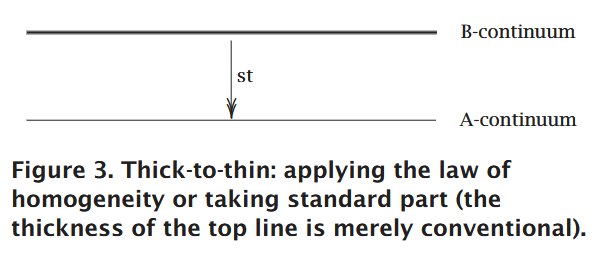
5.3. Standard part principle
5.3 标准部分原理
In any totally ordered field extension E E E of R \mathbb{R} R, every finite element x ∈ E x \in E x∈E is infinitely close to a suitable unique element x 0 ∈ R x_0 \in \mathbb{R} x0∈R. Indeed, via the total order, the element x x x defines a Dedekind cut on R \mathbb{R} R, and the cut specifies a real number x 0 ∈ R ⊂ E x_0 \in \mathbb{R} \subset E x0∈R⊂E. The number x 0 x_0 x0 is infinitely close to x ∈ E x \in E x∈E. The subring E f ⊂ E E_f \subset E Ef⊂E consisting of the finite elements of E E E therefore admits a map
在 R \mathbb{R} R 的任意全序域扩张 E E E 中,每个有限元素 x ∈ E x \in E x∈E 都无限接近唯一实数 x 0 ∈ R x_0 \in \mathbb{R} x0∈R 。事实上,由全序, x x x 定义 R \mathbb{R} R 上的一个戴德金分割,该分割确定实数 x 0 ∈ R ⊂ E x_0 \in \mathbb{R} \subset E x0∈R⊂E,且 x 0 x_0 x0 与 x ∈ E x \in E x∈E 无限接近。因此 E E E 中有限元素构成的子环 E f ⊂ E E_f \subset E Ef⊂E 容许映射
st : E f → R , x ↦ x 0 , \operatorname{st}: E_f \to \mathbb{R}, x \mapsto x_0, st:Ef→R,x↦x0,
called the standard part function .
称为标准部分函数。
The standard part function is illustrated in Figure 3. A more detailed graphic representation may be found in Figure 4. 21 ^{21} 21
标准部分函数如图 3 所示。更详细的图示见图 4。 21 ^{21} 21
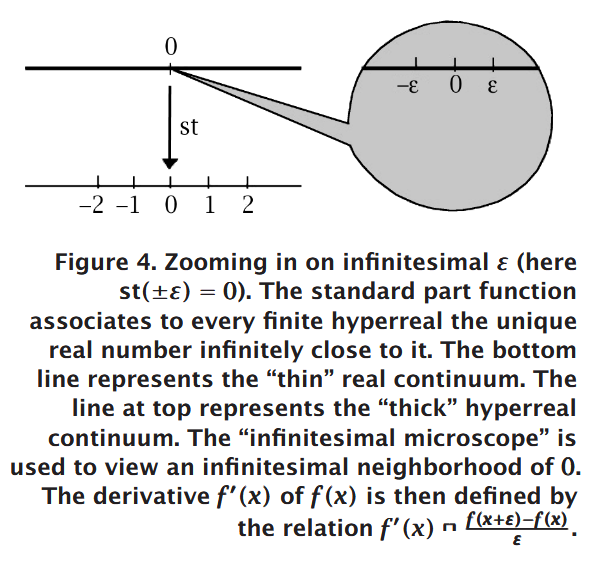
The key remark, due to Robinson, is that the limit in the A-approach and the standard part function in the B-approach are essentially equivalent tools. More specifically, the limit of a Cauchy sequence ( u n ) (u_n) (un) can be expressed, in the context of a hyperreal enlargement of the number system, as the standard part of the value u H u_H uH of the natural extension of the sequence at an infinite hypernatural index n = H n=H n=H. Thus,
鲁宾逊的核心洞见是:A 路径的极限与 B 路径的标准部分函数本质等价 。具体来说,柯西序列 ( u n ) (u_n) (un) 的极限,在超实数扩张系统中可表示为序列自然扩张在无穷超自然数指标 n = H n=H n=H 处的值 u H u_H uH 的标准部分:
lim n → ∞ u n = st ( u H ) . (5.3) \lim_{n \to \infty} u_n = \operatorname{st}(u_H). \tag{5.3} n→∞limun=st(uH).(5.3)
Here the standard part function "st" associates to each finite hyperreal, the unique finite real infinitely close to it (i.e., the difference between them is infinitesimal). This formalizes the natural intuition that for "very large" values of the index, the terms in the sequence are "very close" to the limit value of the sequence. Conversely, the standard part of a hyperreal u = u n u=u_n u=un represented in the ultrapower construction by a Cauchy sequence ( u n ) (u_n) (un), is simply the limit of that sequence:
此处标准部分函数 st 将每个有限超实数对应到与其无限接近的唯一实数(差为无穷小)。这形式化了直观:指标"足够大"时,序列项与极限"足够接近"。反之,在超幂构造中由柯西序列 ( u n ) (u_n) (un) 表示的超实数 u = u n u=u_n u=un,其标准部分即为该序列的极限:
st ( u ) = lim n → ∞ u n . (5.4) \operatorname{st}(u)=\lim_{n\to\infty}u_n. \tag{5.4} st(u)=n→∞limun.(5.4)
Formulas (5.3) and (5.4) express limit and standard part in terms of each other. In this sense, the procedures of taking the limit and taking the standard part are logically equivalent.
公式 (5.3) 与 (5.4) 将极限与标准部分互相表示。在此意义上,取极限与取标准部分的操作逻辑等价。
5.4. Variable quantity
5.4 变量
The mathematical term μ ε ˊ γ ε θ ο ς \mu\acute{\varepsilon}\gamma\varepsilon\theta\omicron\varsigma μεˊγεθος in ancient Greek has been translated into Latin as quantitas . In modern languages it has two competing counterparts: in English -- quantity, magnitude; 22 ^{22} 22 in French -- quantité, grandeur; in German -- Quantität, Grösse. The term grandeur with the meaning real number is still in use in (Bourbaki 1947 20).
古希腊数学术语 μ ε ˊ γ ε θ ο ς \mu\acute{\varepsilon}\gamma\varepsilon\theta\omicron\varsigma μεˊγεθος 译为拉丁文 quantitas 。在现代语言中有两个对应词:英文 quantity(量)、magnitude(大小) 22 ^{22} 22;法文 quantité、grandeur;德文 Quantität、Grösse。表示实数的 grandeur 仍见于布尔巴基(1947 20)。
Variable quantity was a primitive notion in analysis as presented by Leibniz, l'Hôpital, and later Carnot and Cauchy. Other key notions of analysis were defined in terms of variable quantities. Thus, in Cauchy's terminology, a variable quantity becomes an infinitesimal if it eventually drops below any given (i.e., constant) quantity (see Borovik & Katz 17 for a fuller discussion). Cauchy notes that the limit of such a quantity is zero. The notion of limit itself is defined as follows:
变量 是莱布尼茨、洛必达、卡诺、柯西分析体系中的原始概念,分析的其他核心概念均由变量定义。用柯西的话说,一个变量若最终小于任意给定量(常量),则成为无穷小(更完整讨论见博罗维克与卡茨 17)。柯西指出该量的极限为零。极限概念定义如下:
Lorsque les valeurs successivement attribuées à une même variable s'approchent indéfiniment d'une valeur fixe, de manière à finir par en différer aussi peu que l'on voudra, cette dernière est appelée la limite de toutes les autres (Cauchy, Cours d'Analyse 23).
当同一变量相继取的值无限趋近一个固定值,且最终与之相差任意小,则该固定值称为其余所有值的极限(柯西,《分析教程》23)。
Thus, Cauchy defined both infinitesimals and limits in terms of the primitive notion of a variable quantity. In Cauchy, any variable quantity q q q that does not tend to infinity is expected to decompose as the sum of a given quantity c c c and an infinitesimal α \alpha α:
因此,柯西以变量 这一原始概念同时定义无穷小与极限。在柯西体系中,任何不趋于无穷的变量 q q q 均可分解为给定量 c c c 与无穷小 α \alpha α 之和:
q = c + α . (5.5) q=c+\alpha. \tag{5.5} q=c+α.(5.5)
In his 1821 text 23, Cauchy worked with a hierarchy of infinitesimals defined by polynomials in a base infinitesimal α \alpha α. Each such infinitesimal decomposes as
在 1821 年著作 23 中,柯西使用由基无穷小 α \alpha α 的多项式定义的无穷小阶体系 。每个此类无穷小可分解为
α n ( c + ϵ ) . (5.6) \alpha^n (c + \epsilon). \tag{5.6} αn(c+ϵ).(5.6)
for a suitable integer n n n and infinitesimal ε \varepsilon ε. Cauchy's expression (5.6) can be viewed as a generalisation of (5.5).
其中 n n n 为适当整数, ε \varepsilon ε 为无穷小。柯西表达式 (5.6) 可视为 (5.5) 的推广。
In Leibniz's terminology, c c c is an assignable quantity while α \alpha α and ε \varepsilon ε are inassignable. Leibniz's transcendental law of homogeneity (see entry 4.4) authorized the replacement of the inassignable q = c + α q=c+\alpha q=c+α by the assignable c c c since α \alpha α is negligible compared to c c c. As such, the standard part in the sense of exploiting concepts already available in the toolkit of historical infinitesimal calculus, such as Fermat's adequality (entry 2.1), Leibniz's transcendental law of homogeneity (entry 4.4), and Euler's principle of cancellation (see Bair et al. 5).
用莱布尼茨术语, c c c 是可 assignable 量 , α \alpha α 与 ε \varepsilon ε 是不可 assignable 量。莱布尼茨齐次性超越定律(4.4 节)允许用可 assignable 量 c c c 替换不可 assignable 量 q = c + α q=c+\alpha q=c+α,因为 α \alpha α 相对 c c c 可忽略。就此而言,标准部分原理所使用的概念,均来自历史无穷小演算既有工具:费马拟等式(2.1 节)、莱布尼茨齐次性超越定律(4.4 节)、欧拉消去原理(见贝尔等 5)。
Meanwhile, in the A-approach as formalized by Weierstrass, one is forced to work with "external" concepts such as the multiple-quantifier ϵ − δ \epsilon-\delta ϵ−δ definitions (see entry 3.1) which have no counterpart in the historical infinitesimal calculus of Leibniz and Cauchy.
而在魏尔斯特拉斯形式化的 A 路径中,必须使用外在概念 ,如多量词 ϵ − δ \epsilon-\delta ϵ−δ 定义(见 3.1 节),这些在莱布尼茨与柯西的历史无穷小演算中并无对应。
Thus, the notions of standard part and epsilontic limit, while logically equivalent (see entry 5.3), have the following difference between them: the standard part principle corresponds to an "internal" development of the historical infinitesimal calculus, whereas the epsilontic limit is "external" to it.
因此,标准部分与 ϵ − δ \epsilon-\delta ϵ−δ 极限虽逻辑等价(见 5.3 节),但存在关键区别:标准部分原理是历史无穷小演算的内在发展,而 ϵ − δ \epsilon-\delta ϵ−δ 极限是外在的。
5.5. Zeno's paradox of extension
Zeno of Elea (who lived about 2500 years ago) raised a puzzle (the paradox of extension, which is distinct from his better known paradoxes of motion) in connection with treating any continuous magnitude as though it consists of infinitely many indivisibles; see (Sherry 1988 106); (Kirk et al. 1983 76). If the indivisibles have no magnitude, then an extension (such as space or time) composed of them has no magnitude; but if the indivisibles have some (finite) magnitude, then an extension composed of them will be infinite.
5.5 芝诺广延悖论
埃利亚的芝诺(约 2500 年前)提出一个谜题(广延悖论,区别于更著名的运动悖论):若将连续量视为由无穷多不可分量构成,会导致矛盾(见谢里 1988 106;柯克等 1983 76)。若不可分量无大小,则由其构成的广延(如空间、时间)亦无大小;若不可分量有(有限)大小,则其构成的广延必无穷大。
There is a further puzzle: If a magnitude is composed of indivisibles, then we ought to be able to add or concatenate them in order to produce or increase a magnitude. But indivisibles are not next to one another; as limits or boundaries, any pair of indivisibles is separated by what they limit. Thus, the concepts of addition or concatenation seem not to apply to indivisibles.
进一步的困惑:若量由不可分量构成,则应能通过相加或拼接生成或增大量。但不可分量并非彼此相邻;作为极限或边界,任意两个不可分量之间都隔着它们所限定的东西。因此加法或拼接概念似乎不适用于不可分量。
The paradox need not apply to infinitesimals in Leibniz's sense, however (see entry 3.9 on indivisibles and infinitesimals). For, having neither zero nor finite magnitude, infinitely many of them may be just what is needed to produce a finite magnitude. And in any case, the addition or concatenation of infinitesimals (of the same dimension) is no more difficult to conceive of than adding or concatenating finite magnitudes. This is especially important, because it allows one to apply arithmetic operations to infinitesimals (see entry 4.3 on the law of continuity). See also (Reeder 2012 100).
但这一悖论不适用于莱布尼茨意义下的无穷小 (见 3.9 节不可分量与无穷小)。因为无穷小既非零也非有限大小,无穷多个无穷小恰好可构成有限量。无论如何,同维无穷小的相加或拼接,与有限量的相加或拼接同样易于理解。这一点尤为重要,因为它允许对无穷小施行算术运算(见 4.3 节连续性定律)。另见里德(2012 100)。
Acknowledgments
致谢
The work of Vladimir Kanovei was partially supported by RFBR grant 13-01-00006. M. Katz was partially funded by the Israel Science Foundation grant no. 1517/12. We are grateful to Reuben Hersh and Martin Davis for helpful discussions, and to the anonymous referees for a number of helpful suggestions. The influence of Hilton Kramer (1928--2012) is obvious.
弗拉基米尔·卡诺维奇的工作部分得到俄罗斯基础研究基金会 13-01-00006 项目资助。M. 卡茨的工作部分得到以色列科学基金会 1517/12 项目资助。感谢鲁本·赫什与马丁·戴维斯的有益讨论,感谢匿名审稿人的诸多建议。希尔顿·克莱默(1928--2012)的影响显而易见。
References
参考文献
1 Andersen, K.: One of Berkeley's arguments on compensating errors in the calculus. Historia Mathematica 38 (2011), no. 2, 219--239.
安德森:贝克莱关于微积分补偿误差的一个论证。《数学史》38(2011),第 2 期,219--239。
2 Archimedes, De Sphaera et Cylindro , in Archimedis Opera Omnia cum Commentariis Eutocii, vol. I, ed. J.L. Heiberg, B. G. Teubner, Leipzig, 1880.
阿基米德:《论球与圆柱》,见《阿基米德全集附欧托西乌斯评注》卷 I,J.L. 海伯格编,莱比锡,1880。
3 Arthur, R. (2007): Leibniz's syncategorematic infinitesimals, Smooth Infinitesimal Analysis, and Newton's Proposition 6.
阿瑟:莱布尼茨的范畴伴生无穷小、光滑无穷小分析与牛顿命题 6,2007。
4 Bachet: Diophanti Alexandrini, Arithmeticorum Liber V (Bachet's Latin translation).
巴谢:《亚历山大的丢番图算术第五卷》(巴谢拉丁文译本)。
5 Bair, J.; Blaszczyk, P.; Ely, R.; Henry, V.; Kanovei, V.; Katz, K.; Katz, M.; Kutateladze, S.; McGaffey, T.; Schaps, D.; Sherry, D.; Shnider, S.: Interpreting Euler's infinitesimal mathematics (in preparation).
贝尔等:解读欧拉的无穷小数学(待刊)。
6 Bair J.; Henry V.: From Newton's fluxions to Virtual Microscopes. Teaching Mathematics and Computer Science V (2007), 377--384.
贝尔、亨利:从牛顿流数到虚拟显微镜。《数学与计算机科学教学》V(2007),377--384。
7 Bair J.; Henry V.: From Mixed Angles to Infinitesimals. The College Mathematics Journal 39 (2008), no. 3, 230--233.
贝尔、亨利:从混合角到无穷小。《大学数学杂志》39(2008),第 3 期,230--233。
8 Bair J.; Henry V.: Analyse infinitésimale - Le calculus redécouvert. Editions Academia Bruylant Louvain-la-Neuve (Belgium) 2008, 189 pages.
贝尔、亨利:无穷小分析------微积分的再发现。比利时布鲁扬特学术出版社,2008,189 页。
9 Bell, J. L.: Continuity and infinitesimals. Stanford Encyclopedia of philosophy. Revised 20 july 2009.
贝尔:连续性与无穷小。《斯坦福哲学百科全书》,2009 年 7 月 20 日修订。
10 Bishop, E.: Differentiable manifolds in complex Euclidean space. Duke Mathematical Journal 32 (1965), 1--21.
毕晓普:复欧氏空间中的微分流形。《杜克数学期刊》32(1965),1--21。
11 Bishop, E.: Mathematics as a numerical language. 1970 Intuitionism and Proof Theory (Proc. Conf., Buffalo, N.Y., 1968) pp. 53--71. North-Holland, Amsterdam.
毕晓普:作为数值语言的数学。见《直觉主义与证明论》,1970,53--71,阿姆斯特丹。
12 Bishop, E.: The crisis in contemporary mathematics. Proceedings of the American Academy Workshop on the Evolution of Modern Mathematics (Boston, Mass., 1974). Historia Mathematica 2 (1975), no. 4, 507--517.
毕晓普:当代数学的危机。《美国科学院现代数学演化研讨会论文集》,1974。《数学史》2(1975),第 4 期,507--517。
13 Bishop, E.: Review: H. Jerome Keisler, Elementary calculus, Bull. Amer. Math. Soc. 83 (1977), 205--208.
毕晓普:评杰罗姆·凯斯勒《初等微积分》。《美国数学会通报》83(1977),205--208。
14 Bishop, E.: Schizophrenia in contemporary mathematics. In Errett Bishop: reflections on him and his research (San Diego, Calif., 1983), 1--32, Contemp. Math. 39, Amer. Math. Soc., Providence, RI, 1985 originally distributed in 1973.
毕晓普:当代数学的精神分裂。见《埃雷特·毕晓普纪念文集》,1985,1--32。
15 Blaszczyk, P. Katz, M.; Sherry, D.: Ten misconceptions from the history of analysis and their debunking. Foundations of Science 18 (2013), no. 1, 43--74.
布拉什奇克、卡茨、谢里:分析史上十大误解及其澄清。《科学基础》18(2013),第 1 期,43--74。
16 Blaszczyk, P.; Mrowka, K.: Euklides, Elementy, Księgi V--VI . Copernicus Center Press, Kraków, 2013.
布拉什奇克、姆龙卡:《欧几里得原本第五至六卷》,克拉科夫,2013。
17 Borovik, A.; Katz, M.: Who gave you the Cauchy--Weierstrass tale? The dual history of rigorous calculus. Foundations of Science , 17 (2012), no. 3, 245--276.
博罗维克、卡茨:谁编造了柯西--魏尔斯特拉斯神话?严格微积分的双重历史。《科学基础》17(2012),第 3 期,245--276。
18 Bos, H. J. M.: Differentials, higher-order differentials and the derivative in the Leibnizian calculus. Archive for History of Exact Sciences 14 (1974), 1--90.
博斯:莱布尼茨微积分中的微分、高阶微分与导数。《精密科学史文献》14(1974),1--90。
19 Bos, H.; Bunn, R.; Dauben, J.; Grattan-Guinness, I.; Hawkins, T.; Pedersen, K.; From the calculus to set theory, 1630--1910 . Gerald Duckworth & Co. Ltd., London, 1980.
博斯等:《从微积分到集合论 1630--1910》,伦敦,1980。
20 Bourbaki, N.: Théorie de la mesure et de l'intégration . Introduction, Université Henri Poincaré, Nancy 1947.
布尔巴基:测度与积分论导引,南希亨利·庞加莱大学,1947。
21 Bråting, K.: A new look at E. G. Björling and the Cauchy sum theorem. Arch. Hist. Exact Sci. 61 (2007), no. 5, 519--535.
布拉廷:重审约林与柯西和定理。《精密科学史文献》61(2007),第 5 期,519--535。
22 Breger, H.: The mysteries of adaequare: a vindication of Fermat. Archive for History of Exact Sciences 46 (1994), no. 3, 193--219.
布雷格:拟等式之谜:为费马正名。《精密科学史文献》46(1994),第 3 期,193--219。
23 Cauchy, A. L.: Cours d'Analyse de L'Ecole Royale Polytechnique . Première Partie. Analyse algébrique. Paris: Imprimerie Royale, 1821.
柯西:《巴黎综合工科学校分析教程》第一部分:代数分析,巴黎,1821。
24 Cauchy, A.-L. (1815) Théorie de la propagation des ondes à la surface d'un fluide pesant d'une profondeur indéfinie (published 1827, with additional Notes). Oeuvres , Series 1, Vol. 1, 4--318.
柯西:《论深度无限流体表面波的传播》(1815 撰,1827 年出版,含附注)。《全集》第一辑,卷 1,4--318。
25 Cerroni, C.: The contributions of Hilbert and Dehn to non-Archimedean geometries and their impact on the Italian school. Revue d'Histoire des Mathématiques 13 (2007), no. 2, 259--299.
切尔罗尼:希尔伯特与德恩对非阿基米德几何的贡献及其对意大利学派的影响。《数学史评论》13(2007),第 2 期,259--299。
26 Cifoletti, G.: La méthode de Fermat: son statut et sa diffusion . Société Française d'Histoire des Sciences et des Techniques, Paris, 1990.
乔弗莱蒂:《费马方法:地位与传播》,法国科学技术史学会,巴黎,1990。
27 Connes, A.: Noncommutative geometry . Academic Press, Inc., San Diego, CA, 1994.
孔涅:《非交换几何》,圣地亚哥,1994。
28 Dauben, J.: The development of the Cantorian set theory. In (Bos et al. 1980 19), pp. 181--219.
道本:康托尔集合论的发展。见博斯等(1980 19),181--219。
29 Dauben, J.: "Abraham Robinson. 1918--1974," Biographical Memoirs of the National Academy of Sciences 82 (2003), 243--284.
道本:亚伯拉罕·鲁宾逊传。《美国国家科学院传记回忆录》82(2003),243--284。
30 De Morgan, A.: On the early history of infinitesimals in England. Philosophical Magazine , Ser. 4 4 (1852), no. 26, 321--330.
德·摩根:英国无穷小早期史。《哲学杂志》第 4 辑 4(1852),第 26 期,321--330。
31 Dirac, P.: The Principles of Quantum Mechanics . 4th edition. Oxford, at the Clarendon Press, 1958.
狄拉克:《量子力学原理》(第 4 版),牛津,1958。
32 Dossena, R.; Magnani, L.: Mathematics through diagrams: microscopes in non-standard and smooth analysis. Studies in Computational Intelligence (SCI) 64 (2007), 193--213.
多塞纳、马尼亚尼:图示数学:非标准与光滑分析中的显微镜。《计算智能研究》64(2007),193--213。
33 Ehrlich, P.: The rise of non-Archimedean mathematics and the roots of a misconception. I. The emergence of non-Archimedean systems of magnitudes. Archive for History of Exact Sciences 60 (2006), no. 1, 1--121.
埃利希:非阿基米德数学的兴起与误解之源(一)。《精密科学史文献》60(2006),第 1 期,1--121。
34 Ely, R.: Loss of dimension in the history of calculus and in student reasoning. The Mathematics Enthusiast 9 (2012), no. 3, 303--326.
伊利:微积分史与学生推理中的维数丢失。《数学爱好者》9(2012),第 3 期,303--326。
35 Euclid: Euclid's Elements of Geometry , edited, and provided with a modern English translation, by Richard Fitzpatrick, 2007.
欧几里得:《欧几里得几何原本》,理查德·菲茨帕特里克编订英译现代版,2007。
36 Euler, L.: Introductio in Analysin Infinitorum , Tomus primus. SPb and Lausana, 1748.
欧拉:《无穷分析引论》卷一,圣彼得堡与洛桑,1748。
37 Euler, L.: Introduction to analysis of the infinite . Book I. Translated by John D. Blanton. Springer-Verlag, New York, 1988.
欧拉:《无穷分析引论》第一卷,布兰顿英译,纽约,1988。
38 Euler, L.: Institutiones Calculi Differentialis . SPb, 1755.
欧拉:《微分学原理》,圣彼得堡,1755。
39 Euler, L.: Foundations of Differential Calculus . English translation of Chapters 1--9. Translated by D. Blanton, Springer, New York, 2000.
欧拉:《微分学基础》(第 1--9 章英译),布兰顿译,纽约,2000。
40 Ferraro, G.: Differentials and differential coefficients in the Eulerian foundations of the calculus. Historia Mathematica 31 (2004), no. 1, 34--61.
费拉罗:欧拉微积分基础中的微分与微分系数。《数学史》31(2004),第 1 期,34--61。
41 Freudenthal, H.: Cauchy, Augustin-Louis. In Dictionary of Scientific Biography , vol. 3, 131--148. New York: Charles Scribner's sons, 1971.
弗罗伊登塔尔:柯西传。《科学传记辞典》卷 3,131--148,纽约,1971。
42 Gerhardt:, C. I. (ed.): Historia et Origo calculi differentialis a G. G. Leibnitio conscripta , Hannover, 1846.
格尔哈特(编):《莱布尼茨微积分史与起源》,汉诺威,1846。
43 Gerhardt, C. I. (ed.): Leibnizens mathematische Schriften (Berlin and Halle: Eidmann, 1850--1863).
格尔哈特(编):《莱布尼茨数学著作集》,柏林与哈雷,1850--1863。
44 Granger, G.: Philosophie et mathématique leibniziennes. Revue de Métaphysique et de Morale 86e Année, No. 1 (Janvier-Mars 1981), pp. 1--37.
格朗热:莱布尼茨的哲学与数学。《形而上学与道德评论》86(1981),第 1 期,1--37。
45 Grassmann, Hermann: Lehrbuch der Arithmetik , Enslin, Berlin 1861.
格拉斯曼:《算术教程》,柏林,1861。
46 Gray, J.: Plato's ghost . Princeton University Press, Princeton, NJ, 2008.
格雷:《柏拉图的幽灵》,普林斯顿,2008。
47 Gray, J.: A short life of Euler. BSHM Bulletin. Journal of the British Society for the History of Mathematics 23 (2008), no. 1, 1--12.
格雷:欧拉小传。《英国数学史学会通报》23(2008),第 1 期,1--12。
48 Hall, Rupert; Hall, Marie Boas, eds. Unpublished Scientific Papers of Isaac Newton , Cambridge University Press, 1962.
霍尔夫妇(编):《牛顿未刊科学论文集》,剑桥,1962。
49 Hawking, S., Ed.: The mathematical breakthroughs that changed history . Running Press, Philadelphia, PA, 2007.
霍金(编):《改变历史的数学突破》,费城,2007。
50 Hankel, Hermann: Zur Geschichte der Mathematik in Alterthum und Mittelalter . Teubner, Leipzig 1876.
汉克尔:《古代与中世纪数学史》,莱比锡,1876。
51 Heath, T. (ed.) The works of Archimedes . Cambridge University Press, Cambridge, 1897.
希思(编):《阿基米德著作集》,剑桥,1897。
52 Hewitt, E.: Rings of real-valued continuous functions. I. Trans. Amer. Math. Soc. 64 (1948), 45--99.
休伊特:实值连续函数环(I)。《美国数学会汇刊》64(1948),45--99。
53 Heiberg, J. (ed.): Archimedis Opera Omnia cum Commentariis Eutocii , vol. I. Teubner, Leipzig 1880.
海伯格(编):《阿基米德全集附欧托西乌斯评注》卷 I,莱比锡,1880。
54 Heijting, A.: Address to Professor A. Robinson. Nieuw Arch. Wisk. (3) 21 (1973), 134--137.
海廷:致鲁宾逊教授演说。《新数学文献》(3)21(1973),134--137。
55 Herzberg, F.: Stochastic calculus with infinitesimals . Lecture Notes in Mathematics, 2067. Springer, Heidelberg, 2013.
赫茨贝格:《基于无穷小的随机微积分》。《数学讲义》2067,海德堡,2013。
56 Hilbert, D.: Grundlagen der Geometrie . Leipzig 1899.
希尔伯特:《几何基础》,莱比锡,1899。
57 Hilbert, D.: Les principes fondamentaux de la géométrie. Annales scientifiques de l'E.N.S. 3e série 17 (1900), 103--209.
希尔伯特:几何基础。《高等师范学校科学年鉴》第 3 辑 17(1900),103--209。
58 Hölder, O.: Die Axiome der Quantität und die Lehre vom Mass. Berichte über die Verhandlungen der Königlich Sächsischen Gesellschaft der Wissenschaften zu Leipzig. Mathematisch-Physische Classe , 53, Leipzig 1901, 1--63.
赫尔德:量的公理与测度论。《莱比锡萨克森皇家学会报告·数理物理类》53(1901),1--63。
59 Ishiguro, H.: Leibniz's philosophy of logic and language . Second edition. Cambridge University Press, Cambridge, 1990.
59 石黑俊夫:《莱布尼茨的逻辑与语言哲学》(第二版),剑桥大学出版社,1990 年。
60 Jesseph, D.: Leibniz on the Elimination of infinitesimals: Strategies for finding truth in fiction, 27 pages. In Leibniz on the interrelations between mathematics and philosophy , edited by Norma B. Goethe, Philip Beeley and David Rabouin, Archimedes Series, Springer Verlag, 2013.
60 杰西普:莱布尼茨论无穷小的消除:在虚构中寻求真理的策略,27 页。见《莱布尼茨:数学与哲学的关联》,施普林格出版社,2013 年。
61 Kanovei, V.: The correctness of Euler's method for the factorization of the sine function into an infinite product, Russian Mathematical Surveys 43 (1988), 65--94.
61 卡诺维奇:欧拉正弦无穷乘积分解法的正确性,《俄罗斯数学述评》43(1988),65--94。
62 Kanovei, V.; Katz, M.; Mormann, T.: Tools, Objects, and Chimeras: Connes on the Role of Hyperreals in Mathematics. Foundations of Science 18 (2013), no. 2, 259--296.
62 卡诺维奇、卡茨、莫曼:工具、对象与幻像:孔涅论超实数在数学中的角色,《科学基础》18(2013),第 2 期,259--296。
63 Kanovei, V.; Reeken, M.: Nonstandard analysis, axiomatically . Springer Monographs in Mathematics, Berlin: Springer, 2004.
卡诺维奇、里肯:《非标准分析(公理化)》,施普林格数学专著,柏林,2004 年。
64 Kanovei, V.; Shelah, S.: A definable nonstandard model of the reals. Journal of Symbolic Logic 69 (2004), no. 1, 159--164.
卡诺维奇、谢拉赫:实数的可定义非标准模型,《符号逻辑杂志》69(2004),第 1 期,159--164。
65 Katz, K.; Katz, M.: Zooming in on infinitesimal 1 − .9.. 1-.9.. 1−.9.. in a post-triumvirate era. Educational Studies in Mathematics 74 (2010), no. 3, 259--273.
卡茨、卡茨:后魏氏时代下对无穷小 1 − .9.. 1-.9.. 1−.9.. 的审视,《数学教育研究》74(2010),第 3 期,259--273。
66 Katz, K.; Katz, M.: When is .999 ... .999\dots .999... less than 1? The Montana Mathematics Enthusiast 7 (2010), No. 1, 3--30.
卡茨、卡茨:何时 .999 ... .999\dots .999... 小于 1?《蒙大拿数学爱好者》7(2010),第 1 期,3--30。
67 Katz, K.; Katz, M.: Cauchy's continuum. Perspectives on Science 19 (2011), no. 4, 426--452.
67 卡茨、卡茨:柯西的连续统,《科学视角》19(2011),第 4 期,426--452。
68 Katz, K.; Katz, M.: Meaning in classical mathematics: is it at odds with Intuitionism? Intellectica , 56 (2011), no. 2, 223--302.
卡茨、卡茨:经典数学中的意义:它与直觉主义冲突吗?《智识》56(2011),第 2 期,223--302。
69 Katz, K.; Katz, M.: A Burgessian critique of nominalistic tendencies in contemporary mathematics and its historiography. Foundations of Science 17 (2012), no. 1, 51--89.
卡茨、卡茨:伯吉斯式批判:当代数学及其史学中的唯名论倾向,《科学基础》17(2012),第 1 期,51--89。
70 Katz, M.; Leichtnam, E.: Commuting and noncommuting infinitesimals. American Mathematical Monthly 120 (2013), no. 7, 631--641.
70 卡茨、莱希特纳:可交换与不可交换无穷小,《美国数学月刊》120(2013),第 7 期,631--641。
71 Katz, M.; Schaps, D.; Shnider, S.: Almost Equal: The Method of Adequality from Diophantus to Fermat and Beyond. Perspectives on Science 21 (2013), no. 3, 283--324.
71 卡茨、沙普斯、施奈德:近似相等:从丢番图到费马的拟等式方法,《科学视角》21(2013),第 3 期,283--324。
72 Katz, M.; Sherry, D.: Leibniz's laws of continuity and homogeneity. Notices of the American Mathematical Society 59 (2012), no. 11, 1550--1558.
卡茨、谢里:莱布尼茨的连续性定律与齐次性定律,《美国数学会通告》59(2012),第 11 期,1550--1558。
73 Katz, M.; Sherry, D.: Leibniz's infinitesimals: Their fictionality, their modern implementations, and their foes from Berkeley to Russell and beyond. Erkenntnis 78 (2013), no. 3, 571--625.
卡茨、谢里:莱布尼茨的无穷小:虚构性、现代实现及其批判者,《认识》78(2013),第 3 期,571--625。
74 Katz, M.; Tall, D.: A Cauchy-Dirac delta function. Foundations of Science 18 (2013), no. 1, 107--123.
卡茨、托尔:柯西-狄拉克δ函数,《科学基础》18(2013),第 1 期,107--123。
75 Keisler, H. J.: The ultraproduct construction. Ultrafilters across mathematics , 163--179, Contemp. Math., 530, Amer. Math. Soc., Providence, RI, 2010.
75 凯斯勒:超积构造,《全域超滤子数学》,当代数学 530,美国数学会,2010 年,163--179。
76 Kirk, G.S.; Raven, J.E.; Schofield M.: Presocratic Philosophers . Cambridge UP, Cambridge 1983, §316.
柯克、雷文、斯科菲尔德:《前苏格拉底哲学家》,剑桥大学出版社,1983 年,§316。
77 Klein, F.: Elementary Mathematics from an Advanced Standpoint . Vol. I. Arithmetic, Algebra, Analysis. Translation by E. R. Hedrick and C. A. Noble Macmillan, New York, 1932 from the third German edition Springer, Berlin, 1924. Originally published as Elementarmathematik vom höheren Standpunkte aus (Leipzig, 1908).
克莱因:《高观点下的初等数学》第一卷:算术、代数、分析,英文版 1932,德文原版 1908。
78 Kline, M.: Mathematics. The loss of certainty . Oxford University Press, New York, 1980.
克莱因:《数学:确定性的丧失》,牛津大学出版社,1980 年。
79 Laugwitz, D.: Hidden lemmas in the early history of infinite series. Aequationes Mathematicae 34 (1987), 264--276.
劳格维茨:无穷级数早期史中的隐蔽引理,《数学方程》34(1987),264--276。
80 Laugwitz, D.: Definite values of infinite sums: aspects of the foundations of infinitesimal analysis around 1820. Archive for History of Exact Sciences 39 (1989), no. 3, 195--245.
劳格维茨:无穷和的定值:1820 年前后无穷小分析基础,《精密科学史文献》39(1989),第 3 期,195--245。
81 Laugwitz, D.: Early delta functions and the use of infinitesimals in research. Revue d'histoire des sciences 45 (1992), no. 1, 115--128.
劳格维茨:早期δ函数与无穷小在研究中的应用,《科学史评论》45(1992),第 1 期,115--128。
82 Leibniz, G. (1701) Cum Prodiisset ... mss "Cum prodiisset atque increbuisset Analysis mea infinitesimalis..." in Gerhardt 42, pp. 39--50.
莱布尼茨:《既已进展》(1701),见格尔哈特编 42,39--50 页。
83 Leibniz, G. (1702) Letter to Varignon, 2 feb. 1702, in Gerhardt 43, vol. IV, pp. 91--95.
莱布尼茨:致瓦里尼翁信(1702-02-02),见格尔哈特编 43 第四卷,91--95 页。
84 Leibniz, G. (1710) Symbolismus memorabilis calculi algebraici et infinitesimalis in comparatione potentiarum et differentiarum, et de lege homogeneorum transcendentali . In Gerhardt 43, vol. V, pp. 377--382.
莱布尼茨:《代数与无穷小演算的符号系统:幂与微分比较及齐次性超越定律》(1710),见格尔哈特编 43 第五卷,377--382 页。
85 Leibniz, G.: La naissance du calcul différentiel . 26 articles des Acta Eruditorum . Translated from the Latin and with an introduction and notes by Marc Parmentier. Mathesis. Librairie Philosophique J. Vrin, Paris, 1989.
莱布尼茨:《微分学的诞生:学人学报 26 篇》,帕芒蒂埃译注,巴黎,1989 年。
86 Leibniz, G.: De quadratura arithmetica circuli ellipseos et hyperbolae cujus corollarium est trigonometria sine tabulis . Edited, annotated and with a foreword in German by Eberhard Knobloch. Abhandlungen der Akademie der Wissenschaften in Göttingen. Mathematisch-Physikalische Klasse. Folge 3, 43. Vandenhoeck & Ruprecht, Göttingen, 1993.
莱布尼茨:《论圆、椭圆、双曲线的算术求积》,克诺布洛赫编,哥廷根科学院论文集,1993 年。
87 Łoś, J.: Quelques remarques, théoremes et problemes sur les classes définissables d'algèbres. In Mathematical interpretation of formal systems , 98--113, North-Holland Publishing Co., Amsterdam, 1955.
沃希:论代数可定义类的若干注记、定理与问题,见《形式系统的数学解释》,阿姆斯特丹,1955 年,98--113 页。
88 Luxemburg, W.: What is nonstandard analysis? Papers in the foundations of mathematics. American Mathematical Monthly 80 (1973), no. 6, part II, 38--67.
88 卢赞堡:什么是非标准分析?《美国数学月刊》80(1973),第 6 期第二部分,38--67。
89 Magnani, L.; Dossena, R.: Perceiving the infinite and the infinitesimal world: unveiling and optical diagrams in mathematics. Foundations of Science 10 (2005), no. 1, 7--23.
马尼亚尼、多塞纳:感知无穷与无穷小:数学中的揭示与光学图示,《科学基础》10(2005),第 1 期,7--23。
90 Mancosu, P.: Philosophy of mathematics and mathematical practice in the seventeenth century . The Clarendon Press, Oxford University Press, New York, 1996.
90 曼科苏:《17 世纪的数学哲学与数学实践》,牛津大学出版社,1996 年。
91 McClenon, R.: A Contribution of Leibniz to the History of Complex Numbers. American Mathematical Monthly 30 (1923), no. 7, 369--374.
麦克莱农:莱布尼茨对复数史的一项贡献,《美国数学月刊》30(1923),第 7 期,369--374。
92 McKinzie, M.; Tuckey, C.: Hidden lemmas in Euler's summation of the reciprocals of the squares, Archive for History of Exact Sciences 51 (1997), 29--57.
麦金齐、塔基:欧拉倒数平方和中的隐蔽引理,《精密科学史文献》51(1997),29--57。
93 Meschkowski, H.: Aus den Briefbüchern Georg Cantors . Archive for History of Exact Sciences 2 (1965), 503--519.
梅施科夫斯基:《格奥尔格·康托尔书信集》,《精密科学史文献》2(1965),503--519。
94 Mormann, T.; Katz, M.: Infinitesimals as an issue of neo-Kantian philosophy of science. HOPOS: The Journal of the International Society for the History of Philosophy of Science , to appear.
莫曼、卡茨:作为新康德主义科学哲学议题的无穷小,《国际科学哲学史学会杂志》,待刊。
95 Mumford, D.: Intuition and rigor and Enriques's quest. Notices Amer. Math. Soc. 58 (2011), no. 2, 250--260.
芒福德:直观、严格与恩里克斯的探索,《美国数学会通告》58(2011),第 2 期,250--260。
96 Newton, I. (1671), Methodus Fluxionum . English version The method of fluxions and infinite series (1736).
牛顿:《流数法》(1671),英文版 1736 年。
97 Núñez, R.; Edwards, L.; Matos, J.: Embodied cognition as grounding for situatedness and context in mathematics education. Educational Studies in Mathematics 39 (1999), no. 1-3, 45--65.
努涅斯、爱德华兹、马托斯:具身认知作为数学教育情境性的基础,《数学教育研究》39(1999),第 1--3 期,45--65。
98 Parkhurst, W.; Kingsland, W.: Infinity and the infinitesimal. The Monist 35 (1925), 633--666.
帕克赫斯特、金斯兰:无穷与无穷小,《一元论者》35(1925),633--666。
99 Proietti, C.: Natural Numbers and Infinitesimals: A Discussion between Benno Kerry and Georg Cantor. History and Philosophy of Logic 29 (2008), no. 4, 343--359.
普罗耶蒂:自然数与无穷小:克里与康托尔的对话,《逻辑史与逻辑哲学》29(2008),第 4 期,343--359。
100 Reeder, P.: Infinitesimals for Metaphysics: Consequences for the Ontologies of Space and Time. Degree Doctor of Philosophy, Ohio State University, Philosophy, 2012.
里德:形而上学的无穷小:对时空本体论的意义,俄亥俄州立大学哲学博士论文,2012 年。
101 Robinson, A.: Non-standard analysis. Nederl. Akad. Wetensch. Proc. Ser. A 64 = Indag. Math. 23 (1961), 432--440.
鲁宾逊:非标准分析,《荷兰科学院院刊》A 辑 64 = 《数学研究》23(1961),432--440。
102 Robinson, A.: "Reviews: Foundations of Constructive Analysis". American Mathematical Monthly 75 (1968), no. 8, 920--921.
鲁宾逊:评《构造分析基础》,《美国数学月刊》75(1968),第 8 期,920--921。
103 Robinson, A.: Selected papers of Abraham Robinson . Vol. II. Nonstandard analysis and philosophy . Edited and with introductions by W. A. J. Luxemburg and S. Körner. Yale University Press, New Haven, Conn., 1979.
鲁宾逊:《亚伯拉罕·鲁宾逊选集》第二卷:非标准分析与哲学,耶鲁大学出版社,1979 年。
104 Russell, B.: The principles of mathematics . Vol. I. Cambridge Univ. Press, Cambridge, 1903.
罗素:《数学原理》第一卷,剑桥大学出版社,1903 年。
105 Sherry, D.: The wake of Berkeley's Analyst: rigor mathematicae? Stud. Hist. Philos. Sci. 18 (1987), no. 4, 455--480.
谢里:贝克莱《分析者》之后:数学的严格性?《科学史与科学哲学研究》18(1987),第 4 期,455--480。
106 Sherry, D.: Zeno's metrical paradox revisited. Philosophy of Science 55 (1988), no. 1, 58--73.
谢里:芝诺测度悖论再探,《科学哲学》55(1988),第 1 期,58--73。
107 Sherry, D.; Katz, M.: Infinitesimals, imaginaries, ideals, and fictions. Studia Leibnitiana (2013), to appear.
谢里、卡茨:无穷小、虚数、理想与虚构,《莱布尼茨研究》(2013),待刊。
108 Simson, R.: The Elements of Euclid viz. the first six Books, together with the eleventh and twelfth . The Errors by which Theon and others have long ago vitiated these Books are corrected and some of Euclid's Demonstrations are restored. Robert & Andrew Foulis, Glasgow, 1762.
辛森:《欧几里得原本》校勘本,格拉斯哥,1762 年。
109 Skolem, T.: Über Die Unmöglichkeit einer vollständigen Charakterisierung der Zahlenreihe mittels eines endlichen Axiomensystems. Norsk Mat. Forenings Skr., II. Ser. No. 1/12 (1933), 73--82.
斯科勒姆:论无法用有限公理系统完全刻画数列,《挪威数学会论文集》第二辑 1/12(1933),73--82。
110 Skolem, T.: Über Die Nicht-charakterisierbarkeit der Zahlenreihe mittels endlich oder abzählbar unendlich vieler Aussagen mit ausschliesslich Zahlenvariablen. Fundamenta Mathematicae 23 (1934), 150--161.
斯科勒姆:论仅用数变量无法有穷或可数无穷刻画数列,《数学基础》23(1934),150--161。
111 Skolem, T.: Peano's axioms and models of arithmetic. In Mathematical interpretation of formal systems , pp. 1--14. North-Holland Publishing Co., Amsterdam, 1955.
斯科勒姆:皮亚诺公理与算术模型,见《形式系统的数学解释》,阿姆斯特丹,1955 年,1--14 页。
112 Solovay, R.: A model of set-theory in which every set of reals is Lebesgue measurable. Annals of Mathematics (2) 92 (1970), 1--56.
索洛维:每个实数集都勒贝格可测的集合论模型,《数学年刊》(2)92(1970),1--56。
113 Stolz, O.: Vorlesungen über Allgemeine Arithmetik , Teubner, Leipzig 1885.
斯托尔兹:《普通算术讲义》,莱比锡,1885 年。
114 Tall, D.; Katz, M.: A cognitive analysis of Cauchy's conceptions of function, continuity, limit, and infinitesimal, with implications for teaching the calculus. Educational Studies in Mathematics (2013), to appear.
托尔、卡茨:柯西函数、连续、极限、无穷小概念的认知分析及其对微积分教学的启示,《数学教育研究》(2013),待刊。
115 Tho, T.: Equivocation in the foundations of Leibniz's infinitesimal fictions. Society and Politics 6 (2012), No. 2 (12).
托:莱布尼茨无穷小虚构基础中的歧义,《社会与政治》6(2012),第 2 期(12)。
116 Vickers, P.: Understanding Inconsistent Science . Oxford University Press, Oxford, 2013.
维克斯:《理解不相容科学》,牛津大学出版社,2013 年。
117 Wallis, J. (1656) The arithmetic of infinitesimals . Translated from the Latin and with an introduction by Jacqueline A. Stedall. Sources and Studies in the History of Mathematics and Physical Sciences. Springer-Verlag, New York, 2004.
沃利斯:《无穷小算术》(1656),英译本 2004 年,施普林格数学与物理科学史丛书。
Reference
-
1306.5973v1 Is mathematical history written by the victors? - 2013
https://arxiv.org/pdf/1306.5973 -
calculus - Is mathematical history written by the victors? - 2013
https://math.stackexchange.com/questions/445166/is-mathematical-history-written-by-the-victors -
reference request - Good "history of mathematical ideas" book? - 2016
https://math.stackexchange.com/questions/1674375/good-history-of-mathematical-ideas-book