Recurrent Problem 递归问题
Mathematical Induction 数学归纳法
Every recurrence problem can be divided into 3 parts :
(1) Rearsh on the small situations
(2) Give the recurrence relation (递归式)
(3) Make the closed-form(封闭形式)
Mathematical induction = Basis + Induction
We first assume the closed-form (3) is right for n−1n-1n−1, and we use the recurrence relation (2) to proof the nnn is also right. Apparently, the boundary is the small situations (1)
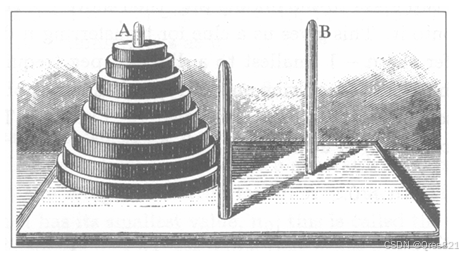
Example : The Tower of Hanoi
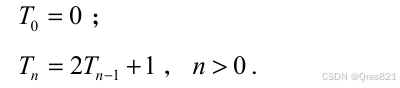
Recurrence relation :
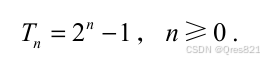
Close-form:
Example:Lines in the plane
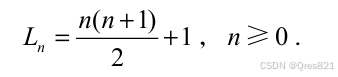
Recurrence relation:

Close-form:
Example: The Josephus Problem
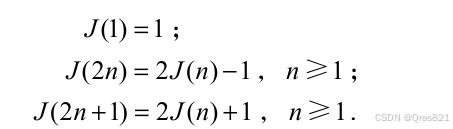
Recurrence relation:
Close-form:

Binary & Rotate
Binary in Josephus Problem
Consider the Josephus Problem, if we write nnn in base-2 notation :
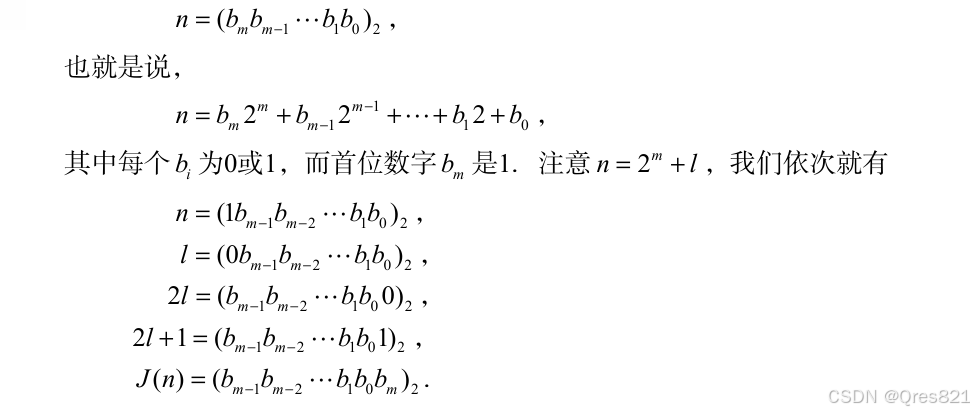
And finally we find that:

So J(n)J(n)J(n) is nnn rotate left by one bit.
Rotate
Thurthermore, we can solve all the recurrent problem in this bit. For:

We can find that:

The main varibles are d and c.
Repertoire method 成套方法
To solve the common problem: (We need its close-form)
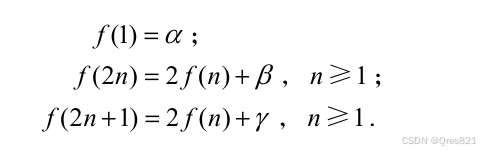
We can assume that:
f(n)=A(n)α+B(n)β+C(n)γf(n)=A(n)\alpha + B(n)\beta + C(n)\gammaf(n)=A(n)α+B(n)β+C(n)γ
Then we have 2 ways:
- Way 1 : We solve A(n),B(n),C(n)A(n), B(n), C(n)A(n),B(n),C(n) separately, using the method Mathmatical Induction
- Way 2 : Use Particular solution to make Equation
For each particular solution, we can substitute to know the particular paremeter , then we get an equation of A(n),B(n),C(n)
The numbers on particular solution we need equals to the numbers of paremeters
For example, in Josephus Problem, if we substitute 3 particular solution:
- α=1,β=γ=0\alpha = 1, \beta = \gamma = 0α=1,β=γ=0, this particular solution enables us to know the closed-form of A(n)A(n)A(n)
- f(n)=1f(n)=1f(n)=1
- f(n)=0f(n)=0f(n)=0
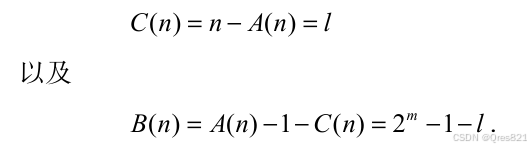
And we get the equations:

As we know the closed form of A(n)A(n)A(n), we can solve fot B(n),C(n)B(n),C(n)B(n),C(n)