C-01 钉死了
__shfl_*_sync与 mask 纪律。手写 mask 能跑,但分组一变复杂就难组合。
本章把分组收成句柄:
thread_block_tile/coalesced_group,并用本机曲线钉死「抽象税≈0」与「tile>32 悬崖」。
TL;DR(工程结论)
口径:RTX 5090 /
sm_120,CUDA event median ;reduce 用--reps 50放大原语代价。完整表见docs/results/C-02_cooperative_groups.md。
- CG = 分组句柄,不是更快的 shuffle :
thread_block_tile<N>(N≤32)把 mask/rank 收进类型;本机 tile32 / cg_reduce 相对手写 intrinsic ≈ 1.00× / 0.99×。 - 该上静态 tile :固定子 warp / 半 warp 集体、少手写 mask、要把 group 当参数传进
__device__函数时,用tiled_partition<N>。 - tile 大小悬崖(本机) :
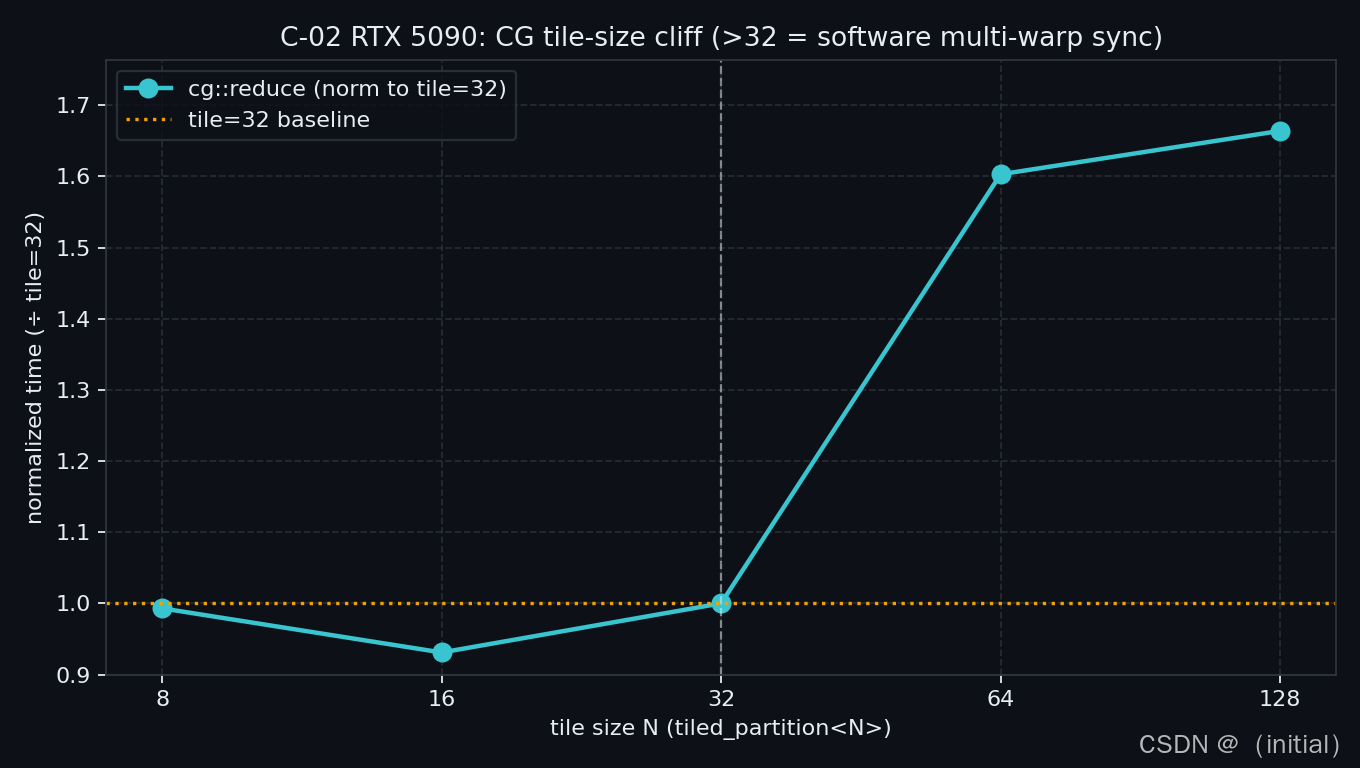
cg::reduce在 tile≤32 持平;64→1.60×,128→1.66× (相对 tile=32)。大 tile 走软件多 warp sync------别当 block-wide 默认。 coalesced_group:发散后「此刻活跃线程」的安全集合,适合聚合原子入口;不是 任意逻辑 mask 的替代(与 C-01activemask纪律同族)。- 判停 :看
tile32/intrinsic≈1 且sweep在 >32 抬升;cluster 有则 verify OK。禁止把 ncu 附着墙钟当结论。
1. 问题:intrinsic 会了,分组怎么写得可组合
| 问题 | 本章交付 |
|---|---|
| 少写 mask,还能同速? | thread_block_tile vs 手写 intrinsic |
| 固定子集集体怎么表达? | tiled_partition<N> |
| 发散后谁该参与集体? | coalesced_threads |
大 tile cg::reduce 能不能当 block reduce? |
sweep 悬崖曲线 |
| Hopper+ 簇内共享怎么验? | cluster 可选支线(功能) |
边界:
| 章节 | 已覆盖 | 本章不重复 |
|---|---|---|
| C-01 | *_sync / shfl vs SMEM / redux |
不重测 smem 树;手写 shfl 只作基线标签 |
| A-04 | Divergence / ITS | 不重讲机制课 |
| C-03(下) | Atomics 争用 | coalesced 只给入口形态 + 正确性 |
| C-04(下) | 同步分层 / grid sync | 不做 this_grid / cooperative launch 全家桶 |
| Module D | DeviceReduce | 不做多 block 全局规约 |
| B-08 | TMA / async | 不抢 DSMEM+TMA 深挖 |
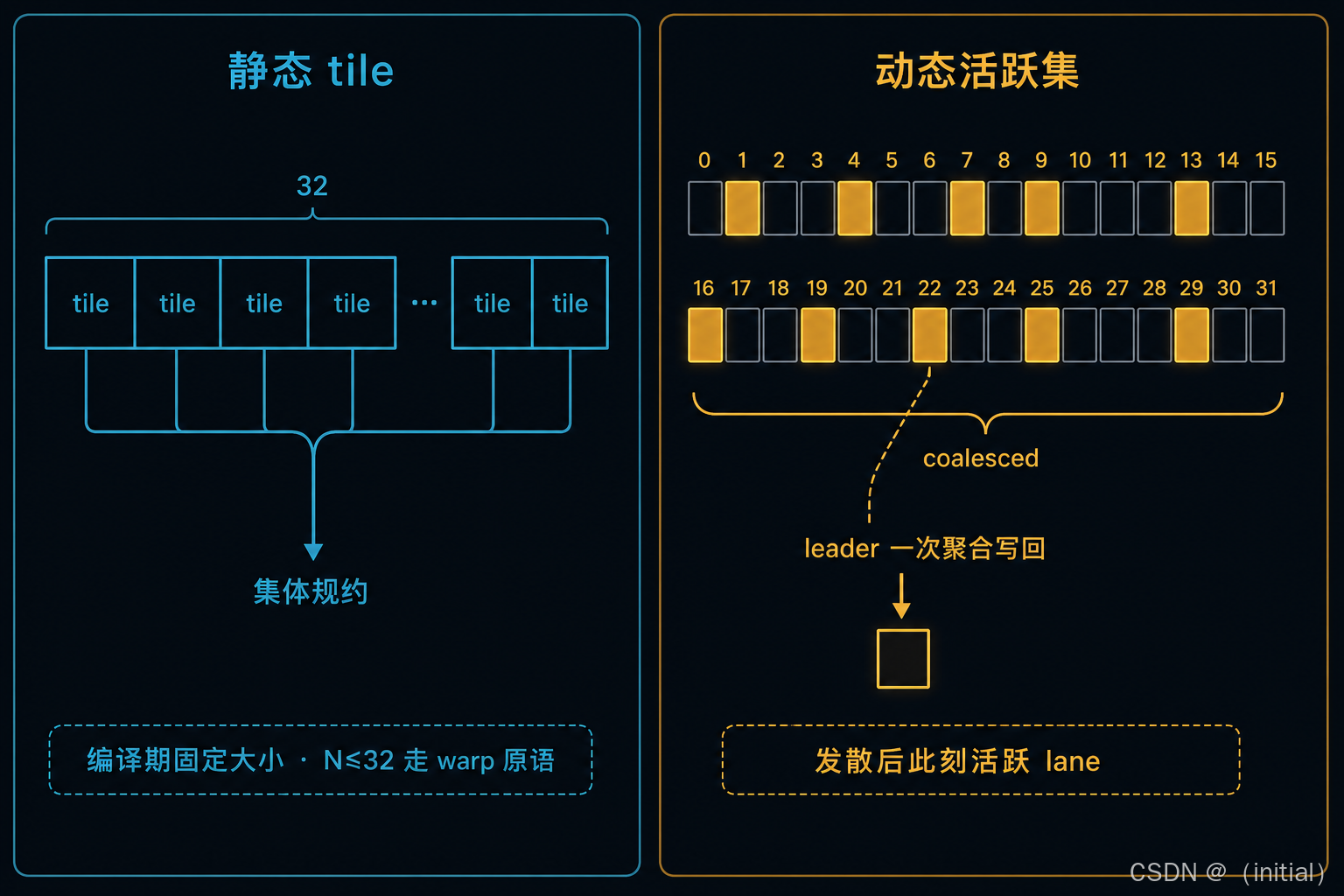
左:静态 tile------编译期固定大小,N≤32 走 warp 原语(对应
tiled_partition<N>)。右:动态活跃集------发散后此刻活跃 lane;leader 一次聚合写回(对应coalesced_threads())。
2. 物理模型:先有 group,再有集体
text
this_thread_block()          ← 启动配置隐含
        │
        ├─ tiled_partition<N>  → thread_block_tile<N>   (固定、可嵌套)
        ├─ coalesced_threads() → coalesced_group        (动态活跃集)
└─ this_cluster() → cluster_group (sm_90+,可选)| 路径 | 集合怎么定 | 典型集体 | 本机角色 |
|---|---|---|---|
手写 __shfl_*_sync |
你填 mask | shuffle / vote | 基线 |
thread_block_tile<N> |
分区几何 + 编译期 N | shfl_* / reduce / sync |
主对照 |
coalesced_group |
此刻收敛的活跃 lane | size / shfl / leader atomic |
定点 |
cluster_group |
启动时 cluster 维 | sync / map_shared_rank |
可选功能 |
N≤32 的 tile 落在单 warp 内,同步便宜;N>32 跨多个 warp,CG 用更通用的软件路径(论坛口径:busy-wait on memory),墙钟会抬------这就是主曲线要钉的悬崖。
3. API 分层(本章用到的)
| 层 | 代表 | 作用 |
|---|---|---|
| Implicit | this_thread_block() |
拿到 block 句柄,再 partition |
| Tile | tiled_partition<N>(block) |
静态子组;N 为 2 的幂且 ≤ block |
| Coalesced | coalesced_threads() |
发散分支内的活跃集 |
| Collectives | g.shfl_down / cg::reduce / g.sync |
在 group 上做集体 |
| Cluster(可选) | this_cluster() |
簇屏障 + DSMEM 映射 |
cpp
namespace cg = cooperative_groups;
cg::thread_block block = cg::this_thread_block();
cg::thread_block_tile<32> tile = cg::tiled_partition<32>(block);
float v = cg::reduce(tile, local, cg::plus<float>());
coalesced 聚合入口(与示例同构):
cpp
if (pred) {
  cg::coalesced_group g = cg::coalesced_threads();
  if (g.thread_rank() == 0)
    atomicAdd(out, (unsigned long long)g.size());
}
mask 细则仍归 C-01;本章用类型把「谁参与」说清楚。grid 级 this_grid() + cudaLaunchCooperativeKernel 留给 C-04。
4. 决策表
| 信号 | 建议 |
|---|---|
| 固定 N≤32 的 warp/子 warp 集体,要少写 mask | thread_block_tile<N> (或 cg::reduce) |
| 要把 group 当参数传入 device 函数 | 传 thread_block_tile<N> / coalesced_group |
| 发散后只对活跃线程聚合原子 | coalesced_threads() → C-03 深挖争用 |
| block-wide / 多 warp 规约要性能 | 别用 大 tile cg::reduce;回 C-01 处方或 CUB |
| 整 device 规约 / Softmax | Module D |
| 跨 block 同步 / grid barrier | C-04 |
| 簇内 DSMEM 小验证(sm_90+) | 本章 cluster 支线;生产路径另测 |
处方(与示例同构)
text
每线程 grid-stride 局部累加
        │
        ├─ intrinsic:__shfl_down_sync 树(基线)
        ├─ tile32:thread_block_tile<32>.shfl_down
        └─ cg_reduce:cg::reduce(tile, ...)  (sweep 扫 N)
--reps 只放大规约轮次(一次 GMEM 载入),把「分组原语差价」从访存墙里剥出来;verify 仍走 reps=1 精确比对。
5. 实验怎么设计
| 项 | 路径 |
|---|---|
| 代码 | examples/03_compute_primitives/02_cooperative_groups.cu |
| 结果 | docs/results/C-02_cooperative_groups.md · C-02_sweep.csv / C-02_modes.csv |
| 绘图 | python scripts/plot_c02_cooperative_groups.py |
一条主命令(主结论)
bash
./bin/03_compute_primitives_02_cooperative_groups --mode sweep定点全表(抽象税 / coalesced / cluster)
bash
./bin/03_compute_primitives_02_cooperative_groups --mode modes| mode | 问题 | 进主结论? |
|---|---|---|
intrinsic / tile32 / cg_reduce |
抽象税 @ tile=32 | 定点 |
sweep |
tile∈{8,16,32,64,128} 的 cg::reduce 形状 |
主曲线 |
coalesced |
聚合计数正确? | 定点表 |
cluster |
sm_90+ DSMEM 邻块读 | 可选 |
modes |
定点一次跑齐 | 写结果用 |
证据优先级:CUDA event median → 相对 tile=32 的 norm;正确性失败非零退出。NCU 可选,本章默认不加 profile shell。
5.1 本机实测(RTX 5090 / sm_120)
平台与完整表:docs/results/C-02_cooperative_groups.md。重画:
bash
python scripts/plot_c02_cooperative_groups.pySweep(主结论)
| tile | median_ms | norm(÷tile32) |
|---|---|---|
| 8 | 0.0275 | 0.993 |
| 16 | 0.0258 | 0.931 |
| 32 | 0.0277 | 1.000 |
| 64 | 0.0444 | 1.603 |
| 128 | 0.0461 | 1.664 |
Modes 定点(tile=32)
| tag | median_ms | 相对 |
|---|---|---|
| intrinsic / tile32 / cg_reduce | 0.0253 / 0.0254 / 0.0250 | 1.004× / 0.990× |
| coalesced | 0.2354 | verify OK(odd=8388608) |
| cluster | 0.0069 | verify OK(clusize=2) |
怎么读
- 抽象税≈0:三种写法在噪声内------CG 不额外收通行费(tile≤32)。tile=16 的 norm 0.93 略快于 32,属亚 warp 波动,不改「≤32 持平」结论。
- 悬崖在 32 之后:64/128 相对 tile32 贵约六成;与「大 tile 软件 sync」同向。
- coalesced / cluster:功能旁证;时延不与 reduce 加速比横比。cluster 核几乎无计算,短时延别当性能故事。
5.2 旁证
本章未跑 NCU。若要补:对比 intrinsic vs cg_reduce@32 的 inst_executed(应对齐),以及 @128 的 barrier/stall 是否抬升。主结论仍以裸跑 median 为准。
6. 工程边界
| 项 | 说明 |
|---|---|
| 硬件 | tile / coalesced:全架构常用路径;this_cluster:sm_90+ |
| 类型 | 示例 float reduce + int coalesced 计数;生产类型按 CUB/CG 文档 |
| 正确性 | partial 求和 / odd_count / DSMEM 邻块值与 host 期望比对 |
| 大 tile | CC≤7.5 的大 tile 可能需 block_tile_memory;sm_80+ 按官方说明 |
| 与 C-01 | mask 纪律不改;本章只换表达层 |
| 与 D | 多 block DeviceReduce → Module D |
7. 扩展阅读(不抢后续章)
| 想继续 | 去向 |
|---|---|
| 生产级 block reduce | CUB BlockReduce(见 §10-B);别用大 tile CG 顶替 |
| warp 聚合原子争用曲线 | C-03(见 §10-D ARC) |
| grid sync / cooperative launch | C-04(见 §10-C SyncMicrobenchmark) |
| Cluster DSMEM 深挖 | 官方 Clusters 节(见 §10-A);不抢 B-08 TMA |
8. SOP + 误区
SOP
- 确认集合是固定 tile、发散活跃集,还是必须跨 warp/block。
- N≤32:优先
thread_block_tile/cg::reduce;要极致可控仍可用手写*_sync。 - N>32 或整 block:回 C-01 处方或 CUB,先跑
--mode sweep看悬崖。 - 发散聚合:
coalesced_threads+ leader;争用曲线留给 C-03。 - 判停:
modes抽象税≈1 且sweep在 >32 抬升;再考虑库与下章。
误区
| 误区 | 正解 |
|---|---|
| CG 比手写 shuffle 更快 | 本机 ≈同速;赚的是可读性与可组合性 |
cg::reduce(tile<128>) 当默认 block reduce |
悬崖:本机 ~1.6×;用 CUB / C-01 模式 |
coalesced_threads = 任意逻辑 mask |
只是此刻活跃集;逻辑 mask 仍自己算(C-01) |
| cluster 短时延 = 生产加速比 | 功能验证核;DSMEM 收益另测 |
继续用 legacy 无 _sync shuffle |
Volta+ 仍走 C-01 纪律 |
9. 小结与下一章
分组先写成句柄:tile≤32 几乎零抽象税;跨过 32 要付软件 sync 的账。
sweep 回答「大 tile 值不值」;coalesced 只演示聚合入口,争用留给下一章。
下一章 C-03 Atomics 与 contention:global vs shared、分层规约、warp-aggregated 深挖------不再复读本章 CG 分层表。
10. 参考文献
A. 官方
- CUDA Programming Guide --- Cooperative Groups
- Device-Callable APIs --- Cooperative Groups
- CUDA C++ Programming Guide --- Thread Block Clusters(Clusters 节)
B. 工程
- NVIDIA, Cooperative Groups: Flexible CUDA Thread Programming
- NVIDIA 论坛,CG vs CUB reduce(tile≤32 vs >32)
- CCCL/CUB --- Block/Warp collectives
C. 实证
- Zhang et al., arXiv:2004.05371(SyncMicrobenchmark;grid sync 成本旁证 → C-04)
- 本仓库 C-01 结果
C-01_warp_primitives.md(手写 shfl 基线)
D. 前沿 / 扩展
- Collange, Warp-synchronous programming with Cooperative Groups
- Durvasula et al., ARC, ASPLOS'25, DOI:10.1145/3669940.3707238 → C-03