上篇
deepseek v4的kv cache类型
python
# https://github.com/vllm-project/vllm/blob/v0.27.1/vllm/models/deepseek_v4/attention.py#L655
class DeepseekV4Attention(nn.Module, AttentionLayerBase, ABC):
    def get_kv_cache_spec(self, vllm_config: VllmConfig) -> KVCacheSpec | None:
        if (
            self.compress_ratio <= 1
        ):  # SWA part. Allocated separately as DeepseekV4SWACache.
            return None
        # fp8_ds_mla is a UE8M0 block-scaled uint8 layout and needs 576B
        # alignment; plain bf16 / per-tensor fp8 rows use natural element-size
        # pages.
        uses_fp8_ds_mla_layout = self.kv_cache_dtype == "fp8_ds_mla"
        return MLAAttentionSpec(
            block_size=vllm_config.cache_config.block_size,
            num_kv_heads=1,
            head_size=self.head_dim,
            dtype=torch.uint8 if uses_fp8_ds_mla_layout else self.kv_cache_torch_dtype,
            compress_ratio=self.compress_ratio,
            cache_dtype_str=self.kv_cache_dtype,
            alignment=576 if uses_fp8_ds_mla_layout else 512,
            model_version="deepseek_v4",
            kv_quant_mode=get_kv_quant_mode(self.kv_cache_dtype),
        )

# https://github.com/vllm-project/vllm/blob/v0.27.1/vllm/models/deepseek_v4/attention.py#L698
class DeepseekV4IndexerCache(torch.nn.Module, AttentionLayerBase):
    def get_kv_cache_spec(self, vllm_config: VllmConfig) -> KVCacheSpec:
        # head_dim already carries the fp8 scale padding
        # compress_ratio=1 for V3.2, >1 for DeepseekV4; both use the same cache layout.
        uses_fp8_ds_mla_layout = vllm_config.cache_config.cache_dtype == "fp8_ds_mla"
        return MLAAttentionSpec(
            block_size=self.cache_config.block_size,
            num_kv_heads=1,
            head_size=self.head_dim,
            dtype=self.dtype,
            compress_ratio=self.compress_ratio,
            # 576B for FlashMLA packing; 512B for FlashInfer sparse (#44577).
            alignment=576 if uses_fp8_ds_mla_layout else 512,
        )

# https://github.com/vllm-project/vllm/blob/v0.27.1/vllm/v1/attention/backends/mla/sparse_swa.py#L87
class DeepseekV4SWACache(torch.nn.Module, AttentionLayerBase):
    def __init__(
        self,
        head_dim: int,
        window_size: int,
        dtype: torch.dtype,
        prefix: str,
        cache_config: CacheConfig,
    ):
        super().__init__()
        self.kv_cache = torch.tensor([])
        self.head_dim = head_dim
        self.window_size = window_size
        self.prefix = prefix
        self.cache_config = cache_config
        self.dtype = dtype

        # Block size is constrained by tensor sharing between SWA and C4A KV blocks.
        # Since both block types share the same physical tensor, they must use the
        # same page size. The C4A KV block shape [256//4, head_dim] = [64, head_dim]
        # determines the SWA block size of 64 tokens per block.
        # TODO(yifan): make SWA block size automatically determined and configurable.
        self.block_size = 64
    def get_kv_cache_spec(self, vllm_config: VllmConfig) -> KVCacheSpec:
        # fp8_ds_mla's UE8M0 paged layout needs 576B alignment; contiguous
        # bf16/fp8 cache uses the natural element-size page.
        uses_fp8_ds_mla_layout = self.cache_config.cache_dtype == "fp8_ds_mla"
        return SlidingWindowMLASpec(
            block_size=self.block_size,
            num_kv_heads=1,
            head_size=self.head_dim,
            dtype=self.dtype,
            sliding_window=self.window_size,
            cache_dtype_str=self.cache_config.cache_dtype,
            # 576B for FlashMLA packing; 512B for FlashInfer sparse (#44577).
            alignment=576 if uses_fp8_ds_mla_layout else 512,
            model_version="deepseek_v4",
            kv_quant_mode=get_kv_quant_mode(self.cache_config.cache_dtype),
        )
python
class DeepseekV4SparseMLABackend(AttentionBackend):
    """DeepSeek-V4 sparse-MLA backend base.

    Subclasses ``AttentionBackend`` directly (not the V3.2
    ``FlashMLASparseBackend``): DeepSeek-V4 runs its own attention layer
    (``DeepseekV4Attention``), so it does not reuse the V3.2 builder or impl, and
    only needs to declare its own metadata builder, KV-cache layout, and the
    sparse-MLA capability flags.
    """

    supported_dtypes: ClassVar[list[torch.dtype]] = [torch.bfloat16]
    supported_kv_cache_dtypes: ClassVar[list[CacheDType]] = [
        "auto",
        "fp8_ds_mla",
        "fp8",  # alias for fp8_ds_mla
    ]

    @staticmethod
    def get_supported_kernel_block_sizes() -> list[int | MultipleOf]:
        return [256]

    @classmethod
    def get_supported_head_sizes(cls) -> list[int]:
        # DeepSeek V4 layout: 448 NoPE + 64 RoPE = 512.
        return [512]

    @staticmethod
    def get_kv_cache_shape(
        num_blocks: int,
        block_size: int,
        num_kv_heads: int,
        head_size: int,
        cache_dtype_str: str = "auto",
    ) -> tuple[int, ...]:
        if cache_dtype_str == "fp8_ds_mla":
            # DeepseekV4 main MLA: 584B per token (448 NoPE + 128 RoPE + 8 fp8 scale).
            # head_size passed in is the semantic head_dim (512).
            return (num_blocks, block_size, 584)
        else:
            return (num_blocks, block_size, head_size)
page_size_bytes 的计算
page_size_bytes实际上是按照alignment对齐后的字节数。后续分析先忽略这一点。
MLAAttentionSpec.real_page_size_bytes
python
def _apply_alignment_padding(spec: MLAAttentionSpec | SlidingWindowMLASpec):
    if spec.alignment is None:
        return
    actual_page_size = spec.real_page_size_bytes
    padded_page_size = round_up(actual_page_size, spec.alignment)
    if padded_page_size != actual_page_size:
        object.__setattr__(spec, "page_size_padded", padded_page_size)

class MLAAttentionSpec(FullAttentionSpec):
    def __post_init__(self):
        super().__post_init__()
        _apply_alignment_padding(self)

    @property
    def real_page_size_bytes(self) -> int:
        if self.cache_dtype_str == "fp8_ds_mla":
            if self.model_version == "deepseek_v4":
                # DeepseekV4: 448B NoPE + 128B RoPE + 8B fp8 scale = 584B per token.
                # head_size stays semantic (512); bytes are determined here.
                return self.storage_block_size * 584
            # V3.2 main MLA: 656-byte custom layout (kv_lora_rank=512 +
            # qk_rope_head_dim=64, head_size=576). See flashmla_sparse.py.
            return self.block_size * 656
        if self.kv_quant_mode == KVQuantMode.INT4_PER_TOKEN_HEAD:
            head_dim = self.head_size // 2
        else:
            head_dim = self.head_size
        return (
            self.storage_block_size
            * self.num_kv_heads
            * head_dim
            * get_dtype_size(self.dtype)
        )

# https://github.com/vllm-project/vllm/blob/v0.27.1/vllm/v1/kv_cache_interface.py#L631
class SlidingWindowMLASpec(SlidingWindowSpec):
    @property
    def real_page_size_bytes(self) -> int:
        if self.model_version == "deepseek_v4" and self.cache_dtype_str == "fp8_ds_mla":
            # DeepseekV4 FlashMLA: 448B NoPE + 128B RoPE + 8B fp8 scale = 584B
            # per token. FlashInfer's contiguous bf16/fp8 cache falls through to
            # the element-size formula below.
            return self.storage_block_size * 584
        assert self.model_version in (None, "deepseek_v4"), (
            f"Unsupported model version: {self.model_version}"
        )
        return (
            self.storage_block_size
            * self.num_kv_heads
            * self.head_size
            * get_dtype_size(self.dtype)
        )
DeepSeek V4 in vLLM: Efficient Long-context Attention
Different layers compress at different rates (1/4 for c4a, 1/128 for c128a, 1/1 for SWA). we fix the logical block at 256 native token positions for every compressed layer. A c4a block then physically holds 256 / 4 = 64 compressed entries, and a c128a block holds 256 / 128 = 2.
CSA 和HCA 逻辑 block_size = 256, storage_block_size = block_size/compress_ratio.
SWA的 block_size = 64。
| Group | compress_ratio | storage_block_size | 每token大小 | real_page_size_bytes |
|---|---|---|---|---|
| CSA | 4 | 256/4 = 64 | 584B | 64 × 584 = 37,376B |
| HCA | 128 | 256/128 = 2 | 584B | 2 × 584 = 1,168B |
| SWA | 1 | 64 | 584B | 64 × 584 = 37,376B |
num_blocks 的计算
text
get_kv_cache_configs()
    ├── get_kv_cache_groups()
    │   └── group_and_unify_kv_cache_specs()  # DeepseekV4 特殊处理
    │       └── _get_kv_cache_groups_uniform_groups()
    ├── _project_kv_cache_groups_to_worker()
    └── get_kv_cache_config_from_groups()  # 循环调用
        └── _use_packed_kv_cache_config()  # 判断是否使用 packed 布局
            └── _get_kv_cache_config_packed()
                └── _get_packed_kv_cache_layout()
python
def get_kv_cache_configs(
    vllm_config: VllmConfig,
    kv_cache_specs: list[dict[str, KVCacheSpec]],
    available_memory: list[int],
) -> list[KVCacheConfig]:
get_kv_cache_config_from_groups
python
def get_kv_cache_config_from_groups(
    vllm_config: VllmConfig,
    kv_cache_groups: list[KVCacheGroupSpec],
    available_memory: int,
) -> KVCacheConfig:
    """
    Generate the KV cache configuration from the KV cache groups and spec
    of each layer.

    Args:
        vllm_config: The global VllmConfig
        kv_cache_groups: The KV cache groups
        available_memory: Memory available for KV cache in bytes
    Returns:
        The generated KVCacheConfig
    """
    if len(kv_cache_groups) == 0:
        # Attention free models do not have KV cache.
        # Return num_blocks=1 as BlockPool always needs a null_block.
        return KVCacheConfig(
            num_blocks=1,
            kv_cache_tensors=[],
            kv_cache_groups=kv_cache_groups,
        )

    # Determine how model runners should initialize the KV cache tensors.
    if len(kv_cache_groups) == 1 and isinstance(
        kv_cache_groups[0].kv_cache_spec, UniformTypeKVCacheSpecs
    ):
        # Special case: all layers have the same type of KV cache but with
        # different hidden sizes. Allocate different amount of memory for each
        # layer based on its hidden size.
        num_blocks = (
            available_memory // kv_cache_groups[0].kv_cache_spec.page_size_bytes
        )
        num_blocks = may_override_num_blocks(vllm_config, num_blocks)
        per_layer_specs = kv_cache_groups[0].kv_cache_spec.kv_cache_specs
        kv_cache_tensors = [
            KVCacheTensor(
                size=per_layer_specs[layer_name].page_size_bytes * num_blocks,
                shared_by=[layer_name],
            )
            for layer_name in kv_cache_groups[0].layer_names
        ]
    elif _use_packed_kv_cache_config(vllm_config, kv_cache_groups):
        # DeepSeek V4 uses the packed layout by default. Other multi-group
        # layouts can opt in with --enable-cross-layers.
        num_blocks, kv_cache_tensors = _get_kv_cache_config_packed(
            vllm_config, kv_cache_groups, available_memory
        )
    else:
        # General case:
        # We will have group_size memory pools, each is shared by one layer from
        # each group. As layers of different groups have different block table,
        # they will use different parts of the shared Tensor.
        # The memory layout for 3 groups (full.0, full.1), (sw.0, sw.2),
        # (sw.1, padding) will be: (group_size = 2)
        # full.0, sw.0, sw.1: share a Tensor with size=available_memory//2
        # full.1, sw.2: share another Tensor with size=available_memory//2
        group_size = max(len(group.layer_names) for group in kv_cache_groups)

        page_size = get_uniform_page_size(
            [group.kv_cache_spec for group in kv_cache_groups]
        )
        assert group_size > 0, "group_size must be greater than 0"
        num_blocks = get_num_blocks(
            vllm_config, group_size, available_memory, page_size
        )
        kv_cache_tensors = []
        for i in range(group_size):
            shared_by = []
            for j in range(len(kv_cache_groups)):
                if i < len(kv_cache_groups[j].layer_names):
                    shared_by.append(kv_cache_groups[j].layer_names[i])
            kv_cache_tensors.append(
                KVCacheTensor(size=page_size * num_blocks, shared_by=shared_by)
            )

    return KVCacheConfig(
        num_blocks=num_blocks,
        kv_cache_tensors=kv_cache_tensors,
        kv_cache_groups=kv_cache_groups,
    )
python
def _get_kv_cache_config_packed(
    vllm_config: VllmConfig,
    kv_cache_groups: list[KVCacheGroupSpec],
    available_memory: int,
) -> tuple[int, list[KVCacheTensor]]:
    """Plan a packed per-block KV cache tensor layout.

    Cache groups use dense, overlapping layouts within one block slab. Each
    emitted tensor aliases the same physical backing allocation.
    """
    block_stride, layers_by_offset = _get_packed_kv_cache_layout(kv_cache_groups)

    num_blocks = available_memory // block_stride
    num_blocks = may_override_num_blocks(vllm_config, num_blocks)

    total_size = block_stride * num_blocks

    kv_cache_tensors: list[KVCacheTensor] = []
    for byte_offset in sorted(layers_by_offset):
        kv_cache_tensors.append(
            KVCacheTensor(
                size=total_size,
                shared_by=layers_by_offset[byte_offset],
                offset=byte_offset,
                block_stride=block_stride,
            )
        )

    return num_blocks, kv_cache_tensors
针对packed kv cache kayout,_allocate_kv_cache_tensors只会分配一块物理内存packed_backing。
block_stride的计算:_get_packed_kv_cache_layout
python
def _get_packed_kv_cache_layout(
    kv_cache_groups: list[KVCacheGroupSpec],
) -> tuple[int, dict[int, list[str]]]:
    """Lay out each cache group densely in one shared block slab.

    A block ID is owned by one cache group at a time, so layouts from different
    groups may overlap. Layers within a group remain disjoint.
    """
    layers_by_offset: dict[int, list[str]] = defaultdict(list)
    block_stride = 0
    for group in kv_cache_groups:
        spec = group.kv_cache_spec
        byte_offset = 0
        for layer_name in group.layer_names:
            if isinstance(spec, UniformTypeKVCacheSpecs):
                page_size = spec.kv_cache_specs[layer_name].page_size_bytes
            else:
                page_size = spec.page_size_bytes
            layers_by_offset[byte_offset].append(layer_name)
            byte_offset += page_size
        block_stride = max(block_stride, byte_offset)
    assert block_stride > 0
    return block_stride, layers_by_offset
计算 block_stride
python
CSA Group:  30层 × 37,376B  = 1,121,280B
HCA Group:  31层 × 1,168B   = 36,208B
SWA Group:  61层 × 37,376B = 2,279,936B  ← 最大

block_stride = max(1,121,280, 36,208, 2,279,936) = 2,279,936B
内存分配时候,按照最大block_stride分配。一个block可以覆盖所有group的内存需求。同一时刻,一个 block 只会被一个 Group 使用。
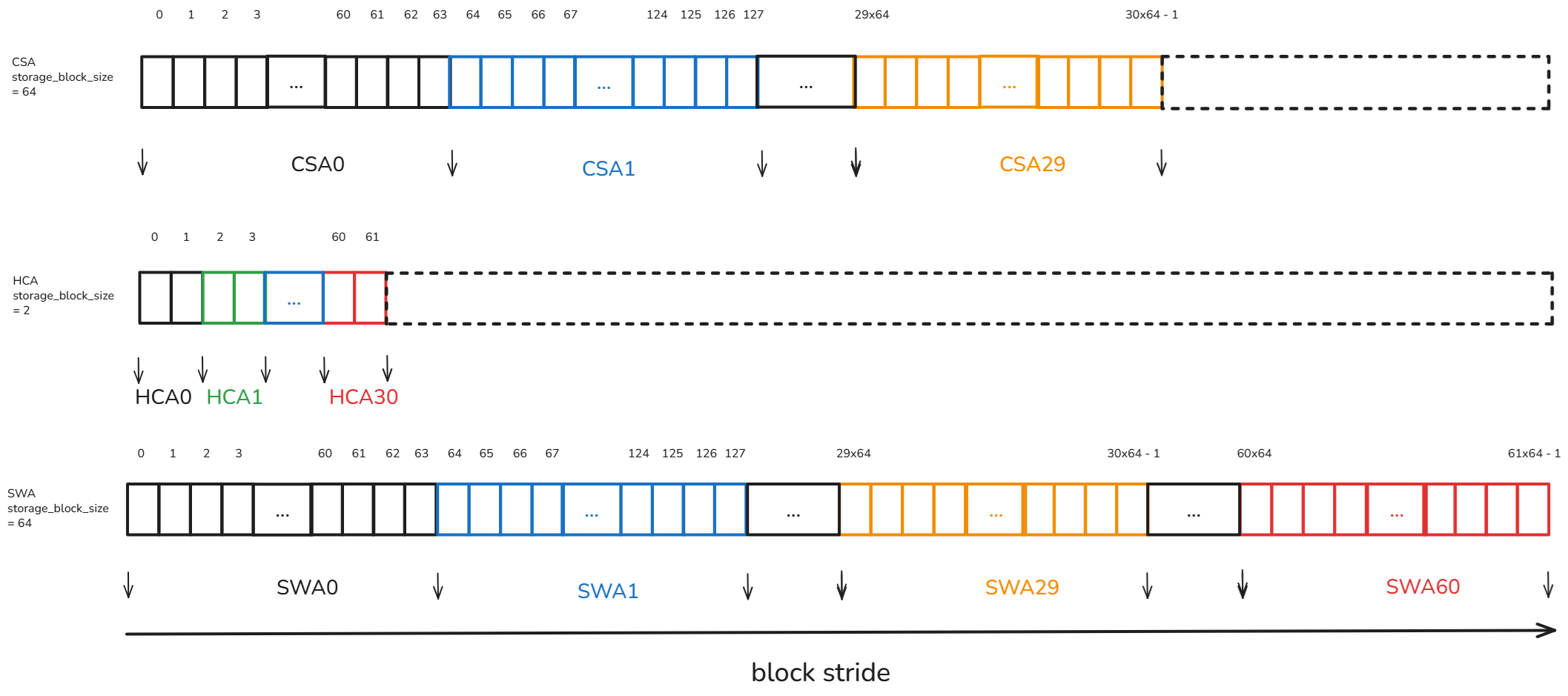
num_blocks的计算:
num_blocks = available_memory // block_strideblock_stride = 2,279,936 字节 (约 2.28 MB)
假设 available_memory = 10 GB (即 10,737,418,240 字节)
则 num_blocks = 10,737,418,240 // 2,279,936 ≈ 4710 个块
内存布局:
text
物理内存(total_size = block_stride × num_blocks):

Block 0 (block_stride B)   Block 1 (block_stride B)   ...   Block N (block_stride B)
┌──────────────────────┐  ┌──────────────────────┐        ┌──────────────────────┐
│ Layer0 (offset=0)    │  │ Layer0 (offset=0)    │        │ Layer0 (offset=0)    │
│ Layer1 (offset=100B) │  │ Layer1 (offset=100B) │        │ Layer1 (offset=100B) │
│ ...                  │  │ ...                  │        │ ...                  │
│ LayerN (offset=...)  │  │ LayerN (offset=...)  │        │ LayerN (offset=...)  │
└──────────────────────┘  └──────────────────────┘        └──────────────────────┘
layers_by_offset 构造过程模拟
Group 1: SWA Group (61层)
python
byte_offset = 0
for i in range(61):
    layer_name = f"swa_{i}"
    page_size = 37,376B
    layers_by_offset[byte_offset].append(layer_name)  # 0: ['swa_0']
    byte_offset += 37,376
遍历完成后:
text
offset 0:      ['swa_0']
offset 37,376: ['swa_1']
offset 74,752: ['swa_2']
offset 112,128: ['swa_3']
...
offset : 2,242,560['swa_60']  # 60 * 37,376
byte_offset = 61 * 37,376 = 2,279,936B
Group 2: CSA Group (30层)
python
byte_offset = 0
for i in range(30):
    layer_name = f"csa_{i}"
    page_size = 37,376B
    layers_by_offset[byte_offset].append(layer_name)
    byte_offset += 37,376
遍历完成后:
text
offset 0:      ['swa_0', 'csa_0']        # 与swa_0重叠
offset 37,376: ['swa_1', 'csa_1']
offset 74,752: ['swa_2', 'csa_2']
offset 112,128: ['swa_3', 'csa_3']
...
offset 1,084,416: ['swa_29', 'csa_29']  # 29 * 37,376
byte_offset = 30 * 37,376 = 1,121,280B
Group 3: HCA Group (31层)
python
byte_offset = 0
for i in range(31):
    layer_name = f"hca_{i}"
    page_size = 1,168B
    layers_by_offset[byte_offset].append(layer_name)
    byte_offset += 1,168
遍历完成后:
text
offset 0:      ['swa_0', 'csa_0', 'hca_0']  # 三者重叠
offset 1,168:  ['hca_1']
offset 2,336:  ['hca_2']
offset 3,504:  ['hca_3']
...
offset 35,040: ['hca_30']  # 30 * 1,168
byte_offset = 31 * 1,168 = 36,208B
最终的 layers_by_offset
text
layers_by_offset = {
    # === 偏移 0 处,三组的第一层完全重叠 ===
    0: ['swa_0', 'csa_0', 'hca_0'],

    # === 偏移 1,168 到 35,040:HCA 组各层占据的间隙 ===
    1,168: ['hca_1'],
    2,336: ['hca_2'],
    3,504: ['hca_3'],
    # ... (中间按 1,168B 步长递增)
    35,040: ['hca_30'],

    # === 偏移 37,376 开始,SWA 和 CSA 层按 37,376B 步长对齐 ===
    37,376: ['swa_1', 'csa_1'],
    74,752: ['swa_2', 'csa_2'],
    112,128: ['swa_3', 'csa_3'],
    # ... (中间按 37,376B 步长递增)
    1,084,416: ['swa_29', 'csa_29'],  # 29 * 37,376

    # === 仅属于 SWA 组的剩余层 (CSA 只有30层) ===
    1,121,280: ['swa_30'],
    1,158,656: ['swa_31'],
    1,196,032: ['swa_32'],
    # ... (中间按 37,376B 步长递增)
    2,242,560: ['swa_60'],  # 60 * 37,376
}
kv cache 内存分配
python
# https://github.com/vllm-project/vllm/blob/v0.27.1/vllm/v1/worker/gpu_model_runner.py#L7541
class GPUModelRunner(
    LoRAModelRunnerMixin, KVConnectorModelRunnerMixin, ECConnectorModelRunnerMixin
):
    def initialize_kv_cache_tensors(
        self, kv_cache_config: KVCacheConfig, kernel_block_sizes: list[int]
    ) -> dict[str, torch.Tensor]:
        """
        Initialize the memory buffer for KV cache.

        Args:
            kv_cache_config: The KV cache config
            kernel_block_sizes: The kernel block sizes for each KV cache group.

        Returns:
            Dict[str, torch.Tensor]: A map between layer names to their
            corresponding memory buffer for KV cache.
        """

        # Try creating KV caches optimized for kv-connector transfers
        cache_dtype = self.cache_config.cache_dtype
        if self.use_uniform_kv_cache(self.attn_groups):
            kv_caches, cross_layers_kv_cache, attn_backend = (
                self.allocate_uniform_kv_caches(
                    kv_cache_config,
                    self.attn_groups,
                    cache_dtype,
                    self.device,
                    kernel_block_sizes,
                )
            )
            self.cross_layers_kv_cache = cross_layers_kv_cache
            self.cross_layers_attn_backend = attn_backend
        else:
            # Fallback to the general case
            # Initialize the memory buffer for KV cache
            kv_cache_raw_tensors = self._allocate_kv_cache_tensors(kv_cache_config)

            # Change the memory buffer to the desired shape
            kv_caches = self._reshape_kv_cache_tensors(
                kv_cache_raw_tensors, kernel_block_sizes
            )

        # Set up cross-layer KV cache sharing
        for layer_name, target_layer_name in self.shared_kv_cache_layers.items():
            logger.debug("%s reuses KV cache of %s", layer_name, target_layer_name)
            kv_caches[layer_name] = kv_caches[target_layer_name]

        num_attn_module = (
            2 if self.model_config.hf_config.model_type == "longcat_flash" else 1
        )
        bind_kv_cache(
            kv_caches,
            self.compilation_config.static_forward_context,
            self.kv_caches,
            num_attn_module,
        )
        return kv_caches


# https://github.com/vllm-project/vllm/blob/v0.27.1/vllm/v1/worker/gpu_model_runner.py#L7312
    def _allocate_kv_cache_tensors(
        self, kv_cache_config: KVCacheConfig
    ) -> dict[str, torch.Tensor]:
        """
        Initializes the KV cache buffer with the correct size. The buffer needs
        to be reshaped to the desired shape before being used by the models.

        Args:
            kv_cache_config: The KV cache config
        Returns:
            dict[str, torch.Tensor]: A map between layer names to their
            corresponding memory buffer for KV cache.
        """
        kv_cache_raw_tensors: dict[str, torch.Tensor] = {}
        packed_backing: torch.Tensor | None = None
        for kv_cache_tensor in kv_cache_config.kv_cache_tensors:
            if kv_cache_tensor.block_stride > 0:
                # Allocate once; all packed tensors alias the same backing.
                if packed_backing is None:
                    packed_backing = torch.zeros(
                        kv_cache_tensor.size,
                        dtype=torch.int8,
                        device=self.device,
                    )
                tensor = packed_backing
            else:
                tensor = torch.zeros(
                    kv_cache_tensor.size, dtype=torch.int8, device=self.device
                )
            for layer_name in kv_cache_tensor.shared_by:
                kv_cache_raw_tensors[layer_name] = tensor

        layer_names = set()
        for group in kv_cache_config.kv_cache_groups:
            for layer_name in group.layer_names:
                if layer_name in self.runner_only_attn_layers:
                    continue
                layer_names.add(layer_name)
        assert layer_names == set(kv_cache_raw_tensors.keys()), (
            "Some layers are not correctly initialized"
        )
        return kv_cache_raw_tensors

# https://github.com/vllm-project/vllm/blob/v0.27.1/vllm/v1/worker/gpu_model_runner.py#L7364
    def _reshape_kv_cache_tensors(
        self,
        kv_cache_raw_tensors: dict[str, torch.Tensor],
        kernel_block_sizes: list[int],
    ) -> dict[str, torch.Tensor]:
        """
        Reshape the KV cache tensors to the desired shape and dtype.

        Args:
            kv_cache_raw_tensors: The KV cache buffer of each layer, with
                correct size but uninitialized shape.
            kernel_block_sizes: The kernel block sizes for each KV cache group.
        Returns:
            Dict[str, torch.Tensor]: A map between layer names to their
            corresponding memory buffer for KV cache.
        """
        kv_caches: dict[str, torch.Tensor] = {}
        has_attn, has_mamba = False, False

        # Map layer names to (offset, block_stride) within the packed
        # backing tensor so we can create strided views per layer.
        layer_packing: dict[str, tuple[int, int]] = {}
        for kv_tensor in self.kv_cache_config.kv_cache_tensors:
            if kv_tensor.block_stride > 0:
                for ln in kv_tensor.shared_by:
                    layer_packing[ln] = (kv_tensor.offset, kv_tensor.block_stride)
        for group in self._kv_cache_spec_attn_group_iterator():
            kv_cache_spec = group.kv_cache_spec
            attn_backend = group.backend
            if group.kv_cache_group_id == len(kernel_block_sizes):
                # There may be a last group for layers without kv cache.
                continue
            kernel_block_size = kernel_block_sizes[group.kv_cache_group_id]
            for layer_name in group.layer_names:
                if layer_name in self.runner_only_attn_layers:
                    continue
                raw_tensor = kv_cache_raw_tensors[layer_name]
                packing = layer_packing.get(layer_name)
                if packing is not None:
                    _, blk_stride = packing
                    num_blocks = raw_tensor.numel() // blk_stride
                else:
                    assert raw_tensor.numel() % kv_cache_spec.page_size_bytes == 0
                    num_blocks = raw_tensor.numel() // kv_cache_spec.page_size_bytes
                if isinstance(kv_cache_spec, AttentionSpec):
                    has_attn = True
                    num_blocks_per_kv_block = (
                        kv_cache_spec.block_size // kernel_block_size
                    )
                    kernel_num_blocks = num_blocks * num_blocks_per_kv_block

                    # For MLA with compression, storage_block_size != block_size
                    if kv_cache_spec.storage_block_size != kv_cache_spec.block_size:
                        shape_block_size = kv_cache_spec.storage_block_size
                    else:
                        shape_block_size = kernel_block_size

                    # Skipped layers (--kv-cache-dtype-skip-layers) need
                    # the unquantized shape.
                    layer_cache_dtype_str = (
                        "auto"
                        if kv_cache_spec.kv_quant_mode == KVQuantMode.NONE
                        else getattr(
                            kv_cache_spec,
                            "cache_dtype_str",
                            None,
                        )
                        or self.cache_config.cache_dtype
                    )
                    kv_cache_shape = attn_backend.get_kv_cache_shape(
                        kernel_num_blocks,
                        shape_block_size,
                        kv_cache_spec.num_kv_heads,
                        kv_cache_spec.head_size,
                        cache_dtype_str=layer_cache_dtype_str,
                    )
                    try:
                        kv_cache_stride_order = attn_backend.get_kv_cache_stride_order()
                        assert len(kv_cache_stride_order) == len(kv_cache_shape)
                    except (AttributeError, NotImplementedError):
                        kv_cache_stride_order = tuple(range(len(kv_cache_shape)))
                    raw_tensor = kv_cache_raw_tensors[layer_name]
                    kv_caches[layer_name] = _reshape_attention_kv_cache(
                        raw_tensor,
                        kv_cache_spec,
                        kv_cache_shape,
                        kv_cache_stride_order,
                        kernel_num_blocks,
                        packing,
                    )

                elif isinstance(kv_cache_spec, MambaSpec):
                    has_mamba = True
                    raw_tensor = kv_cache_raw_tensors[layer_name]
                    page_size_bytes = kv_cache_spec.page_size_bytes
                    # Hold a single contiguous [num_blocks, 1, 1, page_size_bytes]
                    # int8 page view per layer; the layer's bind_kv_cache unpacks
                    # each block's bytes into its conv/ssm state views. Keeping
                    # one tensor per layer lets the KV connector register it
                    # without special-casing Mamba.
                    kv_caches[layer_name] = raw_tensor[
                        : num_blocks * page_size_bytes
                    ].view(num_blocks, 1, 1, page_size_bytes)
                else:
                    raise NotImplementedError

        # Reconcile divergent KV layouts to blocks-first. Triggered by hybrid
        # attention/mamba models, and by encoder-decoder models whose shared
        # decoder/cross-attention allocation mixes K/V-first and blocks-first
        # backends (see _has_mixed_attention_kv_layout).
        if has_attn and (
            has_mamba or self._has_mixed_attention_kv_layout(kernel_block_sizes)
        ):
            self._update_hybrid_attention_mamba_layout(kv_caches, kernel_block_sizes)

        return kv_caches

# https://github.com/vllm-project/vllm/blob/v0.27.1/vllm/v1/worker/gpu/attn_utils.py#L211
def _reshape_attention_kv_cache(
    kv_raw_tensor: torch.Tensor,
    kv_cache_spec: AttentionSpec,
    kv_cache_shape: tuple[int, ...],
    kv_cache_stride_order: tuple[int, ...],
    num_blocks: int,
    packing: tuple[int, int] | None,
    page_aligned_blocks: bool = False,
) -> torch.Tensor:
    permuted_kv_cache_shape = tuple(kv_cache_shape[i] for i in kv_cache_stride_order)
    inv_order = [
        kv_cache_stride_order.index(i) for i in range(len(kv_cache_stride_order))
    ]
    dtype = kv_cache_spec.dtype

    if packing is not None:
        offset, block_stride = packing
        assert inv_order[0] == 0
        page_bytes = prod(kv_cache_shape[1:]) * get_dtype_size(dtype)
        kv_cache = (
            kv_raw_tensor.view(-1, block_stride)[:, offset : offset + page_bytes]
            .view(dtype)
            .view(permuted_kv_cache_shape)
        )
    elif kv_cache_spec.page_size_padded is not None:
        # Use a strided view to skip the padding between physical pages.
        #
        # Only num-blocks-first layouts are supported (the block dimension is
        # dim 0 of the unpermuted shape). kv-first layouts such as ROCm's
        # ``(2, num_blocks, ...)`` are intentionally not supported here. For a
        # num-blocks-first layout the only stride that must change is the block
        # stride: every other (contiguous) stride already steps within the
        # unpadded region of a page, so no further adjustment is needed.
        assert kv_cache_shape[0] == num_blocks, (
            "Padded KV pages require a num-blocks-first KV cache layout (got "
            f"shape {kv_cache_shape} with num_blocks={num_blocks}); "
            "kv-first layouts are not supported."
        )
        dtype_size = get_dtype_size(kv_cache_spec.dtype)
        page_stride = kv_cache_spec.page_size_bytes // dtype_size

        num_blocks_dim = inv_order[0]
        strides = list(torch.empty(permuted_kv_cache_shape, device="meta").stride())
        strides[num_blocks_dim] = page_stride

        kv_cache = torch.as_strided(
            kv_raw_tensor.view(dtype),
            size=permuted_kv_cache_shape,
            stride=tuple(strides),
        )
    elif page_aligned_blocks:
        # A KV-first layout such as ROCm's ``(2, num_blocks, ...)`` puts block
        # ``b``'s K and V in two far-apart halves of the allocation, so block
        # ``b`` does not cover page ``b``. Mamba layers sharing the allocation
        # do address their state by page, so the two would resolve the same
        # bytes. Build the view page-first instead, then swap the dims back.
        assert kv_cache_shape[1] == num_blocks and kv_cache_stride_order == tuple(
            range(len(kv_cache_shape))
        ), (
            "Page-aligned KV blocks expect a default-strided (kv, num_blocks, "
            f"...) layout, got shape {kv_cache_shape} with stride order "
            f"{kv_cache_stride_order} and num_blocks={num_blocks}."
        )
        kv_cache = (
            kv_raw_tensor.view(dtype)
            .view(num_blocks, kv_cache_shape[0], *kv_cache_shape[2:])
            .transpose(0, 1)
        )
    else:
        # No padding --- safe to use a contiguous view.
        kv_cache = kv_raw_tensor.view(dtype).view(permuted_kv_cache_shape)

    return kv_cache.permute(*inv_order)
DeepseekV4SparseMLABackend.get_kv_cache_shape
python
class DeepseekV4FlashMLABackend(AttentionBackend):
    @staticmethod
    def get_kv_cache_shape(
        num_blocks: int,
        block_size: int,
        num_kv_heads: int,
        head_size: int,
        cache_dtype_str: str = "auto",
    ) -> tuple[int, ...]:
        if cache_dtype_str == "fp8_ds_mla":
            # DeepseekV4 main MLA: 584B per token (448 NoPE + 128 RoPE + 8 fp8 scale).
            # head_size passed in is the semantic head_dim (512).
            return (num_blocks, block_size, 584)
        else:
            return (num_blocks, block_size, head_size)
针对packing情形,_allocate_kv_cache_tensors只分配一次packed_backing tensor。函数返回字典kv_cache_raw_tensors,值均为packed_backing。_reshape_kv_cache_tensors 将 KV 缓存内存块(kv_cache_raw_tensors)重塑为模型各注意力层所需具体形状,求取切片。
_reshape_kv_cache_tensors
在函数开始时,会遍历 kv_cache_config.kv_cache_tensors,为所有参与打包的层构建一个映射字典 layer_packing,记录每一层的 (offset, block_stride)。对于上面的例子:
python
layer_packing = {
    'swa_0': (0, 2_279_936),
    'csa_0': (0, 2_279_936),
    'hca_0': (0, 2_279_936),
    'swa_1': (37_376, 2_279_936),
    'csa_1': (37_376, 2_279_936),
    'hca_1': (1_168, 2_279_936),
    # ...
}
_reshape_attention_kv_cache 为每一层创建视图。
python
page_bytes = prod(kv_cache_shape[1:]) * dtype_size  # 计算单页字节数
kv_cache = (raw_tensor.view(-1, block_stride)       # 视图1: [总字节数/block_stride, block_stride]
            [:, offset : offset + page_bytes]       # 视图2: [num_blocks, page_bytes],切片出该层的区域
            .view(dtype)                            # 视图3: 转为目标数据类型 (如 fp8)
            .view(permuted_kv_cache_shape))         # 视图4: 重塑为后端要求的形状
以SWA_1层为例,shape_block_size = kv_cache_spec.storage_block_size =64。
DeepseekV4SparseMLABackend.get_kv_cache_shape 返回 (num_blocks, 64, 584)。
page_bytes = page_size_bytes = 64 x 584 = 37,376B针对SWA_1层,_reshape_attention_kv_cache返回的tensor切片(layer_view)就是下图中红色方框中的存储空间。
SWA_1层可用的存储空间(37,376 字节/块)不连续,而是被分割成 num_blocks 个碎片,分别存储在 packed_backing 的 Block 0、Block 1...Block N 中对应的 offset 处。
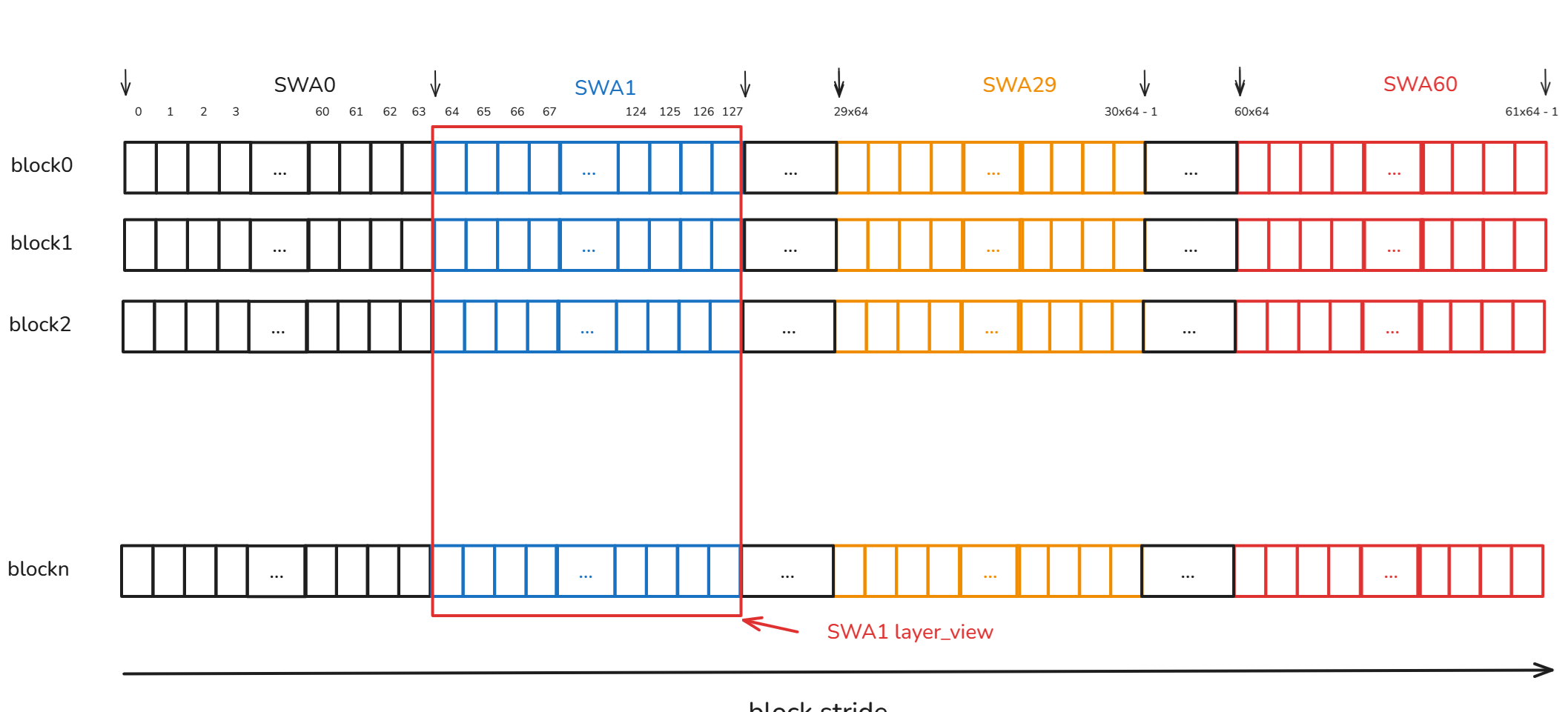
图片中的数字编号只是示意数据块个数,不是slot id的编号。SWA0,SWA1...SWA60对应的存储空间,slot id 各自独立编号。
kv cache的绑定
AttentionLayerBase.bind_kv_cache
python
class AttentionLayerBase(ABC):
    """
    Base class for attention-like layers (Attention, Mamba, etc.)
    that support the v1 engine.

    This provides a common interface for getting attention backends
    from different layer types.
    """

    impl: "AttentionImpl"
    supports_dcp: bool = True

    def bind_kv_cache(self, kv_cache: torch.Tensor) -> None:
        """Bind the allocated KV cache tensor to this layer.

        The default stores the cache view as-is; subclasses (e.g. Mamba)
        override this to unpack the raw buffer into per-state views.
        """
        self.kv_cache = kv_cache
当 forward_contextlayer_name.bind_kv_cache(kv_cache) 被调用时:
- forward_contextlayer_name 获取到模型中的对应注意力层实例。
- 调用该实例的 bind_kv_cache 方法,并将 kv_cache(即 _reshape_kv_cache_tensors 返回的张量视图)作为参数传入。
- 该方法执行 self.kv_cache = kv_cache,将这个张量视图赋值给该层实例的 kv_cache 属性。
kv cache 寻址过程
通用寻址公式
标准 KV 缓存shape为 (num_blocks, block_size, num_heads, head_size)。
一个 slot_id 通常编码了块索引(block_id)和块内偏移(token_offset),即 slot_id = block_id * block_size + token_offset。对于给定的 slot_id 和需要访问的注意力头索引 head_idx(范围 0 到 num_heads-1),其 KV 数据在张量中的物理地址计算方式为:
物理地址 = kv_cache 的基地址
          + block_id * kv_cache.stride(0)        # 跳到目标物理块
          + token_offset * kv_cache.stride(1)    # 跳到块内目标 token 位置
          + head_idx * kv_cache.stride(2)        # 跳到目标 head
+ head_offset * kv_cache.stride(3) # (可选) 跳到 head 内的具体位置- kv_cache.stride(0) = 每个物理块的总字节数(block_size * num_heads * head_size * dtype_size)。
- kv_cache.stride(1) = 每个 token 的总字节数(num_heads * head_size * dtype_size)。
- kv_cache.stride(2) = 单个头的字节数(head_size * dtype_size)。
- kv_cache.stride(3) = dtype_size(例如 bfloat16 为 2,uint8 为 1)。
head_offset:当需要访问 head_size 中的特定元素时使用,通常在注意力计算中,内核会顺序读取整个 head_size。
swa cache的寻址
DeepseekV4FlashMLAAttention._forward_decode
python
class DeepseekV4FlashMLAAttention(DeepseekV4Attention):
    def _forward_decode(
        self,
        q: torch.Tensor,
        kv_cache: torch.Tensor | None,  # Only used when compress_ratio > 1
        swa_metadata: "DeepseekSparseSWAMetadata",
        attn_metadata: DeepseekV4FlashMLAMetadata | None,
        swa_only: bool,
        output: torch.Tensor,
    ) -> None:
        # Prepare SWA cache (num_blocks, swa_block_size, 1, head_bytes)
        # Use unsqueeze to preserve strides (handles padded blocks correctly)
        swa_cache = self.swa_cache_layer.kv_cache.unsqueeze(-2)
        # Reshape KV cache to (num_blocks, block_size, 1, head_bytes)
        if kv_cache is not None:
            kv_cache = kv_cache.unsqueeze(-2)
self.swa_cache_layer.kv_cache 就是通过 bind_kv_cache 绑定到 SWA 层的张量视图,其形状为 (num_blocks, 64, 584)。
执行 unsqueeze(-2) 后,swa_cache 的形状变为:(num_blocks, 64, 1, 584)。
在标准的 MHA 中,KV 缓存通常有 4 个维度:(num_blocks, block_size, num_kv_heads, head_size)。对于 DeepSeek V4 的 MLA 或 SWA,num_kv_heads 为 1。添加这个维度可以让 SWA 缓存与内核期望的通用 4D 布局对齐。
pytorch 为swa_cache张量维护一个"地图",即它的 stride(步长)属性。这个地图精确地记录了如何在物理内存中定位每个逻辑元素。例如:
- swa_cache.stride(0): 要跳到下一个 block,需要在内存中前进多少字节(block_stride)。
- swa_cache.stride(1): 在同一个 block 内,要跳到下一个 Token,需要前进多少字节(通常是 584 字节)。
- swa_cache.stride(2): num_heads 维度(大小为1)的步长。
- swa_cache.stride(3):head_size 维度(584字节)的步长,这里通常是1。
针对swa_cache,根据slot id 定位物理地址:
slot_id:block_id = slot_id // 64, token_offset = slot_id % 64
text
物理地址 = swa_cache 的基地址
          + block_id * swa_cache.stride(0)
          + token_offset * swa_cache.stride(1)
          + 0 * swa_cache.stride(2)
需要注意,SWA0,SWA1...SWA60对应的存储空间,slot id 各自独立编号。
slot id 计算
_compute_swa_indices_and_lens_kernel 根据当前批次中每个 Token 的位置,计算出它需要在 SWA 缓存中关注的 Token 的物理槽位(slot)索引和有效窗口长度。
text
def _compute_swa_indices_and_lens_kernel(
    swa_indices_ptr,
    swa_indices_stride,
    swa_lens_ptr,
    window_size,
    query_start_loc_ptr,
    seq_lens_ptr,
    token_to_req_indices_ptr,
    is_valid_token_ptr,
    block_table_ptr,
    block_table_stride,
    block_size,
    token_offset,
    TRITON_BLOCK_SIZE: tl.constexpr,
):
计算过程:
1. 根据 pos 计算窗口 start_pos 和 end_pos
2. 对窗口内每个 offset:
   pos_offset = start_pos + offset
   block_indices = pos_offset // block_size
   block_number = block_table[block_indices]
   block_offset = pos_offset % block_size
   slot_id = block_number * block_size + block_offset
SWA 缓存:其 block_size 固定为 64,对应 DeepseekV4SWACache 的 storage_block_size。
_compute_global_topk_indices_and_lens_kernel 为全局稀疏索引(Top-K)构建 slot_id 索引。
cpp
def _compute_global_topk_indices_and_lens_kernel(
    global_topk_indices_ptr,
    global_topk_indices_stride,
    topk_lens_ptr,
    topk_indices_ptr,
    topk_indices_stride,
    topk,
    token_to_req_indices_ptr,
    block_table_ptr,
    block_table_stride,
    block_size,
    is_valid_token_ptr,
    TRITON_BLOCK_SIZE: tl.constexpr,
)
计算过程:
1. 直接从 topk_indices_buffer 读取 local_idx
2. 对每个 local_idx (>=0):
    block_indices = local_idx // block_size
    block_number = block_table[block_indices]
    block_offset = local_idx % block_size
    slot_id = block_number * block_size + block_offset
CSA/HCA 缓存:它们管理的是压缩后的 KV 缓存。传入_compute_global_topk_indices_and_lens_kernel的block_size, 代码位置:
text
block_size = attn_metadata.block_size // self.compress_ratio例如,CSA 的 compress_ratio=4,则其 block_size = 256 / 4 = 64;HCA 的 compress_ratio=128,则其 block_size = 256 / 128 = 2。
block id 的分配
每个 SingleTypeKVCacheManager 独立管理各自的 KV 缓存组(如 SWA 组、CSA 组),但它们共享同一个 BlockPool 实例,并从该实例中申请全局唯一的 block_id。
text
KVCacheManager.allocate_slots
│
├── 1. 计算需求 & 准入检查
│   ├── num_tokens_main_model = total_computed_tokens + num_new_tokens
│   ├── 如果 full_sequence_must_fit:
│   │   ├── num_blocks_to_allocate = coordinator.get_num_blocks_to_allocate(...)
│   │   ├── 如果 num_blocks_to_allocate + watermark_blocks > 空闲块数 → 返回 None
│   └── (实际分配时的检查见后)
│
├── 2. 协调层: coordinator.get_num_blocks_to_allocate
│   └── for each manager in single_type_managers:
│       └── manager.get_num_blocks_to_allocate(...)  # 计算该组需求
│
├── 3. 第二次准入检查 (实际分配前)
│   ├── available_blocks = block_pool.get_num_free_blocks() - reserved_blocks
│   ├── 如果 num_blocks_to_allocate + watermark_blocks > available_blocks → 返回 None
│
├── 4. 处理新命中的前缀缓存块 (可选)
│   └── coordinator.allocate_new_computed_blocks(...)
│
├── 5. 执行分配: coordinator.allocate_new_blocks
│   └── for each manager in single_type_managers:
│       └── SingleTypeKVCacheManager.allocate_new_blocks
│           ├── ① 处理部分命中 (CoW)
│           │   ├── 如果 request_id 在 _partial_hit_reqs 中:
│           │   │   ├── cow_block = block_pool.get_new_blocks(1)[0]  ← 第一次调用 get_new_blocks
│           │   │   └── 记录 cow_block.block_id 到 new_block_ids
│           │   └── (该块用于写时复制)
│           │
│           ├── ② 计算常规新块需求
│           │   ├── num_required_blocks = cdiv(num_tokens, self.block_size)
│           │   ├── num_new_blocks = num_required_blocks - len(req_blocks)
│           │   └── 如果 num_new_blocks <= 0 → 跳过,只返回 CoW 块
│           │
│           └── ③ 从 BlockPool 获取新块
│               ├── new_blocks = block_pool.get_new_blocks(num_new_blocks)  ← 第二次调用 get_new_blocks
│               ├── req_blocks.extend(new_blocks)
│               ├── 如果 _record_new_block_ids:
│               │   └── new_block_ids.extend(b.block_id for b in new_blocks)
│               └── 返回 cow_blocks + new_blocks
│
└── 6. 返回结果
└── 返回 KVCacheBlocks(new_blocks) # 包含所有组的新块列表KVCacheCoordinator.allocate_new_blocks