解释器模式(Interpreter Pattern)
解释器模式(Interpreter Pattern)是一种行为型设计模式,用于定义一种语言的文法表示,并提供一个解释器来解释该语言中的句子。这种模式通常用于开发需要解析、解释和执行特定语言或表达式的应用程序。
主要目的是为特定类型的问题定义一种语言,然后用该语言的解释器来解决问题。
主要组成部分
解释器模式的结构通常包括以下几个部分:
-
抽象表达式(AbstractExpression) :定义解释操作的接口。
-
终结符表达式(TerminalExpression) :表示语言中的基本元素,如数字或变量。
-
非终结符表达式(NonTerminalExpression) :表示更复杂的语法规则,通过组合终结符表达式和其他非终结符表达式实现。
-
上下文(Context) :存储解释器在解析表达式时需要的全局信息,比如变量值或共享数据。
-
客户端(Client):构建(或从外部获取)需要解析的表达式,并使用解释器处理表达式。
区分终结符和非终结符主要看它是不是最终的输出,是不是不可再分的组成部分。
案例实现
设计一个动态查询SQL 的解析器,查询SQL模板 + 输入的参数 动态的生成所需要的查询SQL 。
本案例的主要功能:
- 支持占位符替换:如
#{key}替换为参数值。 - 支持动态条件解析:如
<if>标签根据条件决定是否生成部分 SQL。 - 支持集合操作:如
<foreach>动态生成IN子句。 - 使用解释器模式解析查询SQL 模板,分离模板的不同语义块。
案例类图
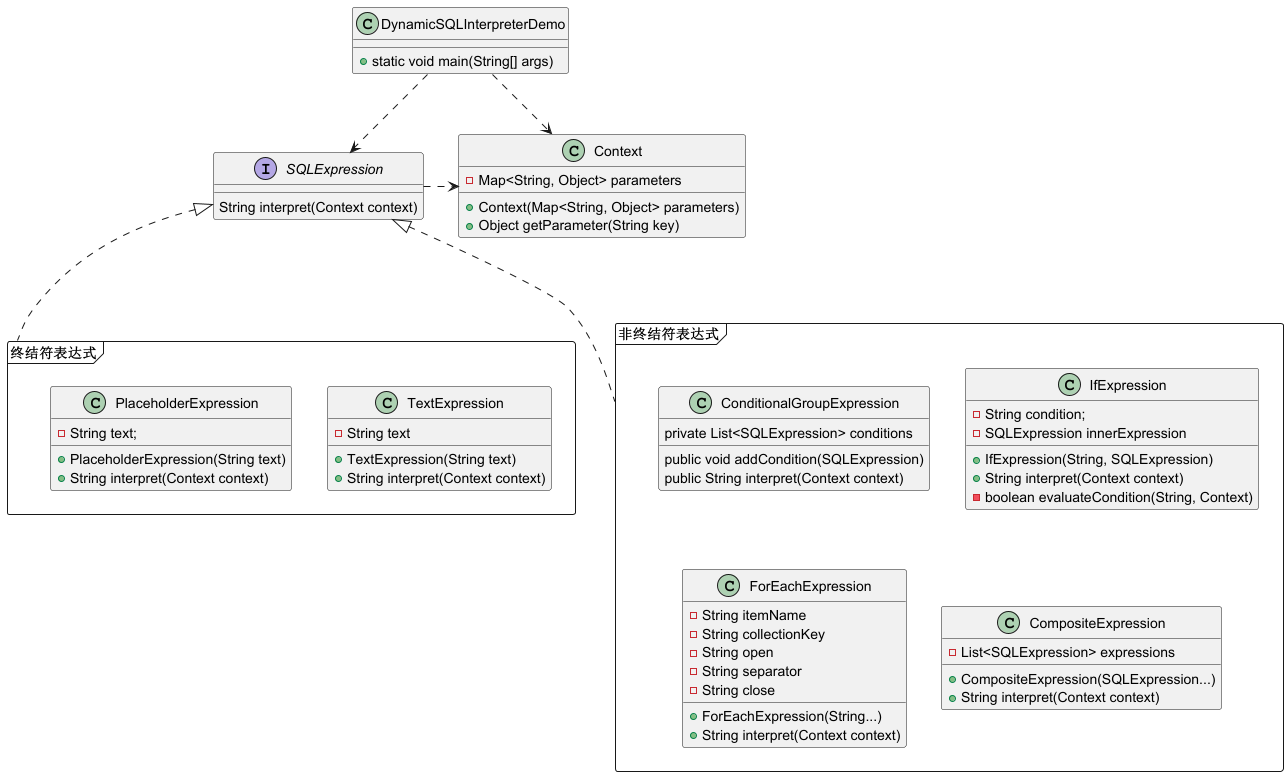
类图简述
-
上下文 (
Context) :存储输入参数,供解释器在解析时访问。 -
抽象表达式 (
SQLExpression) :表示 SQL 模板中的一个语义块,定义interpret方法解析该块,参数为Context输入参数。 -
终结符表达式
-
文本表达式(
TextExpression):不可再分的文本部分(如静态 SQL 片段); -
占位符表达式 (
PlaceholderExpression) :解析并替换#{key}。
- 非终结符表达式
- 条件组表达式(
ConditionalGroupExpression) :解析<where>标签中的一组条件; - 条件表达式 (
IfExpression) :解析<if>标签中的动态 SQL; - 集合表达式 (
ForEachExpression) :解析<foreach>动态生成 SQL; - 复合表达式(
CompositeExpression):将多个表达式组合成一个整体。
上下文
存储动态 SQL 的参数,供解释器在解析时访问。
java
public class Context {
    private Map<String, Object> parameters;

    public Context(Map<String, Object> parameters) {
        this.parameters = parameters;
    }

    public Object getParameter(String key) {
        return parameters.get(key);
    }
}
抽象表达式
表示 SQL 模板中的一个语义块,定义 interpret 方法解析该块。
java
public interface SQLExpression {
    String interpret(Context context);
}
终结符表达式
文本表达式(TextExpression):不可再分的文本部分(如静态 SQL 片段);
占位符表达式 (PlaceholderExpression) :解析并替换 #{key}。
java
// 终结符表达式:文本片段
public class TextExpression implements SQLExpression {
    private String text;

    public TextExpression(String text) {
        this.text = text;
    }

    @Override
    public String interpret(Context context) {
        return text;
    }
}

// 终结符表达式:占位符替换
class PlaceholderExpression implements SQLExpression {
    private String text;

    public PlaceholderExpression(String text) {
        this.text = text;
    }

    @Override
    public String interpret(Context context) {
        // 替换 #{key} 为参数值
        Pattern pattern = Pattern.compile("#\\{(\\w+)}");
        Matcher matcher = pattern.matcher(text);
        StringBuffer result = new StringBuffer();

        while (matcher.find()) {
            String key = matcher.group(1);
            Object value = context.getParameter(key);
            if (value == null) {
                throw new RuntimeException("参数 " + key + " 未提供");
            }
            String replacement = (value instanceof String) ? "'" + value + "'" : value.toString();
            matcher.appendReplacement(result, replacement);
        }
        matcher.appendTail(result);

        return result.toString();
    }
}
非终结符表达式
条件组表达式(ConditionalGroupExpression) :解析<where> 标签中的一组条件;
条件表达式 (IfExpression) :解析 <if> 标签中的动态 SQL;
集合表达式 (ForEachExpression) :解析 <foreach> 动态生成 SQL;
复合表达式(CompositeExpression):将多个表达式组合成一个整体。
java
// 非终结符表达式:条件组,自动管理 WHERE/AND/OR
public class ConditionalGroupExpression implements SQLExpression {
    private List<SQLExpression> conditions = new ArrayList<>();

    public void addCondition(SQLExpression condition) {
        conditions.add(condition);
    }

    @Override
    public String interpret(Context context) {
        StringBuilder result = new StringBuilder();
        int validConditions = 0;

        for (SQLExpression condition : conditions) {
            String conditionResult = condition.interpret(context).trim();
            if (!conditionResult.isEmpty()) {
                // 对首个有效条件去掉前缀
                if (validConditions == 0) {
                    if (conditionResult.toUpperCase().startsWith("AND ")) {
                        conditionResult = conditionResult.substring(4);
                    } else if (conditionResult.toUpperCase().startsWith("OR ")) {
                        conditionResult = conditionResult.substring(3);
                    }
                } else {
                    // 非首条件,确保没有多余的空格或重复逻辑
                    if (!conditionResult.toUpperCase().startsWith("AND") && !conditionResult.toUpperCase().startsWith("OR")) {
                        result.append(" AND ");
                    } else {
                        result.append(" ");
                    }
                }
                result.append(conditionResult);
                validConditions++;
            }
        }

        return validConditions > 0 ? "WHERE " + result.toString().trim() : "";
    }
}
// 非终结符表达式:条件
class IfExpression implements SQLExpression {
    private String condition;
    private SQLExpression innerExpression;

    public IfExpression(String condition, SQLExpression innerExpression) {
        this.condition = condition;
        this.innerExpression = innerExpression;
    }

    @Override
    public String interpret(Context context) {
        // 解析条件,支持 key != null 和 key == value 等
        if (evaluateCondition(condition, context)) {
            return innerExpression.interpret(context);
        }
        return ""; // 条件不满足时返回空字符串
    }

    // 解析条件语法
    private boolean evaluateCondition(String condition, Context context) {
        // 简单支持 key != null 和 key == value 的逻辑
        if (condition.contains("!=")) {
            String[] parts = condition.split("!=");
            String key = parts[0].trim();
            Object value = context.getParameter(key);
            return value != null; // 判断 key 是否存在
        } else if (condition.contains("==")) {
            String[] parts = condition.split("==");
            String key = parts[0].trim();
            String expectedValue = parts[1].trim().replace("'", ""); // 移除单引号
            Object actualValue = context.getParameter(key);
            return expectedValue.equals(actualValue != null ? actualValue.toString() : null);
        }
        throw new RuntimeException("不支持的条件: " + condition);
    }
}

// 非终结符表达式:集合操作
class ForEachExpression implements SQLExpression {
    private String itemName;
    private String collectionKey;
    private String open;
    private String separator;
    private String close;

    public ForEachExpression(String itemName, String collectionKey, String open, String separator, String close) {
        this.itemName = itemName;
        this.collectionKey = collectionKey;
        this.open = open;
        this.separator = separator;
        this.close = close;
    }

    @Override
    public String interpret(Context context) {
        Object collection = context.getParameter(collectionKey);
        if (!(collection instanceof Collection)) {
            throw new RuntimeException("参数 " + collectionKey + " 必须是集合");
        }
        Collection<?> items = (Collection<?>) collection;
        StringJoiner joiner = new StringJoiner(separator, open, close);
        for (Object item : items) {
            joiner.add(item instanceof String ? "'" + item + "'" : item.toString());
        }
        return joiner.toString();
    }
}

// 复合表达式:将多个表达式组合成一个整体
class CompositeExpression implements SQLExpression {
    private List<SQLExpression> expressions = new ArrayList<>();

    public CompositeExpression(SQLExpression... expressions) {
        this.expressions.addAll(Arrays.asList(expressions));
    }

    @Override
    public String interpret(Context context) {
        StringBuilder result = new StringBuilder();
        for (SQLExpression expression : expressions) {
            result.append(expression.interpret(context));
        }
        return result.toString();
    }
}
测试客户端
两条动态查询SQL的生成测试
java
public class DynamicSQLInterpreterDemo {
    public static void main(String[] args) {
        // 动态 SQL 模板
        List<SQLExpression> expressions = new ArrayList<>();
        expressions.add(new TextExpression("SELECT * FROM t_users"));

        // WHERE 条件组
        ConditionalGroupExpression whereGroup = new ConditionalGroupExpression();
        whereGroup.addCondition(new IfExpression("id != null", new PlaceholderExpression("and id = #{id}")));
        whereGroup.addCondition(new IfExpression("name != null", new PlaceholderExpression("OR name = #{name}")));
        whereGroup.addCondition(new IfExpression("ids != null && !ids.isEmpty()", new CompositeExpression(
                new TextExpression("AND id IN "),
                new ForEachExpression("id", "ids", "(", ",", ")")
        )));
        expressions.add(whereGroup);

        // 测试参数
        Map<String, Object> parameters1 = new HashMap<>();
        parameters1.put("id", 1);
        parameters1.put("name", "Alice");
        parameters1.put("ids", Arrays.asList(1, 2, 3));

        Map<String, Object> parameters2 = new HashMap<>();
        parameters2.put("ids", Arrays.asList(1, 2, 3));

        // 输出最终 SQL
        System.out.println("测试 1:");
        generateSQL(expressions, parameters1);
        System.out.println("测试 2:");
        generateSQL(expressions, parameters2);
    }

    private static void generateSQL(List<SQLExpression> expressions, Map<String, Object> parameters) {
        Context context = new Context(parameters);
        StringBuilder parsedSQL = new StringBuilder();

        for (SQLExpression expression : expressions) {
            String result = expression.interpret(context).trim();
            if (!result.isEmpty()) {
                parsedSQL.append(" ").append(result);
            }
        }
        System.out.println(parsedSQL.toString().trim());
    }
}
运行结果
plaintext
测试 1:
SELECT * FROM t_users WHERE id = 1 OR name = 'Alice' AND id IN (1,2,3)
测试 2:
SELECT * FROM t_users WHERE id IN (1,2,3)该案例简单实现了动态查询SQL的生成。List<SQLExpression> expressions 变量在动态SQL表达式只执行两次add()操作,第一次是SELECT * FROM t_user,第二次是where条件语句,然后再根据参数值替换占位符来实现动态SQL的生成。
所有的表达式都可以独立进行扩展调整而不相互影响(灵活性、扩展性)。比如、新增分组查询、查询结果排序等表达式,以及原有表达式的不断优化调整。
也可以,将动态SQL模版改为xml文档进行SQL配置化。解析过程变为:先经过xml文档解析,根据请求参数再进行动态SQL解释,从而灵活生成SQL。这看起来有点MyBatis的味道。
解释器模式的应用
Hibernate :使用 ORM 技术,通过对象关系映射来执行查询;
MyBatis:通过映射器和 XML 配置来处理动态 SQL;
两者都使用了解释器模式来处理查询的解析。
优缺点和适用场景
优点
- 扩展性好:可以轻松地添加新的表达式解析规则。
- 直观性强:语言的规则和实现代码一一对应,清晰明了。
- 适用于领域特定语言:非常适合解决领域特定问题。
缺点
- 复杂性增加:对于复杂的语法规则,类的数量会迅速增加,导致维护成本高。
- 性能问题:解释器模式效率较低,特别是在需要解析大量复杂表达式时。
适用场景
解释器模式适合在以下情况下使用:
- 特定语法或规则:需要为某个特定领域设计一个语言或表达式处理工具。
- 重复问题:问题可以通过一组标准规则或语法重复解决。
- 可扩展性需求:希望能够轻松添加新规则或表达式。
常见示例:
- 计算器程序(解析数学表达式)。
- SQL解析器。
- 编译器中的语法解析器。
- 简单的脚本解释器。
总结
解释器模式适合用于实现轻量级的解析器或简单的领域特定语言,但在面对复杂语法或高性能需求的场景时,可能需要其他更高效的解析工具(如正则表达式、ANTLR等)。
解释器模式提供了一种创建领域特定语言(DSL)的方法。

需要查看往期设计模式文章的,可以在个人主页中或者文章开头的集合中查看,可关注我,持续更新中。。。