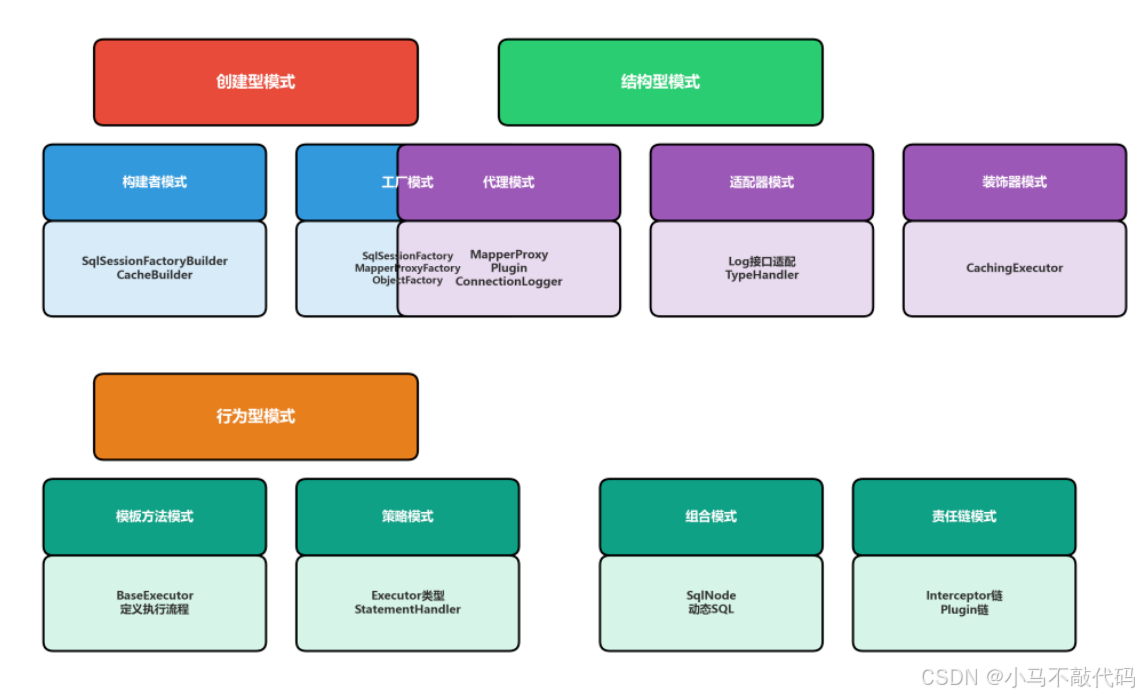
一、MyBatis整体架构与设计模式
MyBatis作为一款优秀的持久层框架,其代码中运用了多种经典的设计模式。这些设计模式的应用,使得MyBatis具有良好的扩展性、灵活性和可维护性。
1.1 MyBatis整体架构
MyBatis采用了分层架构设计,从上到下主要包括:
应用层:用户应用程序
接口层:SqlSession、Mapper接口
核心处理层:SQL解析、执行、结果映射
基础支撑层:反射、类型处理、日志、缓存、事务等
数据层:数据源、连接池、JDBC驱动
在这些层次中,设计模式被广泛应用,贯穿整个框架。
1.2 MyBatis中的主要设计模式
MyBatis中使用的设计模式包括:
构建者模式(Builder Pattern):SqlSessionFactoryBuilder、CacheBuilder、ParameterExpression等
工厂模式(Factory Pattern):SqlSessionFactory、MapperProxyFactory、ObjectFactory、DataSourceFactory等
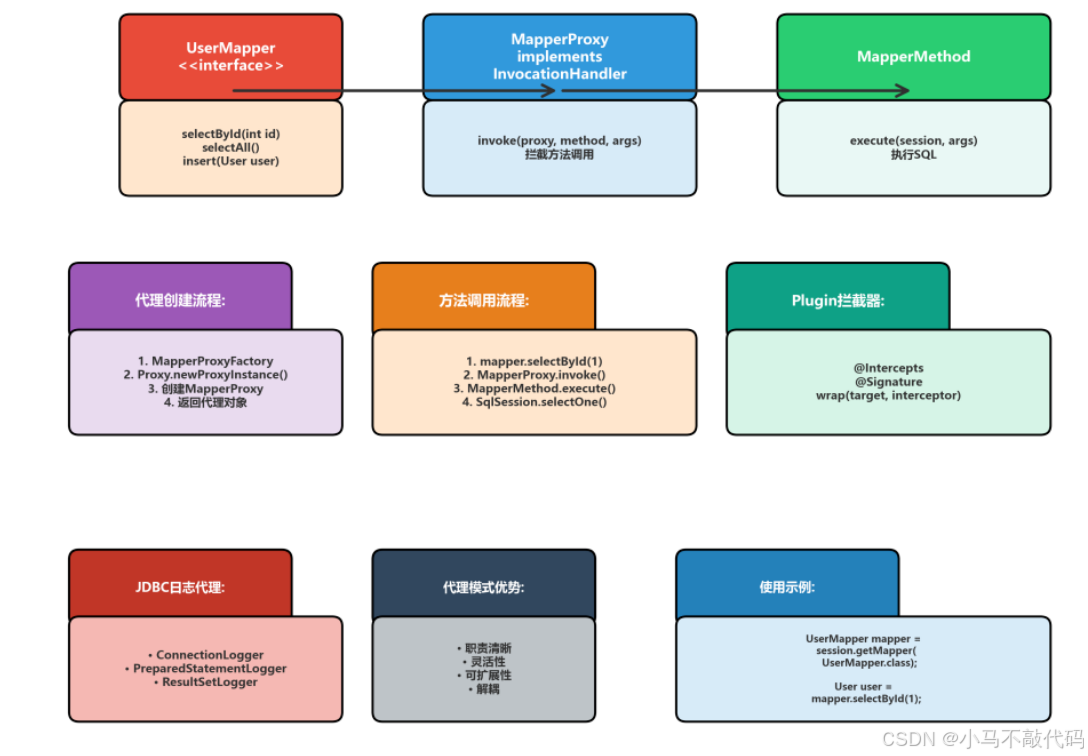
代理模式(Proxy Pattern):MapperProxy、Plugin、ConnectionLogger、PreparedStatementLogger等
组合模式(Composite Pattern):SqlNode、DynamicContext等
模板方法模式(Template Method Pattern):BaseExecutor、SimpleExecutor、BatchExecutor等
适配器模式(Adapter Pattern):Log接口及其适配器
装饰器模式(Decorator Pattern):CachingExecutor、Executor的包装
策略模式(Strategy Pattern):RoutingStatementHandler、ResultSetHandler等
迭代器模式(Iterator Pattern):PropertyTokenizer、DefaultCursor等
责任链模式(Chain of Responsibility):Interceptor链、Plugin链
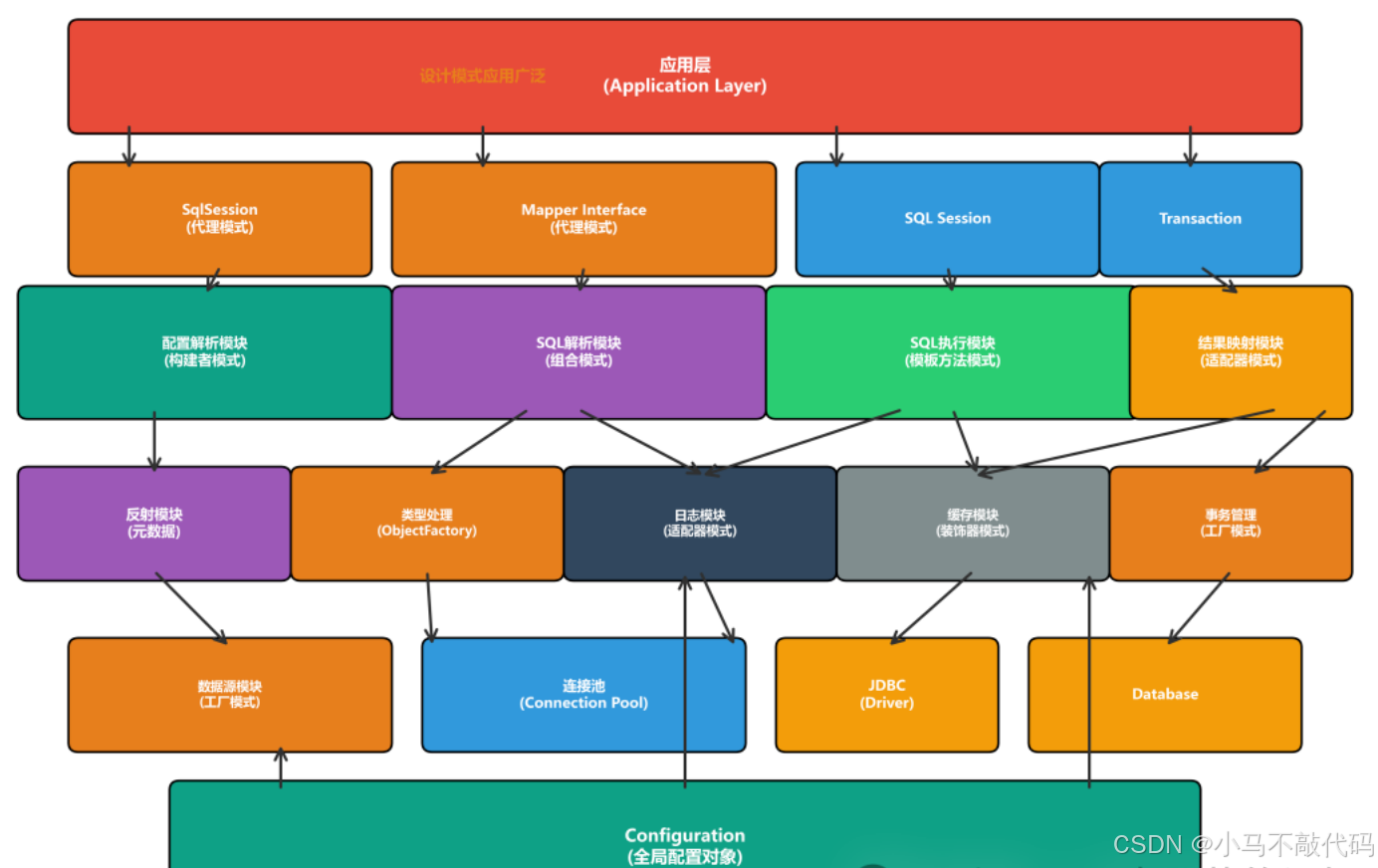
本文将重点讲解构建者模式、工厂模式和代理模式在MyBatis中的应用。
二、构建者模式(Builder Pattern)
构建者模式是一种创建型设计模式,它允许你分步骤创建复杂对象。该模式使你可以使用相同的创建代码生成不同类型和形式的对象。
2.1 SqlSessionFactoryBuilder
SqlSessionFactoryBuilder是MyBatis中最典型的构建者模式应用。它负责从XML配置文件或Configuration对象构建SqlSessionFactory。
2.1.1 基本用法
java
// 从XML文件构建
String resource = "mybatis-config.xml";
InputStream inputStream = Resources.getResourceAsStream(resource);
SqlSessionFactory sqlSessionFactory = new SqlSessionFactoryBuilder().build(inputStream);

// 从Configuration对象构建
Configuration config = new Configuration();
config.addMapper(UserMapper.class);
SqlSessionFactory sqlSessionFactory = new SqlSessionFactoryBuilder().build(config);
2.1.2 源码分析
java
publicclassSqlSessionFactoryBuilder{

    // 从InputStream构建
    public SqlSessionFactory build(InputStream inputStream){
        return build(inputStream, null, null);
    }

    public SqlSessionFactory build(InputStream inputStream, String environment){
        return build(inputStream, environment, null);
    }

    public SqlSessionFactory build(InputStream inputStream, Properties properties){
        return build(inputStream, null, properties);
    }

    public SqlSessionFactory build(InputStream inputStream, String environment, Properties properties){
        try {
            // 1. 解析XML配置文件,创建XMLConfigBuilder
            XMLConfigBuilder parser = new XMLConfigBuilder(inputStream, environment, properties);
            // 2. 解析配置并构建Configuration对象
            return build(parser.parse());
        } catch (Exception e) {
            throw ExceptionFactory.wrapException("Error building SqlSession.", e);
        } finally {
            ErrorContext.instance().reset();
            try {
                inputStream.close();
            } catch (IOException e) {
                // ignore
            }
        }
    }

    // 从Configuration构建
    public SqlSessionFactory build(Configuration config){
        // 3. 创建DefaultSqlSessionFactory
        returnnew DefaultSqlSessionFactory(config);
    }

    // 从Reader构建
    public SqlSessionFactory build(Reader reader){
        return build(reader, null, null);
    }

    public SqlSessionFactory build(Reader reader, String environment){
        return build(reader, environment, null);
    }

    public SqlSessionFactory build(Reader reader, Properties properties){
        return build(reader, null, properties);
    }

    public SqlSessionFactory build(Reader reader, String environment, Properties properties){
        try {
            XMLConfigBuilder parser = new XMLConfigBuilder(reader, environment, properties);
            return build(parser.parse());
        } catch (Exception e) {
            throw ExceptionFactory.wrapException("Error building SqlSession.", e);
        } finally {
            ErrorContext.instance().reset();
            try {
                reader.close();
            } catch (IOException e) {
                // ignore
            }
        }
    }
}
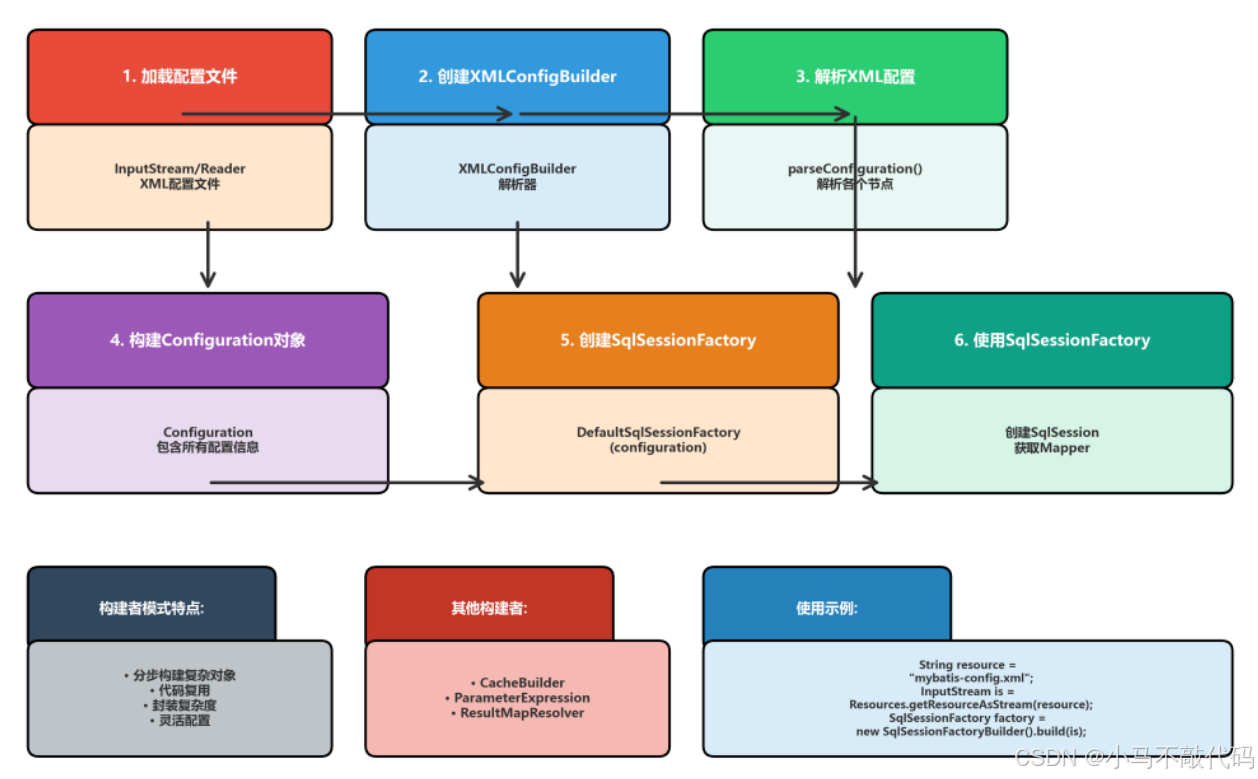
2.1.3 构建过程分析
SqlSessionFactoryBuilder的构建过程可以分为以下几个步骤:
加载配置文件:从InputStream或Reader加载XML配置文件
创建解析器:创建XMLConfigBuilder解析XML配置
解析配置:解析XML配置文件,构建Configuration对象
创建工厂:使用Configuration对象创建SqlSessionFactory
2.2 XMLConfigBuilder
XMLConfigBuilder是实际的构建者,负责解析XML配置文件并构建Configuration对象。
java
publicclassXMLConfigBuilderextendsBaseBuilder{

    privateboolean parsed;
    privatefinal XPathParser parser;
    private String environment;

    publicXMLConfigBuilder(InputStream inputStream, String environment, Properties props){
        this(new XPathParser(inputStream, true, props, new XMLMapperEntityResolver()), environment, props);
    }

    // 解析配置
    public Configuration parse(){
        if (parsed) {
            thrownew BuilderException("Each XMLConfigBuilder can only be used once.");
        }
        parsed = true;
        // 解析configuration节点
        parseConfiguration(parser.evalNode("/configuration"));
        return configuration;
    }

    privatevoidparseConfiguration(XNode root){
        try {
            // 解析各个配置项
            propertiesElement(root.evalNode("properties"));
            typeAliasesElement(root.evalNode("typeAliases"));
            pluginsElement(root.evalNode("plugins"));
            objectFactoryElement(root.evalNode("objectFactory"));
            objectWrapperFactoryElement(root.evalNode("objectWrapperFactory"));
            reflectionFactoryElement(root.evalNode("reflectionFactory"));
            settingsElement(root.evalNode("settings"));
            environmentsElement(root.evalNode("environments"));
            databaseIdProviderElement(root.evalNode("databaseIdProvider"));
            typeHandlerElement(root.evalNode("typeHandlers"));
            mapperElement(root.evalNode("mappers"));
        } catch (Exception e) {
            thrownew BuilderException("Error parsing SQL Mapper Configuration. Cause: " + e, e);
        }
    }
}
2.3 构建者模式的优势
分步构建:将复杂对象的构建过程分解为多个步骤
代码复用:相同的构建代码可以创建不同的对象
封装复杂度:隐藏对象创建的复杂细节
灵活配置:支持多种不同的配置方式
2.4 其他构建者模式应用
除了SqlSessionFactoryBuilder,MyBatis中还有其他构建者模式的应用:
2.4.1 CacheBuilder
java
publicclassCacheBuilder{
    privatefinal String id;
    private Class<? extends Cache> implementation;
    private List<Class<? extends Cache>> decorators;
    private Integer size;
    private Long clearInterval;
    privateboolean readWrite;
    private Properties properties;

    public Cache build(){
        // 设置默认实现
        setDefaultImplementations();

        // 创建缓存
        Cache cache = newBaseCacheInstance(implementation, id);
        setCacheProperties(cache);

        // 应用装饰器
        for (Class<? extends Cache> decorator : decorators) {
            cache = newCacheDecoratorInstance(decorator, cache);
            setCacheProperties(cache);
        }

        return cache;
    }
}
2.4.2 ParameterExpression
java
publicclassParameterExpressionimplementsIterator<ParameterExpression> {
    // 构建者模式用于解析参数表达式
    publicParameterExpression(String expression){
        parseExpression(expression);
    }

    privatevoidparseExpression(String expression){
        // 解析属性表达式
    }
}
三、工厂模式(Factory Pattern)
工厂模式是一种创建型设计模式,它提供了创建对象的最佳方式。在工厂模式中,我们在创建对象时不会对客户端暴露创建逻辑,并且是通过使用一个共同的接口来指向新创建的对象。
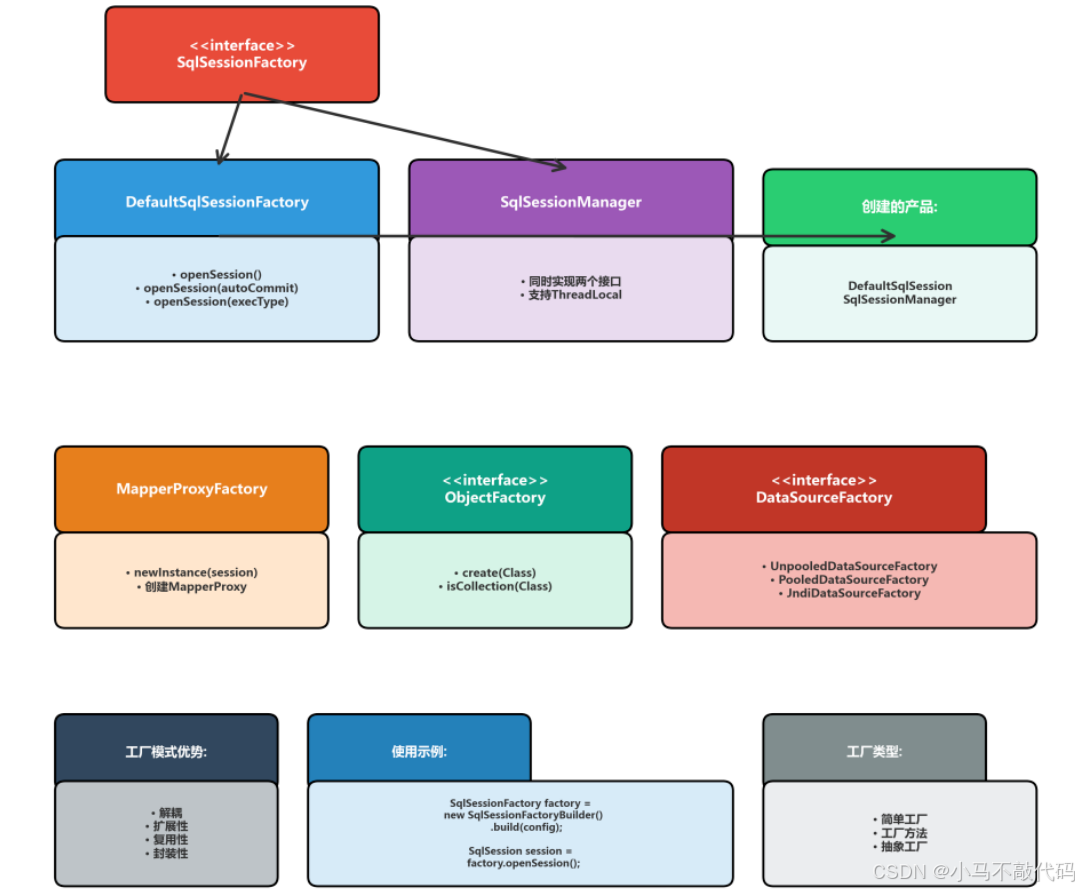
3.1 SqlSessionFactory
SqlSessionFactory是MyBatis中最核心的工厂接口,负责创建SqlSession对象。
3.1.1 接口定义
java
publicinterfaceSqlSessionFactory{

    // 创建SqlSession的各种方法
    SqlSession openSession();
    SqlSession openSession(boolean autoCommit);
    SqlSession openSession(Connection connection);
    SqlSession openSession(TransactionIsolationLevel level);
    SqlSession openSession(ExecutorType execType);
    SqlSession openSession(ExecutorType execType, boolean autoCommit);
    SqlSession openSession(ExecutorType execType, TransactionIsolationLevel level);
    SqlSession openSession(ExecutorType execType, Connection connection);

    Configuration getConfiguration();
}
3.1.2 DefaultSqlSessionFactory
java
publicclassDefaultSqlSessionFactoryimplementsSqlSessionFactory{

    privatefinal Configuration configuration;

    publicDefaultSqlSessionFactory(Configuration configuration){
        this.configuration = configuration;
    }

    @Override
    public SqlSession openSession(){
        return openSessionFromDataSource(configuration.getDefaultExecutorType(), null, false);
    }

    @Override
    public SqlSession openSession(boolean autoCommit){
        return openSessionFromDataSource(configuration.getDefaultExecutorType(), null, autoCommit);
    }

    @Override
    public SqlSession openSession(ExecutorType execType){
        return openSessionFromDataSource(execType, null, false);
    }

    @Override
    public SqlSession openSession(TransactionIsolationLevel level){
        return openSessionFromDataSource(configuration.getDefaultExecutorType(), level, false);
    }

    private SqlSession openSessionFromDataSource(ExecutorType execType,
                                                  TransactionIsolationLevel level,
                                                  boolean autoCommit){
        Transaction tx = null;
        try {
            // 1. 获取环境配置
            Environment environment = configuration.getEnvironment();
            // 2. 获取事务工厂
            TransactionFactory transactionFactory = getTransactionFactoryFromEnvironment(environment);
            // 3. 创建事务对象
            tx = transactionFactory.newTransaction(environment.getDataSource(), level, autoCommit);
            // 4. 创建执行器
            Executor executor = configuration.newExecutor(tx, execType);
            // 5. 创建SqlSession
            returnnew DefaultSqlSession(configuration, executor, autoCommit);
        } catch (Exception e) {
            closeTransaction(tx);
            throw ExceptionFactory.wrapException("Error opening session. Cause: " + e, e);
        } finally {
            ErrorContext.instance().reset();
        }
    }
}
3.2 MapperProxyFactory
MapperProxyFactory负责创建Mapper接口的代理对象。
3.2.1 源码分析
java
publicclassMapperProxyFactory<T> {

    privatefinal Class<T> mapperInterface;
    privatefinal Map<Method, MapperMethod> methodCache = new ConcurrentHashMap<>();

    publicMapperProxyFactory(Class<T> mapperInterface){
        this.mapperInterface = mapperInterface;
    }

    public Class<T> getMapperInterface(){
        return mapperInterface;
    }

    public Map<Method, MapperMethod> getMethodCache(){
        return methodCache;
    }

    @SuppressWarnings("unchecked")
    protected T newInstance(MapperProxy<T> mapperProxy){
        // 使用JDK动态代理创建代理对象
        return (T) Proxy.newProxyInstance(mapperInterface.getClassLoader(),
            new Class[] { mapperInterface },
            mapperProxy);
    }

    public T newInstance(SqlSession sqlSession){
        final MapperProxy<T> mapperProxy = new MapperProxy<>(sqlSession, mapperInterface, methodCache);
        return newInstance(mapperProxy);
    }
}
3.2.2 使用示例
java
// MapperRegistry中注册Mapper
public <T> voidaddMapper(Class<T> type){
    if (type.isInterface()) {
        if (hasMapper(type)) {
            thrownew BindingException("Type " + type + " is already known to the MapperRegistry.");
        }
        boolean loadCompleted = false;
        try {
            // 创建MapperProxyFactory并注册
            knownMappers.put(type, new MapperProxyFactory<>(type));
            // 解析注解
            MapperAnnotationBuilder parser = new MapperAnnotationBuilder(config, type);
            parser.parse();
            loadCompleted = true;
        } finally {
            if (!loadCompleted) {
                knownMappers.remove(type);
            }
        }
    }
}

// 获取Mapper实例
public <T> T getMapper(Class<T> type, SqlSession sqlSession){
    final MapperProxyFactory<T> mapperProxyFactory = (MapperProxyFactory<T>) knownMappers.get(type);
    if (mapperProxyFactory == null) {
        thrownew BindingException("Type " + type + " is not known to the MapperRegistry.");
    }
    try {
        // 通过工厂创建Mapper代理对象
        return mapperProxyFactory.newInstance(sqlSession);
    } catch (Exception e) {
        thrownew BindingException("Error getting mapper instance. Cause: " + e, e);
    }
}
3.3 ObjectFactory
ObjectFactory是MyBatis的对象工厂,负责创建对象实例。
3.3.1 接口定义
java
publicinterfaceObjectFactory{

    // 创建对象
    <T> T create(Class<T> type);

    // 有参构造创建对象
    <T> T create(Class<T> type, List<Class<?>> constructorArgTypes, List<Object> constructorArgs);

    // 判断是否是集合类型
    <T> booleanisCollection(Class<T> type);
}
3.3.2 DefaultObjectFactory
java
publicclassDefaultObjectFactoryimplementsObjectFactory{

    @Override
    public <T> T create(Class<T> type){
        return create(type, null, null);
    }

    @SuppressWarnings("unchecked")
    @Override
    public <T> T create(Class<T> type, List<Class<?>> constructorArgTypes, List<Object> constructorArgs){
        // 1. 解析集合类型
        Class<?> classToCreate = resolveInterface(type);
        // 2. 使用构造器创建实例
        return (T) instantiateClass(classToCreate, constructorArgTypes, constructorArgs);
    }

    private  <T> T instantiateClass(Class<T> type, List<Class<?>> constructorArgTypes,
                                     List<Object> constructorArgs){
        try {
            Constructor<T> constructor;
            // 有参构造
            if (constructorArgTypes == null || constructorArgs == null) {
                constructor = type.getDeclaredConstructor();
                if (!constructor.isAccessible()) {
                    constructor.setAccessible(true);
                }
                return constructor.newInstance();
            } else {
                // 查找匹配的构造器
                constructor = type.getDeclaredConstructor(constructorArgTypes.toArray(new Class[0]));
                if (!constructor.isAccessible()) {
                    constructor.setAccessible(true);
                }
                return constructor.newInstance(constructorArgs.toArray(new Object[0]));
            }
        } catch (Exception e) {
            // 处理异常
        }
    }

    @Override
    public <T> booleanisCollection(Class<T> type){
        return Collection.class.isAssignableFrom(type);
    }
}
3.4 工厂模式的优势
解耦:调用者不需要知道对象创建的细节
扩展性:新增产品类时不需要修改现有代码
复用性:工厂类可以被多个客户端复用
封装性:封装了对象创建的复杂逻辑
四、代理模式(Proxy Pattern)
代理模式是一种结构型设计模式,它允许你提供对象的替代品或占位符。代理控制着对原对象的访问,并允许在将请求提交给对象前后进行一些处理。
4.1 MapperProxy
MapperProxy是MyBatis中最核心的代理模式应用,它为Mapper接口创建代理对象,拦截方法调用并执行相应的SQL操作。
4.1.1 源码分析
java
publicclassMapperProxy<T> implementsInvocationHandler{

    privatefinal SqlSession sqlSession;
    privatefinal Class<T> mapperInterface;
    privatefinal Map<Method, MapperMethod> methodCache;

    publicMapperProxy(SqlSession sqlSession, Class<T> mapperInterface, Map<Method, MapperMethod> methodCache){
        this.sqlSession = sqlSession;
        this.mapperInterface = mapperInterface;
        this.methodCache = methodCache;
    }

    @Override
    public Object invoke(Object proxy, Method method, Object[] args)throws Throwable {
        // 1. 如果是Object类的方法,直接执行
        if (Object.class.equals(method.getDeclaringClass())) {
            return method.invoke(this, args);
        }

        // 2. 获取MapperMethod
        final MapperMethod mapperMethod = cachedMapperMethod(method);

        // 3. 执行Mapper方法
        return mapperMethod.execute(sqlSession, args);
    }

    private MapperMethod cachedMapperMethod(Method method){
        return methodCache.computeIfAbsent(method,
            k -> new MapperMethod(mapperInterface, method, sqlSession.getConfiguration()));
    }
}
4.1.2 MapperMethod
java
publicclassMapperMethod{

    privatefinal SqlCommand command;
    privatefinal MethodSignature method;

    publicMapperMethod(Class<?> mapperInterface, Method method, Configuration config){
        this.command = new SqlCommand(config, mapperInterface, method);
        this.method = new MethodSignature(config, mapperInterface, method);
    }

    public Object execute(SqlSession sqlSession, Object[] args){
        Object result;
        switch (command.getType()) {
            case INSERT: {
                Object param = method.convertArgsToSqlCommandParam(args);
                result = rowCountResult(sqlSession.insert(command.getName(), param));
                break;
            }
            case UPDATE: {
                Object param = method.convertArgsToSqlCommandParam(args);
                result = rowCountResult(sqlSession.update(command.getName(), param));
                break;
            }
            case DELETE: {
                Object param = method.convertArgsToSqlCommandParam(args);
                result = rowCountResult(sqlSession.delete(command.getName(), param));
                break;
            }
            case SELECT:
                if (method.returnsVoid() && method.hasResultHandler()) {
                    executeWithResultHandler(sqlSession, args);
                    result = null;
                } elseif (method.returnsMany()) {
                    result = executeForMany(sqlSession, args);
                } elseif (method.returnsMap()) {
                    result = executeForMap(sqlSession, args);
                } elseif (method.returnsCursor()) {
                    result = executeForCursor(sqlSession, args);
                } else {
                    Object param = method.convertArgsToSqlCommandParam(args);
                    result = sqlSession.selectOne(command.getName(), param);
                    if (method.returnsOptional()
                        && (result == null || !method.getReturnType().equals(result.getClass()))) {
                        result = Optional.ofNullable(result);
                    }
                }
                break;
            case FLUSH:
                result = sqlSession.flushStatements();
                break;
            default:
                thrownew BindingException("Unknown execution method for: " + command.getName());
        }
        if (result == null && method.getReturnType().isPrimitive() && !method.returnsVoid()) {
            thrownew BindingException("Mapper method '" + command.getName()
                + " attempted to return null from a method with a primitive return type (" + method.getReturnType() + ").");
        }
        return result;
    }
}
4.2 Plugin拦截器
Plugin是MyBatis的插件机制的核心,它通过动态代理实现对目标对象的拦截。
4.2.1 Interceptor接口
java
publicinterfaceInterceptor{

    // 拦截方法
    Object intercept(Invocation invocation)throws Throwable;

    // 创建代理对象
    default Object plugin(Object target){
        return Plugin.wrap(target, this);
    }

    // 设置属性
    defaultvoidsetProperties(Properties properties){
        // NOP
    }
}
4.2.2 Plugin类
java
publicclassPluginimplementsInvocationHandler{

    privatefinal Object target;
    privatefinal Interceptor interceptor;
    privatefinal Map<Class<?>, Set<Method>> signatureMap;

    privatePlugin(Object target, Interceptor interceptor, Map<Class<?>, Set<Method>> signatureMap){
        this.target = target;
        this.interceptor = interceptor;
        this.signatureMap = signatureMap;
    }

    publicstatic Object wrap(Object target, Interceptor interceptor){
        // 1. 获取拦截的类和方法签名
        Map<Class<?>, Set<Method>> signatureMap = getSignatureMap(interceptor);
        Class<?> type = target.getClass();

        // 2. 获取所有需要拦截的接口
        Class<?>[] interfaces = getAllInterfaces(type, signatureMap);

        // 3. 如果有需要拦截的接口,创建代理对象
        if (interfaces.length > 0) {
            return Proxy.newProxyInstance(
                type.getClassLoader(),
                interfaces,
                new Plugin(target, interceptor, signatureMap));
        }
        return target;
    }

    @Override
    public Object invoke(Object proxy, Method method, Object[] args)throws Throwable {
        try {
            // 4. 检查当前方法是否需要被拦截
            Set<Method> methods = signatureMap.get(method.getDeclaringClass());
            if (methods != null && methods.contains(method)) {
                // 5. 调用拦截器的intercept方法
                return interceptor.intercept(new Invocation(target, method, args));
            }
            // 6. 不需要拦截,直接调用目标方法
            return method.invoke(target, args);
        } catch (Exception e) {
            throw ExceptionFactory.wrapException("Error: " + e, e);
        }
    }

    privatestatic Map<Class<?>, Set<Method>> getSignatureMap(Interceptor interceptor) {
        // 获取@Intercepts注解
        Intercepts interceptsAnnotation = interceptor.getClass().getAnnotation(Intercepts.class);
        if (interceptsAnnotation == null) {
            thrownew PluginException("No @Intercepts annotation was found in interceptor " + interceptor.getClass().getName());
        }

        Signature[] sigs = interceptsAnnotation.value();
        Map<Class<?>, Set<Method>> signatureMap = new HashMap<>();
        for (Signature sig : sigs) {
            Set<Method> methods = signatureMap.computeIfAbsent(sig.type(), k -> new HashSet<>());
            try {
                Method method = sig.type().getMethod(sig.method(), sig.args());
                methods.add(method);
            } catch (NoSuchMethodException e) {
                thrownew PluginException("Could not find method on " + sig.type() + " named " + sig.method() + ". Cause: " + e, e);
            }
        }
        return signatureMap;
    }

    privatestatic Class<?>[] getAllInterfaces(Class<?> type, Map<Class<?>, Set<Method>> signatureMap) {
        Set<Class<?>> interfaces = new HashSet<>();
        while (type != null) {
            for (Class<?> c : type.getInterfaces()) {
                if (signatureMap.containsKey(c)) {
                    interfaces.add(c);
                }
            }
            type = type.getSuperclass();
        }
        return interfaces.toArray(new Class<?>[0]);
    }
}
4.2.3 插件使用示例
java
@Intercepts({
    @Signature(type = Executor.class,
               method= "update",
               args = {MappedStatement.class, Object.class}),
    @Signature(type= Executor.class,
               method= "query",
               args = {MappedStatement.class, Object.class, RowBounds.class, ResultHandler.class})
})
publicclassMyPluginimplementsInterceptor{

    @Override
    public Object intercept(Invocation invocation)throws Throwable {
        // 前置处理
        System.out.println("Before: " + invocation.getMethod().getName());

        // 执行目标方法
        Object result = invocation.proceed();

        // 后置处理
        System.out.println("After: " + invocation.getMethod().getName());

        return result;
    }

    @Override
    public Object plugin(Object target){
        return Plugin.wrap(target, this);
    }

    @Override
    publicvoidsetProperties(Properties properties){
        // 读取配置
    }
}
4.3 代理模式的优势
职责清晰:将日志、事务等横切关注点与业务逻辑分离
灵活性:可以在不修改原始对象的情况下增加功能
可扩展性:通过插件机制轻松扩展框架功能
解耦:调用者不需要知道代理的存在
五、设计模式的协同应用
在MyBatis中,多种设计模式往往协同工作,共同完成复杂的功能。
5.1 创建SqlSession的完整流程
创建SqlSession的过程涉及多个设计模式的协同:
构建者模式:SqlSessionFactoryBuilder构建Configuration
工厂模式:SqlSessionFactory创建SqlSession
代理模式:MapperProxy创建Mapper代理对象
java
// 1. 构建者模式:构建SqlSessionFactory
SqlSessionFactory factory = new SqlSessionFactoryBuilder()
    .build(Resources.getResourceAsStream("mybatis-config.xml"));
java
// 2. 工厂模式:创建SqlSession
SqlSession session = factory.openSession();
java
// 3. 代理模式:获取Mapper代理对象
UserMapper mapper = session.getMapper(UserMapper.class);
5.2 执行SQL的完整流程
执行SQL的过程也涉及多个设计模式的协同:
代理模式:MapperProxy拦截方法调用
工厂模式:SqlSession创建Statement
模板方法模式:BaseExecutor定义执行流程
策略模式:不同的Executor使用不同的执行策略
六、最佳实践
6.1 使用构建者模式
当你需要创建复杂对象时,可以考虑使用构建者模式:
java
publicclassComplexObjectBuilder{
    private ComplexObject object = new ComplexObject();

    public ComplexObjectBuilder withProperty1(String value){
        object.setProperty1(value);
        returnthis;
    }

    public ComplexObjectBuilder withProperty2(int value){
        object.setProperty2(value);
        returnthis;
    }

    public ComplexObject build(){
        return object;
    }
}

// 使用
ComplexObject obj = new ComplexObjectBuilder()
    .withProperty1("value1")
    .withProperty2(100)
    .build();
6.2 使用工厂模式
当对象的创建逻辑复杂或需要根据配置创建不同实现时,使用工厂模式:
java
publicinterfaceServiceFactory{
    Service createService();
}

publicclassServiceFactoryAimplementsServiceFactory{
    @Override
    public Service createService(){
        returnnew ServiceA();
    }
}

publicclassServiceFactoryBimplementsServiceFactory{
    @Override
    public Service createService(){
        returnnew ServiceB();
    }
}
6.3 使用代理模式
当你需要在不修改原始对象的情况下添加功能时,使用代理模式:
java
publicclassServiceProxyimplementsInvocationHandler{
    private Object target;

    publicServiceProxy(Object target){
        this.target = target;
    }

    publicstatic <T> T createProxy(T target){
        return (T) Proxy.newProxyInstance(
            target.getClass().getClassLoader(),
            target.getClass().getInterfaces(),
            new ServiceProxy(target));
    }

    @Override
    public Object invoke(Object proxy, Method method, Object[] args)throws Throwable {
        // 前置处理
        System.out.println("Before: " + method.getName());

        // 执行目标方法
        Object result = method.invoke(target, args);

        // 后置处理
        System.out.println("After: " + method.getName());

        return result;
    }
}
七、总结
MyBatis作为一款优秀的持久层框架,其代码中大量运用了经典的设计模式。这些设计模式的应用,使得MyBatis具有良好的架构设计和可扩展性。