from transformers import ForImageClassification
model = ForImageClassification.from_pretrained(
""
)
print(model)
打印模型结构
Some weights of ForImageClassification were not initialized from the model checkpoint at /liujiangli-dataand are newly initialized: 'classifier.bias', 'classifier.weight'
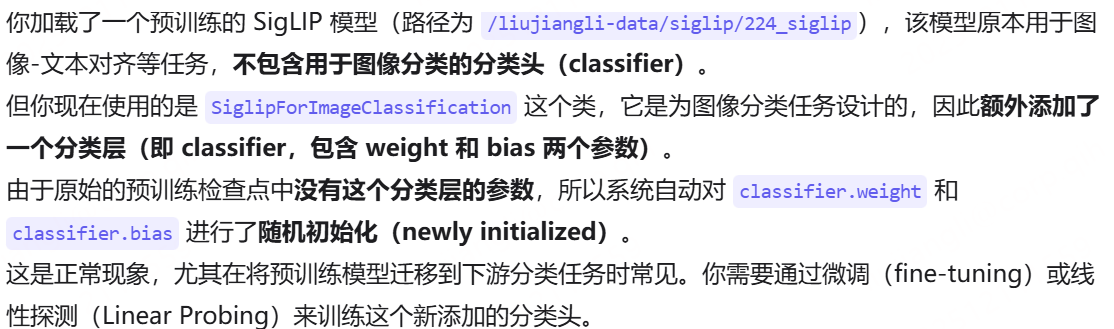
You should probably TRAIN this model on a down-stream task to be able to use it for predictions and inference.
意思就是需要自己训练分类头
ForImageClassification(
(vision_model):VisionTransformer(
这部分负责将图像转化为一系列的token
(embeddings): VisionEmbeddings(
(patch_embedding): Conv2d(3, 768, kernel_size=(16, 16), stride=(16, 16), padding=valid)
-
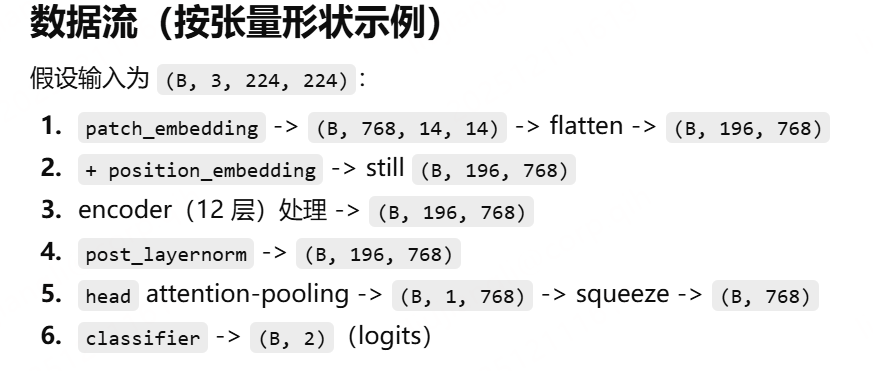
用 3×3 RGB 输入,卷积核大小 16、步幅 16,(卷积核大小和步长大小相同)相当于把图像按照 16×16 的不重叠 patch 切分并对每个 patch 做线性投影(这是很多 ViT 实现常用的 trick,用 conv 实现 patch embedding)。
-
输出通道数 768 表示每个 patch 被投影到 768 维特征向量。
-
若输入是 224×224,输出的 patch 网格大小是 14×14,总 patch 数 196(14×14)。
-
数据形状变化(假设 batch size = B):
-
输入:
(B, 3, 224, 224) -
conv 输出:
(B, 768, 14, 14) -
flatten/transpose 后:
(B, 196, 768)或常见的(B, 768, 196)根据实现差别(你的打印显示 position embedding 是 Embedding(196,768),所以 tokens 数=196)。
-
(position_embedding): Embedding(196, 768)
)
-
为每个 patch token 加上可学习的位置编码(长度 196,每个位置 768 维)。
-
这样模型能区分不同 patch 的空间位置。
包括embeddings 包括patch embedding 和 position embedding
接下来Transformer 的堆叠编码器,负责在所有 patch token 间建模全局交互。
(encoder): Encoder(
(layers): ModuleList(
有12层这样的堆叠在一起 一共 12 层 encoder layer(典型 ViT-Base 的层数)。每一层都包括以下几个部分
(0-11): 12 x EncoderLayer(
(layer_norm1): LayerNorm((768,), eps=1e-06, elementwise_affine=True)
(self_attn): Attention(
(k_proj): Linear(in_features=768, out_features=768, bias=True)
(v_proj): Linear(in_features=768, out_features=768, bias=True)
(q_proj): Linear(in_features=768, out_features=768, bias=True)
(out_proj): Linear(in_features=768, out_features=768, bias=True)
)
(layer_norm2): LayerNorm((768,), eps=1e-06, elementwise_affine=True)
(mlp): MLP(
(activation_fn): GELUTanh()
(fc1): Linear(in_features=768, out_features=3072, bias=True)
(fc2): Linear(in_features=3072, out_features=768, bias=True)
)
)
)
)
EncoderLayer
-
layer_norm1: LayerNorm((768,), eps=1e-06, elementwise_affine=True)- 对 token 的 768 维做 Layer Normalization(归一化),
eps是数值稳定项,elementwise_affine=True意味着有可学习的缩放和平移参数(γ, β)。
- 对 token 的 768 维做 Layer Normalization(归一化),
-
self_attn: Attention-
Transformer 的自注意力子层,包含 Q/K/V 的投影和输出投影:
-
q_proj,k_proj,v_proj:Linear(in_features=768, out_features=768, bias=True)-
把 768 维输入线性变换成 Q、K、V,维度仍是 768。通常会在内部 reshape 为
(num_heads, head_dim)形式进行多头计算。 -
虽然打印没有给出
num_heads,但常见配置是 12 头(768 / 12 = 64 head_dim)。这是个合理假设,但具体头数要看实现。
-
-
out_proj: Linear(768 -> 768):把多头注意力拼回 768 维。
-
-
自注意力作用:每个 patch token 会基于所有 token 的相互注意力加权组合信息,捕捉全局依赖和上下文。
-
-
layer_norm2: LayerNorm((768,), eps=1e-06, elementwise_affine=True)- 注意力后的第二个 LayerNorm(用于残差连接后的规范化 / 稳定训练)。
-
mlp: MLP-
前馈网络(通常称为 MLP 或 FFN),结构如下:
-
fc1: Linear(in_features=768, out_features=3072, bias=True):扩展维度到 3072(通常是 4× hidden dim)。 -
activation_fn: GELUTanh():这是一个自定义激活,名字暗示可能是结合了 GELU 与 tanh 的形式,或是某种带有 tanh 缓和的 GELU 风格激活(不是标准的,但用途类似于 GELU 提供非线性)。作用是引入非线性并帮助模型表达复杂变换。 -
fc2: Linear(in_features=3072, out_features=768, bias=True):把维度投回 768。
-
-
MLP 的作用是对每个 token 进行位置无关的逐 token 非线性变换(增强表示能力)。
-
每个 encoder layer 常见的数据流是:x = x + SelfAttn(LN(x)),x = x + MLP(LN(x))(即 Pre-LN 或 Post-LN 变体,这里看起来是 pre-LN,因为 LayerNorm 在子层前面)。
(post_layernorm): LayerNorm((768,), eps=1e-06, elementwise_affine=True)
- 在全部 encoder layer 堆叠之后再做一次 LayerNorm,输出一个稳定的 token 表示序列。
(head): MultiheadAttentionPoolingHead(
(attention): MultiheadAttention(
(out_proj): NonDynamicallyQuantizableLinear(in_features=768, out_features=768, bias=True)
)
(layernorm): LayerNorm((768,), eps=1e-06, elementwise_affine=True)
(mlp): MLP(
(activation_fn): GELUTanh()
(fc1): Linear(in_features=768, out_features=3072, bias=True)
(fc2): Linear(in_features=3072, out_features=768, bias=True)
)
)
)
这个 head 不是简单的 global average 或 class token,而是用 attention pooling(多头注意力池化)把 token 序列聚合为一个全局表示。
-
(attention): MultiheadAttention( (out_proj): NonDynamicallyQuantizableLinear(in_features=768, out_features=768, bias=True) )-
MultiheadAttention 作为 pooling 操作:通常做法是引入一个 learnable query(或使用一个特殊的 class token),通过 query 对所有 token 做 attention,加权得到一个聚合向量。
-
out_proj把多头拼回 768 维。NonDynamicallyQuantizableLinear是 PyTorch 的一种线性层实现细节(与量化相关的实现差异),对功能没有影响。 -
这一步的结果是把
(B, N, 768)的 token 序列压缩为(B, 1, 768)或(B, 768)的全局向量(取决于实现)。
-
-
(layernorm): LayerNorm((768,), eps=1e-06, elementwise_affine=True)- 对聚合向量做规范化。
-
(mlp): MLP( fc1: 768->3072, activation GELUTanh, fc2: 3072->768 )- 对聚合向量再做一次 MLP 变换以增强判别能力(类似 encoder 内部的 MLP,但只作用于 pooled vector)。
总结:head 把所有 patch token 的信息用注意力方式加权整合成单个语义向量(比简单平均更灵活,因为 attention 可以学习关注重要 patch)。
(classifier): Linear(in_features=768, out_features=2, bias=True)
)
看模型结构 可以决定冻结哪些 微调的数据是原本模型 感觉还是适合全参数微调 把这个前面的vision model和后面的分类头一起训练