概述
在 Objective-C 开发中,协议(Protocol)是实现接口抽象和多态的重要机制。然而,编译器对协议实现的检查有时存在局限性,特别是在动态运行时和复杂的继承关系中。本文将介绍一个完整的协议一致性检查解决方案,涵盖基础实现、功能扩展。
完整代码
Objective-c
// ProtocolConformanceChecker.h
#import <Foundation/Foundation.h>

NS_ASSUME_NONNULL_BEGIN

@interface ProtocolConformanceChecker : NSObject

/**
 验证对象是否完整实现了指定协议

 @param objc 要验证的对象
 @param protocol 要验证的协议
 @param checkOptionalMethods 是否检查可选方法
 @param checkClassMethods 是否检查类方法
 */
+ (void)assertObjC:(id)objc
  conformsToProtocol:(Protocol *)protocol
checkOptionalMethods:(BOOL)checkOptionalMethods
  checkClassMethods:(BOOL)checkClassMethods;

@end

NS_ASSUME_NONNULL_END

// ProtocolConformanceChecker.m
#import "ProtocolConformanceChecker.h"
#import <objc/runtime.h>

@interface _ProtocolMethodInfo : NSObject
@property (nonatomic, copy) NSString *methodName;
@property (nonatomic, copy) NSString *typeEncoding;
@property (nonatomic, assign) BOOL isRequired;
@property (nonatomic, assign) BOOL isInstanceMethod;
@end

@implementation _ProtocolMethodInfo
@end

@implementation ProtocolConformanceChecker

#pragma mark - 主验证方法

+ (void)assertObjC:(id)objc
  conformsToProtocol:(Protocol *)protocol
checkOptionalMethods:(BOOL)checkOptionalMethods
  checkClassMethods:(BOOL)checkClassMethods {

    // 1. 获取所有需要检查的方法
    NSArray<_ProtocolMethodInfo *> *allMethods =
        [self getAllMethodsForProtocol:protocol
                  checkOptionalMethods:checkOptionalMethods
                    checkClassMethods:checkClassMethods];

    // 2. 验证每个方法的实现
    NSMutableArray<NSString *> *unconformsMethods = [NSMutableArray array];

    for (_ProtocolMethodInfo *methodInfo in allMethods) {
        if (![self object:objc implementsMethod:methodInfo]) {
            NSString *methodDesc = [self formatMethodDescription:methodInfo];
            [unconformsMethods addObject:methodDesc];
        }
    }

    // 3. 报告验证结果
    [self reportValidationResultForObject:objc
                      unconformsMethods:unconformsMethods];
}

#pragma mark - 私有辅助方法

+ (NSArray<_ProtocolMethodInfo *> *)getAllMethodsForProtocol:(Protocol *)protocol
                                        checkOptionalMethods:(BOOL)checkOptionalMethods
                                          checkClassMethods:(BOOL)checkClassMethods {

    NSMutableArray<_ProtocolMethodInfo *> *allMethods = [NSMutableArray array];

    // 获取必需方法
    [allMethods addObjectsFromArray:
        [self getMethodsForProtocol:protocol
                         isRequired:YES
                  checkClassMethods:checkClassMethods]];

    // 获取可选方法(如果需要)
    if (checkOptionalMethods) {
        [allMethods addObjectsFromArray:
            [self getMethodsForProtocol:protocol
                             isRequired:NO
                      checkClassMethods:checkClassMethods]];
    }

    return [allMethods copy];
}

+ (NSArray<_ProtocolMethodInfo *> *)getMethodsForProtocol:(Protocol *)protocol
                                             isRequired:(BOOL)isRequired
                                      checkClassMethods:(BOOL)checkClassMethods {

    NSMutableArray<_ProtocolMethodInfo *> *methods = [NSMutableArray array];

    // 获取当前协议的方法
    [methods addObjectsFromArray:
        [self getMethodsForSingleProtocol:protocol
                               isRequired:isRequired
                        checkClassMethods:checkClassMethods]];

    // 递归获取继承协议的方法
    unsigned int protocolListCount;
    Protocol * __unsafe_unretained _Nonnull * _Nullable protocols =
        protocol_copyProtocolList(protocol, &protocolListCount);

    for (unsigned int i = 0; i < protocolListCount; i++) {
        [methods addObjectsFromArray:
            [self getMethodsForProtocol:protocols[i]
                             isRequired:isRequired
                      checkClassMethods:checkClassMethods]];
    }

    if (protocols) free(protocols);

    return [methods copy];
}

+ (NSArray<_ProtocolMethodInfo *> *)getMethodsForSingleProtocol:(Protocol *)protocol
                                                   isRequired:(BOOL)isRequired
                                            checkClassMethods:(BOOL)checkClassMethods {

    NSMutableArray<_ProtocolMethodInfo *> *methods = [NSMutableArray array];

    // 检查实例方法
    unsigned int instanceMethodCount;
    struct objc_method_description *instanceMethodDescriptions =
        protocol_copyMethodDescriptionList(protocol,
                                         isRequired,
                                         YES,  // 实例方法
                                         &instanceMethodCount);

    for (unsigned int i = 0; i < instanceMethodCount; i++) {
        _ProtocolMethodInfo *info = [_ProtocolMethodInfo new];
        info.methodName = NSStringFromSelector(instanceMethodDescriptions[i].name);
        info.typeEncoding = [NSString stringWithUTF8String:instanceMethodDescriptions[i].types];
        info.isRequired = isRequired;
        info.isInstanceMethod = YES;
        [methods addObject:info];
    }

    if (instanceMethodDescriptions) free(instanceMethodDescriptions);

    // 检查类方法(如果需要)
    if (checkClassMethods) {
        unsigned int classMethodCount;
        struct objc_method_description *classMethodDescriptions =
            protocol_copyMethodDescriptionList(protocol,
                                             isRequired,
                                             NO,  // 类方法
                                             &classMethodCount);

        for (unsigned int i = 0; i < classMethodCount; i++) {
            _ProtocolMethodInfo *info = [_ProtocolMethodInfo new];
            info.methodName = NSStringFromSelector(classMethodDescriptions[i].name);
            info.typeEncoding = [NSString stringWithUTF8String:classMethodDescriptions[i].types];
            info.isRequired = isRequired;
            info.isInstanceMethod = NO;
            [methods addObject:info];
        }

        if (classMethodDescriptions) free(classMethodDescriptions);
    }

    return [methods copy];
}

+ (BOOL)object:(id)objc implementsMethod:(_ProtocolMethodInfo *)methodInfo {
    if (methodInfo.isInstanceMethod) {
        // 检查实例方法
        Method method = class_getInstanceMethod([objc class],
                                              NSSelectorFromString(methodInfo.methodName));
        if (!method) return NO;

        // 检查方法签名是否匹配
        const char *typeEncoding = method_getTypeEncoding(method);
        return strcmp(typeEncoding, methodInfo.typeEncoding.UTF8String) == 0;
    } else {
        // 检查类方法
        Method method = class_getClassMethod([objc class],
                                           NSSelectorFromString(methodInfo.methodName));
        if (!method) return NO;

        // 检查方法签名是否匹配
        const char *typeEncoding = method_getTypeEncoding(method);
        return strcmp(typeEncoding, methodInfo.typeEncoding.UTF8String) == 0;
    }
}

+ (NSString *)formatMethodDescription:(_ProtocolMethodInfo *)methodInfo {
    NSString *methodType = methodInfo.isInstanceMethod ? @"实例方法" : @"类方法";
    NSString *requirement = methodInfo.isRequired ? @"必需" : @"可选";

    return [NSString stringWithFormat:@"%@ [%@, %@]",
            methodInfo.methodName,
            methodType,
            requirement];
}

+ (void)reportValidationResultForObject:(id)objc
                    unconformsMethods:(NSArray<NSString *> *)unconformsMethods {

    if (unconformsMethods.count == 0) {
        return; // 验证通过
    }

    NSString *errorMessage = [NSString stringWithFormat:
        @"%@ 未实现以下方法:\n%@",
        objc,
        [unconformsMethods componentsJoinedByString:@"\n"]];

    // 使用断言,在调试时中断执行
    NSAssert(NO, @"%@", errorMessage);

    // 生产环境记录日志
#ifdef RELEASE
    NSLog(@"Protocol Conformance Error: %@", errorMessage);
#endif
}

@end
流程图
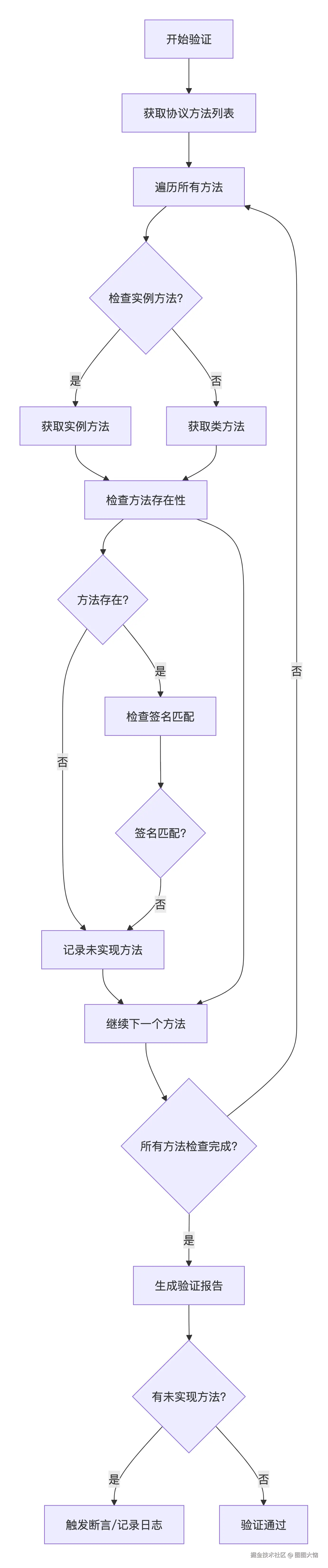
核心功能特性
1. 完整的协议继承链检查
系统采用递归算法遍历协议的所有父协议,确保检查完整的继承关系:
ini
// 递归获取继承协议的方法
unsigned int protocolListCount;
Protocol **protocols = protocol_copyProtocolList(protocol, &protocolListCount);
for (unsigned int i = 0; i < protocolListCount; i++) {
    [self getMethodsForProtocol:protocols[i]
                     isRequired:isRequired
              checkClassMethods:checkClassMethods];
}
2. 灵活的方法检查配置
支持四种检查模式的任意组合:
objectivec
// 使用示例 - 完整检查
[ProtocolConformanceChecker assertObjC:myObject
                    conformsToProtocol:@protocol(MyProtocol)
               checkOptionalMethods:YES   // 检查可选方法
                 checkClassMethods:YES];  // 检查类方法

// 使用示例 - 最小检查
[ProtocolConformanceChecker assertObjC:myObject
                    conformsToProtocol:@protocol(MyProtocol)
               checkOptionalMethods:NO    // 不检查可选方法
                 checkClassMethods:NO];   // 不检查类方法
3. 详细的方法签名验证
不仅检查方法是否存在,还验证方法签名(Type Encoding)是否完全匹配:
scss
+ (BOOL)object:(id)objc implementsMethod:(_ProtocolMethodInfo *)methodInfo {
    const char *typeEncoding = method_getTypeEncoding(method);
    return strcmp(typeEncoding, methodInfo.typeEncoding.UTF8String) == 0;
}
实现细节解析
方法信息封装
使用轻量级的内部类封装方法信息,提高代码的可读性和可维护性:
less
@interface _ProtocolMethodInfo : NSObject
@property (nonatomic, copy) NSString *methodName;      // 方法名
@property (nonatomic, copy) NSString *typeEncoding;    // 类型编码
@property (nonatomic, assign) BOOL isRequired;         // 是否必需
@property (nonatomic, assign) BOOL isInstanceMethod;   // 是否为实例方法
@end
内存管理规范
严格遵守 Objective-C 运行时内存管理规范:
scss
// 正确释放运行时分配的内存
if (instanceMethodDescriptions) free(instanceMethodDescriptions);
if (protocols) free(protocols);
清晰的错误报告
提供详细的错误信息,快速定位问题:
ini
+ (NSString *)formatMethodDescription:(_ProtocolMethodInfo *)methodInfo {
    NSString *methodType = methodInfo.isInstanceMethod ? @"实例方法" : @"类方法";
    NSString *requirement = methodInfo.isRequired ? @"必需" : @"可选";

    return [NSString stringWithFormat:@"%@ [%@, %@]",
            methodInfo.methodName,
            methodType,
            requirement];
}
执行流程详解
步骤1:方法收集阶段
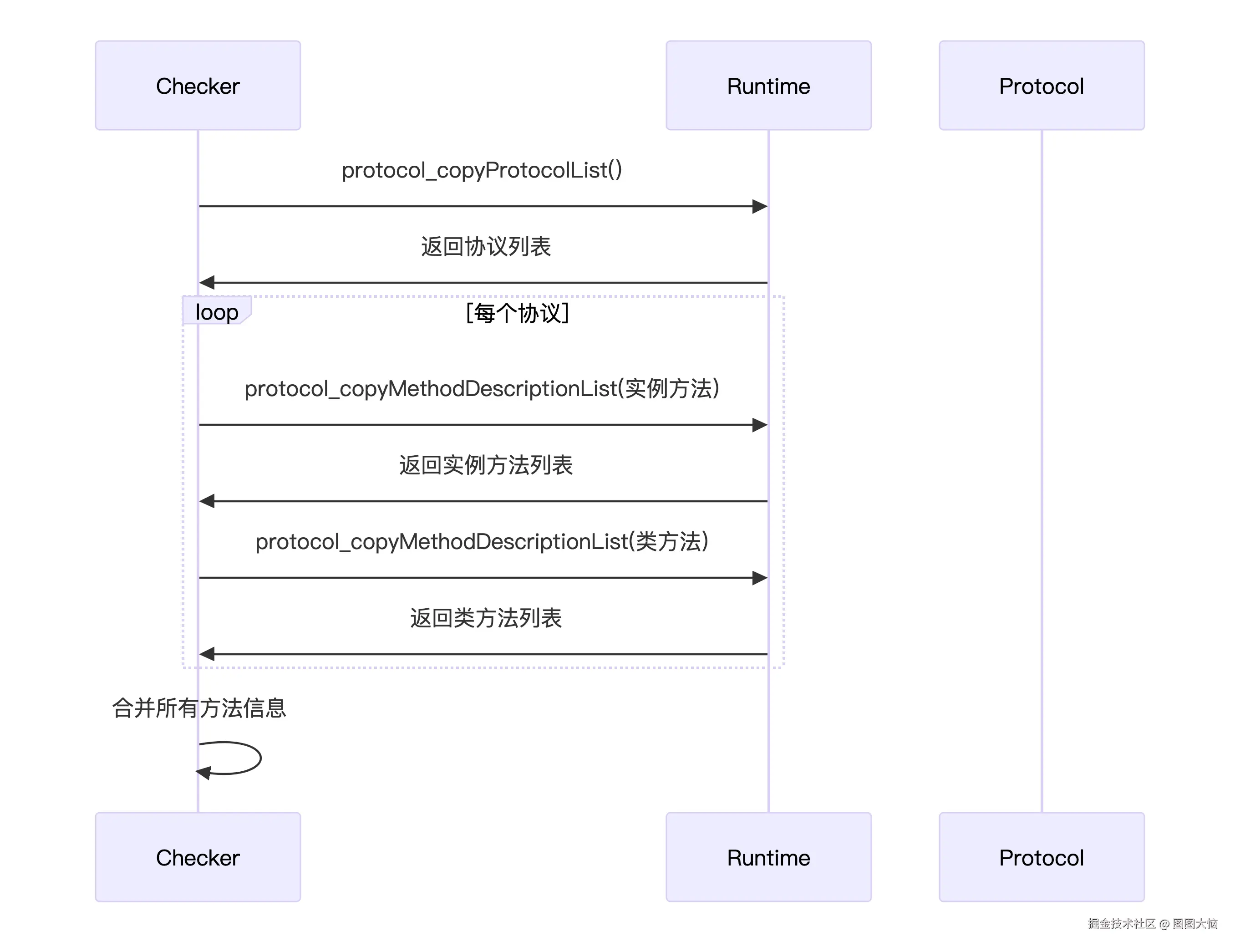
步骤2:方法验证阶段

步骤3:结果报告阶段
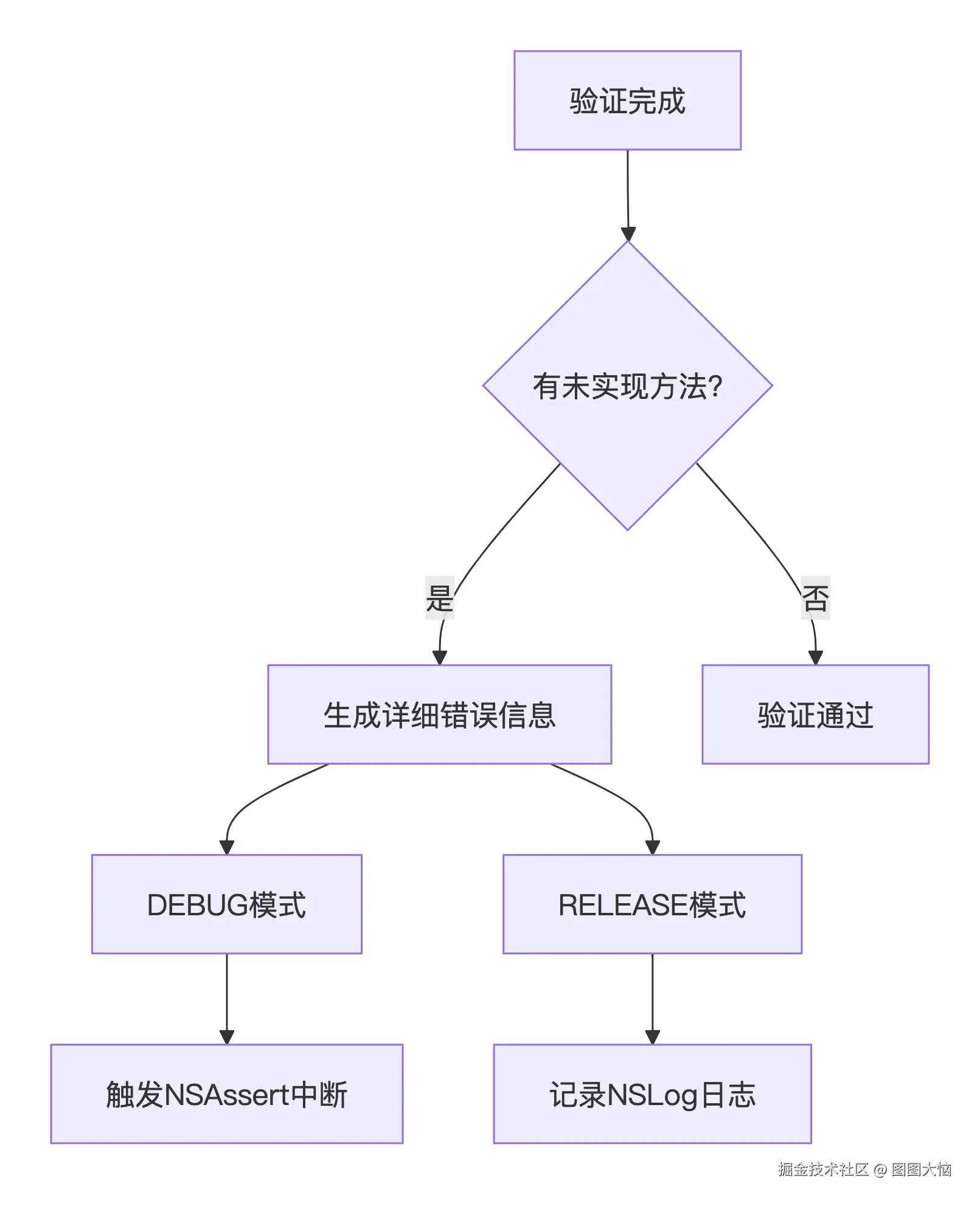
使用场景示例
场景一:单元测试中的协议验证
objectivec
// 验证 Mock 对象是否完整实现协议
- (void)testDataSourceProtocolConformance {
    // 创建 Mock 对象
    id mockDataSource = [OCMockObject mockForProtocol:@protocol(UITableViewDataSource)];

    // 验证协议实现
    [ProtocolConformanceChecker assertObjC:mockDataSource
                        conformsToProtocol:@protocol(UITableViewDataSource)
                   checkOptionalMethods:NO    // UITableViewDataSource 只有必需方法
                     checkClassMethods:NO];   // 数据源协议通常只有实例方法

    // 执行测试逻辑
    // ...
}
场景二:框架初始化验证
objectivec
// 确保框架提供的基类正确实现协议
@implementation MyNetworkManager

+ (void)initialize {
    if (self == [MyNetworkManager class]) {
        // 验证类是否实现必要的协议
        [ProtocolConformanceChecker assertObjC:self
                            conformsToProtocol:@protocol(MyNetworkProtocol)
                       checkOptionalMethods:YES    // 检查所有可选方法
                         checkClassMethods:YES];   // 检查类方法
    }
}

@end
场景三:关键路径的防御性检查
objectivec
// 在设置代理时进行验证
- (void)setDelegate:(id<MyCustomDelegate>)delegate {
    // 只在调试模式下进行完整验证
#ifdef DEBUG
    if (delegate) {
        [ProtocolConformanceChecker assertObjC:delegate
                            conformsToProtocol:@protocol(MyCustomDelegate)
                       checkOptionalMethods:YES    // 检查可选方法
                         checkClassMethods:NO];    // 代理协议通常只有实例方法
    }
#endif

    _delegate = delegate;
}
最佳实践
1. 调试与测试阶段
objectivec
// 在单元测试中全面验证
- (void)testProtocolImplementation {
    [ProtocolConformanceChecker assertObjC:testObject
                        conformsToProtocol:@protocol(RequiredProtocol)
                   checkOptionalMethods:YES
                     checkClassMethods:YES];
}
2. 生产环境使用
less
// 使用条件编译控制检查行为
- (void)setupComponent:(id)component {
#ifdef DEBUG
    // 调试模式下进行全面检查
    [ProtocolConformanceChecker assertObjC:component                        conformsToProtocol:@protocol(ComponentProtocol)                   checkOptionalMethods:YES                     checkClassMethods:NO];
#else
    // 生产环境下可选择性检查或记录日志
    if ([component conformsToProtocol:@protocol(ComponentProtocol)]) {
        // 基础检查通过
    } else {
        NSLog(@"Warning: Component does not conform to protocol");
    }
#endif
}
扩展可能性
1. 批量验证支持
objectivec
// 扩展:支持批量验证多个协议
+ (void)assertObjC:(id)objc
conformsToProtocols:(NSArray<Protocol *> *)protocols
checkOptionalMethods:(BOOL)checkOptionalMethods
  checkClassMethods:(BOOL)checkClassMethods;
2. 自定义验证回调
objectivec
// 扩展:支持自定义验证结果处理
typedef void(^ValidationCompletion)(BOOL success, NSArray<NSString *> *errors);

+ (void)validateObjC:(id)objc
  conformsToProtocol:(Protocol *)protocol
checkOptionalMethods:(BOOL)checkOptionalMethods
  checkClassMethods:(BOOL)checkClassMethods
         completion:(ValidationCompletion)completion;
3. Swift 兼容性扩展
less
// 扩展:更好的 Swift 兼容性
NS_SWIFT_NAME(ProtocolConformanceChecker.validate(_:conformsTo:checkOptional:checkClass:))
+ (void)swift_validateObject:(id)objc
          conformsToProtocol:(Protocol *)protocol
       checkOptionalMethods:(BOOL)checkOptionalMethods
         checkClassMethods:(BOOL)checkClassMethods;
总结
本文介绍了一个简洁高效的 Objective-C 协议一致性检查工具。通过深入理解 Objective-C 运行时机制,我们实现了一个能够全面验证协议实现的解决方案。
核心优势:
- ✅ 完整性:支持完整的协议继承链检查
- ✅ 灵活性:可配置的检查选项满足不同场景需求
- ✅ 准确性:严格的方法签名验证确保实现正确性
- ✅ 简洁性:去除了复杂的缓存逻辑,代码更易于理解和维护
- ✅ 实用性:清晰的错误报告帮助快速定位问题
适用场景:
- 单元测试和集成测试
- 框架和库的初始化验证
- 关键路径的防御性编程
- 协议实现的调试和验证
通过合理运用这个工具,可以在早期发现协议实现的问题,提高代码质量,减少运行时错误,构建更加健壮的 Objective-C 应用程序。