Audio Clock Regeneration
-
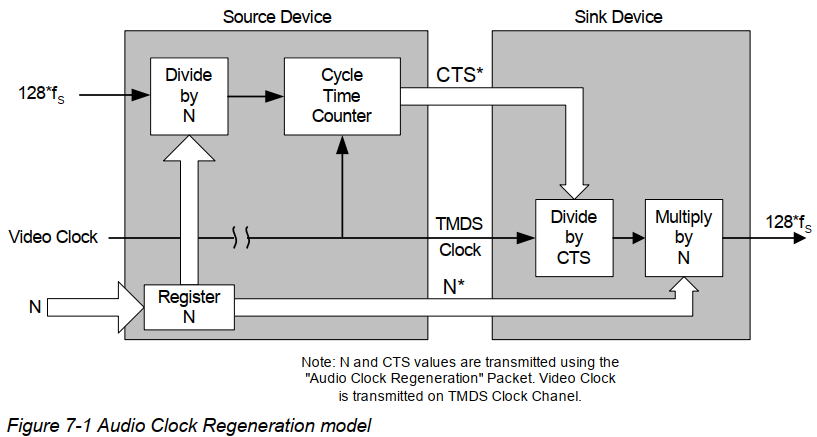
Audio data being carried across the HDMI link, which is driven by a TMDS clock running at a rate corresponding to the video pixel rate, does not retain the original audio sample clock. The task of recreating this clock at the Sink is called Audio Clock Regeneration.
-
coherent clocks :In many video source devices, the audio and video clocks are generated from a common clock
-
The Source shall determine the fractional relationship between the TMDS clock and an audio reference clock (128 *audio sample rate fs) and shall
pass the numerator and denominator of that fraction to the Sink across the HDMI link.
-
The Sink may then recreate the audio clock from the TMDS clock by using a clock divider and a clock multiplier.

- fs : audio sample rate
- N: 在video和audio用同一个clock的情况下, N的定义是在spec推荐的表中Recommended N and Expected CTS,不同一个clock的情况下需要计算(N = 128*fs / 1000Hz)
- CTS: 等于 (fTMDS_clock* N ) / (128 · fs)
-
Typically, this value N will be used in a clock divider to generate an intermediate clock that is slower than the 128·fs clock by the factor N.
-
The Source will typically determine the value of the denominator CTS (Cycle Time Stamp) by counting the number of TMDS clocks in each of the 128·fs/N clocks.
参考文档
- High-Definition Multimedia Interface Specification Version 1.3