项目价值:
1、将海外原来税代记录的外账导入SAP系统平行账作为期初;
2、同时满足总部和属地多准则核算要求
3、提升海外数据准则记录质量
4、降低海外财务审计合规风险
关键控制点:
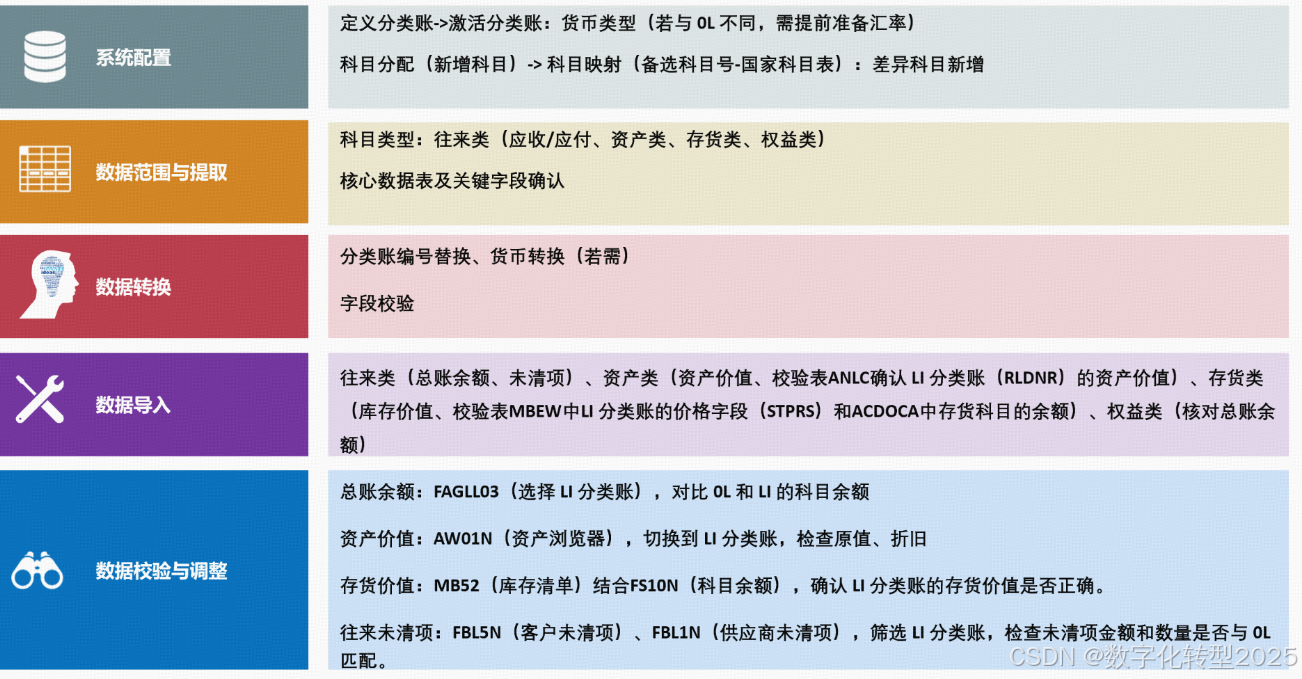
SAP Parallel Ledger (LI) Migration & Validation Process Table (Bilingual)
Phase Name (English) Phase Name (中文) Core Objective (English) Core Objective (中文) Key Actions (English) Key Actions (中文) Purpose (English) Purpose (中文) System Configuration 系统配置 Establish an independent accounting framework for the parallel ledger (LI) and complete account-level mapping and configuration 为平行账(LI)创建独立核算体系,完成科目层面映射与配置 1. Define and activate the ledger, configure the currency type (prepare exchange rates in advance if different from OL)2. Create local ledger accounts and complete account mapping (alternative account number - country chart of accounts), handle differential accounts 1. 定义并激活分类账,配置货币类型(若与 OL 不同需提前准备汇率)2. 新增本地账科目并完成科目映射(备选科目号 - 国家科目表),处理差异科目 Build the foundational accounting framework to ensure the local ledger (LI) has independent and compliant financial accounting rules. 搭建基础核算框架,确保本地账(LI)拥有独立、合规的财务核算规则 Data Scope & Extraction 数据范围与提取 Clarify the scope of data to be migrated and identify core data tables and key fields 明确迁移数据范围,锁定核心数据源表与关键字段 1. Categorize data by account type (AR/AP, Asset, Inventory, Equity)2. Confirm core data tables and key fields for each account type 1. 按科目类型(往来类、资产类、存货类、权益类)划分数据2. 确认各科目类型对应的核心数据表及关键字段 Establish clear data boundaries to prevent omission or redundancy, laying the foundation for subsequent migration and validation. 建立清晰的数据边界,避免数据遗漏或冗余,为后续迁移与校验奠定基础 Data Transformation 数据转换 Transform source system data into a format compliant with the target ledger (LI) rules 将源系统数据转换为符合目标账套(LI)规则的格式 1. Replace ledger IDs2. Perform currency conversion (if required)3. Conduct format and logical validation of fields 1. 替换分类账编号2. 执行货币转换(若需)3. 对字段进行格式与逻辑校验 Ensure data compatibility and accuracy across ledgers, eliminating format and rule discrepancies. 确保数据在不同账套间的兼容性与准确性,消除格式与规则差异 Data Loading 数据导入 Load transformed data into the target ledger (LI) 将转换后的数据加载至目标账套(LI) Load data by account type:• AR/AP (GL balances, open items)• Assets (asset values)• Inventory (inventory values)• Equity (GL balances) 按科目类型分别导入:・往来类(总账余额、未清项)・资产类(资产价值)・存货类(库存价值)・权益类(总账余额) Complete data migration from source to target, providing a complete data foundation for subsequent validation. 完成数据从源到目标的迁移落地,为后续校验提供完整的数据基础 Data Validation & Reconciliation 数据校验与调整 Validate the accuracy of loaded data and resolve discrepancies to ensure consistency between ledgers 验证导入数据的准确性,修正差异以确保账套数据一致 1. GL Balances: Use FAGLL03to compare account balances between OL and LI2. Asset Values: UseAW01Nto check asset original value and depreciation3. Inventory Values: UseMB52+FS10Nto confirm inventory values4. Open Items: UseFBL5N/FBL1Nto reconcile open item amounts and quantities1. 总账余额:用 FAGLL03对比 OL 与 LI 的科目余额2. 资产价值:用AW01N检查资产原值、折旧3. 存货价值:用MB52和FS10N确认存货价值4. 往来未清项:用FBL5N(客户)和FBL1N(供应商)核对未清项金额与数量Ensure financial data consistency between the parallel ledger (LI) and group ledger (OL) through multi-dimensional validation, meeting compliance and accounting requirements. 通过多维度校验,确保平行账(LI)与集团账(OL)财务数据一致,满足合规性与财务核算要求
如下SAP 系统多分类账(通常是平行账,如本地账 LI 与集团账 0L)数据迁移与校验的全流程操作指南,它清晰地拆解了从系统配置到最终数据验证的完整步骤。我帮你梳理一下每个阶段的核心目标和作用:
1. 系统配置
- 核心任务:为平行账(LI)创建独立的分类账体系,并完成财务科目层面的映射与配置。
- 关键动作:激活货币类型(如果与集团账 OL 的本位币不同,需提前配置汇率),新增并映射本地账专用的会计科目。
- 作用:这是基础搭建阶段,确保本地账在系统中拥有独立且合规的核算规则。
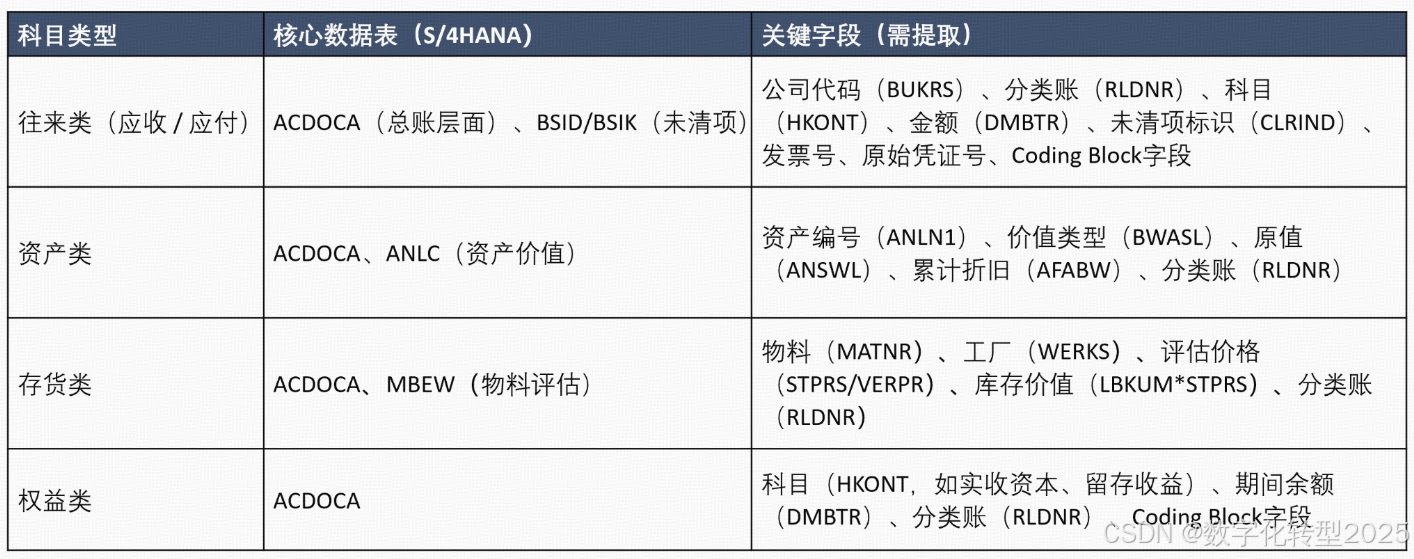
2. 数据范围与提取
- 核心任务:明确需要迁移的财务数据范围,并锁定核心数据表与关键字段。
- 关键动作:按科目类型(往来类、资产类、存货类、权益类)划分数据,并确认各类型对应的核心数据源表。
- 作用:避免数据遗漏或冗余,为后续迁移和校验建立清晰的数据边界。
3. 数据转换
- 核心任务:将源系统数据转换为符合目标账套(LI)规则的格式。
- 关键动作:替换分类账编号、执行货币转换(若涉及多币种),并对字段进行格式与逻辑校验。
- 作用:确保数据在不同账套间的兼容性和准确性。
4. 数据导入
- 核心任务:将转换后的数据加载到目标账套(LI)中。
- 关键动作:按科目类型分别导入往来类、资产类、存货类、权益类数据,并与总账余额进行初步核对。
- 作用:完成数据从源到目标的迁移落地,为后续校验提供数据基础。
5. 数据校验与调整
- 核心任务:验证导入数据的准确性,并修正差异。
- 关键动作 :
- 总账余额 :用事务码
FAGLL03对比 OL 与 LI 的科目余额。 - 资产价值 :用
AW01N检查资产原值与折旧。 - 存货价值 :用
MB52和FS10N确认存货价值。 - 往来未清项 :用
FBL5N(客户)和FBL1N(供应商)核对未清项。
- 总账余额 :用事务码
- 作用:通过多维度校验,确保平行账(LI)与集团账(OL)的财务数据一致,满足合规性要求。
详细定制化方案请评论区留言