注:本文为 "线性代数发展史" 相关合辑。
英文引文,机翻未校。
中文引文,略作重排。
未整理去重,如有内容异常,请看原文。
A Brief History of Linear Algebra and Matrix Theory
线性代数与矩阵理论简史
The introduction and development of the notion of a matrix and the subject of linear algebra followed the development of determinants, which arose from the study of coefficients of systems of linear equations. Leibnitz, one of the two founders of calculus, used determinants in 1693 and Cramer presented his determinant-based formula for solving systems of linear equations (today known as Cramer's Rule) in 1750. In contrast, the first implicit use of matrices occurred in Lagrange's work on bilinear forms in the late 1700s. Lagrange desired to characterize the maxima and minima of multivariate functions. His method is now known as the method of Lagrange multipliers. In order to do this he first required the first order partial derivatives to be 0 and additionally required that a condition on the matrix of second order partial derivatives hold; this condition is today called positive or negative definiteness, although Lagrange didn't use matrices explicitly.
矩阵概念与线性代数这一学科的引入和发展,晚于行列式的发展进程。行列式的概念源于对线性方程组系数的研究。微积分的两位奠基人之一莱布尼茨,于 1693 年率先使用行列式;1750 年,克拉默提出了基于行列式求解线性方程组的公式,该公式如今被称为克拉默法则。与之不同,矩阵的首次隐性应用出现在 18 世纪末拉格朗日关于双线性型的研究中。拉格朗日当时希望找到多元函数极值的判定方法,他提出的方法即为如今的拉格朗日乘数法。为实现这一目标,他首先要求函数的一阶偏导数为 0,其次要求由二阶偏导数构成的矩阵满足特定条件------尽管拉格朗日并未明确使用矩阵这一术语,但该条件如今被称为正定性或负定性。
Gauss developed Gaussian elimination around 1800 and used it to solve least squares problems in celestial computations and later in computations to measure the earth and its surface (the branch of applied mathematics concerned with measuring or determining the shape of the earth or with locating exactly points on the earth's surface is called geodesy). Even though Gauss' name is associated with this technique for successively eliminating variables from systems of linear equations Chinese manuscripts from several centuries earlier have been found that explain how to solve a system of three equations in three unknowns by ''Gaussian'' elimination. For years Gaussian elimination was considered part of the development of geodesy, not mathematics. The first appearance of Gauss-Jordan elimination in print was in a handbook on geodesy written by Wilhelm Jordan. Many people incorrectly assume that the famous mathematician Camille Jordan is the Jordan in ''Gauss-Jordan'' elimination.
1800 年前后,高斯提出了高斯消元法。他先是将这一方法用于天体计算中的最小二乘问题求解,后来又将其应用于地球及其地表测量的相关计算中------应用数学中专门研究地球形状测量与地表点位精确定位的分支,被称为大地测量学。尽管高斯的名字与这种逐次消去线性方程组变量的方法紧密相连,但考古发现表明,数百年前的中国文献中,就已经记载了利用类似高斯消元法求解三元一次方程组的方法。在很长一段时间里,高斯消元法都被视作大地测量学的研究成果,而非数学领域的内容。高斯 - 若尔当消元法的首次公开表述,出现在威廉·若尔当所著的一本大地测量学手册中。许多人会误以为,这里的"若尔当"指的是著名数学家卡米耶·若尔当。
For matrix algebra to fruitfully develop one needed both proper notation and the proper definition of matrix multiplication. Both needs were met at about the same time and in the same place. In 1848 in England, J.J. Sylvester first introduced the term ''matrix,'' which was the Latin word for womb, as a name for an array of numbers. Matrix algebra was nurtured by the work of Arthur Cayley in 1855. Cayley studied compositions of linear transformations and was led to define matrix multiplication so that the matrix of coefficients for the composite transformation ST is the product of the matrix for S times the matrix for T . He went on to study the algebra of these compositions including matrix inverses. The famous Cayley-Hamilton theorem which asserts that a square matrix is a root of its characteristic polynomial was given by Cayley in his 1858 Memoir on the Theory of Matrices . The use of a single letter A to represent a matrix was crucial to the development of matrix algebra. Early in the development the formula det(AB ) = det(A )det(B ) provided a connection between matrix algebra and determinants. Cayley wrote ''There would be many things to say about this theory of matrices which should, it seems to me, precede the theory of determinants.''
矩阵代数的有效发展,需要一套规范的符号体系和矩阵乘法的准确定义作为支撑。这两个条件在同一时期、同一地点得以满足。1848 年,英国数学家 J.J.西尔维斯特首次将"matrix"一词引入数学领域,该词的拉丁语本义为"母体",他用这个词来指代数构成的阵列。1855 年,阿瑟·凯莱的研究进一步推动了矩阵代数的发展。凯莱在对线性变换复合运算的研究中,提出了矩阵乘法的定义,使得复合变换 S T ST ST 对应的系数矩阵,恰好等于变换 S S S 对应的矩阵与变换 T T T 对应的矩阵的乘积。此后,他持续深入研究这类复合运算的代数性质,其中包括矩阵的逆运算。1858 年,凯莱在其论文《矩阵理论回忆录》中提出了著名的凯莱 - 哈密顿定理,该定理指出:任意方阵都是其特征多项式的根。用单个字母(如 A A A)表示矩阵的符号约定,对矩阵代数的发展起到了关键作用。在矩阵代数发展初期,公式 det ( A B ) = det ( A ) det ( B ) \det(AB)=\det(A)\det(B) det(AB)=det(A)det(B) 搭建起了矩阵代数与行列式理论之间的桥梁。凯莱曾写道:"关于矩阵理论,有许多内容值得探讨。在我看来,矩阵理论应当优先于行列式理论而存在。"
Mathematicians also attempted to develop of algebra of vectors but there was no natural definition of the product of two vectors that held in arbitrary dimensions. The first vector algebra that involved a noncommutative vector product (that is, v × w \boldsymbol{v} \times \boldsymbol{w} v×w need not equal w × v \boldsymbol{w} \times \boldsymbol{v} w×v) was proposed by Hermann Grassmann in his book Ausdehnungslehre (1844). Grassmann's text also introduced the product of a column matrix and a row matrix, which resulted in what is now called a simple or a rank-one matrix. In the late 19th century the American mathematical physicist Willard Gibbs published his famous treatise on vector analysis. In that treatise Gibbs represented general matrices, which he called dyadics, as sums of simple matrices, which Gibbs called dyads. Later the physicist P. A. M. Dirac introduced the term ''bra-ket'' for what we now call the scalar product of a ''bra'' (row) vector times a ''ket'' (column) vector and the term ''ket-bra'' for the product of a ket times a bra, resulting in what we now call a simple matrix, as above. Our convention of identifying column matrices and vectors was introduced by physicists in the 20th century.
与此同时,数学家们也在尝试构建向量代数体系,但长期未能找到一种适用于任意维度的、自然的向量乘法定义。1844 年,赫尔曼·格拉斯曼在其著作《扩张论》中,首次提出了包含非交换向量积的向量代数------也就是说,在该代数体系中 v × w \boldsymbol{v} \times \boldsymbol{w} v×w 不一定等于 w × v \boldsymbol{w} \times \boldsymbol{v} w×v。格拉斯曼在书中还引入了列矩阵与行矩阵的乘积运算,其运算结果正是如今所说的简单矩阵或秩 1 矩阵。19 世纪末,美国数学物理学家威拉德·吉布斯出版了关于向量分析的经典论著。在这部著作中,吉布斯将他称之为"并矢"的一般矩阵,表示为若干个他称之为"双积"的简单矩阵之和。后来,物理学家 P.A.M.狄拉克引入了"左矢 - 右矢"的术语体系:他将行向量(左矢)与列向量(右矢)的标量积称为"左矢 - 右矢"积;将列向量与行向量的乘积称为"右矢 - 左矢"积,这一乘积的结果正是前文所述的简单矩阵。将列矩阵与向量视作等价的惯例,则是由物理学家在 20 世纪提出的。
Matrices continued to be closely associated with linear transformations. By 1900 they were just a finite-dimensional subcase of the emerging theory of linear transformations. The modern definition of a vector space was introduced by Peano in 1888. Abstract vector spaces whose elements were functions soon followed.
矩阵始终与线性变换保持着紧密的关联。到 1900 年时,矩阵已被视作新兴的线性变换理论在有限维空间中的特例。1888 年,皮亚诺给出了向量空间的现代定义。不久之后,以函数为元素的抽象向量空间也随之诞生。
There was renewed interest in matrices, particularly on the numerical analysis of matrices, after World War II with the development of modern digital computers. John von Neumann and Herman Goldstine introduced condition numbers in analyzing round-off errors in 1947. Alan Turing and von Neumann were the 20th century giants in the development of stored-program computers. Turing introduced the LU decomposition of a matrix in 1948. The L is a lower triangular matrix with 1's on the diagonal and the U is an echelon matrix. It is common to use LU decompositions in the solution of a sequence of systems of linear equations, each having the same coefficient matrix. The benefits of the QR decomposition was realized a decade later. The Q is a matrix whose columns are orthonormal vectors and R is a square upper triangular invertible matrix with positive entries on its diagonal. The QR factorization is used in computer algorithms for various computations, such as solving equations and find eigenvalues.
第二次世界大战结束后,随着现代数字计算机的发展,人们对矩阵的研究热情再度高涨,矩阵数值分析领域的研究尤为活跃。1947 年,约翰·冯·诺依曼与赫尔曼·戈德斯坦在分析舍入误差时,引入了条件数的概念。艾伦·图灵与冯·诺依曼是 20 世纪存储程序计算机发展史上的两位巨匠。1948 年,图灵提出了矩阵的 LU 分解,其中 L L L 为对角线元素全为 1 的下三角矩阵, U U U 为阶梯形矩阵。在求解一系列系数矩阵相同的线性方程组时,LU 分解是一种常用方法。十年之后,QR 分解的价值逐渐显现。QR 分解中, Q Q Q 为列向量组是标准正交组的矩阵, R R R 为对角线元素为正数的可逆上三角方阵。QR 分解被广泛应用于各类计算机算法中,例如方程组求解、特征值计算等数值计算任务。
References
参考文献
-
S. Athloen and R. McLaughlin, Gauss-Jordan reduction: A brief history, American Mathematical Monthly 94 (1987) 130-142.
S.阿思罗恩、R.麦克劳克林,《高斯 - 若尔当消元法简史》,《美国数学月刊》,第 94 卷 (1987),第 130 - 142 页。
-
A. Tucker, The growing importance of linear algebra in undergraduate mathematics, The College Mathematics Journal , 24 (1993) 3-9.
A.塔克,《线性代数在本科数学教育中日益凸显的重要性》,《大学数学期刊》,第 24 卷 (1993),第 3 - 9 页。
Matrices and determinants
矩阵与行列式
The beginnings of matrices and determinants goes back to the second century BC although traces can be seen back to the fourth century BC. However it was not until near the end of the 17th Century that the ideas reappeared and development really got underway.
矩阵与行列式的起源可追溯至公元前 2 世纪,尽管其痕迹能追溯到公元前 4 世纪。但直到 17 世纪末,这些思想才重新出现,真正的发展也由此展开。
It is not surprising that the beginnings of matrices and determinants should arise through the study of systems of linear equations. The Babylonians studied problems which lead to simultaneous linear equations and some of these are preserved in clay tablets which survive. For example a tablet dating from around 300 BC contains the following problem:-
矩阵与行列式的起源源于线性方程组的研究,这并不令人意外。巴比伦人研究过一些会导出联立线性方程组的问题,其中部分问题被保留在现存的泥板上。例如,一块约公元前 300 年的泥板上记载了如下问题:
There are two fields whose total area is 1800 square yards. One produces grain at the rate of 2 3 \frac{2}{3} 32 of a bushel per square yard while the other produces grain at the rate of 1 2 \frac{1}{2} 21 a bushel per square yard. If the total yield is 1100 bushels, what is the size of each field.
有两块田地,总面积为 1800 平方码。其中一块田地每平方码产粮 2 3 \frac{2}{3} 32 蒲式耳,另一块每平方码产粮 1 2 \frac{1}{2} 21 蒲式耳。若总产量为 1100 蒲式耳,求每块田地的面积。
The Chinese, between 200 BC and 100 BC, came much closer to matrices than the Babylonians. Indeed it is fair to say that the text Nine Chapters on the Mathematical Art written during the Han Dynasty gives the first known example of matrix methods. First a problem is set up which is similar to the Babylonian example given above:-
公元前 200 年至公元前 100 年间,中国人比巴比伦人更接近矩阵的概念。事实上,可以说汉代的《九章算术》给出了已知最早的矩阵方法实例。书中首先提出了一个与上述巴比伦问题类似的问题:
There are three types of corn, of which three bundles of the first, two of the second, and one of the third make 39 measures. Two of the first, three of the second and one of the third make 34 measures. And one of the first, two of the second and three of the third make 26 measures. How many measures of corn are contained of one bundle of each type?
现有三种谷物,已知三束第一种谷物、两束第二种谷物和一束第三种谷物共 39 斗;两束第一种谷物、三束第二种谷物和一束第三种谷物共 34 斗;一束第一种谷物、两束第二种谷物和三束第三种谷物共 26 斗。求每种谷物一束各有多少斗?
Now the author does something quite remarkable. He sets up the coefficients of the system of three linear equations in three unknowns as a table on a 'counting board'.
此时,作者采取了一项非常了不起的做法。他将这个三元一次线性方程组的系数在"算板"上排列成一个表格:
       1   2   3
       2   3   2
       3   1   1
      26  34  39
Our late 20th Century methods would have us write the linear equations as the rows of the matrix rather than the columns but of course the method is identical. Most remarkably the author, writing in 200 BC, instructs the reader to multiply the middle column by 3 and subtract the right column as many times as possible, the same is then done subtracting the right column as many times as possible from 3 times the first column. This gives
我们 20 世纪末的方法会将线性方程组按行写入矩阵,而非按列,但两种方法本质上是相同的。最值得注意的是,这位生活在公元前 200 年的作者指示读者:将中间一列乘以 3,然后尽可能多次地减去最右边一列;接着,将第一列乘以 3,同样尽可能多次地减去最右边一列。由此得到:
       0   0   3
       4   5   2
       8   1   1
      39  24  39
Next the left most column is multiplied by 5 and then the middle column is subtracted as many times as possible. This gives
接下来,将最左边一列乘以 5,然后尽可能多次地减去中间一列,得到:
       0   0   3
       0   5   2
      36   1   1
      99  24  39
from which the solution can be found for the third type of corn, then for the second, then the first by back substitution. This method, now known as Gaussian elimination, would not become well known until the early 19th Century.
通过回代法,先求出第三种谷物的数量,再求出第二种,最后求出第一种。这种方法如今被称为高斯消元法,直到 19 世纪初才广为人知。
Cardan, in Ars Magna (1545), gives a rule for solving a system of two linear equations which he calls regula de modo and which 7 calls mother of rules ! This rule gives what essentially is Cramer's rule for solving a 2 × 2 2 \times 2 2×2 system although Cardan does not make the final step. Cardan therefore does not reach the definition of a determinant but, with the advantage of hindsight, we can see that his method does lead to the definition.
卡尔达诺(Cardan)在其著作《大术》(Ars Magna,1545 年)中给出了求解二元线性方程组的法则,他称之为"regula de modo"(方法法则),而文献7称之为"法则之母"!该法则本质上就是求解 2 × 2 2 \times 2 2×2 方程组的克莱姆法则,尽管卡尔达诺并未完成最后一步推导。因此,卡尔达诺并未给出行列式的定义,但以今人的视角来看,他的方法已趋近于行列式的定义。
Many standard results of elementary matrix theory first appeared long before matrices were the object of mathematical investigation. For example de Witt in Elements of curves, published as a part of the commentaries on the 1660 Latin version of Descartes ' Géométrie , showed how a transformation of the axes reduces a given equation for a conic to canonical form. This amounts to diagonalising a symmetric matrix but de Witt never thought in these terms.
初等矩阵理论中的许多标准结果,在矩阵成为数学研究对象之前很久就已出现。例如,德·维特(de Witt)在《曲线原理》(Elements of curves)中------该书作为 1660 年笛卡尔《几何学》(Géométrie)拉丁文译本的评注部分出版------展示了如何通过坐标轴变换将二次曲线方程化为标准型。这本质上相当于对称矩阵的对角化,但德·维特从未从这个角度思考过。
The idea of a determinant appeared in Japan before it appeared in Europe. In 1683 Seki wrote Method of solving the dissimulated problems which contains matrix methods written as tables in exactly the way the Chinese methods described above were constructed. Without having any word which corresponds to 'determinant' Seki still introduced determinants and gave general methods for calculating them based on examples. Using his 'determinants' Seki was able to find determinants of 2 × 2 2 \times 2 2×2, 3 × 3 3 \times 3 3×3, 4 × 4 4 \times 4 4×4 and 5 × 5 5 \times 5 5×5 matrices and applied them to solving equations but not systems of linear equations.
行列式的概念在欧洲出现之前就已出现在日本。1683 年,关孝和(Seki)撰写了《解隐题之法》(Method of solving the dissimulated problems),书中记载的矩阵方法与上述中国方法完全一致,均以表格形式呈现。尽管当时日本没有对应"行列式"的词汇,关孝和仍引入了行列式的概念,并通过实例给出了通用的计算方法。利用他的"行列式",关孝和能够计算 2 × 2 2 \times 2 2×2、 3 × 3 3 \times 3 3×3、 4 × 4 4 \times 4 4×4 和 5 × 5 5 \times 5 5×5 矩阵的行列式,并将其应用于解方程,但未应用于线性方程组。
The first appearance of a determinant in Europe was ten years later. In 1693 Leibniz wrote to de l'Hôpital. He explained that the system of equations
十年后,行列式的概念首次出现在欧洲。1693 年,莱布尼茨(Leibniz)写信给洛必达(de l'Hôpital),他解释了方程组:
10 + 11 x + 12 y = 0 20 + 21 x + 22 y = 0 30 + 31 x + 32 y = 0 10 + 11x + 12y = 0\\ 20 + 21x + 22y = 0\\ 30 + 31x + 32y = 0 10+11x+12y=020+21x+22y=030+31x+32y=0
had a solution because
有解,因为:
10.21.32 + 11.22.30 + 12.20.31 = 10.22.31 + 11.20.32 + 12.21.30
which is exactly the condition that the coefficient matrix has determinant 0. Notice that here Leibniz is not using numerical coefficients but two characters, the first marking in which equation it occurs, the second marking which letter it belongs to.
这正是系数矩阵行列式为 0 的条件。注意,莱布尼茨此处并未使用数值系数,而是用两个字符表示:第一个字符标记该系数所在的方程,第二个字符标记其对应的未知数。
Hence 21 denotes what we might write as a 21 a_{21} a21 .
因此,21 表示的就是我们如今写作 a 21 a_{21} a21 的量。
Leibniz was convinced that good mathematical notation was the key to progress so he experimented with different notation for coefficient systems. His unpublished manuscripts contain more than 50 different ways of writing coefficient systems which he worked on during a period of 50 years beginning in 1678. Only two publications (1700 and 1710) contain results on coefficient systems and these use the same notation as in his letter to de l'Hôpital mentioned above.
莱布尼茨坚信,良好的数学符号是进步的关键,因此他尝试了多种系数系统的表示方法。从 1678 年开始的 50 年间,他未发表的手稿中包含了 50 多种不同的系数系统书写方式。仅有两篇出版物(1700 年和 1710 年)涉及系数系统的成果,且采用了与上述给洛必达信件中相同的符号。
Leibniz used the word 'resultant' for certain combinatorial sums of terms of a determinant. He proved various results on resultants including what is essentially Cramer's rule. He also knew that a determinant could be expanded using any column - what is now called the Laplace expansion. As well as studying coefficient systems of equations which led him to determinants, Leibniz also studied coefficient systems of quadratic forms which led naturally towards matrix theory.
莱布尼茨将行列式中某些项的组合和称为"结式"(resultant)。他证明了关于结式的多个结果,其中包括本质上的克莱姆法则。他还知晓行列式可以按任意一列展开------即如今所说的拉普拉斯展开。除了研究方程的系数系统(这使他走向行列式),莱布尼茨还研究了二次型的系数系统,这自然地导向了矩阵理论。
In the 1730's Maclaurin wrote Treatise of algebra although it was not published until 1748, two years after his death. It contains the first published results on determinants proving Cramer 's rule for 2 × 2 2 \times 2 2×2 and 3 × 3 3 \times 3 3×3 systems and indicating how the 4 × 4 4 \times 4 4×4 case would work. Cramer gave the general rule for n × n n \times n n×n systems in a paper Introduction to the analysis of algebraic curves (1750). It arose out of a desire to find the equation of a plane curve passing through a number of given points. The rule appears in an Appendix to the paper but no proof is given:-
18 世纪 30 年代,麦克劳林(Maclaurin)撰写了《代数学论著》(Treatise of algebra),但该书直到 1748 年(他去世两年后)才出版。书中包含了首个发表的关于行列式的成果,证明了 2 × 2 2 \times 2 2×2 和 3 × 3 3 \times 3 3×3 方程组的克莱姆法则,并指出了 4 × 4 4 \times 4 4×4 方程组的求解思路。克莱姆(Cramer)在其论文《代数曲线分析导论》(Introduction to the analysis of algebraic curves,1750 年)中给出了 n × n n \times n n×n 方程组的通用法则。该法则源于寻找经过若干给定点的平面曲线方程的需求,出现在论文的附录中,但未给出证明:
One finds the value of each unknown by forming n fractions of which the common denominator has as many terms as there are permutations of n things.
求每个未知数的值时,需构造 n 个分数,其公分母的项数与 n 个元素的排列数相同。
Cramer does go on to explain precisely how one calculates these terms as products of certain coefficients in the equations and how one determines the sign. He also says how the n numerators of the fractions can be found by replacing certain coefficients in this calculation by constant terms of the system.
克莱姆随后详细解释了如何将这些项计算为方程中特定系数的乘积,以及如何确定符号。他还说明了如何通过将计算中的特定系数替换为方程组的常数项,来得到这 n 个分数的分子。
Work on determinants now began to appear regularly. In 1764 Bezout gave methods of calculating determinants as did Vandermonde in 1771. In 1772 Laplace claimed that the methods introduced by Cramer and Bezout were impractical and, in a paper where he studied the orbits of the inner planets, he discussed the solution of systems of linear equations without actually calculating it, by using determinants. Rather surprisingly Laplace used the word 'resultant' for what we now call the determinant: surprising since it is the same word as used by Leibniz yet Laplace must have been unaware of Leibniz 's work. Laplace gave the expansion of a determinant which is now named after him.
此后,关于行列式的研究成果开始定期涌现。1764 年,贝祖(Bezout)给出了行列式的计算方法;1771 年,范德蒙德(Vandermonde)也给出了相关计算方法。1772 年,拉普拉斯(Laplace)认为克莱姆和贝祖提出的方法不切实际,他在一篇研究内行星轨道的论文中,讨论了如何利用行列式求解线性方程组,而无需实际计算。颇为意外的是,拉普拉斯将我们如今所说的行列式称为"结式"(resultant)------这一命名令人惊讶,因为莱布尼茨也曾使用该词,但拉普拉斯显然并不知晓莱布尼茨的相关研究。拉普拉斯给出了行列式的展开式,即如今以他命名的拉普拉斯展开。
Lagrange, in a paper of 1773, studied identities for 3 × 3 3 \times 3 3×3 functional determinants. However this comment is made with hindsight since Lagrange himself saw no connection between his work and that of Laplace and Vandermonde . This 1773 paper on mechanics, however, contains what we now think of as the volume interpretation of a determinant for the first time. Lagrange showed that the tetrahedron formed by O ( 0 , 0 , 0 ) O(0,0,0) O(0,0,0) and the three points M ( x , y , z ) , M ′ ( x ′ , y ′ , z ′ ) , M ′ ′ ( x ′ ′ , y ′ ′ , z ′ ′ ) M(x,y,z), M'(x',y',z'), M''(x'',y'',z'') M(x,y,z),M′(x′,y′,z′),M′′(x′′,y′′,z′′) has volume
1773 年,拉格朗日(Lagrange)在一篇论文中研究了 3 × 3 3 \times 3 3×3 函数行列式的恒等式。但这一评价是事后诸葛亮,因为拉格朗日本人并未意识到他的研究与拉普拉斯、范德蒙德的工作之间存在关联。不过,这篇 1773 年的力学论文首次包含了我们如今所说的行列式的体积解释。拉格朗日证明,由点 O ( 0 , 0 , 0 ) O(0,0,0) O(0,0,0) 和三个点 M ( x , y , z ) M(x,y,z) M(x,y,z)、 M ′ ( x ′ , y ′ , z ′ ) M'(x',y',z') M′(x′,y′,z′)、 M ′ ′ ( x ′ ′ , y ′ ′ , z ′ ′ ) M''(x'',y'',z'') M′′(x′′,y′′,z′′) 构成的四面体的体积为:
1 6 z ( x ′ y ′ ′ − y ′ x ′ ′ ) + z ′ ( y x ′ ′ − x y ′ ′ ) + z ′ ′ ( x y ′ − y x ′ ) \frac{1}{6} z(x'y'' - y'x'') + z'(yx'' - xy'') + z''(xy' - yx') 61z(x′y′′−y′x′′)+z′(yx′′−xy′′)+z′′(xy′−yx′)
The term 'determinant' was first introduced by Gauss in Disquisitiones arithmeticae (1801) while discussing quadratic forms. He used the term because the determinant determines the properties of the quadratic form. However the concept is not the same as that of our determinant. In the same work Gauss lays out the coefficients of his quadratic forms in rectangular arrays. He describes matrix multiplication (which he thinks of as composition so he has not yet reached the concept of matrix algebra) and the inverse of a matrix in the particular context of the arrays of coefficients of quadratic forms.
"行列式"(determinant)一词由高斯(Gauss)在其著作《算术研究》(Disquisitiones arithmeticae,1801 年)中讨论二次型时首次引入。他使用该术语是因为行列式决定了二次型的性质,但此处的行列式概念与我们如今所用的并不完全相同。在同一部著作中,高斯将二次型的系数排列成矩形阵列,并在二次型系数阵列的特定语境下,描述了矩阵乘法(他将其视为一种复合运算,尚未形成矩阵代数的概念)和矩阵的逆。
Gaussian elimination, which first appeared in the text Nine Chapters on the Mathematical Art written in 200 BC, was used by Gauss in his work which studied the orbit of the asteroid Pallas. Using observations of Pallas taken between 1803 and 1809, Gauss obtained a system of six linear equations in six unknowns. Gauss gave a systematic method for solving such equations which is precisely Gaussian elimination on the coefficient matrix.
高斯消元法最早出现在公元前 200 年的《九章算术》中,高斯在研究小行星帕拉斯(Pallas)轨道的工作中运用了这一方法。通过 1803 年至 1809 年间对帕拉斯的观测数据,高斯得到了一个六元一次线性方程组,并给出了求解这类方程组的系统方法------这正是对系数矩阵执行的高斯消元法。
It was Cauchy in 1812 who used 'determinant' in its modern sense. Cauchy's work is the most complete of the early works on determinants. He reproved the earlier results and gave new results of his own on minors and adjoints. In the 1812 paper the multiplication theorem for determinants is proved for the first time although, at the same meeting of the Institut de France, Binet also read a paper which contained a proof of the multiplication theorem but it was less satisfactory than that given by Cauchy .
1812 年,柯西(Cauchy)首次在现代意义上使用"行列式"一词。柯西的研究是早期行列式研究中最完整的成果,他重新证明了先前的结论,并提出了关于子式和伴随矩阵的新成果。1812 年的这篇论文首次证明了行列式的乘法定理------尽管在法国科学院的同一次会议上,比内(Binet)也宣读了一篇包含该定理证明的论文,但柯西的证明更为完善。
In 1826 Cauchy, in the context of quadratic forms in n variables, used the term 'tableau' for the matrix of coefficients. He found the eigenvalues and gave results on diagonalisation of a matrix in the context of converting a form to the sum of squares. Cauchy also introduced the idea of similar matrices (but not the term) and showed that if two matrices are similar they have the same characteristic equation. He also, again in the context of quadratic forms, proved that every real symmetric matrix is diagonalisable.
1826 年,柯西在 n 元二次型的语境下,将系数矩阵称为"表格"(tableau)。他发现了特征值,并在将二次型化为平方和的过程中,给出了矩阵对角化的相关结果。柯西还引入了相似矩阵的思想(但未使用"相似矩阵"这一术语),并证明了相似矩阵具有相同的特征方程。此外,他仍在二次型的语境下,证明了每个实对称矩阵都是可对角化的。
Jacques Sturm gave a generalisation of the eigenvalue problem in the context of solving systems of ordinary differential equations. In fact the concept of an eigenvalue appeared 80 years earlier, again in work on systems of linear differential equations, by D'Alembert studying the motion of a string with masses attached to it at various points.
雅克·斯图姆(Jacques Sturm)在求解常微分方程组的语境下,对特征值问题进行了推广。事实上,特征值的概念早在 80 年前就已出现------达朗贝尔(D'Alembert)在研究带有多个附着质量的弦的振动问题时,在线性微分方程组的相关工作中首次提出了这一概念。
It should be stressed that neither Cauchy nor Jacques Sturm realised the generality of the ideas they were introducing and saw them only in the specific contexts in which they were working. Jacobi from around 1830 and then Kronecker and Weierstrass in the 1850's and 1860's also looked at matrix results but again in a special context, this time the notion of a linear transformation. Jacobi published three treatises on determinants in 1841. These were important in that for the first time the definition of the determinant was made in an algorithmic way and the entries in the determinant were not specified so his results applied equally well to cases were the entries were numbers or to where they were functions. These three papers by Jacobi made the idea of a determinant widely known.
需要强调的是,柯西和雅克·斯图姆都未意识到他们所引入思想的普遍性,仅将其局限于各自的特定研究语境中。1830 年左右的雅可比(Jacobi),以及 19 世纪 50 至 60 年代的克罗内克(Kronecker)和魏尔斯特拉斯(Weierstrass),也对矩阵相关成果进行了研究,但同样局限于特定语境------此次是线性变换的概念。1841 年,雅可比出版了三篇关于行列式的专著,这些著作具有重要意义:它们首次以算法形式给出了行列式的定义,且未限定行列式的元素类型,因此其成果既适用于元素为数字的情况,也适用于元素为函数的情况。雅可比的这三篇论文使行列式的概念得到了广泛传播。
Cayley, also writing in 1841, published the first English contribution to the theory of determinants. In this paper he used two vertical lines on either side of the array to denote the determinant, a notation which has now become standard.
同样在 1841 年,凯莱(Cayley)发表了第一篇关于行列式理论的英文文献。在这篇论文中,他使用阵列两侧各加一条竖线的方式表示行列式,这一符号如今已成为标准表示法。
Eisenstein in 1844 denoted linear substitutions by a single letter and showed how to add and multiply them like ordinary numbers except for the lack of commutativity. It is fair to say that Eisenstein was the first to think of linear substitutions as forming an algebra as can be seen in this quote from his 1844 paper:-
1844 年,艾森斯坦(Eisenstein)用单个字母表示线性变换,并展示了如何像普通数字一样对其进行加法和乘法运算(唯一的区别是不满足交换律)。可以说,艾森斯坦是第一个将线性变换视为构成代数体系的学者,这一点从他 1844 年论文中的引述可看出:
An algorithm for calculation can be based on this, it consists of applying the usual rules for the operations of multiplication, division, and exponentiation to symbolic equations between linear systems, correct symbolic equations are always obtained, the sole consideration being that the order of the factors may not be altered.
据此可建立一种计算算法:将乘法、除法和幂运算的常规规则应用于线性系统之间的符号方程,总能得到正确的符号方程,唯一需要注意的是因子的顺序不得改变。
The first to use the term 'matrix' was Sylvester in 1850. Sylvester defined a matrix to be an oblong arrangement of terms and saw it as something which led to various determinants from square arrays contained within it. After leaving America and returning to England in 1851, Sylvester became a lawyer and met Cayley, a fellow lawyer who shared his interest in mathematics. Cayley quickly saw the significance of the matrix concept and by 1853 Cayley had published a note giving, for the first time, the inverse of a matrix.
1850 年,西尔维斯特(Sylvester)首次使用"矩阵"(matrix)一词。他将矩阵定义为"项的长方形排列",并认为矩阵的主要价值在于其包含的方阵可导出各种行列式。1851 年,西尔维斯特离开美国返回英国后成为一名律师,期间结识了同样身为律师且对数学抱有浓厚兴趣的凯莱。凯莱迅速意识到矩阵概念的重要性,并于 1853 年发表了一篇短文,首次给出了矩阵的逆的定义。
Cayley in 1858 published Memoir on the theory of matrices which is remarkable for containing the first abstract definition of a matrix. He shows that the coefficient arrays studied earlier for quadratic forms and for linear transformations are special cases of his general concept. Cayley gave a matrix algebra defining addition, multiplication, scalar multiplication and inverses. He gave an explicit construction of the inverse of a matrix in terms of the determinant of the matrix. Cayley also proved that, in the case of 2 × 2 2 \times 2 2×2 matrices, that a matrix satisfies its own characteristic equation. He stated that he had checked the result for 3 × 3 3 \times 3 3×3 matrices, indicating its proof, but says:-
1858 年,凯莱发表了《矩阵理论专论》(Memoir on the theory of matrices),该文献的显著贡献在于给出了矩阵的首个抽象定义。凯莱指出,早期研究二次型和线性变换时所用的系数阵列,都是他这一通用概念的特例。他建立了矩阵代数,定义了矩阵的加法、乘法、数乘和逆运算,并根据矩阵的行列式明确构造出矩阵的逆。凯莱还证明了 2 × 2 2 \times 2 2×2 矩阵满足其自身的特征方程,他表示已验证 3 × 3 3 \times 3 3×3 矩阵的情况并给出了证明思路,但同时指出:
I have not thought it necessary to undertake the labour of a formal proof of the theorem in the general case of a matrix of any degree.
我认为无需费力对任意阶矩阵的该定理进行形式化证明。
That a matrix satisfies its own characteristic equation is called the Cayley-Hamilton theorem so its reasonable to ask what it has to do with Hamilton. In fact he also proved a special case of the theorem, the 4 × 4 4 \times 4 4×4 case, in the course of his investigations into quaternions.
矩阵满足其自身特征方程这一结论被称为凯莱-哈密顿定理,因此有必要说明哈密顿(Hamilton)与此定理的关联。事实上,哈密顿在研究四元数的过程中,也证明了该定理的一个特例------ 4 × 4 4 \times 4 4×4 矩阵的情况。
In 1870 the Jordan canonical form appeared in Treatise on substitutions and algebraic equations by Jordan. It appears in the context of a canonical form for linear substitutions over the finite field of order a prime.
1870 年,若尔当(Jordan)在其著作《置换与代数方程论》(Treatise on substitutions and algebraic equations)中提出了若尔当标准型。该标准型是在素数阶有限域上线性变换的典范型语境下出现的。
Frobenius, in 1878, wrote an important work on matrices On linear substitutions and bilinear forms although he seemed unaware of Cayley's work. Frobenius in this paper deals with coefficients of forms and does not use the term matrix. However he proved important results on canonical matrices as representatives of equivalence classes of matrices. He cites Kronecker and Weierstrass as having considered special cases of his results in 1874 and 1868 respectively. Frobenius also proved the general result that a matrix satisfies its characteristic equation. This 1878 paper by Frobenius also contains the definition of the rank of a matrix which he used in his work on canonical forms and the definition of orthogonal matrices.
1878 年,弗罗贝尼乌斯(Frobenius)撰写了一篇关于矩阵的重要论文《论线性变换与双线性型》(On linear substitutions and bilinear forms),尽管他似乎并不知晓凯莱的相关工作。弗罗贝尼乌斯在论文中研究了型的系数,但未使用"矩阵"一词。不过,他证明了关于"典范矩阵作为矩阵等价类代表元"的重要结果,并引用了克罗内克(1874 年)和魏尔斯特拉斯(1868 年)分别研究过的特例。弗罗贝尼乌斯还证明了"矩阵满足其特征方程"这一一般结论。这篇 1878 年的论文还包含了矩阵秩的定义(他将其用于典范型的研究)以及正交矩阵的定义。
The nullity of a square matrix was defined by Sylvester in 1884. He defined the nullity of A , n ( A ) A, n(A) A,n(A), to be the largest i i i such that every minor of A A A of order n − i + 1 n-i+1 n−i+1 is zero. Sylvester was interested in invariants of matrices, that is properties which are not changed by certain transformations. Sylvester proved that
1884 年,西尔维斯特定义了方阵的零度(nullity)。他将矩阵 A A A 的零度 n ( A ) n(A) n(A) 定义为满足" A A A 的所有 n − i + 1 n-i+1 n−i+1 阶子式均为零"的最大整数 i i i。西尔维斯特对矩阵的不变量(即不受特定变换影响的性质)感兴趣,并证明了:
max { n ( A ) , n ( B ) } ≤ n ( A B ) ≤ n ( A ) + n ( B ) \max\{n(A), n(B)\} \leq n(AB) \leq n(A) + n(B) max{n(A),n(B)}≤n(AB)≤n(A)+n(B)
In 1896 Frobenius became aware of Cayley's 1858 Memoir on the theory of matrices and after this started to use the term matrix. Despite the fact that Cayley only proved the Cayley-Hamilton theorem for 2 × 2 2 \times 2 2×2 and 3 × 3 3 \times 3 3×3 matrices, Frobenius generously attributed the result to Cayley despite the fact that Frobenius had been the first to prove the general theorem.
1896 年,弗罗贝尼乌斯了解到凯莱 1858 年的《矩阵理论专论》,此后开始使用"矩阵"一词。尽管凯莱仅证明了 2 × 2 2 \times 2 2×2 和 3 × 3 3 \times 3 3×3 矩阵的凯莱-哈密顿定理,而弗罗贝尼乌斯是首个证明该定理一般形式的学者,但他仍慷慨地将该定理归功于凯莱。
An axiomatic definition of a determinant was used by Weierstrass in his lectures and, after his death, it was published in 1903 in the note On determinant theory. In the same year Kronecker's lectures on determinants were also published, again after his death. With these two publications the modern theory of determinants was in place but matrix theory took slightly longer to become a fully accepted theory. An important early text which brought matrices into their proper place within mathematics was Introduction to higher algebra by Bôcher in 1907. Turnbull and Aitken wrote influential texts in the 1930's and Mirsky's An introduction to linear algebra in 1955 saw matrix theory reach its present major role in as one of the most important undergraduate mathematics topic.
魏尔斯特拉斯(Weierstrass)在其授课中使用了行列式的公理化定义,该定义在他去世后于 1903 年发表在《论行列式理论》(On determinant theory)一文中。同年,克罗内克关于行列式的授课内容也在其去世后出版。这两部著作的问世标志着现代行列式理论的成熟,但矩阵理论成为一门被广泛认可的独立理论则稍晚一些。1907 年,博谢(Bôcher)的《高等代数导论》(Introduction to higher algebra)是早期将矩阵纳入数学体系的重要教材。20 世纪 30 年代,特恩布尔(Turnbull)和艾特肯(Aitken)撰写了具有深远影响的教材;1955 年,米尔基(Mirsky)的《线性代数导论》(An introduction to linear algebra)的出版,使矩阵理论成为如今大学本科数学中最重要的课程之一。
References (show)
参考文献(展开)
I Grattan-Guinness and W Ledermann, Matrix theory, in I Grattan-Guinness (ed.), Companion Encyclopedia of the History and Philosophy of the Mathematical Sciences (London, 1994), 775 - 786.
I·格拉坦-吉尼斯(I Grattan-Guinness)、W·莱德曼(W Ledermann),《矩阵理论》(Matrix theory),收录于 I·格拉坦-吉尼斯(编),《数学科学历史与哲学百科全书》(Companion Encyclopedia of the History and Philosophy of the Mathematical Sciences),伦敦,1994 年,第 775-786 页。
T W Hawkins, Cauchy and the spectral theory of matrices, Historia Mathematica 2 (1975), 1 - 29.
T·W·霍金斯(T W Hawkins),《柯西与矩阵谱理论》(Cauchy and the spectral theory of matrices),《数学史》(Historia Mathematica),第 2 卷(1975 年),第 1-29 页。
T W Hawkins, Another look at Cayley and the theory of matrices, Archives Internationales d'Histoire des Sciences 26 (100) (1977), 82 - 112.
T·W·霍金斯(T W Hawkins),《重访凯莱与矩阵理论》(Another look at Cayley and the theory of matrices),《国际科学史档案》(Archives Internationales d'Histoire des Sciences),第 26 卷(第 100 期,1977 年),第 82-112 页。
T W Hawkins, Weierstrass and the theory of matrices, Archive for History of Exact Sciences 17 (1977), 119 - 163.
T·W·霍金斯(T W Hawkins),《魏尔斯特拉斯与矩阵理论》(Weierstrass and the theory of matrices),《精确科学史档案》(Archive for History of Exact Sciences),第 17 卷(1977 年),第 119-163 页。
T Hawkins, The theory of matrices in the 19 th century, Proceedings of the International Congress of Mathematicians 2 (Montreal, Que., 1975), 561 - 570.
T·霍金斯(T Hawkins),《19 世纪的矩阵理论》(The theory of matrices in the 19th century),《国际数学家大会会议录》(Proceedings of the International Congress of Mathematicians),第 2 卷(加拿大魁北克蒙特利尔,1975 年),第 561-570 页。
A Jennings, Matrices, ancient and modern, Bull. Inst. Math. Appl. 13 (5) (1977), 117 - 123.
A·詹宁斯(A Jennings),《矩阵:古代与现代》(Matrices, ancient and modern),《数学应用研究所通报》(Bull. Inst. Math. Appl.),第 13 卷(第 5 期,1977 年),第 117-123 页。
E Knobloch, Determinants, in I Grattan-Guinness (ed.), Companion Encyclopedia of the History and Philosophy of the Mathematical Sciences (London, 1994), 766 - 774.
E·克诺布洛赫(E Knobloch),《行列式》(Determinants),收录于 I·格拉坦-吉尼斯(编),《数学科学历史与哲学百科全书》(Companion Encyclopedia of the History and Philosophy of the Mathematical Sciences),伦敦,1994 年,第 766-774 页。
E Knobloch, From Gauss to Weierstrass : determinant theory and its historical evaluations, in The intersection of history and mathematics (Basel, 1994), 51 - 66.
E·克诺布洛赫(E Knobloch),《从高斯到魏尔斯特拉斯:行列式理论及其历史评价》(From Gauss to Weierstrass: determinant theory and its historical evaluations),收录于《历史与数学的交汇》(The intersection of history and mathematics),巴塞尔,1994 年,第 51-66 页。
E Knobloch, Zur Vorgeschichte der Determinantentheorie, Theoria cum praxi : on the relationship of theory and praxis in the seventeenth and eighteenth centuries IV (Hannover, 1977), 96 - 118.
E·克诺布洛赫(E Knobloch),《行列式理论的前期历史》(Zur Vorgeschichte der Determinantentheorie),《理论与实践:17-18 世纪理论与实践的关系》(Theoria cum praxi: on the relationship of theory and praxis in the seventeenth and eighteenth centuries),第 IV 卷(汉诺威,1977 年),第 96-118 页。
E Knobloch, Der Beginn der Determinantentheorie, Leibnizens nachgelassene Studien zum Determinantenkalkül (Hildesheim, 1980).
E·克诺布洛赫(E Knobloch),《行列式理论的开端:莱布尼茨未发表的行列式演算研究》(Der Beginn der Determinantentheorie, Leibnizens nachgelassene Studien zum Determinantenkalkül),希尔德斯海姆,1980 年。
A E Malykh, Development of the general theory of determinants up to the beginning of the nineteenth century (Russian), Mathematical analysis (Leningrad, 1990), 88 - 97.
A·E·马雷赫(A E Malykh),《19 世纪初以前行列式一般理论的发展》(俄语)(Development of the general theory of determinants up to the beginning of the nineteenth century),《数学分析》(Mathematical analysis),列宁格勒,1990 年,第 88-97 页。
T Muir, The Theory of Determinants in the Historical Order of Development (4 Volumes) (London, 1960).
T·缪尔(T Muir),《行列式理论的历史发展》(4 卷本)(The Theory of Determinants in the Historical Order of Development),伦敦,1960 年。
J Tvrdá, On the origin of the theory of matrices, Acta Historiae Rerum Naturalium necnon Technicarum (Prague, 1971), 335 - 354.
J·特夫达(J Tvrdá),《矩阵理论的起源》(On the origin of the theory of matrices),《自然与技术史学报》(Acta Historiae Rerum Naturalium necnon Technicarum),布拉格,1971 年,第 335-354 页。
Written by J J O'Connor and E F Robertson
作者:J·J·奥康纳(J J O'Connor)、E·F·罗伯逊(E F Robertson)
Last Update February 1996
A Brief History of Linear Algebra
线性代数简史
Jeff Christensen
杰夫·克里斯坦森(Jeff Christensen)
April 2012
2012 年 4 月
Final Project Math 2270
数学 2270 课程期末项目
Grant Gustafson
格兰特·古斯塔夫森(Grant Gustafson)
University of Utah
犹他大学(University of Utah)
In order to unfold the history of linear algebra, it is important that we first determine what Linear Algebra is. As such, this definition is not a complete and comprehensive answer, but rather a broad definition loosely wrapping itself around the subject. I will use several different answers so that we can see these perspectives. First, linear algebra is the study of a certain algebraic structure called a vector space (BYU). Second, linear algebra is the study of linear sets of equations and their transformation properties. Finally, it is the branch of mathematics charged with investigating the properties of finite dimensional vector spaces and linear mappings between such spaces (wiki). This project will discuss the history of linear algebra as it relates linear sets of equations and their transformations and vector spaces. The project seeks to give a brief overview of the history of linear algebra and its practical applications touching on the various topics used in concordance with it.
要梳理线性代数的历史,首先明确线性代数的定义至关重要。因此,这里给出的定义并非完整且全面的答案,而是对该学科的宽泛概括。我将引用几种不同的定义,以便呈现多重视角:首先,线性代数是对一种名为向量空间的代数结构的研究(杨百翰大学(BYU)定义);其次,线性代数研究线性方程组及其变换性质;最后,它是数学的一个分支,致力于探究有限维向量空间的性质以及这类空间之间的线性映射(维基百科定义)。本项目将围绕线性方程组、其变换及向量空间,探讨线性代数的历史,简要概述线性代数的发展历程及其实际应用,并涉及相关的各类主题。
Around 4000 years ago, the people of Babylon knew how to solve a simple 2 × 2 2 \times 2 2×2 system of linear equations with two unknowns. Around 200 BC, the Chinese published that "Nine Chapters of the Mathematical Art," they displayed the ability to solve a 3 × 3 3 \times 3 3×3 system of equations (Perotti). The simple equation of a x + b = 0 a x + b = 0 ax+b=0 is an ancient question worked on by people from all walks of life. The power and progress in linear algebra did not come to fruition until the late 17 t h 17^{th} 17th century.
大约 4000 年前,巴比伦人已掌握求解简单的二元 2 × 2 2 \times 2 2×2 线性方程组的方法。公元前 200 年左右,中国人在《九章算术》中展现了求解 3 × 3 3 \times 3 3×3 方程组的能力(佩罗蒂(Perotti))。简单方程 a x + b = 0 a x + b = 0 ax+b=0 是一个古老的问题,各行各业的人都曾研究过它。而线性代数的影响力与发展直到 17 世纪末才真正成熟。
The emergence of the subject came from determinants, values connected to a square matrix, studied by the founder of calculus, Leibnitz, in the late 17 t h 17^{th} 17th century. Lagrange came out with his work regarding Lagrange multipliers, a way to "characterize the maxima and minima multivariate functions." (Darkwing) More than fifty years later, Cramer presented his ideas of solving systems of linear equations based on determinants more than 50 years after Leibnitz (Darkwing). Interestingly enough, Cramer provided no proof for solving an n × n n \times n n×n system. As we see, linear algebra has become more relevant since the emergence of calculus even though it's foundational equation of a x + b = 0 a x + b = 0 ax+b=0 dates back centuries.
该学科的兴起源于行列式------一种与方阵相关的数值。微积分的创始人莱布尼茨(Leibnitz)在 17 世纪末率先对其展开研究。拉格朗日(Lagrange)随后提出了拉格朗日乘数法,这是一种"刻画多元函数极值"的方法(达克温(Darkwing))。莱布尼茨之后的 50 多年,克莱姆(Cramer)提出了基于行列式求解线性方程组的思想(达克温(Darkwing))。有趣的是,克莱姆并未为 n × n n \times n n×n 方程组的求解方法提供证明。由此可见,尽管线性代数的基础方程 a x + b = 0 a x + b = 0 ax+b=0 可追溯至数百年前,但自微积分诞生后,它的重要性才日益凸显。
∣ a b c d ∣ = a d − b c \left|\begin{array}{ll} a & b \\ c & d \end{array}\right| = a d - b c acbd =ad−bc
Euler brought to light the idea that a system of equations doesn't necessarily have to have a solution (Perotti). He recognized the need for conditions to be placed upon unknown variables in order to find a solution. The initial work up until this period mainly dealt with the concept of unique solutions and square matrices where the number of equations matched the number of unknowns.
欧拉(Euler)首次提出,方程组并非一定有解(佩罗蒂(Perotti))。他意识到,要找到解,必须对未知变量施加特定条件。在此之前的早期研究,主要集中于唯一解的概念以及方程数与未知数个数相等的方阵。
With the turn into the 19 t h 19^{th} 19th century Gauss introduced a procedure to be used for solving a system of linear equations. His work dealt mainly with the linear equations and had yet to bring in the idea of matrices or their notations. His efforts dealt with equations of differing numbers and variables as well as the traditional pre- 19 t h 19^{th} 19th century works of Euler, Leibnitz, and Cramer. Gauss' work is now summed up in the term Gaussian elimination. This method uses the concepts of combining, swapping, or multiplying rows with each other in order to eliminate variables from certain equations. After variables are determined, the student is then to use back substitution to help find the remaining unknown variables.
进入 19 世纪,高斯(Gauss)提出了一种求解线性方程组的流程。他的研究主要聚焦于线性方程本身,尚未引入矩阵的概念及其符号表示。他的成果既涉及方程数与变量数不相等的情况,也延续了 19 世纪前欧拉、莱布尼茨和克莱姆的传统研究。如今,高斯的这一方法被总结为"高斯消元法"。该方法通过行组合、行交换或行乘法等操作,消去某些方程中的变量;确定部分变量后,再通过回代法求解剩余的未知变量。
As mentioned before, Gauss work dealt much with solving linear equations themselves initially, but did not have as much to do with matrices. In order for matrix algebra to develop, a proper notation or method of describing the process was necessary. Also vital to this process was a definition of matrix multiplication and the facets involving it. "The introduction of matrix notation and the invention of the word matrix were motivated by attempts to develop the right algebraic language for studying determinants. In 1848, J.J. Sylvester introduced the term "matrix," the Latin word for womb, as a name for an array of numbers. He used womb, because he viewed a matrix as a generator of determinants (Tucker, 1993). The other part, matrix multiplication or matrix algebra came from the work of Arthur Cayley in 1855.
如前所述,高斯的早期研究主要专注于线性方程的求解,与矩阵关联不大。矩阵代数要发展,就需要一套恰当的符号或方法来描述其运算过程,而矩阵乘法的定义及其相关方面也至关重要。"矩阵符号的引入和 'matrix' 一词的创造,源于人们试图为研究行列式构建合适的代数语言。1848 年,J.J. 西尔维斯特(J.J. Sylvester)引入 'matrix' 这一术语------该词在拉丁语中意为'子宫',用以指代一组数字构成的阵列。他选用这个词,是因为他将矩阵视为行列式的'生成器'(塔克(Tucker),1993 年)。而矩阵乘法(即矩阵代数)的相关理论,则源于阿瑟·凯莱(Arthur Cayley)1855 年的研究。"
Cayley's defined matrix multiplication as, "the matrix of coefficients for the composite transformation T 2 T 1 T_{2} T_{1} T2T1 is the product of the matrix for T 2 T_{2} T2 times the matrix of T 1 T_{1} T1" (Tucker, 1993). His work dealing with Matrix multiplication culminated in his theorem, the Cayley-Hamilton Theorem. Simply stated, a square matrix satisfies its characteristic equation. Cayley's efforts were published in two papers, one in 1850 and the other in 1858. His works introduced the idea of the identity matrix as well as the inverse of a square matrix. He also did much to further the ongoing transformation of the use of matrices and symbolic algebra. He used the letter "A" to represent a matrix, something that had been very little before his works. His efforts were little recognized outside of England until the 1880s.
凯莱将矩阵乘法定义为:"复合变换 T 2 T 1 T_{2} T_{1} T2T1 的系数矩阵,等于变换 T 2 T_{2} T2 的矩阵与变换 T 1 T_{1} T1 的矩阵的乘积"(塔克(Tucker),1993 年)。他在矩阵乘法方面的研究最终促成了凯莱-哈密顿定理(Cayley-Hamilton Theorem)的诞生。该定理简而言之:方阵满足其自身的特征方程。凯莱的研究成果发表于两篇论文中,分别是 1850 年和 1858 年的著作。他的研究引入了单位矩阵和方阵逆矩阵的概念,还极大地推动了矩阵与符号代数应用的持续发展。他用字母"A"表示矩阵,这在他之前是极为罕见的做法。直到 19 世纪 80 年代,他的成果在英国之外才逐渐获得认可。
Matrices at the end of the 19 t h 19^{th} 19th century were heavily connected with Physics issues and for mathematicians, more attention was given to vectors as they proved to be basic mathematical elements. For a time, however, interest in a lot of linear algebra slowed until the end of World War II brought on the development of computers. Now instead of having to break down an enormous n × n n \times n n×n matrix, computers could quickly and accurately solve these systems of linear algebra. With the advancement of technology using the methods of Cayley, Gauss, Leibnitz, Euler, and others determinants and linear algebra moved forward more quickly and more effective. Regardless of the technology though Gaussian elimination still proves to be the best way known to solve a system of linear equations (Tucker, 1993).
19 世纪末,矩阵与物理学问题紧密相关;而对于数学家而言,向量作为基本数学元素,受到了更多关注。然而,在一段时间内,人们对线性代数诸多领域的兴趣有所减弱,这种状况一直持续到二战结束后计算机的发展。如今,无需人工拆解庞大的 n × n n \times n n×n 矩阵,计算机便能快速、准确地求解这些线性代数方程组。借助凯莱、高斯、莱布尼茨、欧拉等人提出的方法,技术的进步推动行列式与线性代数的发展变得更加迅速和高效。不过,无论技术如何发展,高斯消元法仍是目前已知的求解线性方程组的最佳方法(塔克(Tucker),1993 年)。
The influence of Linear Algebra in the mathematical world is spread wide because it provides an important base to many of the principles and practices. Some of the things Linear Algebra is used for are to solve systems of linear format, to find least-square best fit lines to predict future outcomes or find trends, and the use of the Fourier series expansion as a means to solving partial differential equations. Other more broad topics that it is used for are to solve questions of energy in Quantum mechanics. It is also used to create simple every day household games like Sudoku. It is because of these practical applications that Linear Algebra has spread so far and advanced. The key, however, is to understand that the history of linear algebra provides the basis for these applications.
线性代数在数学领域的影响力极为广泛,因为它为众多原理和实践提供了重要基础。线性代数的应用包括:求解线性方程组、寻找最小二乘拟合直线以预测未来结果或发现趋势、利用傅里叶级数展开求解偏微分方程等。更广泛的应用领域还包括量子力学中的能量问题求解,甚至用于设计数独等日常家庭小游戏。正是这些实际应用,使得线性代数得以广泛传播和发展。然而,关键在于理解:线性代数的历史为这些应用奠定了坚实的基础。
Although linear algebra is a fairly new subject when compared to other mathematical practices, it's uses are widespread. With the efforts of calculus savvy Leibnitz the concept of using systems of linear equations to solve unknowns was formalized. Other efforts from scholars like Cayley, Euler, Sylvester, and others changed linear systems into the use of matrices to represent them. Gauss brought his theory to solve systems of equations proving to be the most effective basis for solving unknowns. Technology continues to push the use further and further, but the history of Linear Algebra continues to provide the foundation. Even though every few years companies update their textbooks, the fundamentals stay the same.
尽管与其他数学分支相比,线性代数是一门相对较新的学科,但其应用范围却十分广泛。凭借精通微积分的莱布尼茨的努力,利用线性方程组求解未知数的概念得以正式确立。凯莱、欧拉、西尔维斯特等学者的研究,则将线性系统转化为矩阵表示形式。高斯提出的方程组求解理论,成为求解未知数最有效的基础方法。技术不断推动线性代数的应用向更深更广发展,但线性代数的历史始终是其根基。尽管每隔几年教材会更新版本,但这些基础始终保持不变。
References
- Darkwing. (n.d.). A brief history of linear algebra and matrix theory. Retrieved from
http://darkwing.uoregon.edu/~vitulli/441.sp04/LinAlgHistory.html - Perotti. (n.d.). History of linear algebra. Retrieved from
http://www.science.unitn.it/~perotti/History of Linear Algebra.pdf - Strang, G. (1993). The fundamental theorem of linear algebra. The American Mathematical
- Monthly,100(9), 848-855. Retrieved from http://www.jstor.org/stable/2324660
- Tucker, A. (1993). The growing importance of linear algebra in undergraduate mathematics. The
- College Mathematics Journal, 24(1), 3-9. Retrieved from http://www.jstor.org/stable/2686426
- Weisstein, E.W. Linear Algebra. From MathWorld--A Wolfram Web
Resource. http://mathworld.wolfram.com/LinearAlgebra.html
5 History of Linear Algebra
5 线性代数的历史
Linear algebra is a very useful subject, and its basic concepts arose and were used in different areas of mathematics and its applications. It is therefore not surprising that the subject had its roots in such diverse fields as number theory (both elementary and algebraic), geometry, abstract algebra (groups, rings, fields, Galois theory), analysis (differential equations, integral equations, and functional analysis), and physics. Among the elementary concepts of linear algebra are linear equations, matrices, determinants, linear transformations, linear independence, dimension, bilinear forms, quadratic forms, and vector spaces. Since these concepts are closely interconnected, several usually appear in a given context (e.g., linear equations and matrices) and it is often impossible to disengage them.
线性代数是一门极具实用性的学科,其基本概念源于并应用于数学及其应用的多个不同领域。因此,该学科根植于数论(包括初等数论和代数数论)、几何学、抽象代数(群、环、域、伽罗瓦理论)、分析学(微分方程、积分方程、泛函分析)和物理学等诸多不同领域,也就不足为奇了。线性代数的基本概念包括线性方程组、矩阵、行列式、线性变换、线性无关性、维数、双线性形式、二次形式和向量空间等。由于这些概念紧密相连,在特定情境中通常会同时出现多个(例如线性方程组和矩阵),且往往难以将它们分割开来。
By 1880, many of the basic results of linear algebra had been established, but they were not part of a general theory. In particular, the fundamental notion of vector space, within which such a theory would be framed, was absent. This was introduced only in 1888 by Peano. Even then it was largely ignored (as was the earlier pioneering work of Grassmann), and it took off as the essential element of a fully-fledged theory in the early decades of the twentieth century. So the historical development of the subject is the reverse of its logical order.
到 1880 年,线性代数的许多基本成果已逐步确立,但它们并未构成一个统一的通用理论。尤其是作为该理论框架基本的向量空间这一基本概念,当时尚未出现。这一概念直到 1888 年才由佩亚诺(Peano)提出。即便如此,它在很大程度上仍被忽视(格拉斯曼(Grassmann)早期的开创性工作亦是如此),直到二十世纪初的几十年间,它才成为一门成熟理论的基本要素并迅速发展起来。因此,该学科的历史发展顺序与它的逻辑顺序是相反的。
We will describe the elementary aspects of the evolution of linear algebra under the following headings: linear equations; determinants; matrices and linear transformations; linear independence, basis and dimension; and vector spaces. Along the way, we will comment on some of the other concepts mentioned above.
我们将从以下几个方面阐述线性代数发展的基本情况:线性方程组;行列式;矩阵与线性变换;线性无关性、基与维数;以及向量空间。同时,我们还会对上述提及的部分其他概念进行评述。
5.1 Linear equations
5.1 线性方程组
About 4000 years ago the Babylonians knew how to solve a system of two linear equations in two unknowns (a 2 × 2 2 × 2 2×2 system). In their famous Nine Chapters of the Mathematical Art (c. 200 BC) the Chinese solved 3 × 3 3 × 3 3×3 systems by working solely with their (numerical) coefficients. These were prototypes of matrix methods, not unlike the "elimination methods" introduced by Gauss and others some 2000 years later. See 20.
大约 4000 年前,巴比伦人就已经掌握了求解含两个未知数的两个线性方程组(即 2 × 2 2 × 2 2×2 系统)的方法。在著名的《九章算术》(约公元前 200 年)中,中国人仅通过(数值)系数来求解 3 × 3 3 × 3 3×3 系统。这些都是矩阵方法的雏形,与约 2000 年后高斯(Gauss)等人提出的"消元法"颇为相似。参见20。
The modern study of systems of linear equations can be said to have originated with Leibniz, who in 1693 invented the notion of a determinant for this purpose. But his investigations remained unknown at the time. In his Introduction to the Analysis of Algebraic Curves of 1750, Cramer published the rule named after him for the solution of an n × n n ×n n×n system, but he provided no proofs. He was led to study systems of linear equations while attempting to solve a geometric problem, determining an algebraic curve of degree n n n passing through 1 2 n 2 + 3 2 n \frac{1}{2} n^{2}+\frac{3}{2} n 21n2+23n fixed points. See 1, 20.
线性方程组的现代研究可追溯至莱布尼茨(Leibniz),他于 1693 年为此发明了行列式的概念。但他的研究在当时并未为人所知。1750 年,克莱姆(Cramer)在其著作《代数曲线分析引论》中发表了以他命名的求解 n × n n ×n n×n 系统的法则,但未给出证明。他是在尝试解决一个几何问题时开始研究线性方程组的------该问题是确定一条经过 1 2 n 2 + 3 2 n \frac{1}{2} n^{2}+\frac{3}{2} n 21n2+23n 个定点的 n n n 次代数曲线。参见1, 20。
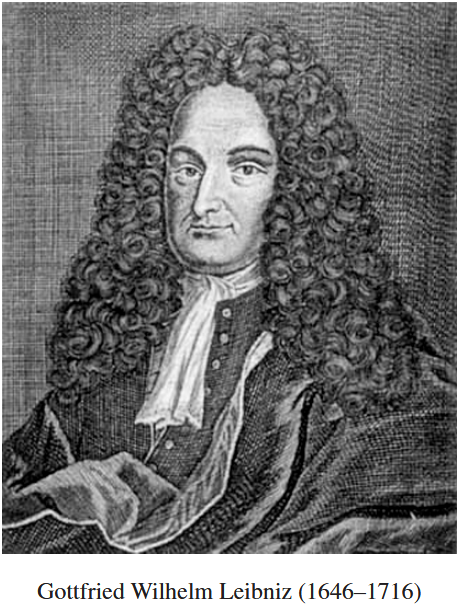
戈特弗里德·威廉·莱布尼茨(1646--1716)
Euler was perhaps the first to observe that a system of n n n equations in n n n unknowns does not necessarily have a unique solution, noting that to obtain uniqueness it is necessary to add conditions. He had in mind the idea of dependence of one equation on the others, although he did not give precise conditions. In the eighteenth century the study of linear equations was usually subsumed under that of determinants, so no consideration was given to systems in which the number of equations differed from the number of unknowns. See 8, 9.
欧拉(Euler)或许是最早发现含 n n n 个未知数的 n n n 个方程所构成的方程组不一定有唯一解的人,他指出要获得唯一解,必须添加额外条件。他当时已萌生了一个方程依赖于其他方程的想法,尽管并未给出精确的条件。在十八世纪,线性方程组的研究通常被归入行列式的研究范畴,因此人们并未考虑方程个数与未知数个数不相等的方程组。参见8, 9。
In connection with his invention of the method of least squares (published in a paper in 1811 dealing with the determination of the orbit of an asteroid), Gauss introduced a systematic procedure, now called Gaussian elimination, for the solution of systems of linear equations, though he did not use the matrix notation. He dealt with the cases in which the number of equations and unknowns may differ 20. The theoretical properties of systems of linear equations, including the issue of their consistency, were treated in the second half of the nineteenth century, and were at least partly motivated by questions of the reduction of quadratic and bilinear forms to "simple" (canonical) ones. See 16, 18.
高斯在发明最小二乘法(该方法于 1811 年发表在一篇关于小行星轨道测定的论文中)的过程中,引入了一种求解线性方程组的系统方法------即如今所说的高斯消元法,不过他当时并未使用矩阵符号。他还处理了方程个数与未知数个数可能不相等的情况。线性方程组的理论性质(包括相容性问题)在十九世纪下半叶得到了研究,这至少在一定程度上是受到了将二次形式和双线性形式化简为"简单"(典范)形式这一问题的推动。参见16, 18。
5.2 Determinants
5.2 行列式
Although one speaks nowadays of the determinant of a matrix, the two concepts had different origins. In particular, determinants appeared before matrices, and the early stages in their history were closely tied to linear equations. Subsequent problems that gave rise to new uses of determinants included elimination theory (finding conditions under which two polynomials have a common root), transformation of coordinates to simplify algebraic expressions (e.g., quadratic forms), change of variables in multiple integrals, solution of systems of differential equations, and celestial mechanics. See 24.
尽管如今人们会提及矩阵的行列式,但这两个概念的起源各不相同。具体而言,行列式的出现早于矩阵,其早期发展与线性方程组密切相关。后续出现的一系列问题催生了行列式的新用途,包括消元理论(寻找两个多项式有公共根的条件)、通过坐标变换简化代数表达式(例如二次形式)、重积分中的变量替换、微分方程组的求解以及天体力学等。参见24。
As we have noted in the previous section on linear equations, Leibniz invented determinants. He "knew in substance their modern combinatorial definition" 21, and he used them in solving linear equations and in elimination theory. He wrote many papers on determinants, but they remained unpublished till recently. See 21, 22.
正如我们在上一节关于线性方程组的内容中所提及的,莱布尼茨发明了行列式。他"实质上已经掌握了其现代组合定义",并将行列式用于求解线性方程组和消元理论中。他撰写了多篇关于行列式的论文,但这些论文直到最近才得以发表。参见 21, 22。
The first publication to contain some elementary information on determinants was Maclaurin's Treatise of Algebra , in which they were used to solve 2 × 2 2 × 2 2×2 and 3 × 3 3 × 3 3×3 systems. This was soon followed by Cramer's significant use of determinants (cf. the previous section). See 1, 20, 21.
第一篇包含行列式基本内容的出版物是麦克劳林(Maclaurin)的《代数学论著》,书中利用行列式求解了 2 × 2 2 × 2 2×2 和 3 × 3 3 × 3 3×3 系统。不久之后,克莱姆便对行列式进行了重要应用(参见上一节)。参见1, 20, 21。
An exposition of the theory of determinants independent of their relation to the solvability of linear equations was first given by Vandermonde in his "Memoir on elimination theory" of 1772. (The word "determinant" was used for the first time by Gauss, in 1801, to stand for the discriminant of a quadratic form, where the discriminant of the form a x 2 + b x y + c y 2 a x^{2}+b x y+c y^{2} ax2+bxy+cy2 is b 2 − 4 a c b^{2}-4 a c b2−4ac .) Laplace extended some of Vandermonde's work in his Researches on the Integral Calculus and the System of the World (1772), showing how to expand n × n n ×n n×n determinants by cofactors. See 24.
1772 年,范德蒙德(Vandermonde)在其《关于消元理论的备忘录》中首次阐述了独立于线性方程组可解性的行列式理论。("行列式"一词由高斯于 1801 年首次使用,用于表示二次形式的判别式,其中形式 a x 2 + b x y + c y 2 a x^{2}+b x y+c y^{2} ax2+bxy+cy2 的判别式为 b 2 − 4 a c b^{2}-4 a c b2−4ac。)拉普拉斯(Laplace)在其 1772 年的著作《积分演算与世界体系研究》中拓展了范德蒙德的部分工作,展示了如何通过代数余子式展开 n × n n ×n n×n 行列式。参见24。
The first to give a systematic treatment of determinants was Cauchy in an 1815 paper entitled "On functions which can assume but two equal values of opposite sign by means of transformations carried out on their variables." He can be said to be the founder of the theory of determinants as we know it today. Many of the results on determinants found in a first textbook on linear algebra are due to him. For example, he proved the important product rule det ( A B ) = ( det A ) ( det B ) \det(AB)=(\det A)(\det B) det(AB)=(detA)(detB) . His work provided mathematicians with a powerful algebraic apparatus for dealing with n n n-dimensional algebra, geometry, and analysis. For instance, in 1843 Cayley developed the analytic geometry of n n n dimensions using determinants as a basic tool, and in the 1870s Dedekind used them to prove the important result that sums and products of algebraic integers are algebraic integers. See 18, 21, 22, 24.
第一个对行列式进行系统论述的是柯西(Cauchy),他在 1815 年发表了一篇题为《论通过变量变换仅能取两个相等且符号相反值的函数》的论文。可以说,他是我们如今所知的行列式理论的奠基人。线性代数入门教材中许多关于行列式的结论都归功于他。例如,他证明了重要的乘积法则 det ( A B ) = ( det A ) ( det B ) \det(AB)=(\det A)(\det B) det(AB)=(detA)(detB)。他的工作为数学家们提供了处理 n n n 维代数、几何学和分析学的强大代数工具。例如,1843 年凯莱(Cayley)以行列式为基本工具发展了 n n n 维解析几何;19 世纪 70 年代,戴德金(Dedekind)利用行列式证明了一个重要结论:代数整数的和与积仍是代数整数。参见18, 21, 22, 24。
Weierstrass and Kronecker introduced a definition of the determinant in terms of axioms, probably in the 1860s. (Rigorous thinking was characteristic of both mathematicians.) For example, Weierstrass defined the determinant as a normed, linear, homogeneous function. Their work became known in 1903, when Weierstrass' On Determinant Theory and Kronecker's Lectures on Determinant Theory were published posthumously. Determinant theory was a vigorous and independent subject of research in the nineteenth century, with over 2000 published papers. But it became largely unfashionable for much of the twentieth century, when determinants were no longer needed to prove the main results of linear algebra. See 21, 22, 24, 25.
大约在 19 世纪 60 年代,魏尔斯特拉斯(Weierstrass)和克罗内克(Kronecker)以公理的形式给出了行列式的定义。(严谨的思维是这两位数学家的共同特点。)例如,魏尔斯特拉斯将行列式定义为一种规范的、线性的齐次函数。他们的工作在 1903 年公之于众------当时魏尔斯特拉斯的《行列式理论》和克罗内克的《行列式理论讲义》均在他们去世后出版。在 19 世纪,行列式理论是一个活跃且独立的研究领域,发表的相关论文超过 2000 篇。但在 20 世纪的大部分时间里,它却逐渐不再流行,因为此时证明线性代数的主要结论已不再需要行列式。参见21, 22, 24, 25。
5.3 Matrices and linear transformations
5.3 矩阵与线性变换
Matrices are "natural" mathematical objects: they appear in connection with linear equations, linear transformations, and also in conjunction with bilinear and quadratic forms, which were important in geometry, analysis, number theory, and physics.
矩阵是"自然存在"的数学对象:它们不仅与线性方程组、线性变换相关联,还与双线性形式和二次形式密切相关------这些形式在几何学、分析学、数论和物理学中都具有重要意义。
Matrices as rectangular arrays of numbers appeared around 200 BC in Chinese mathematics, but there they were merely abbreviations for systems of linear equations. Matrices become important only when they are operated on-added, subtracted, and especially multiplied; more important, when it is shown what use they are to be put to.
矩阵作为数字的矩形阵列,约在公元前 200 年就已出现在中国数学中,但当时它们仅仅是线性方程组的缩写形式。只有当矩阵能够进行运算------加法、减法,尤其是乘法------并且其用途得以明确时,它们才变得重要起来。
Matrices were introduced implicitly as abbreviations of linear transformations by Gauss in his Disquisitiones mentioned earlier, but now in a significant way. Gauss undertook a deep study of the arithmetic theory of binary quadratic forms, f ( x , y ) = a x 2 + b x y + c y 2 f(x, y)=a x^{2}+b x y+c y^{2} f(x,y)=ax2+bxy+cy2 . He called two forms f ( x , y ) f(x, y) f(x,y) and F ( X , Y ) = A X 2 + B X Y + C Y 2 F(X, Y)=A X^{2}+B X Y+C Y^{2} F(X,Y)=AX2+BXY+CY2 "equivalent" if they yield the same set of integers, as x , y , X , x , y , X , x,y,X, and Y Y Y range over all the integers ( a , b , c a , b , c a,b,c and A , B , C A , B , C A,B,C are integers). He showed that this is the same as saying that there exists a linear transformation T T T of the coordinates ( x , y ) (x, y) (x,y) to ( X , Y ) (X, Y) (X,Y) with determinant = 1 that transforms f ( x , y ) f(x, y) f(x,y) into F ( X , Y ) F(X, Y) F(X,Y) . The linear transformations were represented as rectangular arrays of numbers-matrices, although Gauss did not use matrix terminology. He also defined implicitly the product of matrices (for the 2 × 2 2 × 2 2×2 and 3 × 3 3 × 3 3×3 cases only); he had in mind the composition of the corresponding linear transformations. See 1, 7, 16.
如前所述,高斯在其《算术研究》中已将矩阵隐含地作为线性变换的缩写形式引入,但此次引入具有重要意义。高斯深入研究了二元二次形式 f ( x , y ) = a x 2 + b x y + c y 2 f(x, y)=a x^{2}+b x y+c y^{2} f(x,y)=ax2+bxy+cy2 的算术理论。他称两个形式 f ( x , y ) f(x, y) f(x,y) 和 F ( X , Y ) = A X 2 + B X Y + C Y 2 F(X, Y)=A X^{2}+B X Y+C Y^{2} F(X,Y)=AX2+BXY+CY2 是"等价的",如果当 x , y , X , Y x, y, X, Y x,y,X,Y 取所有整数时( a , b , c a, b, c a,b,c 和 A , B , C A, B, C A,B,C 均为整数),它们产生相同的整数集合。他证明了这等同于存在一个行列式为 1 的线性变换 T T T,将坐标 ( x , y ) (x, y) (x,y) 映射到 ( X , Y ) (X, Y) (X,Y),并将 f ( x , y ) f(x, y) f(x,y) 转化为 F ( X , Y ) F(X, Y) F(X,Y)。这些线性变换被表示为数字的矩形阵列------即矩阵,尽管高斯并未使用"矩阵"这一术语。他还隐含地定义了矩阵的乘积(仅针对 2 × 2 2 × 2 2×2 和 3 × 3 3 × 3 3×3 情形);其本质是对应线性变换的复合。参见1, 7, 16。
Linear transformations of coordinates, y j = ∑ k = 1 n a j k x k ( 1 ≤ j ≤ m ) y_{j}=\sum_{k=1}^{n} a_{j k} x_{k}(1 ≤j ≤m) yj=∑k=1najkxk(1≤j≤m) , appear prominently in the analytic geometry of the seventeenth and eighteenth centuries (mainly for m = n ≤ 3 m=n ≤3 m=n≤3 ). This led naturally to computations done on rectangular arrays of numbers ( a j k ) (a_{j k}) (ajk) . Linear transformations also show up in projective geometry, founded in the seventeenth century and described analytically in the early nineteenth. See 2, 9.
坐标的线性变换 y j = ∑ k = 1 n a j k x k ( 1 ≤ j ≤ m ) y_{j}=\sum_{k=1}^{n} a_{j k} x_{k}(1 ≤j ≤m) yj=∑k=1najkxk(1≤j≤m) 在 17 和 18 世纪的解析几何中占据重要地位(主要针对 m = n ≤ 3 m=n ≤3 m=n≤3 的情形)。这自然引发了对数字矩形阵列 ( a j k ) (a_{j k}) (ajk) 的运算。线性变换也出现在射影几何中------射影几何创立于 17 世纪,并在 19 世纪初得到了解析描述。参见2, 9。
In attempts to extend Gauss' work on quadratic forms, Eisenstein and Hermite tried to construct a general arithmetic theory of forms f ( x 1 , x 2 , . . . , x n ) f(x_{1}, x_{2}, ..., x_{n}) f(x1,x2,...,xn) of any degree in any number of variables. In this connection they too introduced linear transformations, denoted them by single letters-an important idea-and studied them as independent entities, defining their addition and multiplication (composition). See 16.
为了拓展高斯在二次形式方面的工作,艾森斯坦(Eisenstein)和埃尔米特(Hermite)尝试构建适用于任意变量个数、任意次数的形式 f ( x 1 , x 2 , . . . , x n ) f(x_{1}, x_{2}, ..., x_{n}) f(x1,x2,...,xn) 的通用算术理论。在此过程中,他们也引入了线性变换,并用单个字母表示它们------这是一个重要的想法------同时将线性变换作为独立的研究对象,定义了它们的加法和乘法(复合)运算。参见16。
Cayley formally introduced m × n m ×n m×n matrices in two papers in 1850 and 1858 (the term "matrix" was coined by Sylvester in 1850). He noted that they "comport themselves as single entities" and recognized their usefulness in simplifying systems of linear equations and composition of linear transformations. He defined the sum and product of matrices for suitable pairs of rectangular matrices, and the product of a matrix by a scalar, a real or complex number. He also introduced the identity matrix and the inverse of a square matrix, and showed how the latter can be used in solving n × n n ×n n×n linear systems under certain conditions.
凯莱在 1850 年和 1858 年的两篇论文中正式引入了 m × n m ×n m×n 矩阵("矩阵"一词由西尔维斯特(Sylvester)于 1850 年创造)。他指出矩阵"可作为独立的实体运作",并认识到它们在简化线性方程组和线性变换复合运算方面的实用性。他定义了适用于特定矩形矩阵对的矩阵加法和乘法,以及矩阵与标量(实数或复数)的乘法。他还引入了单位矩阵和方阵的逆矩阵,并说明了在特定条件下如何利用逆矩阵求解 n × n n ×n n×n 线性系统。
In his 1858 paper "A memoir on the theory of matrices" Cayley proved the important Cayley--Hamilton theorem that a square matrix satisfies its characteristic polynomial. The proof consisted of computations with 2 × 2 2 × 2 2×2 matrices, and the observation that he had verified the result for 3 × 3 3 × 3 3×3 matrices. He noted that the result applies more widely. But he added: "I have not thought it necessary to undertake the labour of a formal proof of the theorem in the general case of a matrix of any degree." Hamilton proved the theorem independently (for n = 4 n=4 n=4 , but without using the matrix notation) in his work on quaternions. Cayley used matrices in another paper to solve a significant problem, the so-called Cayley--Hermite problem, which asks for the determination of all linear transformations leaving a quadratic form in n n n variables invariant. See 16, 18.
在 1858 年的论文《关于矩阵理论的备忘录》中,凯莱证明了重要的凯莱-哈密顿定理:方阵满足其特征多项式。该证明基于 2 × 2 2 × 2 2×2 矩阵的运算,并指出他已验证该结论对 3 × 3 3 × 3 3×3 矩阵成立。他提到该结论具有更广泛的适用性,但补充道:"我认为没有必要费力对任意次数矩阵的一般情形进行正式证明。"哈密顿(Hamilton)在其四元数研究中独立证明了该定理(针对 n = 4 n=4 n=4 的情形,但未使用矩阵符号)。凯莱在另一篇论文中利用矩阵解决了一个重要问题------即所谓的凯莱-埃尔米特问题,该问题旨在确定所有使 n n n 元二次形式保持不变的线性变换。参见16, 18。
Cayley advanced considerably the important idea of viewing matrices as constituting a symbolic algebra. In particular, his use of a single letter to represent a matrix was a significant step in the evolution of matrix algebra. But his papers of the 1850s were little noticed outside England until the 1880s. See 3, 4, 12, 16, 20, and Chapter 8.1.3.
凯莱极大地推动了将矩阵视为符号代数组成部分这一重要思想的发展。特别是他用单个字母表示矩阵的做法,是矩阵代数发展过程中的关键一步。但他在 19 世纪 50 年代发表的论文,直到 80 年代才在英国以外的地区受到广泛关注。参见第 8.1.3 章。
During the intervening years (roughly the 1820s--1870s) deep work on matrices (in one guise or another) was done on the continent, by Cauchy, Jacobi, Jordan, Weierstrass, and others. They created what may be called the spectral theory of matrices: their classification into types such as symmetric, orthogonal, and unitary; results on the nature of the eigenvalues of the various types of matrices; and, above all, the theory of canonical forms for matrices-the determination, among all matrices of a certain type, of those that are canonical in some sense. An important example is the Jordan canonical form, introduced by Weierstrass (and independently by Jordan), who showed that two matrices are similar if and only if they have the same Jordan canonical form.
在此期间(大致为 19 世纪 20 年代至 70 年代),欧洲大陆的数学家们(包括柯西、雅可比(Jacobi)、若尔当(Jordan)、魏尔斯特拉斯等人)以各种形式对矩阵进行了深入研究。他们创立了所谓的矩阵谱理论:将矩阵分类为对称矩阵、正交矩阵、酉矩阵等类型;研究各类矩阵特征值的性质;最重要的是,建立了矩阵典范形式理论------即在某一类矩阵中,确定在某种意义下具有典范性的矩阵。一个重要的例子是若尔当典范形式,它由魏尔斯特拉斯(若尔当也独立提出)引入,该形式表明:两个矩阵相似当且仅当它们具有相同的若尔当典范形式。
Spectral theory originated in the eighteenth century in the study of physical problems. This led to the investigation of differential equations and eigenvalue problems. In the nineteenth century these ideas gave rise to a purely mathematical theory. Hawkins gives an excellent account of this development in several articles 15, 16, 17, 18; see also 11.
谱理论起源于 18 世纪对物理问题的研究,这引发了对微分方程和特征值问题的探索。到了 19 世纪,这些思想逐渐发展成为一门纯粹的数学理论。霍金斯(Hawkins)在多篇论文中对这一发展过程进行了出色的阐述;参见 11。
In a seminal paper in 1878 titled "On linear substitutions and bilinear forms" Frobenius developed substantial elements of the theory of matrices in the language of bilinear forms. (The theory of bilinear and quadratic forms was created by Weierstrass and Kronecker.) The forms, he said, can be viewed "as a system of n 2 n^{2} n2 quantities which are ordered in n n n rows and n n n columns." He was inspired by his teacher Weierstrass, and his paper is in the Weierstrass tradition of stressing a rigorous approach and seeking the fundamental ideas underlying the theories. For example, he made a thorough study of the general problem of canonical forms for bilinear forms, attributing special cases to Kronecker and Weierstrass. "Frobenius' paper ... represents an important landmark in the history of the theory of matrices, for it brought together for the first time the work on spectral theory of Cauchy, Jacobi, Weierstrass and Kronecker with the symbolical tradition of Eisenstein, Hermite and Cayley" 18. See also 15, 16.
1878 年,弗罗贝尼乌斯(Frobenius)在其具有开创性的论文《论线性代换与双线性形式》中,以双线性形式的语言发展了矩阵理论的重要内容。(双线性形式和二次形式理论由魏尔斯特拉斯和克罗内克创立。)他指出,双线性形式可以被视为"由 n 2 n^2 n2 个量组成的系统,这些量按 n n n 行 n n n 列排列"。他的研究受到了老师魏尔斯特拉斯的启发,其论文延续了魏尔斯特拉斯学派强调严谨性、追求理论背后基本思想的传统。例如,他深入研究了双线性形式典范形式的一般问题,并将特殊情形的成果归功于克罗内克和魏尔斯特拉斯。"弗罗贝尼乌斯的论文......是矩阵理论史上的重要里程碑,因为它首次将柯西、雅可比、魏尔斯特拉斯和克罗内克在谱理论方面的工作,与艾森斯坦、埃尔米特和凯莱的符号代数传统相结合"。参见 15, 16。
Frobenius applied his theory of matrices to group representations and to quaternions, showing for the latter that the only n n n-tuples of real numbers which are division algebras are the real numbers, the complex numbers, and the quaternions, a result proved independently by C. S. Peirce. (Cayley, in his 1858 paper, also related matrices to quaternions by showing that the quaternions are isomorphic to a subalgebra of the algebra of 2 × 2 2 × 2 2×2 matrices over the complex numbers.) The relationship between (associative) algebras and matrices was to be of fundamental importance for subsequent developments of noncommutative ring theory. See Chapter 3.1.
弗罗贝尼乌斯将其矩阵理论应用于群表示论和四元数研究中,针对四元数,他证明了:实数域上仅有的可除代数(以 n n n 元组形式呈现)是实数、复数和四元数------这一结论由 C. S. 皮尔斯(C. S. Peirce)独立证明。(凯莱在其 1858 年的论文中也建立了矩阵与四元数的联系,他证明了四元数与复数域上 2 × 2 2 × 2 2×2 矩阵代数的一个子代数同构。)(结合)代数与矩阵之间的这种关系,对后续非交换环理论的发展具有根本性的重要意义。参见第 3.1 章。
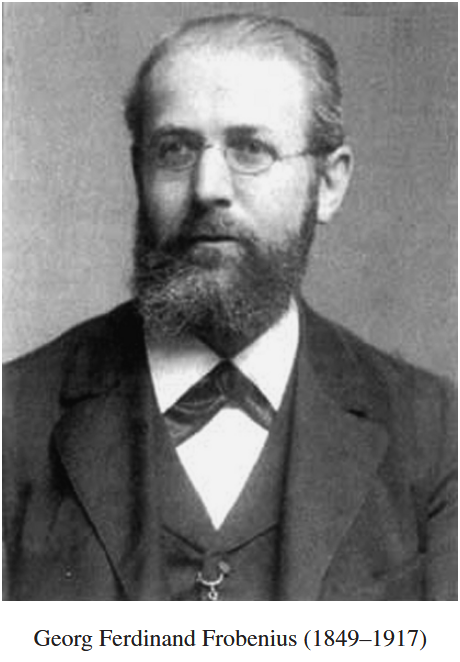
格奥尔格·费迪南德·弗罗贝尼乌斯(1849--1917)
5.4 Linear independence, basis, and dimension
5.4 线性无关性、基与维数
The notions of linear independence, basis, and dimension appear, not necessarily with formal definitions, in various contexts, among them algebraic number theory, fields and Galois theory, hypercomplex number systems (algebras), differential equations, and analytic geometry.
线性无关性、基和维数的概念,尽管未必有正式定义,但已出现在多个领域中,包括代数数论、域与伽罗瓦理论、超复数系(代数)、微分方程和解析几何等。
In algebraic number theory the objects of study are algebraic number fields Q ( α ) Q(\alpha) Q(α) , where Q Q Q denotes the rationals and α \alpha α is an algebraic number. If the minimal polynomial of α \alpha α has degree n n n , then every element of Q ( α ) Q(\alpha) Q(α) can be expressed uniquely in the form a 0 + a 1 α + a 2 α 2 + ⋯ + a n − 1 α n − 1 a_{0}+a_{1} \alpha+a_{2} \alpha^{2}+\cdots+a_{n-1} \alpha^{n-1} a0+a1α+a2α2+⋯+an−1αn−1 , where a i ∈ Q a_{i} \in Q ai∈Q . Thus 1 , α , α 2 , . . . , α n − 1 1, \alpha, \alpha^{2}, ..., \alpha^{n-1} 1,α,α2,...,αn−1 form a basis of Q ( α ) Q(\alpha) Q(α) , considered as a vector space over Q Q Q . This is precisely the line of thought pursued by Dedekind in his Supplement X of 1871 to Dirichlet's book on number theory (and with more clarity and detail in Supplements to subsequent editions of Dirichlet's book), although there is no formal definition of a vector space. See Chapter 3.2 and especially Chapter 8.2.4.
代数数论的研究对象是代数数域 Q ( α ) Q(\alpha) Q(α),其中 Q Q Q 表示有理数域, α \alpha α 是一个代数数。如果 α \alpha α 的极小多项式次数为 n n n,那么 Q ( α ) Q(\alpha) Q(α) 中的每个元素都可以唯一表示为 a 0 + a 1 α + a 2 α 2 + ⋯ + a n − 1 α n − 1 a_{0}+a_{1} \alpha+a_{2} \alpha^{2}+\cdots+a_{n-1} \alpha^{n-1} a0+a1α+a2α2+⋯+an−1αn−1 的形式,其中 a i ∈ Q a_{i} \in Q ai∈Q。因此,将 Q ( α ) Q(\alpha) Q(α) 视为 Q Q Q 上的向量空间时, 1 , α , α 2 , . . . , α n − 1 1, \alpha, \alpha^{2}, ..., \alpha^{n-1} 1,α,α2,...,αn−1 构成了它的一组基。这正是戴德金在 1871 年为狄利克雷(Dirichlet)的数论著作撰写的第十补编中所遵循的思路(在狄利克雷著作后续版本的补编中,这一思路得到了更清晰、详细的阐述),尽管当时尚未有向量空间的正式定义。参见第 3.2 章,尤其是第 8.2.4 章。
In connection with his work in algebraic number theory Dedekind introduced the notion of a field. He defined it as a subset of the complex numbers satisfying certain axioms. He included important concepts and results on fields, some related to ideas of linear algebra. For example, if E E E is a subfield of K K K , he defined the "degree" of K K K over E E E as the dimension of K K K considered as a vector space over E E E , and showed that if the degree is finite, then every element of K K K is algebraic over E E E . The notions of linear independence, basis, and dimension appear here in a transparent way; the notion of vector space also appears, but only implicitly. See Chapter 4.2 and Chapter 8.2.
戴德金在其代数数论研究中引入了域的概念。他将域定义为满足特定公理的复数子集,并纳入了关于域的重要概念和结论,其中一些与线性代数思想相关。例如,如果 E E E 是 K K K 的子域,他将 K K K 在 E E E 上的"次数"定义为 K K K 作为 E E E 上向量空间的维数,并证明了:若该次数有限,则 K K K 中的每个元素都是 E E E 上的代数数。线性无关性、基和维数的概念在此处体现得十分明确;向量空间的概念也有所体现,但仅为隐含形式。参见第 4.2 章和第 8.2 章。
In 1893 Weber gave an axiomatic definition of finite groups and fields, with the objective of giving an abstract formulation of Galois theory. Among the results on fields is the following: If F F F is a subfield of E E E , which in turn is a subfield of K K K , then ( K : F ) = ( K : E ) ( E : F ) (K: F)=(K: E)(E: F) (K:F)=(K:E)(E:F) , where for any subfield S S S of T T T , ( T : S ) (T: S) (T:S) denotes the dimension of T T T as a vector space over S S S (we assume that all dimensions in question are finite). See Chapter 4.6.
1893 年,韦伯(Weber)给出了有限群和域的公理化定义,旨在为伽罗瓦理论提供抽象表述。其中关于域的一个重要结论是:如果 F F F 是 E E E 的子域,而 E E E 又是 K K K 的子域,那么 ( K : F ) = ( K : E ) ( E : F ) (K: F)=(K: E)(E: F) (K:F)=(K:E)(E:F),其中对于 T T T 的任意子域 S S S, ( T : S ) (T: S) (T:S) 表示 T T T 作为 S S S 上向量空间的维数(假设所有涉及的维数均为有限)。参见第 4.6 章。
Many of the ideas of Dedekind and Weber on field extensions were brought to perfection in Steinitz's groundbreaking paper of 1910, "Algebraic theory of fields," in which he presented an abstract development of field theory. In the 1920s Artin "linearized" Galois theory-a most important idea. Contemporary treatment of the subject usually follows his. See 9 and Chapter 4.8.
戴德金和韦伯关于域扩张的许多思想,在施泰尼茨(Steinitz)1910 年发表的开创性论文《域的代数理论》中得到了完善,施泰尼茨在该论文中对域理论进行了抽象化发展。20 世纪 20 年代,阿廷(Artin)将伽罗瓦理论"线性化"------这是一个极具重要性的思想。如今对该学科的处理方式通常遵循阿廷的方法。参见第 4.8 章。
An algebra (it is both a ring and a vector space over a field) was called in the nineteenth century a hypercomplex number system. The first such example was Hamilton's quaternions. This inspired generalizations to higher dimensions. For example, Cayley and Graves independently introduced octonions (in 1844), elements of the form a 1 e 1 + a 2 e 2 + ⋯ + a 8 e 8 a_{1} e_{1}+a_{2} e_{2}+\cdots+a_{8} e_{8} a1e1+a2e2+⋯+a8e8 , where a i a_{i} ai are real numbers and e i e_{i} ei are "basis" elements subject to laws of multiplication. In 1854, in a paper in which he defined finite groups, Cayley introduced the group algebra of such a group-a linear combination of the group elements with real or complex coefficients. He called it a system of "complex quantities" and observed that it is analogous in many ways to the quaternions. See Chapter 3.1.
在 19 世纪,代数(既是环也是域上的向量空间)被称为超复数系。第一个这样的例子是哈密顿的四元数。这一成果启发了人们向更高维度的推广。例如,凯莱和格雷夫斯(Graves)于 1844 年独立引入了八元数,其形式为 a 1 e 1 + a 2 e 2 + ⋯ + a 8 e 8 a_{1} e_{1}+a_{2} e_{2}+\cdots+a_{8} e_{8} a1e1+a2e2+⋯+a8e8,其中 a i a_{i} ai 是实数, e i e_{i} ei 是满足特定乘法法则的"基"元素。1854 年,凯莱在一篇定义有限群的论文中,引入了该群的群代数------即群元素与实数或复数系数的线性组合。他将其称为"复量系统",并指出它在许多方面与四元数相似。参见第 3.1 章。
In a groundbreaking paper in 1870 entitled "Linear associative algebra," B. Peirce gave a definition of a finite-dimensional associative algebra as the totality of formal expressions of the form ∑ i = 1 n a i e i \sum_{i=1}^{n} a_{i} e_{i} ∑i=1naiei , where the a i a_{i} ai are complex numbers and the e i e_{i} ei are "basis" elements, subject to associative and distributive laws. See Chapter 3.1.
1870 年,B. 皮尔斯(B. Peirce)在其开创性论文《线性结合代数》中,将有限维结合代数定义为所有形如 ∑ i = 1 n a i e i \sum_{i=1}^{n} a_{i} e_{i} ∑i=1naiei 的形式表达式的集合,其中 a i a_{i} ai 是复数, e i e_{i} ei 是满足结合律和分配律的"基"元素。参见第 3.1 章。
Euler began to lay the framework for the solution of linear homogeneous differential equations. He observed that the general solution of such an equation with constant coefficients could be expressed as a linear combination of linearly independent particular solutions. Later in the eighteenth century Lagrange extended his result to equations with nonconstant coefficients. Demidov 6 discusses the analogy between linear algebraic equations and linear differential equations, focusing on the early nineteenth century.
欧拉率先为线性齐次微分方程的求解奠定了框架。他发现,常系数线性齐次微分方程的通解可以表示为若干个线性无关特解的线性组合。18 世纪后期,拉格朗日(Lagrange)将这一结果推广到了变系数方程。德米多夫(Demidov)探讨了 19 世纪早期线性代数方程与线性微分方程之间的相似性。
The interaction of algebra and geometry is fundamental in linear algebra (for example, n n n-dimensional Euclidean geometry can be viewed as an n n n-dimensional vector space over the reals together with a symmetric bilinear form B ( x , y ) = ∑ a i j x i y j B(x, y)=\sum a_{i j} x_{i} y_{j} B(x,y)=∑aijxiyj that serves to define the length of a vector and the angle between two vectors). It began with the introduction of analytic geometry by Descartes and Fermat in the early seventeenth century, was extended by Euler in the eighteenth to 3 dimensions, and was put in modern form (the way we see it today) by Monge in the early nineteenth. The notions of linear combination, coordinate system, and basis were fundamental, as were other basic notions of linear algebra such as matrix, determinant, and linear transformation. See 2, 8, 9, 13.
代数与几何的相互作用是线性代数的基础(例如, n n n 维欧几里得几何可以被视为实数域上的 n n n 维向量空间,同时配备一个对称双线性形式 B ( x , y ) = ∑ a i j x i y j B(x, y)=\sum a_{i j} x_{i} y_{j} B(x,y)=∑aijxiyj,该形式用于定义向量的长度和两个向量之间的夹角)。这种相互作用始于 17 世纪初笛卡尔(Descartes)和费马(Fermat)引入解析几何,18 世纪欧拉将其推广到 3 维空间,19 世纪初蒙日(Monge)将其整理为现代形式(即我们如今所见的形式)。线性组合、坐标系和基的概念是基础性的,矩阵、行列式和线性变换等其他线性代数基本概念亦是如此。参见 2, 8, 9, 13。
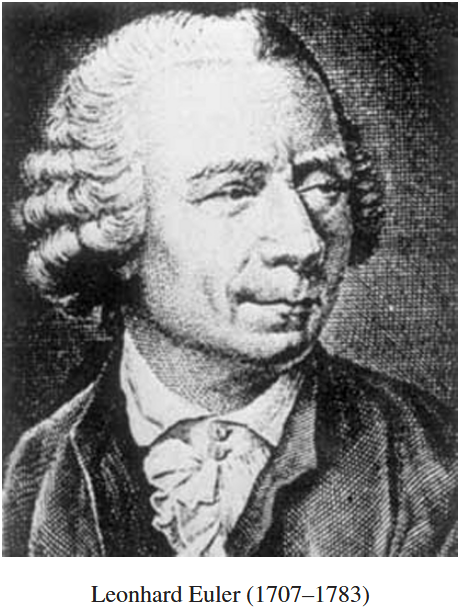
莱昂哈德·欧拉(1707--1783)
Further details on linear independence, basis, and dimension appear in the following section.
关于线性无关性、基和维数的更多细节将在下一节中阐述。
5.5 Vector spaces
5.5 向量空间
As we mentioned, by 1880 many of the fundamental results of linear algebra had been established, but they were not considered as parts of a general theory. In particular, the fundamental notion of vector space, within which such a theory would be framed, was absent. It was introduced by Peano in 1888.
正如我们所提及的,到 1880 年,线性代数的许多基本成果已被确立,但它们并未被视为一个通用理论的组成部分。尤其是作为该理论框架的向量空间这一基本概念,当时尚未出现。这一概念由佩亚诺于 1888 年提出。
The earliest notion of vector comes from physics, where it means a quantity having both magnitude and direction (e.g., velocity or force). This idea was well established by the end of the seventeenth century, as was that of the parallelogram of vectors, a parallelogram determined by two vectors as its adjacent sides. In this setting the addition of vectors and their multiplication by scalars had clear physical meanings. See 5.
向量最早的概念源于物理学,指具有大小和方向的量(例如速度或力)。到 17 世纪末,这一概念以及向量平行四边形法则(由两个向量作为邻边构成平行四边形)已完全确立。在这一背景下,向量的加法和数乘具有明确的物理意义。参见 5。
The mathematical notion of vector originated in the geometric representation of complex numbers, introduced independently by several authors in the late eighteenth and early nineteenth centuries, starting with Wessel in 1797 and culminating with Gauss in 1831. The representation of the complex numbers in these works was geometric, as points or as directed line segments in the plane. In 1835 Hamilton defined the complex numbers algebraically as ordered pairs of reals, with the usual operations of addition and multiplication, as well as multiplication by real numbers (the term "scalar" originated in his work on quaternions). He noted that these pairs satisfy the closure laws and the commutative and distributive laws, have a zero element, and have additive and multiplicative inverses. (The associative laws were mentioned in his 1843 work on quaternions.) See 5, 14.
向量的数学概念源于复数的几何表示,这一表示在 18 世纪末至 19 世纪初由多位学者独立提出------始于 1797 年的韦塞尔(Wessel),最终在 1831 年高斯的研究中得以完善。这些著作中,复数被几何化为平面上的点或有向线段。1835 年,哈密顿从代数角度将复数定义为实数的有序对,并定义了通常的加法、乘法以及与实数的数乘运算("标量"一词源于他对四元数的研究)。他指出,这些有序对满足封闭律、交换律和分配律,存在零元素,且每个元素都有加法逆元和乘法逆元。(结合律在他 1843 年关于四元数的著作中被提及。)参见 5, 14。
An important development was the extension of vector ideas to three-dimensional space. Hamilton constructed an algebra of vectors within his system of quaternions. (Josiah Willard Gibbs and Oliver Heaviside introduced a competing system-their vector analysis-in the 1880s.) These were represented in the form a i + b j + c k a i+b j+c k ai+bj+ck where a , b , c a, b, c a,b,c are real numbers and i , j , k i , j , k i,j,k the quaternion units-a clear precursor of a basis for three-dimensional Euclidean space. It was here that he introduced the term "vector" for these objects. See 5, 14.
一项重要的发展是将向量思想推广到三维空间。哈密顿在其四元数体系中构建了向量代数。(约西亚·威拉德·吉布斯(Josiah Willard Gibbs)和奥利弗·赫维赛德(Oliver Heaviside)于 19 世纪 80 年代引入了一个竞争体系------向量分析。)这些向量表示为 a i + b j + c k a i+b j+c k ai+bj+ck 的形式,其中 a , b , c a, b, c a,b,c 是实数, i , j , k i, j, k i,j,k 是四元数单位------这显然是三维欧几里得空间基的雏形。正是在此处,他将这些对象命名为"向量"。参见14。
A crucial development in vector-space theory was the further extension of the notions on three-dimensional space to spaces of higher dimension, advanced independently in the early 1840s by Cayley, Hamilton, and Grassmann. Hamilton called the extension of 3-space to four dimensions a "leap of the imagination." He had in mind, of course, his quaternions, a four-dimensional vector space (also a division algebra). He introduced them in dramatic fashion in 1843, and spent the next twenty years in their exploration and applications. Cayley's ideas on dimensionality appeared in his 1843 paper "Chapters of analytic geometry of n n n-dimensions." See 2, 5, 14, 19, and Chapter 8.5.
向量空间理论的一个关键发展是将三维空间的概念进一步推广到更高维空间,这一工作在 19 世纪 40 年代初由凯莱、哈密顿和格拉斯曼独立推进。哈密顿将 3 维空间向 4 维空间的推广称为"想象力的飞跃"。当然,他所指的正是四元数------一个 4 维向量空间(同时也是可除代数)。1843 年,他以极具戏剧性的方式引入了四元数,并在随后的二十年里致力于其探索与应用。凯莱关于维数的思想体现在他 1843 年的论文《 n n n 维解析几何章节》中。参见第 8.5 章。
The pioneering ideas were expounded by Grassmann in his Doctrine of Linear Extension (1844). This was a brilliant work whose aim was to construct a coordinate-free algebra of n n n-dimensional space. It contained many of the basic ideas of linear algebra, including the notion of an n n n-dimensional vector space, subspace, spanning set, independence, basis, dimension, and linear transformation.
格拉斯曼在其 1844 年的著作《线性扩张论》中阐述了这些开创性思想。这是一部极具洞察力的著作,旨在构建一种不依赖坐标的 n n n 维空间代数。书中包含了线性代数的诸多基本思想,包括 n n n 维向量空间、子空间、生成集、无关性、基、维数和线性变换等概念。
The definition of vector space was given as the set of linear combinations ∑ a i e i ( i = 1 , 2 , . . . , n ) \sum a_{i} e_{i}(i=1,2, ..., n) ∑aiei(i=1,2,...,n) , where a i a_{i} ai are real numbers and e i e_{i} ei "units," assumed to be linearly independent. Addition, subtraction, and multiplication by real numbers of such sums were defined in the usual manner, followed by a list of "fundamental properties." Among these are the commutative and associative laws of addition, the subtraction laws a + b − b = a a+b-b=a a+b−b=a and a − b + b = a a-b+b=a a−b+b=a , and several laws dealing with multiplication by scalars. From these, Grassmann claimed, all the usual laws of addition, subtraction, and multiplication by scalars follow. He proved various results about vector spaces, including the fundamental relation dim V + dim W = dim ( V + W ) + dim ( V ∩ W ) \dim V+\dim W=\dim(V+W)+\dim(V \cap W) dimV+dimW=dim(V+W)+dim(V∩W) for subspaces V V V and W W W of a vector space. See 5, 9, 10.
格拉斯曼将向量空间定义为所有线性组合 ∑ a i e i ( i = 1 , 2 , . . . , n ) \sum a_{i} e_{i}(i=1,2, ..., n) ∑aiei(i=1,2,...,n) 构成的集合,其中 a i a_{i} ai 是实数, e i e_{i} ei 是假定为线性无关的"单位元"。他以常规方式定义了这些线性组合的加法、减法和与实数的数乘运算,并列出了一系列"基本性质",包括加法交换律、加法结合律、减法法则 a + b − b = a a+b-b=a a+b−b=a 和 a − b + b = a a-b+b=a a−b+b=a,以及若干数乘法则。格拉斯曼声称,从这些性质可以推导出所有常见的加法、减法和数乘法则。他还证明了向量空间的多个结论,包括对于向量空间的子空间 V V V 和 W W W,存在基本关系 dim V + dim W = dim ( V + W ) + dim ( V ∩ W ) \dim V+\dim W=\dim(V+W)+\dim(V \cap W) dimV+dimW=dim(V+W)+dim(V∩W)。参见。
Grassmann's work was difficult to understand, containing many new ideas couched in philosophical language. It was thus ignored by the mathematical community. An 1862 edition was better received. It motivated Peano to give an abstract formulation of some of Grassmann's ideas in his Geometric Calculus (1888).
格拉斯曼的著作晦涩难懂,其中包含许多以哲学语言表述的新思想,因此遭到了数学界的忽视。1862 年的修订版反响较好,这促使佩亚诺在其 1888 年的著作《几何演算》中,对格拉斯曼的部分思想进行了抽象化表述。
In the last chapter of this work, entitled "Transformations of linear systems," Peano gave an axiomatic definition of a vector space over the reals. He called it a "linear system." It was in the modern spirit of axiomatics, more or less as we have it today. He postulated the closure operations, associativity, distributivity, and the existence of a zero element. This was defined to have the property 0 × a = 0 0 ×a=0 0×a=0 for every element a a a in the vector space. He defined a − b a-b a−b to mean a + ( − 1 ) b a+(-1) b a+(−1)b and showed that a − a = 0 a-a=0 a−a=0 and a + 0 = a a+0=a a+0=a . Another of his axioms was that a = b a=b a=b implies a + c = b + c a+c=b+c a+c=b+c for every c c c. As examples of vector spaces he gave the real numbers, the complex numbers, vectors in the plane or in 3-space, the set of linear transformations from one vector space to another, and the set of polynomials in a single variable. See 23.
在该书最后一章《线性系统的变换》中,佩亚诺给出了实数域上向量空间的公理化定义,并将其称为"线性系统"。这一定义符合现代公理化精神,与我们如今所使用的定义大致相同。他设定了封闭运算、结合律、分配律以及零元素的存在性。零元素被定义为满足对向量空间中的每个元素 a a a 都有 0 × a = 0 0 ×a=0 0×a=0 的元素。他将 a − b a-b a−b 定义为 a + ( − 1 ) b a+(-1) b a+(−1)b,并证明了 a − a = 0 a-a=0 a−a=0 和 a + 0 = a a+0=a a+0=a。他的另一项公理是:若 a = b a=b a=b,则对任意 c c c 都有 a + c = b + c a+c=b+c a+c=b+c。他给出的向量空间例子包括实数、复数、平面或三维空间中的向量、从一个向量空间到另一个向量空间的所有线性变换,以及单变量多项式的集合。参见23。
Peano also defined other concepts of linear algebra, including dimension and linear transformation, and proved a number of theorems. For example, he defined the dimension of a vector space as the maximum number of linearly independent elements (but did not prove that it is the same for every choice of such elements), and showed that any set of n n n linearly independent elements in an n n n-dimensional vector space constitutes a basis. He noted that if the set of polynomials in a single variable is at most of degree n n n , the dimension of the resulting vector space is n + 1 n+1 n+1 , but if there is no restriction on the degree, the resulting vector space is infinite-dimensional. See 9, 23.
佩亚诺还定义了线性代数的其他概念,包括维数和线性变换,并证明了多个定理。例如,他将向量空间的维数定义为线性无关元素的最大个数(但未证明这一个数与所选线性无关元素组无关),并证明了 n n n 维向量空间中任意 n n n 个线性无关的元素都构成一组基。他指出,若单变量多项式的次数至多为 n n n,则该多项式集合构成的向量空间维数为 n + 1 n+1 n+1;但若对次数无限制,则构成的向量空间是无限维的。参见23。
Peano's work was ignored for the most part, probably because axiomatics was in its infancy, and perhaps because the work was tied so closely to geometry, setting aside other important contexts of the ideas of linear algebra, which we have described above.
佩亚诺的工作在很大程度上也被忽视了,这可能是因为当时公理化方法尚处于起步阶段,也可能是因为其工作与几何学联系过于紧密,而忽略了我们上述提及的线性代数思想的其他重要应用背景。
A word about the axiomatic method. Although it became well established only in the early decades of the twentieth century, it was "in the air" in the last two decades of the nineteenth. For example, there appeared axiomatic definitions of groups and fields, the positive integers (cf. the Peano axioms), and projective geometry.
关于公理化方法,尽管它直到 20 世纪初的几十年才完全确立,但在 19 世纪末的二十年里已逐渐成为趋势。例如,群、域、正整数(参见佩亚诺公理)和射影几何等都出现了公理化定义。
In 1918, in his book Space, Time, Matter , which dealt with general relativity, Weyl axiomatized finite-dimensional real vector spaces, apparently unaware of Peano's work. The definition appears in the first chapter of the book, entitled Foundations of Affine Geometry. As in Peano's case, this was not quite the modern definition. It took time to get it just right! See 23.
1918 年,外尔(Weyl)在其论述广义相对论的著作《空间、时间、物质》中,对有限维实数向量空间进行了公理化处理,显然他当时并未知晓佩亚诺的工作。这一定义出现在该书第一章《仿射几何基础》中,与佩亚诺的定义类似,它并非完全等同于现代定义。一个完美的定义需要时间的打磨!参见23。
In his doctoral dissertation of 1920 Banach axiomatized complete normed vector spaces (now called Banach spaces) over the reals. The first thirteen axioms are those of a vector space, in very much a modern spirit. He put it thus:
I consider sets of elements about which I postulate certain properties; I deduce from them certain theorems, and I then prove for each particular functional domain that the postulates adopted are true for it.
1920 年,巴拿赫(Banach)在其博士论文中对实数域上的完备赋范向量空间(现称为巴拿赫空间)进行了公理化。前十三项公理即为向量空间的公理,极具现代精神。他这样表述:
"我考虑一类元素集合,对其设定若干性质;从这些性质中推导出若干定理,然后针对每个特定的函数领域,证明所采用的公理对该领域成立。"
In her 1921 paper "Ideal theory in rings" Emmy Noether introduced modules, and viewed vector spaces as special cases (see Chapter 6.2 and 6.3). We thus see vector spaces arising in three distinct contexts: geometry, analysis, and algebra. In his 1930 classic text Modern Algebra van der Waerden has a chapter entitled Linear Algebra 25. Here for the first time the term is used in the sense in which we employ it today. Following in Noether's footsteps, he begins with the definition of a module over a (not necessarily commutative) ring. Only on the following page does he define a vector space!
1921 年,埃米·诺特(Emmy Noether)在其论文《环中的理想理论》中引入了模的概念,并将向量空间视为模的特殊情形(参见第 6.2 章和第 6.3 章)。由此可见,向量空间起源于三个不同的领域:几何学、分析学和代数学。1930 年,范德瓦尔登(van der Waerden)在其经典著作《近世代数》中设有一章名为"线性代数"。在该书中,"线性代数"这一术语首次被赋予了我们如今所使用的含义。效仿诺特的思路,范德瓦尔登首先定义了(不必为交换的)环上的模,仅在接下来的一页才定义了向量空间!
References
参考文献
- I. G. Bashmakova and G. S. Smirnova, The Beginnings and Evolution of Algebra, The Mathematical Association of America, 2000. (Translated from the Russian by A. Shenitzer.)
- N. Bourbaki, Elements of the History of Mathematics, Springer-Verlag, 1994.
- T. Crilly, A gemstone in matrix algebra, Math. Gazette 1992, 76: 182--188.
- T. Crilly, Cayley's anticipation of a generalized Cayley-Hamilton theorem, Hist. Math. 1978, 5: 211--219.
- M. J. Crowe, A History of Vector Analysis, University of Notre Dame Press, 1967.
- S. S. Demidov, On the history of the theory of linear differential equations, Arch. Hist. Exact Sc. 1983, 28: 369--387.
- J. Dieudonné, Abrégé d'Histoire des Mathématiques 1700--1900, vol. I, Hermann, 1978.
- J.-L. Dorier (ed.), On the Teaching of Linear Algebra, Kluwer, 2000.
- J.-L. Dorier, A general outline of the genesis of vector space theory, Hist. Math. 1985, 22: 227--261.
- D. Fearnley-Sander, Hermann Grassmann and the creation of linear algebra, Amer. Math. Monthly 1979, 86: 809--817.
- J. A. Goulet, The principal axis theorem, The UMAP Journal 1983, 4: 135--156.
- I. Grattan-Guinness and W. Ledermann, Matrix theory, in: Companion Encyclopedia of the History and Philosophy of the Mathematical Sciences, ed. by I. Grattan-Guinness, Routledge, 1994, vol. 1, pp. 775--786.
- J. Gray, Finite-dimensional vector spaces, in: Companion Encyclopedia of the History and Philosophy of the Mathematical Sciences, ed. by I. Grattan-Guinness, Routledge, 1994, vol. 2, pp. 947--951.
- T. L. Hankins, Sir William Rowan Hamilton, The Johns Hopkins University Press, 1980.
- T. Hawkins, Weierstrass and the theory of matrices, Arch. Hist. Exact Sc. 1977, 17: 119--163.
- T. Hawkins, Another look at Cayley and the theory of matrices, Arch. Int. d'Hist. des Sc. 1977, 27: 82--112.
- T. Hawkins, Cauchy and the spectral theory of matrices, Hist. Math. 1975, 2: 1--29.
- T. Hawkins, The theory of matrices in the 19th century, Proc. Int. Congr. Mathematicians (Vancouver), vol. 2, 1974, pp. 561--570.
- V. J. Katz, A History of Mathematics, 2nd ed., Addison-Wesley, 1998.
- V. J. Katz, Historical ideas in teaching linear algebra, in Learn from the Masters, ed. by F. Swetz et al, Math. Assoc. of America, 1995, pp. 189--206.
- E. Knobloch, Determinants, in: Companion Encyclopedia of the History and Philosophy of the Mathematical Sciences, ed. by I. Grattan-Guinness, Routledge, vol. 1, 1994, pp. 766--774.
- E. Knobloch, From Gauss to Weierstrass: determinant theory and its historical evaluations, in C. Sasaki et al (eds), Intersection of History and Mathematics, Birkhäuser, 1994, pp. 51--66.
- G. H. Moore, An axiomatization of linear algebra: 1875--1940, Hist. Math. 1995, 22: 262--303.
- T. Muir, The Theory of Determinants in the Historical Order of Development, 4 vols., Dover, 1960. (The original work was published by Macmillan, 1890--1923.)
- B. L. van der Waerden, Modern Algebra, 2 vols., Springer-Verlag, 1930--31.
行与列对应未知数的表示方式演化、差异及现代应用研究
摘要
本文围绕线性方程组中"行/列对应未知数"的表示方式展开系统研究,梳理其从古代到现代的演化脉络,分析不同历史阶段表示规则的形成背景与特征;深入探讨该表示方式在现代数学、工程、计算机等领域的具体应用差异;提出实际问题中确定行/列对应关系的实用方法;通过多维度对比揭示演化过程中的关键差异根源。研究表明,表示方式的演化本质是数学工具适配性的演变,经历了从"列=方程"到"行=方程"的关键转变,现代统一约定的形成与代数运算逻辑、跨学科应用需求及书写习惯变革密切相关。
关键词:线性方程组;未知数表示;行列对应;演化历程;应用差异
一、引言
线性方程组是数学及各应用学科的基础工具,未知数与矩阵行列的对应关系直接影响方程求解逻辑、运算效率及跨领域交流的一致性。从古代算筹上的竖行阵列到现代线性代数的抽象符号,行与列对应未知数的表示方式经历了漫长的演化过程,其中最关键的转变是从中国古代"列表示方程"到现代西方"行表示方程"的范式转换。
同时,在现代多元应用场景中,这种对应关系的选择仍存在特定差异,而实际问题中如何准确判断对应方式,是避免计算错误、确保应用合理性的关键。本文基于历史文献与现代应用案例,系统梳理该表示方式的演化轨迹、差异表现、应用场景及判断方法,为相关理论研究与实践应用提供参考。
二、行/列对应未知数表示方式的演化脉络
2.1 古代阶段(公元前 150 年-公元 3 世纪)------列表示方程,行表示未知数
2.1.1 时代背景
该阶段无统一数学符号体系,数学运算依赖具象化算具(中国算筹),主要目标是解决土地测量、谷物分配、赋税计算等实际问题。中国古代采用竖行书写习惯,算筹自上而下、自右而左排列,表示方式需适配这一物理布局与手工操作逻辑,尚未发展出复杂抽象代数推导。代表文明包括中国(《九章算术》)等。
2.1.2 表示规则与特征
- 列的功能 :每一纵列(竖行)对应一个完整的线性方程,纵向排列同一方程中不同未知数的系数,最下方为方程的常数项,列成为独立方程的具象化载体。这种布局适配"直除法"(整列与整列相减)的消元操作。
- 行的功能 :每一横行聚合所有方程中同一个未知数的系数,便于手工计算中同类系数的对齐与比较。
2.1.3 典型案例(《九章算术》谷物问题阵列)
《九章算术》"方程"章第 1 题记载:
"今有上禾三秉,中禾二秉,下禾一秉,实三十九斗;上禾二秉,中禾三秉,下禾一秉,实三十四斗;上禾一秉,中禾二秉,下禾三秉,实二十六斗。问上、中、下禾实一秉各几何?"
原始算筹记录形式(现代数字表示,自右而左为右行、中行、左行):
| 未知量 | 右行(方程 1) | 中行(方程 2) | 左行(方程 3) |
|---|---|---|---|
| 上禾( x x x) | 3 | 2 | 1 |
| 中禾( y y y) | 2 | 3 | 2 |
| 下禾( z z z) | 1 | 1 | 3 |
| 实(常数) | 39 | 34 | 26 |
对应关系解析:
- 列与方程的对应 :右列 3 , 2 , 1 , 39 3, 2, 1, 39 3,2,1,39 自上而下对应方程 3 x + 2 y + z = 39 3x + 2y + z = 39 3x+2y+z=39;中行 2 , 3 , 2 , 34 2, 3, 2, 34 2,3,2,34 对应方程 2 x + 3 y + 2 z = 34 2x + 3y + 2z = 34 2x+3y+2z=34;左列 1 , 2 , 3 , 26 1, 2, 3, 26 1,2,3,26 对应方程 x + 2 y + 3 z = 26 x + 2y + 3z = 26 x+2y+3z=26。
- 行与未知数的对应 :上禾行 3 , 2 , 1 3, 2, 1 3,2,1 为所有方程中 x x x 的系数集合;中禾行 2 , 3 , 2 2, 3, 2 2,3,2 为所有方程中 y y y 的系数集合;下禾行 1 , 1 , 3 1, 1, 3 1,1,3 为所有方程中 z z z 的系数集合;实行 39 , 34 , 26 39, 34, 26 39,34,26 为常数项。
运算逻辑------直除法 :古代采用"直除法"求解,即整列与整列相减 进行消元。以右列和中列为例,右列×2 得 6 , 4 , 2 , 78 6, 4, 2, 78 6,4,2,78,减去中列×3 得 6 , 9 , 6 , 102 6, 9, 6, 102 6,9,6,102,消去上禾系数,得到新的方程列。这种运算天然要求"列=方程"。
2.1.4 演化驱动因素
- 书写习惯适配:中国古代竖行书写、自右而左的排列习惯,决定了以列为方程单位的布局。
- 算具操作适配:算筹的物理摆放以纵向为运算单位,"直除法"要求整列运算,列的布局使消元操作直观高效。
- 问题导向逻辑:从"每个实际问题对应一个方程"出发,列作为独立问题的载体,符合古代数学"逐题求解、分类计算"的主导思路。
2.2 近代过渡阶段(17 世纪末-19 世纪中叶)------书写习惯变革与符号化尝试
2.2.1 时代背景
微积分诞生推动数学抽象化发展,韦达、笛卡尔建立符号代数体系,字母开始用于表示未知数和系数。随着西方数学传入及书写习惯变革(从竖写改为横写),学者们逐步调整表示方式。这一阶段,欧洲学者围绕线性方程组求解,尝试建立统一的表示规则,但尚未形成严格共识。代表学者包括莱布尼茨、克莱姆、欧拉等。
2.2.2 表示规则与特征
- 书写方式转变:欧洲采用横行书写,逐步将方程组横向排列,为现代"行=方程"的约定奠定基础。
- 无统一标准:不同学者基于自身研究需求选择表示方式,缺乏跨学术交流的统一标准,但普遍趋向于将方程横向排列。
- 符号化萌芽:莱布尼茨(1693 年,未发表直到 1850 年)首次用双字符表示系数(如"21"表示第 2 个方程的第 1 个未知数系数),隐含"行=方程、列=未知数"的雏形,但未形成系统矩阵理论;克莱姆(1750 年)提出克莱姆法则时,将方程组系数按行排列,作为行列式计算的辅助形式。
2.2.3 关键进展
- 高斯消元法的重新认识:高斯消元法实际上最早见于《九章算术》(约公元前 150 年),牛顿 1707 年也重新发现,1811 年高斯将其用于最小二乘法并改进了符号表示。随着表示方式从"列运算"转向"行运算",这一方法逐步以"行变换"为主导操作,强化了"行=方程"的新传统。
2.3 现代阶段(19 世纪中叶至今)------符号化体系与全球统一约定
2.3.1 时代背景
西尔维斯特(1850 年)首次提出"矩阵"(matrix)术语,凯莱(1858 年)发表《矩阵理论专论》,系统定义矩阵加法、乘法等运算,矩阵理论正式建立,线性代数成为独立学科。跨学科应用需求(如物理、工程)推动表示方式的完全统一,"行=方程、列=未知数"成为全球标准。
2.3.2 表示规则与特征
- 行的功能:每一行对应一个完整的线性方程,行内从左至右依次为不同未知数的系数,增广矩阵中最后一列为常数项,行成为方程的标准化载体。
- 列的功能:每一列聚合所有方程中同一个未知数的系数,列向量与未知数向量直接对应,适配矩阵乘法运算逻辑。
- 主要依据 :线性方程组的矩阵表示 A x = b Ax = b Ax=b 中, A A A 为 m × n m \times n m×n 系数矩阵( m m m 为方程数, n n n 为未知数个数), x x x 为 n × 1 n \times 1 n×1 列向量,矩阵乘法要求"前矩阵列数=后矩阵行数",天然决定 A A A 的列需对应 x x x 的元素(未知数)。
2.3.3 典型案例(现代增广矩阵形式)
同一《九章算术》谷物问题,现代标准表示为:
3 2 1 39 2 3 2 34 1 2 3 26 \left\\begin{array}{ccc\|c} 3 \& 2 \& 1 \& 39 \\\\ 2 \& 3 \& 2 \& 34 \\\\ 1 \& 2 \& 3 \& 26 \\end{array}\\right 321232123393426
对应关系解析:
- 行与方程的对应 :第 1 行 3 , 2 , 1 ∣ 39 3, 2, 1 \| 39 3,2,1∣39 对应方程 3 x + 2 y + z = 39 3x + 2y + z = 39 3x+2y+z=39;第 2 行 2 , 3 , 2 ∣ 34 2, 3, 2 \| 34 2,3,2∣34 对应方程 2 x + 3 y + 2 z = 34 2x + 3y + 2z = 34 2x+3y+2z=34;第 3 行 1 , 2 , 3 ∣ 26 1, 2, 3 \| 26 1,2,3∣26 对应方程 x + 2 y + 3 z = 26 x + 2y + 3z = 26 x+2y+3z=26。
- 列与未知数的对应 :第 1 列 3 , 2 , 1 T 3, 2, 1^T 3,2,1T 为所有方程中 x x x 的系数集合;第 2 列 2 , 3 , 2 T 2, 3, 2^T 2,3,2T 为所有方程中 y y y 的系数集合;第 3 列 1 , 2 , 3 T 1, 2, 3^T 1,2,3T 为所有方程中 z z z 的系数集合;第 4 列 39 , 34 , 26 T 39, 34, 26^T 39,34,26T 为常数项向量。
2.3.4 演化驱动因素
- 书写习惯变革:西方横行书写习惯成为全球标准,推动"行=方程"约定的确立。
- 矩阵代数运算逻辑:凯莱定义的矩阵乘法规则,要求行列维度严格匹配,"行=方程、列=未知数"的约定使线性方程组与矩阵运算无缝衔接,简化理论推导与计算过程。
- 跨学科交流需求:符号系统的统一(如笛卡尔坐标系、字母符号标准化),使该表示方式成为数学、物理、工程等领域的通用语言,避免跨领域协作中的理解偏差。
- 计算工具发展:高斯消元法以"行变换"为主导操作,计算机矩阵库(如 NumPy、MATLAB)均基于该约定设计,大幅提升运算效率,推动其在现代应用中的普及。
三、代数、矩阵与行列式的历史发展次序
3.1 历史出现次序
| 次序 | 学科 | 思想雏形 | 学科确立 | 关键人物 |
|---|---|---|---|---|
| 1 | 代数 | 公元前 4 世纪-前 2 世纪(巴比伦、《九章算术》"方程术") | 16-17 世纪(韦达符号代数、笛卡尔解析几何) | 韦达、笛卡尔 |
| 2 | 行列式 | 1683 年(关孝和)、1693 年(莱布尼茨) | 1812 年(柯西现代定义) | 关孝和、莱布尼茨、柯西 |
| 3 | 矩阵 | 18-19 世纪初(欧拉、拉格朗日线性变换) | 1858 年(凯莱《矩阵理论专论》) | 西尔维斯特、凯莱 |
3.2 关键里程碑事件
| 时间 | 事件 | 学者 | 意义 |
|---|---|---|---|
| 公元前 150 年 | 《九章算术》"方程术"与"直除法" | 佚名(中国古代数学家) | 最早的线性方程组系统解法,高斯消元法先驱;"列=方程"布局起源 |
| 1683 年 | 行列式思想(系数组合判断可解性) | 关孝和(日本) | 《解隐题之法》中表格化处理系数 |
| 1693 年 | 行列式思想(双字符系数表示) | 莱布尼茨 | 致洛必达的信件,提出行列式莱布尼茨公式 |
| 1750 年 | 克莱姆法则 | 克莱姆 | 利用行列式求解 n × n n \times n n×n 方程组,采用横行排列 |
| 1801 年 | 首次使用"determinant"术语 | 高斯 | 针对二次型提出 |
| 1812 年 | 现代行列式定义与乘法定理 | 柯西 | 法国科学院论文,确立行列式理论基础 |
| 1841 年 | 行列式标准符号(两侧竖线) | 凯莱 | 英文论文确立现代记法 |
| 1850 年 | 首次提出"matrix"术语 | 西尔维斯特 | 定义为"项的长方形排列" |
| 1858 年 | 矩阵抽象定义与代数运算 | 凯莱 | 《矩阵理论专论》,矩阵理论正式诞生,确立"行=方程"现代约定 |
| 1878 年 | 矩阵的秩、正交矩阵、凯莱-哈密顿定理 | 弗罗贝尼乌斯 | 《论线性变换与双线性型》 |
| 1903 年 | 行列式公理化定义 | 魏尔斯特拉斯 | 《论行列式理论》(去世后出版) |
四、现代应用中的差异
行与列对应未知数的表示方式,在现代不同领域的应用中呈现出特定差异,本质是各领域运算逻辑、工具适配性与问题需求的差异体现:
4.1 数学理论研究领域
- 统一遵循"行=方程、列=未知数"约定:线性代数教材、学术论文中,矩阵表示均以该规则为标准,确保理论推导的一致性(如特征值求解、矩阵对角化、线性变换表示等)。例如,在向量空间理论中,列向量表示未知向量,系数矩阵的列对应基向量的系数,符合空间映射的代数逻辑。
- 古代表示方式的研究价值:在数学史研究、比较数学等领域,学者需准确理解古代"列=方程"的原始布局,才能正确还原《九章算术》等文献的求解思路,避免用现代约定曲解古代数学成就。
4.2 工程计算领域
- 结构力学/机械工程:有限元分析中,行对应结构的平衡方程(如力平衡、位移协调方程),列对应未知位移或内力,适配矩阵乘法与数值求解算法。若误用行列对应关系,会导致刚度矩阵、载荷向量的维度不匹配,计算结果失效。
- 电气工程:电路分析中,节点电压法建立的方程组以行表示节点电流平衡方程,列表示节点电压(未知数),与 SPICE 等电路仿真软件的底层逻辑一致,确保仿真结果的准确性。
4.3 计算机科学领域
- 编程与算法 :矩阵运算库(NumPy、MATLAB、TensorFlow)默认"行=方程、列=未知数",行变换函数(如
numpy.linalg.solve)直接基于该约定实现。例如,求解线性方程组时,输入的系数矩阵需按"每行一个方程"排列,否则需手动转置矩阵,增加代码复杂度。 - 数据处理:机器学习中,特征矩阵的列对应特征(可视为广义未知数的系数维度),行对应样本(每个样本构成一个观测方程),符合梯度下降、最小二乘等算法的矩阵运算逻辑,确保模型训练的效率与正确性。
4.4 统计学领域
- 回归分析 :设计矩阵 X X X 的列对应自变量(回归系数为未知数),行对应样本观测值(每个样本对应一个回归方程),最小二乘解 β ^ = ( X T X ) − 1 X T y \hat{\beta} = (X^T X)^{-1} X^T y β^=(XTX)−1XTy 严格依赖该行列对应关系,若颠倒则无法得到有效回归系数。
- 实验设计:正交试验中,列对应试验因素(未知数为因素水平效应),行对应试验方案(每个方案对应一个观测方程),便于通过矩阵运算分析因素显著性。
4.5 历史数学与文化研究领域
- 古代文献解读:研究《九章算术》《算学启蒙》等古代数学著作时,必须理解"列=方程"的原始布局,特别是"直除法"的整列运算逻辑,才能准确还原古代数学家的求解思路与运算过程,避免以现代"行=方程"的视角误读历史文献。
五、实际问题中行/列的对应方式
实际应用中,准确判断行与列对应未知数的方式,需结合问题背景、符号体系、运算逻辑等多方面因素,具体方法如下:
5.1 上下文与背景分析
- 文献/题目说明 :现代教材、论文、工程规范通常会明确说明行列对应关系,例如"以下增广矩阵中,每行表示一个平衡方程,列对应未知位移""设矩阵 A A A 的第 j j j 列对应未知数 x j x_j xj"。
- 历史/文化背景 :若问题源自古代中国数学文献(如《九章算术》《算学启蒙》),其布局为**"列=方程、行=未知数",运算方式为"直除法"(整列相减);若为现代跨学科问题(如工程计算、机器学习),默认"行=方程、列=未知数"**,基于矩阵代数理论。
- 问题描述逻辑:若问题按"每个观测/方案对应一个方程"描述(如"5 个样本的观测数据构成 5 个方程"),则行对应方程;若按"每个类别/维度对应一个方程"描述(如"3 种资源分配方案构成 3 个方程"),需结合其他因素进一步判断。
5.2 符号体系匹配法
- 系数符号标注 :若出现 a i j a_{ij} aij 形式的系数,现代约定中 a i j a_{ij} aij 表示"第 i i i 个方程的第 j j j 个未知数的系数",即行标 i i i 对应方程序号,列标 j j j 对应未知数序号;若古代文献中出现类似双字符标注(如莱布尼茨的"21"),需结合学者的符号定义判断。
- 向量表示形式 :若未知数以列向量 x = x 1 , x 2 , ... , x n T x = x_1, x_2, \\dots, x_n^T x=x1,x2,...,xnT 表示,且存在矩阵乘法 A x = b Ax = b Ax=b,则 A A A 的列对应未知数;若未知数以行向量 x = x 1 , x 2 , ... , x n x = x_1, x_2, \\dots, x_n x=x1,x2,...,xn 表示(极少情况),则 A A A 的行对应未知数。
5.3 运算逻辑反推法
- 矩阵乘法维度匹配 :线性方程组的主要表示形式为 A x = b Ax = b Ax=b,若 A A A 为 m × n m \times n m×n 矩阵, b b b 为 m × 1 m \times 1 m×1 列向量,则 x x x 必为 n × 1 n \times 1 n×1 列向量,即 A A A 的列对应 x x x 的元素(未知数);若 A A A 为 n × m n \times m n×m 矩阵, b b b 为 1 × m 1 \times m 1×m 行向量,则 x x x 为 1 × n 1 \times n 1×n 行向量,即 A A A 的行对应未知数。
- 消元操作逻辑 :若运算过程以"行交换、行加减、行乘常数"为主(如高斯消元法),则行对应方程;若涉及古代《九章算术》的"直除法",需注意其为整列相减,对应"列=方程"的原始布局。
5.4 工具/软件默认约定参考法
- 专业软件规则:MATLAB、NumPy、Maple 等数学软件,以及 ANSYS、COMSOL 等工程仿真软件,均默认"行=方程、列=未知数",输入数据时需遵循该规则才能得到正确结果。
- 行业标准规范:工程领域(如机械、电气、土木)的设计规范、计算手册中,会明确行列对应关系,需按行业标准执行,避免与后续计算、校验环节冲突。
5.5 实例验证法
- 小规模问题验证 :对于简单线性方程组(如 2 × 2 2 \times 2 2×2 或 3 × 3 3 \times 3 3×3 系统),可假设两种对应方式,分别代入求解,对比结果与实际物理意义或问题约束是否一致,一致的假设即为正确的对应方式。
- 维度一致性校验 :通过矩阵维度运算验证,例如若 A A A 为 3 × 2 3 \times 2 3×2 矩阵, b b b 为 3 × 1 3 \times 1 3×1 列向量,则 x x x 必为 2 × 1 2 \times 1 2×1 列向量,即 A A A 的 2 列对应 2 个未知数,3 行对应 3 个方程,符合维度匹配规则。
六、演化与应用中的差异对比
| 对比维度 | 古代阶段(列=方程,行=未知数) | 现代阶段(行=方程,列=未知数) |
|---|---|---|
| 行列对应关系 | 列:完整方程;行:同一未知数的系数集合 | 行:完整方程;列:同一未知数的系数集合 |
| 表示媒介 | 算筹实物阵列,竖行书写,自右而左 | 抽象符号矩阵,横行书写, A = ( a i j ) A=(a_{ij}) A=(aij) |
| 运算逻辑 | 直除法(整列相减),手工消元 | 初等行变换,高斯消元法 |
| 书写习惯 | 竖行书写,自右而左 | 横行书写,自左而右 |
| 理论基础 | 经验算法,实用导向 | 向量空间、线性映射理论 |
| 符号依赖 | 无字母符号,依赖位置与算筹摆放 | 标准化矩阵符号体系 |
| 应用范围 | 土地测量、谷物分配等具体问题 | 跨学科通用数学工具 |
| 确定方法依赖 | 历史背景分析、古代文献注释、算筹布局 | 上下文说明、符号体系、运算逻辑、工具约定 |
| 适配工具 | 算筹等手工工具 | 数学软件、工程仿真工具、编程矩阵库 |
| 跨领域兼容性 | 限于特定古代文明的数学体系 | 全球跨学科通用 |
演化本质 :从古代到现代,经历了从 "列=方程"到"行=方程" 的关键范式转换,这一转变的驱动因素包括:
- 书写习惯变革:从中国古代竖行书写到西方横行书写的全球标准化
- 从具象到抽象:从算筹实物到符号矩阵的表示媒介演进
- 从经验到理论:从实用算法到线性代数体系的理论升华
- 运算逻辑适配:从"直除法"(列运算)到"行变换"(行运算)的算法演进
七、结论
-
演化本质的再认识 :行与列对应未知数表示方式的演化,经历了从"列=方程"到"行=方程"的关键范式转换。这一转变并非简单的"行列互换",而是书写习惯变革(竖写到横写)、表示媒介演进(算筹到符号)、理论体系发展(实用算法到抽象代数)共同作用的结果。古代《九章算术》与现代线性代数在行列对应关系上存在本质差异,需严格区分以避免历史误读。
-
现代应用中的统一性与特殊性:数学理论、工程计算、计算机科学、统计学等领域统一采用"行=方程、列=未知数",这一约定源于矩阵乘法逻辑、横行书写习惯与跨学科交流需求。但在数学史研究中,必须回归"列=方程"的原始语境,才能准确理解《九章算术》等古代文献的数学思想。
-
实际应用中的判断关键:确定对应方式需综合运用上下文分析、符号体系匹配、运算逻辑反推等方法。现代无特殊说明时,默认遵循"行=方程、列=未知数"的全球统一约定;涉及古代中国数学文献时,必须转换为"列=方程、行=未知数"的历史视角。
-
历史与现代的连续性:两种表示阶段体现了不同文明、不同时代的数学智慧。古代"列=方程"布局是中国竖行书写习惯与算筹操作逻辑的完美结合,现代"行=方程"约定是西方横行书写习惯与矩阵代数理论的标准化成果。理解两者的演化背景与范式差异,对准确应用线性方程组、传承数学文化、避免历史误读具有重要意义。
参考文献
1 李继闵. 《九章算术》校证与研究M. 西安:陕西科学技术出版社,1993.
2 吴文俊. 中国数学史大系:第二卷 秦汉三国M. 北京:北京师范大学出版社,1998.
3 Shen Kangsheng, John N Crossley, Anthony W C Lun. The Nine Chapters on the Mathematical Art: Companion and CommentaryM. Oxford: Oxford University Press, 1999.
4 李兆华. 中国数学史基础M. 天津:天津教育出版社,2010.
5 曲安京. 中国历法与数学M. 北京:科学出版社,2015.
6 Katz V J. A History of Mathematics: An IntroductionM. 3rd ed. Boston: Addison-Wesley, 2009.
7 Cayley A. A Memoir on the Theory of MatricesM. Cambridge: Cambridge University Press, 1858.
8 Strang G. Linear Algebra and Its ApplicationsM. 4th ed. Belmont: Brooks/Cole, 2006.
9 Higham N J. Gaussian EliminationJ. WIREs Computational Statistics, 2011, 3(3): 229-238.
10 李文汉. 高斯消元法是中国古法J. 中国大学教学, 1994(4): 30-32.
via:
-
christensen-HistoryLinearAlgebra
https://www.math.utah.edu/~gustafso/s2012/2270/web-projects/christensen-HistoryLinearAlgebra.pdf -
5 History of Linear Algebra
http://www.science.unitn.it/~perotti/History of Linear Algebra.pdf -
On the Histories of Linear Algebra: The Case of Linear Systems - HistoryPaper-v8 - Larson.pdf
http://sigmaa.maa.org/rume/crume2010/Archive/Larson.pdf -
A Brief History of Linear Algebra and Matrix Theory...
http://darkwing.uoregon.edu/~vitulli/441.sp04/LinAlgHistory.html -
Matrices and determinants - MacTutor History of Mathematics
https://mathshistory.st-andrews.ac.uk/HistTopics/Matrices_and_determinants/ -
......