函数(function)使用 fn 关键字来声明。函数的参数需要标注类型,就和变量一样,如果函数返回一个值,返回类型必须在箭头 -> 之后指定。
函数最后的表达式将作为返回值。也可以在函数内使用 return 语句来提前返一个值,甚至可以在循环或 if 内部使用。
让我们使用函数来重写 FizzBuzz 程序吧!
// 第9章 函数

// 和 C/C++ 不一样,Rust 的函数定义位置是没有限制的
fn main() {
    // 我们可以在这里使用函数,后面再定义它
    fizzbuzz_to(100);
    println!("Hello Rust");
}

// 一个返回布尔值的函数
fn is_divisible_by(lhs: u32, rhs: u32) -> bool {
    // 边界情况,提前返回
    if rhs == 0 {
        return false;
    }

    // 这是一个表达式,可以不用 `return` 关键字
    lhs % rhs == 0
}

// 一个 "不" 返回值的函数。实际上会返回一个单元类型 `()`。
fn fizzbuzz(n: u32) -> () {
    if is_divisible_by(n, 15) {
        println!("fizzbuzz");
    } else if is_divisible_by(n, 3) {
        println!("fizz");
    } else if is_divisible_by(n, 5) {
        println!("buzz");
    } else {
        println!("{}", n);
    }
}

// 当函数返回 `()` 时,函数签名可以省略返回类型
fn fizzbuzz_to(n: u32) {
    for n in 1..=n {
        fizzbuzz(n);
    }
}

// rustc main.rs
// ./main
编译运行:
PS F:\rustproject\rustbyexample\chapter09\example09_1> rustc main.rs
PS F:\rustproject\rustbyexample\chapter09\example09_1> ./main
1
2
fizz
4
buzz
fizz
7
8
fizz
buzz
11
fizz
13
14
fizzbuzz
16
17
fizz
19
buzz
fizz
22
23
fizz
buzz
26
fizz
28
29
fizzbuzz
31
32
fizz
34
buzz
fizz
37
38
fizz
buzz
41
fizz
43
44
fizzbuzz
46
47
fizz
49
buzz
fizz
52
53
fizz
buzz
56
fizz
58
59
fizzbuzz
61
62
fizz
64
buzz
fizz
67
68
fizz
buzz
71
fizz
73
74
fizzbuzz
76
77
fizz
79
buzz
fizz
82
83
fizz
buzz
86
fizz
88
89
fizzbuzz
91
92
fizz
94
buzz
fizz
97
98
fizz
buzz
Hello Rust
PS F:\rustproject\rustbyexample\chapter09\example09_1>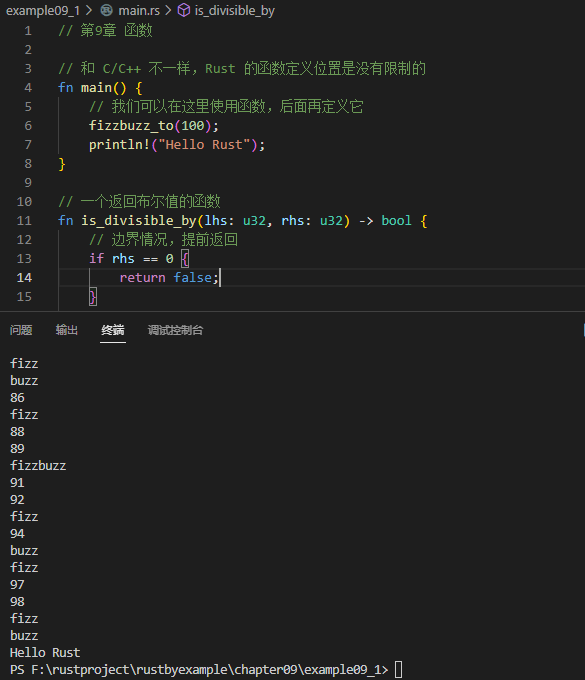
9.1 方法
方法(method)是依附于对象的函数。这些方法通过关键字 self 来访问对象中的数据和其他。方法在 impl 代码块中定义。
// 9.1节 方法

struct Point {
    x: f64,
    y: f64,
}

// 实现的代码块,`Point` 的所有方法都在这里给出
impl Point {
    // 这是一个静态方法(static method)
    // 静态方法不需要被实例调用
    // 这类方法一般用作构造器(constructor)
    fn origin() -> Point {
        Point {x:0.0, y: 0.0}
    }

    // 另外一个静态方法,需要两个参数:
    fn new(x: f64, y: f64) -> Point {
        Point {x: x, y: y}
    }
}

struct Rectangle {
    p1: Point,
    p2: Point,
}

impl Rectangle {
    // 这是一个实例方法(instance method)
    // `&self` 是 `self: &Self` 的语法糖(sugar),其中 `Self` 是方法调用者的
    // 类型。在这个例子中 `Self` = `Rectangle`
    fn area(&self) -> f64 {
        // `self` 通过点运算符来访问结构体字段
        let Point {x: x1, y: y1} = self.p1;
        let Point {x: x2, y: y2} = self.p2;

        // `abs` 是一个 `f64` 类型的方法,返回调用者的绝对值
        ((x1 - x2) * (y1 - y2)).abs()
    }

    //周长
    fn perimeter(&self) -> f64 {
        let Point{x: x1, y: y1} = self.p1;
        let Point{x: x2, y: y2} = self.p2;

        2.0 * ((x1 - x2).abs() + (y1 - y2).abs())
    }

    // 这个方法要求调用者是可变的
    // `&mut self` 为 `self: &mut Self` 的语法糖
    fn translate(&mut self, x: f64, y: f64) {
        self.p1.x += x;
        self.p2.x += x;

        self.p1.y += y;
        self.p2.y += y;
    }
}

// `Pair` 拥有资源:两个堆分配的整型
struct Pair(Box<i32>, Box<i32>);

impl Pair {
    // 这个方法会 "消耗" 调用者的资源
    // `self` 为 `self: Self` 的语法糖
    fn destroy(self) {
        // 解构 `self`
        let Pair(first, second) = self;
        println!("Destroying Pair({}, {})", first, second);
        // `first` 和 `second` 离开作用域后释放
    }
}

fn main() {
    let rectangle = Rectangle {
        // 静态方法使用双冒号调用
        p1: Point::origin(),
        p2: Point::new(3.0, 4.0),
    };

    // 实例方法通过点运算符来调用
    // 注意第一个参数 `&self` 是隐式传递的,亦即:
    // `rectangle.perimeter()` === `Rectangle::perimeter(&rectangle)`
    println!("Rectangle perimeter: {}", rectangle.perimeter());
    println!("Rectangle area: {}", rectangle.area());

    let mut square = Rectangle {
        p1: Point::origin(),
        p2: Point::new(1.0, 1.0),
    };

    // 报错! `rectangle` 是不可变的,但这方法需要一个可变对象
    //rectangle.translate(1.0, 0.0);
    // 试一试 ^ 去掉此行的注释

    // 正常运行!可变对象可以调用可变方法
    square.translate(1.0, 1.0);

    let pair = Pair(Box::new(1), Box::new(2));

    pair.destroy();
    // 报错!前面的 `destroy` 调用 "消耗了" `pair`
    //pair.destroy();
    // 试一试 ^ 将此行注释去掉
    println!("Hello Rust");
}

// rustc main.rs
// ./main
编译运行:
PS F:\rustproject\rustbyexample\chapter09\example09_2> rustc main.rs
PS F:\rustproject\rustbyexample\chapter09\example09_2> ./main
Rectangle perimeter: 14
Rectangle area: 12
Destroying Pair(1, 2)
Hello Rust
PS F:\rustproject\rustbyexample\chapter09\example09_2>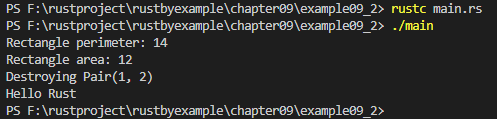
9.2 闭包
Rust 中的闭包(closure),也叫做 lambda 表达式或者 lambda,是一类能够捕获周围作用域中变量的函数。例如,一个可以捕获 x 变量的闭包如下:
|val| val + x它们的语法和能力使它们在临时(on the fly)使用时相当方便。调用一个闭包和调用一个函数完全相同,不过调用闭包时,输入和返回类型两者都可以 自动推导,而输入变量名必须指明。
其他的特点包括:
-
声明时使用
||替代()将输入参数括起来。 -
函数体定界符(
{})对于单个表达式是可选的,其他情况必须加上。 -
有能力捕获外部环境的变量。
// 9.2节 闭包
fn main() {
// 通过闭包和函数分别实现自增。
// 译注:下面这行是使用函数的实现
fn function(i: i32) -> i32 {i +1}// 闭包是匿名的,这里我们将它们绑定到引用。 // 类型标注和函数的一样,不过类型标注和使用 `{}` 来围住函数体都是可选的。 // 这些匿名函数(nameless function)被赋值给合适地命名的变量。 let closure_annotated = |i:i32| -> i32 {i+1}; let closure_inferred = |i| i+1; // 译注:将闭包绑定到引用的说法可能不准。 // 据[语言参考](https://doc.rust-lang.org/beta/reference/types.html#closure-types) // 闭包表达式产生的类型就是 "闭包类型",不属于引用类型,而且确实无法对上面两个 // `closure_xxx` 变量解引用。 let i = 1; // 调用函数和闭包。 println!("function: {}", function(i)); println!("closure_annotated: {}", closure_annotated(i)); println!("closure_inferred: {}", closure_inferred(i)); // 没有参数的闭包,返回一个 `i32` 类型。 // 返回类型是自动推导的。 let one = || 1; println!("closure returning one: {}", one()); println!("Hello Rust");}
// rustc main.rs
// ./main
编译运行:
PS F:\rustproject\rustbyexample\chapter09\example09_3> rustc main.rs
PS F:\rustproject\rustbyexample\chapter09\example09_3> ./main
function: 2
closure_annotated: 2
closure_inferred: 2
closure returning one: 1
Hello Rust
PS F:\rustproject\rustbyexample\chapter09\example09_3>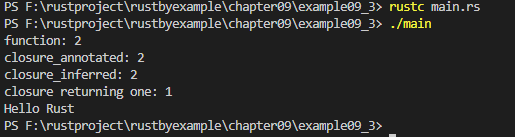
9.2.1 捕获
闭包本质上很灵活,能做功能要求的事情,使闭包在没有类型标注的情况下运行。这使得捕获(capture)能够灵活地适应用例,既可移动(move),又可借用(borrow)。闭包可以通过以下方式捕获变量:
- 通过引用:
&T - 通过可变引用:
&mut T - 通过值:
T
闭包优先通过引用来捕获变量,并且仅在需要时使用其他方式。
// 9.2.1节 捕获

fn main() {
    use std::mem;
    let color = String::from("green");
    // 这个闭包打印 `color`。它会立即借用(通过引用,`&`)`color` 并将该借用和
    // 闭包本身存储到 `print` 变量中。`color` 会一直保持被借用状态直到`print` 离开作用域。

    // `println!` 只需传引用就能使用,而这个闭包捕获的也是变量的引用,因此无需
    // 进一步处理就可以使用 `println!`。
    let print = || println!("'color': {}", color);
    // 使用借用来调用闭包 `color`。
    print();
    // `color` 可再次被不可变借用,因为闭包只持有一个指向 `color` 的不可变引用。
    let reborrow = &color;
    println!("reborrow = {}", reborrow);
    print();

    // 在最后使用 `print` 之后,移动或重新借用都是允许的。
    let color_moved = color;
    println!("color_moved = {}", color_moved);

    let mut count = 0;
    // 这个闭包使 `count` 值增加。要做到这点,它需要得到 `&mut count` 或者
    // `count` 本身,但 `&mut count` 的要求没那么严格,所以我们采取这种方式。
    // 该闭包立即借用 `count`。
    //
    // `inc` 前面需要加上 `mut`,因为闭包里存储着一个 `&mut` 变量。调用闭包时,
    // 该变量的变化就意味着闭包内部发生了变化。因此闭包需要是可变的。
    let mut inc = || {
        count += 1;
        println!("'count': {}", count);
    };
    // 使用可变借用调用闭包
    inc();
    // 因为之后调用闭包,所以仍然可变借用 `count`
    // 试图重新借用将导致错误
    // let _reborrow = &count;
    // ^ 试一试:将此行注释去掉。
    inc();

    // 闭包不再借用 `&mut count`,因此可以正确地重新借用
    let count_reborrowed = &mut count;
    println!("count_reborrowed = {}", count_reborrowed);

    // 不可复制类型(non-copy type)
    let movable = Box::new(3);

    // `mem::drop` 要求 `T` 类型本身,所以闭包将会捕获变量的值。这种情况下,
    // 可复制类型将会复制给闭包,从而原始值不受影响。不可复制类型必须移动
    // (move)到闭包中,因而 `movable` 变量在这里立即移动到了闭包中。
    let consume = || {
        println!("'movable': {:?}", movable);
        mem::drop(movable);
    };

    // `consume` 消耗了该变量,所以该闭包只能调用一次。
    consume();
    //consume();
    // ^ 试一试:将此行注释去掉。

    println!("Hello Rust");
}

// rustc main.rs
// ./main
编译运行:
PS F:\rustproject\rustbyexample\chapter09\example09_4> rustc main.rs
PS F:\rustproject\rustbyexample\chapter09\example09_4> ./main
'color': green
reborrow = green
'color': green
color_moved = green
'count': 1
'count': 2
count_reborrowed = 2
'movable': 3
Hello Rust
PS F:\rustproject\rustbyexample\chapter09\example09_4>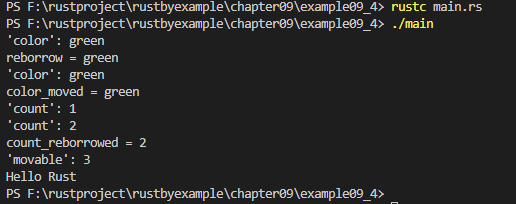
在竖线 | 之前使用 move 会强制闭包取得被捕获变量的所有权:
// 9.2.1节 捕获
// 在竖线 | 之前使用 move 会强制闭包取得被捕获变量的所有权:

fn main() {
    // `Vec` 在语义上是不可复制的。
    let haystack = vec![1, 2, 3];

    let contains = move |needle| haystack.contains(needle);

    println!("{}", contains(&1));
    println!("{}", contains(&4));
    //println!("There're {} elements in vec", haystack.len());
    // ^ 取消上面一行的注释将导致编译时错误,因为借用检查不允许在变量被移动走
    // 之后继续使用它。

    // 在闭包的签名中删除 `move` 会导致闭包以不可变方式借用 `haystack`,因此之后
    // `haystack` 仍然可用,取消上面的注释也不会导致错误。

    println!("Hello Rust");
}

// rustc main.rs
// ./main
编译运行:
PS F:\rustproject\rustbyexample\chapter09\example09_5> rustc main.rs
PS F:\rustproject\rustbyexample\chapter09\example09_5> ./main
true
false
Hello Rust
PS F:\rustproject\rustbyexample\chapter09\example09_5>
参见:
9.2.2 作为输入参数
虽然 Rust 无需类型说明就能在大多数时候完成变量捕获,但在编写函数时,这种模糊写法是不允许的。当以闭包作为输入参数时,必须指出闭包的完整类型,它是通过使用以下 trait 中的一种来指定的。其受限制程度按以下顺序递减:
Fn:表示捕获方式为通过引用(&T)的闭包FnMut:表示捕获方式为通过可变引用(&mut T)的闭包FnOnce:表示捕获方式为通过值(T)的闭包
译注:顺序之所以是这样,是因为 &T 只是获取了不可变的引用,&mut T 则可以改变变量,T 则是拿到了变量的所有权而非借用。
对闭包所要捕获的每个变量,编译器都将以限制最少的方式来捕获。
译注:这句可能说得不对,事实上是在满足使用需求的前提下尽量以限制最多的方式捕获。
例如用一个类型说明为 FnOnce 的闭包作为参数。这说明闭包可能采取 &T,&mut T 或 T 中的一种捕获方式,但编译器最终是根据所捕获变量在闭包里的使用情况决定捕获方式。
这是因为如果能以移动的方式捕获变量,则闭包也有能力使用其他方式借用变量。注意反过来就不再成立:如果参数的类型说明是 Fn,那么不允许该闭包通过 &mut T 或 T 捕获变量。
在下面的例子中,试着分别用一用 Fn、FnMut 和 FnOnce,看看会发生什么:
// 9.2.2节 作为输入参数
// 该函数将闭包作为参数并调用它。
fn apply<F>(f: F) where
    // 闭包没有输入值和返回值。
    F: FnOnce() {
    // ^ 试一试:将 `FnOnce` 换成 `Fn` 或 `FnMut`。
    f();
}

// 输入闭包,返回一个 `i32` 整型的函数。
fn apply_to_3<F>(f: F) -> i32 where
    // 闭包处理一个 `i32` 整型并返回一个 `i32` 整型。
    F: Fn(i32) -> i32 {
    f(3)
}

fn main() {
    use std::mem;

    let greeting = "hello";
    // 不可复制的类型。
    // `to_owned` 从借用的数据创建有所有权的数据。
    let mut farewell = "goodbye".to_owned();

    // 捕获 2 个变量:通过引用捕获 `greeting`,通过值捕获 `farewell`。
    let diary = || {
        // `greeting` 通过引用捕获,故需要闭包是 `Fn`。
        println!("I said {}.", greeting);

        // 下文改变了 `farewell` ,因而要求闭包通过可变引用来捕获它。
        // 现在需要 `FnMut`。
        farewell.push_str("!!!");
        println!("Then I screamed {}.", farewell);
        println!("Now I can sleep. zzzzz");

        // 手动调用 drop 又要求闭包通过值获取 `farewell`。
        // 现在需要 `FnOnce`。
        mem::drop(farewell);
    };

    // 以闭包作为参数,调用函数 `apply`。
    apply(diary);

    // 闭包 `double` 满足 `apply_to_3` 的 trait 约束。
    let double = |x| x*2;
    println!("3 doubled: {}", apply_to_3(double));
    println!("Hello Rust");
}

// rustc main.rs
// ./main
编译运行:
PS F:\rustproject\rustbyexample\chapter09\example09_6> rustc main.rs
PS F:\rustproject\rustbyexample\chapter09\example09_6> ./main
I said hello.
Then I screamed goodbye!!!.
Now I can sleep. zzzzz
3 doubled: 6
Hello Rust
PS F:\rustproject\rustbyexample\chapter09\example09_6>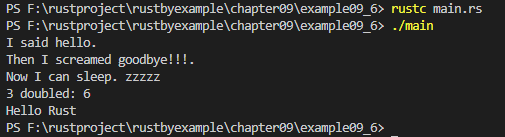
参见:
std::mem::drop, Fn, FnMut, 和 FnOnce
9.2.3 类型匿名
闭包从周围的作用域中捕获变量是简单明了的。这样会有某些后果吗?确实有。观察一下使用闭包作为函数参数,这要求闭包是泛型的,闭包定义的方式决定了这是必要的。
// `F` 必须是泛型的。
fn apply<F>(f: F) where
    F: FnOnce() {
    f();
}
当闭包被定义,编译器会隐式地创建一个匿名类型的结构体,用以储存闭包捕获的变量,同时为这个未知类型的结构体实现函数功能,通过 Fn、FnMut 或 FnOnce 三种 trait 中的一种。
若使用闭包作为函数参数,由于这个结构体的类型未知,任何的用法都要求是泛型的。然而,使用未限定类型的参数 <T> 过于不明确,并且是不允许的。事实上,指明为该结构体实现的是 Fn、FnMut、或 FnOnce 中的哪种 trait,对于约束该结构体的类型而言就已经足够了。
// 9.2.3节 类型匿名
// `F` 必须为一个没有输入参数和返回值的闭包实现 `Fn`,
// 这和对 `print` 的要求恰好一样。
fn apply<F>(f: F) where
    F: Fn() {
    f();
}

fn main() {
    let x = 7;
    // 捕获 `x` 到匿名类型中,并为它实现 `Fn`。
    // 将闭包存储到 `print` 中。
    let print = || println!("{}", x);
    apply(print);

    println!("Hello Rust");
}

// rustc main.rs
// ./main
编译运行:
PS F:\rustproject\rustbyexample\chapter09\example09_7> rustc main.rs
PS F:\rustproject\rustbyexample\chapter09\example09_7> ./main
7
Hello Rust
PS F:\rustproject\rustbyexample\chapter09\example09_7>
参见:
9.2.4 输入函数
既然闭包可以作为参数,你很可能想知道函数是否也可以呢。确实可以!如果你声明一个接受闭包作为参数的函数,那么任何满足该闭包的 trait 约束的函数都可以作为其参数。
// 9.2.4节 输入函数
// 定义一个函数,可以接受一个由 `Fn` 限定的泛型 `F` 参数并调用它。
fn call_me<F: Fn()>(f: F) {
    f()
}

// 定义一个满足 `Fn` 约束的封装函数(wrapper function)。
fn function() {
    println!("I'm a function!");
}

fn main() {
    // 定义一个满足 `Fn` 约束的闭包。
    let closure = || println!("I'm a closure!");
    call_me(closure);
    call_me(function);

    println!("Hello Rust");
}

// rustc main.rs
// ./main
编译运行:
PS F:\rustproject\rustbyexample\chapter09\example09_8> rustc main.rs
PS F:\rustproject\rustbyexample\chapter09\example09_8> ./main
I'm a closure!
I'm a function!
Hello Rust
PS F:\rustproject\rustbyexample\chapter09\example09_8>
多说一句,Fn、FnMut 和 FnOnce 这些 trait 明确了闭包如何从周围的作用域中捕获变量。
参见:
9.2.5 作为输出参数
闭包作为输入参数是可能的,所以返回闭包作为输出参数(output parameter)也应该是可能的。然而返回闭包类型会有问题,因为目前 Rust 只支持返回具体(非泛型)的类型。按照定义,匿名的闭包的类型是未知的,所以只有使用impl Trait才能返回一个闭包。
返回闭包的有效特征是:
FnFnMutFnOnce
除此之外,还必须使用 move 关键字,它表明所有的捕获都是通过值进行的。这是必须的,因为在函数退出时,任何通过引用的捕获都被丢弃,在闭包中留下无效的引用。
// 9.2.5节 作为输出参数
fn create_fn() -> impl Fn() {
    let text = "Fn".to_owned();
    move || println!("This is a: {}", text)
}

fn create_fnmut() -> impl FnMut() {
    let text = "FnMut".to_owned();
    move || println!("This is a: {}", text)
}

fn create_fnonce() -> impl FnOnce() {
    let text = "FnOnce".to_owned();
    move || println!("This is a: {}", text)
}

fn main() {
    let fn_plain = create_fn();
    let mut fn_mut = create_fnmut();
    let fn_once = create_fnonce();

    fn_plain();
    fn_mut();
    fn_once();

    println!("Hello Rust");
}

// rustc main.rs
// ./main
编译运行:
PS F:\rustproject\rustbyexample\chapter09\example09_9> rustc main.rs
PS F:\rustproject\rustbyexample\chapter09\example09_9> ./main
This is a: Fn
This is a: FnMut
This is a: FnOnce
Hello Rust
PS F:\rustproject\rustbyexample\chapter09\example09_9>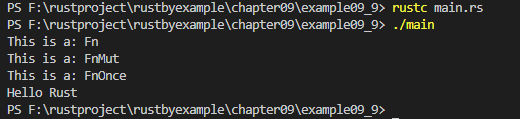
参见:
Fn, FnMut, 泛型 和 impl Trait.
9.2.6 std中的例子
本小节列出几个标准库中使用闭包的例子。
Iterator::any
Iterator::any 是一个函数,若传给它一个迭代器(iterator),当其中任一元素满足谓词(predicate)时它将返回 true,否则返回 false(译注:谓词是闭包规定的, true/false 是闭包作用在元素上的返回值)。它的签名如下:
pub trait Iterator {
    // 被迭代的类型。
    type Item;

    // `any` 接受 `&mut self` 参数(译注:回想一下,这是 `self: &mut Self` 的简写)
    // 表明函数的调用者可以被借用和修改,但不会被消耗。
    fn any<F>(&mut self, f: F) -> bool where
        // `FnMut` 表示被捕获的变量最多只能被修改,而不能被消耗。
        // `Self::Item` 表明变量是通过值传递给闭包(译注:是迭代器对应的元素的类型)
        F: FnMut(Self::Item) -> bool {}
}
示例代码:
// 9.2.6.1节 Iterator::any

fn main() {
    let vec1 = vec![1,2,3];
    let vec2 = vec!(4,5,6);

    // 对 vec 的 `iter()` 举出 `&i32`。(通过用 `&x` 匹配)把它解构成 `i32`。
    // 译注:注意 `any` 方法会自动地把 `vec.iter()` 举出的迭代器的元素一个个地
    // 传给闭包。因此闭包接收到的参数是 `&i32` 类型的。
    println!("2 in vec1: {}", vec1.iter().any(|&x| x == 2));
    // 对 vec 的 `into_iter()` 举出 `i32` 类型。无需解构。
    println!("2 in vec2: {}", vec2.into_iter().any(|x| x == 2));

    let array1 = [1, 2, 3];
    let array2 = [4, 5, 6];

    // 对数组的 `iter()` 举出 `&i32`。
    println!("2 in array1: {}", array1.iter().any(|&x| x == 2));
    // 对数组的 `into_iter()` 举出 `i32`。
    //println!("2 in array2: {}", array2.into_iter().any(|x| *x == 2));
    println!("2 in array2: {}", IntoIterator::into_iter(array2).any(|x| x == 2));

    println!("Hello Rust");
}

// rustc main.rs
// ./main
编译运行:
PS F:\rustproject\rustbyexample\chapter09\example09_10> rustc main.rs
PS F:\rustproject\rustbyexample\chapter09\example09_10> ./main
2 in vec1: true
2 in vec2: false
2 in array1: true
2 in array2: false
Hello Rust
PS F:\rustproject\rustbyexample\chapter09\example09_10>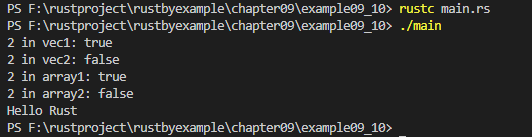
参见:
Iterator::find
Iterator::find 是一个函数,在传给它一个迭代器时,将用 Option 类型返回第一个满足谓词的元素。它的签名如下:
pub trait Iterator {
    // 被迭代的类型。
    type Item;

    // `find` 接受 `&mut self` 参数,表明函数的调用者可以被借用和修改,
    // 但不会被消耗。
    fn find<P>(&mut self, predicate: P) -> Option<Self::Item> where
        // `FnMut` 表示被捕获的变量最多只能被修改,而不能被消耗。
        // `&Self::Item` 指明了被捕获变量的类型(译注:是对迭代器元素的引用类型)
        P: FnMut(&Self::Item) -> bool {}
}
示例代码:
// 9.2.6.2节 Iterator::find

fn main() {
    let vec1 = vec![1,2,3];
    let vec2 = vec!(4,5,6);

    // 对 vec1 的 `iter()` 举出 `&i32` 类型。
    let mut iter = vec1.iter();
    // 对 vec2 的 `into_iter()` 举出 `i32` 类型。
    let mut into_iter = vec2.into_iter();
    // 对迭代器举出的元素的引用是 `&&i32` 类型。解构成 `i32` 类型。
    // 译注:注意 `find` 方法会把迭代器元素的引用传给闭包。迭代器元素自身
    // 是 `&i32` 类型,所以传给闭包的是 `&&i32` 类型。
    println!("Find 2 in vec1: {:?}", iter.find(|&&x| x == 2));
    // 对迭代器举出的元素的引用是 `&i32` 类型。解构成 `i32` 类型。
    println!("Find 2 in vec2: {:?}", into_iter.find(|&x| x == 2));

    let array1 = [1, 2, 3];
    let array2 = [4, 5, 6];

    // 对数组的 `iter()` 举出 `&i32`。
    println!("Find 2 in array1: {:?}", array1.iter().find(|&&x| x == 2));
    // 对数组的 `into_iter()` 通常举出 `&i32``。
    //println!("Find 2 in array2: {:?}", array2.into_iter().find(|&x| *x == 2));
    println!("Find 2 in array2: {:?}", IntoIterator::into_iter(array2).find(|&x| x == 2));

    println!("Hello Rust");
}

// rustc main.rs
// ./main
编译运行:
PS F:\rustproject\rustbyexample\chapter09\example09_11> rustc main.rs
PS F:\rustproject\rustbyexample\chapter09\example09_11> ./main
Find 2 in vec1: Some(2)
Find 2 in vec2: None
Find 2 in array1: Some(2)
Find 2 in array2: None
Hello Rust
PS F:\rustproject\rustbyexample\chapter09\example09_11>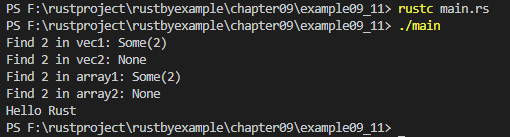
参见:
9.3 高阶函数
Rust 提供了高阶函数(Higher Order Function, HOF),指那些输入一个或多个函数,并且/或者产生一个更有用的函数的函数。HOF 和惰性迭代器(lazy iterator)给 Rust 带来了函数式(functional)编程的风格。
// 9.3节 高阶函数
fn is_odd(n: u32) -> bool {
    n % 2 == 1
}

fn main() {
    println!("Find the sum of all the squared odd numbers under 1000");
    let upper = 1000;

    // 命令式(imperative)的写法
    // 声明累加器变量
    let mut acc = 0;
    // 迭代:0,1, 2, ... 到无穷大
    for n in 0.. {
        // 数字的平方
        let n_squared = n * n;
        if n_squared >= upper {
            // 若大于上限则退出循环
            break;
        } else if is_odd(n_squared) {
            // 如果是奇数就计数
            acc += n_squared;
        }
    }
    println!("imperative style: {}", acc);

    // 函数式的写法
    let sum_of_squared_odd_numbers: u32 =
        (0..).map(|n| n * n)                // 所有自然数取平方
        .take_while(|&n| n < upper)    // 取小于上限的
        .filter(|&n| is_odd(n))        // 取奇数
        .fold(0, |sum, i| sum + i);    // 最后加起来
    println!("functional style: {}", sum_of_squared_odd_numbers);

    println!("Hello Rust");
}

// rustc main.rs
// ./main
编译运行:
PS F:\rustproject\rustbyexample\chapter09\example09_12> rustc main.rs
PS F:\rustproject\rustbyexample\chapter09\example09_12> ./main
Find the sum of all the squared odd numbers under 1000
imperative style: 5456
functional style: 5456
Hello Rust
PS F:\rustproject\rustbyexample\chapter09\example09_12>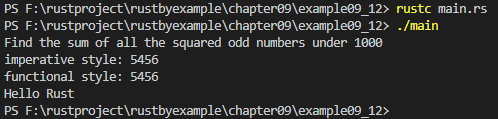
9.4 发散函数
发散函数(diverging function)绝不会返回。 它们使用 ! 标记,这是一个空类型。
// 9.4节 发散函数
// 发散函数(diverging function)绝不会返回。 它们使用 ! 标记,这是一个空类型。
#![allow(unused)]
fn main() {
    fn foo() -> ! {
        panic!("This call never returns.");
    }
    //foo();
    println!("Hello Rust");
}

// rustc main.rs
// ./main
编译运行:
PS F:\rustproject\rustbyexample\chapter09\example09_13> rustc main.rs
PS F:\rustproject\rustbyexample\chapter09\example09_13> ./main
Hello Rust
PS F:\rustproject\rustbyexample\chapter09\example09_13>
和所有其他类型相反,这个类型无法实例化,因为此类型可能具有的所有可能值的集合为空。 注意,它与 () 类型不同,后者只有一个可能的值。
如下面例子,虽然返回值中没有信息,但此函数会照常返回。
// 9.4节 发散函数
// 返回值中没有信息,但此函数会照常返回。
fn some_fn() {
    ()
}

fn main() {
    let a: () = some_fn();
    println!("This function returns and you can see this line.");
    println!("a = {:?}", a);
    println!("Hello Rust");
}

// rustc main.rs
// ./main
编译运行:
PS F:\rustproject\rustbyexample\chapter09\example09_14> rustc main.rs
PS F:\rustproject\rustbyexample\chapter09\example09_14> ./main
This function returns and you can see this line.
a = ()
Hello Rust
PS F:\rustproject\rustbyexample\chapter09\example09_14>
下面这个函数相反,这个函数永远不会将控制内容返回给调用者。
#![feature(never_type)]

fn main() {
    let x: ! = panic!("This call never returns.");
    println!("You will never see this line!");
}
虽然这看起来像是一个抽象的概念,但实际上这非常有用且方便。这种类型的主要优点是它可以被转换为任何其他类型,从而可以在需要精确类型的地方使用,例如在 match 匹配分支。 这允许我们编写如下代码:
// 9.4节 发散函数
// match 匹配分支。 这允许我们编写如下代

fn main() {
    fn sum_odd_numbers(up_to: u32) -> u32 {
        let mut acc = 0;
        for i in 0..up_to {
            // 注意这个 match 表达式的返回值必须为 u32,
            // 因为 "addition" 变量是这个类型。
            let addition: u32 = match i % 2 == 1 {
                // "i" 变量的类型为 u32,这毫无问题。
                true => i,
                // 另一方面,"continue" 表达式不返回 u32,但它仍然没有问题,
                // 因为它永远不会返回,因此不会违反匹配表达式的类型要求。
                false => continue,
            };
            acc += addition;
        }
        acc
    }
    println!("Sum of odd numbers up to 9 (excluding): {}", sum_odd_numbers(9));
    println!("Hello Rust");
}

// rustc main.rs
// ./main
编译运行:
PS F:\rustproject\rustbyexample\chapter09\example09_16> rustc main.rs
PS F:\rustproject\rustbyexample\chapter09\example09_16> ./main
Sum of odd numbers up to 9 (excluding): 16
Hello Rust
PS F:\rustproject\rustbyexample\chapter09\example09_16>
这也是永远循环(如 loop {})的函数(如网络服务器)或终止进程的函数(如 exit())的返回类型。