一、采用顺序存储结构实现栈(即顺序栈)
总结:
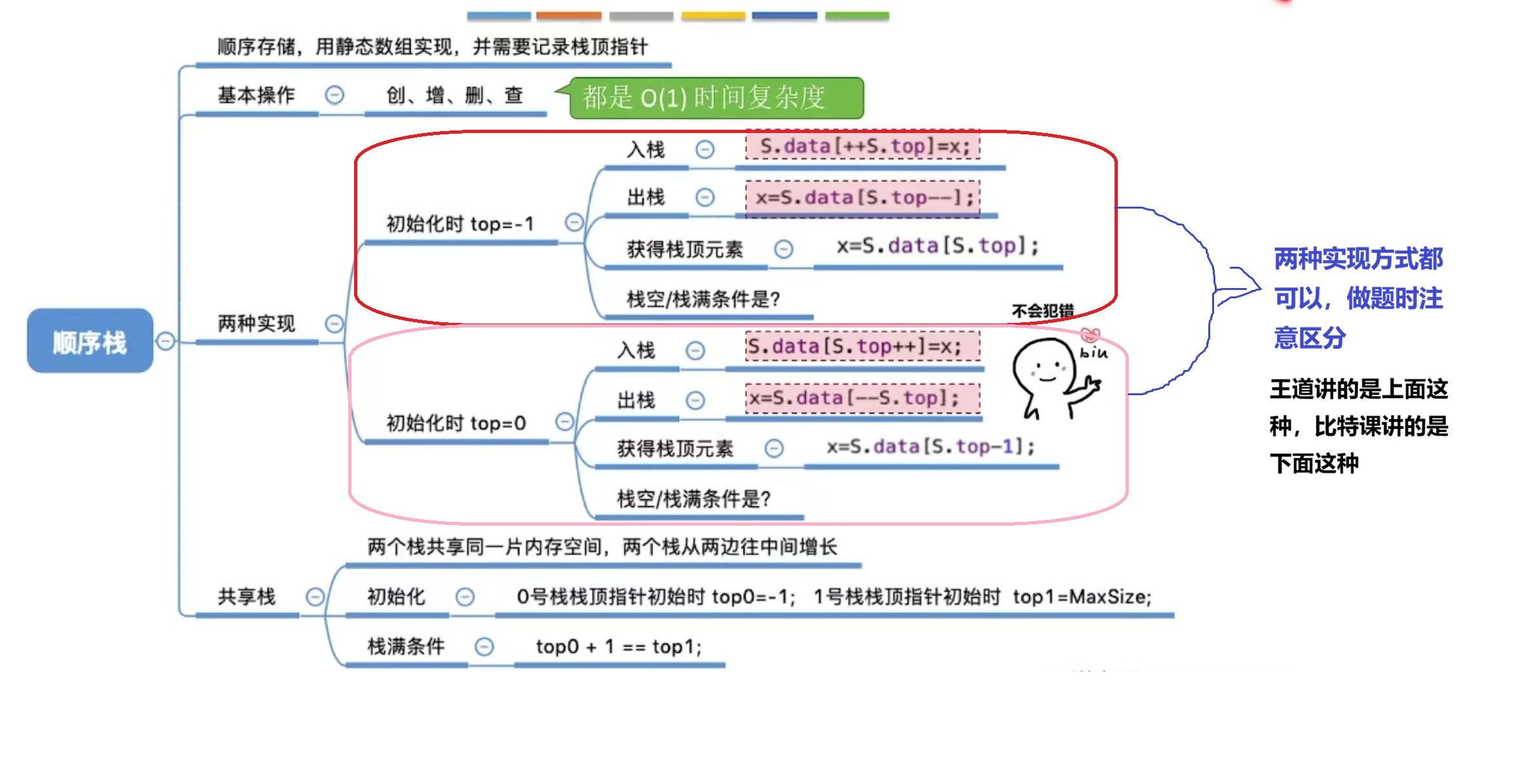
Stack.h
cpp
#pragma once
#include<stdio.h>
#include<stdbool.h>

#define MaxSize 10
typedef int ElemType;
// 采用顺序结构实现栈
// 定义栈的结构
typedef struct SqStack
{
	ElemType arr[MaxSize]; // 栈中最多可以存储MaxSize个ElemType类型的数据
	int top; // top是栈顶指针,指向栈顶元素
}SqStack;

// 栈的初始化
void Init(SqStack& S);

// 判断栈是否为空。为空返回true,否则返回false。
bool Empty(SqStack S);

// 新元素x入栈
bool Push(SqStack& S, ElemType x);

// 删除栈顶元素(出栈操作),并将栈顶元素的值赋给变量e
bool Pop(SqStack& S, ElemType& e);


// 获取栈顶元素,并将栈顶元素的值赋给变量e
bool GetTop(SqStack S, ElemType& e);
Stack.cpp
cpp
#define _CRT_SECURE_NO_WARNINGS 1
#include"Stack.h"
// 栈的初始化
void Init(SqStack& S)
{
	S.top = -1;
}

// 判断栈是否为空。为空返回true,否则返回false
bool Empty(SqStack S)
{
	if (S.top == -1)
		return true;	// 栈为空
	else
		return false;	// 栈不为空
}

// 新元素x入栈
bool Push(SqStack& S, ElemType x)
{
	if (S.top == MaxSize - 1) // 此时表示栈中已经存满了元素,无法执行入栈操作
		return false;
	S.top++;
	S.arr[S.top] = x; // 将新元素x放到栈顶的位置
	return true;
}


// 删除栈顶元素(出栈操作),并将栈顶元素的值赋给变量e
bool Pop(SqStack& S, ElemType& e)
{
	if (S.top == -1) // 表示此时栈为空,无法执行出栈操作
		return false;
	e = S.arr[S.top]; // 将栈顶元素赋给e
	S.top--;
	return true;
}


// 获取栈顶元素,并将栈顶元素的值赋给变量e
bool GetTop(SqStack S, ElemType& e)
{
	if (S.top = -1)
		return false; // 表示栈为空,无法指向获取栈顶元素的操作
	e = S.arr[S.top];
	return true;
}
二、共享栈
共享栈就是两个栈共享同一片空间
cpp
// 定义共享栈的结构(两个栈共享同一块内存,这两个栈分别命名为0号栈与1号栈)
# define MaxSize 10
typedef int ElmeType;
typedef struct ShStack {
	ElmeType data[MaxSize];
	int top0; // 0号栈的栈顶指针
	int top1; // 1号栈的栈顶指针
}ShStack;

// 共享栈的初始化
void InitStack(ShStack& S)
{
	S.top0 = 0;
	S.top1 = MaxSize;
}

// 共享栈满了的条件:S.top0+1 == S.top1