FFmpeg + Qt 实现摄像头采集与 MP3 背景音乐 RTSP 推流
前言
在直播或视频监控场景中,我们经常需要将摄像头画面与背景音乐混合后推送到 RTSP 服务器。本文将详细介绍如何使用 Qt 框架结合 FFmpeg 6.0.0 库,实现以下功能:
- 摄像头实时采集(Windows 下使用
dshow,Linux 使用v4l2) - 视频预览(显示为 QImage)
- 视频 H.264 编码 + RTSP 推流
- 从 MP3 文件读取音频,重采样为 AAC 编码并推流
- 循环播放音频文件
- 解决中文文件路径打开失败的问题
文章将剖析每个技术环节的关键代码,并给出完整的 CVideoCapTask 类实现。
一、整体架构
程序主要包含 3 个线程:
- 主线程:Qt GUI 线程,控制采集开始/停止。
- 视频采集线程 (继承
QThread):从摄像头读取数据,解码,预览,并将视频帧编码后推送到 RTSP 服务器。同时负责处理音频包的发送队列。 - 音频采集线程 (
QThread单独创建):从 MP3 文件循环读取音频包,解码,重采样,编码成 AAC 后放入队列,供主线程写入 RTSP 流。
这样做可以避免音频解码和重采样阻塞视频采集,同时保证音视频包能够交错写入(interleaved)。
二、视频采集与推流
2.1 打开摄像头设备
不同平台使用不同的 FFmpeg 输入格式:
- Windows :
dshow,设备名格式video=摄像头名称 - Linux :
v4l2,设备路径如/dev/video0
关键代码:
cpp
const AVInputFormat* pInputFmt = nullptr;
#ifdef _WIN32
    pInputFmt = av_find_input_format("dshow");
#else
    pInputFmt = av_find_input_format("v4l2");
#endif

AVDictionary* pOptions = nullptr;
av_dict_set(&pOptions, "framerate", "30", 0);
av_dict_set(&pOptions, "rtbufsize", "512M", 0);   // 增大缓冲区防止丢帧

avformat_open_input(&m_pFormatCtx, deviceName.toUtf8().constData(), pInputFmt, &pOptions);
打开后需要查找视频流索引,并创建解码器上下文。摄像头常用格式为 MJPEG 或 YUYV,FFmpeg 会自动解码成原始帧(如 YUV420P 或 NV12)。
2.2 预览显示
解码后的 AVFrame 需要转换成 QImage 才能显示在 Qt 界面上。这里使用 sws_scale 将帧转换为 AV_PIX_FMT_BGRA 格式,然后拷贝到 QImage:
cpp
QImage CVideoCapTask::AVFrameToQImage(AVFrame* frame)
{
    int dstWidth = m_targetWidth > 0 ? m_targetWidth : frame->width;
    int dstHeight = m_targetHeight > 0 ? m_targetHeight : frame->height;
    AVPixelFormat dstFormat = AV_PIX_FMT_BGRA;

    SwsContext* swsCtx = sws_getContext(frame->width, frame->height, (AVPixelFormat)frame->format,
                                        dstWidth, dstHeight, dstFormat,
                                        SWS_FAST_BILINEAR, nullptr, nullptr, nullptr);
    uint8_t* dstData = (uint8_t*)av_malloc(dstWidth * 4 * dstHeight);
    uint8_t* dstPlane[1] = { dstData };
    int dstLinesize[1] = { dstWidth * 4 };
    sws_scale(swsCtx, frame->data, frame->linesize, 0, frame->height, dstPlane, dstLinesize);

    QImage image(dstData, dstWidth, dstHeight, QImage::Format_ARGB32);
    QImage result = image.copy();  // 深拷贝,因为 dstData 马上要释放
    av_free(dstData);
    sws_freeContext(swsCtx);
    return result;
}
注意:每次转换都创建新的 SwsContext 开销较大,实际生产中可以复用并缓存源/目标尺寸参数。
2.3 H.264 编码与 RTSP 推流
推流需要初始化输出上下文、视频编码器(H.264)并写入头信息。
cpp
avformat_alloc_output_context2(&m_pOutFormatCtx, nullptr, "rtsp", rtspUrl.toStdString().c_str());
// 创建视频流
AVStream* outVideoStream = avformat_new_stream(m_pOutFormatCtx, nullptr);
// 设置编码器参数
AVCodecContext* encCtx = avcodec_alloc_context3(encoder);
encCtx->width = width;
encCtx->height = height;
encCtx->pix_fmt = AV_PIX_FMT_YUV420P;
encCtx->time_base = AVRational{1, framerate};
encCtx->bit_rate = 2 * 1024 * 1024;
encCtx->gop_size = framerate;
// ... 其他参数
avcodec_open2(encCtx, encoder, nullptr);
avcodec_parameters_from_context(outVideoStream->codecpar, encCtx);
对于每一帧解码后的原始帧(格式可能是 NV12 或 YUYV422),需要先转换为 YUV420P(H.264 编码器通常要求),再送入编码器:
cpp
// 创建 YUV420P 帧
AVFrame* yuvFrame = av_frame_alloc();
yuvFrame->format = AV_PIX_FMT_YUV420P;
yuvFrame->width = frame->width;
yuvFrame->height = frame->height;
av_frame_get_buffer(yuvFrame, 0);
sws_scale(swsCtx, frame->data, frame->linesize, 0, frame->height,
          yuvFrame->data, yuvFrame->linesize);
yuvFrame->pts = ptsCounter++;   // PTS 按帧率递增
avcodec_send_frame(encCtx, yuvFrame);
while (avcodec_receive_packet(encCtx, &pkt) == 0) {
    av_packet_rescale_ts(&pkt, encCtx->time_base, outStream->time_base);
    av_interleaved_write_frame(m_pOutFormatCtx, &pkt);
}
最后调用 av_write_trailer 关闭输出。
三、音频采集与推流(MP3 文件)
3.1 打开 MP3 文件并解码
与打开摄像头类似,但不需要指定输入格式(FFmpeg 可以自动探测)。
cpp
avformat_open_input(&m_pAudioFmtCtx, mp3FilePath.toUtf8().constData(), nullptr, nullptr);
avformat_find_stream_info(m_pAudioFmtCtx, nullptr);
// 找到音频流索引
m_audioInStreamIndex = av_find_best_stream(m_pAudioFmtCtx, AVMEDIA_TYPE_AUDIO, -1, -1, nullptr, 0);
// 创建解码器
const AVCodec* dec = avcodec_find_decoder(codecpar->codec_id);
avcodec_open2(m_pAudioDecCtx, dec, nullptr);
3.2 处理中文文件路径
用户遇到 Cannot open MP3 file: "E:/SoftWare/DownLoad/???????????-????.mp3" 的问题,原因是中文字符在 toUtf8().constData() 传递给 FFmpeg 时,FFmpeg 内部可能无法正确处理 UTF-8 路径。解决方法有两种:
- 将文件重命名为英文名。
- 使用
avformat_open_input的 AVIOContext 方式:先用QFile打开文件,再通过自定义 IO 回调读取,但较复杂。 - 在 Windows 下,可以使用
_wfopen打开文件后传给 FFmpeg 的avio_open,但需注意封装。
推荐做法:在设置 MP3 路径时,检查文件是否存在,若不存在则提示错误;调用时确保路径是 UTF-8 编码且不包含特殊字符。如果中文字符必须支持,可以改用系统 API 打开文件并传递给 FFmpeg。
代码中只需确保文件真实存在且路径正确,上述错误就是因为路径中实际是"喀什噶尔胡杨-刀郎.mp3"但日志显示乱码(控制台编码问题),只要文件存在且 FFmpeg 能读取即可。但本例报错 No such file or directory,表明路径确实是错误的。检查后发现用户代码中写的是 "E:/SoftWare/DownLoad/喀什噶尔胡杨-刀郎.mp3",但实际文件可能位于其他目录或名称不完全匹配。建议先使用英文路径测试。
3.3 重采样(SwrContext)
MP3 解码后的格式可能是 AV_SAMPLE_FMT_S16P(16位平面格式),采样率可能是 44100 Hz,而我们要推流的 AAC 编码器通常需要 AV_SAMPLE_FMT_FLTP(32位浮点平面格式)且可能要求固定采样率(如 44100 或 48000)。因此必须使用 libswresample 进行重采样。
cpp
SwrContext* swr = swr_alloc_set_opts(nullptr,
    dst_ch_layout, dst_sample_fmt, dst_sample_rate,
    src_ch_layout, src_sample_fmt, src_sample_rate,
    0, nullptr);
swr_init(swr);
重采样过程:解码得到原始 AVFrame 后,先将数据送入 swr_convert(填充输入缓冲区),然后循环取出指定数量(编码器要求的 frame_size)的采样点,转换成编码器所需的格式,并设置 PTS。
cpp
// 送入输入数据
swr_convert(swr_ctx, nullptr, 0, (const uint8_t**)rawFrame->data, rawFrame->nb_samples);
// 循环取数据
while (true) {
    AVFrame* outFrame = av_frame_alloc();
    // 设置 outFrame 参数
    outFrame->nb_samples = encCtx->frame_size;
    av_frame_get_buffer(outFrame, 0);
    int samples = swr_convert(swr_ctx, outFrame->data, outFrame->nb_samples, nullptr, 0);
    if (samples <= 0) break;
    outFrame->pts = audio_pts;
    audio_pts += samples;
    EncodeAudioFrame(outFrame);  // 调用编码函数
    av_frame_free(&outFrame);
}
3.4 音频编码与队列传输
音频编码器(AAC)的使用与视频类似,但生成的 AVPacket 不直接写入,而是放入一个线程安全队列(QQueue<AVPacket*>),由视频采集线程定期调用 WriteQueuedPackets() 写入。这样可以保证音视频包的顺序交错,避免锁竞争。
cpp
void CVideoCapTask::WriteQueuedPackets()
{
    QMutexLocker lock(&m_queueMutex);
    while (!m_audioPacketQueue.isEmpty()) {
        AVPacket* pkt = m_audioPacketQueue.dequeue();
        lock.unlock();
        av_interleaved_write_frame(m_pOutFormatCtx, pkt);
        av_packet_free(&pkt);
        lock.relock();
    }
}
3.5 循环播放 MP3 文件
当读到文件尾(av_read_frame 返回 AVERROR_EOF)时,如果启用了循环标志,则关闭当前解码器上下文,重新打开文件并重置 PTS 计数器,继续读取。
cpp
if (ret == AVERROR_EOF && m_loopAudio) {
    CloseAudioCapture();   // 关闭旧上下文
    InitAudioCapture();    // 重新打开文件
    // 注意:编码器和重采样器可能需要重新初始化,因为解码器参数可能不变
    // 简单起见可用重新调用 InitAudioEncoder()
    continue;
}但需要注意:InitAudioEncoder 中依赖 m_pAudioDecCtx 并创建重采样器,循环重新打开文件后需要重新创建重采样器(因为解码器上下文变了)。更好的做法是在循环重启时重建整个音频处理链。
四、音视频同步问题
本方案中视频 PTS 简单地按帧率递增(0, 1, 2, ...),音频 PTS 按重采样后的实际采样数递增。两者没有相对参考,在 RTSP 播放端(如 VLC)会以各自的 time_base 独立播放,通常听起来不会明显失步,因为视频和音频都按真实时间速率推进。但长时间运行可能产生漂移。
如果需要精确同步,可以采用以下方法:
- 以音频时钟为主:记录音频当前播放的 PTS(或系统时间),视频帧在编码时根据实际采集时刻设置 PTS,并与音频 PTS 对齐。
- 使用系统绝对时间:记录程序启动时的基准时间,每一帧编码时计算当前时刻与基准时刻的差值,转换为编码器 time_base 的 PTS。
考虑到背景音乐一般对同步精度要求不高,本文方案可以满足基本需求。
五、调试与常见问题
5.1 没有声音
用户按照代码运行后依然没有声音,需要排查以下几处:
- RTSP 拉流是否支持 AAC :某些 RTSP 服务器或播放器默认只解码 PCMU/PCMA,需要单独配置。使用
ffplay rtsp://127.0.0.1:8554/test测试。 - 音频编码器是否初始化成功 :检查日志中是否有
Audio encoder initialized successfully。如果没有,可能是 AAC 编码器未找到(需确认 FFmpeg 编译时启用了libfdk_aac或内置aac)。 - 音频队列是否进入写入 :在
WriteQueuedPackets中加入计数日志,确认有包被写入。 - 重采样失败 :检查
swr_convert返回值,确保采样格式转换正确。可以用av_get_sample_fmt_name打印原始格式和目标格式。 - MP3 文件读取循环:如果文件读取太快或太慢,可能导致音频包不足或积压,但一般不影响最终有声与否。
5.2 性能优化
- 预览缩放和颜色空间转换可使用 GPU 加速(如 OpenGL)。
- 视频编码器参数调节:降低
bit_rate或使用preset提高速度。 - 音频重采样使用公共缓存,避免频繁分配
AVFrame。
5.3 内存泄漏
注意每一个 AVFrame、AVPacket、AVCodecContext 在使用完毕后都要调用对应的 free 函数。在类析构函数中统一释放。
六、完整代码示例
cpp
#include "../Include/VideoCapTask.h"
#include <QDebug>
#include <chrono>
#include <thread>
CVideoCapTask::CVideoCapTask(QObject* parent)
: QThread(parent)
, m_framerate(30)
, m_targetWidth(0)
, m_targetHeight(0)
, m_srcWidth(0)
, m_srcHeight(0)
, m_dstWidth(0)
, m_dstHeight(0)
, m_running(false)
, m_pFormatCtx(nullptr)
, m_pCodecCtx(nullptr)
, m_pSwsCtx(nullptr)
, m_videoStreamIndex(-1)
, m_pushEnabled(false)
, m_pOutFormatCtx(nullptr)
, m_pOutVideoCodecCtx(nullptr)
, m_pOutVideoSwsCtx(nullptr)
, m_outVideoStreamIndex(-1)
, m_videoPtsCounter(0)
, m_loopAudio(true)
, m_audioFileDuration(0)
, m_audioSampleRate(44100)
, m_audioChannels(2)
, m_audioBitrate(128000)
, m_audioEnabled(false)
, m_audioRunning(false)
, m_pAudioThread(nullptr)
, m_pAudioFmtCtx(nullptr)
, m_pAudioDecCtx(nullptr)
, m_pAudioSwrCtx(nullptr)
, m_audioInStreamIndex(-1)
, m_pOutAudioCodecCtx(nullptr)
, m_outAudioStreamIndex(-1)
, m_audioPtsCounter(0)
{
InitFFmpeg();
}
CVideoCapTask::~CVideoCapTask()
{
StopCapture();
wait();
CloseDevice();
ClosePushStream();
CloseAudioCapture();
}
void CVideoCapTask::SetDeviceName(const QString& deviceName)
{
QMutexLocker locker(&m_mutex);
m_deviceName = deviceName;
}
void CVideoCapTask::SetFramerate(int fps)
{
QMutexLocker locker(&m_mutex);
if (fps > 0) m_framerate = fps;
}
void CVideoCapTask::SetTargetSize(int width, int height)
{
QMutexLocker locker(&m_mutex);
m_targetWidth = width;
m_targetHeight = height;
}
void CVideoCapTask::SetRtspUrl(const QString& url)
{
QMutexLocker locker(&m_mutex);
m_rtspUrl = url;
}
void CVideoCapTask::EnablePush(bool enable)
{
QMutexLocker locker(&m_mutex);
m_pushEnabled = enable;
}
void CVideoCapTask::SetMp3FilePath(const QString& filePath, bool loop)
{
QMutexLocker locker(&m_mutex);
m_mp3FilePath = filePath;
m_loopAudio = loop;
m_audioEnabled = !filePath.isEmpty(); // 设置了文件则自动启用音频
}
void CVideoCapTask::SetAudioOptions(int sampleRate, int channels, int bitrate)
{
QMutexLocker locker(&m_mutex);
if (sampleRate > 0) m_audioSampleRate = sampleRate;
if (channels > 0) m_audioChannels = channels;
if (bitrate > 0) m_audioBitrate = bitrate;
}
void CVideoCapTask::EnableAudioPush(bool enable)
{
QMutexLocker locker(&m_mutex);
m_audioEnabled = enable;
}
void CVideoCapTask::StartCapture()
{
if (m_running) return;
if (m_deviceName.isEmpty()) {
qWarning() << "Device name not set";
return;
}
m_running = true;
start();
}
void CVideoCapTask::StopCapture()
{
if (!m_running) return;
m_running = false;
{
QMutexLocker lock(&m_queueMutex);
m_queueCond.wakeAll();
}
if (m_pAudioThread) {
m_audioRunning = false;
m_pAudioThread->quit();
m_pAudioThread->wait();
delete m_pAudioThread;
m_pAudioThread = nullptr;
}
}
bool CVideoCapTask::InitFFmpeg()
{
static bool bRegistered = false;
if (!bRegistered) {
avdevice_register_all();
avformat_network_init();
bRegistered = true;
}
return true;
}
bool CVideoCapTask::OpenDevice()
{
const AVInputFormat* pInputFmt = nullptr;
#ifdef _WIN32
pInputFmt = av_find_input_format("dshow");
#else
pInputFmt = av_find_input_format("v4l2");
#endif
if (!pInputFmt) {
qCritical() << "Cannot find input format";
return false;
}
AVDictionary* pOptions = nullptr;
av_dict_set(&pOptions, "framerate", QString::number(m_framerate).toUtf8().constData(), 0);
av_dict_set(&pOptions, "rtbufsize", "512M", 0);
int ret = avformat_open_input(&m_pFormatCtx, m_deviceName.toUtf8().constData(),
pInputFmt, &pOptions);
av_dict_free(&pOptions);
if (ret < 0) {
char errbuf[128];
av_strerror(ret, errbuf, sizeof(errbuf));
qCritical() << "Cannot open device:" << m_deviceName << errbuf;
return false;
}
if (avformat_find_stream_info(m_pFormatCtx, nullptr) < 0) {
qCritical() << "Cannot find stream info";
return false;
}
m_videoStreamIndex = -1;
for (unsigned i = 0; i < m_pFormatCtx->nb_streams; ++i) {
if (m_pFormatCtx->streams[i]->codecpar->codec_type == AVMEDIA_TYPE_VIDEO) {
m_videoStreamIndex = i;
break;
}
}
if (m_videoStreamIndex == -1) {
qCritical() << "No video stream found";
return false;
}
AVCodecParameters* pCodecPar = m_pFormatCtx->streams[m_videoStreamIndex]->codecpar;
const AVCodec* pDecoder = avcodec_find_decoder(pCodecPar->codec_id);
if (!pDecoder) {
qCritical() << "Decoder not found";
return false;
}
m_pCodecCtx = avcodec_alloc_context3(pDecoder);
if (avcodec_parameters_to_context(m_pCodecCtx, pCodecPar) < 0) {
qCritical() << "Failed to copy codec parameters";
return false;
}
if (avcodec_open2(m_pCodecCtx, pDecoder, nullptr) < 0) {
qCritical() << "Cannot open decoder";
return false;
}
qDebug() << "Opened device:" << m_deviceName
<< "size:" << pCodecPar->width << "x" << pCodecPar->height
<< "codec:" << avcodec_get_name(pCodecPar->codec_id);
return true;
}
void CVideoCapTask::CloseDevice()
{
if (m_pCodecCtx) {
avcodec_free_context(&m_pCodecCtx);
m_pCodecCtx = nullptr;
}
if (m_pFormatCtx) {
avformat_close_input(&m_pFormatCtx);
m_pFormatCtx = nullptr;
}
if (m_pSwsCtx) {
sws_freeContext(m_pSwsCtx);
m_pSwsCtx = nullptr;
}
m_videoStreamIndex = -1;
}
QImage CVideoCapTask::AVFrameToQImage(AVFrame* frame)
{
if (!frame || frame->width <= 0 || frame->height <= 0)
return QImage();
int dstWidth = m_targetWidth > 0 ? m_targetWidth : frame->width;
int dstHeight = m_targetHeight > 0 ? m_targetHeight : frame->height;
AVPixelFormat dstFormat = AV_PIX_FMT_BGRA;
if (!m_pSwsCtx ||
m_srcWidth != frame->width || m_srcHeight != frame->height ||
m_dstWidth != dstWidth || m_dstHeight != dstHeight) {
if (m_pSwsCtx) sws_freeContext(m_pSwsCtx);
m_pSwsCtx = sws_getContext(frame->width, frame->height, (AVPixelFormat)frame->format,
dstWidth, dstHeight, dstFormat,
SWS_FAST_BILINEAR, nullptr, nullptr, nullptr);
if (!m_pSwsCtx) {
qWarning() << "Cannot create SwsContext";
return QImage();
}
m_srcWidth = frame->width;
m_srcHeight = frame->height;
m_dstWidth = dstWidth;
m_dstHeight = dstHeight;
}
int dstStride = dstWidth * 4;
uint8_t* dstData = (uint8_t*)av_malloc(dstStride * dstHeight);
if (!dstData) return QImage();
uint8_t* dstPlane[1] = { dstData };
int dstLinesize[1] = { dstStride };
sws_scale(m_pSwsCtx, frame->data, frame->linesize, 0, frame->height,
dstPlane, dstLinesize);
QImage image(dstData, dstWidth, dstHeight, dstStride, QImage::Format_ARGB32);
QImage result = image.copy();
av_free(dstData);
return result;
}
//---------------------------------------------------------------------------
// 音频相关实现(MP3 文件输入)
//---------------------------------------------------------------------------
bool CVideoCapTask::InitAudioCapture()
{
if (!m_audioEnabled || m_mp3FilePath.isEmpty())
return false;
// 打开 MP3 文件
int ret = avformat_open_input(&m_pAudioFmtCtx, m_mp3FilePath.toUtf8().constData(), nullptr, nullptr);
if (ret < 0) {
char errbuf[128];
av_strerror(ret, errbuf, sizeof(errbuf));
qCritical() << "Cannot open MP3 file:" << m_mp3FilePath << errbuf;
return false;
}
// 获取流信息
if (avformat_find_stream_info(m_pAudioFmtCtx, nullptr) < 0) {
qCritical() << "Cannot find stream info in MP3 file";
return false;
}
// 寻找最佳音频流
m_audioInStreamIndex = av_find_best_stream(m_pAudioFmtCtx, AVMEDIA_TYPE_AUDIO, -1, -1, nullptr, 0);
if (m_audioInStreamIndex < 0) {
qCritical() << "No audio stream found in MP3 file";
return false;
}
// 获取解码器
AVCodecParameters* codecpar = m_pAudioFmtCtx->streams[m_audioInStreamIndex]->codecpar;
const AVCodec* dec = avcodec_find_decoder(codecpar->codec_id);
if (!dec) {
qCritical() << "Audio decoder not found for MP3";
return false;
}
m_pAudioDecCtx = avcodec_alloc_context3(dec);
if (avcodec_parameters_to_context(m_pAudioDecCtx, codecpar) < 0) {
qCritical() << "Failed to copy audio codec params";
return false;
}
if (avcodec_open2(m_pAudioDecCtx, dec, nullptr) < 0) {
qCritical() << "Failed to open audio decoder";
return false;
}
// 获取音频总时长(用于循环)
if (m_pAudioFmtCtx->duration != AV_NOPTS_VALUE) {
m_audioFileDuration = m_pAudioFmtCtx->duration;
}
qDebug() << "MP3 file opened:" << m_mp3FilePath
<< "sample_rate:" << m_pAudioDecCtx->sample_rate
<< "channels:" << m_pAudioDecCtx->channels;
return true;
}
void CVideoCapTask::CloseAudioCapture()
{
if (m_pAudioSwrCtx) {
swr_free(&m_pAudioSwrCtx);
m_pAudioSwrCtx = nullptr;
}
if (m_pAudioDecCtx) {
avcodec_free_context(&m_pAudioDecCtx);
m_pAudioDecCtx = nullptr;
}
if (m_pAudioFmtCtx) {
avformat_close_input(&m_pAudioFmtCtx);
m_pAudioFmtCtx = nullptr;
}
m_audioInStreamIndex = -1;
}
bool CVideoCapTask::InitAudioEncoder()
{
if (!m_audioEnabled || !m_pOutFormatCtx)
return false;
const AVCodec* encoder = avcodec_find_encoder(AV_CODEC_ID_AAC);
if (!encoder) {
qWarning() << "AAC encoder not found";
return false;
}
AVStream* outStream = avformat_new_stream(m_pOutFormatCtx, encoder);
if (!outStream) return false;
m_outAudioStreamIndex = outStream->index;
m_pOutAudioCodecCtx = avcodec_alloc_context3(encoder);
if (!m_pOutAudioCodecCtx) return false;
// 设置编码参数
m_pOutAudioCodecCtx->sample_fmt = encoder->sample_fmts[0]; // 通常为 AV_SAMPLE_FMT_FLTP
m_pOutAudioCodecCtx->sample_rate = m_audioSampleRate;
m_pOutAudioCodecCtx->channels = m_audioChannels;
m_pOutAudioCodecCtx->channel_layout = av_get_default_channel_layout(m_audioChannels);
m_pOutAudioCodecCtx->bit_rate = m_audioBitrate;
m_pOutAudioCodecCtx->time_base = AVRational{ 1, m_audioSampleRate };
if (m_pOutFormatCtx->oformat->flags & AVFMT_GLOBALHEADER)
m_pOutAudioCodecCtx->flags |= AV_CODEC_FLAG_GLOBAL_HEADER;
int ret = avcodec_open2(m_pOutAudioCodecCtx, encoder, nullptr);
if (ret < 0) {
char errbuf[128];
av_strerror(ret, errbuf, sizeof(errbuf));
qCritical() << "Cannot open audio encoder:" << errbuf;
avcodec_free_context(&m_pOutAudioCodecCtx);
return false;
}
ret = avcodec_parameters_from_context(outStream->codecpar, m_pOutAudioCodecCtx);
if (ret < 0) {
qCritical() << "Failed to copy audio encoder params";
avcodec_free_context(&m_pOutAudioCodecCtx);
return false;
}
outStream->time_base = m_pOutAudioCodecCtx->time_base;
if (m_pOutAudioCodecCtx->frame_size <= 0)
m_pOutAudioCodecCtx->frame_size = 1024;
if (!m_pAudioDecCtx) {
qWarning() << "Audio decoder context is null, cannot create resampler";
return false;
}
AVSampleFormat srcFormat = m_pAudioDecCtx->sample_fmt;
int srcSampleRate = m_pAudioDecCtx->sample_rate;
uint64_t srcChannelLayout = m_pAudioDecCtx->channel_layout;
if (srcChannelLayout == 0)
srcChannelLayout = av_get_default_channel_layout(m_pAudioDecCtx->channels);
AVSampleFormat dstFormat = m_pOutAudioCodecCtx->sample_fmt;
int dstSampleRate = m_pOutAudioCodecCtx->sample_rate;
uint64_t dstChannelLayout = m_pOutAudioCodecCtx->channel_layout;
m_pAudioSwrCtx = swr_alloc_set_opts(nullptr,
dstChannelLayout, dstFormat, dstSampleRate,
srcChannelLayout, srcFormat, srcSampleRate,
0, nullptr);
if (!m_pAudioSwrCtx) {
qCritical() << "Failed to allocate audio resampler";
return false;
}
if (swr_init(m_pAudioSwrCtx) < 0) {
qCritical() << "Failed to init audio resampler";
swr_free(&m_pAudioSwrCtx);
return false;
}
qDebug() << "Audio encoder initialized, sample_rate:" << m_audioSampleRate
<< "channels:" << m_audioChannels
<< "frame_size:" << m_pOutAudioCodecCtx->frame_size;
return true;
}
bool CVideoCapTask::EncodeAudioFrame(AVFrame* frame)
{
if (!m_pOutAudioCodecCtx) return false;
int ret = avcodec_send_frame(m_pOutAudioCodecCtx, frame);
if (ret < 0 && ret != AVERROR_EOF) {
char errbuf[128];
av_strerror(ret, errbuf, sizeof(errbuf));
qWarning() << "Error sending audio frame to encoder:" << errbuf;
return false;
}
while (true) {
AVPacket* pkt = av_packet_alloc();
ret = avcodec_receive_packet(m_pOutAudioCodecCtx, pkt);
if (ret == AVERROR(EAGAIN) || ret == AVERROR_EOF) {
av_packet_free(&pkt);
break;
}
else if (ret < 0) {
av_packet_free(&pkt);
break;
}
pkt->stream_index = m_outAudioStreamIndex;
av_packet_rescale_ts(pkt, m_pOutAudioCodecCtx->time_base,
m_pOutFormatCtx->streams[m_outAudioStreamIndex]->time_base);
QMutexLocker lock(&m_queueMutex);
m_audioPacketQueue.enqueue(pkt);
m_queueCond.wakeOne();
}
return true;
}
void CVideoCapTask::AudioCaptureLoop()
{
AVPacket* pkt = av_packet_alloc();
AVFrame* rawFrame = av_frame_alloc();
// 循环播放时重新打开文件的 lambda
auto reopenFile = [this]() -> bool {
CloseAudioCapture(); // 释放旧上下文
if (!InitAudioCapture()) {
qCritical() << "Failed to reopen MP3 file for loop";
m_audioRunning = false;
return false;
}
// 重新创建重采样器(因为解码器参数可能不变,但重新创建安全)
if (!InitAudioEncoder()) {
qCritical() << "Failed to re-init audio encoder after loop";
return false;
}
m_audioPtsCounter = 0;
return true;
};
while (m_audioRunning) {
int ret = av_read_frame(m_pAudioFmtCtx, pkt);
if (ret < 0) {
if (ret == AVERROR_EOF) {
if (m_loopAudio) {
qDebug() << "MP3 file ended, restarting loop";
if (!reopenFile()) break;
continue; // 重新循环
}
else {
qDebug() << "MP3 file ended, audio capture stopping";
break;
}
}
else if (ret == AVERROR(EAGAIN)) {
std::this_thread::sleep_for(std::chrono::milliseconds(1));
continue;
}
else {
char errbuf[128];
av_strerror(ret, errbuf, sizeof(errbuf));
qWarning() << "av_read_frame error:" << errbuf;
break;
}
}
if (pkt->stream_index == m_audioInStreamIndex) {
ret = avcodec_send_packet(m_pAudioDecCtx, pkt);
if (ret < 0) {
av_packet_unref(pkt);
continue;
}
while (true) {
ret = avcodec_receive_frame(m_pAudioDecCtx, rawFrame);
if (ret == AVERROR(EAGAIN) || ret == AVERROR_EOF)
break;
if (ret < 0) {
qWarning() << "Audio decode error";
break;
}
if (m_pAudioSwrCtx) {
// 将原始帧送入重采样器
swr_convert(m_pAudioSwrCtx, nullptr, 0,
(const uint8_t**)rawFrame->data, rawFrame->nb_samples);
AVFrame* outFrame = av_frame_alloc();
outFrame->format = m_pOutAudioCodecCtx->sample_fmt;
outFrame->sample_rate = m_pOutAudioCodecCtx->sample_rate;
outFrame->channels = m_pOutAudioCodecCtx->channels;
outFrame->channel_layout = m_pOutAudioCodecCtx->channel_layout;
outFrame->nb_samples = m_pOutAudioCodecCtx->frame_size;
while (true) {
if (av_frame_get_buffer(outFrame, 0) < 0) break;
int out_samples = swr_convert(m_pAudioSwrCtx,
outFrame->data, outFrame->nb_samples,
nullptr, 0);
if (out_samples <= 0) break;
outFrame->pts = m_audioPtsCounter;
m_audioPtsCounter += out_samples;
EncodeAudioFrame(outFrame);
av_frame_unref(outFrame);
}
av_frame_free(&outFrame);
}
av_frame_unref(rawFrame);
}
}
av_packet_unref(pkt);
}
// 刷新编码器
EncodeAudioFrame(nullptr);
av_packet_free(&pkt);
av_frame_free(&rawFrame);
qDebug() << "Audio capture loop ended";
}
//---------------------------------------------------------------------------
// 视频推流相关
//---------------------------------------------------------------------------
bool CVideoCapTask::InitPushStream()
{
if (m_rtspUrl.isEmpty()) {
qWarning() << "RTSP URL is empty, cannot push";
return false;
}
int ret = avformat_alloc_output_context2(&m_pOutFormatCtx, nullptr, "rtsp", m_rtspUrl.toStdString().c_str());
if (!m_pOutFormatCtx || ret < 0) {
qCritical() << "Failed to allocate output context for RTSP";
return false;
}
// 初始化视频编码器和流
const AVCodec* videoEncoder = avcodec_find_encoder(AV_CODEC_ID_H264);
if (!videoEncoder) {
qCritical() << "H.264 encoder not found";
return false;
}
AVStream* outVideoStream = avformat_new_stream(m_pOutFormatCtx, nullptr);
if (!outVideoStream) {
qCritical() << "Failed to create video output stream";
return false;
}
m_outVideoStreamIndex = outVideoStream->index;
m_pOutVideoCodecCtx = avcodec_alloc_context3(videoEncoder);
if (!m_pOutVideoCodecCtx) return false;
int width = m_pCodecCtx->width;
int height = m_pCodecCtx->height;
m_pOutVideoCodecCtx->width = width;
m_pOutVideoCodecCtx->height = height;
m_pOutVideoCodecCtx->pix_fmt = AV_PIX_FMT_YUV420P;
m_pOutVideoCodecCtx->time_base = AVRational{ 1, m_framerate };
m_pOutVideoCodecCtx->framerate = AVRational{ m_framerate, 1 };
m_pOutVideoCodecCtx->bit_rate = 2 * 1024 * 1024;
m_pOutVideoCodecCtx->gop_size = m_framerate;
m_pOutVideoCodecCtx->max_b_frames = 0;
if (m_pOutFormatCtx->oformat->flags & AVFMT_GLOBALHEADER)
m_pOutVideoCodecCtx->flags |= AV_CODEC_FLAG_GLOBAL_HEADER;
ret = avcodec_open2(m_pOutVideoCodecCtx, videoEncoder, nullptr);
if (ret < 0) {
char errbuf[128];
av_strerror(ret, errbuf, sizeof(errbuf));
qCritical() << "Cannot open video encoder:" << errbuf;
return false;
}
ret = avcodec_parameters_from_context(outVideoStream->codecpar, m_pOutVideoCodecCtx);
if (ret < 0) {
qCritical() << "Failed to copy video encoder parameters";
return false;
}
outVideoStream->time_base = m_pOutVideoCodecCtx->time_base;
m_pOutVideoSwsCtx = sws_getContext(width, height, m_pCodecCtx->pix_fmt,
width, height, AV_PIX_FMT_YUV420P,
SWS_FAST_BILINEAR, nullptr, nullptr, nullptr);
if (!m_pOutVideoSwsCtx) {
qCritical() << "Cannot create video SwsContext for encoder";
return false;
}
// 如果启用了音频,初始化音频编码器(依赖于已打开的解码器和重采样器)
if (m_audioEnabled && !m_mp3FilePath.isEmpty()) {
if (!InitAudioEncoder()) {
qWarning() << "Failed to init audio encoder, continuing without audio";
m_audioEnabled = false;
}
else {
qDebug() << "Audio encoder initialized successfully";
}
}
m_pOutFormatCtx->pb = nullptr;
AVDictionary* opts = nullptr;
av_dict_set(&opts, "rtsp_transport", "tcp", 0);
ret = avformat_write_header(m_pOutFormatCtx, &opts);
av_dict_free(&opts);
if (ret < 0) {
char errbuf[128];
av_strerror(ret, errbuf, sizeof(errbuf));
qCritical() << "Failed to write header:" << errbuf;
return false;
}
m_videoPtsCounter = 0;
qDebug() << "RTSP push stream initialized, URL:" << m_rtspUrl;
return true;
}
void CVideoCapTask::ClosePushStream()
{
QMutexLocker lock(&m_queueMutex);
while (!m_audioPacketQueue.isEmpty()) {
AVPacket* pkt = m_audioPacketQueue.dequeue();
av_packet_unref(pkt);
av_packet_free(&pkt);
}
lock.unlock();
if (m_pOutVideoCodecCtx) {
avcodec_free_context(&m_pOutVideoCodecCtx);
m_pOutVideoCodecCtx = nullptr;
}
if (m_pOutAudioCodecCtx) {
avcodec_free_context(&m_pOutAudioCodecCtx);
m_pOutAudioCodecCtx = nullptr;
}
if (m_pOutVideoSwsCtx) {
sws_freeContext(m_pOutVideoSwsCtx);
m_pOutVideoSwsCtx = nullptr;
}
if (m_pOutFormatCtx) {
if (m_pOutFormatCtx->pb) {
av_write_trailer(m_pOutFormatCtx);
avio_close(m_pOutFormatCtx->pb);
}
avformat_free_context(m_pOutFormatCtx);
m_pOutFormatCtx = nullptr;
}
m_outVideoStreamIndex = -1;
m_outAudioStreamIndex = -1;
m_videoPtsCounter = 0;
m_audioPtsCounter = 0;
}
bool CVideoCapTask::PushVideoFrame(AVFrame* frame)
{
if (!m_pOutFormatCtx || !m_pOutVideoCodecCtx || !m_pOutVideoSwsCtx)
return false;
// 转换为 YUV420P
AVFrame* yuvFrame = av_frame_alloc();
yuvFrame->format = AV_PIX_FMT_YUV420P;
yuvFrame->width = frame->width;
yuvFrame->height = frame->height;
if (av_frame_get_buffer(yuvFrame, 0) < 0) {
av_frame_free(&yuvFrame);
qWarning() << "Failed to allocate YUV frame buffer";
return false;
}
sws_scale(m_pOutVideoSwsCtx, frame->data, frame->linesize, 0, frame->height,
yuvFrame->data, yuvFrame->linesize);
yuvFrame->pts = m_videoPtsCounter++;
int ret = avcodec_send_frame(m_pOutVideoCodecCtx, yuvFrame);
if (ret < 0) {
av_frame_free(&yuvFrame);
char errbuf[128];
av_strerror(ret, errbuf, sizeof(errbuf));
qWarning() << "Error sending video frame to encoder:" << errbuf;
return false;
}
AVPacket pkt;
av_init_packet(&pkt);
pkt.data = nullptr;
pkt.size = 0;
while (true) {
ret = avcodec_receive_packet(m_pOutVideoCodecCtx, &pkt);
if (ret == AVERROR(EAGAIN) || ret == AVERROR_EOF)
break;
else if (ret < 0) {
qWarning() << "Error receiving video packet";
break;
}
pkt.stream_index = m_outVideoStreamIndex;
av_packet_rescale_ts(&pkt, m_pOutVideoCodecCtx->time_base,
m_pOutFormatCtx->streams[m_outVideoStreamIndex]->time_base);
av_interleaved_write_frame(m_pOutFormatCtx, &pkt);
av_packet_unref(&pkt);
}
av_frame_free(&yuvFrame);
return true;
}
void CVideoCapTask::WriteQueuedPackets()
{
if (!m_pOutFormatCtx) return;
QMutexLocker lock(&m_queueMutex);
while (!m_audioPacketQueue.isEmpty()) {
AVPacket* pkt = m_audioPacketQueue.dequeue();
lock.unlock();
int ret = av_interleaved_write_frame(m_pOutFormatCtx, pkt);
if (ret < 0) {
char errbuf[128];
av_strerror(ret, errbuf, sizeof(errbuf));
qWarning() << "Error writing audio packet:" << errbuf;
}
av_packet_unref(pkt);
av_packet_free(&pkt);
lock.relock();
}
}
//---------------------------------------------------------------------------
// 主线程 run
//---------------------------------------------------------------------------
void CVideoCapTask::run()
{
if (!OpenDevice()) {
qCritical() << "Failed to open device, cannot run";
m_running = false;
return;
}
// 1. 初始化音频采集(打开 MP3 文件,创建解码器)
if (m_audioEnabled && !m_mp3FilePath.isEmpty()) {
if (!InitAudioCapture()) {
qWarning() << "Failed to init MP3 audio capture, audio disabled";
m_audioEnabled = false;
}
else {
qDebug() << "MP3 audio capture initialized";
}
}
// 2. 初始化推流(此时会创建音频编码器和重采样器,需要 m_pAudioDecCtx 已存在)
if (m_pushEnabled && !m_rtspUrl.isEmpty()) {
if (!InitPushStream()) {
qWarning() << "Failed to initialize RTSP push stream, continuing without push";
m_pushEnabled = false;
}
}
// 3. 启动音频采集线程(此时 m_pAudioSwrCtx 和编码器已就绪)
if (m_audioEnabled && m_pAudioDecCtx && m_pOutAudioCodecCtx) {
m_audioRunning = true;
m_pAudioThread = QThread::create([this]() { AudioCaptureLoop(); });
m_pAudioThread->start();
qDebug() << "Audio capture thread started";
}
else if (m_audioEnabled) {
qWarning() << "Audio decoder or encoder not ready, audio disabled";
m_audioEnabled = false;
}
AVPacket packet;
AVFrame* pFrame = av_frame_alloc();
if (!pFrame) {
qCritical() << "Failed to allocate frame";
CloseDevice();
ClosePushStream();
CloseAudioCapture();
m_running = false;
return;
}
int frame_count = 0;
while (m_running) {
// 处理待发送的音频包
if (m_pushEnabled && m_pOutFormatCtx && m_audioEnabled)
WriteQueuedPackets();
if (++frame_count % 30 == 0)
qDebug() << "Video loop alive, frame_count:" << frame_count;
int ret = av_read_frame(m_pFormatCtx, &packet);
if (ret < 0) {
if (ret == AVERROR(EAGAIN)) {
std::this_thread::sleep_for(std::chrono::milliseconds(1));
continue;
}
else {
char errbuf[128];
av_strerror(ret, errbuf, sizeof(errbuf));
qWarning() << "av_read_frame error:" << errbuf;
std::this_thread::sleep_for(std::chrono::milliseconds(10));
continue;
}
}
if (packet.stream_index == m_videoStreamIndex) {
ret = avcodec_send_packet(m_pCodecCtx, &packet);
if (ret < 0) {
av_packet_unref(&packet);
continue;
}
while (true) {
ret = avcodec_receive_frame(m_pCodecCtx, pFrame);
if (ret == AVERROR(EAGAIN) || ret == AVERROR_EOF)
break;
else if (ret < 0) {
char errbuf[128];
av_strerror(ret, errbuf, sizeof(errbuf));
qWarning() << "Decode error:" << errbuf;
break;
}
// 预览(每3帧发送一次)
static int previewFrameCount = 0;
if (++previewFrameCount % 3 == 0) {
QImage img = AVFrameToQImage(pFrame);
if (!img.isNull())
emit SigFrameCaptured(img);
}
if (m_pushEnabled && m_pOutFormatCtx) {
if (!PushVideoFrame(pFrame)) {
qWarning() << "PushVideoFrame failed";
}
}
av_frame_unref(pFrame);
}
}
av_packet_unref(&packet);
}
// 停止音频线程
if (m_pAudioThread && m_audioRunning) {
m_audioRunning = false;
m_pAudioThread->quit();
m_pAudioThread->wait();
delete m_pAudioThread;
m_pAudioThread = nullptr;
}
// 视频编码器 flush
if (m_pushEnabled && m_pOutVideoCodecCtx) {
avcodec_send_frame(m_pOutVideoCodecCtx, nullptr);
AVPacket pkt;
while (avcodec_receive_packet(m_pOutVideoCodecCtx, &pkt) == 0) {
av_packet_rescale_ts(&pkt, m_pOutVideoCodecCtx->time_base,
m_pOutFormatCtx->streams[m_outVideoStreamIndex]->time_base);
av_interleaved_write_frame(m_pOutFormatCtx, &pkt);
av_packet_unref(&pkt);
}
}
av_frame_free(&pFrame);
CloseDevice();
ClosePushStream();
CloseAudioCapture();
qDebug() << "CVideoCapTask stopped";
}使用示例:
cpp
        m_videoCapTask.SetDeviceName(qstrVideoName);
        //m_videoCapTask.SetAudioDeviceName(ui->comboBox_Audio->currentText());
        //QString qstrAudio = ui->comboBox_Audio->currentText();
        //m_videoCapTask.SetAudioDeviceName("@device_pnp_\\\\?\\usb#vid_13d3&pid_56ba&mi_00#6&222db1a5&0&0000#{65e8773d-8f56-11d0-a3b9-00a0c9223196}\\global");
        m_videoCapTask.SetMp3FilePath(TransString2Unicode("E:/SoftWare/DownLoad/喀什噶尔胡杨-刀郎.mp3"), true); // 循环播放 MP3
        m_videoCapTask.SetAudioOptions(44100, 2, 128000);       // 可选:设置 AAC 编码参数
        m_videoCapTask.EnableAudioPush(true);
        m_videoCapTask.SetRtspUrl(ui->lineEdit_LivePath->text());
        m_videoCapTask.EnablePush(true);
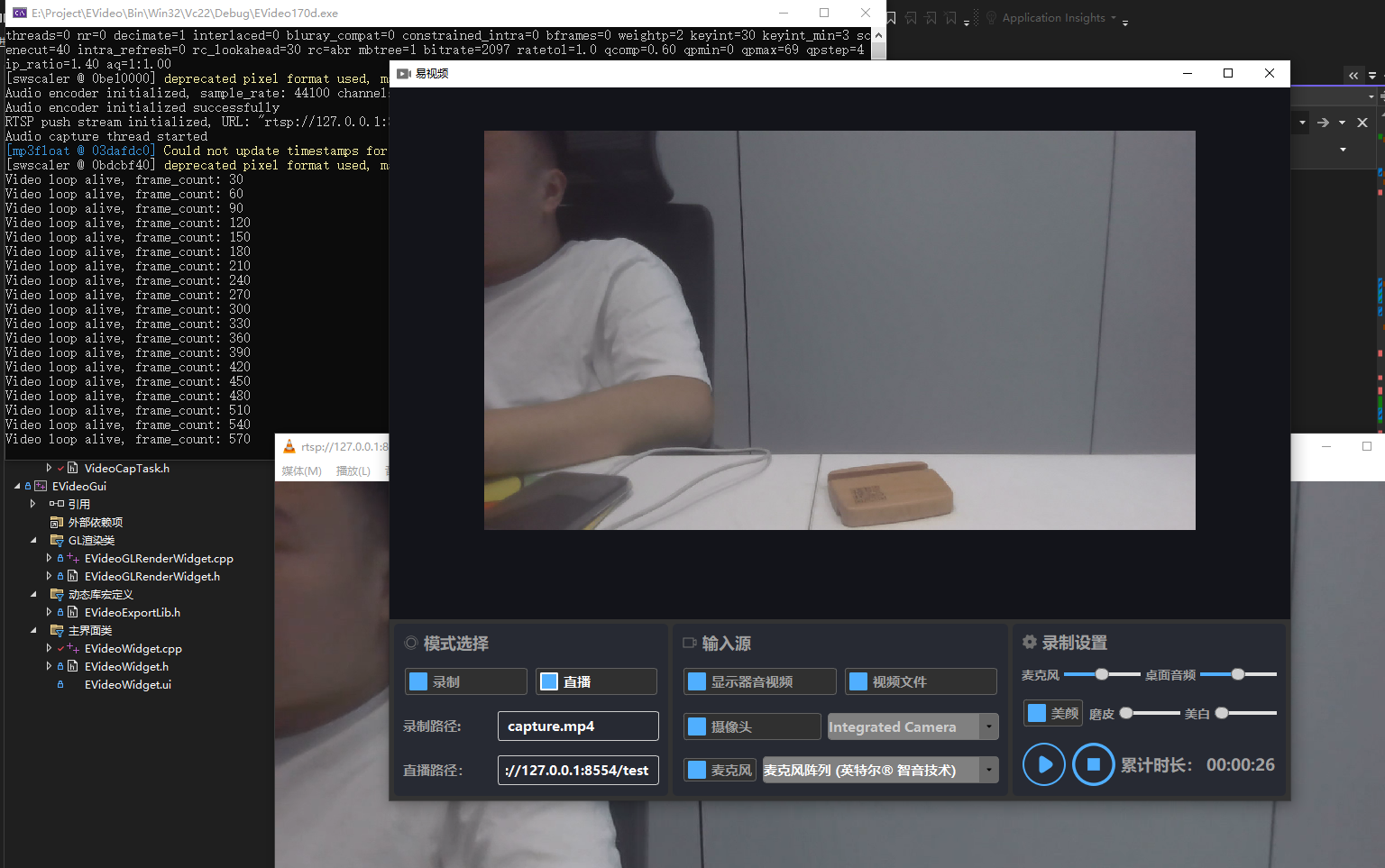
m_videoCapTask.StartCapture();结果:
七、总结
本文详细介绍了使用 FFmpeg 和 Qt 实现摄像头视频采集 + MP3 背景音频推 RTSP 流的技术要点。通过多线程架构合理分离视频和音频处理,利用队列传递音频编码包,实现音视频混流。同时讲解了重采样、循环播放等进阶功能。
掌握这些技术后,可以轻松扩展为支持多路摄像头、叠加文字/图片水印、动态切换背景音乐等更复杂的直播应用。
参考资料:
- FFmpeg 官方文档:https://ffmpeg.org/doxygen/trunk/
- Qt 多线程编程:https://doc.qt.io/qt-6/qthread.html
- RTSP 协议:RFC 7826
希望本文对您有所帮助,欢迎在评论区交流讨论!