Abstract
二硼化镁MgB2陶瓷超导材料,凭借 39 开尔文的优异超导转变温度,已得到国内外科研领域的广泛研究
Magnesium diboride (MgB2) ceramics, due to their impressive transition temperature of 39 K for superconductivity, have been widely investigated.
工艺
high-pressure-assisted spark plasma sintering (HP-SPS) 超高压辅助放电等离子烧结
提升外加压力可使二硼化镁物相在热分解临界温度以上维持物相稳定,进而抑制氧化镁、四硼化镁等非超导杂相的生成。
An increase in pressure helped in stabilizing the \(\boldsymbol{MgB_2}\) phase above thermal decomposition, thus avoiding the formation of non-superconducting phases such as MgO and MgB4.
Introduction
Superconductors are materials whose conductivity tends to infinite as resistivity tends to zero at a critical temperature.
Critical current density refers to a current density that is strong enough to quench the superconducting state.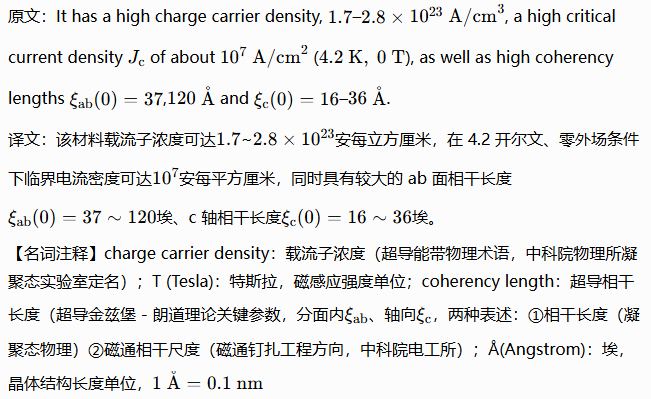


High-temperature superconductors such as Rare-earth barium copper oxide are mostly used in magnetic levitation applications.
译文:稀土钡铜氧化物这类高温超导材料是当前磁悬浮工程的主流用材。
However, their complex fabrication processes pose challenges for the production of large-size bulks, limiting the domain of their applications .
译文:但该类材料制备工艺流程繁复,难以规模化制备大尺寸块材,制约了其工程落地范围
The emergence of large-size magnesium diboride (MgB₂) ceramics as a promising alternative has opened new horizons for magnetic suspension device applications.
大尺寸二硼化镁(MgB₂)陶瓷超导材料的出现成为优质替代方案,为磁悬浮器件研发开辟了新路径。