注:本文为 "目数" 相关合辑。
英文引文,机翻未校。
中文引文,略作重排。
未整理去重。如有内容异常,请看原文。
MESH and MICRON SIZES
目数与微米尺寸
What is a micron? Micron is the measure of length most frequently used to describe tiny particle sizes. The term micron is actually a commonly used shorthand for micrometer (American spelling) or micrometre (international spelling). The official symbol for the micron or micrometer is μ m \boldsymbol{\mu m} μm, sometimes simplified as um. A micron is defined as one-millionth of a meter, a little more than one twenty-five thousandth of an inch.
什么是微米?微米是最常用于描述微小颗粒尺寸的长度单位。微米(micron)是微米(micrometer,美式拼写)或micrometre(国际拼写)的常用简称。微米的标准符号为 μ m \boldsymbol{\mu m} μm,有时简写为 um。1 微米定义为 1 米的百万分之一,略大于 1 英寸的两万五千分之一。
Note: ISM offers fluid, gas and air flow management components some of which contain filter mesh as a component part. ISM does offer mesh itself and is unable to source or provide it.
注:ISM 提供流体、气体与空气流量管理部件,部分部件包含滤网组件。ISM 不销售滤网本身,亦无法采购或供应滤网。
What does mesh size mean? Mesh size usually is referring to the mesh number (a US measurement standard) and its relationship to the size of the openings in the mesh and thus the size of particles that can pass through these openings. Figuring out the mesh number is simple. All you do is count the number of openings in one linear inch of screen. This count is the mesh number. A 4-mesh screen means there are four little square openings across one inch of screen. A 100-mesh screen has 100 openings per inch, and so on.
目数是什么意思?目数通常指网号(美国计量标准)及其与网孔尺寸的对应关系,进而决定可通过该网孔的颗粒尺寸。计算目数方法简单:只需统计 1 线性英寸筛网上的开孔数量,该数值即为目数。4 目筛网指 1 英寸长度内有 4 个方形小孔;100 目筛网指每英寸有 100 个开孔,以此类推。
As the number indicating the mesh size increases, the size of the openings and thus the size of particles captured by the screen decreases. Higher mesh numbers = smaller particle sizes. It is very important to remember that mesh size is not a precise measurement of the mesh opening size. This is because screens can be made with different materials with different thicknesses of strands or wire. The thicker the strands, the smaller the openings that a particle can pass through, and vice versa.
目数数值越大,网孔越小,可截留的颗粒尺寸也越小。目数越大 = 颗粒尺寸越小。务必注意:目数并非网孔尺寸的精确度量。原因在于筛网可由不同材料制成,丝径厚度各异。丝径越粗,颗粒可通过的网孔越小,反之亦然。
Also keep in mind that mesh is a two-dimensional sheet and the actual 3D shapes of particles vary dramatically. A good example of this is the diameter of a hair versus its length. Particles can also be elastic amalgams or clumps of mixed materials that can deform and squeeze through mesh openings.
同时需注意:筛网为二维平面,而颗粒实际三维形态差异极大。典型例子是头发的直径与长度。颗粒也可能是弹性混合物或团聚体,可发生形变并挤过网孔。
How fine do screens get? This depends on the thickness of the wire or strand used to make the mesh. Most ISM flow control components do not contain filter screens any finer than 500 mesh. The primary reason for this is that as the mesh number rises, the space between the wires or strands becomes smaller. At some point the mesh number becomes so high that the percentage of open area is too low to be useful. This point is usually somewhere between 450 and 700 mesh depending on the diameter of the wire or filament used. Note: Beyond 325 to 400 mesh, particle size is normally described only in microns.
筛网最高能达到多细?这取决于制作筛网的金属丝或纤维丝的粗细。ISM 多数流量控制部件所用滤网不细于 500 目。主要原因是:目数升高时,丝间间隙持续减小。当目数过高,开孔率过低则失去实用价值。该临界值通常在 450~700 目之间,具体取决于所用丝径。注:超过 325~400 目后,颗粒尺寸通常仅用微米表述。
| US Mesh* | Microns 微米 | Inches 英寸 | Millimeters 毫米 |
|---|---|---|---|
| 35 | 500 | 0.0197 | 0.5000 |
| 40 | 400 | 0.0165 | 0.4000 |
| 45 | 354 | 0.0138 | 0.3540 |
| 50 | 297 | 0.0117 | 0.2970 |
| 60 | 250 | 0.0098 | 0.2500 |
| 70 | 210 | 0.0083 | 0.2100 |
| 80 | 177 | 0.0070 | 0.1770 |
| 100 | 149 | 0.0059 | 0.1490 |
| 120 | 125 | 0.0049 | 0.1250 |
| 140 | 105 | 0.0041 | 0.1050 |
| 170 | 88 | 0.0035 | 0.0880 |
| 200 | 74 | 0.0029 | 0.0740 |
| 230 | 63 | 0.0025 | 0.0630 |
| 270 | 53 | 0.0021 | 0.0530 |
| 325 | 44 | 0.0017 | 0.0440 |
| 400 | 37 | 0.0015 | 0.0370 |
| 450 | 32 | 0.0013 | 0.0320 |
| 500 | 25 | 0.0010 | 0.0250 |
| 635 | 20 | 0.0008 | 0.0200 |
*Values are based on the American National Standard for Industrial Wire Cloth (American Standard ASTM - E 11).
*数值依据美国工业金属丝网国家标准(美国标准 ASTM - E 11)。
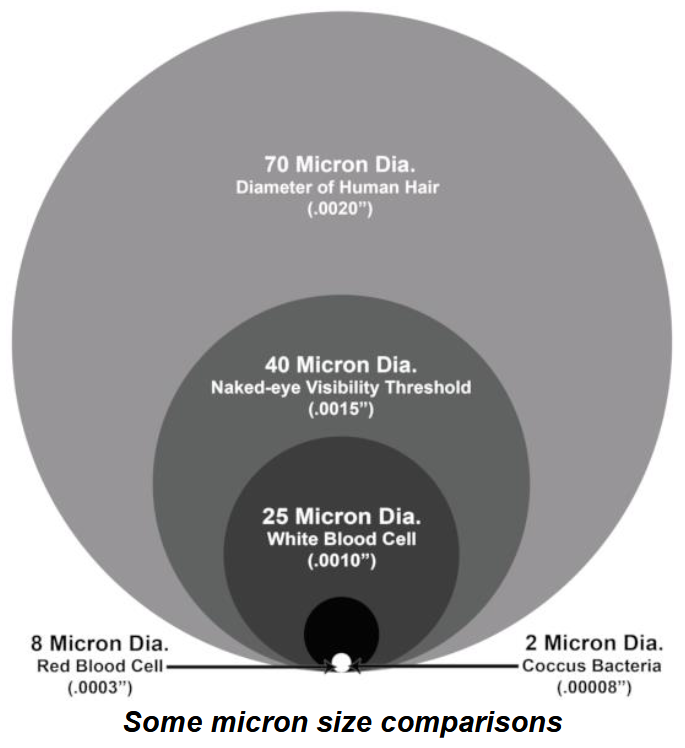
Some micron size comparisons
部分微米尺寸对比
| Diameter of Human Hair 人发直径(.0020") | 70 微米 (0.0020 英寸) |
|---|---|
| Naked-eye Visibility Threshold 人眼可见下限(.0015") | 40 微米直径 (0.0015 英寸) |
| White Blood Cell 白细胞(.0010") | 25 微米直径 (0.0010 英寸) |
| Red Blood Cell 红细胞(.0003") | 8 微米直径 (0.0003 英寸) |
| Coccus Bacteria 球菌(.00008") | 2 微米直径 (0.00008 英寸) |
PARTICLE SIZES in MICRONS of COMMON MATERIALS
常见物质颗粒尺寸(微米)
| 物质名称 | 粒径范围(微米) |
|---|---|
| bacteria 细菌 | 0.3 to 60 |
| beach sand 海滩沙 | 100 to 2000 |
| cayenne pepper (ground) 辣椒粉 | 15 to 1000 |
| cement dust 水泥粉尘 | 3 to 100 |
| cinnamon (ground) 肉桂粉 | 70 to 200 |
| clay 黏土 | 0.1 to 2 |
| coal dust 煤尘 | 1 to 100 |
| coffee (ground) 咖啡粉 | 5 to 400 |
| concrete dust 混凝土粉尘 | 3 to 100 |
| copier toner 复印机碳粉 | 0.5 to 15 |
| corn starch dust (atmospheric) 玉米淀粉粉尘(大气) | 0.1 to 0.8 |
| dust (household) 室内灰尘 | 0.05 to 100 |
| dust mites 尘螨 | 100 to 300 |
| eye of a needle 针孔 | 1230 |
| flour (wheat - milled) 小麦粉 | 25 to 212 |
| gelatin powder 明胶粉 | 5 to 90 |
| giardia cysts 贾第虫包囊 | 8 to 14 |
| ginger (ground) 姜粉 | 25 to 40 |
| human hair 人发 | 70 (40 to 120) |
| human vision (lower limit) 人眼视觉下限 | 40 |
| mustard (ground) 芥末粉 | 6 to 10 |
| oil smoke 油烟 | 0.03 to 1 |
| pet dander 宠物皮屑 | 0.5 to 100 |
| pollens 花粉 | 2 to 200 |
| red blood cells 红细胞 | 6 to 8 |
| salt (table salt) 食盐 | 100 to 300 |
| sand (beach) 海滩沙 | 62.5 to 2000 |
| sand (fine) 细沙 | 125 to 250 |
| silt 粉砂 | 2 to 50 |
| skin flakes 皮屑 | 0.5 to 10 |
| smoke (oil) 油烟 | 0.03 to 1 |
| smoke (wood) 木烟 | 0.2 to 3 |
| spider web 蜘蛛网 | 2 to 3 |
| spores (mold) 霉菌孢子 | 3 to 12 |
| spores (plant) 植物孢子 | 3 to 100 |
| spray dried milk powder 喷雾干燥奶粉 | 30 to 80 |
| sugar (granulated) 白砂糖 | 250 to 500 |
| sugar (icing) 糖霜 | 20 to 24 |
| sugar (powdered) 糖粉 | 60 |
| talcum powder (ground talc) 滑石粉 | 0.5 to 50 |
| tea dust 茶末 | 8 to 300 |
| tobacco smoke 烟草烟雾 | 0.01 to 4 |
| viruses 病毒 | 0.005 to 0.3 |
| white blood cells 白细胞 | 6 to 20 |
| yeast cells 酵母细胞 | 1 to 50 |
US STANDARD and TYLER MESH
美国标准目数与泰勒目数
美国标准目数与泰勒目数对照表
| Approximate Equivalent Mesh Count | US Sieve Mesh Number 1 美国标准筛目数 | Tyler Equivalent Mesh 2 泰勒等效目数 | Typical Nominal Wire Diameter (mm) 典型公称丝径(毫米) | Typical Nominal Wire Diameter (inch) 典型公称丝径(英寸) | Typical Nominal Sieve Size Opening (mm) 典型公称筛孔尺寸(毫米) | Typical Nominal Sieve Size Opening (inch) 典型公称筛孔尺寸(英寸) |
|---|---|---|---|---|---|---|
| 2 | - | 2½ Mesh | 5.600 | 0.2205 | 8.0000 | 0.3150 |
| 3 | - | 3 Mesh | 1.870 | 0.0736 | 6.7000 | 0.2638 |
| 3 | No. 3½ | 3½ Mesh | 1.6000 | 0.0630 | 5.6000 | 0.2205 |
| 4 | No. 4 | 4 Mesh | 1.6000 | 0.0630 | 4.7500 | 0.1870 |
| 5 | No. 5 | 5 Mesh | 1.4000 | 0.0551 | 4.0000 | 0.1575 |
| 6 | No. 6 | 6 Mesh | 1.2500 | 0.0492 | 3.3500 | 0.1319 |
| 7 8 | No. 7 No. 8 | 7 Mesh 8 Mesh | 1.1200 1.0000 | 0.0441 0.0394 | 2.8000 2.3600 | 0.1102 0.0929 |
| 10 | No.10 | 9 Mesh | 0.9000 | 0.0354 | 2.0000 | 0.0787 |
| 12 | No. 12 | 10 Mesh | 0.8000 | 0.0315 | 1.7000 | 0.0669 |
| 14 | No. 14 | 12 Mesh | 0.7100 | 0.0280 | 1.4000 | 0.0551 |
| 16 | No. 16 | 14 Mesh | 0.6300 | 0.0248 | 1.1800 | 0.0465 |
| 18 | No. 18 | 16 Mesh | 0.5600 | 0.0220 | 1.0400 | 0.0409 |
| 20 | No. 20 | 20 Mesh | 0.5000 | 0.0197 | 0.8500 | 0.0335 |
| 24 | No. 25 | 24 Mesh | 0.4500 | 0.0177 | 0.7100 | 0.0280 |
| 28 | No. 30 | 28 Mesh | 0.4000 | 0.0157 | 0.6000 | 0.0236 |
| 32 | No. 35 | 32 Mesh | 0.3150 | 0.0124 | 0.5000 | 0.0197 |
| 35 | No. 40 | 35 Mesh | 0.2800 | 0.0110 | 0.4250 | 0.0167 |
| 42 | No. 45 | 42 Mesh | 0.2240 | 0.0088 | 0.3550 | 0.0140 |
| 48 | No. 50 | 48 Mesh | 0.2000 | 0.0079 | 0.3000 | 0.0118 |
| 60 | No. 60 | 60 Mesh | 0.1600 | 0.0063 | 0.2500 | 0.0098 |
| 65 | No. 70 | 65 Mesh< | 0.1400 | 0.0055 | 0.2120 | 0.0083 |
| 80 | No. 80 | 80 Mesh | 0.1250 | 0.0049 | 0.1800 | 0.0071 |
| 100 | No.100 | 100 Mesh | 0.1000 | 0.0039 | 0.1500 | 0.0059 |
| 115 | No. 120 | 115 Mesh | 0.0900 | 0.0035 | 0.1250 | 0.0049 |
| 150 | No. 140 | 150 Mesh | 0.0710 | 0.0028 | 0.1060 | 0.0042 |
| 170 | No. 170 | 170 Mesh | 0.0630 | 0.0025 | 0.0900 | 0.0035 |
| 200 | No. 200 | 200 Mesh | 0.0500 | 0.0020 | 0.0750 | 0.0030 |
| 250 | No. 230 | 250 Mesh | 0.0450 | 0.0018 | 0.0630 | 0.0025 |
| 270 | No. 270 | 270 Mesh | 0.0360 | 0.0014 | 0.0530 | 0.0021 |
| 325 | No. 325 | 325 Mesh | 0.0320 | 0.0013 | 0.0450 | 0.0018 |
| 400 | No. 400 | 400 Mesh | 0.0300 | 0.0012 | 0.0380 | 0.0015 |
| 435 3 | No. 450 | - | 0.0280 | 0.0011 | 0.0305 | 0.0012 |
| 500 3 | No. 500 5 | - | 0.0250 | 0.0010 | 0.0254 | 0.0010 |
| 632 3 | No. 635 5 | - | 0.0200 | 0.0008 | 0.0203 | 0.0008 |
-
US sieve numbers differ from Tyler Mesh in that they are arbitrary numbers.
美国筛号与泰勒目数不同,美国筛号为自定义编号。
-
Tyler Equivalent Mash or Tyler Mesh Size is the number of openings per linear inch of mesh.
泰勒等效目数(泰勒目数)指每线性英寸的网孔数量。
-
These mesh numbers are calculated approximations.
该目数为计算近似值。
-
Values are based on ASTM E11-17, ISO 565-1990 and ISO 3310-1:2016 sieve specifications.
数值依据 ASTM E11-17、ISO 565-1990 及 ISO 3310-1:2016 筛网规范。
-
These sieves are not standard series sieves but are in common use.
该类筛网非标准系列,但为常用规格。
MESH and MICRONS FAQs
目数与微米常见问题
一、网孔尺寸换算相关
1. How do you convert mesh opening size to microns?|如何将网孔尺寸换算为微米?
It is possible to calculate an approximate mesh opening size for plane weave mesh with square openings. Both the wire or strand diameter and the distance between the centers of two adjoining strands must be known to do this. Filter mesh manufacturers provide the mesh opening size or the mesh's percent of open area or both. If a mesh opening size is provided in inches, it can be easily converted to microns. One micron is one-millionth of a meter and 1 inch = 25.4 millimeters.
平纹方孔筛网可核算近似网孔孔径,核算需已知丝线直径与相邻丝线中心距。滤网厂商一般会标注网孔孔径、开孔率,或同时标注两项参数。若孔径单位为英寸,可直接换算为微米:1 微米 = 1/1000000 米,1 英寸 = 25.4 毫米。
二、目数及国内外筛制标准定义
1. What is mesh number?|什么是目数?
Mesh number indicates the number of filaments or wires per linear inch of fabric or wire filter cloth. As mesh number increases, the size of the mesh openings decreases. Mesh number is not a precise measurement of particle size because of variations in the size of the wire or strands used in the screen. The mesh scales used to classify particle sizes in the US are: US Sieve Series and Tyler Mesh Size.
目数代表每英寸长度滤布上纤维丝或金属丝的根数;目数数值越大,对应网孔孔径越小。受筛网丝线线径差异影响,目数无法精准标定颗粒粒径。美国通用颗粒分级筛制分为:美国标准筛系列、泰勒筛目数体系。
2. What is US Standard Mesh?|什么是美国标准筛目数?
US Standard Mesh, also called US Standard Sieve is a series of screen sieves generally used to classify granular material by particle size. US Standard Mesh numbers are also more broadly used to describe the size of screen, strainer and filter mesh woven from monofilament or metal wires. US Standard Sieve uses arbitrarily assigned numbering and is based on ASTM E11-17.
美国标准目数(美国标准筛)是一套用于颗粒物料粒径分级的成套筛具,也普遍用于标注单丝、金属丝编织筛网、滤网的规格;该筛制采用自定义编号规则,执行标准为 ASTM E11-17。
3. What is Tyler Mesh?|什么是泰勒筛目数?
Tyler Equivalent, also called Tyler Mesh or Tyler Standard Sieve Series is the other commonly used series of screen sieves generally used to classify granular material by particle size in the US. Tyler Mesh numbers represent the actual number of openings per linear inch of mesh. Tyler mesh was created by the W. S. Tyler screening company in 1910. This series of standard screen sizes was adopted as a national standard by the United States and many other countries.
泰勒等效目数(泰勒标准筛)是美国另一套主流颗粒分级筛制;泰勒目数对应筛网每英寸实际开孔数量,1910 年由美国 W.S.Tyler 筛分公司制定,后续被美国及全球多国采信为国家标准。
4. What is mesh sieve?|什么是分样筛?
Sieves and screens are usually used in material handling for characterizing larger particle sized materials, usually greater than 44-micron (325 Mesh). Two scales are used to classify particle sizes: US Sieve Series and Tyler Mesh Size.
分样筛多用于物料筛分检测,适用于粒径≥44 μm(325 目)的粗颗粒物料;业内采用美国标准筛、泰勒筛两套体系完成粒径分级。
三、筛网参数实测与计量方法
1. How do you measure mesh size?|筛网规格如何测定?
Woven filter mesh and screen technical specifications are usually given as mesh counts, mesh numbers, mesh openings and/or center-to-center distances. Mesh count and mesh number are the number of openings per inch measured starting at the center of one wire. Mesh opening is a measure of the space between the wires. Mesh center-to-center measurements are from the center of one wire to the center of the next adjacent parallel wire.
编织滤网的技术参数包含:目数、网孔孔径、丝线中心距。目数以单根丝线中心为起点,统计每英寸长度内的开孔数量;网孔孔径指相邻丝线之间的空隙尺寸;丝线中心距为两根平行相邻丝线圆心之间的距离。
2. How is wire mesh measured?|金属丝网规格如何标定?
Woven filter mesh and screen measurements are provided as mesh counts, mesh opening sizes and/or a center-to-center distances. Mesh count is the number of openings per inch measured starting at the center of one wire. Mesh opening size is the space between wires or strands. Mesh center-to-center measurements are from the center of one wire or strand to the center of the next adjacent parallel wire.
金属编织网标注参数包含目数、网孔孔径、丝线中心距;目数自丝线中心起算,统计每英寸开孔数量,孔径为丝间空隙,中心距为相邻平行丝线圆心间距。
四、微米单位与参照物尺寸科普
1. How large is a micron?|1微米尺寸参考?
A micron is a metric unit of measure. A micron is one-thousandth of a millimeter.
微米为公制长度单位, 1 μ m = 1 1000 mm 1\ \mu\text{m} = \dfrac{1}{1000}\ \text{mm} 1 μm=10001 mm。
2. How large is a human hair in microns?|人体毛发直径区间(微米)?
Europeans consider hair with a diameter of 0.04 to 0.06 mm as thin, hair with a diameter between 0.06 and 0.08 mm as normal, and hair with a diameter between 0.08 and 0.1 mm as thick. By comparison with European hair, Asian hair is significantly thicker at 0.08 to 0.12 mm.
欧美毛发粗细划分:细发 0.04~0.06 mm、普通发质 0.06~0.08 mm、粗发 0.08~0.10 mm;亚洲人毛发偏粗,直径普遍在 0.08~0.12 mm。
3. What is the lower size limit of human vision?|人眼裸眼分辨极限?
A normal eye with good but average vision can see objects as small as about a tenth of a millimeter.
视力正常者裸眼最小可分辨尺寸约 0.1 mm。
五、粉尘、烟雾颗粒物基础常识
1. What is dust made up of?|灰尘的组分构成?
Household dust contains small amounts of plant pollen, human and animal hairs, textile fibers, paper fibers, minerals from outdoor soil, human skin cells, plus other materials which are found in the local environment. Atmospheric dust is even more diverse.
室内粉尘包含花粉、人畜毛发、纺织与纸质纤维、室外土壤矿物、人体皮屑及周边环境杂质;大气浮尘组分更为繁杂。
2. How small are smoke particles?|烟雾颗粒粒径特点?
Smoke is a collection of airborne solid and liquid particulates and gases. The composition of smoke and the sizes of particles vary widely. In general smoke particle size is dependent on what is being burned and the combustion conditions.
烟雾由悬浮固态微粒、液态雾滴与气态组分混合而成,颗粒粒径跨度极大,具体尺寸由燃烧物料与燃烧工况决定。
六、过滤与筛分专业术语释义
1. What is micron rating of a filter?|过滤器微米精度等级含义?
Generally, the micron rating of a filter micron is intended to indicate the ability of a filter to remove particles of that micron size or larger.
过滤器微米精度等级,代表滤件可有效截留该粒径及更大固体颗粒。
2. What is sieve size?|筛孔尺寸执行标准?
Sieve sizes are usually regulated by standards. Sieve standards in common use are ISO 565:1990 and ISO 3310-1:2000 (international), EN 933-1(European) and ASTM E11:17 (US). EN standards are available with national badging such as BS EN (Britain), FR EN (France), DIN EN (Germany), etc.
筛孔尺寸受标准化文件管控,现行主流标准:国际标准 ISO 565:1990、ISO 3310-1:2000;欧洲标准 EN 933-1;美国标准 ASTM E11-17;欧洲EN体系衍生各国版本:英标BS EN、法标NF EN、德标DIN EN。
3. What is sieve analysis?|筛分分析(级配试验)定义?
A sieve analysis (or gradation test) is a practice or procedure used (commonly used in civil engineering) to assess the particle size distribution (also called gradation) of a granular material. The size distribution is often of critical importance to the way the material performs in use.
筛分分析(又称颗粒级配试验)多用于岩土、建材领域,用于测定散料粒径分布(颗粒级配),粒径分布直接决定物料应用性能。
4. What is a mesh screen?|筛网成型工艺分类?
A metal mesh may be woven, knitted, welded, expanded, photo-chemically etched or electroformed (screen filter) from steel or other metals. In clothing, mesh is loosely woven or knitted fabric that has a large number of closely spaced holes.
金属筛网可通过编织、针织、点焊、钢板拉伸、化学蚀刻、电铸等工艺由钢材或其他合金制成;纺织类网眼布为疏松织造物,布面密布细密网孔。
5. What is porosity?|孔隙率定义?
Porosity refers to the ratio of open space in a filter material to the amount of volume taken up by the filter media itself. Typically, a filter with high porosity will have a more open structure, and therefore, higher flow with lower pressure drops.
孔隙率是滤材内部孔隙容积与滤材总体积的比值;高孔隙率滤材内部通道通畅,通流能力更强、运行压损更低。
目数与微米专业术语表
一、粒径相关定义
1. Particle size distribution|粒径分布
The particle-size distribution of a powder, granular material or particles dispersed in fluid describes the relative number of particles present according to their size.
粉末、粒状物料或分散于流体中的固体颗粒,其粒径分布表征体系内不同粒径颗粒的占比构成。
二、过滤精度参数
1. Absolute filtration rating|绝对过滤精度
The absolute rating or cut-off point of a filter material refers to the diameter of the largest spherical glass particle, usually given in micrometers that will pass through the filter under laboratory conditions. It is provided as an indication of the largest opening in the filter material.
滤材绝对过滤精度(临界截留粒径),指标准实验室工况下能够穿过滤材的最大球形玻璃珠直径,计量单位通常为微米,该参数用于标定滤材的最大通孔孔径。
三、滤布织造分类
1. Closed weave cloth|密织滤布
When closed weave filter cloth is viewed at a right angle to its surface, the spaces between the filaments are not visible. Closed weave cloths tend to be thicker and stiffer than open weave cloths.
垂直正视密织滤布布面,丝线交织缝隙肉眼不可见;相较于稀织滤布,密织滤布布身更厚、刚性更强。
2. Open weave|稀织滤布
Open weave cloths, when viewed at right angles to their surfaces, have visible spaces between the filaments.
垂直正视稀织滤布布面,丝线间存在肉眼可见的交织孔隙。
3. Plain weave|平纹编织
This is the most basic weave. It uses a simple over and under pattern. See also "square weave".
最基础的织造工艺,丝线采用一上一下交替交织结构,详见「方织」词条。
4. Square weave|方织
This is the most basic weave. It uses a simple over and under pattern. See also "plain weave".
基础织造工艺,丝线采用一上一下交替交织结构,详见「平纹编织」词条。
四、筛网尺寸参数
1. Mesh count|网孔数
The mesh count is the number of filaments or wires per linear inch of fabric or wire filter cloth.
网孔数:每英寸直线长度内滤布丝线或金属丝的根数。
2. Mesh number|目数
Mesh number indicates the number of filaments or wires per linear inch of fabric or wire filter cloth. Because mesh number frequently refers to mesh standards also, it also may indicate the filament or wire diameter too.
目数:每英寸直线长度内滤布丝线/金属丝的根数;目数配套行业筛网标准,参数可同步关联丝线线径规格。
3. Mesh opening (aperture size)|网孔孔径
The mesh opening is a description of the open area between the wires or filaments in the warp and weft directions of a mesh screen.
网孔孔径:筛网经、纬向丝线交织后形成的通孔尺寸。
4. Mesh thickness|筛网厚度
Mesh thickness is the thickness of unstretched mesh.
筛网厚度:筛网处于无拉伸自然状态下的实测厚度。
5. Open area|开孔率
Open area is the proportion of total screen area that is open space. It is given as a percentage.
开孔率:筛网通孔总面积占筛网总表面积的比值,以百分率标注。
五、原料材质定义
1. Monofilament|单丝
Monofilament is a single extruded synthetic filament. Monofilament fibers can be manufactured in precise sizes.
单丝:经由挤出工艺成型的单根合成纤维,成品线径尺寸可精密定制。
2. Wire cloth|金属丝网
Wire cloth is a woven product. The most common metals used for wire cloth strands include aluminum and aluminum alloys, copper and copper alloys such as brass and bronze, steel and stainless steel. Wire cloth is used for sifting, straining and screening.
金属丝网:金属丝线编织而成的筛网制品;常用材质包含铝及铝合金、铜系合金(黄铜、青铜)、碳钢、不锈钢,多用于物料筛分、过滤作业。
六、过滤结构方位术语
1. Feed side|进料侧
The side of a filter or filtration processing system is where the material to be filtered enters.
进料侧:过滤器及过滤系统中,待滤物料的流入端面。
2. Upstream side or surface|上游侧/迎料面
This is the feed side of a filter.
上游侧(迎料面):即过滤器进料侧。
七、过滤产物与介质
1. Retentate|截留物
Retentate is the material captured on the upstream side of a filter.
截留物:被截留在过滤器上游迎料面的固体物料。
2. Surface filter media|表面过滤介质
Surface filter media captures particles on its upstream surface. Its ratings is usually based on the smallest particle it can repeatedly capture.
表面过滤介质:颗粒拦截作用发生在介质上游表面,其过滤精度依据可稳定截留的最小颗粒粒径标定。
八、工艺与设备词条
1. Screen (filter screen)|筛网(滤网)
Screen or filter screen is sheets made of perforated metal, woven monofilament or woven wire strands.
筛网(滤网):由冲孔金属板材、编织单丝、编织金属丝线加工而成的片状过滤元件。
2. Screen filtration|筛滤
Screen filtration is the mechanical filtration of particles, using filter screen or mesh, from liquid or gas flows.
筛滤:依托滤网,从气流或液流中机械分离固体颗粒的过滤方式。
3. Separation|分离(过滤工序)
Separation is a filtration process that divides mixtures of particles and liquids or gases into filtered liquid or gas and captured particles.
分离:通过过滤工序,将固-液/固-气混合物料拆分成为洁净流体与截留固体颗粒。
4. Sieve|试验筛/分样筛
In general, a sieve is a device for separating wanted material from unwanted material using screen. Sieves are widely used in material handling for characterizing the particle size distribution of a sample using standardized uniform screens.
分样筛:依托筛网分选物料的装置;行业普遍采用国标标准化筛具,用于检测样品粒径分布。
九、织造方向定义
1. Warp|经丝
Warp is used to identify the filaments or wires running the length of a cloth or screen as it is woven.
经丝:织造时沿滤布、筛网长度方向排布的丝线/金属丝。
2. Weft|纬丝
Weft is used to identify the filaments or wires running across the width of a cloth or screen as it is woven.
纬丝:织造时沿滤布、筛网幅宽方向横穿排布的丝线/金属丝。
网布目数适配与场景化选型
如何选择合适的网布目数?从需求到场景,一篇看懂
发布时间:2025-10-22 13:55:35
作者:金珏小编
网布目数可以改变网布的使用效果,匹配目数能够使网布正常完成过滤、防护、筛分作业;目数选型失误,会降低作业效率,极端条件下会造成功能失效。例如选用 10 目网布筛分面粉,面粉结块会穿过网眼发生漏料;选用 200 目网布搭建水产养殖围网,鱼苗可从网眼穿出逃逸。市场选型环节中,选购人员普遍存在目数规格越高使用效果越优的错误认知,常见选型规格包含 10 目、100 目、300 目等。本文按照参数认知、需求、场景匹配三段式逻辑,网布目数选型方法,降低采购错配带来的物资损耗。
一、基础参数认知:网布目数对应的两项物理变化规律
开展目数选型工作前,需掌握两项客观变化规律,作为选型判定依据。
- 目数与网眼孔径呈反比例变化
目数定义为 1 英寸(约 2.54 cm 2.54 \ \text{cm} 2.54 cm)长度区间内排布的网眼数量,单位长度内网眼排布数量越多,单孔孔径尺寸越小。
- 10 10 10 目网布:单孔孔径约 2 mm 2 \ \text{mm} 2 mm,多用于大尺寸固体物料阻隔;
- 100 100 100 目网布:单孔孔径约 0.15 mm 0.15 \ \text{mm} 0.15 mm,适用于粉状原料筛分作业;
- 300 300 300 目网布:单孔孔径约 0.05 mm 0.05 \ \text{mm} 0.05 mm,适配高精度精细过滤工况。
- 目数与介质通透性能呈反比例变化
网眼孔径收窄后,气体、液体、可见光穿过网布的速率同步下降。以纱窗用材举例, 20 20 20 目网布空气流通速率更快,无法阻隔小型飞虫; 80 80 80 目网布可阻挡蚊虫侵入,但空气流通速率出现下降。
结合两项规律可得,不存在全工况通用的固定目数规格,选型工作以网眼孔径贴合现场使用条件作为判定准则。
二、目数选型三步流程:依托使用需求完成场景匹配
工业生产、民用家居、农林养殖全品类网布选型,均可依照需求分类、工况参数解析、行业标准参考的流程逐步确定目数区间,分步骤说明如下。
| 应用场景 | 需求说明 | 推荐目数(英寸制) | 材质建议 |
|---|---|---|---|
| 水产养殖围网(成鱼) | 阻挡成鱼逃逸,通水流 | 10--20 目 | 尼龙网(耐腐) |
| 面粉 / 淀粉过滤 | 滤掉结块,保细腻 | 80--100 目 | 涤纶网(易清洁) |
| 家用纱窗(防蚊) | 挡蚊子,通风透光 | 80--100 目 | 玻璃纤维网(耐用) |
| 工业污水处理(初滤) | 滤掉大块杂质,保水流 | 30--50 目 | 聚乙烯网(耐酸碱) |
| 电子元件清洗过滤 | 滤掉微米级杂质,防损伤 | 300--500 目 | 不锈钢网(精密) |
| 果园防鸟网 | 挡鸟类,透光不挡风 | 20--30 目 | 聚乙烯网(轻便) |
步骤1:划分使用功能,确定目数大致区间
依照网布承担的作业类型,划分为物料阻隔、杂质过滤、高精度精细过滤、通透式防护四类使用场景,对应不同目数选用范围。
- 大体积物料阻隔工况
应用场景包含水产养殖围网、果园防鸟围挡、固体废料分拣筛分,作业要求为网体截留目标物料,同时保留水体、空气的流通空间,适配选型区间: 10 ∼ 50 10 \sim 50 10∼50 目。 - 常规杂质过滤工况
应用场景包含面粉除结块筛分、生豆浆除渣、车载空调粉尘拦截,作业要求为截留固体杂质,保障流体介质正常穿透网体,适配选型区间: 60 ∼ 200 60 \sim 200 60∼200 目。 - 微米级高精度过滤工况
应用场景包含实验室液相提纯、电子元器件清洗液过滤、制药工序药液精制,作业要求为拦截微米级细微悬浮杂质,适配选型区间: 200 200 200 目及以上。 - 兼顾通风透光的防虫防护工况
以民用纱窗、大田防虫网为代表,依照目标虫体体型划分规格:阻隔蝇类选用 40 ∼ 60 40 \sim 60 40∼60 目,阻隔蚊虫选用 80 ∼ 100 80 \sim 100 80∼100 目,阻隔蛾类小飞虫选用 120 120 120 目及以上。
步骤2:结合物料与环境参数,微调目数与网体材质
在初选目数区间基础上,依托过滤物料理化属性、现场使用环境优化选型参数,该环节易出现选型疏漏,具体调整规则如下。
- 依据物料硬度调整用材
过滤矿石粉料、金属碎屑等硬质颗粒物时,即便选用中低目数规格,优先选用不锈钢材质网布,规避硬质颗粒磨损网体、扩大网眼孔径;过滤棉絮、豆渣等软性絮状杂质时,高目数网布需要设定周期性清理方案,减少网孔堵塞概率。 - 依据物料粘性限定目数上限
淀粉浆液、工业涂料等高粘性物料过滤,不推荐选用 200 200 200 目及以上规格,粘稠物料易粘连网孔,持续降低介质流通速率,常规选用 100 ∼ 150 100 \sim 150 100∼150 目规格,配套带防粘涂层的网布产品。 - 依据使用环境优化材质选型
户外露天布设的养殖网、果树防鸟网,长期经受风雨拉扯,低目数产品优先选用高韧性尼龙材质,规避外力拉扯造成网体形变;污水处理等长期潮湿工况,选用聚乙烯材质网布,规避锈蚀、老化破损问题。
步骤3:对标行业成熟标准,压缩选型试错成本
各应用行业经过长期实操积累,形成标准化目数选用参考范围,对标行业数据可快速锁定选型区间,最终规格可结合现场实际工况小幅调整。
三、选型三项误区:规避主观选型偏差
误区1:目数规格越高,产品综合性能越优
目数仅代表单位长度内网孔排布密度,不存在优劣等级划分。例如水产养殖选用 300 300 300 目网布,狭小网孔会阻滞水体循环,造成养殖水体溶氧量下降;民用纱窗选用 300 300 300 目规格,空气流通速率下降幅度可达 50 % 50\% 50% 以上,降低日常使用舒适度。
误区2:仅参照目数选型,忽略基材材质影响
相同目数规格下,基材种类会改变网布理化性能。 100 100 100 目尼龙网耐腐蚀性能突出、结构强度偏低,适配食品原料过滤;同目数不锈钢网机械强度优异、耐酸碱腐蚀性能偏弱,多用于高温工业过滤。酸性药液过滤场景选用不锈钢网,网体出现腐蚀破损后,原有标定目数失去参考意义。
误区3:忽略行业通用目数公差范围
国内网布生产执行 ± 5 % \pm5\% ±5% 的目数制造公差,标注 100 100 100 目的成品网布,实测目数区间为 95 ∼ 105 95 \sim 105 95∼105 目。常规民用、粗放型工业过滤工况中,公差带来的影响可以忽略;医药精制等高精度过滤场景,采购阶段需要供方出具成品孔径实测报告,规避公差超标引发的杂质穿透问题。
四、标准化选型逻辑
完整选型链路:
使用功能分类(大物阻隔/常规过滤/精密过滤) → \rightarrow → 划定基础目数区间(低目/中目/高目) → \rightarrow → 结合物料硬度、粘性与现场环境修正参数 → \rightarrow → 对标行业选型规范 → \rightarrow → 确定网布基材与公差管控标准。
工业批量采购、家用纱窗选配、小型过滤装置选材均可遵照上述逻辑开展选型,能够规避绝大多数选型失误。存在非标定制需求时,可向生产厂家提交工况、物料、环境相关参数,由生产方出具针对性目数方案,适配的选型结果可以充分发挥网布使用性能,规避无效采购带来的物资损耗。
reference
- Mesh and Microns Conversion Chart and Information E-book from ISM - mesh-micron-sizes-chart-ebook-ism.pdf
https://www.industrialspec.com/images/files/mesh-micron-sizes-chart-ebook-ism.pdf - 如何选择合适的网布目数?从需求到场景,一篇看懂-台州网眼布厂家
https://www.cn-screen.com/hangyenews/638.html