Ultralytics:解读Concat模块
前言
- 由于本人水平有限,难免出现错漏,敬请批评改正。
- 更多精彩内容,可点击进入Python日常小操作专栏、OpenCV-Python小应用专栏、YOLO系列专栏、自然语言处理专栏、人工智能混合编程实践专栏或我的个人主页查看
- YOLOs-CPP:一个免费开源的YOLO全系列C++推理库(以YOLO26为例)
- PaddleOCR:Win10上安装使用PPOCRLabel标注工具
- 目标检测:使用自己的数据集微调DEIMv2进行物体检测
- 图像分割:PyTorch从零开始实现SegFormer语义分割
- 图像超分:使用自己的数据集微调Real-ESRGAN-x4plus进行超分重建
- 图像生成:PyTorch从零开始实现一个简单的扩散模型
- Stable Diffusion:使用自己的数据集微调 Stable Diffusion 3.5 LoRA 文生图模型
- 图像超分:使用自己的数据集微调Real-ESRGAN-x2plus进行超分重建
- Anomalib:使用Anomalib 2.1.0训练自己的数据集进行异常检测
- Anomalib:在Linux服务器上安装使用Anomalib 2.1.0
- 人工智能混合编程实践:C++调用封装好的DLL进行异常检测推理
- 人工智能混合编程实践:C++调用封装好的DLL进行FP16图像超分重建(v3.0)
- 隔离系统Python:源码编译3.11.8到自定义目录(含PGO性能优化)
- 在线机的Python环境迁移到离线机上
- Nuitka 将 Python 脚本封装为 .pyd 或 .so 文件
- Ultralytics:使用 YOLO11 进行速度估计
- Ultralytics:使用 YOLO11 进行物体追踪
- Ultralytics:使用 YOLO11 进行物体计数
- Ultralytics:使用 YOLO11 进行目标打码
- 人工智能混合编程实践:C++调用Python ONNX进行YOLOv8推理
- 人工智能混合编程实践:C++调用封装好的DLL进行YOLOv8实例分割
- 人工智能混合编程实践:C++调用Python ONNX进行图像超分重建
- 人工智能混合编程实践:C++调用Python AgentOCR进行文本识别
- 通过计算实例简单地理解PatchCore异常检测
- Python将YOLO格式实例分割数据集转换为COCO格式实例分割数据集
- YOLOv8 Ultralytics:使用Ultralytics框架训练RT-DETR实时目标检测模型
- 基于DETR的人脸伪装检测
- YOLOv7训练自己的数据集(口罩检测)
- YOLOv8训练自己的数据集(足球检测)
- YOLOv5:TensorRT加速YOLOv5模型推理
- YOLOv5:IoU、GIoU、DIoU、CIoU、EIoU
- 玩转Jetson Nano(五):TensorRT加速YOLOv5目标检测
- YOLOv5:添加SE、CBAM、CoordAtt、ECA注意力机制
- YOLOv5:yolov5s.yaml配置文件解读、增加小目标检测层
- Python将COCO格式实例分割数据集转换为YOLO格式实例分割数据集
- YOLOv5:使用7.0版本训练自己的实例分割模型(车辆、行人、路标、车道线等实例分割)
- 使用Kaggle GPU资源免费体验Stable Diffusion开源项目
- Stable Diffusion:在服务器上部署使用Stable Diffusion WebUI进行AI绘图(v2.0)
- Stable Diffusion:使用自己的数据集微调训练LoRA模型(v2.0)
相关介绍
Ultralytics 简介
Ultralytics 基于多年的计算机视觉和人工智能基础研究,创建了最先进的 (SOTA) YOLO 模型。我们的模型不断更新性能和灵活性,快速、准确且易于使用。他们擅长对象检测、跟踪、实例分割、语义分割、图像分类和姿势估计任务。
前提条件
- 熟悉Python、Pytorch
实验环境
bash
Package                  Version
------------------------ ------------
Python                   3.11.8
absl-py                  2.4.0
accelerate               1.13.0
annotated-doc            0.0.4
anyio                    4.13.0
calflops                 0.3.2
certifi                  2026.4.22
charset-normalizer       3.4.7
click                    8.3.3
colorama                 0.4.6
contourpy                1.3.3
cycler                   0.12.1
filelock                 3.29.0
flatbuffers              25.12.19
fonttools                4.62.1
fsspec                   2026.4.0
grpcio                   1.80.0
h11                      0.16.0
hf-xet                   1.5.0
httpcore                 1.0.9
httpx                    0.28.1
huggingface_hub          1.14.0
idna                     3.15
Jinja2                   3.1.6
kiwisolver               1.5.0
Markdown                 3.10.2
markdown-it-py           4.2.0
MarkupSafe               3.0.3
matplotlib               3.10.9
mdurl                    0.1.2
ml_dtypes                0.5.0
mpmath                   1.3.0
networkx                 3.6.1
numpy                    1.26.4
nvidia-cublas-cu12       12.8.3.14
nvidia-cuda-cupti-cu12   12.8.57
nvidia-cuda-nvrtc-cu12   12.8.61
nvidia-cuda-runtime-cu12 12.8.57
nvidia-cudnn-cu12        9.7.1.26
nvidia-cufft-cu12        11.3.3.41
nvidia-cufile-cu12       1.13.0.11
nvidia-curand-cu12       10.3.9.55
nvidia-cusolver-cu12     11.7.2.55
nvidia-cusparse-cu12     12.5.7.53
nvidia-cusparselt-cu12   0.6.3
nvidia-nccl-cu12         2.26.2
nvidia-nvjitlink-cu12    12.8.61
nvidia-nvtx-cu12         12.8.55
onnx                     1.19.0
onnxruntime-gpu          1.26.0
onnxslim                 0.1.94
opencv-python            4.6.0.66
packaging                26.2
pillow                   12.2.0
pip                      24.0
polars                   1.40.1
polars-runtime-32        1.40.1
protobuf                 7.34.1
psutil                   7.2.2
pycocotools              2.0.11
Pygments                 2.20.0
pyparsing                3.3.2
python-dateutil          2.9.0.post0
PyYAML                   6.0.3
regex                    2026.5.9
requests                 2.34.1
rich                     15.0.0
safetensors              0.7.0
scipy                    1.16.0
setuptools               65.5.0
shellingham              1.5.4
six                      1.17.0
sympy                    1.14.0
tabulate                 0.10.0
tensorboard              2.20.0
tensorboard-data-server  0.7.2
tokenizers               0.22.2
torch                    2.7.1+cu128
torchaudio               2.7.1+cu128
torchvision              0.22.1+cu128
tqdm                     4.67.3
transformers             5.8.1
triton                   3.3.1
typer                    0.25.1
typing_extensions        4.15.0
ultralytics              8.4.58
ultralytics-thop         2.0.19
urllib3                  2.7.0
Werkzeug                 3.1.8
Concat(张量拼接模块)
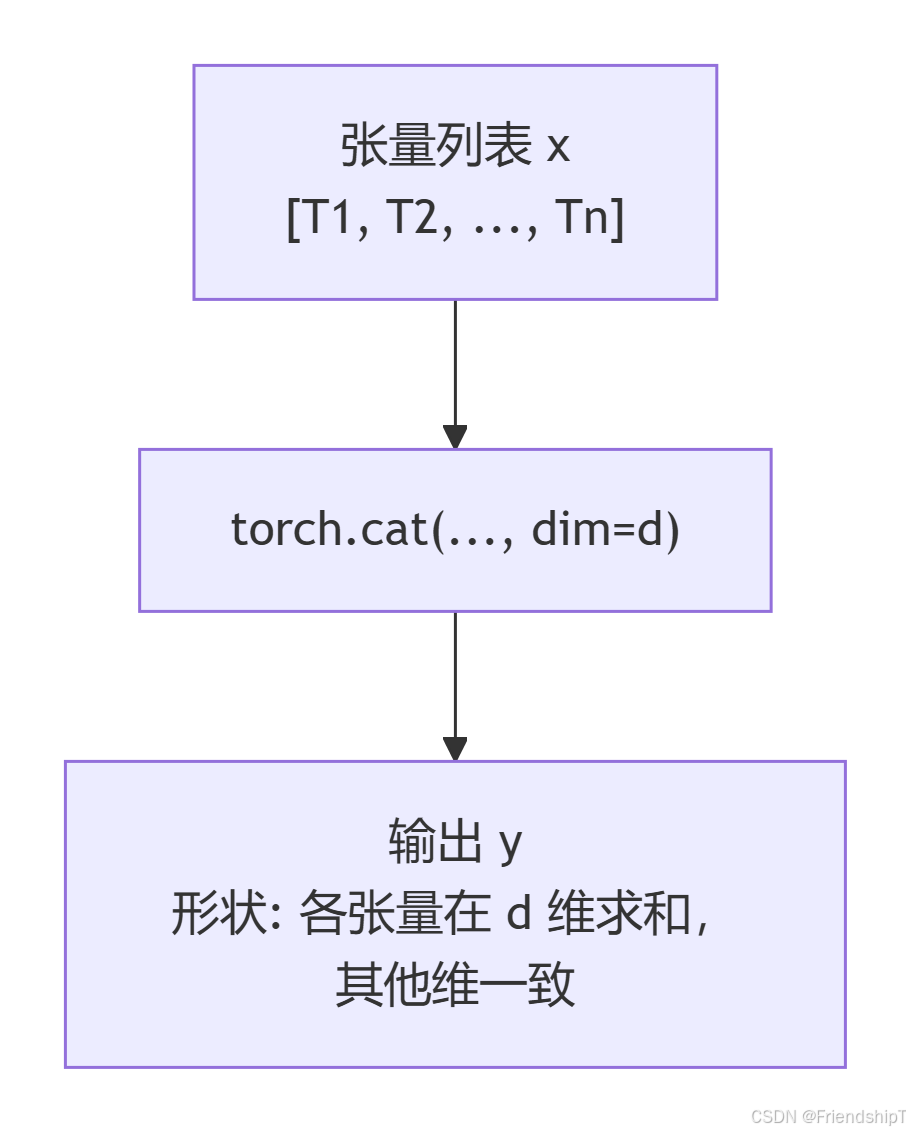
Concat 是 torch.cat 的简单封装,用于在指定维度上拼接多个张量。在目标检测模型(如 YOLO)中,它常用于特征金字塔(FPN)的跨层级特征融合,将不同尺度的特征图在通道维度(或批维度)上拼接,以增强多尺度表示能力。
代码实现
python
import cv2
import math
import torch
import numpy as np
import matplotlib.pyplot as plt
from torch import nn

class Concat(nn.Module):
    """Concatenate a list of tensors along specified dimension.

    Attributes:
        d (int): Dimension along which to concatenate tensors.
    """

    def __init__(self, dimension=1):
        """Initialize Concat module.

        Args:
            dimension (int): Dimension along which to concatenate tensors.
        """
        super().__init__()
        self.d = dimension

    def forward(self, x: list[torch.Tensor]):
        """Concatenate input tensors along specified dimension.

        Args:
            x (list[torch.Tensor]): List of input tensors.

        Returns:
            (torch.Tensor): Concatenated tensor.
        """
        return torch.cat(x, self.d)
功能
- 简单拼接:将输入张量列表按指定维度连接,不改变各张量的数值,仅沿维度方向堆叠。
- 灵活配置 :通过
dimension参数指定拼接维度(默认为 1,即通道维度),适应不同需求。 - 即插即用:常用于网络结构中的特征融合,如将上采样后的深层特征与浅层特征拼接。
初始化参数
| 参数 | 类型 | 说明 |
|---|---|---|
dimension |
int | 拼接维度(默认 1),例如 dimension=1 表示沿通道维拼接。 |
该模块没有可学习参数,仅做张量操作。
前向方法
forward(x):输入x为张量列表,返回值是torch.cat(x, self.d)。
使用示例
python
if __name__ == '__main__':
    # 1. 读取图像
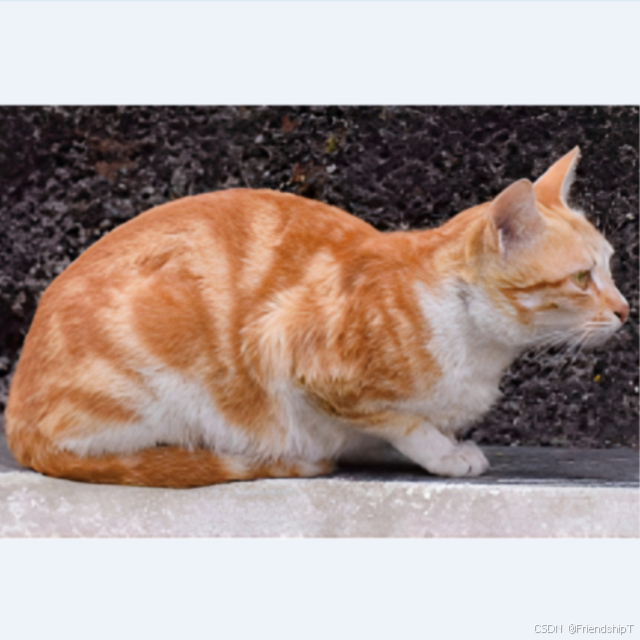
    img_path = "cat_640x640.png"
    img_bgr = cv2.imread(img_path)
    if img_bgr is None:
        raise FileNotFoundError(f"图片 {img_path} 不存在!")
    img_rgb = cv2.cvtColor(img_bgr, cv2.COLOR_BGR2RGB)
    img_tensor = torch.from_numpy(img_rgb).float().permute(2, 0, 1).unsqueeze(0)  # [1, 3, 640, 640]

    # 2. 创建水平翻转图像(用于拼接对照)
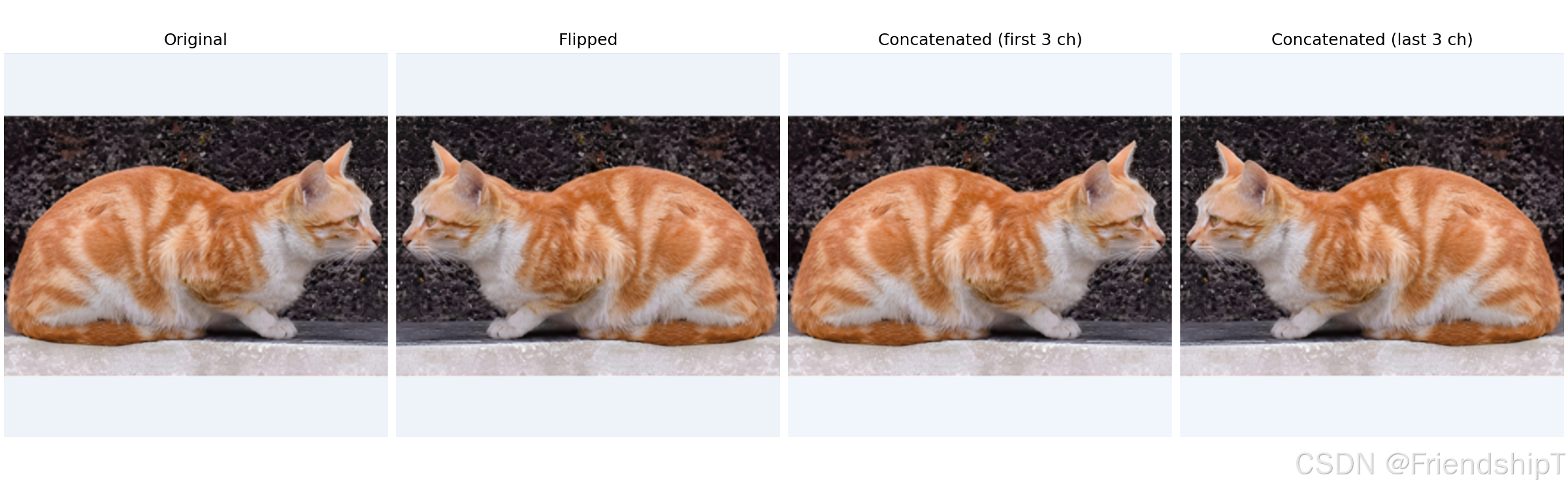
    flipped = torch.flip(img_tensor, dims=[3])  # [1, 3, 640, 640]

    # 3. 沿通道维拼接(dimension=1)
    concat = Concat(dimension=1)
    out = concat([img_tensor, flipped])  # [1, 6, 640, 640]
    print("拼接后形状:", out.shape)

    # 4. 拆分拼接后的前 3 通道(原图)和后 3 通道(翻转图)
    out_rgb1 = out[0, :3, :, :].cpu().numpy()  # [3, 640, 640]
    out_rgb2 = out[0, 3:, :, :].cpu().numpy()  # [3, 640, 640]
    # 转置为 HWC 格式便于 matplotlib 显示
    out_rgb1 = np.transpose(out_rgb1, (1, 2, 0))
    out_rgb2 = np.transpose(out_rgb2, (1, 2, 0))
    # 归一化到 [0, 255] uint8(便于显示)
    def normalize(img):
        img = (img - img.min()) / (img.max() - img.min() + 1e-8) * 255
        return img.astype(np.uint8)
    out_rgb1 = normalize(out_rgb1)
    out_rgb2 = normalize(out_rgb2)

    # 原图和翻转图(用于对比)
    orig = img_rgb
    flipped_np = flipped[0].cpu().numpy().transpose(1, 2, 0).astype(np.uint8)

    # 5. 可视化:原图、翻转图、拼接前3通道、拼接后3通道
    plt.figure(figsize=(16, 5), constrained_layout=True)
    plt.subplot(1, 4, 1)
    plt.imshow(orig)
    plt.title("Original")
    plt.axis("off")

    plt.subplot(1, 4, 2)
    plt.imshow(flipped_np)
    plt.title("Flipped")
    plt.axis("off")

    plt.subplot(1, 4, 3)
    plt.imshow(out_rgb1)
    plt.title("Concatenated (first 3 ch)")
    plt.axis("off")

    plt.subplot(1, 4, 4)
    plt.imshow(out_rgb2)
    plt.title("Concatenated (last 3 ch)")
    plt.axis("off")

    plt.savefig("concat_visualization.png", dpi=150)
    # plt.show()  # 若在远程服务器,建议注释
print("可视化已保存为 concat_visualization.png")输出示例:
拼接后形状: torch.Size([1, 6, 640, 640])
可视化已保存为 concat_visualization.png
流程示意图
代码解读
__init__ 方法
- 存储拼接维度
self.d,默认值为 1(通道维),因为在 CNN 特征融合中,通常沿通道拼接不同层的特征。
forward 方法
- 直接调用
torch.cat(x, self.d),对输入列表进行拼接。 - 要求列表中各张量在非拼接维度上的尺寸完全一致,否则会报错。
注意事项
- 输入必须为列表或元组 :
forward期望接收一个可迭代对象,且内部元素均为torch.Tensor。 - 维度一致性 :所有张量在除拼接维度外的其他维度上必须具有相同的形状,否则
torch.cat会抛出RuntimeError。 - 支持负维度索引 :
dimension可为负数(如-1表示最后一维),但使用时需注意区分。 - 无梯度计算影响:拼接本身是可微的,梯度会正确传播到各个输入张量。
- 常见场景 :在 YOLOv8 的 Head 部分,
Concat用于将上采样后的深层特征与骨干网络的同尺度特征拼接,以便后续检测头利用多层级信息。
优缺点
优点
- 实现极简:仅一行代码,轻量无开销。
- 通用性强:可用于任意维度的拼接,不仅限于通道维。
- 与网络结构兼容 :在 PyTorch 中,
Concat可无缝嵌入nn.Sequential或作为子模块使用。 - 易于理解:功能单一,行为清晰,便于调试和可视化。
缺点
- 功能过于简单 :几乎等同于直接调用
torch.cat,额外封装的意义有限(仅为了统一模块风格或便于配置文件解析)。 - 缺乏输入校验:不检查张量尺寸是否匹配,可能将错误推迟到运行时。
- 灵活性受限:无法支持拼接前的预处理(如归一化或缩放),若有需求需额外添加。
在 YOLOv8 等模型中,Concat 通常出现在 Neck 部分的特征融合阶段,配合 Upsample 和 C2f 一起构建特征金字塔。虽然它只是一个简单的拼接操作,但作为模块化设计的一部分,有利于网络结构的可视化配置(如通过 YAML 文件描述)。在实际开发中,若需更强大的融合机制,可考虑 Add(相加)或加权融合等替代方案。
参考文献
1 https://docs.ultralytics.com/
2 https://github.com/ultralytics/ultralytics.git
- 由于本人水平有限,难免出现错漏,敬请批评改正。
- 更多精彩内容,可点击进入Python日常小操作专栏、OpenCV-Python小应用专栏、YOLO系列专栏、自然语言处理专栏、人工智能混合编程实践专栏或我的个人主页查看
- YOLOs-CPP:一个免费开源的YOLO全系列C++推理库(以YOLO26为例)
- PaddleOCR:Win10上安装使用PPOCRLabel标注工具
- 目标检测:使用自己的数据集微调DEIMv2进行物体检测
- 图像分割:PyTorch从零开始实现SegFormer语义分割
- 图像超分:使用自己的数据集微调Real-ESRGAN-x4plus进行超分重建
- 图像生成:PyTorch从零开始实现一个简单的扩散模型
- Stable Diffusion:使用自己的数据集微调 Stable Diffusion 3.5 LoRA 文生图模型
- 图像超分:使用自己的数据集微调Real-ESRGAN-x2plus进行超分重建
- Anomalib:使用Anomalib 2.1.0训练自己的数据集进行异常检测
- Anomalib:在Linux服务器上安装使用Anomalib 2.1.0
- 人工智能混合编程实践:C++调用封装好的DLL进行异常检测推理
- 人工智能混合编程实践:C++调用封装好的DLL进行FP16图像超分重建(v3.0)
- 隔离系统Python:源码编译3.11.8到自定义目录(含PGO性能优化)
- 在线机的Python环境迁移到离线机上
- Nuitka 将 Python 脚本封装为 .pyd 或 .so 文件
- Ultralytics:使用 YOLO11 进行速度估计
- Ultralytics:使用 YOLO11 进行物体追踪
- Ultralytics:使用 YOLO11 进行物体计数
- Ultralytics:使用 YOLO11 进行目标打码
- 人工智能混合编程实践:C++调用Python ONNX进行YOLOv8推理
- 人工智能混合编程实践:C++调用封装好的DLL进行YOLOv8实例分割
- 人工智能混合编程实践:C++调用Python ONNX进行图像超分重建
- 人工智能混合编程实践:C++调用Python AgentOCR进行文本识别
- 通过计算实例简单地理解PatchCore异常检测
- Python将YOLO格式实例分割数据集转换为COCO格式实例分割数据集
- YOLOv8 Ultralytics:使用Ultralytics框架训练RT-DETR实时目标检测模型
- 基于DETR的人脸伪装检测
- YOLOv7训练自己的数据集(口罩检测)
- YOLOv8训练自己的数据集(足球检测)
- YOLOv5:TensorRT加速YOLOv5模型推理
- YOLOv5:IoU、GIoU、DIoU、CIoU、EIoU
- 玩转Jetson Nano(五):TensorRT加速YOLOv5目标检测
- YOLOv5:添加SE、CBAM、CoordAtt、ECA注意力机制
- YOLOv5:yolov5s.yaml配置文件解读、增加小目标检测层
- Python将COCO格式实例分割数据集转换为YOLO格式实例分割数据集
- YOLOv5:使用7.0版本训练自己的实例分割模型(车辆、行人、路标、车道线等实例分割)
- 使用Kaggle GPU资源免费体验Stable Diffusion开源项目
- Stable Diffusion:在服务器上部署使用Stable Diffusion WebUI进行AI绘图(v2.0)
- Stable Diffusion:使用自己的数据集微调训练LoRA模型(v2.0)