注:英文引文,机翻未校。
如有内容异常,请看原文。
The long history of shortening: a diachronic analysis of abbreviation practices from the 15th to the 21st Century 1 ^1 1
缩写的漫长发展史:十五至二十一世纪缩写使用的历时分析
English Language and Linguistics, 28.1: 43--71. © The Author(s), 2023. Published by Cambridge University Press. This is an Open Access article, distributed under the terms of the Creative Commons Attribution licence (http://creativecommons.org/licenses/by/4.0/), which permits unrestricted re-use, distribution and reproduction, provided the original article is properly cited.
《英语语言与语言学》,第 28 卷第 1 期:43--71 页。© 作者,2023 年,剑桥大学出版社出版。本文为开放获取文章,依据知识共享署名许可协议(http://creativecommons.org/licenses/by/4.0/)发布,在规范引用原文的前提下,允许无限制复用、分发与转载。
doi:10.1017/S1360674323000436
数字对象标识符:10.1017/S1360674323000436
1 ^1 1 We are grateful to Professor Merja Stenroos, Dr Samuli Kaislaniemi and Dr Costas Gabrielatos for their help. This research has been funded by the British Academy (grant no. SRG18R1\180447) and Swiss National Science Foundation (P300P1_174409).
本文谨向梅尔娅·斯滕鲁斯教授、萨穆利·凯斯拉涅米博士与科斯塔斯·加夫列拉托斯博士致以谢意,感谢三位给予的协助。 本研究由英国人文与社会科学院(项目资助编号:SRG18R1\180447)、瑞士国家科学基金会(项目编号:P300P1_174409)提供经费支持。
ALPO HONKAPOHJA
阿尔波·洪卡波赫亚
University of Oslo
奥斯陆大学
and IMOGEN MARCUS
伊莫金·马库斯
Edge Hill University
埃奇希尔大学
(Received 11 April 2022; revised 15 July 2023)
(收稿日期:2022 年 04 月 11 日;修订稿日期:2023 年 07 月 15 日)
This article investigates continuities and changes in abbreviation practices from late Middle English to twenty-first-century digital platforms. Adopting a diachronic perspective and lexicological framework, it quantitatively analyses frequency patterns across fifteenth-century memoranda, letters and administrative receipts, seventeenth-century letters and depositions, late nineteenth-century letters, early twentieth-century letters and a subcorpus of WhatsApp instant messages dating from 2018--19. It then presents analyses of the frequencies of various abbreviation forms, such as clippings, and abbreviated lexemes, such as their use for names, over time. The article then provides a qualitative analysis of these lexeme categories over the centuries, with a focus on specific examples. Major changes to overall abbreviation density across time are identified. The forms of abbreviation also go through major change, but the types of lexemes that are abbreviated stay more consistent over time. For example, abbreviations being used for closed-class function words such as the and that are dominant from the earliest data we have looked at to the present day. Overall, the study demonstrates how situating new media abbreviation practices within a historical continuum can enhance our understanding of them.
本文探究从中古英语晚期至二十一世纪数字平台语境下缩写使用的延续性与演变特征。研究采用历时研究视角与词汇学分析框架,对五类语料中的缩写频次分布开展量化分析:十五世纪备忘录、私人信件与行政收据,十七世纪信件与法庭证词,十九世纪晚期信件,二十世纪早期信件,以及 2018--2019 年 WhatsApp 即时消息子语料库。文章随后梳理各类缩写形式(如截短词)、各类缩写词项(如人名缩写)随时代变化的使用频次,并结合典型实例,对数个世纪以来不同词类缩写展开质性分析。研究识别出缩写整体使用密度随时间发生的重大变化;缩写形式同样历经显著演变,但可被缩写的词项类型长期保持稳定。例如,the、that 等封闭类功能词的缩写,在研究所覆盖的最早语料至当代文本中始终占据主流。整体而言,本研究证实:将新媒体缩写使用置于完整历史脉络中考察,能够深化我们对缩写现象的理解。
Keywords: abbreviation, lexis, writing systems, diachronic variation, computer-mediated communication
关键词:缩写;词汇;文字系统;历时变异;计算机中介交际
1 Introduction
1 引言
Abbreviating words instead of spelling them out in full is a phenomenon found throughout the history of written communication, from ancient inscriptions carved into stone and medieval manuscripts to modern-day instant messages. Unsurprisingly, ABBREVIATION has been studied in various fields of research, including lexicology, studies into computer-mediated communication (CMC) and palaeography. However, as these different disciplines do not necessarily engage with each other, this attention has been compartmentalised, typically only focusing on a single period, text type or type of abbreviation. The current article therefore seeks to bridge the gap between studies of earlier abbreviation practices and those present in CMC by using a corpus-based, long diachronic approach, data from the fifteenth to the twenty-first century, and a framework that examines both abbreviation types and lexis that is abbreviated. In so doing, it aims to lay the foundation for further diachronic studies of abbreviation practices.
不完整拼写单词、使用缩写形式是贯穿文字交际全程的语言现象,从古代石刻铭文、中世纪手抄本,到当代即时通讯文本均有体现。学界已在词汇学、计算机中介交际(CMC)、古文字学等多个领域针对缩写展开研究。但各学科研究缺乏互通,相关研究呈现割裂状态,大多仅聚焦单一时代、单一文本类型或单一缩写形式。因此本文采用基于语料库的长历时研究路径,覆盖十五至二十一世纪语料,搭建同时考察缩写形式与被缩写词项的分析框架,填补古代缩写研究与新媒体缩写研究之间的空白,为后续缩写历时研究奠定基础。
We define 'abbreviation' as in Bieswanger (2013: 474), as a term which is used 'to refer to all strategies that result in lexical forms that are made up by fewer characters than the full form of a word or a combination of words'. Using the shorter form means that some intelligibility may be lost, but has the advantage that the message can be fitted into shorter space or written in a shorter time. This advantage is the same whether you were writing on paper in the late fifteenth century or using an electronic device in the twenty-first. The motivation to use abbreviations, i.e. to save space and time (see Petti's 'economy of space' and 'economy of time', 1977: 22), has not changed over the centuries. There are also similarities over time in relation to which lexical items are abbreviated, as well as the types of abbreviation used. Consider the following four examples, each of which represents a period in the development of the English language: twenty-first century English (1), Late Modern English (LModE) (2), Early Modern English (EModE) (3) and Middle English (ME) (4).
本文参照比斯万格(2013:474)对"缩写"的定义:缩写指代所有能生成字符数量少于单词完整拼写、短语完整拼写的词汇简写手段。使用简写形式可能降低文本可读性,但优势在于节省书写空间与书写时间。无论是十五世纪晚期纸质手写文本,还是二十一世纪电子设备文字输入,缩写的这一优势始终不变。缩写的使用动因------节约空间、节约书写时间(参见佩蒂 1977:22 提出的"空间经济性""时间经济性"),数个世纪以来从未改变。同时,不同时代可被缩写的词项、常用缩写形式也存在共性。下文列举四组示例,分别对应英语发展四大阶段:二十一世纪英语(1)、晚期现代英语(LModE)(2)、早期现代英语(EModE)(3)、中古英语(ME)(4) 2 ^2 2。
2 ^2 2 We start our study with late Middle English, even though many of the ME practices descend from OE and Medieval Latin. However, we have chosen to limit our focus for two reasons. Firstly, the dissemination of Latin abbreviations into vernaculars has been covered in palaeographical handbooks. Secondly, the greater survival of ephemeral text types such as receipts, memoranda and letters (as original copies on paper rather than copied into manuscripts) towards the end of the Middle Ages provides a degree of continuity for our investigation. Continuity with Old English is impossible to achieve, since Old English lacks the more informal text types.
本研究将中古英语晚期设为研究起点,尽管中古英语的大量缩写习惯都传承自古英语与中世纪拉丁语。我们划定该研究范围有两点原因:第一,拉丁语缩写传入各本土语言的相关内容,各类古文字学手册已有完整介绍;第二,中世纪晚期留存了大量收据、备忘录、信件等短效纸质原始文书(均为原稿,并非誊写手抄本),能够为本研究提供连贯的语料线索。古英语阶段无法形成连贯的研究脉络,因为该时期没有留存这类非正式文本。
注释
- late Middle English:中古英语晚期
- ME = Middle English:中古英语
- OE = Old English:古英语
- Medieval Latin:中世纪拉丁语
- vernaculars:本土白话、民族语言(区别于拉丁语书面语)
- palaeographical handbooks:古文字学工具书
- ephemeral text types:短效日常文书、非正式短时文本
- manuscripts:手抄誊写稿
(1) WhatsApp message (18/02/2018, 11:59)
WhatsApp 消息(2018 年 02 月 18 日 11:59)
Sorry I've not been in touch, I've been doing teaching etc in a day so far so quite pushed for time when in Bris ! I'll be around on Weds too later.
抱歉,我一直没联系你,这几天整天都在上课之类的,在布里斯托时忙得不可开交!周三晚些时候我也会在。
| 缩写 | 完整形式 | 释义 |
|---|---|---|
| I've | I have | 我已经 |
| etc | et cetera | 等等 |
| Bris | Bristol | 布里斯托(英国城市) |
| I'll | I will | 我将 |
| Weds | Wednesday | 星期三 |
(2) A letter by Ernest Dowson (1889)
欧内斯特·道森 1889 年信件
Thanks for yours. Also for Chap ... Your letter depressed me - but I will try & live till next week. Satdy I go to a matinée of Minnie T .
谢谢你的来信。也谢谢 Chap ... 你的信让我沮丧------但我会试着撑到下周。周六我要去看 Minnie T. 的日场演出。
| yours | your letter | 你的来信 |
|---|---|---|
| Chap | chapter | 章节 |
| & | and | 和 |
| Satdy | Saturday | 星期六 |
| matinée | (法语借词) | 日场演出 |
| T. | (姓氏首字母) | 某姓氏 |
(3) A letter by Daniel Fleming (1660)
丹尼尔·弗莱明 1660 年信件
Our adversary Studholme was apprehended yesterday by S r S^{\text{r}} Sr William Carleton at y e y^{\text{e}} ye house of one Sturdy a Quaker. There is a dangerous accusation put in against him, as to y e y^{\text{e}} ye life of his Ma ty \text{Ma}^{\text{ty}} Maty, where I found D r \mathbf{Dr} Dr Carleton, his Ma ties \text{Ma}^{\text{ties}} Maties chaplaine, & c \&c &c
我方对手斯塔德霍姆昨日被威廉·卡莱顿爵士在贵格会教徒斯特迪家中逮捕。有人对他提出了一项涉及陛下生命安全的严重指控;我在那里见到了卡莱顿博士------陛下的随军牧师,等等。
| S r S^{\text{r}} Sr | Sir | 爵士 |
|---|---|---|
| y e y^{\text{e}} ye | the | 定冠词 the |
| Ma ty \text{Ma}^{\text{ty}} Maty | Majesty | 陛下 |
| Ma ties \text{Ma}^{\text{ties}} Maties | Majesty's | 陛下的(属格) |
| & c \&c &c | et cetera | 等等 |
(4) A receipt (1462)
1462 年收据
þᵉ Fryday next be foʳ þᵉ fest of Seynt Clem̄t þᵉ yeʳ of kyn⁹ Edward
þᵉ ıııȷ þᵉ íȷ · yˢ resseyvyd by þᵉ handʃ of Steph̄.
圣克莱门特节前的下一个星期五,爱德华国王在位第三十二年;本款项由斯蒂芬亲手签收。
现代标准英文
The Friday next before the Feast of Saint Clement, in the thirty-second regnal year of King Edward; this sum was received by the hands of Stephen.
| 手稿符号 | 中古英语 | 现代英语 | 符号说明 |
|---|---|---|---|
| þᵉ | þe | the | 字母þ(thorn)+上标ᵉ,中世纪定冠词标准简写 |
| foʳ | for | before | 词尾上标ʳ,省略字母 r 的手写缩写 |
| Fryday | Fryday | Friday | 中古英语传统拼写 |
| Seynt | Seynt | Saint | 中古拼写,意为"圣(徒)" |
| Clem̄t | Clement | 克莱门特 | 字母上方长音横线 macron,省略中间鼻辅音 n |
| yeʳ | yeer / year | year | 词尾上标 ʳ 简写 |
| kyn⁹ | kynge | king | 上标⁹为字母 g 的手写替代符号 |
| ıııȷ | xxx | thirty | 中古手写罗马数字:3 个 i 代表三十,ȷ 为数字尾缀 |
| íȷ | ij | two | 中古手写罗马数字,代表二 |
| · | and | (连词,和) | 中世纪文书句中分隔点,连接十位、个位年份 |
| yˢ | þis / this | this | y 替代 thorn 表 th,上标ˢ简写词尾 s |
| resseyvyd | resseyvyd | received | 中古英语过去分词,意为"收到、签收" |
| handʃ | handes | hands | 上标变形长 sʃ,复数后缀 es 简写 |
| Steph̄ | Stephen | 斯蒂芬 | 长音横线 macron 省略末尾 n |
Abbreviating expressions of time are found in examples (1) (Weds 'Wednesday'), (2) (Satd 'Saturday') and (4) (yer of kyng Edward þe iij 'year of king Edward IV'). Personal names are abbreviated in (2) (Minnie T. ) and (4) (Steph 'Stephen, Stephanus'), titles in (3) (Sr 'Sir', Maty 'Majesty', Dr 'Doctor') and (4) (kyng 'king') and function words in (1) (I've 'I have', I'll 'I will') and (4) (ys 'this'). The discourse-organising abbreviation 'et cetera', which indicates 'the statement refers not only to the things enumerated, but to others which may be inferred from analogy' (Oxford English Dictionary (OED) ), is used in both the EModE example and the twenty-first-century one, even though the form of the abbreviation changes (&c versus etc ).
时间缩略表达见于例 (1)(Weds 即 'Wednesday' 星期三)、例 (2)(Satd 即 'Saturday' 星期六)以及例 (4)(yer of kyng Edward þe iij 即 'year of king Edward IV' 爱德华四世某年)。人名缩略见于例 (2)(Minnie T. )和例 (4)(Steph 即 'Stephen, Stephanus' 斯蒂芬);头衔缩略见于例 (3)(Sr 即 'Sir' 爵士、Maty 即 'Majesty' 陛下、Dr 即 'Doctor' 博士)和例 (4)(kyng 即 'king' 国王);功能词缩略见于例 (1)(I've 即 'I have'、I'll 即 'I will')和例 (4)(ys 即 'this' 此)。话语组织性缩略语 'et cetera'(等等),其含义为"该陈述不仅指所列举的事项,还包括可据类推得出的其他事项"(《牛津英语词典》Oxford English Dictionary (OED) ),既见于早期现代英语(EModE)例句,也见于二十一世纪例句,尽管其缩略形式有所变化(&c 与 etc 之别)。
| 缩略形式 | 完整形式 | 释义 |
|---|---|---|
| Weds | Wednesday | 星期三 |
| Satd | Saturday | 星期六 |
| yer | year | 年份 |
| kyng | king | 国王 |
| þe | the | 定冠词 |
| iij | IV(据注释) | 罗马数字 4 |
| Minnie T. | 人名 | 明妮 · T. |
| Steph | Stephen / Stephanus | 斯蒂芬 |
| Sr | Sir | 爵士 |
| Maty | Majesty | 陛下 |
| Dr | Doctor | 博士 |
| I've | I have | 我已经 |
| I'll | I will | 我将 |
| ys | this | 此、这 |
| &c / etc | et cetera | 等等 |
| EModE | Early Modern English | 早期现代英语 |
| OED | Oxford English Dictionary | 《牛津英语词典》 |
However, as well as similarities over time, there are also differences. Abbreviation forms display change as well as continuity. Example (4) from the ME period contains several instances of indicating abbreviation by so-called BREVIGRAPHS, handwritten abbreviations which shorten the word by specific signs or flourishes (be fo'before', ye, kynꝰ, Stepħ, handꝭ'hand(e/i/y)s'). SUPERSCRIPT LETTERS are common in the EModE example (3): they include S r S^{r} Sr , M a t y M a^{t y} Maty M a t i e s M a^{ties } Maties , as well as the non-abbreviating superscript y e y^{e} ye ('the'). Present-Day English (PDE) and LModE examples (1) and (2) favour abbreviating words by leaving out letters from the end by CLIPPING (Bris 'Bristol', Chap 'Chapter') or from the middle by CONTRACTION (Weds, Satdy), although the latter is also attested in the EModE example (3) ( D r Dr Dr ), and in the ME example (4) (Clem t, 'Clement, Clementinus'), albeit accompanied by a horizontal bar indicating the presence of an abbreviation. The purpose of the present study is to therefore to examine both abbreviation forms and abbreviated lexemes in order to provide a quantitative description of what exactly changes and what stays the same over time.
但不同时代的缩写同时存在显著差异,缩写形式在延续中不断演变。中古英语例(4)大量使用速写符号 ,这类手写缩写依靠专属笔画、花体符号简化单词,如 be fo(之前)、ye、kynꝰ、Stepħ、handꝭ(人手,复数);早期现代英语例(3)普遍使用上标字母 ,代表形式有 S r S^{r} Sr、 M a t y Ma^{ty} Maty、 M a t i e s Ma^{ties} Maties,也包含不具备缩写功能的上标写法 y e y^{e} ye(定冠词 the)。当代英语与晚期现代英语示例(1)(2)主流缩写分为两类:一是截短词 ,省略单词末尾字母,如 Bris(布里斯托尔)、Chap(章节);二是缩合词,省略单词中间字母,如 Weds、Satdy。缩合形式在早期现代英语(Dr)与中古英语(Clem t,克莱门特)中也能见到,只是中古英语会搭配短横线标注缩写。因此本研究同时考察缩写形式与被缩写词项,通过量化分析厘清缩写现象随时代不变与演变的具体特征。
In order to assess both continuity and change in abbreviation usage, the study quantitatively analyses overall abbreviation frequency patterns across four periods in the history of English: twenty-first century, LModE, EModE and ME. We collected a dataset of abbreviated spellings in each subcorpus and annotated them for both ABBREVIATION FORM (e.g. brevigraph, contraction, clipping, superscript) and LEXEME CATEGORY (e.g. name, title, function word, expression of time). This dataset was then subjected to exploratory quantitative analyses, including descriptive statistics (specifically log likelihood tests). The research questions of the study are:
为评估缩写使用的延续性与历时变化,本研究对英语四大历史阶段(二十一世纪、晚期现代英语、早期现代英语、中古英语)的缩写整体频次开展量化分析。研究提取各子语料库内所有缩写拼写,从缩写形式 (速写符号、缩合词、截短词、上标等)与词项类别(人名、称谓、功能词、时间表达等)两个维度标注语料,随后开展探索性量化分析,包含描述统计与对数似然检验。本文核心研究问题如下:
I How frequent is abbreviation in each historical period?
一、各历史阶段缩写的整体使用频次如何?
II What forms of abbreviation are used in each period, and how common are they?
二、各时代主流缩写形式有哪些,各类形式使用占比如何?
III What kind of lexemes get abbreviated in different periods?
三、不同时代中,哪些类型的词项更常被缩写?
The quantitative analysis was then combined with secondary qualitative analyses, with a focus on specific examples. The results were cross-checked and contextualised using previous studies of abbreviation and dictionaries, such as the OED and the Middle English Dictionary (MED), and corpora, such as the Corpus of Contemporary American English (COCA, Davies 2008--).
量化分析结果辅以针对性质性分析,以典型缩写实例为核心;同时结合既往缩写研究、权威词典(《牛津英语词典》OED、《中古英语词典》MED)、大型语料库(当代美国英语语料库 COCA,戴维斯,2008--至今)交叉验证、补充语境解读。
The article is structured as follows. Section 2 presents an overview of secondary literature across relevant disciplines. Section 3 outlines the analytical categories used to annotate abbreviation forms (3.1) and lexemes (3.2). Section 4 details the corpora used in the present study, highlights the reasons used for selecting texts and outlines our methodology. Section 5 presents the analysis, starting with overall frequencies of abbreviated lexemes in each period (5.1). It then presents quantitative, diachronic analyses of the frequencies of various abbreviation forms (5.2) and what kind of lexemes they are abbreviating (5.3). We discuss in detail names (5.4), discursive and metadiscursive abbreviations (5.5) and expressions of time (5.6), as well as new lexeme categories in LModE and twenty-first-century English (5.7). Section 6 provides some discussion and concluding remarks.
本文行文结构如下:第 2 章梳理各相关学科现有文献;第 3 章界定缩写形式(3.1)、词项类别(3.2)两大标注分析维度;第 4 章详述研究所用语料库、文本选取依据与研究方法;第 5 章展示分析结果,依次分析各时代缩写整体密度(5.1)、各类缩写形式历时频次变化(5.2)、各类缩写词项历时分布(5.3),并细分人名缩写(5.4)、篇章元话语缩写(5.5)、时间表达缩写(5.6),以及晚期现代英语、二十一世纪新增缩写词类(5.7)展开深度讨论;第 6 章为研究讨论与结论。
2 Research context
2 研究文献综述
Abbreviation has received attention across a range of disciplines. Writing manuals often comment on the topic, giving stylistic recommendations on when to use abbreviations and when to avoid them (see e.g. Williams 1981; Lang 2019). In lexicology, the focus has predominantly been on ACRONYMS AND INITIALISMS (see e.g. Cannon 1989; Rodríguez & Cannon 1994; Klymenko 2019) and clipping (Bauer 1993; Plag 2003; Stockwell & Minkova 2003; Bassac 2004; Katamba 2005; Jamet 2009) in relation to word-formation processes. Most analyses of abbreviation are part of more general studies of lexis and word formation, in which clipping is sometimes described as a 'marginal' word-formation process, as it produces a fairly limited number of words (see Bassac 2004: 170; Jamet 2009: 20), although Rodríguez & Cannon (1994: 270--1) put forward the case for the importance of initialisms in relation to dynamic word formation. The situation is rather different in CMC studies, where abbreviation received attention at the turn of the millennium.
缩写现象受到多学科关注。写作规范手册常针对缩写提供文体使用建议,区分适用与禁用场景(威廉姆斯 1981;朗 2019)。词汇学领域的缩写研究重点聚焦首字母缩写词 与截短构词,将二者视作构词手段开展分析(坎农 1989;罗德里格斯、坎农 1994;克利缅科 2019;鲍尔 1993;普拉格 2003 等)。多数缩写研究隶属于词汇、构词总论,学界一度认为截短构词产出新词数量有限,属于"边缘构词法"(巴萨克 2004:170;雅梅 2009:20);但罗德里格斯与坎农(1994:270--271)提出,首字母缩写是极具活力的构词方式,地位不可忽视。计算机中介交际领域的缩写研究则呈现另一番发展脉络,相关讨论于千禧年前后集中涌现。
2.1 Abbreviation in CMC
2.1 计算机中介交际中的缩写研究
Abbreviations have often been characterised as a feature of CMC and can indeed be found in, for example, internet relay chat (IRC), online forums, instant messaging (IM), text messaging and weblogs (see e.g. Drouin & Davis 2009; Bieswanger 2013: 463; Lyddy et al. 2014). The presence of abbreviation in new media was especially highlighted by what Androutsopoulos (2006: 420) calls the 'first wave' of CMC research. In these early studies, abbreviations frequently appeared in lists of 'common features of digital writing' (Danet 2001: 17) or 'Netspeak' (Crystal 2001: 17), along with emojis and non-standard spellings.
缩写长期被视作计算机中介交际的典型语言特征,在网络实时聊天、线上论坛、即时通讯、短信、博客文本中广泛出现(德鲁安、戴维斯 2009;比斯万格 2013:463;利迪等人 2014)。安德鲁索普洛斯(2006:420)将 2000 年前后的相关研究称为计算机中介交际"第一波研究",这类早期文献着重强调新媒体文本的缩写特征。在早期研究中,缩写与表情符号、非标准拼写并列,被归入"网络书写典型特征""网络语言"范畴(达内特 2001:17;克里斯特尔 2001:17)。
However, later studies criticised the concept of a single 'Netspeak', or internet language, put forward by first-wave CMC researchers. They suggested it was based on overgeneralisation (see Bieswanger 2013: 465--6). Quantitative studies that sought to verify Crystal's (2001: 84) claims on the high frequency of abbreviations in 'Netspeak' never found abbreviation frequencies higher than 20 per cent (see Bieswanger 2013: 476). Furthermore, whilst early studies (see e.g. Herring 2005) found abbreviation to be characteristic of synchronous CMC modes like chat and IM, the binary distinction between synchronous and asynchronous CMC modes has more recently been found by Bieswanger (2016: 297) to be 'conceptually problematic' and 'not necessarily closely linked to actual patterns of language use'.
但后续研究批判了第一波研究者提出的单一"网络语言"概念,认为该结论存在过度概括问题(比斯万格 2013:465--466)。克里斯特尔(2001:84)声称网络文本缩写使用频率极高,而验证该观点的量化研究均显示缩写占比从未超过 20%(比斯万格 2013:476)。此外,早期研究(赫林 2005)认为缩写是实时同步交际(聊天、即时消息)的标志性特征;但比斯万格(2016:297)后续提出,同步/异步交际的二元划分存在概念缺陷,二者和实际缩写使用规律无强关联。
More recent CMC studies have looked at the relationship between abbreviation and standardisation (and the notion of post-standardisation) (see e.g. Shortis 2016 in relation to SMS text messaging). More recently still, researchers such as Zelenkauskaite (2017), Klymenko (2019) and Eberl (2020) have investigated how abbreviation usage is affected by technological length constraints on social media platforms such as Facebook and Twitter, while Heuman (2021) has investigated it in relation to the constraints and possibilities of digital writing more generally.
近年计算机中介交际研究转向缩写与语言标准化、后标准化的关联探讨(肖蒂斯 2016 针对手机短信展开研究)。泽连考斯凯特(2017)、克利缅科(2019)、埃贝尔(2020)考察脸书、推特等社交平台字符长度限制对缩写使用的影响;休曼(2021)则从数字书写整体限制与表达空间角度分析缩写行为。
2.2 Abbreviation in palaeography
2.2 古文字学领域的缩写研究
Medieval abbreviation has predominantly been studied within the field of palaeography because abbreviations are one of the main features used to date and localise samples of medieval handwriting, as well as identify scribes (Ker 1960: 54; Lowe 2006: 134; Kjeldsen 2013: 391, 404; Kestemont 2015: 172--3). Quantitative palaeographical studies of medieval Latin have uncovered abbreviation frequencies above 50 per cent (Honkapohja & Liira 2020), which is considerably higher than numbers uncovered by quantitative studies that sought to verify Crystal's (2001: 84) claim about the high frequency of abbreviations in CMC 'Netspeak'.
中世纪缩写是古文字学核心研究对象:缩写是判定手抄本年代、地域、抄写者身份的关键文字特征(克尔 1960:54;洛 2006:134;谢尔德森 2013:391、404;凯斯蒙特 2015:172--173)。针对中世纪拉丁文手抄本的古文字量化研究显示,缩写占比可达 50% 以上(洪卡波赫亚、利拉 2020),远高于克里斯特尔所宣称的网络文本缩写密度。
2.3 Lack of long diachrony in abbreviation studies
2.3 现有缩写研究缺乏长历时维度
Both lexicological and CMC studies tend to focus on fairly recent developments in language and abbreviation types that are characteristic of the present day. First-wave CMC researchers sometimes acknowledge the use of abbreviations before computing, but do not discuss them in detail. For instance, Danet mentions that 'even private emails were often sprinkled with abbreviations some of which were already in use before computers' (2001: 18), naming FYI 'for your information' as a pre-computing example (ibid.). More recently, McCulloch (2019: 10--11) mentions Roman SPQR 'Senatus Que Populus Romanus Senate and the Roman People', medieval scribes using symbols such as & and %, and Renaissance scholars' Latinate abbreviations like e.g. and ibid., before saying 'that the true golden era of acronyms began surprisingly recently' (2019: 10) and describing their rise in popularity starting with World War II (see also Cannon 1989: 99; Rodríguez & Cannon 1994). There is thus an awareness that abbreviation did exist long before computing, but it is rarely investigated.
词汇学、计算机中介交际研究大多聚焦近现代语言与当代专属缩写形式。第一波网络语言研究者虽承认电脑出现前已有缩写,但未展开系统论述。达内特(2001:18)提出私人邮件中大量缩写在计算机诞生前就已流通,并举例 FYI(供参考);麦卡洛克(2019:10--11)梳理古罗马缩写 SPQR、中世纪抄写员使用的 &、% 符号、文艺复兴时期拉丁语源缩写 e.g.、ibid.,但提出"首字母缩写真正黄金时代始于近代",兴盛于二战后(坎农 1989:99;罗德里格斯、坎农 1994)。学界虽知晓缩写自古存在,但缺少贯通古今的长历时实证研究。
The need for a study of abbreviation in long diachrony is highlighted by studies such as Elspaß (2002), which have compared CMC to nineteenth-century letters, but not earlier data. As Androutsopoulos (2011: 150) notes, 'researchers who compare CMC to earlier vernacular writing, ranging from nineteenth century private letters to contemporary popular culture (... Bergs 2009; Elspaß 2002; ...), conclude that the novelty of digital writing is often exaggerated or lacks historical depth'. The purpose of the present study is to provide this depth. It complements the earlier study by Rodríguez & Cannon (1994), which is one of the few to attempt to cover abbreviation in long diachrony. However, we are updating it with reference to the internet and by using an empirical quantitative approach.
埃尔施帕斯(2002)对比十九世纪信件与网络文本,指出学界亟需覆盖更长时间跨度的缩写历时研究,但该研究未纳入更早语料。安德鲁索普洛斯(2011:150)提出:将网络文本与十九世纪私人信件等近代通俗书面语对比的学者普遍认为,数字书写的"新颖性"常被夸大,相关讨论缺少历史纵深。本文旨在填补这一空白,完善罗德里格斯、坎农(1994)为数不多的长历时缩写研究;相较于前人,本文纳入互联网时代语料,采用实证量化路径更新相关结论。
3 Definition of abbreviation
3 缩写概念界定
3.1 Form categories
3.1 缩写形式分类
As noted above, we define 'abbreviation' as in Bieswanger (2013: 474), as a neutral term which is used 'to refer to all strategies that result in lexical forms that are made up by fewer characters than the full form of a word or a combination of words'. This definition implies two things: first, the existence of a full form of the word that is abbreviated and second, that the abbreviated form of the word is shorter than the full form. Our definition includes abbreviations which represent spoken language ('tis, can't) if they result in a spelling that is shorter than the full form.
如前文所述,本文沿用比斯万格(2013:474)的中性定义:缩写指代所有生成字符数少于单词/短语完整拼写的简写手段。该定义包含两大前提:一是存在对应的完整原词;二是简写形式字符数量少于完整拼写。口语衍生简写('tis、can't)若拼写短于完整形式,同样纳入缩写范畴。
The requirement of a full form excludes words formed by clipping in which the full form is no longer transparent, such as twenty-first-century bus < omnibus or pram < perambulator. Applying this criterion to historical data is, as always, difficult, as we do not have access to the linguistic knowledge of historical informants. For example, if we encounter the word bus in the LModE corpus, how can we be sure if they understood it as an abbreviation of omnibus or a lexeme of its own? In practice, we cross-checked the forms in the OED and the MED for contextualisation. For the EModE and ME corpora used in this study we relied on the editorial decisions of their compilers.
"存在完整原词"这一标准,将语义溯源模糊的截短词排除在外,如当代 bus(源自 omnibus)、pram(源自 perambulator)。将该标准运用于历史语料存在天然局限:我们无法还原古人的语言认知。例如晚期现代英语语料中的 bus,难以判定当时使用者将其视作 omnibus 的缩写,还是独立词汇。实操中,本文依托《牛津英语词典》《中古英语词典》交叉核对词源;中古、早期现代英语语料则遵循语料库编纂者的标注判定标准。
We break down our choices in the following subsections, referring to categories used in lexicology, palaeography and studies of CMC. An important reference point here is the article by Rodríguez & Cannon (1994), who also adopt palaeographical terminology for describing early abbreviation practices.
下文结合词汇学、古文字学、计算机中介交际研究通用分类体系,细化缩写形式划分;分类标准主要参考罗德里格斯、坎农(1994),该文献同样借用古文字学术语描述古代缩写。
A. Acronyms and initialisms
A 首字母缩写类
Category A includes words abbreviated to a single letter, including single words (5) and combinations of several words, as in (6) and (7). As it is impossible to know for sure how an abbreviation was pronounced in earlier periods, we do not distinguish between acronyms, pronounced as one word (7) and initialisms pronounced letter by letter (6). We include both forms in which the presence of abbreviation is indicated by a full stop (v., P.S.) and ones in which it is not (omg, lol).
A 类包含单词简化为单个字母、多词短语简化为首字母组合两类,示例见(5)(6)(7)。古代缩写的发音方式无法考证,因此本文不区分拼读式首字母缩写(整体读为单词,例7)与逐字母朗读式首字母缩写(例6);带句点标注(v.、P.S.)与无标点(omg、lol)的首字母简写统一归入此类。
(5) v. 'very'
v. 表示 'very'(非常)
(6) omg 'oh my god', pm 'post meridiem', p.s. 'post scriptum'
omg 表示 'oh my god'(我的天哪),pm 表示 'post meridiem'(下午),p.s. 表示 'post scriptum'(附言)
(7) lol 'laughing out loud'
lol 表示 'laughing out loud'(大声笑)
B. Clipping
B. 截断词(Clipping)
Category B includes words abbreviated by deleting the end of the word (8).
B 类包括通过删除词尾进行缩略的词(见例 8)。
(8) Feb 'February', Ric 'Richard, Ricardus', Tho. Moore 'Thomas Moore', min 'minute', fab 'fabulous'
Feb 表示 'February'(二月),Ric 表示 'Richard, Ricardus'(理查德),Tho. Moore 表示 'Thomas Moore'(托马斯·穆尔),min 表示 'minute'(分钟),fab 表示 'fabulous'(极好的)
C. Contraction
C. 缩约词(Contraction)
Category C includes words abbreviated by leaving out letters in the middle (9). We also categorise ordinal numerals, when they are indicated by a Hindu-Arabic numeral and final letters, as contractions (10). We include medieval abbreviations, in which a horizontal bar indicates the word is abbreviated, similarly to a full stop (11).
C 类包括通过省略中间字母进行缩略的词(见例 9)。此外,当序数词由阿拉伯数字加末尾字母表示时,我们也将其归为缩约词(见例 10)。我们还收录了中世纪缩略词,其中一条横线表示该词被缩略,其作用与句点类似(见例 11)。
(9) lres 'lettres', Mr 'Master, mister, magister', bday 'birthday', tmrw 'tomorrow'
lres 表示 'lettres'(法语:信件),Mr 表示 'Master, mister, magister'(先生/硕士),bday 表示 'birthday'(生日),tmrw 表示 'tomorrow'(明天)
(10) 2nd 'second', 9th 'ninth'
2nd 表示 'second'(第二),9th 表示 'ninth'(第九)
(11) Rīcūs 'Ric(ard)us'
Rīcūs 表示 'Ric(ard)us'(理查德,中世纪拉丁形式)
D. Elisions and informal spellings
D 省音简写与非正式拼写
Form category D is more complicated to define than categories A to C, which are based on where the word is shortened. We use the term ELISION to refer to a convention in which unstressed syllables are replaced by an apostrophe, sometimes also involving blending of two words together (12). Petti (1977: 25) describes it as 'silencing of letters for metrical necessity, euphony or colloquial convenience'. In phonetics, elision refers to a process in which phonemes are dropped in certain contexts, for example in medial position in unstressed syllables. Diachronically, elision is connected to the grammaticalisation of auxiliaries such as have, will or shall, which causes the auxiliary to be unstressed and elided. As these elided spellings make the word shorter, they fall under our definition of abbreviation.
D 类定义相较于前三类更为复杂,前三者依据字符省略位置划分。本文定义省音简写:以撇号替代非重读音节字母,常伴随两词融合(12)。佩蒂(1977:25)将其阐释为"为韵律、悦耳度、口语便利省略字母"。语音学层面,省音指特定语境下音素脱落,多发生在单词中间非重读音节。历时维度上,have、will、shall 等助动词语法化后失去重音,拼写随之省音;这类简写缩短字符,符合本文缩写定义。
Words were categorised as D elisions rather than C contractions, when they were indicated by an apostrophe or there was a good reason to assume the shortened spelling was used to mimic spoken utterance. We also include informal spellings, which mimic spoken language (13), ME spellings in which the definite article appears merged with the noun head (14) and French elisions (15).
以撇号标注、或明显模仿口语发音的简写归入 D 类省音简写,而非 C 类缩合词;同时纳入模仿口语的非正式拼写(13)、中古英语定冠词与名词融合写法(14)、法语省音形式(15)。
(12) 'tis 'it is', don't 'do not', Edinboro' 'Edinburgh'
'tis 表示 'it is'(它是),don't 表示 'do not'(不要),Edinboro' 表示 'Edinburgh'(爱丁堡)
(13) wanna 'want to', deffo 'definitely'
wanna 表示 'want to'(想要),deffo 表示 'definitely'(肯定地)
(14) tharchaungelt 'the archangel', thvnuu ˢᵗᵗᵉ 'the university'
tharchaungelt 表示 'the archangel'(大天使),thvnuuˢᵗᵗᵉ 表示 'the university'(大学)
(15) c'est 'it is', l'oeuvre 'the work'
c'est 表示 'it is'(它是),l'oeuvre 表示 'the work'(作品)
E. Logograms and self-standing symbols
E 词符独立符号
Category E includes special signs (16), which are called logograms (see Honkapohja 2021: §10--§14). We only include what can be termed 'pure' logograms. If the special sign is combined with alphabetic characters (19), it is classified under category F.
E 类为独立表意符号,又称词符(洪卡波赫亚 2021:第十至十四节),本文仅收录纯独立符号;若符号与字母组合书写(19),归入 F 类速写符号。
(16) @ 'at', & 'and', £ 'British pound', ₽ 'per'
@ 表示 'at'(在),& 表示 'and'(和),£ 表示 'British pound'(英镑),₽ 表示 'per'(每)
F. Brevigraphs
F 速写符号
Category F includes the characteristically medieval abbreviations known as brevigraphs, which developed over centuries 'to shorten the labour of writing Latin' (Hector 1958: 37). Most brevigraphs originated in Latin, but were also applied to the vernacular, albeit with lower frequency (Honkapohja & Liira 2020). Brevigraphs involve replacing a commonly occurring letter combination by a single character, stroke or flourish. This made the word shorter to write than the full form, which required more pen strokes. The abbreviated part often corresponds with morphemes ((17), bestꝭ'best(is) beasts', the plural marker) or syllables ((18), ꝑsones '(per)sones'), making the category overlap with syllabic writing systems such as Japanese hiragana and katakana, although not all brevigraphs correspond to syllables.
F 类为中世纪特有速写符号,历经数百年演变,初衷是"简化拉丁文书写工作量"(赫克托 1958:37)。速写符号大多源自古拉丁文,后少量运用于本土英语。核心规则:以单一字符、笔画、花体替代高频字母组合,减少书写笔触。被替代部分常对应词素(17,bestꝭ 复数后缀)或音节(18,ꝑsones),与日语假名音节文字存在相似性,但并非所有速写符号都对应音节。
The term brevigraph is somewhat fuzzy and may be divided into subcategories (see Honkapohja 2013: table 1). For example, Cappelli (1899) and Hector (1958), make a distinction between 'special signs of abbreviation', which correspond with specific graphs, indicating that two or three letters need to be supplied, and 'general signs of abbreviation', which simply indicate that the word has been abbreviated. The very common 'macron' or 'title', a horizontal bar written above letters, is often used to abbreviate a nasal (as in im ediately 'im(m)ediately'), where it is used as a special sign, but can also simply indicate that the word has been abbreviated (as in Rıc us 'Ric(ard) us' in (11) above, where it is used as a general sign).
速写符号定义边界模糊,可细分次级类型(洪卡波赫亚 2013:表1)。卡佩利(1899)、赫克托(1958)将其分为两类:专用缩写符号(固定对应两至三个缺失字母)、通用省略标记(仅提示单词存在省略)。最常用的长横线(长音符号)分两种用法:一是专用符号,省略鼻辅音(im ediately = immediately);二是通用省略标记(前文例11 Rıc us)。
If the macron was used to indicate a nasal, we classified it as F brevigraph. If it was used as a general sign of abbreviation, we classified it as B clipping or C contraction based on what part of the word was abbreviated. The latter usage is analogous to modern full stop -- a multipurpose sign, which can be used as general sign of abbreviation, but also has other uses, including in punctuation or to indicate decimal points in numerals.
长横线若用于省略鼻辅音,归入 F 速写符号;若仅作通用省略标记,则根据字符省略位置归入 B 截短词或 C 缩合词。该用法与现代句点类似:句点既可标注缩写,也具备标点、小数点等多重功能。
Another point of overlap is with category E logograms and self-standing symbols, since brevigraphs could sometimes be used independently. For example, the 'crossed-p' ꝑ'per through, during, by means of' was found in our data both independently to stand for the Latin preposition per (16) and to abbreviate the syllable as a part of a word (ꝑsones '(per)sons', (18)). In these cases, we used the following criteria: if the special graph was self-standing, we classified it as E; if it was used as part of a word, we classified it as F.
速写符号与 E 类独立词符存在交叉:部分速写符号可单独使用。如交叉字母 ꝑ,既可独立作介词 per(16,E 类),也可嵌入单词缩写音节 ꝑsones(18,F 类)。划分标准:符号独立书写归 E,嵌入单词归 F。
(17) x̄pofer '(Christo)pher', bestʃ 'best(is)beasts'
x̄pofer 表示 '(Christo)pher'(克里斯托弗),bestʃ 表示 'best(is)beasts'(最好的 / 野兽)
(18) souᵍaun 'sov(er)aign', psones '(per)sones'
souᵍaun 表示 'sov(er)aign'(君主),psones 表示 '(per)sones'(人)
(19) Xmas '(Christ)mas'
Xmas 表示 '(Christ)mas'(圣诞节)
G. Superscript letters
G 上标字母缩写
Category G includes abbreviations in which part of the abbreviated word, often the last letter, is written above the line (20). Following our definition of abbreviation, we have not included non-abbreviating superscripts, such as p e p^{e} pe , y e y^{e} ye 'the', which are fairly common in the EModE and ME periods.
G 类缩写:单词部分字母(多为末尾字母)写于基线之上形成简写(20)。依据本文缩写定义,无省略功能的上标写法(中古、早期现代英语高频 p e p^{e} pe、 y e y^{e} ye 表 the)不纳入此类。
(20) wᵗ 'with', mᵗⁱᵉ 'majesty'
wᵗ 表示 'with'(与),mᵗⁱᵉ 表示 'majesty'(陛下)
3.2 Lexeme categories for the purpose of function analysis
3.2 功能分析所用词项分类标准
After we had categorised the abbreviated words based on the form of abbreviation, we turned our attention to which lexemes were being abbreviated, using an exploratory bottom-up methodology. We sorted these lexemes into various categories (see table 1).
完成缩写形式划分后,本文采用自下而上探索式方法,统计各类被缩写词项,划分语义功能类别,详见表1。
Table 1. Lexeme categories
表 1. 词位分类
| Lexeme category 词汇单位类别 | Examples 示例 |
|---|---|
| Date/time 日期 / 时间 | Dec, xmas, Sat Dec(十二月),xmas(圣诞节),Sat(星期六) |
| Names (personal and place names) 名称(人名与地名) | Jo, Tho. 'Thomas', Bydenhm Jo(乔),Tho. 'Thomas'(托马斯),Bydenhm(拜德纳姆) |
| Titles 头衔 | Mr, Rev., G.P. Mr(先生),Rev.(牧师),G.P.(全科医生) |
| Address/affection/honorific terms 称呼 / 昵称 / 敬语 | Mdear, darl, souᵍaun, mᵗⁱᵉ Mdear(亲爱的),darl(亲爱的),souᵍaun(君主),mᵗⁱᵉ(陛下) |
| Discursive and metadiscursive items 话语及元话语标记 | i.e., etc., P.S., re:, e.g., OK i.e.(即),etc.(等等),P.S.(附言),re:(关于),e.g.(例如),OK(好的) |
| Function words 功能词 | tho, btwn, &, wᵗ tho(though,虽然),btwn(between,在......之间),&(and,和),wᵗ(with,与) |
| Measurements 计量单位 | li 'libra/pound', £ 'British pound', 2ᵈ 'two pence', % li 'libra/pound'(磅),£ 'British pound'(英镑),2ᵈ 'two pence'(两便士),%(百分比) |
| Other lexical words 其他词汇 | vestimentʃ 'vestiments', pᵗⁱᵉ 'party', impʳisonment 'imprisonment', inclosᵈ 'enclosed', Govt. 'government', email, vocab 'vocabulary', tix 'tickets' vestimentʃ 'vestiments'(祭服),pᵗⁱᵉ 'party'(聚会),impʳisonment 'imprisonment'(监禁),inclosᵈ 'enclosed'(随附的),Govt. 'government'(政府),email(电子邮件),vocab 'vocabulary'(词汇),tix 'tickets'(票) |
| Ordinal numerals 序数词 | vijᵗʰ 'seventh', 26ᵗʰ, 3ʳᵈ vijᵗʰ 'seventh'(第七),26ᵗʰ(第二十六),3ʳᵈ(第三) |
| Exclamations 感叹词 | wtf, omg, lol wtf(what the fuck,搞什么),omg(oh my god,天哪),lol(laughing out loud,大笑) |
| Brand and organisational names 品牌与机构名称 | M&S 'Marks & Spencer' M&S 'Marks & Spencer'(玛莎百货) |
Some of these lexemes represent clear semantic fields, such as words referring to date and time or personal names. Others require further explication.
部分类别语义边界清晰,如时间日期、人名;其余类别需补充说明。
Some of the lexemes which are frequently abbreviated are part of address formula in correspondence. As Hasenohr (2002: 80) notes, words that get abbreviated are ones 'which come often under the pen'. The conventions of addressing people are a good example of this, as 'people relied on the various letter-writing customs which developed over the centuries' (Nevala 2004: 2127). Another group of lexemes which commonly get abbreviated are function words, including prepositions, pronouns and closed-class adverbs (Biber et al. 2000: 2.2.3.1).
书信固定称呼是高频缩写词项;哈瑟诺尔(2002:80)提出,缩写高频词均为"书写高频词"。数个世纪以来书信称呼规范固定,相关称谓长期简写(内瓦拉 2004:2127)。另一大类高频缩写词为功能词,涵盖介词、代词、封闭类副词(拜伯等人 2000)。
Lexemes which are abbreviated reasonably frequently are what we call discursive and metadiscursive items, following Álvarez-Gil & Bondi (2021: 2). These devices do not have to do with the propositional content of a text, but rather 'the metadiscursive level, which in principle provides the audience with material guiding them through their process of interpretation' (Álvarez-Gil & Bondi 2021: 2, quoting Williams 1981: 121--2). We included in this category such commonly used and abbreviated devices as etc. and P.S. and also OK. The latter is mainly discursive, because in text types like IM it is used to express 'assent, concession or approval, esp. with regard to a previous statement or question' (OED, s.v. okay, def. B1).
本文参照阿尔瓦雷斯-希尔、邦迪(2021:2)定义篇章元话语标记,这类词汇不承载命题语义,作用是引导读者解读文本。etc、P.S.、OK 归入此类;OK 在即时通讯中多用于表达赞同、让步、认可(《牛津英语词典》okay 词条释义B1)。
The initial lexeme categories, such as date/time, function words and address terms, relevant to the medieval data, were also sufficient for EModE and LModE corpora. However, there were some categories that only emerged when we examined the data from the later periods: exclamations such as the internet staples omg and lol, and brand and organisational names. Finally, there were a number of miscellaneous lexical words across various semantic fields, which were gathered under the umbrella term 'other lexical words'.
中古语料适用的基础分类(时间、功能词、称谓)同样适配早期、晚期现代英语;但后世语料新增两类独有缩写词项:网络感叹简写(omg、lol)、品牌机构名称;其余各类零散实义词汇统一归入"其他实义词汇"。
4 Data and methodology
4 语料与研究方法
The study was designed to provide comparative written data from the twenty-first century, LModE, EModE and ME. As mentioned in section 2.3 above, the starting point was that claims made about the novelty of digital writing tend to lack historical depth. Our digital writing data were a subcorpus of twenty-first-century WhatsApp instant messages, dating from 2014--19, collected and compiled for the Transhistorical Corpus of Written English (TCWE, Marcus & Maden-Weinberger 2021). The IM data were collected from people in their teens, twenties, thirties, forties, fifties and sixties. It contains a mixture of both one-to-one and group chats.
本研究搭建覆盖四大阶段的对比语料:中古英语、早期现代英语、晚期现代英语、二十一世纪英语。如2.3节所述,现有网络语言研究普遍缺乏历史纵深。数字文本语料取自跨历史书面英语语料库(TCWE,马库斯、马登-温伯格 2021)2014--2019 年 WhatsApp 即时消息子库,样本覆盖十几至六十岁使用者,包含一对一私聊与多人群聊。
A key reason instant messaging (IM) was chosen as the digital text type under investigation is the existence of notable previous research done into the use of abbreviation within it. Tagliamonte & Denis (2008: 3) conceptualise IM a 'unique new hybrid register, exhibiting a fusion of the full range of variants from the speech community: formal, informal, and highly vernacular'. Furthermore, like other kinds of CMC, IM has been conceived as a 'blend or hybrid of written and spoken aspects of language' (Androutsopoulos 2011: 5). In light of these characterisations, we aimed to select historical written data which either represented informal communication, would have been written down quickly enough to match the partly synchronous nature of IM, or which had an element of 'spokenness'.
选取即时消息作为数字文本代表的核心原因:学界已有大量针对即时通讯缩写的成熟研究。塔利亚蒙特、德尼斯(2008:3)将即时消息定义为独特混合语域,融合正式、非正式、纯口语变体;安德鲁索普洛斯(2011:5)提出即时通讯兼具书面、口语双重属性。据此,历史文本选取标准:非正式交际、书写速度快、带有口语化特征,匹配即时消息同步交际属性。
We chose epistolary data from all three of the earlier periods because the 'spokenness of private correspondence' is a characteristic noted by a number of scholars. The letters have been taken from The Corpus of Early English Correspondence (CEEC, Nevalainen et al. 1998) and the Corpus of Late Modern English Prose (Denison 1994), a corpus of informal private letters by British writers dating from 1861 to 1919. We also took a selection of the early twentieth-century Upton Letters from Project Gutenberg and a selection of transcripts of World War I Letters to Loved Ones from the Imperial War Museums website. To provide a point of comparison with IM, we specifically chose private personal letters rather than public, business letters, because the former usually contain more informal, everyday discourse than the latter.
前三个历史阶段均选用书信语料,私人信件具备显著口语化特征。书信来源:早期英语书信语料库 CEEC(内瓦莱宁等人 1998)、晚期现代英语散文语料库(丹尼森 1994,1861--1919 英国私人信件)、古登堡计划二十世纪早期厄普顿书信、帝国战争博物馆一战家书转录文本。为匹配即时消息非正式属性,本文仅选取私人信件,排除公文、商务信函。
For the two earlier periods, we complemented correspondence with other text types containing everyday, non-literary discourse with 'speech-like' qualities, including court records which recorded spoken-language testimonies given in court. The Early Modern Corpus therefore also contains witness depositions from the English Witness Depositions 1560--1760: An Electronic Text Edition (ETED, Kytö et al. 2011). They were chosen because, according to Culpeper & Kytö (2010: 18), they are firmly within the 'speech-based' category.
中古、早期现代英语阶段除书信外,补充口语化非文学文本:法庭证词记录。早期现代英语语料纳入 1560--1760 英国证人证词电子文本库 ETED(基托等人 2011),卡尔佩珀、基托(2010:18)证实该类文本高度依托口语实录。
For ME, we used the Middle English Local Documents (MELD) corpus, which is based directly on manuscript sources and encodes abbreviations. We picked two text types in addition to correspondence: statements, specifically receipts, and memoranda. Statements 'may be made by a person or group, usually in first person but sometimes in the third'. A particularly common form of statement from the medieval period is the receipt, which is 'a brief acknowledgement of the receipt of money, legal documents, goods, or prisoners'. Memoranda are a very heterogeneous and variable group but are usefully classified as 'records of various kinds', which 'note down facts, events or decisions'. They usually contain 'no formulaic content apart from an initial Memorandum'.
中古英语语料采用中古英语地方文献语料库 MELD,该库直接依托手抄本原文,完整标注原始缩写。除书信外,补充两类文本:书面声明(以收据为主)、备忘录。收据是中世纪高频声明文本,用于记录钱款、文书、货物、囚犯签收;备忘录为各类事实、事件、决议记录,仅开头有固定标识,无成套套语。
It should also be noted that the selection of corpora is limited by the availability of texts containing abbreviations, since an editorial practice of expanding them silently is commonplace. Historical linguistic corpora often inherit the practice of silently expanding abbreviations from printed editions. In some born-digital corpora abbreviations are not deemed to be important for research questions and are expanded for this reason. MELD and ETED are compiled directly from manuscripts and encode abbreviations. This also meant that we could follow the editorial decisions of their compilers on what constitutes an abbreviation. An overview of data sources and word counts is presented in table 2.
语料库选取存在客观限制:多数历史语料库印刷整理时会直接还原缩写、不标注简写形式;部分原生数字语料库因研究主题无关,统一还原缩写。本文选用 MELD、ETED 两大直接基于手抄本、保留缩写标注的语料库,完全遵循其编纂者对缩写的界定标准。全部语料来源、总词数汇总见表2。
Table 2. Overview of corpora and subcorpora
表 2. 语料库及子语料库概览
| Language time period 语言时期 | Subcorpus 子语料库 | Text type 文本类型 | Word count 词数 | Total word count for time period 该时期总词数 | Total word count of whole corpus 全部语料库总词数 |
|---|---|---|---|---|---|
| ME (1066--1500) 中古英语(1066--1500) | Middle English Local Documents Corpus (MELD) 《中古英语地方文献语料库》(MELD) | 15th-century letters 15 世纪书信 | 3,323 | 16,486 | |
| Middle English Local Documents Corpus (MELD) 《中古英语地方文献语料库》(MELD) | 15th-century statements, receipts 15 世纪声明、收据 | 1,705 | |||
| Middle English Local Documents Corpus (MELD) 《中古英语地方文献语料库》(MELD) | 15th-century memoranda 15 世纪备忘录 | 11,458 | |||
| EModE (1500--1700) 早期现代英语(1500--1700) | The Corpus of Early English Correspondence (CEEC) 《早期英语书信语料库》(CEEC) | 17th-century letters 17 世纪书信 | 21,580 | 25,871 | |
| English Witness Depositions 1560--1760: An Electronic Text Edition (ETED) 《1560--1760 年英语证人证词:电子文本版》(ETED) | 17th-century depositions 17 世纪证词 | 4,291 | |||
| LModE (1700--1945) 晚期现代英语(1700--1945) | The Corpus of Early English Correspondence (CEEC) 《早期英语书信语料库》(CEEC) | Late 19th-century letters 19 世纪晚期书信 | 14,456 | 25,883 | |
| Corpus of Late Modern English Prose , Project Gutenberg, Imperial War Museums Website 《晚期现代英语散文语料库》,古腾堡计划,帝国战争博物馆网站 | Early 20th-century letters 20 世纪早期书信 | 11,427 | |||
| 21st-century English (2000--present day) 21 世纪英语(2000 年至今) | Transhistorical Corpus of Written English (TCWE) 《跨历史书面英语语料库》(TCWE) | 21st-century instant messages 21 世纪即时消息 | 21,228 | 21,228 | |
| 89,468 words 89,468 词 |
To analyse the data we located abbreviations manually and annotated them in a dataset, which formed the basis for the quantitative corpus-based analysis. Table 3 illustrates what the dataset looks like. For instance, Tho. is a clipping of the English name 'Thomas', which is why it is listed as clipping under 'Form', 'Name' under Lexeme category and 'Eng' under Language.
研究人工提取全文缩写,构建标注数据集作为量化分析基础;数据集标注格式见表3。示例:Tho. 是人名 Thomas 的截短词,因此形式栏标注截短词,词项类别标注人名,语言标注英语。
Table 3. Dataset
表3 标注数据集示例
| 缩写 | 完整原词 | 缩写形式 | 词项类别 | 语言 |
|---|---|---|---|---|
| Tho. | Thomas | B 截短词 | 人名 | 英语 |
| tho | though | B 截短词 | 功能词 | 英语 |
| P.S. | post scriptum | A 首字母缩写 | 元话语标记 | 拉丁语 |
| WTF | What the fuck | A 首字母缩写 | 感叹表达 | 英语 |
5 Results
5 分析结果
5.1 Overall frequencies of abbreviation
5.1 缩写整体使用密度
Our results indicate a high frequency of abbreviation usage in the medieval period: a mean of 140.08 abbreviations per 1,000 words (14 per cent of all words in the ME data being abbreviated), which compares with lower densities in the EModE and LModE periods of 82.82 abbreviations per 1,000 words (8.8 per cent of the total word count) and 34.07 abbreviations per 1,000 words (3.4 per cent of the total word count) respectively. After this steady decline there is a clear increase in the twenty-first century (57.47 instances per 1,000 words, which translates to 5.7 per cent of the total number of words in this subcorpus).
结果显示中世纪缩写密度最高:每千词平均出现 140.08 处缩写,占全部词汇的 14%;早期现代英语降至每千词 82.82 处(8.8%),晚期现代英语进一步下滑至每千词 34.07 处(3.4%);持续下跌后,二十一世纪缩写密度明显回升,每千词 57.47 处,占文本总词数 5.7%。
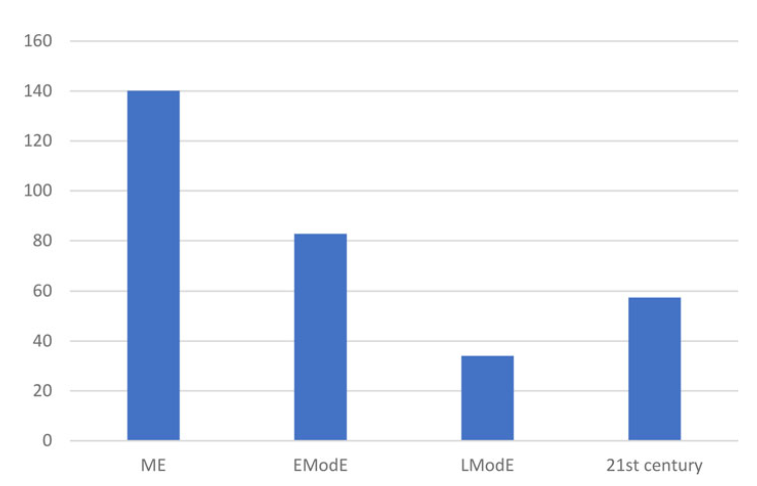
Figure 1. Abbreviation density normalised per 1,000 words, by period
按句点对每1000个单词的缩写密度进行标准化
A log likelihood test (on raw word counts) was conducted to analyse the frequency changes between the four time periods. From ME to EModE there was a drop of 36.58 per cent, from EModE to LModE a drop of 56.86 per cent, and then from LModE to twenty-first-century English, a major increase in relative frequency of 60.47 per cent (%DIFF), with a high level of confidence. The log likelihood score for this last comparison is 119.27, and the Bayesian Information Criterion score is 108.51, which, coupled with the 60.47 per cent difference in effect size, makes it statistically highly significant. There is also a large effect size difference of 155.55 per cent between nineteenth- and twentieth-century letters, suggesting that abbreviation had become very infrequent at the turn of the twentieth century, before an even larger increase from the twentieth-century corpus to the twenty-first century (effect size 199.87 per cent).
本文基于原始词数开展对数似然检验,对比四大阶段缩写频次变化:中古至早期现代英语缩写密度下降 36.58%;早期至晚期现代英语再降 56.86%;晚期现代至二十一世纪大幅回升 60.47%,该差异统计显著性极高(对数似然值 119.27,贝叶斯信息准则 108.51)。十九至二十世纪信件缩写密度效应值差值达 155.55%,证明二十世纪初缩写使用跌至低谷;二十世纪至二十一世纪缩写涨幅更大,效应值增幅 199.87%。
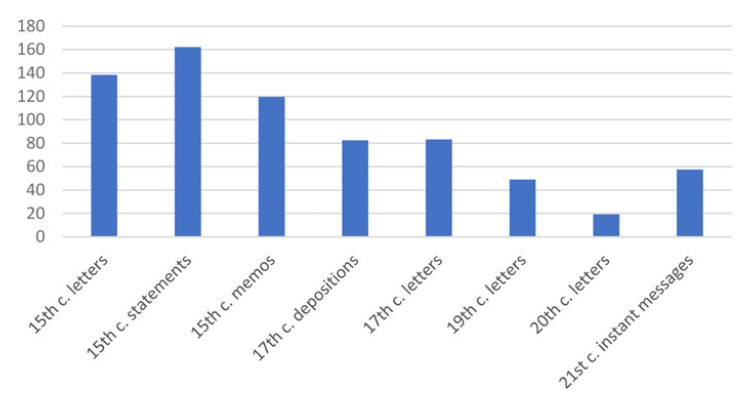
Figure 2. Abbreviation density normalised per 1,000 words, by text type
按文本类型,每1000个单词归一化的缩写密度
The differences between text types within each time period are mostly smaller than between periods. The difference between ME statements and memoranda is 35.53%, whilst the difference between seventeenth-century letters and depositions is 0.77 per cent. When the results presented above are broken down by the different text types in the four time periods, it is possible to see similar frequencies across ME letters (13.8 per cent), statements (16.2 per cent) and memoranda (12.8 per cent), and across seventeenth-century letters (8.3 per cent) and depositions (8.2 per cent). Since differences between text types are smaller than diachronic differences, this supports our decision to group them together.
同一时代内部不同文本类型的缩写密度差异,远小于跨时代差异。中古英语收据与备忘录缩写密度差值 35.53%;十七世纪信件与证词仅相差 0.77%。细分文本类型可见:中古信件(13.8%)、收据(16.2%)、备忘录(12.8%)缩写密度接近;十七世纪信件(8.3%)与证词(8.2%)数值基本持平。同代文本差异小于历时差异,印证将同期文本合并统计的合理性。
5.2 Changes in abbreviation forms
5.2 各类缩写形式历时演变
Our analysis reveals clear changes in the prevalent forms of abbreviation used over the centuries across different text types, as illustrated in figure 3 and summarised in table 4.
我们的分析揭示了不同文本类型中几个世纪以来普遍使用的缩略形式发生了明显的变化,如图 3 所示,并在表 4 中进行了总结。
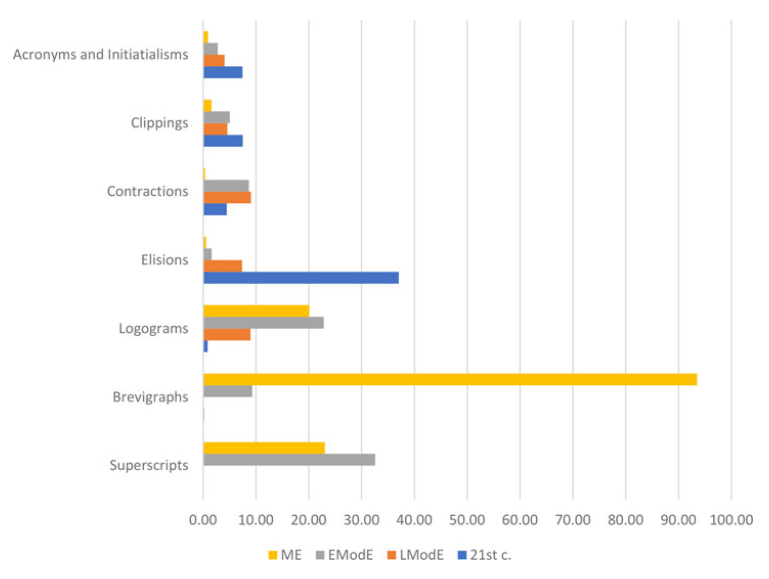
Figure 3. Numbers of abbreviation forms per 1,000 words
每 1000 个单词的缩写形式数
Table 4. Changes in abbreviation form (normalised frequency per 1,000 words)
表 4. 缩略形式的变化(每 1,000 词标准化频率)
| ME 中古英语 | EModE 早期现代英语 | LModE 晚期现代英语 | 21st century 21 世纪 | |
|---|---|---|---|---|
| Acronyms and initialisms 首字母缩略词与首字母词 | 0.92 | 2.77 | 4.06 | 7.44 |
| Clippings 截断词 | 1.59 | 5.06 | 4.59 | 7.49 |
| Contractions 缩约词 | 0.37 | 8.68 | 9.05 | 4.48 |
| Elisions 省略词 | 0.56 | 1.62 | 7.36 | 37.03 |
| Letter number homophones 字母数字同音词 | 0.00 | 0.00 | 0.00 | 0.00 |
| Logograms 语标符号 | 20.08 | 22.82 | 8.98 | 0.85 |
| Brevigraphs 缩写符号 | 93.51 | 9.29 | 0.00 | 0.19 |
| Superscripts 上标缩略 | 23.05 | 32.58 | 0.03 | 0.00 |
The chart and corresponding table show a major transformation in the abbreviation landscape. The ME period shows a high incidence of brevigraphs, which drops drastically in the second period and virtually disappears in the third and fourth ones. Meanwhile, logograms and superscripts reach their peak in the EModE period and then taper off -- although logograms like £, % and & are still attested in the twenty-first-century corpus, giving the normalised frequency 0.85/1,000 words. In contrast, the use of acronyms, clippings and elisions increases towards the present-day, while contractions reach their highest usage in the LModE period. Thus, our data reveal a major shift in abbreviation forms, primarily occurring between the EModE and LModE periods.
图表与上表直观呈现缩写体系的巨大变革:中古英语速写符号使用频次极高,进入早期现代英语后大幅下滑,晚期现代英语与二十一世纪几乎绝迹;独立词符、上标字母缩写在早期现代英语达到使用顶峰,此后持续衰减,不过 £、%、& 等词符在当代语料中仍有留存,标准化频次为每千词 0.85 次。与之相对,首字母缩写、截短词、省音简写的使用频次随时代向当代持续上升,缩合词则在晚期现代英语达到使用峰值。数据证明缩写形式发生了根本性转型,这一转变主要发生在早期现代英语向晚期现代英语过渡阶段。
Three forms of abbreviation show an increase in the twenty-first-century corpus. They are elisions, clippings as well as acronyms and initialisms. The last category shows a consistent rise across the periods with a substantial change from 4.06/1,000 words to 7.44/1,000 from LModE to the twenty-first century. These findings support the claims made by McCulloch (2019) and Cannon (1989) that the present day is the golden era of acronyms. The increase in clippings from 4.59/1,000 to 7.49/1,000 is also unsurprising, as clipping is considered to be a productive word-formation process in twenty-first-century English. Consequently, the two word-formation-related categories which have received the majority of attention in lexicology do exhibit a moderate increase.
二十一世纪语料中有三类缩写形式使用量持续上涨:省音简写、截短词、首字母缩写。首字母缩写在四个时代中持续走高,从晚期现代英语每千词 4.06 次升至二十一世纪每千词 7.44 次,该结果佐证麦卡洛克(2019)与坎农(1989)提出的观点------当代是首字母缩写的黄金发展期。截短词由每千词 4.59 次增至 7.49 次也符合学界预期,截短在当代英语中是具备强产出能力的构词手段。由此可见,词汇学重点研究的两类构词型缩写均呈现温和增长态势。
The biggest and most sudden increase, however, takes place with elision. During the LModE period, elisions show a modest increase with a frequency of 7.36/1,000 words. In the final period, the normalised frequency of elisions skyrockets to 37.03/1,000. This increase can be partly attributed to the development of auxiliaries over time (with constructions such as you'd becoming more prevalent). The frequent use of elisions aligns with earlier studies of IM behaviour. For instance, Baron (2004) found that college students used elisions instead of full forms in 65.3% of instances, but her college IM corpus 'yielded surprisingly few CMC abbreviations or acronyms'. Our results are similar, with elisions being the most popular form of abbreviation. It is quite likely that this is due to the informal register of LModE personal letters and twenty-first-century IM.
但涨幅最迅猛、增幅最突兀的是省音简写。晚期现代英语时期省音简写仅小幅增长,频次为每千词 7.36 次;到二十一世纪,标准化频次暴涨至每千词 37.03 次。这一增长部分源于助动词长期以来的语法化演变(you'd 这类简写形式大量普及)。省音简写的高频使用与既往即时通讯行为研究结论一致。例如巴伦(2004)发现,大学生在 65.3% 的语境下都会使用省音简写而非完整拼写,但其大学生即时通讯语料中,纯粹网络专属缩写与首字母缩写数量极少。本文数据与之相符,省音简写是使用最广泛的缩写形式,根源在于晚期现代私人信件与二十一世纪即时消息均属于非正式语域。
In the final period, in addition to elisions, some informants use non-standard abbreviated spellings like defo or probs, which require conscious effort as they are not suggested by predictive text. Out of 786 elisions, only 34 are informal spellings. These spellings, along with their frequencies, are all listed in (21) below:
在二十一世纪阶段,除常规省音简写外,部分使用者会主动使用 defo、probs 这类输入法联想词之外的非标简写,需要刻意输入,但这类写法总量稀少:全部 786 处省音简写中仅有 34 例属于非正式非标拼写,各类写法及出现频次如下(21):
(21) wanna (3),fabbo (1),tix 'tickets'(1),deffo (5),probs (1),ya (3),cos (3),dunno (1),gonna (3),okay (4),sayin (1),camp n furnace (3),nite (1),okies (1),soz 'sorry'(1),ta 'thanks'(1),u (1)
wanna 'want to'(想要,3 次),fabbo 'fabulous'(极好的,1 次),tix 'tickets'(票,1 次),deffo 'definitely'(肯定地,5 次),probs 'probably'(可能,1 次),ya 'you'(你,3 次),cos 'because'(因为,3 次),dunno 'don't know'(不知道,1 次),gonna 'going to'(将要,3 次),okay (好的,4 次),sayin 'saying'(说,1 次),camp n furnace (3 次),nite 'night'(夜晚,1 次),okies 'OK'(好的,1 次),soz 'sorry'(抱歉,1 次),ta 'thanks'(谢谢,1 次),u 'you'(你,1 次)
The intentional use of non-standard spellings is usually considered in CMC research to be a way for IM users to signal 'to others that the producer understands the particulars of the linguistic characteristics of IM, and therefore, understands the IM culture' (Quan-Haase 2009: 37). However, these spellings are fairly rare in our data. What people actually use most of the time are elisions indicated by an apostrophe.
计算机中介交际领域的研究普遍认为,使用者刻意使用非标拼写是一种身份标识,向对话者表明自己熟悉即时通讯的语言特征与圈内文化(宽-哈斯 2009:37)。但本文语料中这类非标写法占比极低,人们日常最常使用的依旧是撇号标注的省音简写。
5.3 Changes in abbreviated lexeme categories
5.3 被缩写词项类别的历时变化
Lexeme categories exhibit both continuity and change from ME to the twenty-first century. Figure 4 provides a visual representation, while summarised results are presented in table 5.
从中古英语到二十一世纪,各类缩写词项同时体现延续性与演变特征,图4直观展示分布趋势,汇总数据见表 5。
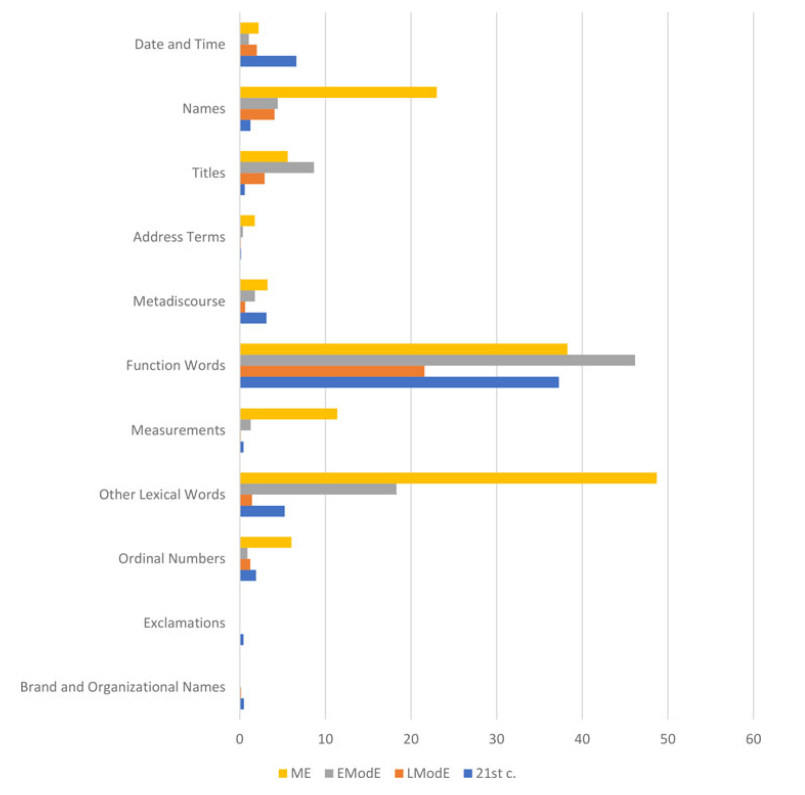
Figure 4. Frequencies of abbreviations across different lexeme categories (normalised per 1,000words)
不同词素类别中缩略语的频率(每 1000 个单词归一化)
Table 5. Frequencies of abbreviations across different lexeme categories (normalised per 1,000 words)
表 5. 不同词汇单位类别中缩略词的频率(每 1,000 词标准化频率)
| ME 中古英语 | EModE 早期现代英语 | LModE 晚期现代英语 | 21st century 21 世纪 | |
|---|---|---|---|---|
| Date and time 日期与时间 | 2.18 | 1.05 | 1.98 | 6.60 |
| Names 名称 | 23.00 | 4.43 | 4.04 | 1.22 |
| Titles 头衔 | 5.58 | 8.65 | 2.88 | 0.57 |
| Address terms 称呼语 | 1.74 | 0.35 | 0.10 | 0.14 |
| Discursive and metadiscursive items 话语及元话语标记 | 3.23 | 1.75 | 0.62 | 3.11 |
| Function words 功能词 | 38.27 | 46.17 | 21.56 | 37.26 |
| Measurements 计量单位 | 11.38 | 1.26 | 0.10 | 0.42 |
| Other lexical words 其他词汇 | 48.70 | 18.29 | 1.43 | 5.23 |
| Ordinal numbers 序数词 | 6.02 | 0.88 | 1.21 | 1.88 |
| Exclamations 感叹词 | 0 | 0 | 0 | 0.42 |
| Brand and organisational names 品牌与机构名称 | 0 | 0 | 0.14 | 0.47 |
The results show more continuity than abbreviation forms, although some notable changes can be observed. The main point of continuity is that abbreviations used for grammatical function words like with or that remain highly frequent across all four time periods. On the other hand, the biggest change is observed in the category 'Other lexical words', which shows a major fall from 48.70/1,000 words in the ME and EModE periods to 18.29/1,000 words. This change can most likely be explained by the major change that occur in abbreviation forms. During the ME period, scribes employed brevigraphs to abbreviate all kinds of lexical words, such as handꝭ'hands', vestımentꝭ'vestiments' or ꝑtıe 'party'. However, after the ME period the use of brevigraphs steadily decreased, which can plausibly explain the reduced number of 'other lexical words' being abbreviated.
相较于缩写形式,词项类别的整体延续性更强,但仍存在显著变化。最核心的延续特征:with、that 等语法功能词的缩写在四个时代均保持高频。变化幅度最大的类别是"其他实义词汇":中古英语、早期现代英语阶段每千词出现 48.70 次,后续大幅降至每千词 18.29 次。该变化可由缩写形式的更迭解释:中古抄写员依靠速写符号缩写各类实义词汇,如 handꝭ(双手)、vestımentꝭ(服饰)、ꝑtıe(群体);中古英语之后速写符号使用量持续下滑,直接导致普通实义词汇的缩写频次大幅降低。
Six out of nine lexeme categories ('Other lexical words', 'Names', 'Address terms', 'Discursive and metadiscursive items', 'Measurements', and 'Ordinal numerals') exhibit higher abbreviation frequencies in ME compared to the subsequent periods. The high numbers in the ME period can be attributed to the higher number of abbreviations and the versatile nature of brevigraphs.
九大类词项中有六类(其他实义词汇、人名、称呼敬语、元话语标记、度量单位、序数词)在中古英语的缩写频次高于后世,这源于中古文本整体缩写密度更高,且速写符号可灵活缩写各类词汇。
However, while abbreviation is most common in the ME corpora, there are three categories in which the normalised frequencies of abbreviations are higher in later periods. These categories are function words, titles and date and time. Two of these reach their highest peak in the subsequent period, EModE. The high frequency of abbreviated function words can be linked to the widespread use of a single abbreviation form: the superscript. The EModE period can be considered the golden age of superscript abbreviation, with many function words abbreviated using this form.
尽管中古英语整体缩写密度最高,但有三类词项在后世的缩写标准化频次更高:功能词、头衔称谓、时间日期。其中两类在紧随其后的早期现代英语达到峰值。功能词缩写高频的核心原因是上标缩写的普及,早期现代英语堪称上标缩写的鼎盛时期,大量功能词均采用该形式简写。
Another category which peaks in the EModE period is titles, which are, by far, most numerous in this period. The reasons for the results are hard to verify, but they may be connected to the elaborate politeness conventions and rigid social structures of early modern England (see Jucker 2020). Titles also display considerable variation between periods, with no single title found in all corpora. The abbreviation Mr. 'master/mister' and Mrs. 'mistress/missus' are not found in our data, despite the high number of personal names. The following sections break down some of the most noteworthy categories via a qualitative analysis.
头衔称谓缩写同样在早期现代英语达到峰值,是该时代缩写占比最高的词项类别。该现象成因难以完全证实,但推测与近代英格兰繁复的礼貌用语规范、森严的社会等级结构相关(朱克 2020)。不同时代的称谓缩写差异极大,不存在贯穿所有语料库的通用头衔简写;尽管人名样本数量充足,本研究语料中却未出现 Mr.、Mrs. 两类简写。下文将通过质性分析,拆解几类重点词项的缩写特征。
5.4 Names
5.4 人名地名缩写
The category of names displays a drastic decline from ME to the subsequent periods, with the lowest number of names observed in the twenty-first century. These observations can most likely be attributed to text types and ethical considerations associated with the TCWE corpus. The high frequency of names in our ME data can be explained by the presence of lists of abbreviated witnesses' names in ME memoranda contained in a subcorpus. The EModE and LModE datasets, consisting mostly of correspondence, display very similar frequencies to each other in terms of names. In the twenty-first-century IM corpus, the low frequency of names is due to the removal of personal names from the data to maintain confidentiality (only abbreviated place names were included in the count). Hence, in this case, the changes appear to be linked to specific dataset issues rather than alternations in abbreviation practices.
人名地名缩写频次自中古英语起持续大幅下滑,二十一世纪降至最低。该趋势主要受语料文本类型与隐私伦理限制影响,并非单纯的语言习惯变化:中古备忘录中大量证人姓名简写列表推高了该类缩写占比;早期、晚期现代英语以私人信件为主,人名缩写频次数值相近;二十一世纪即时消息语料库出于隐私保护,剔除所有人名,仅保留地名缩写参与统计,因此频次显著偏低。
There is, however, something else that takes place with abbreviations for names, which emerges from qualitative analysis. If we examine the forms of abbreviation used for names, we find abbreviations becoming more 'efficient'. In ME, personal names are primarily abbreviated by brevigraphs (22) with only regnal years sometimes being reduced to initials: r'regni Ricardi'. In the EModE corpora, names are often clipped or contracted (23). In the LModE period, personal names are reduced to initials (24). Names of people are found abbreviated in all periods except the twenty-first, where names were omitted to protect the identity of informants, as noted above.
但质性分析发现人名缩写存在一条贯穿全程的演变规律:简写形式不断趋向"高效简化"。中古英语人名主要依靠速写符号缩写(22),仅君主纪年偶尔使用首字母简写 r(理查国王治下);早期现代英语人名多采用截短、缩合形式(23);晚期现代英语直接简化为首字母组合(24)。除二十一世纪因隐私剔除人名外,其余时代均存在人名简写。
(22) Robt 'Robert', Will 'William', Oliuert 'Oliveris'
Robt 表示 'Robert'(罗伯特),Will 表示 'William'(威廉),Oliuert 表示 'Oliveris'(奥利弗里斯)
(23) Tho. Moore 'Thomas Moore', Wm 'William', Jo. 'John'
Tho. Moore 表示 'Thomas Moore'(托马斯·穆尔),Wm 表示 'William'(威廉),Jo. 表示 'John'(约翰)
(24) P.L. , H.B. , M.
P.L. (姓名首字母缩写),H.B. (姓名首字母缩写),M.(姓名首字母缩写 / 先生)
5.5 Discursive and metadiscursive abbreviations
5.5 篇章元话语类缩写
The category of discursive and metadiscursive items shows both considerable change, but also continuity in the form of Latin abbreviations that are still used today, especially in more formal registers. Table 6 presents examples of discursive and metadiscursive abbreviations.
篇章元话语缩写同时存在演变与延续特征:部分拉丁语源简写沿用至今,多用于正式语体,各类时代示例见表6。
Table 6. Discursive and metadiscursive abbreviations
表 6. 话语及元话语缩略语
| ME 中古英语 | EModE 早期现代英语 | LModE 晚期现代英语 | 21st century 21 世纪 |
|---|---|---|---|
| &c- 等等 | &c~ 等等 | etc. 等等 | etc 等等 |
| π 'Nota' 注意 | --- | --- | --- |
| Mᵈ 'memorandum' 备忘录 | --- | --- | --- |
| Jt⁹ 'Item' 条目 | --- | --- | --- |
| --- | Viz (Videlicet) 即,也就是 | --- | --- |
| --- | gᵒ 'ergo' 因此 | --- | --- |
| --- | --- | PS PS(附言) | P.S. 附言 |
| --- | --- | --- | TBC TBC(待定) |
| --- | --- | --- | re 关于 |
| --- | --- | --- | BTW 顺便说一下 |
| --- | --- | --- | Ok, okay, k, okies 好的 |
As table 6 shows, the only abbreviation classified as a discursive and metadiscursive item that can be found in all periods is 'et cetera'. This medieval Latin manuscript abbreviation has survived to the present day, although the form of the abbreviation has changed. Somewhere between EModE and LModE, &c. became etc.
由表 6 可见,唯一贯穿四大时代的元话语缩写是 et cetera(等等)。该手抄本拉丁语简写延续千年,仅书写形式发生改变:在早期现代英语写作 &c,进入晚期现代英语后统一变为 etc,并沿用至当代。
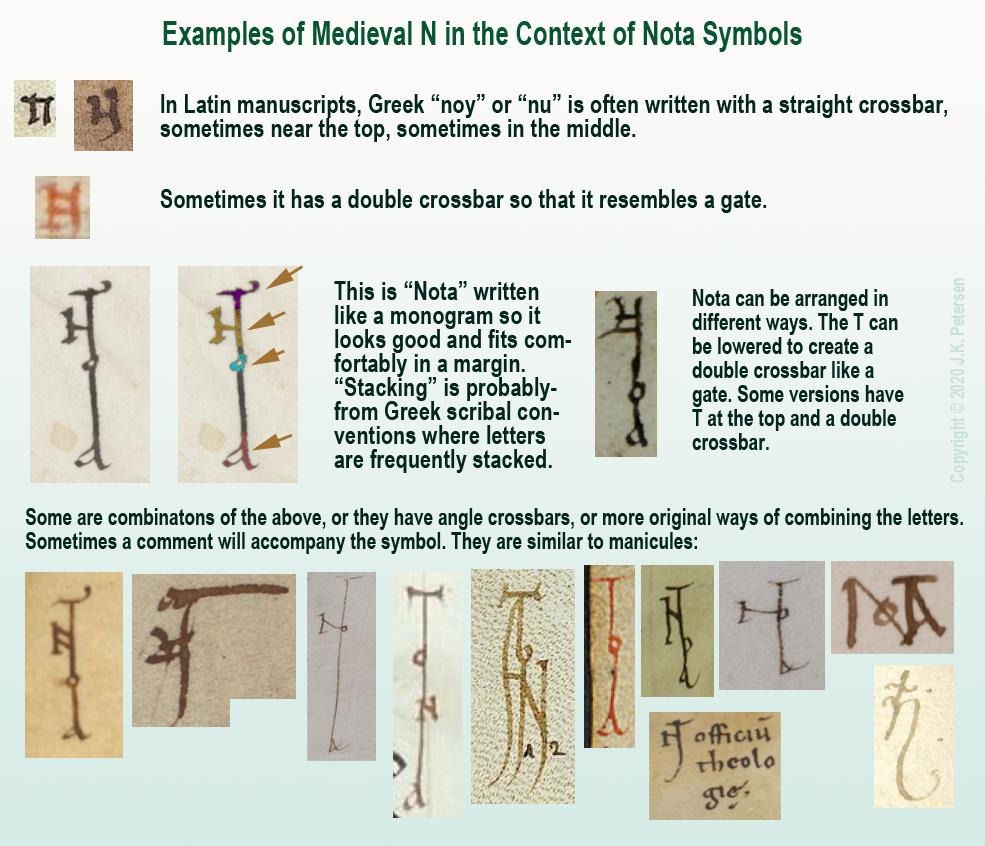
Other medieval Latin discursive and metadiscursive abbreviations such as the symbol u 'Nota' or M d M^{d} Md 'memorandum', typically found in texts classified as memoranda, are not used in later periods. The EModE corpus also includes two Latin abbreviations not found in the other subcorpora: g o g^{o} go for 'ergo' and viz for 'videlicet'. The latter means 'that is to say; namely; to wit' (OED, s.v. videlicet) and is defined by Moore as 'the expository apposition marker videlicet: a discourse marker introducing an amplification, more precise explanation or specifying list' (2006: 246). Both of these abbreviations were part of a Latin bibliographical system also used in the vernacular (see Stam 2017: 79; Honkapohja & Liira 2020: 283). Yet another Latin abbreviation, P S P S PS for 'post scriptum', is first attested in English in seventeenth-century correspondence (OED, s.v. P.S., n. shows the first attestation in 1616). However, P.S. is only found in our two more recent subcorpora, LModE and twenty-first-century English.
其余中古拉丁语元话语简写(如备忘录专用标记 Nota、 M d M^{d} Md memorandum)在后世彻底消亡。早期现代英语独有两类拉丁语简写: g o g^{o} go(ergo 因此)、viz(videlicet 即、也就是)。摩尔(2006:246)将 viz 定义为阐释类同位标记,用于引出补充说明、精准释义与列举内容;二者均源自拉丁语文献标注体系,后被本土英语借用。附言缩写 P.S.(post scriptum)最早见于十七世纪书信(《牛津英语词典》1616 年书证),但本研究仅在晚期现代英语与二十一世纪语料中检索到该简写。
Otherwise, the IM data display a range of discursive and metadiscursive abbreviations not found in the other subcorpora, such as the clipping re. 'regarding', usually found in email communication, the acronyms BTW 'by the way' and TBC 'to be confirmed', and the ubiquitous ok, which can be abbreviated to just k or written as okay. This innovation is not surprising given that, according to Androutsopoulos (2011: 150), CMC has quickly developed 'new means of textual cohesion, strategies for quoting and addressing in multi-party environments, and strategies for resolving misunderstandings with deixis'. However, our data indicate that, in IM at least, these newer abbreviations exist alongside the older, more established ones such as etc and P.S.
即时消息语料中出现大量前代未有的元话语简写:邮件常用截短词 re.(关于)、首字母缩写 BTW(顺便说一句)、TBC(待确认),以及通用口语标记 ok,可进一步简写为 k 或完整写作 okay。该类新型缩写的出现符合安德鲁索普洛斯(2011:150)的论断:计算机中介交际快速生成全新的文本衔接手段、多人对话引用与称呼范式、指示语消歧义策略。但数据显示,这类新兴简写并未取代 etc、P.S. 等传统简写,二者在即时通讯文本中并行使用。
5.6 Expressions of time
5.6 时间日期类缩写
The category of expressions of time is consistently abbreviated in all periods, but there is a noticeable increase in abbreviation frequency in the final period. Table 7 provides a breakdown of the subcategories within the time category.
时间日期类词汇在所有时代均存在缩写行为,且二十一世纪缩写频次显著提升,细分子类示例见表7。
| Period | ME | EModE | LModE | 21st century |
|---|---|---|---|---|
| Year | yoe, yer, ʒer, ao, ao dm, rr 'regni Ricardi' 年份 | Anno dnī, A.D., Anno Dom, Anno do: 公元 | Yrs 年份 | yrs 年份 |
| Month | Feb, Febrū, Aprell, Aprill, septo, octob, Octobr, Nouembr, Nouembr, k 'kalendas', Menʃ 'Mensis' 月份 | Jan:, Jan., Feb., Febry, Mar., Aug., Oct., Novem., Nov. 月份 | Jan., Aug., Sepr, Sept., Oct, Nov, Dec 月份 | Jan, Feb, sept, oct, dec 月份 |
| Day of the week | Saṭday 星期六 | --- | Thurs, Satdy, Mony 星期四、星期六、星期一 | mon, tues, Wed, Thu, Thurs 星期一、星期二、星期三、星期四 |
| Holidays | Estowoke, Esto, Anūcācoñ 'annunciation' 节日 | Xmas, Xtmas, Midsumēr 圣诞节、仲夏 | --- | NY, NYE, nye, bday, xmas, Xmas 新年、新年前夜、生日、圣诞节 |
| Time of day | --- | --- | p.m., a.m., hrs, o'clock, eve 下午、上午、小时、点钟、傍晚 | pm, am, min, mins, morn, tmrw, o'clock 下午、上午、分钟、分钟、早晨、明天、点钟 |
In all corpora, abbreviated forms meaning 'year' are observed. There are, however, some variations in the specific abbreviations used across different periods. Latin datings by regnal years are exclusive to the ME corpus, while abbreviations for 'Anno Domini' (ao dm, A.D., Anno do:, Anno dnī, Anno Dom) are present in both ME and EModE corpora. During the EModE period, 'Anno Domini' is the sole abbreviation for denoting years and is used in both correspondence and witness depositions. In both LModE and twenty-first-century corpora, the abbreviation for 'year' is yr. Therefore, the lexeme for 'year' is abbreviated in all periods, and the same applies to months.
所有语料库均存在年份简写,但各时代书写形式差异明显:依托君主纪年的拉丁语简写仅见于中古英语;公元纪年缩写 ao dm、A.D. 同时存在于中古、早期现代英语,后者的信件与法庭证词统一使用 Anno Domini 系列简写标注年份;晚期现代英语与二十一世纪统一使用 yr 表示年份。年份、月份两类词汇在四个时代均高频简写。
Names of months are found abbreviated in all periods with reasonably high frequencies. The only month to be abbreviated in all four is 'October', but other months are also abbreviated. Much like in personal names, there is a tendency towards more efficient abbreviation. Abbreviations become shorter, with clipping becoming the norm (e.g. Jan., Feb., Oct., Nov.). Clippings are already prevalent in the EModE corpora. However, LModE letters still display some variation (for example, 'September' is abbreviated both as the clipping Sept. and the contraction Sepr).
各时代月份缩写使用频次稳定,十月是唯一贯穿四大阶段均出现简写的月份,其余月份也普遍简写。与人名缩写规律一致,月份简写持续趋向简化,截短词成为主流(Jan.、Feb.、Oct.、Nov.),截短写法在早期现代英语已广泛普及;晚期现代英语仍保留变体,如 September 同时写作截短形式 Sept. 与缩合形式 Sepr。
References to specific times of the day become more common in the later corpora. Abbreviations related to hours of the day (o'clock and A.M. and P.M.) are only found in the last two corpora. The abbreviation for 'minutes' is exclusive to the twenty-first-century corpus. The higher incidence of more precise expressions of time in the twenty-first century can partly be attributed to the synchronous nature of IM -- when using IM, people often discuss meeting at a certain time.
精确时刻类缩写仅出现在晚近语料中:o'clock、A.M.、P.M. 仅见于晚期现代英语与二十一世纪文本;分钟 min/mins 简写为二十一世纪独有。二十一世纪精确时间缩写频次更高,原因在于即时通讯的同步交际属性,使用者频繁约定具体会面时间。
5.7 New categories in LModE and twenty-first-century English
5.7 晚期现代英语与二十一世纪新增缩写词类
Two lexeme categories were completely missing from ME and EModE, namely the use of exclamations and brand names. Both of these are, however, fairly low-frequency phenomena. There were only nine tokens which were classified as exclamations. There are three examples of lol 'laughing out loud', two of omg 'oh my God', one of tbf 'to be fair' and three of o 'oh' in the 21,228 words of the IM data (although 'O' is only arguably an abbreviation, it does fall under our definition of an abbreviation by being shorter than its variant spelling oh).
中古、早期现代英语完全不存在两类缩写:网络感叹表达、品牌机构名称,且二者整体频次极低。即时消息 21,228 词样本中,感叹类缩写仅 9 处:lol(大笑)3 次、omg(我的天)2 次、tbf(客观来说)1 次、o(哦)3 次;o 虽是否属于缩写存在争议,但因其拼写短于完整形式 oh,符合本文缩写定义,纳入统计。
The numbers of these last four forms may superficially appear low, given that they are often impressionistically seen to be characteristic of CMC. However, cross-checking the abbreviation in COCA and secondary literature suggests similar developments. The frequency of lol in COCA for example, is 11,009 instances in 1,001,610,938 words of data, from 1990 to 2019, representing 0.001 per cent of the total word count for that twenty-nine-year time period. Similarly, in a previous study of IM, Tagliamonte & Denis (2008: 11--12) found haha to be a much more frequently used form to symbolise laughter (16,183 instances of haha, comprising a 1.47 per cent proportion of the total IM word count compared to 4,506 instances of lol, comprising 0.41 per cent of the total IM word count). They therefore note the 'sheer infrequency of the so-called "characteristic IM forms"' (2008: 12), including lol, in their data, and state that they are, according to their analysis at least, 'much rarer than the media have led us to believe'.
大众普遍认为 lol、omg 是网络文本标志性缩写,但本研究数据中这类形式占比极低,COCA 语料库与既往文献也佐证该特征:1990--2019 年十亿余词的当代美国英语语料中,lol 仅出现 11,009 次,占总词数 0.001%。塔利亚蒙特、德尼斯(2008:11--12)的即时通讯研究显示,表达笑声时 haha(16,183 例,占比 1.47%)远多于 lol(4,506 例,占比 0.41%)。两位学者指出,这类所谓"即时通讯专属标识"实际使用频次远低于媒体宣传给大众留下的印象。
Only two abbreviations were classified as 'Brand and organisational names' in the nineteenth-century letters subcorpus: Archëol. Soc., which stands for 'Archeological Society' and F.O. 'Foreign Office'. The final period, on the other hand, contains thirteen tokens classified in this category: M&S 'Marks and Spencer' (2), U3A 'University of the Third Age' (1), FB 'Facebook' (1), LIMF 'Liverpool International Music Festival' (2), camp n furnace 'Camp and Furnace' (3), C&F 'Camp and Furnace' (1), BL 'British Library' (3).
十九世纪信件中品牌机构类缩写仅有两例:Archëol. Soc.(考古学会)、F.O.(外交部);二十一世纪即时消息共检索到 13 处该类简写:M&S 玛莎百货(2 次)、U3A 第三年龄大学(1 次)、FB 脸书(1 次)、LIMF 利物浦国际音乐节(2 次)、camp n furnace 利物浦酒馆(3 次)、C&F 该酒馆首字母简写(1 次)、BL 大英图书馆(3 次)。
The importance of acronyms in the category of brand and organisational names is shown by the fact that all the abbreviations in this category, with the exception of the elision/informal spelling in camp n furnace, are acronyms. Even Camp n Furnace, a nightclub in Liverpool, is once abbreviated to the acronym C&F -- a usage which would be familiar to all chat participants. Therefore, despite not being very frequent, the uses of acronyms and initialisms that are present in our data arguably add to our understanding of acronym and initialism as productive, dynamic processes of word formation in English.
品牌机构类缩写除 camp n furnace 口语化融合写法外,其余全部为首字母缩写,凸显首字母简写在该类别中的核心地位;利物浦酒馆 Camp and Furnace 还衍生出缩写 C&F,为聊天圈内通用写法。尽管该类缩写整体频次不高,但样本能够证明首字母缩写是英语极具活力、持续产出新词的构词手段。
6 Discussion and concluding remarks
6 研究讨论与结论
This study aimed to bridge the gap between medieval abbreviation practices and those found in CMC by employing a corpus-based, long diachronic approach, complemented by qualitative analysis. The results shed light on major changes in both the overall frequency of abbreviation and popular abbreviations used in each period. Our study demonstrates that, far from being specific to CMC, abbreviation was more common when all texts were handwritten. In the medieval data, approximately 14 per cent of all words are abbreviated, followed by a steady decline to 8.8 per cent in the EModE data, and 3.4 per cent in the LModE data. After that, there is an increase from 3.4 per cent of the total word count in LModE to 5.7 per cent in the twenty-first-century data. Consequently, while the frequency of abbreviation usage in ME and EModE texts is much higher than in both LModE and the present day, there is a statistically significant increase from LModE to the twenty-first century. This particular finding lends support to the idea that the arrival of the internet and CMC has increased the use of abbreviation since the LModE period.
本研究采用基于语料库的长历时研究法,辅以质性分析,填补中世纪缩写与计算机中介交际缩写研究之间的空白。研究结果清晰揭示缩写整体密度、主流缩写形式随时代发生的重大变迁。核心结论:缩写并非互联网新媒体独有,手写文本时代缩写使用密度更高。中古英语约 14% 的词汇为缩写,早期现代英语降至 8.8%,晚期现代英语进一步跌至 3.4%;二十一世纪回升至 5.7%。中古、早期现代英语缩写密度远高于近现代与当代,但从晚期现代英语到二十一世纪的回升具备极高统计显著性,印证互联网与计算机中介交际的确推动了缩写使用的复苏。
Both continuity and change can be observed in relation to abbreviated lexemes over time, a complex situation which the above analysis has hopefully shed some light on. Abbreviation forms undergo major changes. A notable change in abbreviation forms is the decline in the use of brevigraphs and superscript abbreviations, which were characteristic of handwritten texts. The biggest change occurs between EModE to LModE, showing a considerable drop in frequency and a major change in abbreviation forms. Rodríguez & Cannon (1994: 265) highlight social changes which might partly explain this decrease. They note that from 'the early 17th century there was a notable reduction of abbreviations for literary use, and the bar and other brevigraphs were generally discarded. During the 18th century we still find a considerable number of abbreviations in legal documents . . . but their use was forbidden by Parliament during the reign of George II (1727--60)'. In contrast, the forms of abbreviation that receive the most attention in lexicology, such as clippings, acronyms and initialisms, show an increase towards the present day. However, the most significant type of increase is the rise in the use of elision in the final period, the frequency of which eclipses all of the other developments.
被缩写词项同时体现延续与演变双重特征,前文多维度分析已厘清这一复杂规律;缩写形式的更迭更为剧烈。标志性变化:手写时代专属的速写符号、上标缩写持续衰落,核心转型节点位于早期现代英语向晚期现代英语过渡阶段,缩写密度大幅下滑、主流简写类型彻底更替。罗德里格斯与坎农(1994:265)提出社会变革是该下滑的部分成因:十七世纪初文学写作大量削减缩写,横线速写符号基本被淘汰;十八世纪法律文书仍保留一定缩写,但乔治二世在位期间(1727--1760)议会出台禁令限制缩写使用。与之相对,词汇学重点研究的截短词、首字母缩写随时代持续增长;增幅最突出的是省音简写,二十一世纪使用频次远超其余所有缩写类型。
Our study also highlights the surprising longevity of individual abbreviated forms, which can be considered fossilised. These include the logograms £, % and &, all of which are medieval or earlier in origin. Another example is the abbreviation 'Christmas' as xmas. This practice descends from an early Christian tradition of Nomina Sacra 'Holy Names', in which Greek letters were used to abbreviate words, such as xps for 'Christos'. In the ME corpus, this practice can be found, for example, in the name xp ofe'(Christo)pher'. The application of this abbreviation to 'Christmas' is also an old practice. According to the OED, the earliest attestation is in Old English in the Anglo-Saxon Chronicle c. 1100 as Xpes mǣsse 'Christ's mass'. These kinds of fossilised forms demonstrate the longevity and cultural persistence of abbreviations.
研究同时发现部分缩写具备极强的历史延续性,成为语言化石符号:£、%、& 等独立词符起源于中世纪甚至更早;Xmas(圣诞节)简写源自早期基督教"圣名缩写"传统,以希腊字母替代 Christos,中古英语中 xp ofe(Christopher)沿用该写法,Xmas 用于圣诞节的记录最早见于公元1100年《盎格鲁-撒克逊编年史》古英语文本 Xpes mǣsse。这类固化简写证明缩写具备跨越千年的文化延续力。
When an abbreviation fulfills a discursive or metadiscursive function, it can become extremely widely used in this capacity. Two examples of such abbreviations are etc. and P.S., which have become so entrenched in our culture that they are frequently used even in an informal speech-like text type such as IM. Another more recent example is ok, which is 'believed to be a short form of "Oll Korrect," which in turn most likely came from a fad of "comical misspellings" in an 1838 satirical article about grammar published in Boston' (Lang 2019: 153; see also Rodríguez & Cannon 1994: 266--7 and Metcalf 2010). This American English abbreviation has subsequently achieved massive international popularity across the world's languages in a relatively short time. Interestingly, it was not yet used in the LModE corpus by any of our informants, all of whom were British.
承担元话语衔接功能的缩写极易固化、全民通用,典型代表 etc、P.S.,即便在即时消息这类口语化非正式文本中也高频出现。近代典型简写 ok 起源于 1838 年波士顿一篇语法讽刺文章的趣味错拼 Oll Korrect(全部正确)(朗 2019:153;梅特卡夫 2010),这一美式简写在短时间内传遍全球各语言;有趣的是,本研究全部英国使用者构成的晚期现代英语语料中未出现 ok 相关写法。
The present study provides a broad overview of abbreviation use over a long period of time. It is important to acknowledge the limitations and weaknesses inherent in this approach. Firstly, the study is based on a 'long-and-thin' dataset, the size of which is limited due to a number of factors. These include the availability of suitable texts, particularly for earlier periods, and the labour-intensive process of manually identifying abbreviations in the corpora. As a result, when it comes to less frequently used lexical words in particular, it is worth considering that examining a larger number of texts from one particular time period could potentially yield different results.
本文搭建了贯通十五至二十一世纪的缩写宏观演变图景,但该长历时研究存在固有局限:语料属于"跨度大、单时代样本量有限"的薄样本数据集,受古代手抄本存世量、人工逐句标注缩写巨大工作量限制。针对低频次普通实义词汇的结论存在偏差可能性,扩充单一时代文本量或会得到不同结果。
Another limitation of this study is its focus on a single text type for the twenty-first century, despite the existence of a wide range of CMC text types. As mentioned, the choice of IM as the focus of this investigation stems from the existence of previous research into the use of abbreviation within it and the conception of it as a hybrid register that is a good representative of CMC because it exhibits 'a fusion of the full range of variants from the speech community: formal, informal, and highly vernacular' (Tagliamonte & Denis 2008: 3). However, there are a variety of genres and text types within the digital communication sphere and they differ in some fundamental ways. For instance, email can be considered relatively formal compared to IM, and is more consistently asynchronous (IM can be both synchronous and asynchronous depending on interaction and language user).
第二个局限:二十一世纪仅选取即时消息一类数字文本,而计算机中介交际包含多样文体。选取即时消息是基于学界已有成熟研究,且该语域融合正式、非正式、纯口语变体,可作为数字文本典型样本(塔利亚蒙特、德尼斯 2008:3);但邮件、社交动态、论坛等数字文体语域差异巨大:邮件相对正式、纯异步,即时消息则兼具同步、异步两种交际模式。
In future studies it would therefore be beneficial to investigate the development of abbreviation practices in a wider range of genres, especially email correspondence, and place it in the context of earlier personal letter writing, although accessing modern email data is challenging due to privacy concerns. With earlier periods, the problem is the lack of corpora which would have abbreviations encoded. Exploring pre-digital text types known for their brevity could also provide valuable insights. For instance, classified ads in printed newspapers might provide interesting comparative data between printed and digital sources (they are known for their high degree of abbreviation because people had to pay for each character).
未来研究可拓宽数字文体覆盖范围,重点纳入邮件文本,与近代私人信件形成对照;但现代邮件数据受隐私保护限制难以获取。古代研究则缺少完整标注缩写的大型语料库。同时可挖掘印刷时代简洁类文本开展对比,如报纸分类广告------字符计费机制催生大量缩写,可作为印刷文本与数字文本缩写的对照样本。
Furthermore, it is important to acknowledge that text types may affect some of the results. For example, the disproportionately high number of abbreviated names in the ME period is probably caused by the text types which contain long lists of witnesses (see section 5.4 above). However, while the higher occurrence of abbreviated names in the ME corpora may be influenced by the kinds of text types included, the study has highlighted consistent changes in how names are abbreviated across periods which are not solely due to the influence of individual text types. The use of brevigraphs in ME and the development towards more efficient, initial-based abbreviations in LModE are consistent trends across periods.
同时需承认文本类型会干扰部分数据结果:中古英语人名缩写频次畸高,源于备忘录中大量证人姓名清单(5.4节)。但即便存在文本类型干扰,人名简写的演变规律具备跨时代稳定性:中古速写符号简写、近代截短缩合、晚期现代首字母简写的递进趋势,不受单类文本影响。
A broad study like this one suggests a whole range of directions for future research. Further investigations could delve into smaller analytic categories within the ones used in the present study. In particular, abbreviations could be studied in more detail by examining their textual functions. Furthermore, while function words are frequently abbreviated throughout, and 'and' is commonly abbreviated in all periods, there does appear to be a shift in relation to the kinds of function words which get abbreviated. In the first two periods, a high number of pronouns such as 'that' are abbreviated, whereas in the later periods, with the rise of elision, auxiliary verbs become more prominent. Additionally, incorporating sociolinguistic variables like gender, class and age, or conducting cross-linguistic comparisons, would be a major priority.
本宏观长历时研究为后续细分研究提供多条可行方向:可在现有分类基础上细化次级分析维度,深入探究缩写的篇章功能;功能词缩写虽全程高频,且 and 贯穿所有时代,但缩写的功能词子类发生转移:中古、早期现代英语以 that 等代词简写为主,晚近时代省音简写普及后,助动词缩写占比提升。未来可引入社会语言学变量(年龄、阶层、性别)开展分层分析,或开展跨语言缩写对比研究。
Another interesting approach would be to focus on how each period has its own dynamic and productive abbreviation strategies. For example, the twenty-first-century data show a seemingly spontaneous use of an initialism to abbreviate 'Camp and Furnace' to C&F. In the ME period, brevigraphs could be used to abbreviate any lexical item with a notable decrease in the number of brevigraphs and 'other lexical words' in the EModE period. The use of superscript abbreviations in the EModE period could similarly be very productive and still has traces today in the way word-processing software likes to autoformat ordinal numerals into superscript. In contrast to this kind of productivity, it is worth keeping in mind that abbreviations can stay in use for extended periods of time and become fossilised. It would therefore be interesting to systematically compare standardisation and variability in the abbreviations of the same lexeme.
另一可行研究路径:聚焦各时代独有的高产出缩写体系。例如二十一世纪社群自发创造 C&F 简写;中古速写符号可缩写全部实义词汇,进入早期现代英语后速写符号与普通实义词汇缩写同步锐减;早期现代英语上标缩写产出力极强,如今文字处理软件自动将序数词设为上标,仍是该传统的遗留痕迹。除动态创新外,缩写还存在长期固化现象,可系统对比同一词汇缩写形式的标准化程度与变体差异。
In conclusion, despite its limitations, this study establishes an important framework. Investigating CMC abbreviation practices using a quantitative, diachronic approach helps to place them in their proper historical context. While many handwritten abbreviations have disappeared, the continued survival of abbreviations like etc. or xmas demonstrates that they did not all vanish without a trace. Additionally, our study highlights the continuity from LModE to twenty-first-century English, as many of the trends such as the increased use of elision and acronyms are already apparent in the LModE data. Whilst it is important to acknowledge that a study such as this one can only hope to scratch the surface, as there are a multitude of factors that need to be studied in more detail, we hope to have laid a foundation and proposed some research questions for future diachronic studies of abbreviation usage.
综上,尽管存在样本与文本类型局限,本研究搭建了缩写长历时分析的核心框架。用量化历时视角解读计算机中介交际缩写,能够还原其完整历史脉络。手写时代多数专属缩写虽已消亡,但 etc、Xmas 等简写持续沿用,证明缩写传统从未彻底断裂。同时,晚期现代英语与二十一世纪缩写存在清晰延续性:省音简写、首字母缩写上涨趋势在十九至二十世纪信件中已初现端倪。本文仅为宏观初探,仍有大量变量、细分维度有待深挖,期望能够为后世缩写历时研究奠定基础、提供可行研究问题。
Authors' addresses
作者通讯地址
Department of Literature, Area Studies and European Languages
University of Oslo
PO Box 1003
0315 Oslo
Norway
挪威 奥斯陆 0315 邮政信箱 1003
奥斯陆大学 文学、区域研究与欧洲语言系
邮箱:alpo.honkapohja@gmail.com
Department of English & Creative Arts
Edge Hill University
St Helens Road
Ormskirk L39 4QP
United Kingdom
英国 奥姆斯柯克 L39 4QP 圣海伦斯路
埃奇希尔大学 英语与创意艺术系
邮箱:imogen.marcus@edgehill.ac.uk
Sources
语料与文献来源
Corpora
语料库
Davies, Mark. 2008-- The Corpus of Contemporary American English (COCA). https://corpus.byu.edu/coca/ (accessed 14 June 2023).
戴维斯·马克,2008--至今,当代美国英语语料库(COCA),https://corpus.byu.edu/coca/,2023 年 06 月 14 日
Denison, David. 1994. A Corpus of Late Modern English Prose. https://personalpages.manchester.ac.uk/staff/david.denison/lmode_prose.html (accessed 14 June 2023).
戴维·丹尼森,1994,晚期现代英语散文语料库,https://personalpages.manchester.ac.uk/staff/david.denison/lmode_prose.html,2023 年 06 月 14 日
Kytö, Merja, Terry Walker & Peter Grund. 2011. English Witness Depositions 1560--1760: An Electronic Text Edition (ETED). CD-ROM.
梅尔雅·基托、特里·沃克、彼得·格伦德,2011,1560--1760 英国证人证词电子文本库(ETED),光盘版
Laing, Margaret. 2013. A Linguistic Atlas of Early Middle English (LAEME), version 3.2. The University of Edinburgh. www.lel.ed.ac.uk/ihd/laeme2/laeme2.html (accessed 14 June 2023).
玛格丽特·莱恩,2013,早期中古英语语言地图集(LAEME)3.2 版,爱丁堡大学,www.lel.ed.ac.uk/ihd/laeme2/laeme2.html,2023 年 06 月 14 日
Marcus, Imogen & Uschi Maden-Weinberger. 2021. A Transhistorical Corpus of Written English (TCWE). www.sketchengine.eu/transhistorical-corpus-of-written-english/ (accessed 14 June 2023).
伊莫金·马库斯、乌施·马登-温伯格,2021,跨历史书面英语语料库(TCWE),www.sketchengine.eu/transhistorical-corpus-of-written-english/,2023 年 06 月 14 日
Nevalainen, Terttu, Helena Raumolin-Brunberg, Jukka Keränen, Minna Nevala, Arja Nurmi & Minna Palander-Collin. 1998. Corpus of Early English Correspondence (CEEC). www.helsinki.fi/en/researchgroups/variation-contacts-and-change-in-english-correspondence (accessed 14 June 2023).
特尔图·内瓦莱宁等,1998,早期英语书信语料库(CEEC),www.helsinki.fi/en/researchgroups/variation-contacts-and-change-in-english-correspondence,2023 年 06 月 14 日
Stenroos, Merja, Kjetil V. Thengs & Geir Bergstrøm with the assistance of Anastasia Khanukaeva, Delia Schipor & Kenneth Solberg-Harestad. 2020. A Corpus of Middle English Local Documents (MELD), version 2017.1. www.uis.no/en/meld-corpus-files (accessed 14 June 2023).
梅尔雅·斯滕鲁斯等,2020,中古英语地方文献语料库(MELD)2017.1 版,www.uis.no/en/meld-corpus-files,2023 年 06 月 14 日
Lexicographical sources
词典类文献
Middle English Dictionary (MED). Ed. Robert E. Lewis et al. Ann Arbor: University of Michigan Press, 1952--2001. Online edition in Middle English Compendium. Ed. Frances McSparran et al. Ann Arbor: University of Michigan Library, 2000--18. http://quod.lib.umich.edu/m/middleenglish-dictionary/ (accessed 14 June 2023).
《中古英语词典》,罗伯特·E·刘易斯主编,安娜堡:密歇根大学出版社,1952--2001;线上合订本,弗朗西斯·麦斯帕伦主编,密歇根大学图书馆,2000--2018,http://quod.lib.umich.edu/m/middleenglish-dictionary/,2023 年 06 月 14 日
Oxford English Dictionary (OED) online (3rd edition). 2000--. Oxford: Oxford University Press. www.oed.com (last accessed 14 June 2023).
《牛津英语词典》线上第三版,2000--至今,牛津大学出版社,www.oed.com,:2023 年 06 月 14 日
Other primary sources
其他原始文本
Benson, Arthur Christopher. 1905. The Upton Letters. Project Gutenberg. First Posted 19 February 2002. www.gutenberg.org/files/4615/4615-h/4615-h.htm (accessed 14 June 2023).
阿瑟·克里斯托弗·本森,1905,《厄普顿书信》,古登堡计划,2002 年 02 月 19 日上线,www.gutenberg.org/files/4615/4615-h/4615-h.htm,2023 年 06 月 14 日
Letters to loved ones. Imperial War Museum. www.iwm.org.uk/history/letters-to-loved-ones (accessed 14 June 2023).
《致亲人书信集》,帝国战争博物馆馆藏,www.iwm.org.uk/history/letters-to-loved-ones,2023 年 06 月 14 日
References
参考文献
Álvarez-Gil, Francisco & Marina Bondi. 2021. Introduction to the monographic section: Metadiscourse devices in academic discourse. Revista Signos: Estudios de Lingüística 54(106), 518--28.
弗朗西斯科·阿尔瓦雷斯-希尔、玛丽娜·邦迪,2021,专题导言:学术语篇中的元话语标记,《符号学刊:语言学研究》第 54 卷第 106 期,518--528 页
Amador-Moreno, Carolina. 2019. Orality in written texts: Using historical corpora to investigate Irish English 1700--1900. Abingdon: Routledge.
卡罗莱纳·阿马多尔-莫雷诺,2019,书面文本中的口语性:基于历史语料库研究 1700--1900 年爱尔兰英语,阿宾登:劳特利奇出版社
Androutsopoulos, Jannis. 2006. Introduction: Sociolinguistics and computer-mediated communication. Journal of Sociolinguistics 10(4), 419--38.
扬尼斯·安德鲁索普洛斯,2006,导言:社会语言学与计算机中介交际,《社会语言学刊》第 10 卷第 4 期,419--438 页
Androutsopoulos, Jannis. 2011. Language change and digital media: A review of conceptions and evidence. In Tore Kristiansen & Nikolas Coupland (eds.), Standard languages and language standards in a changing Europe, 145--59. Oslo: Novus Press.
扬尼斯·安德鲁索普洛斯,2011,语言演变与数字媒介:理论与实证综述,收录于托雷·克里斯蒂安森、尼可拉斯·科普兰(编),《变革欧洲的标准语言与语言规范》,145--159 页,奥斯陆:诺瓦斯出版社
Baron, Naomi. 2004. See you online: Gender issues in college students' use of instant messaging. Journal of Language and Social Psychology 23(4), 397--423.
娜奥米·巴伦,2004,线上相见:大学生即时通讯使用中的性别差异,《语言与社会心理学期刊》第 23 卷第 4 期,397--423 页
Bassac, Christian. 2004. Principes de morphologie anglaise. Linguistica. Pessac: Presses Universitaires de Bordeaux.
克里斯蒂安·巴萨克,2004,英语形态学原理,语言学丛书,佩萨克:波尔多大学出版社
Bauer, Laurie. 1993 1983. English word-formation. Cambridge: Cambridge University Press.
劳里·鲍尔,1983(1993 再版),英语构词法,剑桥大学出版社
Bergs, Alexander. 2009. Just the same old story? The linguistics of text messaging and its cultural repercussions. In Charley Rowe & Eva Lia Wyss (eds.), Language and new media: Linguistic, cultural, and technological evolutions, 55--73. Cresskill, NJ: Hampton.
亚历山大·伯格斯,2009,老生常谈?短信语言学及其文化影响,收录于查理·罗、伊娃·莉娅·威斯(编),《语言与新媒体:语言、文化、技术演变》,55--73 页,新泽西州克雷斯基尔:汉普顿出版社
Biber, Douglas & Edward Finegan. 1989. Drift and the evolution of English style: A history of three genres. Language 65(3), 487--517.
道格拉斯·拜伯、爱德华·芬尼根,1989,语言漂移与英语文体演变:三类文体发展史,《语言》第 65 卷第 3 期,487--517 页
Biber, Douglas, Stig Johansson, Geoffrey Leech, Susan Conrad & Edward Finegan. 2000. Longman grammar of spoken and written English. London: Longman.
道格拉斯·拜伯等,2000,《朗文英语口语与书面语语法》,伦敦:朗文出版社
Bieswanger, Markus. 2013. Micro-linguistic structural features of computer-mediated communication. In Susan Herring, Dieter Stein & Tuija Virtanen (eds.), Pragmatics of computer-mediated communication, 463--85. Berlin: De Gruyter Mouton.
马库斯·比斯万格,2013,计算机中介交际的微观语言结构特征,收录于苏珊·赫林等(编),《计算机中介交际语用学》,463--485 页,柏林:德古意特穆顿出版社
Bieswanger, Markus. 2016. Electronically-mediated Englishes: Synchronicity revisited. In Lauren Squires (ed.), English in computer-mediated communication: Variation, representation, and change, 281--300. Berlin: De Gruyter Mouton.
马库斯·比斯万格,2016,电子媒介英语:重审同步交际概念,收录于劳伦·斯夸尔斯(编),《计算机中介交际中的英语:变异、表征与演变》,281--300 页,柏林:德古意特穆顿出版社
Cannon, Garland. 1989. Abbreviations and acronyms in English word-formation. American Speech 64(2), 99--127.
加兰·坎农,1989,英语构词体系中的缩写与首字母缩写,《美国言语》第 64 卷第 2 期,99--127 页
Cappelli, Adriano. 1899. Lexicon abbreviaturarum dizionario di abbreviature latine ed italiane. Milan: Hoepli.
阿德里亚诺·卡佩利,1899,《拉丁语与意大利语缩写词典》,米兰:霍普利出版社
Crystal, David. 2001. Language and the Internet. Cambridge: Cambridge University Press.
戴维·克里斯特尔,2001,《语言与互联网》,剑桥大学出版社
Culpeper, Jonathan & Merja Kytö. 2010. Early Modern English dialogues: Spoken interaction as writing. Cambridge: Cambridge University Press.
乔纳森·卡尔佩珀、梅尔雅·基托,2010,早期现代英语对话文本:书面记录的口语互动,剑桥大学出版社
Danet, Brenda. 2001. Cyberpl@y: Communicating online. Abingdon: Routledge.
布伦达·达内特,2001,《网络互动:线上交际研究》,阿宾登:劳特利奇出版社
Drouin, Michelle & Claire Davis. 2009. R u txting? Is the use of text speak hurting your literacy? Journal of Literacy Research 41(1), 46--67.
米歇尔·德鲁安、克莱尔·戴维斯,2009,你在发短信吗?网络文字是否损害读写能力,《读写研究期刊》第 41 卷第 1 期,46--67 页
Eberl, Martin. 2020. Double trouble. In Sofia Rüdiger & Daria Dayter (eds.), Corpus approaches to social media: Studies in corpus linguistics, 131--46. Amsterdam: John Benjamins.
马丁·埃贝尔,2020,双重困境,收录于索菲亚·吕迪格、达莉亚·戴特(编),《社交媒体语料库研究》,131--146 页,阿姆斯特丹:约翰·本杰明出版社
Elspaß, Stephan. 2002. Alter Wein und neue Schläuche? Briefe der Wende zum 20. Jahrhundert und Texte der neuen Medien -- ein Vergleich. Osnabrücker Beiträge zur Sprachtheorie 64, 7--32.
斯特凡·埃尔施帕斯,2002,旧酒新瓶?世纪之交书信与新媒体文本对比,《奥斯纳布吕克语言理论论丛》第 64 辑,7--32 页
Fitzmaurice, Susan. 2002. The familiar letter in Early Modern English: A pragmatic approach. Amsterdam: John Benjamins.
苏珊·菲茨莫里斯,2002,早期现代英语私人书信:语用学视角,阿姆斯特丹:约翰·本杰明出版社
Hasenohr, Geneviève. 2002. Écrire en latin, écrire en roman: Réflexions sur la pratique des abréviations dans les manuscrits français des XIIe et XIIIe siècles. In Michel Banniard (ed.), Langages et peuples d'Europe: Cristallisation des identités romanes et germaniques (VIIe--Xie siècle), 79--110. Toulouse: CNRS Université de Toulouse-Le Mirail.
热纳维耶芙·哈瑟诺尔,2002,拉丁文与罗曼语书写:十二、十三世纪法国手抄本缩写实践反思,收录于米歇尔·巴尼亚尔(编),《欧洲语言与族群:罗曼、日耳曼身份固化(7--11世纪)》,79--110 页,图卢兹:法国国家科学研究中心图卢兹大学出版社
Hector, Leonard. 1958. The handwriting of English documents. Ilkley: Scolar Press.
伦纳德·赫克托,1958,《英文文书手写字体》,伊尔克利:斯科拉出版社
Herring, Susan C. 2005. Computer-mediated communication on the internet. Annual Review of Information Science and Technology 36(1).
苏珊·C·赫林,2005,互联网中的计算机中介交际,《信息科学与技术年度综述》第 36 卷第 1 期
Heuman, Anna. 2021. Acceptable language online: Negotiating the impact of digital affordances. In Marjut Johansson, Sanna-Kaisa Tanskanen & Jan Chovanec (eds.), Analyzing digital discourses: Between convergence and controversy, 163--87. London: Springer Nature.
安娜·休曼,2021,网络规范语言:协商数字媒介特性带来的语言影响,收录于马尔尤特·约翰松等(编),《数字语篇分析:融合与争议》,163--187 页,伦敦:施普林格自然出版社
Honkapohja, Alpo. 2013. Manuscript abbreviations in Latin and English: History, typologies and how to tackle them in encoding. Studies in Variation, Contacts and Change in English 14.
阿尔波·洪卡波赫亚,2013,拉丁与英文手抄本缩写:历史、分类与文本标注方法,《英语变异、接触与演变研究》第14辑
Honkapohja, Alpo. 2021. Digital approaches to manuscript abbreviations: Where are we at the beginning of the 2020s? Digital Medievalist 14.
阿尔波·洪卡波赫亚,2021,手抄本缩写数字化研究:2020年代初研究现状,《数字中世纪研究》第14期
Honkapohja, Alpo & Aino Liira. 2020. Abbreviations and standardisation in the Polychronicon: Latin to English and manuscript to print. In Laura Wright (ed.), The multilingual origins of standard English, 269--316. Berlin: De Gruyter Mouton.
阿尔波·洪卡波赫亚、艾诺·利拉,2020,《编年史》中的缩写与标准化:从拉丁语到英语、手抄本到印刷本,收录于劳拉·赖特(编),《标准英语的多语言起源》,269--316 页,柏林:德古意特穆顿出版社
Jamet, Denis. 2009. A morphological approach to clipping in English: Can the study of clipping be formalized? Lexis: Journal in English Lexicology (HS 1).
德尼斯·雅梅,2009,英语截短词的形态学分析:截短词研究能否形式化,《词汇学刊:英语词汇研究》第1辑
Jucker, Andreas H. 2020. Politeness in the history of English: From the Middle Ages to the present day. Cambridge: Cambridge University Press.
安德烈亚斯·H·朱克,2020,英语礼貌表达发展史:中世纪至当代,剑桥大学出版社
Katamba, Francis. 2005. English words. Structure, history, usage, 2nd edn. Abingdon: Routledge.
弗朗西斯·卡坦巴,2005,《英语词汇:结构、历史与用法》第二版,阿宾登:劳特利奇出版社
Ker, Neil R. 1960. English manuscripts in the century after the Norman Conquest. Oxford: Clarendon.
尼尔·R·克尔,1960,诺曼征服后百年间的英文手抄本,牛津:克拉伦登出版社
Kestemont, Mike. 2015. A computational analysis of the scribal profiles in two of the oldest manuscripts of Hadewijch's letters. Scriptorium 69, 159--75.
迈克·凯斯蒙特,2015,哈德基书信两份古抄本抄写特征计算分析,《手抄本研究》第69卷,159--175 页
Kjeldsen, Alex Speed. 2013. Filologiske studier i kongesagahåndskriftet Morkinskinna. Copenhagen: Museum Tusculanum Press.
亚历克斯·斯皮德·谢尔德森,2013,《莫尔金斯金纳》王室档案抄本文献学研究,哥本哈根:图斯库兰博物馆出版社
Klymenko, Olga. 2019. Twitterverse: The birth of new words. Proceedings of the Linguistic Society of America 4(1), 1--11.
奥尔加·克利缅科,2019,推特语言场域:新词的诞生,《美国语言学会论文集》第4卷第1期,1--11 页
Lang, Tom. 2019. The long and the short of abbreviations. European Science Editing 45(1), 152--60.
汤姆·朗,2019,缩写长短谈,《欧洲科学编辑》第 45 卷第 1 期,152--160 页
Lowe, Kathryn. 2006. Palaeography. In Keith Brown (ed.), Encyclopedia of language and linguistics, 2nd edn, 134--41. London: Elsevier.
凯瑟琳·洛,2006,古文字学,收录于基思·布朗(编),《语言与语言学百科全书》第二版,134--141 页,伦敦:爱思唯尔出版社
Lyddy, Fiona, Francesca Farina, James Hanney, Lynn Farrell & Niamh Kelly O'Neill. 2014. An analysis of language in university students' text messages. Journal of Computer-Mediated Communication, 19(3), 546--61.
菲奥娜·利迪等,2014,大学生短信语言分析,《计算机中介交际期刊》第 19 卷第 3 期,546--561 页
Marcus, Imogen. 2017. The linguistics of spoken communication in Early Modern English writing: Exploring Bess of Hardwick's manuscript letters. Cham: Springer.
伊莫金·马库斯,2017,早期现代英语书面文本中的口语交际语言学:哈德威克夫人贝斯手抄书信研究,尚姆:施普林格出版社
McCulloch, Gretchen. 2019. Because internet: Understanding how language is changing. London: Vintage.
格雷琴·麦卡洛克,2019,《皆因互联网:读懂语言的演变》,伦敦:温塔奇出版社
Metcalf, Allan. 2010. OK: The improbable story of America's greatest word. Oxford: Oxford University Press.
艾伦·梅特卡夫,2010,
Reference
- The long history of shortening: a diachronic analysis of abbreviation practices from the fifteenth to the twenty-first century | English Language & Linguistics | Cambridge Core
https://www.cambridge.org/core/journals/english-language-and-linguistics/article/long-history-of-shortening-a-diachronic-analysis-of-abbreviation-practices-from-the-fifteenth-to-the-twentyfirst-century/3296F47F350D4C519DC737A9ED18447D - the-long-history-of-shortening-a-diachronic-analysis-of-abbreviation-practices-from-the-fifteenth-to-the-twenty-first-century.pdf
https://www.cambridge.org/core/services/aop-cambridge-core/content/view/3296F47F350D4C519DC737A9ED18447D/S1360674323000436a.pdf/the-long-history-of-shortening-a-diachronic-analysis-of-abbreviation-practices-from-the-fifteenth-to-the-twenty-first-century.pdf