yaml
title: Agent Memory 多维分类------从认知科学到工程实现
tags: [agent, memory, ai, architecture]
date: 2026-07-13
概述
AI Agent 的长期记忆分类几乎全是从人类认知心理学搬运过来的。当前学界和工业界最主流的分类框架将 Agent Memory 分为 Perceptual、Working、Episodic、Semantic 四类,外加常被忽略但至关重要的 Procedural、Prospective、Collective 三类补充类型。
本文以认知科学为源头,结合 主流框架对比,用 Golang 给出完整参考实现,并补充一个常被忽略的维度:记忆的管理策略(遗忘、生命周期转化、读写操作)。
阅读建议:如果你只想快速了解四类核心记忆,直接跳到 二、四种核心记忆分类。如果你想看代码怎么落地,跳到 [七、Golang 参考实现](#七、Golang 参考实现 "#%E4%B8%83%E3%80%81Golang%20%E5%8F%82%E8%80%83%E5%AE%9E%E7%8E%B0")。
一、认知科学源头
AI Agent 的记忆分类根植于四个经典认知理论。这里只列要点,详细讨论见 认知科学到 AI Agent 记忆分类的完整映射。
1.1 Atkinson & Shiffrin 多存储模型(1968)
按时间维度 :感觉记忆(0.5s) → 短期记忆(20-30s) → 长期记忆(永久)
这是 LangGraph 两层架构(Checkpointer / Store)的直接理论来源。
1.2 Tulving 的情景 vs 语义二分法(1972)
长期记忆 = 情景记忆 ("我记得我去过巴黎")+ 语义记忆("我知道巴黎是法国首都")
| 维度 | 情景记忆 | 语义记忆 |
|---|---|---|
| 内容 | 个人经历的事件 | 事实、概念、知识 |
| 时间 | 有明确时间标签 | 无时间标签 |
| 组织 | 时空关系 | 概念关系 |
| 遗忘 | 细节容易丢失 | 相对稳定 |
Tulving 后来(1985)补充了 Perceptual Representation Systems------对应 AI 中的 embedding 层。
1.3 Baddeley 的工作记忆模型(1974)
短期记忆不是被动存储,而是主动加工系统 :中央执行器 → 语音回路 + 视空间画板 + 情景缓冲区
在 AI 中:Context Window = 工作记忆,不只是"存消息",而是模型在此窗口内进行注意、推理、整合。
1.4 Cohen & Squire 的陈述性 vs 程序性(1980)
| 类型 | 含义 | AI 对应 |
|---|---|---|
| 陈述性/外显记忆 | "知道巴黎是法国首都" | Episodic + Semantic |
| 程序性/内隐记忆 | "知道怎么骑车" | System Prompt、Tool Defs、Fine-tuning 权重 |
二、四种核心记忆分类
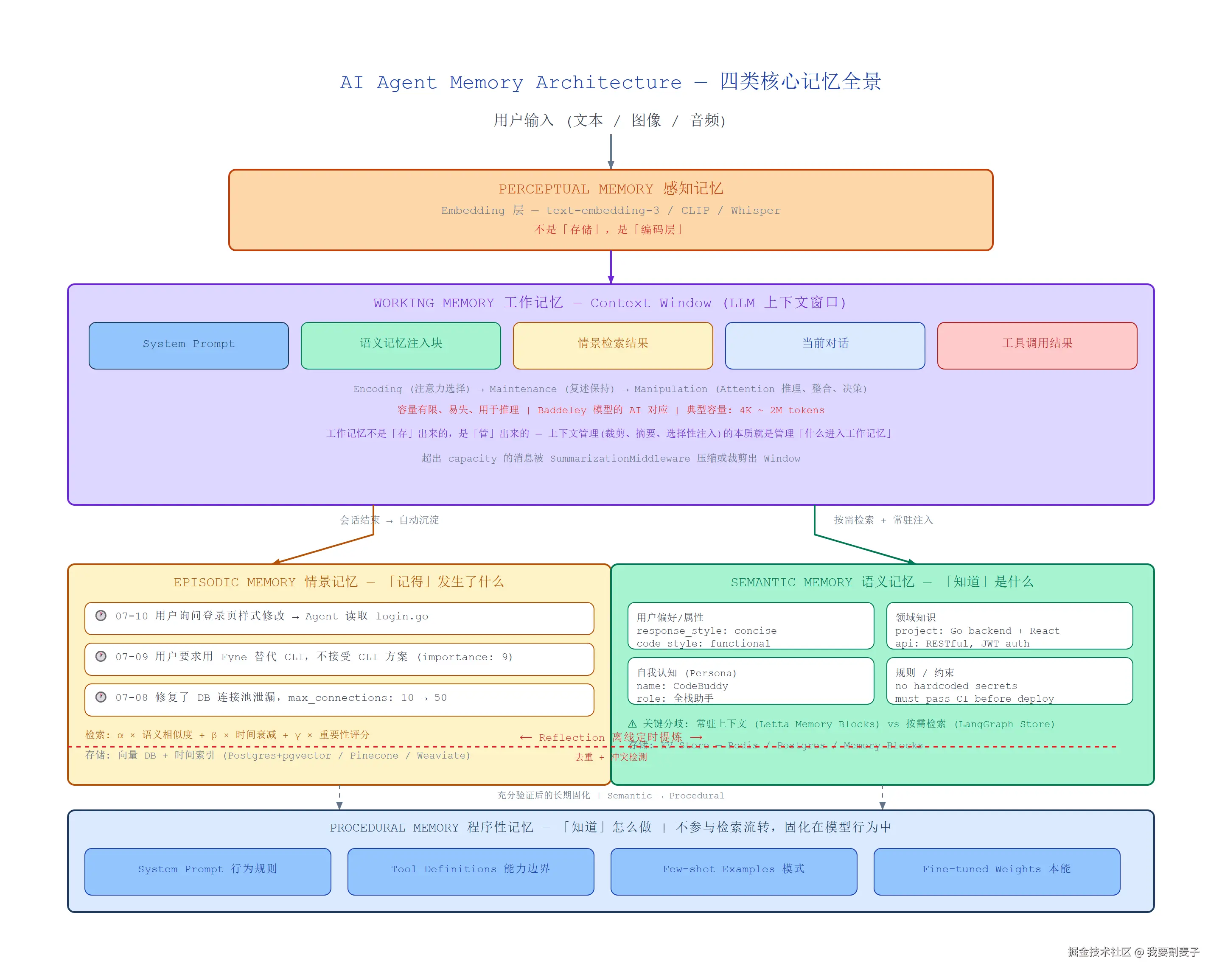
上图为四种核心记忆类型的全景架构。图中展示了从用户输入经由感知层编码 → 工作记忆处理 → 情景记忆和语义记忆存储的双通道设计,以及始终生效的程序性记忆。
2.1 Perceptual Memory------感知记忆
认知原型:人类的图像记忆(Iconic Memory,~0.5秒)和回声记忆(Echoic Memory,~3-4秒)。
AI 对应 :Embedding 层------不是"存储系统",而是输入信号的编码器。
关键特征:
- 模态相关:文本用 text-embedding,图片用 CLIP,音频用 Whisper encoder
- 是情景记忆和语义记忆的索引基础(所有检索都依赖 embedding 质量)
- 不直接存储,输出向量供下游使用
框架体现 :LangGraph Store →
IndexConfig(embed=my_func),Letta → 内置 embedding 负责 archival memory 索引。
2.2 Working Memory------工作记忆
认知原型:Baddeley 的工作记忆------容量约 7±2 个组块,持续约 20-30 秒。
AI 对应 :LLM 的 Context Window------Agent "此刻正在思考什么"。
sql
┌─── Working Memory (Context Window) ─────────────────────┐
│ System Prompt (行为约束)                                   │
│ [Semantic Block] "用户偏好简洁回答" ← 从语义记忆注入        │
│ [Episodic Result] "上次对话摘要..."  ← 从情景记忆检索        │
│ Human: "帮我修改登录页面样式"         ← 当前输入            │
│ AI: "先看一下代码..."                ← 当前推理            │
│ Tool: read_file → login.go (234行)   ← 工具结果            │
│ [消息超Window时被 SummarizationMiddleware 压缩]            │
│ 容量上限: 模型上下文窗口 (128K / 200K / 1M tokens)         │
└──────────────────────────────────────────────────────────┘
三个关键操作:
| 操作 | 认知对应 | AI 实现 |
|---|---|---|
| 编码 (Encoding) | 注意力选择信息 | @before_model 钩子选择性注入记忆 |
| 维持 (Maintenance) | 复述保持 | 消息追加到 state["messages"] |
| 操作 (Manipulation) | 推理、整合、决策 | LLM Attention 在上下文内计算 |
核心洞察:工作记忆不是"存"出来的,是"管"出来的。上下文管理(裁剪、摘要、选择性注入)的本质就是管理"什么进入工作记忆"。
2.3 Episodic Memory------情景记忆
认知原型 :Tulving------记得(remembering) 而非知道(knowing) 。包含 what、when、where 三要素。
AI 对应 :过往交互的记录序列------每次对话、每个工具调用、每个决策,以事件为单位存储。
go
// 情景记忆的数据结构(参考 Generative Agents 的 Memory Stream)
type EpisodicRecord struct {
    ID          string      `json:"id"`
    Timestamp   time.Time   `json:"timestamp"`
    Content     string      `json:"content"`
    Importance  float64     `json:"importance"`  // LLM 评分 1-10
    Embedding   []float32   `json:"embedding"`
    ThreadID    string      `json:"thread_id"`
}

// 示例数据
examples := []EpisodicRecord{
    {
        Timestamp:  time.Now().Add(-time.Hour),
        Content:   "用户询问了登录页面样式修改,Agent 读取了 login.go",
        Importance: 6,
        ThreadID:  "conv-042",
    },
    {
        Timestamp:  time.Now().Add(-24 * time.Hour),
        Content:   "用户要求用 Fyne 替代终端 UI,不接受 CLI 方案",
        Importance: 9,
        ThreadID:  "conv-041",
    },
}检索策略:情景记忆的检索混合三个权重------这和语义记忆有本质区别。
检索得分 = α × sematic_similarity + β × recency_score + γ × importance_score

Generative Agents 权重: 1.0 × recency + 1.0 × importance + 1.0 × relevance
CrewAI v1.15 权重: 0.5 × semantic + 0.3 × recency + 0.2 × importance冷启动问题:新用户只有少量 episodic 记录,相似度全部很低时,不注入比注入不相关的更好。应该设置置信度门控。
| 框架 | 情景记忆实现 |
|---|---|
| Generative Agents | Memory Stream------recency × importance × relevance 检索 |
| Letta | Archival Memory------向量DB + archival_memory_search,Out-of-context |
| LangGraph | Store (namespace="conversations")------带时间戳的 JSON 文档 |
| EM-LLM | 事件分割 + 两阶段检索(语义相似 → 时间邻近扩展) |
| CrewAI | Unified Memory 的 composite scoring |
2.4 Semantic Memory------语义记忆
认知原型 :Tulving------知道(knowing) 。没有时间标签------你知道"巴黎是法国首都"但你不记得"什么时候学会的"。
AI 对应 :结构化的、精心维护的长期知识------关于用户是谁、Agent 自己是谁、领域知识是什么。
go
// 语义记忆 = 精炼的、无时间性的知识
type SemanticStore struct {
    UserProfile    UserProfile     `json:"user_profile"`
    Persona        AgentPersona    `json:"persona"`
    DomainKnowledge map[string]any `json:"domain_knowledge"`
}

type UserProfile struct {
    Name        string            `json:"name"`
    Role        string            `json:"role"`
    TechStack   []string          `json:"tech_stack"`
    Preferences map[string]string `json:"preferences"`
    Constraints map[string]string `json:"constraints"`
}

type AgentPersona struct {
    Name         string   `json:"name"`
    Capabilities []string `json:"capabilities"`
    Limitations  []string `json:"limitations"`
    Rules        []string `json:"behavior_rules"`
}
语义记忆常驻 vs 按需的关键分歧:
| 策略 | 代表框架 | 做法 |
|---|---|---|
| 常驻上下文 | Letta Memory Blocks | 语义记忆固定在上下文中,Agent 用工具自行修改 |
| 按需检索 | LangGraph Store | 语义记忆存在外部,每次对话开始时检索注入 |
Letta 的做法更接近人类------你不需要"检索"自己的名字,它一直在那里。
三、超越四分类------常被忽略的记忆类型
3.1 Procedural Memory------程序性记忆
认知原型:Cohen & Squire------知道"怎么做"而非"知道是什么"。你可以骑自行车但很难用语言描述。
AI 对应 :固化在模型行为中,不需要检索:
go
// 程序性记忆在 AI Agent 中的四种体现
type ProceduralMemory struct {
    // 1. System Prompt------始终在上下文中的行为规则
    SystemPrompt string

    // 2. Tool Definitions------Agent 的能力边界
    Tools []ToolDef

    // 3. Few-shot Examples------验证过的行为模式
    Examples []InteractionPattern

    // 4. 最终形态:Fine-tuned Weights------模型本能
}

// 示例:Voyager 的 Skill Library 是程序性记忆的代码化实现
type SkillLibrary struct {
    Skills map[string]Skill // 可执行、可组合的代码技能
}

type Skill struct {
    Name        string   `json:"name"`
    Code        string   `json:"code"`         // 可执行代码
    Description string   `json:"description"`
    DependsOn   []string `json:"depends_on"`   // 可组合:技能之间可以调用
}
Voyager 的核心贡献 :技能以可执行代码存储,可以在新环境中直接复用,无需重新生成。这避免了 fine-tuning 的灾难性遗忘。
3.2 Prospective Memory------前瞻记忆
你笔记里没覆盖的类型。它是唯一面向未来的记忆------"将来要做什么"。
认知原型:记住"下午 3 点有会议"------意图和计划。
go
// 前瞻记忆------Agent 的意图和待办系统
type ProspectiveMemory struct {
    ActiveGoals     []Goal        `json:"active_goals"`
    ScheduledTasks  []ScheduledTask `json:"scheduled_tasks"`
    InterruptedTasks []InterruptedTask `json:"interrupted_tasks"`
}

type Goal struct {
    ID        string    `json:"id"`
    Content   string    `json:"content"`
    Priority  int       `json:"priority"`
    CreatedAt time.Time `json:"created_at"`
    Status    string    `json:"status"` // active | blocked | completed
    ParentID  string    `json:"parent_id"` // 子目标层级
}

type InterruptedTask struct {
    OriginalGoal  Goal   `json:"original_goal"`
    InterruptedAt time.Time `json:"interrupted_at"`
    Context       string `json:"context"` // 恢复任务需要的上下文
    ResumeHint    string `json:"resume_hint"`
}
为什么重要 :AutoGPT 最大的失败模式就是 goal drift------Agent 在复杂任务中忘记了最初的目标。前瞻记忆就是为解决这个问题而存在的。
3.3 Collective Memory------集体记忆
认知原型:社会共享知识------团队 wiki、组织文化。
AI 对应 :多 Agent 系统的共享知识池。
go
// 集体记忆:多 Agent 共享的知识池
type CollectiveMemory struct {
    SharedEpisodic  *VectorStore  // 所有 Agent 可见的事件日志
    SharedSemantic  *GraphStore   // 共享知识图谱
    AgentPrivate    map[string]*MemoryStore // 每个 Agent 的私有记忆
}

// ChatDev 的例子:
// CEO、CTO、Programmer 三个 Agent 共享一个 project memory
// 但各自有自己的 working memory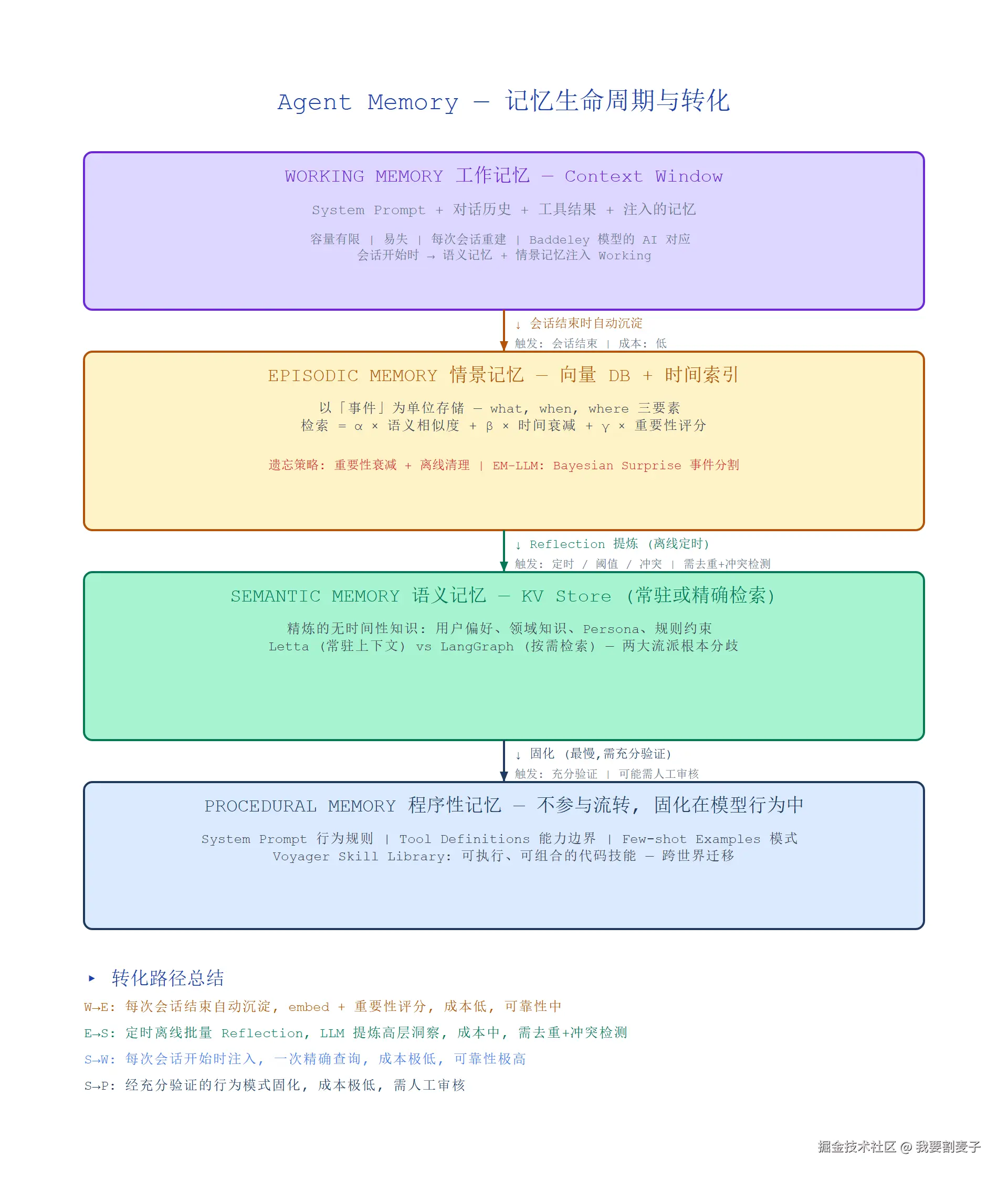
上图展示了记忆之间的转化关系全景:从 Working → Episodic 的自动沉淀,到 Episodic → Semantic 的 Reflection 提炼,再到 Semantic → Procedural 的长期固化。同时展示了 Collective Memory 与各 Agent 私有记忆的共享与隔离关系。
四、记忆的生命周期与转化
四类记忆不是孤立的------它们之间存在动态的转化关系。这一点在原始认知模型中没有对应,是 AI Agent 独有的工程挑战。
4.1 转化路径
go
// 记忆生命周期管理器
type MemoryLifecycleManager struct {
    working     *WorkingMemory
    episodic    *EpisodicStore
    semantic    *SemanticStore
    procedural  *ProceduralConfig
}

// 路径 1: Working → Episodic(自动)
// 每次对话结束时,工作记忆自动沉淀为情景记忆事件
func (m *MemoryLifecycleManager) CommitSession(session *Session) error {
    record := EpisodicRecord{
        Timestamp:  time.Now(),
        Content:    summarizeSession(session),
        Importance: llmScoreImportance(session),  // LLM 评分 1-10
        Embedding:  embed(session.Summary),
        ThreadID:   session.ID,
    }
    return m.episodic.Store(record)
}

// 路径 2: Episodic → Semantic(需要 Reflection)
// 从多条情景记忆中提炼语义知识------定时批量处理,不阻塞用户交互
func (m *MemoryLifecycleManager) Reflect(ctx context.Context, userID string) error {
    recent := m.episodic.Query(userID, sinceLastReflection(userID), limit=20)
    if len(recent) < 3 {
        return nil // 不够多,不值得反思
    }

    insights := m.llmGenerate(ctx, buildReflectionPrompt(recent))
    for _, ins := range insights {
        if ins.Confidence > 0.7 && !m.semantic.AlreadyExists(ins) {
            m.semantic.Upsert(userID, ins.Key, ins.Value)
        }
    }
    return nil
}

// 路径 3: Semantic → Working(注入)
// 每次新对话开始时注入用户画像
func (m *MemoryLifecycleManager) InjectIntoWorking(userID string) string {
    profile := m.semantic.GetProfile(userID)
    prefs   := m.semantic.GetPreferences(userID)
    return fmt.Sprintf("[用户: %s, 偏好: %v]", profile, prefs)
}

// 路径 4: Semantic → Procedural(固化,最慢)
// 经过充分验证的行为模式固化为 System Prompt 或 Fine-tune 样本
func (m *MemoryLifecycleManager) Solidify(rule Rule, evidenceCount int) {
    if evidenceCount >= SOLIDIFICATION_THRESHOLD {
        m.procedural.AddSystemRule(rule.Content)
        logSolidification(rule)
    }
}
4.2 关键设计决策
| 转化路径 | 触发时机 | 成本 | 可靠性要求 |
|---|---|---|---|
| Working → Episodic | 每次会话结束 | 低(一次 embed + insert) | 中 |
| Episodic → Semantic | 定时离线(夜间/批量) | 中(LLM 调用反思) | 高(需去重+冲突检测) |
| Semantic → Working | 每次会话开始 | 低(一次精确查询) | 极高 |
| Semantic → Procedural | 经过充分验证后 | 低(追加配置) | 极高(需人工审核) |
4.3 EM-LLM 的事件分割贡献
EM-LLM(ICLR 2025)提出了一个关键创新:事件分割(Event Segmentation) 。不是按轮次或 token 数切割情景记忆,而是用 Bayesian Surprise 检测事件边界------当上下文发生显著变化时自动切分为新事件。
vbnet
原始 token 序列
    │
    ▼ Bayesian Surprise 检测边界
    ├── Event 1: "用户询问天气"       [tokens 0-145]
    ├── Event 2: "Agent 调用 API"     [tokens 146-312]
    ├── Event 3: "返回结果并解释"     [tokens 313-489]
    └── Event 4: "用户追问细节"       [tokens 490-...]
    │
    ▼ 两阶段检索
  Stage 1: 语义相似度 → 找到 Event 1
  Stage 2: 时间邻近扩展 → 带出 Event 2, 3, 4(保持事件完整性)
这比固定长度的 sliding window 更接近人类处理情景记忆的方式------人类记忆也是按"事件"而非"token 数"组织的。
五、遗忘策略------被忽视的记忆管理维度
几乎所有论文都在研究"怎么存更多",很少有人讨论"怎么忘更好"。但不遗忘反而使系统更差------当 episodic memory 无限增长,检索精度会随噪声密度上升而下降。
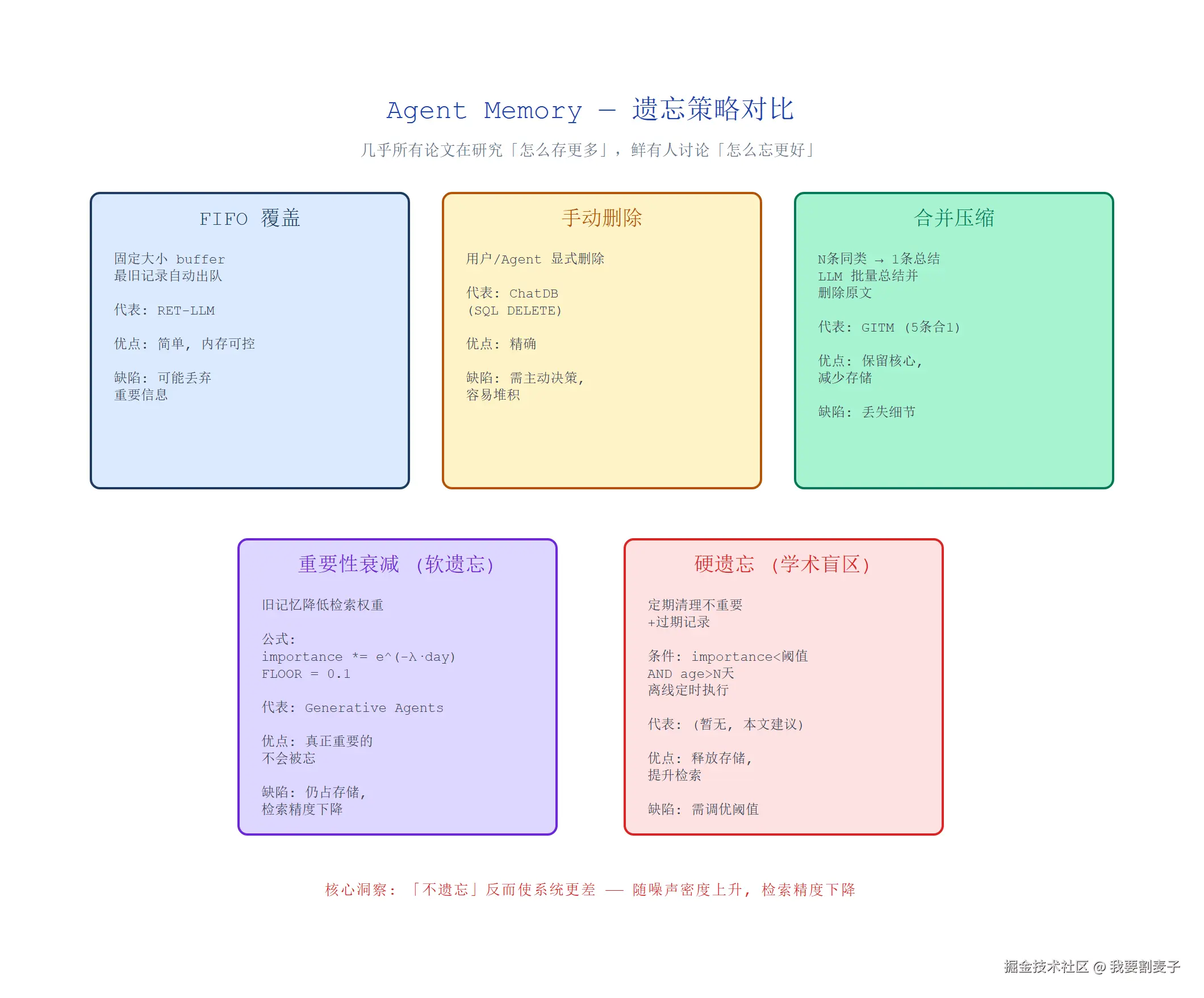
上图对比了五种主流遗忘策略在不同维度上的表现。
5.1 策略对比
| 策略 | 实现方式 | 代表系统 | 优点 | 缺陷 |
|---|---|---|---|---|
| FIFO 覆盖 | 固定 buffer,最旧的出队 | RET-LLM | 简单,内存可控 | 可能丢弃重要旧信息 |
| 手动删除 | 用户/Agent 显式删除 | ChatDB | 精确 | 需主动决策,容易堆积 |
| 合并压缩 | N 条同类 → 1 条总结 | GITM | 保留核心,减少存储 | 丢失细节 |
| 重要性衰减 | low-importance 沉到底部 | Generative Agents | 软遗忘,不丢失数据 | 仍然占用存储 |
| 硬遗忘 | 定期清理低于阈值的老记录 | (学术盲区) | 释放存储,提升检索质量 | 需要调阈值 |
5.2 Golang 实现
go
// 遗忘策略接口
type ForgettingStrategy interface {
    ShouldForget(record EpisodicRecord) bool
}

// 策略 1: 软遗忘------重要性衰减
type ImportanceDecay struct {
    DecayRate float64 // 如 0.1 => 每天衰减 10%
}

func (s *ImportanceDecay) Apply(records []EpisodicRecord) []EpisodicRecord {
    for i := range records {
        days := time.Since(records[i].Timestamp).Hours() / 24
        records[i].Importance *= math.Exp(-s.DecayRate * days)
        if records[i].Importance < 0.1 {
            records[i].Importance = 0.1 // floor------不完全消失
        }
    }
    return records
}

// 策略 2: 硬遗忘------存储清理(通常离线执行)
type HardForget struct {
    ImportanceThreshold float64
    AgeDaysThreshold    int
}

func (s *HardForget) Cleanup(store EpisodicStore, userID string) (int, error) {
    candidates, err := store.Query(userID, QueryFilter{
        ImportanceMax: s.ImportanceThreshold,
        OlderThanDays: s.AgeDaysThreshold,
    })
    if err != nil {
        return 0, err
    }
    for _, record := range candidates {
        store.Delete(record.ID)
    }
    return len(candidates), nil
}

// 策略 3: 合并压缩------同类信息聚合
type MergeCompress struct {
    MergeThreshold int // 同类记录达到 N 条时触发合并
}

func (s *MergeCompress) Compact(store EpisodicStore, userID, topic string) error {
    related := store.FindByTopic(userID, topic)
    if len(related) < s.MergeThreshold {
        return nil
    }
    summary := llmSummarize(related) // LLM 总结 N 条 → 1 条
    for _, old := range related {
        store.Delete(old.ID)
    }
    return store.Store(EpisodicRecord{
        Content:    summary,
        Importance: maxImportance(related),
        Timestamp:  time.Now(),
    })
}

// 遗忘调度器:定时执行
type ForgettingScheduler struct {
    strategies []ForgettingStrategy
}

func (s *ForgettingScheduler) RunDaily(ctx context.Context) {
    // 在用户不活跃的时间段(如凌晨 3 点)运行
    for _, strat := range s.strategies {
        strat.Apply(...)
    }
}
六、框架实现对比
| 维度 | Generative Agents | Letta (MemGPT) | LangGraph | CrewAI | EM-LLM |
|---|---|---|---|---|---|
| Working | Context Window | Context Window | Checkpointer (state) | 当前对话 | Context Window |
| Episodic | Memory Stream (recency×importance×relevance) | Archival Memory (向量DB) | Store ("episodic" ns) | Unified Memory (composite score) | Event-based (Bayesian Surprise 分割) |
| Semantic | Reflections 写回 Stream | Memory Blocks (常驻、自编辑) | Store ("semantic" ns) | Unified Memory (同一 DB) | (不单独区分) |
| Procedural | Planning 机制 | System Prompt | Tool Defs + Prompt | Agent Role Config | --- |
| 核心创新 | Reflection | Agent 自己管理记忆(tool calling) | namespace 隔离的通用 Store | 统一向量库 + 复合评分 | 认知式事件分割 |
| 遗忘策略 | 重要性衰减 | 手动 (memory_replace) | 开发者自行实现 | --- | --- |
| 分类哲学 | 学术完整性优先 | Agent 自主管理优先 | 灵活性与自由度优先 | 简单统一优先 | 认知逼真度优先 |
关键分歧:Letta 让 Agent 自己管理语义记忆(用 tool calling),比其他框架更"认知真实"但也更激进;LangGraph 把分类决策完全交给开发者,是最灵活也最需要设计能力的方案。
七、Golang 参考实现
以下是一个最小可行架构的完整骨架。不是生产级代码,但覆盖了四类核心记忆的读写检索逻辑,可以作为实际项目的起点。
7.1 核心接口定义
scss
package memory

import (
    "context"
    "time"
)

// ============================================================
// 核心类型
// ============================================================

// MemoryVector 记忆项的向量表示(感知层输出)
type MemoryVector []float32

// MemoryRecord 通用记忆记录
type MemoryRecord struct {
    ID         string        `json:"id"`
    Content    string        `json:"content"`
    Embedding  MemoryVector  `json:"embedding"`
    Importance float64       `json:"importance"`
    CreatedAt  time.Time     `json:"created_at"`
    UpdatedAt  time.Time     `json:"updated_at"`
    Metadata   map[string]any `json:"metadata"`
}

// RetrievalScore 检索评分
type RetrievalScore struct {
    SemanticSimilarity float64
    Recency            float64
    Importance         float64
    Composite          float64
}

// ============================================================
// 感知层接口 (Perceptual Memory)
// ============================================================

type Embedder interface {
    Embed(ctx context.Context, text string) (MemoryVector, error)
    EmbedBatch(ctx context.Context, texts []string) ([]MemoryVector, error)
    Dimension() int
}

// ============================================================
// 工作记忆接口 (Working Memory)
// ============================================================

type WorkingMemory interface {
    // 管理上下文窗口内的信息
    Append(msg Message)
    GetWindow(maxTokens int) []Message
    Summarize(ctx context.Context, model LLM) (string, error)
    // 注入外部记忆
    Inject(block string) // 语义记忆常驻块
    InjectEpisodic(results []MemoryRecord) // 情景检索结果
}

type Message struct {
    Role      string    `json:"role"`     // system / user / assistant / tool
    Content   string    `json:"content"`
    ToolName  string    `json:"tool,omitempty"`
    Timestamp time.Time `json:"timestamp"`
}

// ============================================================
// 情景记忆接口 (Episodic Memory)
// ============================================================

type EpisodicStore interface {
    // 写入
    Store(record MemoryRecord) error
    StoreBatch(records []MemoryRecord) error

    // 检索(时间+语义混合)
    Search(ctx context.Context, query string, opts SearchOptions) ([]MemoryRecord, error)
    SearchByTime(userID string, since, until time.Time) ([]MemoryRecord, error)

    // 管理
    UpdateImportance(id string, importance float64) error
    Delete(id string) error

    // 遗忘
    ApplyForgetting(strategy ForgettingStrategy, userID string) (int, error)
}

type SearchOptions struct {
    UserID    string
    Limit     int
    // 三要素权重
    Alpha     float64 // semantic weight
    Beta      float64 // recency weight
    Gamma     float64 // importance weight
    // 门控
    MinScore  float64 // 低于此分数的结果不返回(解决冷启动问题)
}

// ============================================================
// 语义记忆接口 (Semantic Memory)
// ============================================================

type SemanticStore interface {
    // 精确读写(语义记忆应该是结构化的)
    Get(namespace, key string) (string, error)
    Put(namespace, key string, value any) error
    Delete(namespace, key string) error
    List(namespace string) (map[string]any, error)

    // 用户画像(最常用的语义记忆子集)
    GetProfile(userID string) (*UserProfile, error)
    UpdatePreference(userID, key, value string) error
}

// ============================================================
// 反思机制 (Reflection)
// ============================================================

type ReflectionEngine interface {
    // 从情景记忆中提炼语义知识
    Reflect(ctx context.Context, userID string, recent []MemoryRecord) ([]Insight, error)
}

type Insight struct {
    Key        string  `json:"key"`
    Value      string  `json:"value"`
    Confidence float64 `json:"confidence"`
    Evidence   []string `json:"evidence"` // 支撑这条 insight 的 episodic record IDs
}

// ============================================================
// 前瞻记忆接口 (Prospective Memory)
// ============================================================

type ProspectiveStore interface {
    // 目标追踪
    SetGoal(goal Goal) error
    GetActiveGoals(userID string) ([]Goal, error)
    CompleteGoal(goalID string) error

    // 中断恢复
    SaveCheckpoint(taskID string, context string) error
    ResumeTask(taskID string) (string, error) // 返回恢复上下文
}
7.2 核心实现:混合检索
go
// 情景记忆的检索实现------这是整个系统最核心的逻辑
func (s *episodicStore) Search(
    ctx context.Context, query string, opts SearchOptions,
) ([]MemoryRecord, error) {
    if opts.Limit == 0 {
        opts.Limit = 5
    }
    if opts.Alpha == 0 && opts.Beta == 0 && opts.Gamma == 0 {
        // 默认权重(Generative Agents 风格)
        opts.Alpha, opts.Beta, opts.Gamma = 1.0, 1.0, 1.0
    }

    // Step 1: 语义相似度检索(粗筛)
    queryVec, err := s.embedder.Embed(ctx, query)
    if err != nil {
        return nil, fmt.Errorf("embed query: %w", err)
    }

    candidates, err := s.vectorDB.Search(ctx, queryVec, opts.Limit*3) // 过采样
    if err != nil {
        return nil, fmt.Errorf("vector search: %w", err)
    }

    // Step 2: 复合评分
    now := time.Now()
    type scored struct {
        record MemoryRecord
        score  RetrievalScore
    }
    var scored []scored

    for _, c := range candidates {
        // 语义相似度(从向量搜索中获取)
        semanticScore := c.Score

        // 时间衰减:指数衰减,越近越高
        hoursAgo := now.Sub(c.Record.CreatedAt).Hours()
        recencyScore := math.Exp(-0.01 * hoursAgo) // λ=0.01

        // 重要性(LLM 评分或默认)
        importanceScore := c.Record.Importance
        if importanceScore == 0 {
            importanceScore = 5.0 // 默认中等重要
        }

        composite := opts.Alpha*semanticScore +
            opts.Beta*recencyScore +
            opts.Gamma*importanceScore/10.0

        // 门控:低于阈值的直接丢弃
        if composite < opts.MinScore {
            continue
        }

        scored = append(scored, scored{c.Record, RetrievalScore{
            SemanticSimilarity: semanticScore,
            Recency:            recencyScore,
            Importance:         importanceScore,
            Composite:          composite,
        }})
    }

    // Step 3: 按复合分数排序
    sort.Slice(scored, func(i, j int) bool {
        return scored[i].score.Composite > scored[j].score.Composite
    })

    // Step 4: 截断
    if len(scored) > opts.Limit {
        scored = scored[:opts.Limit]
    }

    records := make([]MemoryRecord, len(scored))
    for i, s := range scored {
        records[i] = s.record
    }

    return records, nil
}
7.3 记忆管理器:聚合所有类型
go
// MemoryManager 是所有记忆类型的聚合入口
type MemoryManager struct {
    embedder    Embedder
    working     WorkingMemory
    episodic    EpisodicStore
    semantic    SemanticStore
    prospective ProspectiveStore
    reflector   ReflectionEngine
    llm         LLM
}

func NewMemoryManager(cfg Config) (*MemoryManager, error) {
    embedder, err := NewOpenAIEmbedder(cfg.EmbeddingModel)
    if err != nil {
        return nil, err
    }

    return &MemoryManager{
        embedder:    embedder,
        working:     NewSlidingWindow(cfg.MaxWindowTokens),
        episodic:    NewPGVectorStore(cfg.DBConn, embedder),
        semantic:    NewRedisStore(cfg.RedisAddr), // 语义记忆用 Redis 追求低延迟
        prospective: NewInMemoryProspectiveStore(),
        reflector:   NewLLMReflector(cfg.ReflectModel),
        llm:         NewOpenAI(cfg.Model),
    }, nil
}

// OnSessionStart 每次新会话开始时调用
func (m *MemoryManager) OnSessionStart(ctx context.Context, userID string) error {
    // 1. 注入语义记忆(常驻)
    profile, err := m.semantic.GetProfile(userID)
    if err != nil {
        return err
    }
    m.working.Inject(formatProfileBlock(profile))

    // 2. 检索相关情景记忆(按需)
    recentEpisodes, err := m.episodic.Search(ctx, "recent interactions", SearchOptions{
        UserID:  userID,
        Limit:   3,
        Alpha:   0.5,
        Beta:    0.3,
        Gamma:   0.2,
        MinScore: 0.3, // 门控:太不相关的不要注入
    })
    if err != nil {
        return err
    }
    m.working.InjectEpisodic(recentEpisodes)

    return nil
}

// OnSessionEnd 每次会话结束时调用
func (m *MemoryManager) OnSessionEnd(session *Session) error {
    record := MemoryRecord{
        Content:    buildSessionSummary(session),
        Importance: m.llm.ScoreImportance(session),
        Embedding:  m.embedder.Embed(ctx, session.Summary),
        CreatedAt:  time.Now(),
        Metadata: map[string]any{
            "user_id":    session.UserID,
            "thread_id":  session.ThreadID,
            "msg_count":  len(session.Messages),
        },
    }
    return m.episodic.Store(record)
}

// NightlyReflection 离线反思任务(每天凌晨执行)
func (m *MemoryManager) NightlyReflection(ctx context.Context, userID string) error {
    recent, err := m.episodic.SearchByTime(userID,
        time.Now().Add(-24*time.Hour), time.Now())
    if err != nil || len(recent) < 3 {
        return err
    }

    insights, err := m.reflector.Reflect(ctx, userID, recent)
    if err != nil {
        return err
    }

    for _, ins := range insights {
        if ins.Confidence < 0.7 {
            continue
        }
        if exists, _ := m.semantic.Get("insights", ins.Key); exists != "" {
            continue // 去重:已有相似 insight
        }
        m.semantic.Put("insights", ins.Key, ins.Value)
    }

    // 同时执行遗忘清理
    cleaned, _ := m.episodic.ApplyForgetting(&HardForget{
        ImportanceThreshold: 1.0,
        AgeDaysThreshold:    30,
    }, userID)
    log.Printf("nightly reflection: %d insights, cleaned %d old records", len(insights), cleaned)

    return nil
}
7.4 最小可跑示例
less
func main() {
    mgr, _ := memory.NewMemoryManager(memory.Config{
        EmbeddingModel: "text-embedding-3-small",
        Model:          "gpt-4o",
        ReflectModel:   "gpt-4o-mini", // 反思用便宜模型
        DBConn:         os.Getenv("PG_CONN"),
        RedisAddr:      os.Getenv("REDIS_ADDR"),
    })

    ctx := context.Background()
    userID := "user-zhangsan"

    // 1. 会话开始------注入记忆
    mgr.OnSessionStart(ctx, userID)

    // 2. 模拟一轮对话
    session := &memory.Session{
        UserID:   userID,
        ThreadID: "conv-042",
        Messages: []memory.Message{
            {Role: "user", Content: "帮我把登录页的样式改成 Material Design"},
            {Role: "assistant", Content: "好的,我先看一下现在的 login.go..."},
        },
    }

    // 3. 会话结束------自动沉淀
    mgr.OnSessionEnd(session)

    // 4. 下次会话------检索到上次对话
    records, _ := mgr.episodic.Search(ctx, "登录页面样式修改", memory.SearchOptions{
        UserID: userID, Limit: 3,
    })
    for _, r := range records {
        fmt.Printf("[%s] %s (importance: %.1f)\n",
            r.CreatedAt.Format("01-02 15:04"), r.Content, r.Importance)
    }
    // Output:
    // [07-10 15:23] 用户要求用 Material Design 修改登录页面样式 (importance: 7.0)
}
八、总结:双轴设计框架
综合全部分析,Agent 记忆系统的完整设计空间可以归纳为一个双轴框架:
分类轴 (What) ------记忆的类型:
| 类型 | 核心问题 | 存储 | 检索 | 生命周期 |
|---|---|---|---|---|
| Perceptual | 输入如何编码? | ---(编码层) | --- | 实时 |
| Working | 此刻在思考什么? | Context Window | Attention | 秒级 |
| Episodic | 过去发生了什么? | 向量DB + 时间索引 | 时间+语义混合 | 日/周级 |
| Semantic | 知道什么事实? | KV Store (快速读写) | 常驻或精确匹配 | 长期 |
| Procedural | 怎么做? | System Prompt + Tool Defs | 始终生效 | 版本级 |
| Prospective | 将来要做什么? | 任务队列 | 优先级 + 状态 | 会话/跨会话 |
管理轴 (How) ------记忆的操作:
scss
写入策略              检索策略              遗忘策略           转化策略
    │                    │                    │                 │
自动 vs 主动         注入 vs 按需         软遗忘(衰减)        W→E (自动)
去重 vs 保留         时间 vs 语义         硬遗忘(删除)        E→S (Reflection)
实时 vs 批量         置信度门控           合并(压缩)          S→P (固化)
设计建议速查
| 你的需求 | 最小方案 | 完整方案 |
|---|---|---|
| "记一个会话就行" | Working(裸 Context Window) | + Checkpointer |
| "跨会话记住用户" | + Semantic Store | + 每次注入 Profile |
| "智能召回历史对话" | + Episodic Store | + 时间+语义混合检索 + 置信度门控 |
| "从经验中自我改进" | + Reflection 定时任务 | + Memory Blocks 自编辑 |
| "全都要" | 四类完整实现 + 前瞻记忆 | + 记忆生命周期管理 + 遗忘调度 |
这是一个渐进式的设计路径------不需要一开始就上全部组件。根据任务周期和复杂度,逐步叠加。
参考论文与框架
| 来源 | 核心贡献 |
|---|---|
| 认知科学到 AI Agent 记忆分类的完整映射 | 从认知科学到 AI 的完整理论映射 |
| Generative Agents (Park et al. 2023) | Memory Stream + Reflection 机制 |
| MemGPT / Letta (Packer et al. 2023) | Agent 自主管理记忆,Memory Blocks |
| Voyager (Wang et al. 2023) | Skill Library------可执行代码作为程序性记忆 |
| Reflexion (Shinn et al. 2023) | 极简 episodic buffer + verbal reinforcement |
| EM-LLM (Fountas et al. 2024) | Bayesian Surprise 事件分割 |
| LLM Agent Survey (Xi et al. 2023) | Memory Operations (Read/Write/Reflect) 框架 |