深夜食堂:那个让我加班到凌晨的 ! 符号
一个 C# 开发者的自白:从被编译器支配的恐惧,到与
!符号和解的故事
开篇:一个让人头秃的深夜
凌晨两点,办公室里只剩下我和屏幕上的错误信息在对峙:
bash
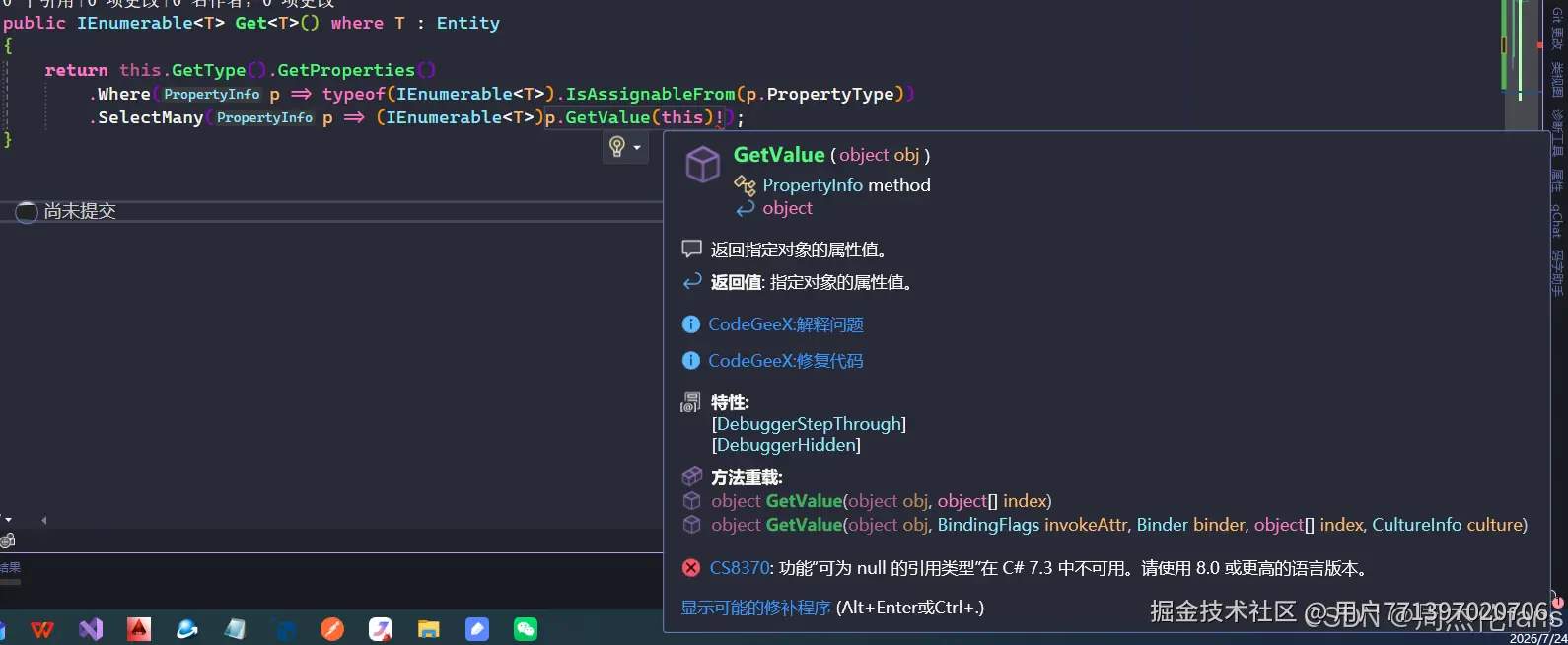
CS8370: 功能"可为 null 的引用类型"在 C# 7.3 中不可用。请使用 8.0 或更高的语言版本。"不就是个感叹号吗?"我揉了揉发酸的眼睛,"凭什么不让我用!"
是的,就是这个 !,在 C# 里它叫 null 包容运算符(null-forgiving operator),但在那一刻,它更像是在嘲笑我:"你能拿我怎样?"
第一章:! 到底是什么?
1.1 从问题说起
想象一下这个场景:你正在写一个方法,从数据库中获取用户信息:
csharp
public string GetUserName(int userId)
{
    var user = _db.Users.Find(userId);
    return user.Name; // ⚠️ 警告:user 可能是 null
}编译器很贴心地提醒你:"兄弟,如果用户不存在,user 就是 null,你调用 Name 会炸的!"
正常情况下,你应该这样写:
csharp
public string GetUserName(int userId)
{
    var user = _db.Users.Find(userId);
    return user?.Name ?? "未知用户"; // 安全!
}但有些时候,你就是 100% 确定某个值不会是 null,比如:
csharp
public Customer GetCustomer()
{
    var customer = _cache.Get("customer_123");
    return customer!; // 我保证!缓存里一定有!
}
这个 ! 就是对编译器说:"闭嘴,我知道我在做什么!"
1.2 通俗理解
把编译器想象成一个特别啰嗦的同事:
- 编译器:"老兄,这个变量可能是 null 哦~"
- 开发者:"不,我确定它不是。"
- 编译器:"可是...万一呢?"
- 开发者 :
!"没有万一,听我的!"
第二章:为什么会报错?
2.1 语言版本的"代沟"
C# 的发展就像手机系统升级:
- C# 7.3(你的项目):老年机,功能齐全但保守
- C# 8.0:智能手机,引入了"可为 null 的引用类型"这个新功能
!运算符:是 C# 8.0 的专属功能,需要"新系统"支持
你的项目还在用 C# 7.3,就像一个诺基亚想运行 iOS 应用,当然不行!
2.2 错误信息解读
bash
CS8370: 功能"可为 null 的引用类型"在 C# 7.3 中不可用。
请使用 8.0 或更高的语言版本。
翻译成人话:
- CS8370:错误编号,就像是"你闯红灯了"的代码
- 功能"可为 null 的引用类型":你在用 C# 8.0 的新功能
- C# 7.3 中不可用:你的"手机系统"不支持这个功能
- 请使用 8.0 或更高:要么升级系统,要么别用这个功能
第三章:解决方案(从入门到放弃)
方案一:升级语言版本(推荐 ✅)
修改项目文件,就像给手机升级系统:
xml
<!-- 你的 .csproj 文件 -->
<PropertyGroup>
    <TargetFramework>netcoreapp3.1</TargetFramework>
    <LangVersion>8.0</LangVersion>  <!-- 升级! -->
    <Nullable>enable</Nullable>      <!-- 开启新功能 -->
</PropertyGroup>
升级后,你可以愉快地使用 !:
csharp
var user = GetUser()!; // 编译通过!😊适合人群:有权限修改项目配置的人
方案二:移除 ! 运算符(兼容模式 🔧)
就像回到旧时代,用最原始的方式:
csharp
// 原来
.SelectMany(p => (IEnumerable<T>)p.GetValue(this)!)

// 改成
.SelectMany(p => (IEnumerable<T>)(p.GetValue(this) ?? Enumerable.Empty<T>()))
完整示例:
csharp
public IEnumerable<T> Get<T>() where T : Entity
{
    return this.GetType().GetProperties()
        .Where(p => typeof(IEnumerable<T>).IsAssignableFrom(p.PropertyType))
        .SelectMany(p =>
        {
            var value = p.GetValue(this);
            return value is IEnumerable<T> enumerable
                ? enumerable
                : Enumerable.Empty<T>();
        });
}适合人群:不能升级 C# 版本,但又想解决编译错误的人
方案三:完整兼容版本(最稳妥 👍)
完全抛弃 !,用最安全的方式:
csharp
public IEnumerable<T> Get<T>() where T : Entity
{
    var properties = this.GetType().GetProperties();
    var result = new List<T>();

    foreach (var prop in properties)
    {
        if (typeof(IEnumerable<T>).IsAssignableFrom(prop.PropertyType))
        {
            var value = prop.GetValue(this);
            if (value is IEnumerable<T> enumerable)
            {
                result.AddRange(enumerable);
            }
        }
    }

    return result;
}适合人群:追求稳定、不喜欢花里胡哨的人
第四章:! 的十八般武艺
4.1 告诉编译器"这个参数不是 null"
csharp
public void ProcessData(string? data)
{
    // 我保证 data 不是 null,因为我在调用前已经检查过了
    int length = data!.Length;
    Console.WriteLine($"数据长度:{length}");
}
4.2 断言对象存在
csharp
public Customer FindCustomer(int id)
{
    var customer = _context.Customers.FirstOrDefault(c => c.Id == id);
    return customer!; // 我知道 ID 一定存在
}
4.3 处理字典/集合
csharp
var dict = new Dictionary<string, string>
{
    ["name"] = "张三"
};

var name = dict["name"]!; // 我知道这个键一定存在
4.4 与 JSON 反序列化配合
csharp
var json = @"{""name"":""李四"",""age"":25}";
var customer = JsonSerializer.Deserialize<Customer>(json)!;
// 我保证 JSON 格式正确,一定能反序列化成功
4.5 单元测试中的使用
csharp
[Fact]
public void Test_GetCustomer_ShouldReturnValidCustomer()
{
    var customer = _service.GetCustomer(1)!;
    Assert.NotNull(customer);
    // 我保证测试环境下 customer 一定存在
}
第五章:底层探秘 - ! 到底做了什么?
5.1 编译前 vs 编译后
我们的代码:
csharp
var user = GetUser()!;
var name = user.Name;
编译后的 IL 代码(简化版):
il
// 注意:! 在 IL 层面没有任何特殊指令!
call GetUser        // 调用方法,获取用户
stloc.0             // 存储到局部变量
ldloc.0             // 加载局部变量
callvirt User.get_Name()  // 调用 Name 属性
震惊的发现 :! 在编译后的代码中消失了!它只是一个"编译器注释",告诉编译器:"别管这里,我知道我在做什么。"
5.2 状态机的角度
当 ! 出现在异步方法或迭代器中:
csharp
public async Task<string> GetDataAsync()
{
    var data = await GetDataFromApiAsync()!;
    return data.ToString();
}
编译器会生成一个状态机,但 ! 不会影响状态机的生成逻辑:
csharp
// 编译器生成的简化版状态机
private sealed class <GetDataAsync>d__0 : IAsyncStateMachine
{
    public int <>1__state;
    public AsyncTaskMethodBuilder<string> <>t__builder;
    private string <data>5__1;
    private TaskAwaiter<string> <>u__1;

    public void MoveNext()
    {
        // ! 不会在这里产生任何特殊逻辑
        // 它只是在编译时告诉编译器忽略 null 警告
    }
}
5.3 性能影响
csharp
// 使用 !
var customer = GetCustomer()!;

// 不使用 !(带 null 检查)
var customer = GetCustomer() ?? throw new Exception("Customer is null");
! 是零开销 的,运行时完全忽略它。而使用 ?? 或条件判断会产生额外的 IL 指令。
第六章:实际开发中的坑与经验
坑 1:过度使用导致 NullReferenceException
csharp
// ❌ 错误示例
var customer = _db.Customers.Find(999)!; // 如果 999 不存在呢?
var name = customer.Name; // 💥 NullReferenceException!

// ✅ 正确示例
var customer = _db.Customers.Find(999);
if (customer == null)
{
    throw new NotFoundException("用户不存在");
}
var name = customer.Name;
坑 2:与外部的"约定"不一致
csharp
// 第三方库文档说:这个方法可能返回 null
// 但你的代码:
var result = ThirdPartyLibrary.GetValue()!;
// 如果库真的返回了 null,游戏结束 😱
经验法则
- 只在你知道为什么的时候使用
! - 优先使用
??、?.等安全操作符 - 在单元测试中可以使用,因为环境可控
- 生产代码慎重使用,最好加上注释
csharp
var customer = _cache.Get("customer_123")!; // 缓存预热时已存入,不会为 null第七章:实战演练 - 一个完整的例子
假设我们在做一个电商系统:
csharp
public class OrderService
{
    private readonly IOrderRepository _orderRepo;
    private readonly IUserRepository _userRepo;
    private readonly IProductRepository _productRepo;

    public async Task<OrderDto> GetOrderDetailAsync(int orderId)
    {
        // 场景1:从数据库获取订单,我们知道订单一定存在
        var order = await _orderRepo.GetByIdAsync(orderId)!;

        // 场景2:获取用户信息,如果获取不到就抛异常
        var user = await _userRepo.GetByIdAsync(order.UserId)
            ?? throw new UserNotFoundException($"用户 {order.UserId} 不存在");

        // 场景3:获取产品信息,批量处理
        var productIds = order.Items.Select(i => i.ProductId);
        var products = productIds.Select(id => _productRepo.GetById(id)!)
                                 .ToList(); // 我们保证产品都存在

        // 场景4:缓存中的数据,肯定有值
        var cacheKey = $"order_summary_{orderId}";
        var summary = _cache.Get(cacheKey)!;

        return new OrderDto
        {
            Order = order,
            User = user,
            Products = products,
            Summary = summary
        };
    }
}
结尾:与 ! 和解
经过这个深夜的探索,我终于明白了:
!不是恶魔,它是你的"免检通行证"- 但要慎重使用,滥用会把自己坑进去
- 升级到 C# 8.0 是最好的选择
- 如果真的不能升级,用空合并运算符替代
现在,当我看到编译器的 null 警告时,我会想:
- "这个值真的可能为 null 吗?" → 如果是,加 null 检查
- "我有 100% 的把握不会为 null 吗?" → 如果是,加
! - "我是不是在偷懒?" → 如果是,好好写 null 检查!
后记:第二天,我把项目升级到了 .NET 6(支持 C# 10),再也不用为版本问题烦恼了。有时候,解决问题的最好方式,就是"打不过就加入" 😄
写于一个终于不用加班的夜晚
附录:快速参考卡
| 场景 | 使用 | 不使用 |
|---|---|---|
| 缓存数据 | var data = cache.Get(key)! |
var data = cache.Get(key) ?? LoadFromDB() |
| 数据库查询 | var user = db.Find(id)! |
var user = db.Find(id) ?? throw new NotFoundException() |
| 配置读取 | var config = Config.Get(key)! |
var config = Config.Get(key) ?? new DefaultConfig() |
| 单元测试 | var result = GetData()! |
var result = GetData(); Assert.NotNull(result) |
| 第三方库 | ❌ 不建议使用 | ✅ 使用 ?. 和 ?? |
记住 :! 不是"我保证不会错",而是"我愿意承担它出错的后果"。