跟着AI Agent学powershell
原文地址: pldz1.com/article/2fa...
视频制作工具: github.com/pldz1/html-...
更多参考: pldz1.com
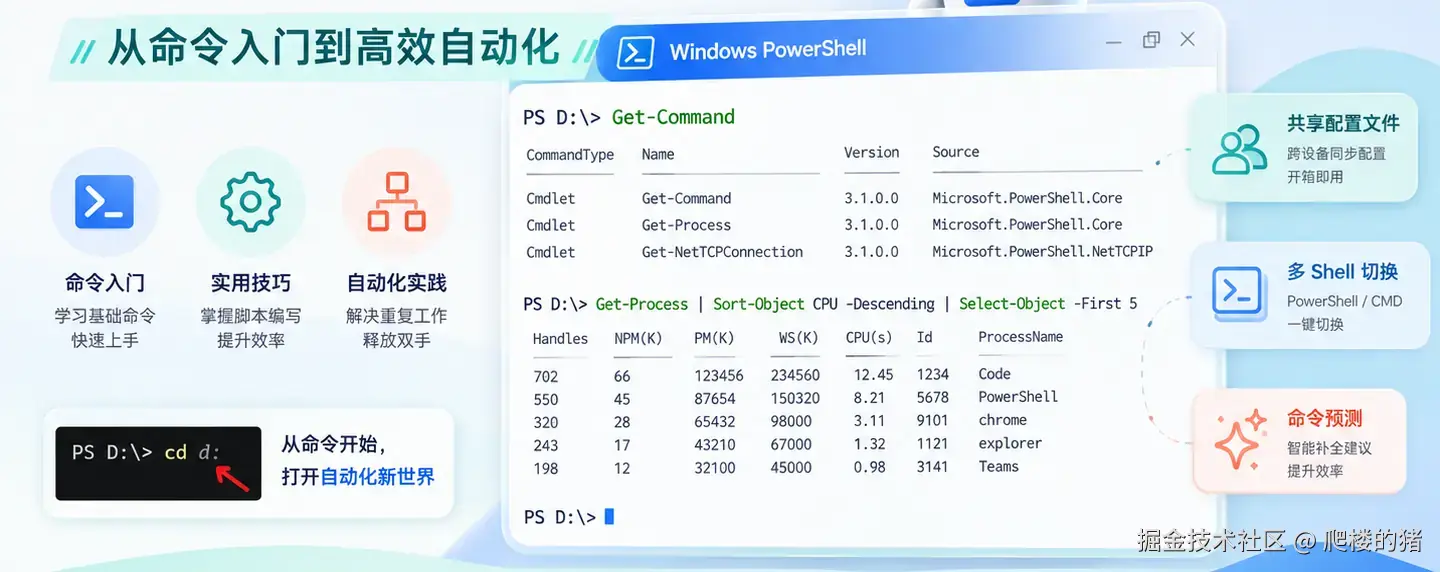
点击封面前往 B 站观看
之前,让codex配置了Windows的powershell版本到7之后,这里分享一些实用的ps的用法给大家
前排提示, powershell在windows上和 Windows terminal搭配起来 复用效果更好.
下面的内容包含了 AI的扩展,但是推荐大家阅读的已经打了 ⭐ 号标记
希望大家阅读完重点内容能回答这5个问题 哈哈哈
-
共享配置:$PROFILE 里用什么语法加载 shared-profile.ps1?
-
切换终端:在 PowerShell 里输入什么进入 CMD?
-
特有配置:关闭 PSReadLine 命令预测用什么命令?
-
Linux 类似命令:PowerShell 7 里查看当前路径,可以直接输入什么?
-
特有指令:查询本机 8080 端口用什么 PowerShell 命令?
⭐ 1. 共享配置
让 Windows PowerShell 5.1 和 PowerShell 7 共用同一套配置。
$PROFILE
PowerShell 启动时会自动执行 $PROFILE。
可以查看当前 Profile 路径:
powershell
$PROFILE不同 PowerShell 版本的 $PROFILE 路径可能不同,因此不建议把所有配置分别复制到每个 Profile。
更适合的方式是:
text
PS5 Profile ──┐
              ├── shared-profile.ps1
PS7 Profile ──┘
Profile 内容
在 PowerShell 5.1 和 PowerShell 7 的 $PROFILE 中都写:
powershell
. "$HOME\Documents\PowerShell\shared-profile.ps1". 是 PowerShell 的 dot-sourcing。
作用是:
text
读取 shared-profile.ps1
并把其中定义的 function / alias / 设置
加载到当前 PowerShell 会话
这样以后只需要修改:
text
shared-profile.ps1PS5 和 PS7 都会使用新的配置。
⭐ 2. 在不同终端 / Shell 之间切换
Windows Terminal 只是终端窗口。
里面可以运行不同 Shell:
text
cmd
Windows PowerShell 5.1
PowerShell 7
Git Bash
WSL2 Ubuntu
很多时候不需要重新开窗口,直接在当前 Shell 中启动另一个 Shell 即可。
PowerShell → Git Bash
自定义一个函数:
powershell
function git-bash {
    & "D:\Git\bin\bash.exe" --login -i
}
因此可以直接:
powershell
git-bash进入 Git Bash。
Shell 切换关系
可以把它理解成:
text
Windows Terminal
       │
       ├── cmd
       │
       ├── powershell
       │      └── Windows PowerShell 5.1
       │
       ├── pwsh
       │      └── PowerShell 7
       │
       ├── git-bash
       │      └── Git Bash
       │
       └── wsl
              └── WSL2 Ubuntu
常用:
text
当前 Shell              输入

PowerShell → CMD         cmd
CMD → PS5                powershell
CMD → PS7                pwsh
PS5 → PS7                pwsh
PS7 → PS5                powershell
PS → Git Bash            git-bash
PS / CMD → WSL           wsl
PS / CMD → Ubuntu        wsl -d Ubuntu
返回上一层                exit
3. PowerShell 特有配置与历史清理
⭐ 3.1 PS 7 关闭命令预测
PowerShell 的 PSReadLine 默认可能显示命令预测。

例如输入:
text
git后面可能出现灰色预测内容。
如果不需要,而且觉得妨碍输入,可以关闭:
powershell
Set-PSReadLineOption -PredictionSource None已经放入:
text
shared-profile.ps1所以每次启动 PS5 / PS7 都会自动关闭。
3.2 PowerShell 的历史记录和 CMD 不完全一样
PowerShell 的历史至少要区分两个部分:
text
PowerShell Session History
+
PSReadLine Persistent History
因此:
powershell
Clear-History并不一定等于:
text
彻底删除以前输入过的所有命令3.3 清理当前 PowerShell History
powershell
Clear-History查看:
powershell
Get-History3.4 PSReadLine 的磁盘历史
PSReadLine 会把历史保存到文件。
查看这个文件在哪里:
powershell
(Get-PSReadLineOption).HistorySavePath删除:
powershell
(Get-PSReadLineOption).HistorySavePath |
    Remove-Item
为了避免文件不存在时报错:
powershell
(Get-PSReadLineOption).HistorySavePath |
    Remove-Item -ErrorAction SilentlyContinue
3.5 清屏
powershell
Clear-Host也可以直接:
powershell
cls或者:
powershell
clear3.6 一次全部清理
定义:
powershell
function Clear-All {
    Clear-Host
    Clear-History
    (Get-PSReadLineOption).HistorySavePath |
        Remove-Item -ErrorAction SilentlyContinue
}
再定义:
powershell
Set-Alias cla Clear-All以后:
powershell
cla相当于:
text
清屏
+
清当前 PowerShell History
+
删除 PSReadLine 持久化历史
注意这里主要清理的是:
text
命令历史严格来说并不是传统意义上的系统 cache。
4. ⭐ 和 Linux / Bash 类似的常用命令
PowerShell 可以直接使用很多和 Bash 类似的名字。
当前路径
Bash:
bash
pwdPowerShell:
powershell
pwd本体:
powershell
Get-Location查看目录
powershell
lsPowerShell:
powershell
Get-ChildItem自定义:
powershell
ll也是:
powershell
Get-ChildItem查看隐藏文件:
powershell
Get-ChildItem -Force递归:
powershell
Get-ChildItem -Recurse切换目录
powershell
cd D:\work本体:
powershell
Set-Location D:\work查看文件
powershell
cat file.txt本体:
powershell
Get-Content file.txt前 20 行:
powershell
Get-Content file.txt -Head 20后 20 行:
powershell
Get-Content file.txt -Tail 20实时查看日志:
powershell
Get-Content app.log -Tail 50 -Wait类似:
bash
tail -f app.log复制
powershell
cp file1 file2本体:
powershell
Copy-Item移动 / 重命名
powershell
mv old.txt new.txt本体:
powershell
Move-Item删除
powershell
rm file.txt本体:
powershell
Remove-Item递归删除:
powershell
Remove-Item folder -Recurse创建目录
powershell
mkdir test也可以:
powershell
New-Item -ItemType Directory test进程 ps
可以:
powershell
psPowerShell 本体:
powershell
Get-Process例如:
powershell
ps直接查看当前进程。
查询 Python:
powershell
Get-Process pythonKill
PowerShell:
powershell
Stop-Process -Id 1234或者:
powershell
Stop-Process -Name python强制:
powershell
Stop-Process -Id 1234 -Forcegrep
PowerShell:
powershell
Select-String "error" file.log例如:
powershell
Select-String "error" *.log递归:
powershell
Get-ChildItem -Recurse -File |
    Select-String "error"
find
类似:
bash
find . -name "*.txt"PowerShell:
powershell
Get-ChildItem -Recurse -Filter "*.txt"which
Bash:
bash
which pythonPowerShell 更推荐:
powershell
Get-Command python只看路径:
powershell
(Get-Command python).Source如果存在多个 Python:
powershell
Get-Command python -AllWindows 自带命令也可以:
powershell
where.exe python查 Git / Python / Bash 在哪里
powershell
Get-Command python
Get-Command pip
Get-Command git
Get-Command bash
Get-Command java
例如:
powershell
(Get-Command python).Source可以直接得到 Python executable 路径。
环境变量
类似 Bash:
bash
echo $PATHPowerShell:
powershell
$env:PATH查看全部:
powershell
Get-ChildItem Env:常见对应
text
Linux / Bash        PowerShell

pwd                 pwd / Get-Location
ls                  ls / Get-ChildItem
cat                 cat / Get-Content
cd                  cd / Set-Location
cp                  cp / Copy-Item
mv                  mv / Move-Item
rm                  rm / Remove-Item
mkdir               mkdir / New-Item

ps                  ps / Get-Process
kill                Stop-Process

grep                Select-String
find                Get-ChildItem -Recurse
which               Get-Command
which -a            Get-Command -All

head                Get-Content -Head
tail                Get-Content -Tail
tail -f             Get-Content -Tail -Wait

sort                Sort-Object
uniq                Sort-Object -Unique
wc                  Measure-Object

ping                Test-Connection
dig                 Resolve-DnsName
traceroute          Test-NetConnection -TraceRoute
5. PowerShell 常用特有命令
这部分是 PowerShell 比单纯模仿 Linux 命令更有价值的地方。
5.1 查询程序在哪里
powershell
Get-Command python例如:
powershell
Get-Command python
Get-Command pip
Get-Command git
Get-Command pwsh
Get-Command powershell
Get-Command bash
只取 executable 路径:
powershell
(Get-Command python).Source查看所有匹配项:
powershell
Get-Command python -All5.2 查询程序类型
例如:
powershell
Get-Command python可能显示:
text
CommandType    Name          Source
-----------    ----          ------
Application    python.exe    ...
而:
powershell
Get-Command ll可能显示:
text
Alias
powershell
Get-Command git-bash会显示:
text
Function因此 Get-Command 不只是 which,还能判断它究竟是:
text
Application
Cmdlet
Function
Alias
Script
5.3 查询进程
powershell
Get-Process查 Python:
powershell
Get-Process python查 Chrome:
powershell
Get-Process *chrome*按照 CPU 时间排序:
powershell
Get-Process |
    Sort-Object CPU -Descending |
    Select-Object -First 10 Name, Id, CPU
按照内存排序:
powershell
Get-Process |
    Sort-Object WorkingSet -Descending |
    Select-Object -First 10 ProcessName,
        @{N='MemoryMB';E={[math]::Round($_.WorkingSet / 1MB, 1)}}
5.4 查询线程
指定 PID:
powershell
(Get-Process -Id 1234).Threads统计每个进程线程数量:
powershell
Get-Process |
    Select-Object Id, ProcessName,
        @{N='Threads';E={$_.Threads.Count}} |
    Sort-Object Threads -Descending
5.5 查询 TCP 连接
powershell
Get-NetTCPConnection相当于 Linux 常用:
bash
ss或者:
text
netstat5.6 查询正在监听的端口
powershell
Get-NetTCPConnection -State Listen例如查 8080:
powershell
Get-NetTCPConnection -LocalPort 8080重要字段:
text
LocalAddress
LocalPort
RemoteAddress
RemotePort
State
OwningProcess
5.7 查询哪个程序占用了端口
例如查 8080:
powershell
Get-NetTCPConnection -LocalPort 8080假设:
text
OwningProcess = 1234然后:
powershell
Get-Process -Id 1234也可以直接:
powershell
Get-NetTCPConnection -LocalPort 8080 |
    ForEach-Object {
        Get-Process -Id $_.OwningProcess
    }
5.8 UDP
powershell
Get-NetUDPEndpoint5.9 测试端口能不能连接
例如:
powershell
Test-NetConnection github.com -Port 443数据库:
powershell
Test-NetConnection localhost -Port 5432Web 服务:
powershell
Test-NetConnection localhost -Port 8080这是排查:
text
服务有没有开
端口有没有监听
防火墙有没有拦
网络能不能连通
时非常实用的命令。
5.10 Ping
powershell
Test-Connection google.com例如:
powershell
Test-Connection google.com -Count 25.11 DNS
powershell
Resolve-DnsName github.com5.12 路由
powershell
Test-NetConnection github.com -TraceRoute5.13 Windows 服务
查看:
powershell
Get-Service查某类服务:
powershell
Get-Service *docker*启动:
powershell
Start-Service sshd停止:
powershell
Stop-Service sshd重启:
powershell
Restart-Service sshd5.14 查询对象有哪些属性
PowerShell 很重要的命令:
powershell
Get-Member例如:
powershell
Get-Process | Get-Member可以查看 Get-Process 输出对象拥有哪些:
text
Property
Method
Member
如果不知道:
text
"这个结果还能查什么?"就可以:
powershell
... | Get-Member例如:
powershell
Get-NetTCPConnection | Get-Member5.15 对结果进行筛选
例如只看 CPU 大于 10 的进程:
powershell
Get-Process |
    Where-Object CPU -gt 10
完整写法:
powershell
Get-Process |
    Where-Object { $_.CPU -gt 10 }
5.16 选择字段
powershell
Get-Process |
    Select-Object Id, ProcessName, CPU
5.17 排序
powershell
Get-Process |
    Sort-Object CPU -Descending
5.18 只取前几个
powershell
Get-Process |
    Select-Object -First 10
组合:
powershell
Get-Process |
    Sort-Object CPU -Descending |
    Select-Object -First 10 Id, ProcessName, CPU