Agentic memory systems are a foundational component of capable AI agents, addressing the fundamental limitation of finite context windows.
智能体记忆系统是高性能 AI 智能体的基础组件,用以解决上下文窗口长度有限这一根本性约束
capable ˈkeɪpəb(ə)l adj. 有能力的;有本领的,能干的;可以......的,容许......的
coherent kəʊˈhɪərənt adj. 有条理的,连贯的;说话条理清晰的,易于理解的;团结一致的,凝聚的
reactive riˈæktɪv adj. 反应的;电抗的;反动的
anticipatory ænˌtɪsɪˈpeɪtəri adj. 预期的;提早发生的;期待着的
intervention ˌɪntəˈvenʃ(ə)n n. 干预,介入;调停,斡旋;(为改善情况尤指病痛采取的)措施,做法
compound ˈkɒmpaʊnd
n. 混合物,化合物;复合词;大院,有围墙的场地
adj. 复合的,混合的;以复利计算的
v. 使加重,使恶化;合成,混合;以复利计算支付;和解,私了
We have surveyed:
• A four-way taxonomy (working, episodic, semantic, procedural) that mirrors cognitive science and reflects distinct engineering requirements.
• Five architectural families: RAG-based, summarization-based, graph-based, key-value networks, and tiered virtual context (MemGPT).
• Four core operations: write (with importance scoring and contradiction detection), read/retrieve (with temporal decay and query expansion), update (with conflict resolution and consolidation), and reflect (meta-cognitive insight generation).
• Multi-turn and multi-agent extensions: user modeling, session continuity, shared memory pools, and blackboard architectures.
• RL training of memory systems: reward signals for memory operations, learning what to remember, and memory-augmented policy optimization.
• Proactive memory: decoupled memory agents that monitor executor behavior and inject reminders before drift compounds---a shift from reactive retrieval to anticipatory intervention.
a shift from reactive retrieval to anticipatory intervention (从被动检索转向主动干预)
The field is rapidly evolving. Key open challenges include:
(1) memory grounding---ensuring retrieved memories are faithfully incorporated rather than ignored or hallucinated over;
(2) scalable consistency---maintaining coherent shared memory in large multi-agent systems;
(3) privacy-preserving memory---enabling personalization without compromising user data; and
(4) proactive injection policies---learning when and what to remind the executor without overwhelming its context.
As context windows grow, the boundary between in-context and external memory will shift, but the fundamental need for selective, structured, retrievable information storage will remain
drift compounds
drift:漂移,Agent 慢慢遗忘目标、偏离任务方向
compounds:偏差越滚越大、问题不断累积恶化
reactive retrieval 被动检索(旧模式)
需要了 → 才去搜记忆
主 Agent 自己意识到 "我忘了",才发起检索
anticipatory intervention 预判式干预(新模式‑主动记忆)
还没忘、还没出错 → 记忆模块提前把信息喂进去
举例
被动检索(reactive,传统记忆)
在写一份方案,写到第 5 步才突然想起:"哦,我忘了用户之前的约束条件",这时 Agent 才调用检索,翻历史记忆
问题:已经跑偏一会了
主动记忆(proactive)
后台独立记忆 Agent 一直在观察你的每一步操作;
当它判断:再往下走几步就会遗忘关键条件、任务即将漂移,不等你发问,就主动把约束条件插入对话,给你提醒
主动记忆
dozen ˈdʌz(ə)n n. 一打,十二个;大量,许多;十多个
dedicated ˈdedɪkeɪtɪd
adj. 专心致志的,献身的;专用的,专门用途的
vt. 致力于,献身于;(在书、音乐或作品的前部)题献词;为(大楼,纪念碑)揭幕
背景
A fundamental challenge in long-horizon agentic tasks is behavioral state decay: after dozens of tool calls, the executor agent loses track of its original goals, constraints, and accumulated context. Standard memory systems address this reactively---the agent queries memory when it needs information. Proactive memory architectures 253 (Meta AI, July 2026, "Remember When It Matters") take a different approach: a dedicated memory agent monitors the executor and injects constraints before the executor drifts.
在长期目标的 agentic 任务中,一个根本性挑战是行为状态退化(behavioral state decay):在数十次工具调用之后,执行器代理会失去对原始目标、约束条件以及累积上下文的跟踪。传统的记忆系统对此采取的是反应式方式(reactively,被动式)------当需要信息时才查询记忆。而主动式(Proactive)记忆架构253(Meta AI,2026年7月,"记住关键时刻")则采用不同的方法:专门的记忆 agent 会持续监控执行器,并在执行器偏离之前注入约束条件。
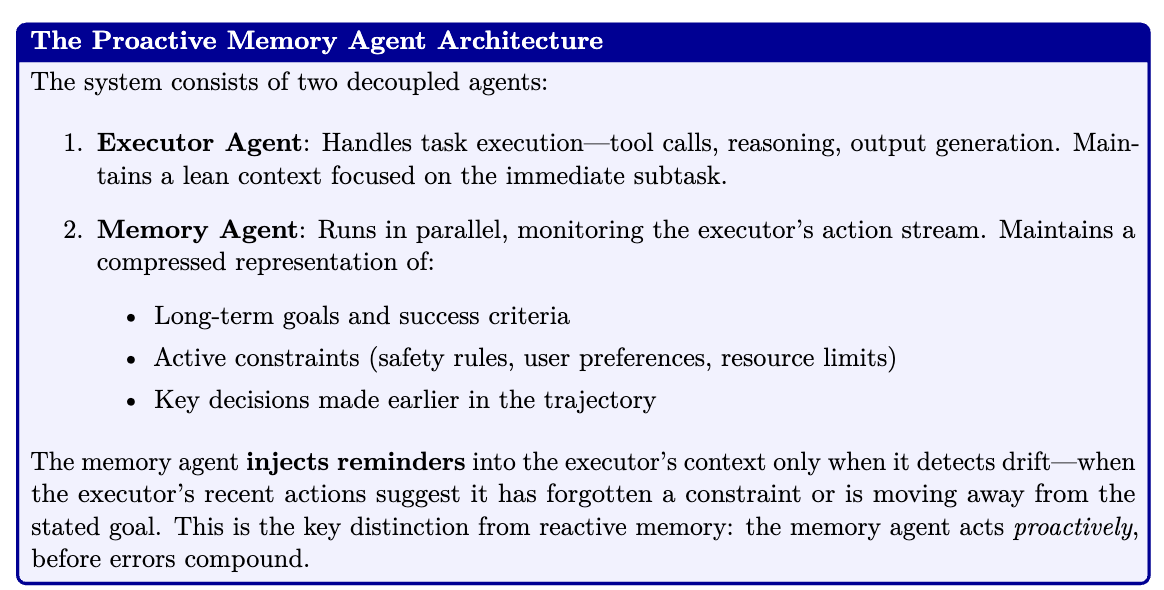
结构(两个独立智能体)
The system consists of two decoupled agents:
该系统由两个互相解耦、独立运行的智能体构成:
lean liːn
v. (身体)倾斜;倾向于做;倚靠,靠在
adj. 瘦且健康的;(肉)瘦的,脂肪少的;不景气的,贫乏的;精简的,效率高的;(混合汽化燃料)空气所占比例高的,稀化的
n. 倾斜,歪曲;瘦肉
Executor Agent: Handles task execution---tool calls, reasoning, output generation. Maintains a lean context focused on the immediate subtask.
执行智能体(Executor Agent):负责实际任务执行,包含工具调用、推理思考、生成输出。它只维护一份精简上下文,注意力只放在当下正在处理的子任务上。
Memory Agent: Runs in parallel, monitoring the executor's action stream. Maintains a compressed representation of:
记忆智能体(Memory Agent):与执行器并行后台运行,持续监控执行智能体输出的所有动作流。它保存一份经过压缩的全局信息快照,包含:
- Long‑term goals and success criteria 长期目标、任务成功的判定标准(success)
- Active constraints (safety rules, user preferences, resource limits) 当前生效的约束条件(安全规则、用户偏好、资源上限)
- Key decisions made earlier in the trajectory 任务流程早期做出过的关键决策
The memory agent injects reminders into the executor's context only when it detects drift---when the executor's recent actions suggest it has forgotten a constraint or is moving away from the stated goal. This is the key distinction from reactive memory: the memory agent acts proactively, before errors compound.
记忆智能体只有检测到任务漂移 (drift) 时,才会把提醒信息注入执行器的上下文;漂移指:从执行器最近的行为判断,它已经遗忘了某项约束、或是正在偏离原始目标。
这正是它和被动记忆最核心的区别:记忆模块提前主动干预,在偏差不断累积、演变成严重错误之前就出手纠正
Proactive Memory 主动式记忆的效果
sustained səˈsteɪnd
adj. 持续的,持久的;坚定的,坚持不懈的
v. 维持,保持;遭受,经受;(在体力或精神方面)支持,支撑
dramatically drəˈmætɪkli adv. 剧烈地,明显地;戏剧性地,夸张地
adherence ədˈhɪərəns n. (尤指对规则、信念等的)遵守,坚持
主动记忆:实验实测结果
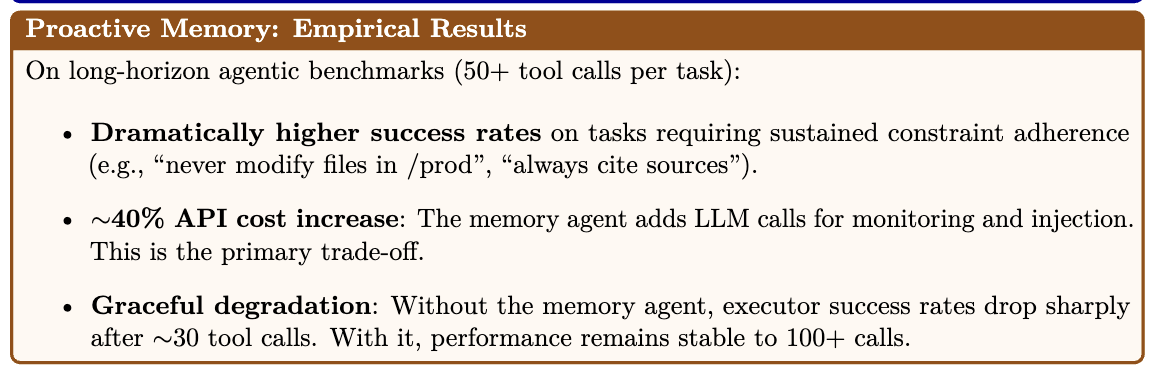
On long‑horizon agentic benchmarks (50+ tool calls per task):
在长时序智能体基准测试上(单个任务需要调用工具 50 次以上):
Dramatically higher success rates on tasks requiring sustained constraint adherence
(e.g., "never modify files in /prod", "always cite sources").
在需要长期遵守约束条件的任务上,成功率大幅提升
举例约束:"永远不要修改 /prod 目录下的文件"、"所有内容必须标注引用来源"
~40% API cost increase: The memory agent adds LLM calls for monitoring and injection. This is the primary trade‑off.
API 调用成本上升约 40%:记忆智能体需要额外调用大模型,用来做行为监控和漂移检测、生成提醒内容。这是最主要的取舍代价
哪哪儿都是取舍,哪哪都是trade-off
Graceful degradation: Without the memory agent, executor success rates drop sharply after ~30 tool calls. With it, performance remains stable to 100+ calls.
平缓衰减特性(性能退化曲线更友好):
没有主动记忆智能体时,执行器在大约 30 次工具调用之后,任务成功率就会断崖式下跌;
开启主动记忆后,即便工具调用次数达到 100 次以上,任务性能依旧能够保持稳定。
RL Connection,记忆智能体作为状态摘要器
belief bɪˈliːf n. 相信,信心;看法,信念,观点;信仰,信条
asymmetric ˌeɪsɪˈmetrɪk adj. 不对称的;不对等的
promising ˈprɒmɪsɪŋ
adj. 有希望的,有前途的
v. 承诺,答应;使很可能,预示(promise 的现在分词形式)
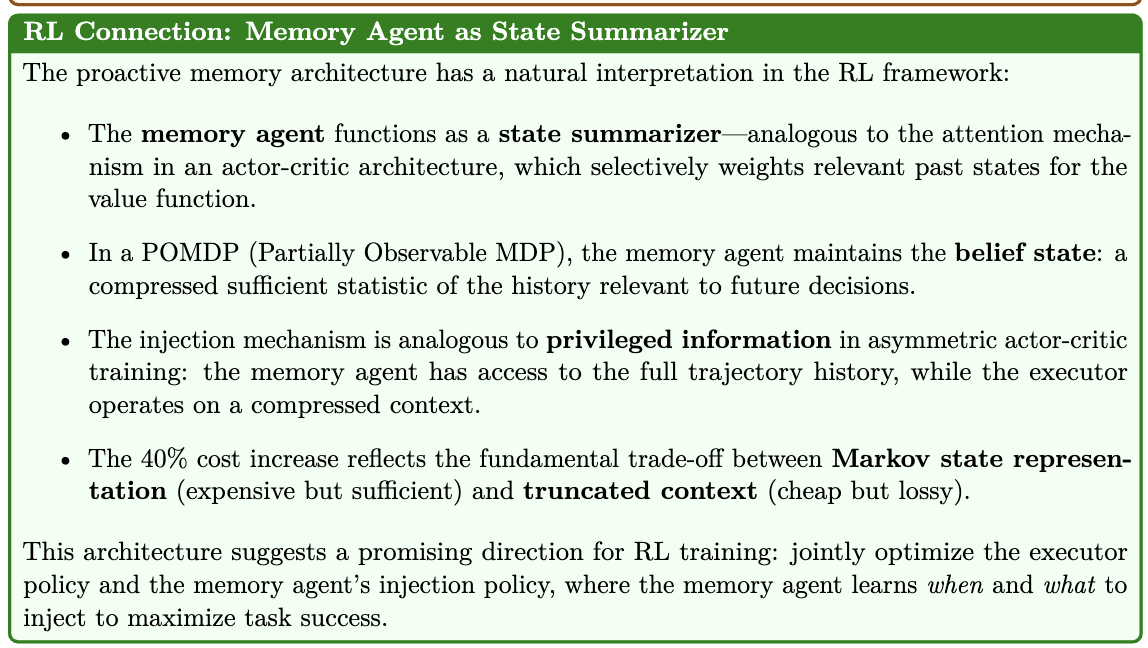
RL Connection: Memory Agent as State Summarizer
强化学习关联视角:记忆智能体作为状态摘要器(State Summarizer)
The proactive memory architecture has a natural interpretation in the RL framework:
主动式记忆架构,可以很自然地放到强化学习(RL)框架下解释(has a natural interpretation):
The memory agent functions as a state summarizer---analogous to the attention mechanism in an actor‑critic architecture, which selectively weights relevant past states for the value function
记忆智能体承担状态摘要器的角色:类比 Actor‑Critic(演员‑评论家)架构里的注意力机制,为价值函数有选择性地对历史相关状态分配权重。
In a POMDP (Partially Observable MDP), the memory agent maintains the belief state: a compressed sufficient statistic of the history relevant to future decisions.
在部分可观测马尔可夫决策过程中,记忆智能体维护信念状态 (belief‑state):一份对历史轨迹做压缩后的充分统计量,用来支撑未来决策
The injection mechanism is analogous to privileged information in asymmetric actor‑critic training: the memory agent has access to the full trajectory history, while the executor operates on a compressed context.
记忆注入机制,类比非对称 Actor‑Critic 训练中的特权信息(privileged information):记忆智能体能够拿到完整的历史轨迹;而执行器 (executor) 只能在压缩后的上下文上工作
The 40% cost increase reflects the fundamental trade‑off between Markov state representation (expensive but sufficient) and truncated context (cheap but lossy).
40% 的额外开销,反映了一组根本权衡:马尔可夫完整状态表示 state representation(代价高、信息完备) VS 截断上下文窗口(成本低、存在信息损失)
This architecture suggests a promising direction for RL training: jointly optimize the executor policy and the memory agent's injection policy, where the memory agent learns when and what to inject to maximize task success.
该架构给出了一条很有前景的 RL 训练方向:联合优化执行器策略 executor policy + 记忆智能体的注入策略 injection policy ,让记忆智能体自主学习「什么时候注入记忆、注入哪些记忆」,最大化任务成功率
POMDP
MDP(马尔可夫决策过程):智能体可以完全看见当前环境全部状态
举例子:下象棋,棋盘所有棋子全能看见 → 完全可观测 (MDP)
马尔可夫性质:未来只由当前状态决定,不需要全部历史
POMDP = 部分可观测
现实里很多场景,看不到环境完整真实状态,只能拿到一部分观测信号
真实环境状态是隐藏的,只能看到「不完全的线索」
举一个通俗例子:斗地主
只能看见自己手里的牌,看不见对手手牌
真实状态:三家手里所有的牌(隐藏,看不到)
你的观测:只有自己的手牌(片面信息)
永远无法拿到完整状态,只能猜,这个就是 POMDP 场景
放到 LLM‑Agent / 记忆架构里面,LLM 有上下文窗口限制,旧对话会被滚出去、丢掉。Executor(执行智能体)只能看见最近一小段上下文,看不见全部历史轨迹
- 真实完整状态:全部历史对话、过往决策(隐藏信息)
- Executor 的观测:只剩窗口内的内容(片面)
所以原生的无记忆 LLM Agent,本质就是一个 POMDP 问题
belief state
Memory‑Agent(记忆模块)干什么?
维护 belief state(信念状态)
belief‑state:对隐藏完整历史的压缩总结、充分统计量
记忆模块把看不见的久远历史浓缩,喂给 executor,用来补齐缺失信息