原工程地址
https://github.com/ceva-ip/DPDFNet
Model Profile
8 kHz models
| Model |
Params M |
MACs G |
TFLite Size MB |
ONNX Size MB |
| dpdfnet2_8khz |
2.51 |
1.29 |
10.5 |
9.7 |
| dpdfnet8_8khz |
3.56 |
3.99 |
16.5 |
13.8 |
16 kHz models
| Model |
Params M |
MACs G |
TFLite Size MB |
ONNX Size MB |
| baseline |
2.31 |
0.36 |
8.5 |
8.3 |
| dpdfnet2 |
2.49 |
1.35 |
10.7 |
9.7 |
| dpdfnet4 |
2.84 |
2.36 |
12.9 |
11.1 |
| dpdfnet8 |
3.54 |
4.37 |
17.2 |
13.9 |
48 kHz models
| Model |
Params M |
MACs G |
TFLite Size MB |
ONNX Size MB |
| dpdfnet2_48khz_hr |
2.58 |
2.42 |
11.6 |
10.0 |
| dpdfnet8_48khz_hr |
3.63 |
7.17 |
18.7 |
14.2 |
音频文件处理效果图
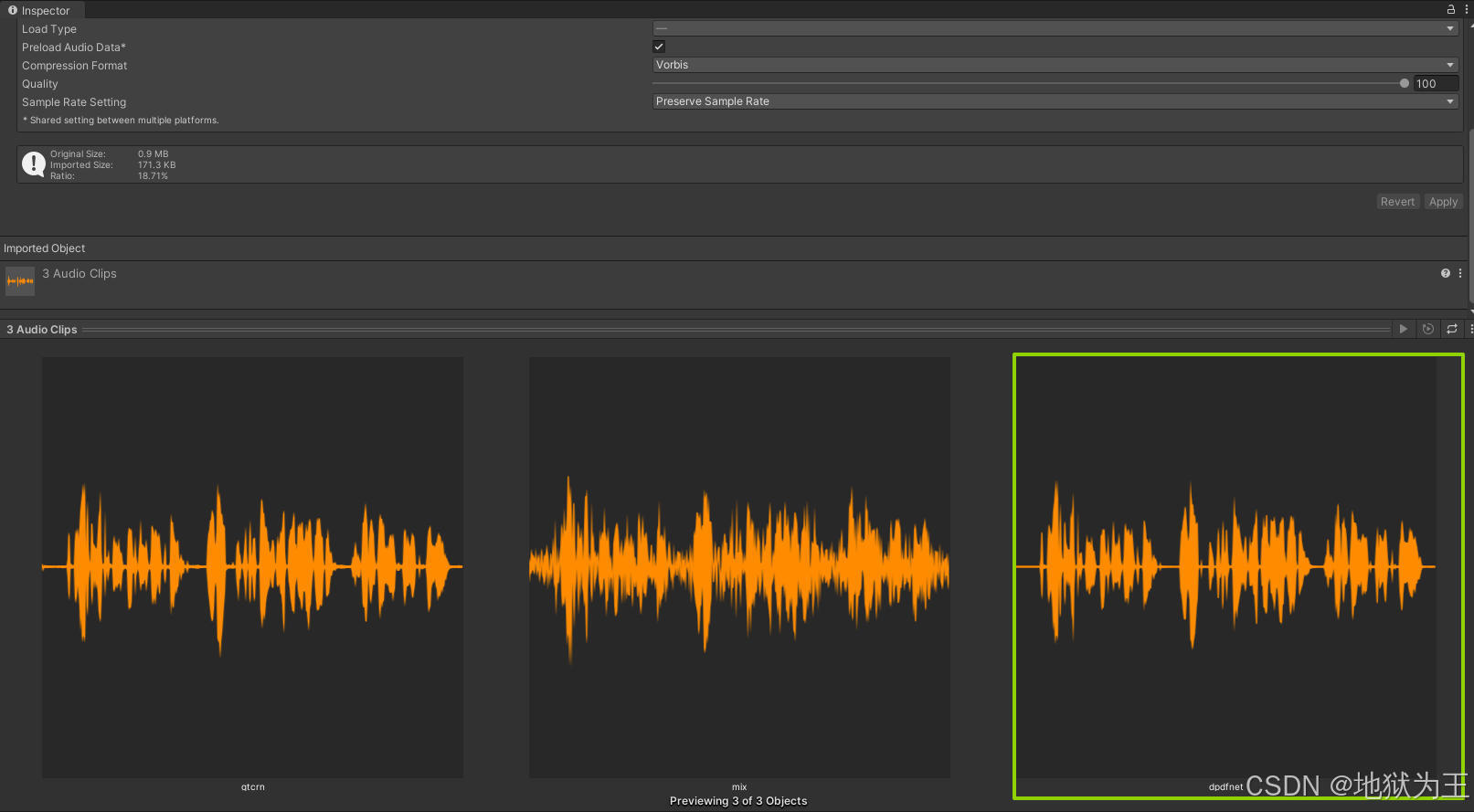
主要代码
using System;
using System.IO;
using UnityEngine;

namespace DPDFNetUnity
{
    /// <summary>
    /// 16 kHz 音频文件离线降噪示例(不依赖任何额外包,仅需 onnxruntime 包)。
    /// 严格对齐 DPDFNet 源码 onnx_model/infer_dpdfnet_onnx.py 的 enhance_file_onnx:
    ///   center=True 反射填充 STFT -> 流式 ONNX(state) -> center=True ISTFT(win^2 归一化)
    ///   -> postprocess_spec(裁 win_len*2 / 补 win_len*2) -> fit_length。
    /// 与「实时」路径(real_time_demo.py 的因果流式 STFT)不同:文件离线用 librosa 的
    /// center=True 算法,逐帧对齐与边界处理都不一样,故结果以源码为准。
    /// 适用于桌面 / Editor 下以本地文件路径处理;移动端请将模型与音频放在可读写路径
    /// (如 Application.persistentDataPath),因 StreamingAssets 在 Android 内打包为 APK 资源。
    /// </summary>
    public class DpdfNetFileExample : MonoBehaviour
    {
        private void Start()
        {
            ProcessWav(Application.streamingAssetsPath + "/dpdfnet/dpdfnet4.onnx",
                Application.dataPath + "/mix.wav",
                Application.dataPath + "/dpdfnet.wav");
        }

        /// <summary>
        /// 处理一个 16 kHz WAV 文件(单/多声道均可,自动转单声道)。
        /// 输出为同采样率的 16-bit PCM 单声道 WAV。
        /// </summary>
        /// <param name="modelPath">ONNX 模型文件路径(如 StreamingAssets/dpdfnet/dpdfnet2.onnx)</param>
        /// <param name="inputWav">输入 WAV 路径(建议 16 kHz)</param>
        /// <param name="outputWav">输出 WAV 路径</param>
        public void ProcessWav(string modelPath, string inputWav, string outputWav)
        {
            // 1) 读取 WAV -> 单声道 float 数组(归一化到 [-1,1])
            if (!WavIo.TryRead(inputWav, out float[] samples, out int sampleRate, out _))
                throw new InvalidOperationException($"[DPDFNet] 无法读取 WAV: {inputWav}");

            if (sampleRate != 16000)
                Debug.LogWarning($"[DPDFNet] 输入采样率为 {sampleRate} Hz,DPDFNet 模型为 16 kHz 训练,建议先重采样到 16000 再处理(此处按原率处理,结果可能异常)。");

            // 2) 加载模型(using 释放,替代原先经 DpdfNetProcessor.Dispose 释放)
            using var session = new OnnxRuntimeSession(modelPath);
            var cfg = DpdfNetModelConfig.FromSession(session);

            // 3) 离线增强(严格对齐 infer_dpdfnet_onnx.enhance_file_onnx)
            float[] enhanced = EnhanceOffline(samples, session, cfg);

            // 4) 写回 WAV(16 kHz 单声道 16-bit PCM)
            WavIo.Write(outputWav, enhanced, 16000, 1);
            Debug.Log($"[DPDFNet] 已处理 {samples.Length} 样本 -> {outputWav}");
        }

        /// <summary>
        /// 离线增强,逐行对应 infer_dpdfnet_onnx.enhance_file_onnx(attn_limit 缺省关闭):
        ///   末端补 win_len -> center=True 反射填充 STFT -> 流式 ONNX(state) ->
        ///   center=True ISTFT(win^2 归一化 OLA, 两端裁 n_fft/2) ->
        ///   postprocess_spec(裁 win_len*2, 补 win_len*2) -> fit_length。
        /// </summary>
        static float[] EnhanceOffline(float[] x, IOnnxSession session, DpdfNetModelConfig cfg)
        {
            int nFft = cfg.n_fft;            // 320
            int hop = cfg.hop_length;        // 160
            int winLen = cfg.window_length;  // 320
            float[] win = VorbisWindow.Compute(winLen);
            int half = nFft / 2;

            // 1) 末端补 win_len 个 0:np.pad(waveform, (0, win_len), mode='constant')
            int L = x.Length;
            float[] xpad = new float[L + winLen];
            Array.Copy(x, 0, xpad, 0, L);

            // 2) center=True 反射填充 n_fft//2(librosa pad_mode='reflect')
            float[] xp = ReflectPad(xpad, half);

            // 3) center=True 分帧 STFT(librosa.stft,逐帧 rfft)
            int numFrames = 1 + (xp.Length - nFft) / hop;
            var specRI = new float[numFrames][];
            for (int t = 0; t < numFrames; t++)
            {
                var frame = new float[nFft];
                int off = t * hop;
                for (int i = 0; i < nFft; i++) frame[i] = xp[off + i] * win[i];
                specRI[t] = StftMath.Rfft(frame);
            }

            // 4) 流式 ONNX(state 逐帧回传,对应 run_onnx_streaming)
            float[] state = cfg.BuildInitialState();
            var specE = new float[numFrames][];
            for (int t = 0; t < numFrames; t++)
            {
                session.Run(specRI[t], state, out var se, out var st);
                specE[t] = se;
                state = st;
            }

            // 5) center=True ISTFT(librosa.istft):win^2 归一化 OLA,再两端裁 n_fft//2
            int expected = nFft + hop * (numFrames - 1);
            float[] y = new float[expected];
            float[] winSum = new float[expected];
            for (int t = 0; t < numFrames; t++)
            {
                float[] td = StftMath.Irfft(specE[t], nFft);
                int off = t * hop;
                for (int i = 0; i < nFft; i++)
                {
                    y[off + i] += td[i] * win[i];
                    winSum[off + i] += win[i] * win[i];
                }
            }
            for (int i = 0; i < expected; i++)
                y[i] = winSum[i] > 1e-12f ? y[i] / winSum[i] : 0f;

            int waveELen = expected - 2 * half;
            float[] waveE = new float[waveELen];
            Array.Copy(y, half, waveE, 0, waveELen);

            // 6) postprocess_spec:裁掉前 win_len*2,末尾补 win_len*2 个 0(长度不变)
            int drop = winLen * 2;
            float[] post = new float[waveELen];
            if (waveELen > drop)
                Array.Copy(waveE, drop, post, 0, waveELen - drop);
            // 末尾 drop 个 0 由零初始化

            // 7) fit_length:对齐到原始长度
            float[] outArr = new float[L];
            int copyLen = Math.Min(L, post.Length);
            Array.Copy(post, 0, outArr, 0, copyLen);
            return outArr;
        }

        /// <summary>np.pad(x, pad, mode='reflect'):不含边缘重复的对称反射填充。</summary>
        static float[] ReflectPad(float[] x, int pad)
        {
            if (pad <= 0) return (float[])x.Clone();
            int L = x.Length;
            float[] r = new float[L + 2 * pad];
            for (int i = 0; i < L; i++) r[pad + i] = x[i];
            for (int i = 0; i < pad; i++) r[i] = x[pad - i];             // x[pad]..x[1]
            for (int i = 0; i < pad; i++) r[pad + L + i] = x[L - 2 - i]; // x[L-2]..x[L-1-pad]
            return r;
        }
    }

    /// <summary>
    /// 极简 WAV 读写(仅依赖 System.IO / UnityEngine.Debug),覆盖常见 PCM 格式。
    /// 读:自动转为单声道 float[-1,1];写:16-bit PCM(单/多声道)。
    /// 仅作示例用途;生产环境可替换为 NAudio / Unity AudioClip 等成熟实现。
    /// </summary>
    public class WavIo
    {
        public static bool TryRead(string path, out float[] mono, out int sampleRate, out int channels)
        {
            mono = null; sampleRate = 0; channels = 0;
            try
            {
                using var fs = new FileStream(path, FileMode.Open, FileAccess.Read);
                using var br = new BinaryReader(fs);

                if (new string(br.ReadChars(4)) != "RIFF") return false;
                br.ReadInt32(); // chunk size
                if (new string(br.ReadChars(4)) != "WAVE") return false;

                int fmtSampleRate = 0, fmtChannels = 0, fmtBits = 0, audioFormat = 0;
                byte[] data = null;
                while (fs.Position < fs.Length)
                {
                    string id = new string(br.ReadChars(4));
                    int size = br.ReadInt32();
                    if (id == "fmt ")
                    {
                        audioFormat = br.ReadInt16();
                        fmtChannels = br.ReadInt16();
                        fmtSampleRate = br.ReadInt32();
                        br.ReadInt32(); // byteRate
                        br.ReadInt16(); // blockAlign
                        fmtBits = br.ReadInt16();
                        int skip = size - 16;
                        if (skip > 0) br.ReadBytes(skip);
                    }
                    else if (id == "data")
                    {
                        data = br.ReadBytes(size);
                    }
                    else
                    {
                        br.ReadBytes(size);
                    }
                }
                if (data == null || fmtSampleRate == 0) return false;

                sampleRate = fmtSampleRate;
                channels = fmtChannels;
                mono = Decode(data, audioFormat, fmtChannels, fmtBits);
                return true;
            }
            catch (Exception e)
            {
                Debug.LogError($"[DPDFNet] WAV 读取失败: {e.Message}");
                return false;
            }
        }

        private static float[] Decode(byte[] data, int audioFormat, int channels, int bits)
        {
            int bytesPerSample = bits / 8;
            int totalSamples = data.Length / (bytesPerSample * channels);
            float[] outBuf = new float[totalSamples];
            int offset = 0;
            for (int i = 0; i < totalSamples; i++)
            {
                float sum = 0f;
                for (int c = 0; c < channels; c++)
                {
                    int pos = offset + c * bytesPerSample;
                    float v = 0f;
                    if (audioFormat == 3) // IEEE float
                    {
                        if (bits == 32) v = BitConverter.ToSingle(data, pos);
                        else if (bits == 64) v = (float)BitConverter.ToDouble(data, pos);
                    }
                    else if (bits == 16)
                    {
                        v = BitConverter.ToInt16(data, pos) / 32768f;
                    }
                    else if (bits == 24)
                    {
                        int s = (data[pos + 2] << 16) | (data[pos + 1] << 8) | data[pos];
                        if ((s & 0x800000) != 0) s |= unchecked((int)0xFF000000);
                        v = s / 8388608f;
                    }
                    else if (bits == 32)
                    {
                        v = BitConverter.ToInt32(data, pos) / 2147483648f;
                    }
                    else if (bits == 8)
                    {
                        v = (data[pos] - 128) / 128f;
                    }
                    sum += v;
                }
                outBuf[i] = sum / channels;
                offset += bytesPerSample * channels;
            }
            return outBuf;
        }

        public static void Write(string path, float[] samples, int sampleRate, int channels)
        {
            using var fs = new FileStream(path, FileMode.Create, FileAccess.Write);
            using var bw = new BinaryWriter(fs);

            int dataLen = samples.Length * 2 * channels; // 16-bit
            bw.Write("RIFF".ToCharArray());
            bw.Write(36 + dataLen);
            bw.Write("WAVE".ToCharArray());

            bw.Write("fmt ".ToCharArray());
            bw.Write(16);                       // PCM fmt chunk 大小
            bw.Write((short)1);                 // PCM
            bw.Write((short)channels);
            bw.Write(sampleRate);
            bw.Write(sampleRate * channels * 2); // byteRate
            bw.Write((short)(channels * 2));     // blockAlign
            bw.Write((short)16);                // bitsPerSample

            bw.Write("data".ToCharArray());
            bw.Write(dataLen);

            if (channels == 1)
            {
                foreach (float s in samples)
                    bw.Write(Clamp16(s));
            }
            else
            {
                // 示例简化:samples 视为单声道,写入第 0 声道,其余声道置 0
                for (int i = 0; i < samples.Length; i++)
                {
                    bw.Write(Clamp16(samples[i]));
                    for (int c = 1; c < channels; c++) bw.Write((short)0);
                }
            }
        }

        private static short Clamp16(float s)
        {
            float v = Math.Max(-1f, Math.Min(1f, s));
            return (short)(v * 32767f);
        }
    }
}
using System;
using System.Collections;
using System.Collections.Generic;
using System.Threading;
using UnityEngine;

namespace DPDFNetUnity
{
    /// <summary>
    /// 实时麦克风降噪 Demo(无 OnAudioFilterRead / 无重采样架构)。
    ///
    /// 参考原工程 DPDFNet/real_time_demo.py 的本质:采集率 == 模型率 == 播放率(均为 16 kHz),
    /// 因此全程不需要重采样,也不存在此前 OnAudioFilterRead(data 处于输出率) 导致的采样率错位与队列漂移。
    ///
    /// 管线:
    ///   麦克风(16000) --Microphone.GetData 逐帧--> DPDFNetProcessor.Process(hop=160)
    ///        --> 增强样本入播放环形队列 --> PCMReaderCallback 喂给 playClip --> AudioSource 播放。
    ///
    /// 说明:
    ///   - DPDFNetProcessor 对齐 Python stream.py 的 StreamEnhancer:win_len 帧缓冲,
    ///     首窗未满(~20ms)无输出,之后每次调用返回 1 个 hop 的增强样本(可变长,可能为空)。
    ///   - 用 Microphone.GetData 轮询读取(带环绕安全处理 + 跨帧 leftover 续传,不丢样本)。
    ///   - 播放通过 AudioClip.Create 的 PCMReaderCallback 提供数据,AudioSource 直接播放该 clip。
    ///     PCMReaderCallback 是 clip 的数据供给回调,并非 OnAudioFilterRead。
    ///   - 采集时钟与播放时钟均源自同一音频硬件、同为 16000,速率天然匹配,环形队列仅作平滑缓冲。
    /// 建议戴耳机避免啸叫。
    /// </summary>
    [RequireComponent(typeof(AudioSource))]
    public class DpdfNetMicrophoneDemo : MonoBehaviour
    {
        [Header("模型")]
        [Tooltip("StreamingAssets/dpdfnet 下的模型名(不含扩展名)")] public string modelName = "dpdfnet2";
        [Tooltip("请求麦克风采样率,必须与模型一致(16000)")] public int captureSampleRate = 16000;

        [Header("输出")]
        [Range(0f, 1f)] public float playbackMix = 0f;   // 0=纯增强, 1=纯原始
        public bool monitorBypass = false;                // true=直出原始麦克风(诊断用)
        public bool enableAgc = true;

        [Header("调试")]
        public float lastInferenceMs;
        [Tooltip("每 N 秒打印一次诊断(RMS/帧耗时)")] public float diagInterval = 0.5f;

        private DpdfNetProcessor processor;
        private AudioClip micClip;
        private AudioClip playClip;
        private string micDevice;
        private AudioSource src;
        private int micRate;

        // 播放环形队列(主线程写,音频线程读)。用 lock 保护。
        private readonly Queue<float> playbackQueue = new Queue<float>();
        private readonly object queueLock = new object();
        private const int MaxQueueSamples = 16000 * 4;   // 4s 上限,溢出丢弃最旧

        // 麦克风读取游标与跨帧续传
        private int micPrevPos;
        private readonly Queue<float> pending = new Queue<float>();
        private float[] mixBuf;
        private bool running;

        // 诊断累计
        private float diagTimer;
        private float inRmsSum, outRmsSum;
        private int rmsFrames;
        private bool loggedModelError;
        private float agcGain = 1f;

        // ------ 后台推理(Loom)相关 ------
        // DPDFNet 是 stateful 流式模型:state 必须逐帧串行传递,且 Process 内部维护
        // win_len 输入帧缓冲(StreamEnhancer 语义)。用 inferLock 把「推理 + 原始样本
        // 对齐出队」包成原子,既保证帧顺序不被并发打乱,也保证 rawDelay 队列一致性。
        private readonly object inferLock = new object();
        // 原始样本对齐队列:输出流是输入流的延迟镜像(输出样本 m ↔ 输入样本 m),
        // Process 每吐出 N 个增强样本,就从队头取 N 个原始样本与之配对(供 playbackMix)。
        private readonly Queue<float> rawDelay = new Queue<float>();
        private int inflight;                       // 在途推理任务数(背压计数)
        private const int MaxInflight = 2;          // 背压上限:超过则丢弃本帧
        private int droppedFrames;                  // 诊断:因背压丢弃的帧数

        void Start() => Initialize();
        void OnDisable() => Cleanup();
        void OnDestroy() => Cleanup();

        [ContextMenu("Reinitialize")]
        public void Initialize()
        {
            Cleanup();

            // 零依赖:先加载 ONNX,再从 session 推导配置与初始 state(不再读 JSON)。
            string onnxPath = System.IO.Path.Combine(Application.streamingAssetsPath, "dpdfnet", modelName + ".onnx");
            if (!System.IO.File.Exists(onnxPath))
            {
                Debug.LogError($"[DPDFNet] 未找到 ONNX 模型: {onnxPath}");
                return;
            }
            IOnnxSession session;
            try
            {
                session = new OnnxRuntimeSession(onnxPath);
            }
            catch (Exception e)
            {
                Debug.LogError($"[DPDFNet] 加载 ONNX 失败(是否已安装 Microsoft.ML.OnnxRuntime?):{e.Message}");
                return;
            }
            var cfg = DpdfNetModelConfig.FromSession(session);

            if (cfg.sample_rate != captureSampleRate)
                Debug.LogWarning($"[DPDFNet] 模型率 {cfg.sample_rate} 与 captureSampleRate {captureSampleRate} 不一致,建议统一为 16000。");

            processor = new DpdfNetProcessor(cfg, session);
            mixBuf = new float[processor.HopLength];

            if (Microphone.devices.Length == 0)
            {
                Debug.LogError("[DPDFNet] 未检测到麦克风设备。");
                return;
            }
            micDevice = Microphone.devices[0];
            // 直接以模型率(16000)录制,原生即 16k,无需重采样。
            micClip = Microphone.Start(micDevice, true, 1, captureSampleRate);
            micRate = micClip.frequency;

            // 播放 clip:16k、单声道、循环、由 PCMReaderCallback 持续供给增强后的样本。
            playClip = AudioClip.Create("DPDFNetOut", captureSampleRate * 2, 1, captureSampleRate, true, OnAudioRead, null);
            src = GetComponent<AudioSource>();
            src.clip = playClip;
            src.loop = true;
            src.playOnAwake = false;
            src.Play();

            micPrevPos = 0;
            pending.Clear();
            lock (inferLock) rawDelay.Clear();
            lock (queueLock) playbackQueue.Clear();
            running = true;
            StartCoroutine(CaptureLoop());
            Debug.Log($"[DPDFNet] 采集率={micRate}, 模型率={cfg.sample_rate}, 播放率={captureSampleRate}(全程 16k,无重采样)");
        }

        private IEnumerator CaptureLoop()
        {
            int total = micClip.samples;
            int hop = processor.HopLength;
            float[] hopBuf = new float[hop];
            while (running && micClip != null)
            {
                int pos = Microphone.GetPosition(micDevice);
                int avail = (pos - micPrevPos + total) % total;
                if (avail > 0)
                {
                    // 环绕安全读取 avail 个样本到 region(最多 2 次 GetData)。
                    float[] region = new float[avail];
                    int first = Math.Min(avail, total - micPrevPos);
                    if (first == avail)
                    {
                        micClip.GetData(region, micPrevPos);
                    }
                    else
                    {
                        float[] head = new float[first];
                        micClip.GetData(head, micPrevPos);
                        Array.Copy(head, 0, region, 0, first);
                        float[] tail = new float[avail - first];
                        micClip.GetData(tail, 0);
                        Array.Copy(tail, 0, region, first, avail - first);
                    }
                    micPrevPos = (micPrevPos + avail) % total;

                    // 入 pending,按 hop 精确切帧(跨帧 leftover 续传,不丢样本)。
                    for (int i = 0; i < avail; i++) pending.Enqueue(region[i]);
                    while (pending.Count >= hop)
                    {
                        for (int i = 0; i < hop; i++) hopBuf[i] = pending.Dequeue();
                        DispatchHop(hopBuf);   // 主线程只负责读+提交,重活在 Loom 后台线程
                    }
                }
                yield return null;
            }
        }

        /// <summary>
        /// 主线程调度:算出输入 RMS,把 hop 提交到后台线程推理(Loom,不阻塞主线程)。
        /// 背压:在途任务超过上限则丢弃本帧(降质但不无限延迟)。
        /// </summary>
        private void DispatchHop(float[] hop)
        {
            double inSq = 0;
            for (int i = 0; i < hop.Length; i++) inSq += hop[i] * hop[i];
            float inRms = (float)Math.Sqrt(inSq / hop.Length + 1e-12f);

            if (monitorBypass)
            {
                CommitOutput(hop, hop, inRms, 0f);   // 跳过模型,原样透传(主线程同步)
                return;
            }

            // 背压:在途推理任务过多则丢弃本帧,避免 ThreadPool 堆积与无限延迟。
            if (Interlocked.Increment(ref inflight) > MaxInflight)
            {
                Interlocked.Decrement(ref inflight);
                droppedFrames++;
                return;
            }

            // 拷贝 hop(hopBuf 会被协程下一轮复用),后台线程持有独立副本。
            float[] task = new float[hop.Length];
            Array.Copy(hop, task, hop.Length);
            Loom.RunAsync(
                () => DoInfer(task, inRms),
                (ex) => { Interlocked.Decrement(ref inflight); Debug.LogError($"[DPDFNet] 推理异常:{ex.Message}"); });
        }

        /// <summary>
        /// 后台线程:调用 ONNX 推理。用 inferLock 把「推理 + 原始样本对齐出队」包成原子------
        /// 保证流式 state 的帧顺序(stateful 模型必须逐帧串行),并保证 rawDelay 队列一致。
        /// DpdfNetProcessor.Process 为 StreamEnhancer 语义:返回本次已提交的增强样本
        /// (hop 的整数倍,首窗未满时为空),输出样本 m 与输入样本 m 一一对应(延迟镜像),
        /// 故增强结果与 rawDelay 队头的原始样本严格对齐。推理耗时测好后再回主线程落地。
        /// </summary>
        private void DoInfer(float[] hop, float inRms)
        {
            var sw = System.Diagnostics.Stopwatch.StartNew();
            try
            {
                float[] enh;
                float[] rawAligned;
                lock (inferLock)
                {
                    // 原始样本先进对齐队列,再推理:输出是输入的延迟镜像(m↔m),
                    // Process 吐出的 N 个样本对应队头最旧的 N 个原始样本。
                    for (int i = 0; i < hop.Length; i++) rawDelay.Enqueue(hop[i]);
                    enh = processor.Process(hop);   // 新数组实例(StreamEnhancer),无需拷走
                    rawAligned = new float[enh.Length];
                    for (int i = 0; i < enh.Length; i++)
                        rawAligned[i] = rawDelay.Count > 0 ? rawDelay.Dequeue() : enh[i];
                }
                double ms = sw.ElapsedTicks * 1000.0 / System.Diagnostics.Stopwatch.Frequency;
                Loom.QueueOnMainThread(() => CommitOutput(enh, rawAligned, inRms, (float)ms));
            }
            finally
            {
                Interlocked.Decrement(ref inflight);
            }
        }

        /// <summary>
        /// 主线程落地:混合(playbackMix) + 块级 AGC + 入播放队列 + 诊断累计。
        /// 由 Loom 泵送(或 monitorBypass 时由 DispatchHop 同步)调用,始终在主线程。
        /// enh 为 StreamEnhancer 语义的可变长输出(hop 的整数倍;首窗未满 win_len 预热期为空),
        /// rawHop 为与 enh 逐样本对齐的原始样本(DoInfer 中经 rawDelay 出队配对)。
        /// </summary>
        private void CommitOutput(float[] enh, float[] rawHop, float inRms, float inferMs)
        {
            lastInferenceMs = inferMs;
            if (enh == null || enh.Length == 0) return;   // 预热期无输出,跳过

            float outRms;
            lock (queueLock)
            {
                if (mixBuf == null || mixBuf.Length < enh.Length) mixBuf = new float[enh.Length];
                double mSq = 0;
                for (int i = 0; i < enh.Length; i++)
                {
                    float raw = (rawHop != null && i < rawHop.Length) ? rawHop[i] : enh[i];
                    float v = (1f - playbackMix) * enh[i] + playbackMix * raw;
                    mixBuf[i] = v;
                    mSq += v * v;
                }
                float rms = (float)Math.Sqrt(mSq / enh.Length + 1e-12f);
                if (enableAgc)
                {
                    const float targetRms = 0.12f, floor = 1e-3f, minGain = 0.25f, maxGain = 8f;
                    float desired = Mathf.Clamp(targetRms / Mathf.Max(rms, floor), minGain, maxGain);
                    agcGain = Mathf.Lerp(agcGain, desired, 0.05f);
                    for (int i = 0; i < enh.Length; i++)
                        mixBuf[i] = Mathf.Clamp(mixBuf[i] * agcGain, -1f, 1f);
                    outRms = (float)Math.Sqrt((mSq * agcGain * agcGain) / enh.Length + 1e-12f);
                }
                else
                {
                    for (int i = 0; i < enh.Length; i++)
                        mixBuf[i] = Mathf.Clamp(mixBuf[i], -1f, 1f);
                    outRms = rms;
                }

                for (int i = 0; i < enh.Length; i++) playbackQueue.Enqueue(mixBuf[i]);
                while (playbackQueue.Count > MaxQueueSamples) playbackQueue.Dequeue(); // 溢出丢弃最旧
            }

            AccumDiag(inRms, outRms);
        }

        // 由 Unity 音频线程调用,把增强样本供给 playClip。
        private void OnAudioRead(float[] data)
        {
            lock (queueLock)
            {
                for (int i = 0; i < data.Length; i++)
                    data[i] = playbackQueue.Count > 0 ? playbackQueue.Dequeue() : 0f;
            }
        }

        private void AccumDiag(float inRms, float outRms)
        {
            inRmsSum += inRms;
            outRmsSum += outRms;
            rmsFrames++;
        }

        void Update()
        {
            diagTimer += Time.deltaTime;
            if (diagTimer >= diagInterval && rmsFrames > 0)
            {
                float avgIn = inRmsSum / rmsFrames;
                float avgOut = outRmsSum / rmsFrames;
                int q;
                lock (queueLock) q = playbackQueue.Count;
                Debug.Log($"[DPDFNet] inRMS={avgIn:F4} outRMS={avgOut:F4} infer={lastInferenceMs:F2}ms bypass={monitorBypass} qPlay={q} drop={droppedFrames}");
                inRmsSum = outRmsSum = 0f;
                rmsFrames = 0;
                diagTimer = 0f;
            }
        }

        private void Cleanup()
        {
            running = false;
            StopAllCoroutines();
            if (micDevice != null && micClip != null && Microphone.IsRecording(micDevice))
                Microphone.End(micDevice);
            if (src != null && src.isPlaying) src.Stop();
            processor?.Dispose();
            processor = null;
            micDevice = null;
            micClip = null;
            playClip = null;
            pending.Clear();
            lock (inferLock) rawDelay.Clear();
            lock (queueLock) playbackQueue.Clear();
        }
    }
}
最后是工程地址
https://github.com/xue-fei/dpdfnet-unity.git