C 语言 malloc() 详解与实战 Demo
malloc() 是 C 语言动态内存管理中最核心的函数之一,用于在程序运行期间动态申请内存。
它和 malloc() 最大的区别是:
malloc():申请指定大小的内存,不会初始化内存内容。calloc():申请指定数量和大小的内存,并将所有字节清零。
本篇从基础语法、内存原理、指针操作、结构体、动态数组、链表、内存池等方面展开,并提供可运行的实战 Demo。
一、malloc() 基本概念
1. 函数原型
malloc() 定义在 <stdlib.h> 头文件中。
arduino
#include <stdlib.h>

void *malloc(size_t size);| 参数 | 类型 | 说明 |
|---|---|---|
size |
size_t |
申请的内存字节数 |
| 返回值 | void * |
成功返回内存首地址,失败返回 NULL |
例如:
c
int *p = malloc(sizeof(int));这段代码表示:
sizeof(int)计算int类型占用的字节数。malloc()申请对应大小的内存。- 返回申请到的内存首地址。
- 将地址赋值给
int *p。 - 此时
*p尚未初始化,不能直接读取其值。
假设 int 占 4 字节,则申请 4 字节内存。
2. malloc() 的内存结构
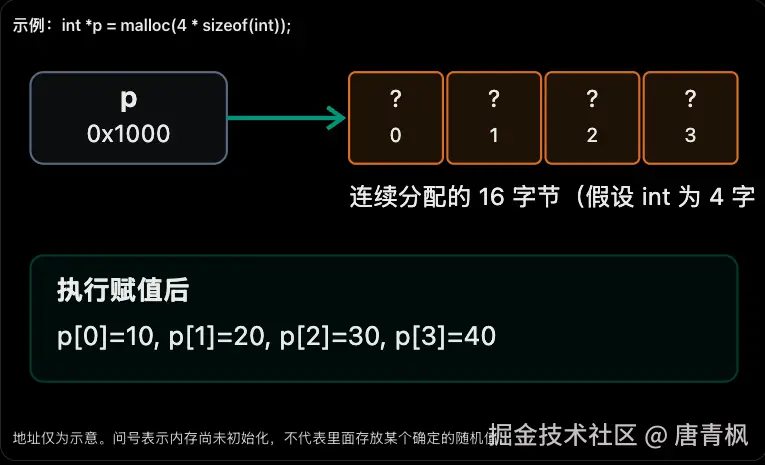
malloc() 返回的内存满足适用于普通对象类型的对齐要求,但它不会告诉你分配了多少个元素,也不会自动管理生命周期。
二、基础 Demo:动态申请一个整数
c
#include <stdio.h>
#include <stdlib.h>

int main(void) {
    int *p = malloc(sizeof(*p));

    if (p == NULL) {
        perror("malloc failed");
        return EXIT_FAILURE;
    }

    *p = 100;

    printf("Value: %d\n", *p);
    printf("Address: %p\n", (void *)p);
    printf("Size: %zu bytes\n", sizeof(*p));

    free(p);
    p = NULL;

    return EXIT_SUCCESS;
}
运行结果(地址每次可能不同):
makefile
Value: 100
Address: 0x600003a24010
Size: 4 bytes
这里需要理解几个关键语法。
| 表达式 | 含义 |
|---|---|
int *p |
声明一个指向 int 的指针 |
malloc(sizeof(*p)) |
申请一个 int 大小的内存 |
p |
内存首地址 |
*p |
解引用,访问指向的整数 |
&p |
获取指针变量自身的地址 |
free(p) |
释放指针指向的动态内存 |
为什么 malloc() 不需要强制类型转换?
c
int *p = malloc(sizeof(int));因为 malloc() 返回 void *,在 C 语言中可以隐式转换成对象指针类型。
不推荐这样写:
c
int *p = (int *)malloc(sizeof(int));虽然合法,但在 C 语言中通常没有必要。
注意,C++ 的规则不同,不能直接套用。
三、实战 Demo 1:动态整数数组
这是 malloc() 最常见的应用。
c
#include <stdio.h>
#include <stdlib.h>
#include <stdint.h>

int main(void) {
    size_t count;

    printf("请输入数组长度: ");

    if (scanf("%zu", &count) != 1 || count == 0) {
        fprintf(stderr, "Invalid count\n");
        return EXIT_FAILURE;
    }

    // 防止乘法溢出
    if (count > SIZE_MAX / sizeof(int)) {
        fprintf(stderr, "Array too large\n");
        return EXIT_FAILURE;
    }

    int *numbers = malloc(count * sizeof(*numbers));

    if (numbers == NULL) {
        perror("malloc");
        return EXIT_FAILURE;
    }

    // 初始化数组
    for (size_t i = 0; i < count; i++) {
        numbers[i] = (int)(i % 1000);
    }

    // 输出数组
    for (size_t i = 0; i < count; i++) {
        printf("%d ", numbers[i]);
    }

    printf("\n");

    free(numbers);
    numbers = NULL;

    return EXIT_SUCCESS;
}
示例:
makefile
请输入数组长度: 5
0 1 2 3 4
这里 numbers[i] 实际上等价于:
css
*(numbers + i)例如:
ini
numbers[2] = 30;

// 等价于
*(numbers + 2) = 30;
注意,指针加 2 不是增加 2 字节,而是前进两个 int 元素的距离。
假设 sizeof(int) == 4,实际前进 8 字节。
四、实战 Demo 2:动态创建结构体对象
在业务开发中,结构体类似于 C#、Java 中的数据对象,但 C 结构体没有内置构造函数。
例如创建用户对象:
c
#include <stdio.h>
#include <stdlib.h>
#include <string.h>

typedef struct {
    int id;
    char name[64];
    int age;
} User;

User *user_create(int id, const char *name, int age) {
    if (name == NULL || strlen(name) >= sizeof(((User *)0)->name)) {
        return NULL;
    }

    User *user = malloc(sizeof(*user));

    if (user == NULL) {
        return NULL;
    }

    user->id = id;
    strcpy(user->name, name);
    user->age = age;

    return user;
}

void user_destroy(User *user) {
    free(user);
}

int main(void) {
    User *user = user_create(1001, "Alice", 25);

    if (user == NULL) {
        fprintf(stderr, "Create user failed\n");
        return EXIT_FAILURE;
    }

    printf("ID: %d\n", user->id);
    printf("Name: %s\n", user->name);
    printf("Age: %d\n", user->age);

    user_destroy(user);

    return EXIT_SUCCESS;
}
输出:
yaml
ID: 1001
Name: Alice
Age: 25
这里有两个值得注意的知识点。
第一,-> 运算符。
shell
user->id等价于:
bash
(*user).id因为 user 是结构体指针,而不是结构体变量。
第二,结构体创建和销毁函数。
scss
User *user_create(...);
void user_destroy(User *user);
这种设计很常见。它让调用者不需要知道对象内部的内存申请细节,类似于面向对象语言中的工厂方法和资源释放方法。
上面的字符串长度检查也可以更直观地写成:
arduino
if (name == NULL || strlen(name) >= 64) {
    return NULL;
}
但使用 sizeof 的形式,在修改结构体字段大小时更容易维护。
五、实战 Demo 3:malloc() 实现单向链表
链表是理解动态内存分配的重要数据结构。
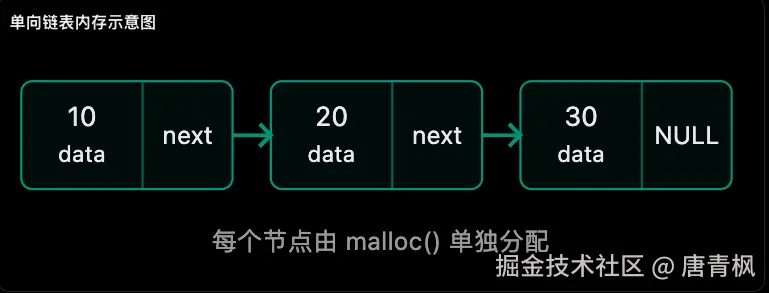
数组通常是一整块连续内存,而链表的节点可以分散在不同的内存位置,通过指针连接。
链表结构
完整代码
ini
#include <stdio.h>
#include <stdlib.h>

typedef struct Node {
    int data;
    struct Node *next;
} Node;

// 创建节点
Node *node_create(int value) {
    Node *node = malloc(sizeof(*node));

    if (node == NULL) {
        return NULL;
    }

    node->data = value;
    node->next = NULL;

    return node;
}

// 头部插入
int list_push_front(Node **head, int value) {
    Node *node = node_create(value);

    if (node == NULL) {
        return -1;
    }

    node->next = *head;
    *head = node;

    return 0;
}

// 遍历
void list_print(const Node *head) {
    while (head != NULL) {
        printf("%d -> ", head->data);
        head = head->next;
    }

    printf("NULL\n");
}

// 释放链表
void list_destroy(Node **head) {
    Node *current = *head;

    while (current != NULL) {
        Node *next = current->next;

        free(current);

        current = next;
    }

    *head = NULL;
}

int main(void) {
    Node *head = NULL;

    if (list_push_front(&head, 30) != 0 ||
        list_push_front(&head, 20) != 0 ||
        list_push_front(&head, 10) != 0) {
        list_destroy(&head);
        return EXIT_FAILURE;
    }

    list_print(head);

    list_destroy(&head);

    return EXIT_SUCCESS;
}
输出:
rust
10 -> 20 -> 30 -> NULL为什么使用 Node **head?
这里涉及二级指针:
java
int list_push_front(Node **head, int value)因为函数需要修改调用者的 head 指针本身。
例如:
ini
Node *head = NULL;

list_push_front(&head, 10);
传入 &head,相当于传入指针变量的地址。
在函数内部:
ini
*head = node;就能修改外部 head 的值。
如果只传 Node *head,修改的是指针参数的局部副本,不会改变调用者的 head。
六、实战 Demo 4:malloc() 实现二维动态数组
二维数组可以采用两种主要的动态分配方式。
方案一:单块连续内存
ini
#include <stdio.h>
#include <stdlib.h>
#include <stdint.h>

int main(void) {
    size_t rows = 3;
    size_t cols = 4;

    if (rows > SIZE_MAX / cols ||
        rows * cols > SIZE_MAX / sizeof(int)) {
        return EXIT_FAILURE;
    }

    int *matrix = malloc(rows * cols * sizeof(*matrix));

    if (matrix == NULL) {
        return EXIT_FAILURE;
    }

    for (size_t i = 0; i < rows; i++) {
        for (size_t j = 0; j < cols; j++) {
            matrix[i * cols + j] = (int)(i * cols + j + 1);
        }
    }

    for (size_t i = 0; i < rows; i++) {
        for (size_t j = 0; j < cols; j++) {
            printf("%3d ", matrix[i * cols + j]);
        }

        printf("\n");
    }

    free(matrix);
    return EXIT_SUCCESS;
}
输出:
  1   2   3   4
  5   6   7   8
  9  10  11  12
访问公式:
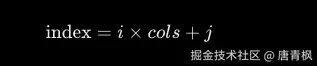
这种方案的优点是内存连续、缓存局部性较好、只需要一次 malloc() 和一次 free()。
方案二:二级指针分配
ini
#include <stdio.h>
#include <stdlib.h>

int main(void) {
    size_t rows = 3;
    size_t cols = 4;

    int **matrix = malloc(rows * sizeof(*matrix));

    if (matrix == NULL) {
        return EXIT_FAILURE;
    }

    for (size_t i = 0; i < rows; i++) {
        matrix[i] = malloc(cols * sizeof(**matrix));

        if (matrix[i] == NULL) {
            for (size_t j = 0; j < i; j++) {
                free(matrix[j]);
            }

            free(matrix);
            return EXIT_FAILURE;
        }
    }

    for (size_t i = 0; i < rows; i++) {
        for (size_t j = 0; j < cols; j++) {
            matrix[i][j] = (int)(i * cols + j);
        }
    }

    for (size_t i = 0; i < rows; i++) {
        for (size_t j = 0; j < cols; j++) {
            printf("%d ", matrix[i][j]);
        }

        printf("\n");
    }

    for (size_t i = 0; i < rows; i++) {
        free(matrix[i]);
    }

    free(matrix);

    return EXIT_SUCCESS;
}
这种方案的特点:
- 每一行可以单独申请内存。
- 每行可以拥有不同长度。
- 行与行之间不保证连续。
- 需要分别释放每一行,最后释放指针数组。
对于固定大小的数值矩阵,通常更推荐连续内存方案。
七、实战 Demo 5:malloc() 实现动态字符串
C 语言没有内置的可自动扩容字符串对象,字符串通常使用字符数组表示。
例如动态复制一个字符串:
arduino
#include <stdio.h>
#include <stdlib.h>
#include <string.h>

char *string_duplicate(const char *source) {
    if (source == NULL) {
        return NULL;
    }

    size_t length = strlen(source);

    char *result = malloc(length + 1);

    if (result == NULL) {
        return NULL;
    }

    memcpy(result, source, length + 1);

    return result;
}

int main(void) {
    char *name = string_duplicate("Hello C Language");

    if (name == NULL) {
        return EXIT_FAILURE;
    }

    printf("%s\n", name);
    printf("Length: %zu\n", strlen(name));

    free(name);

    return EXIT_SUCCESS;
}
输出:
makefile
Hello C Language
Length: 16
这里为什么需要 length + 1?
因为 C 字符串必须以 '\0' 结束。
例如:
arduino
"hello"实际需要存储:
arduino
'h' 'e' 'l' 'l' 'o' '\0'所以长度是 5,但需要 6 字节内存。
memcpy(result, source, length + 1) 也会复制结尾的 '\0'。
八、实战 Demo 6:malloc() 与 realloc() 实现动态数组
假设你需要一个类似 C# List<int> 的动态数组,容量不够时自动扩容。
ini
#include <stdio.h>
#include <stdlib.h>
#include <stdint.h>

typedef struct {
    int *data;
    size_t size;
    size_t capacity;
} Vector;

int vector_init(Vector *v, size_t capacity) {
    if (capacity == 0) {
        capacity = 4;
    }

    if (capacity > SIZE_MAX / sizeof(*v->data)) {
        return -1;
    }

    v->data = malloc(capacity * sizeof(*v->data));

    if (v->data == NULL) {
        return -1;
    }

    v->size = 0;
    v->capacity = capacity;

    return 0;
}

int vector_push(Vector *v, int value) {
    if (v->size == v->capacity) {
        if (v->capacity > SIZE_MAX / 2) {
            return -1;
        }

        size_t new_capacity = v->capacity * 2;

        if (new_capacity > SIZE_MAX / sizeof(*v->data)) {
            return -1;
        }

        int *new_data = realloc(
            v->data,
            new_capacity * sizeof(*v->data)
        );

        if (new_data == NULL) {
            return -1;
        }

        v->data = new_data;
        v->capacity = new_capacity;
    }

    v->data[v->size++] = value;

    return 0;
}

void vector_destroy(Vector *v) {
    free(v->data);

    v->data = NULL;
    v->size = 0;
    v->capacity = 0;
}

int main(void) {
    Vector v = {0};

    if (vector_init(&v, 2) != 0) {
        return EXIT_FAILURE;
    }

    for (int i = 1; i <= 10; i++) {
        if (vector_push(&v, i * 10) != 0) {
            vector_destroy(&v);
            return EXIT_FAILURE;
        }
    }

    printf("Size: %zu\n", v.size);
    printf("Capacity: %zu\n", v.capacity);

    for (size_t i = 0; i < v.size; i++) {
        printf("%d ", v.data[i]);
    }

    printf("\n");

    vector_destroy(&v);

    return EXIT_SUCCESS;
}
输出:
makefile
Size: 10
Capacity: 16
10 20 30 40 50 60 70 80 90 100
扩容过程: 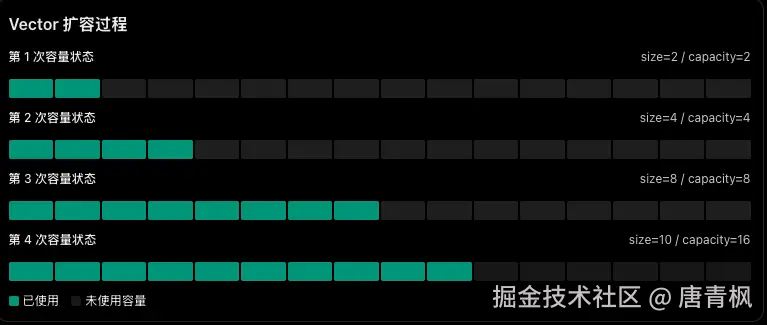 这里
realloc() 有一个重要规则:
int *temp = realloc(v->data, new_size);
必须先用临时指针保存返回值。
不要直接写:
ini
v->data = realloc(v->data, new_size);因为一旦分配失败,返回 NULL,原来的内存仍然有效,但你已经丢失了原始地址,造成内存泄漏。
九、malloc() 的常见错误
1. 未初始化就读取
c
int *p = malloc(sizeof(int));

printf("%d\n", *p);  // 错误:读取未初始化的值
正确:
c
int *p = malloc(sizeof(int));

if (p != NULL) {
    *p = 100;
    printf("%d\n", *p);
    free(p);
}
2. 内存泄漏
c
void test(void) {
    int *p = malloc(100 * sizeof(int));

    // 忘记 free(p)
}
函数返回后,指针丢失,内存无法再通过它释放。
3. Use After Free
ini
int *p = malloc(sizeof(int));

if (p != NULL) {
    *p = 10;
    free(p);

    // printf("%d", *p); // 错误
}
释放后的指针不能再用于访问原来的内存。
4. Double Free
scss
free(p);
free(p); // 错误:重复释放
可以在释放后将指针置为 NULL,但这不能解决所有别名指针的问题。
5. 数组越界
c
int *p = malloc(5 * sizeof(int));

if (p != NULL) {
    p[5] = 100; // 错误:有效索引是 0~4
    free(p);
}
6. 错误使用 sizeof()
c
int *p = malloc(sizeof(p));这里 sizeof(p) 得到的是指针自身的大小,不是 int 的大小。
正确写法:
c
int *p = malloc(sizeof(*p));在 64 位系统上,指针通常占 8 字节,而 int 通常占 4 字节。虽然前一种写法可能恰好分配了足够内存,但语义不正确,换成其他类型就可能出现问题。
十、malloc()、calloc()、realloc()、free() 对比
| 函数 | 作用 | 是否初始化 |
|---|---|---|
malloc(size) |
申请指定字节数 | 否 |
calloc(n, size) |
申请 n 个元素的内存 | 所有字节清零 |
realloc(ptr, size) |
调整内存大小 | 新增部分不初始化 |
free(ptr) |
释放内存 | 不适用 |
malloc() 申请的内存一定在堆上吗?
从 C 语言标准角度来说,malloc() 获取的是动态分配的存储空间,标准并没有强制要求它必须位于某个名为"堆"的内存区域。
在常见的 Linux/macOS 实现中,内存分配器可能使用堆区域,也可能通过 mmap() 等机制获得内存。
因此,"malloc 在堆上分配内存"是常见的简化说法,而不是所有平台都必须遵守的实现细节。
malloc() 与栈内存有什么区别?
ini
void test(void) {
    int a = 10;

    int *p = malloc(sizeof(int));

    if (p == NULL) {
        return;
    }

    *p = 20;

    free(p);
}a是具有自动存储期的局部变量,通常位于栈中。p本身是局部指针变量,通常也位于栈中。p指向的内存由malloc()动态分配。- 函数返回时,局部变量的生命周期结束。
- 动态分配的内存不会因为函数返回就自动释放。
十一、如何检测 malloc() 相关的内存错误?
例如:macOS + CLion,可以使用 Clang 的 AddressSanitizer 检查内存错误。
例如:
css
clang -g -O1 \
  -fsanitize=address \
  -fno-omit-frame-pointer \
  main.c -o main
执行:
bash
./mainAddressSanitizer 可以帮助检测:
- Heap Buffer Overflow(堆缓冲区越界)
- Use After Free(释放后访问)
- Double Free(重复释放)
- 部分内存泄漏(取决于平台及运行时支持)
如果使用 CMake,可以为调试构建添加:
ini
target_compile_options(fork_demo PRIVATE
    -fsanitize=address
    -fno-omit-frame-pointer
)

target_link_options(fork_demo PRIVATE
    -fsanitize=address
)
这里 fork_demo 替换成实际 CMake target 名称。