从DDPM到DDIM(四) 预测噪声与后处理
前情回顾
下图展示了DDPM的双向马尔可夫模型。
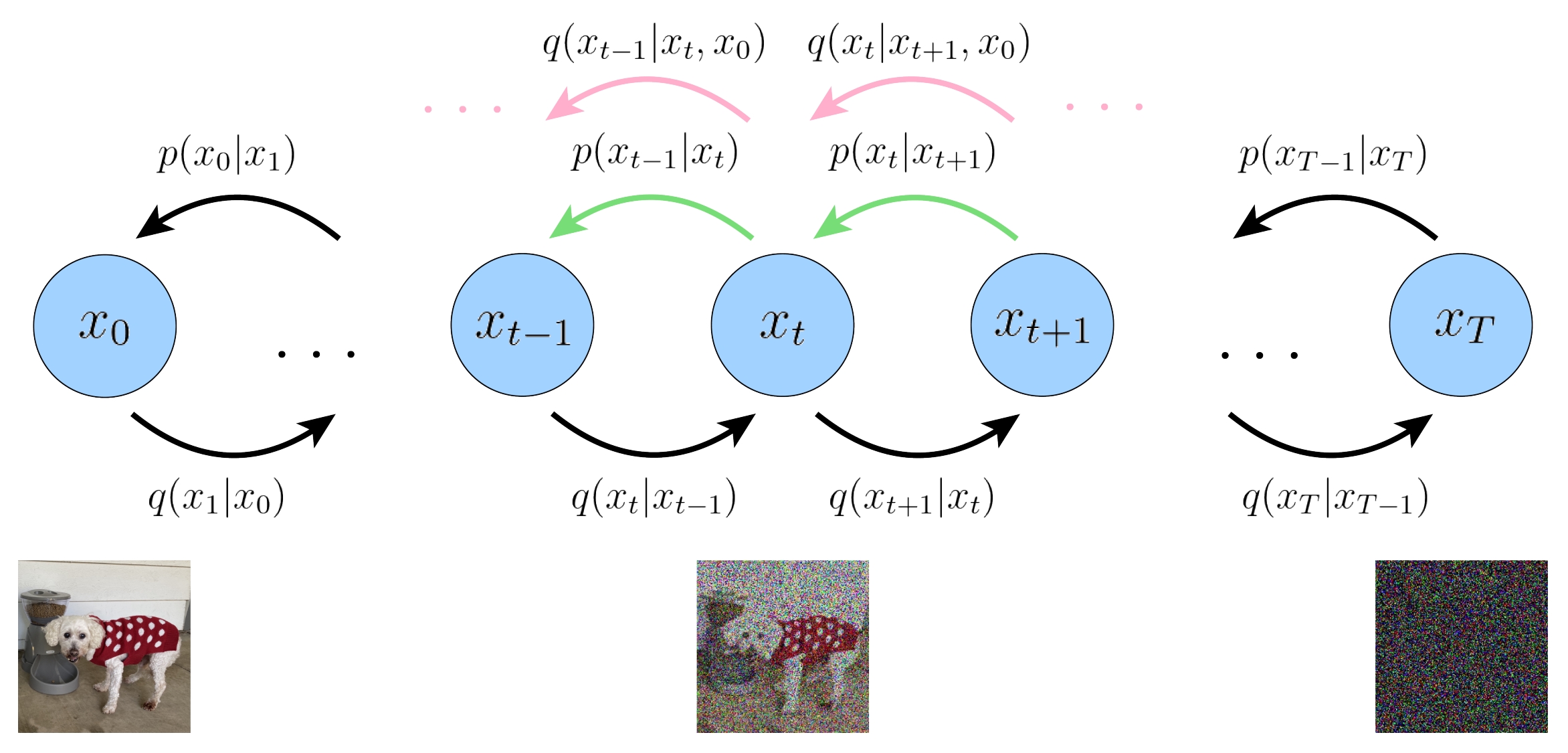
训练目标。最大化证据下界等价于最小化以下损失函数:
\\\boldsymbol{\\theta}\^\*=\\underset{\\boldsymbol{\\theta}}{\\operatorname{argmin}} \\sum_{t=1}\^T \\frac{1}{2 \\sigma\^2(t)} \\frac{\\left(1-\\alpha_t\\right)\^2 \\overline{\\alpha}_{t-1}}{\\left(1-\\overline{\\alpha}_t\\right)\^2} \\mathbb{E}_{q\\left(\\mathbf{x}_t \\mid \\mathbf{x}_0\\right)}\\left\[\\Vert\\tilde{\\mathbf{x}}_{\\boldsymbol{\\theta}}\\left(\\mathbf{x}_t, t\\right)-\\mathbf{x}_0\\Vert_2\^2\\right \tag{1} \]
推理过程。推理过程利用马尔可夫链蒙特卡罗方法。
\\\begin{aligned} \\mathbf{x}_{t-1} \&\\sim p_{\\theta}\\left(\\mathbf{x}_{t-1} \| \\mathbf{x}_{t}\\right) = \\mathcal{N}(\\mathbf{x}_{t-1}; \\tilde{\\bm{\\mu}}_{\\theta}\\left(\\mathbf{x}_{t}, t\\right) , \\sigma\^2 \\left(t\\right) \\mathbf{I}) \\\\ \\mathbf{x}_{t-1} \&= \\tilde{\\bm{\\mu}}_{\\theta}\\left(\\mathbf{x}_{t}, t\\right) + \\sigma \\left(t\\right) \\bm{\\epsilon} \\\\ \&= \\frac{\\left( 1 - \\overline{\\alpha}_{t-1} \\right) \\sqrt{\\alpha_t}}{\\left( 1 - \\overline{\\alpha}_{t} \\right)} \\mathbf{x}_{t} + \\frac{\\left(1 - \\alpha_t\\right) \\sqrt{\\overline{\\alpha}_{t-1}}}{\\left( 1 - \\overline{\\alpha}_{t} \\right)} \\tilde{\\mathbf{x}}_{\\theta} \\left(\\mathbf{x}_{t}, t\\right) + \\sigma \\left(t\\right) \\bm{\\epsilon} \\end{aligned} \\tag{2} \\
1、预测噪声
上一篇文章我们提到,扩散模型的神经网络用于预测 \(\mathbf{x}_{0}\),然而DDPM并不是这样做的,而是用神经网络预测噪声。这也是DDPM 第一个字母 D(Denoising)的含义。为什么采用预测噪声的参数化方法?DDPM作者在原文中提到去噪分数匹配(denoising score matching, DSM),并说这样训练和DSM是等价的。可见应该是收了DSM的启发。另外一个解释我们一会来讲。
按照上一篇文章的化简技巧,对于神经网络的预测输出 \(\tilde{\mathbf{x}}_{\boldsymbol{\theta}}\left(\mathbf{x}_t, t\right)\),也可以进行进一步参数化(parameterization):
已知:
\\\begin{aligned} \\mathbf{x}_{t} = \\sqrt{\\overline{\\alpha}_t} \\mathbf{x}_{0} + \\sqrt{1 - \\overline{\\alpha}_t} \\bm{\\epsilon} \\end{aligned} \\tag{3} \\
于是:
\\\begin{aligned} \\mathbf{x}_{0} = \\frac{1}{\\sqrt{\\overline{\\alpha}_t}} \\mathbf{x}_{t} + \\frac{\\sqrt{1 - \\overline{\\alpha}_t}}{\\sqrt{\\overline{\\alpha}_t}} \\bm{\\epsilon} \\end{aligned} \\tag{4} \\
\\\begin{aligned} \\tilde{\\mathbf{x}}_{\\boldsymbol{\\theta}}\\left(\\mathbf{x}_t, t\\right) = \\frac{1}{\\sqrt{\\overline{\\alpha}_t}} \\mathbf{x}_{t} + \\frac{\\sqrt{1 - \\overline{\\alpha}_t}}{\\sqrt{\\overline{\\alpha}_t}} \\tilde{\\bm{\\epsilon}}_{\\boldsymbol{\\theta}}\\left(\\mathbf{x}_t, t\\right) \\end{aligned} \\tag{5} \\
这里我们解释以下为什么采用预测噪声的方式的第二个原因。从(4)(5)两式可见,噪声项可以看作是 \(\mathbf{x}{0}\) 与 \(\mathbf{x}{t}\) 的残差项。回顾经典的Resnet结构:
\\\left\[\\mathbf{y}=\\mathbf{x}+\\mathcal{F}\\left(\\mathbf{x}, W_i\\right)\\right \]
Resnet也是用神经网络学习的残差项。DDPM采用预测噪声的方法和Resnet残差学习由异曲同工之妙。
下面我们将(3)(4)两式代入(1)式,继续化简,有:
\\\begin{aligned} \\Vert\\tilde{\\mathbf{x}}_{\\boldsymbol{\\theta}}\\left(\\mathbf{x}_t, t\\right)-\\mathbf{x}_0\\Vert_2\^2 \&= \\frac{1 - \\overline{\\alpha}_t}{\\overline{\\alpha}_t} \\Vert\\tilde{\\bm{\\epsilon}}_{\\boldsymbol{\\theta}}\\left(\\mathbf{x}_t, t\\right)-\\bm{\\epsilon}\\Vert_2\^2 \\end{aligned} \\
注意 \(\overline{\alpha}t\) = \(\overline{\alpha}{t-1} \alpha_t\)于是可以得出新的优化方程:
\\\boldsymbol{\\theta}\^\*=\\underset{\\boldsymbol{\\theta}}{\\operatorname{argmin}} \\sum_{t=1}\^T \\frac{1}{2 \\sigma\^2(t)} \\frac{\\left(1-\\alpha_t\\right)\^2}{\\left(1-\\overline{\\alpha}_t\\right) \\alpha}_t \\mathbb{E}_{q\\left(\\mathbf{x}_t \\mid \\mathbf{x}_0\\right)}\\left\[\\Vert\\tilde{\\bm{\\epsilon}}_{\\boldsymbol{\\theta}}\\left(\\sqrt{\\overline{\\alpha}_t} \\mathbf{x}_{0} + \\sqrt{1 - \\overline{\\alpha}_t} \\bm{\\epsilon}, t\\right)-\\bm{\\epsilon}\\Vert_2\^2\\right \tag{6} \]
(6) 式表示,我们的神经网络 \(\tilde{\bm{\epsilon}}_{\boldsymbol{\theta}}\left(\sqrt{\overline{\alpha}t} \mathbf{x}{0} + \sqrt{1 - \overline{\alpha}_t} \bm{\epsilon}, t\right)\) 被用于预测最初始的噪声 \(\bm{\epsilon}\)。忽略掉前面的系数,对应的训练算法如下:
Algorithm 3 . Training a Deniosing Diffusion Probabilistic Model. (Version: Predict noise)
Repeat the following steps until convergence.
- For every image \(\mathbf{x}_0\) in your training dataset \(\mathbf{x}_0 \sim q\left(\mathbf{x}_0\right)\)
- Pick a random time step \(t \sim \text{Uniform}1, T\).
- Generate normalized Gaussian random noise \(\bm{\epsilon} \sim \mathcal{N} \left(\mathbf{0}, \mathbf{I}\right)\)
- Take gradient descent step on
\\\nabla_{\\boldsymbol{\\theta}} \\Vert\\tilde{\\bm{\\epsilon}}_{\\boldsymbol{\\theta}}\\left(\\sqrt{\\overline{\\alpha}_t} \\mathbf{x}_{0} + \\sqrt{1 - \\overline{\\alpha}_t} \\bm{\\epsilon}, t\\right)-\\bm{\\epsilon}\\Vert_2\^2 \\
You can do this in batches, just like how you train any other neural networks. Note that, here, you are training one denoising network \(\tilde{\bm{\epsilon}}_{\boldsymbol{\theta}}\) for all noisy conditions.
推理的过程依然从马尔可夫链蒙特卡洛(MCMC)开始,因为这里是预测噪声,而推理的过程中也需要加噪声,为了区分,我们将推理过程中添加的噪声用 \(\mathbf{z} \sim \mathcal{N} \left(\mathbf{0}, \mathbf{I}\right)\) 来表示。推理过程中每次推理的噪声 \(\mathbf{z}\) 都是不同的,但训练过程中要拟合的最初的目标噪声 \(\bm{\epsilon}\) 是相同的。
\\\begin{aligned} \\mathbf{x}_{t-1} \&\\sim p_{\\theta}\\left(\\mathbf{x}_{t-1} \| \\mathbf{x}_{t}\\right) = \\mathcal{N}(\\mathbf{x}_{t-1}; \\tilde{\\bm{\\mu}}_{\\theta}\\left(\\mathbf{x}_{t}, t\\right) , \\sigma\^2 \\left(t\\right) \\mathbf{I}) \\\\ \\mathbf{x}_{t-1} \&= \\tilde{\\bm{\\mu}}_{\\theta}\\left(\\mathbf{x}_{t}, t\\right) + \\sigma \\left(t\\right) \\mathbf{z} \\\\ \&= \\frac{\\left( 1 - \\overline{\\alpha}_{t-1} \\right) \\sqrt{\\alpha_t}}{\\left( 1 - \\overline{\\alpha}_{t} \\right)} \\mathbf{x}_{t} + \\frac{\\left(1 - \\alpha_t\\right) \\sqrt{\\overline{\\alpha}_{t-1}}}{\\left( 1 - \\overline{\\alpha}_{t} \\right)} \\tilde{\\mathbf{x}}_{\\theta} \\left(\\mathbf{x}_{t}, t\\right) + \\sigma \\left(t\\right) \\mathbf{z} \\end{aligned} \\tag{7} \\
将(5)式代入:
\\\begin{aligned} \\tilde{\\bm{\\mu}}_{\\theta}\\left(\\mathbf{x}_{t}, t\\right) \&= \\frac{\\left( 1 - \\overline{\\alpha}_{t-1} \\right) \\sqrt{\\alpha_t}}{\\left( 1 - \\overline{\\alpha}_{t} \\right)} \\mathbf{x}_{t} + \\frac{\\left(1 - \\alpha_t\\right) \\sqrt{\\overline{\\alpha}_{t-1}}}{\\left( 1 - \\overline{\\alpha}_{t} \\right)} \\tilde{\\mathbf{x}}_{\\theta} \\left(\\mathbf{x}_{t}, t\\right) \\\\ \&= \\frac{\\left( 1 - \\overline{\\alpha}_{t-1} \\right) \\sqrt{\\alpha_t}}{\\left( 1 - \\overline{\\alpha}_{t} \\right)} \\mathbf{x}_{t} + \\frac{\\left(1 - \\alpha_t\\right) \\sqrt{\\overline{\\alpha}_{t-1}}}{\\left( 1 - \\overline{\\alpha}_{t} \\right)} \\left( \\frac{1}{\\sqrt{\\overline{\\alpha}_t}} \\mathbf{x}_{t} + \\frac{\\sqrt{1 - \\overline{\\alpha}_t}}{\\sqrt{\\overline{\\alpha}_t}} \\tilde{\\bm{\\epsilon}}_{\\boldsymbol{\\theta}}\\left(\\mathbf{x}_t, t\\right) \\right) \\\\ \&= \\text{some algebra calculation} \\\\ \&= \\frac{1}{\\sqrt{\\overline{\\alpha}_t}} \\mathbf{x}_{t} + \\frac{1 - \\alpha_t}{ \\sqrt{ \\left( 1 - \\overline{\\alpha}_{t} \\right)\\alpha}_t} \\tilde{\\bm{\\epsilon}}_{\\boldsymbol{\\theta}}\\left(\\mathbf{x}_t, t\\right) \\end{aligned} \\
所以推理的表达式为:
\\\begin{aligned} \\mathbf{x}_{t-1} \&= \\frac{1}{\\sqrt{\\overline{\\alpha}_t}} \\mathbf{x}_{t} + \\frac{1 - \\alpha_t}{ \\sqrt{ \\left( 1 - \\overline{\\alpha}_{t} \\right)\\alpha}_t} \\tilde{\\bm{\\epsilon}}_{\\boldsymbol{\\theta}}\\left(\\mathbf{x}_t, t\\right) + \\sigma \\left(t\\right) \\mathbf{z} \\end{aligned} \\tag{7} \\
下面可以写出采用拟合噪声策略的推理算法:
Algorithm 4 . Inference on a Deniosing Diffusion Probabilistic Model. (Version: Predict noise)
You give us a white noise vector \(\mathbf{x}_T \sim \mathcal{N} \left(\mathbf{0}, \mathbf{I}\right)\)
Repeat the following for \(t = T, T − 1, ... , 1\).
- Generate \(\mathbf{z} \sim \mathcal{N} \left(\mathbf{0}, \mathbf{I}\right)\) if \(t > 1\) else \(\mathbf{z} = \mathbf{0}\)
\\\mathbf{x}_{t-1} = \\frac{1}{\\sqrt{\\overline{\\alpha}_t}} \\mathbf{x}_{t} + \\frac{1 - \\alpha_t}{ \\sqrt{ \\left( 1 - \\overline{\\alpha}_{t} \\right)\\alpha}_t} \\tilde{\\bm{\\epsilon}}_{\\boldsymbol{\\theta}}\\left(\\mathbf{x}_t, t\\right) + \\sigma \\left(t\\right) \\mathbf{z} \\
Return \(\mathbf{x}_{0}\)
2、后处理
首先要注意到,在推理算法的最后一步,生成图像的时候,并没有添加噪声,而是直接采用预测的均值作为 \(\mathcal{x}_0\) 的估计值。
另外,生成的图像原本是归一化到 \(-1, 1\) 之间的,所以要反归一化到 \(0, 255\)。这里比较简单,直接看 diffusers 库中的代码:
python
image = (image / 2 + 0.5).clamp(0, 1)
image = image.cpu().permute(0, 2, 3, 1).numpy()
if output_type == "pil":
    image = self.numpy_to_pil(image)

if not return_dict:
    return (image,)


def numpy_to_pil(images):
    """
    Convert a numpy image or a batch of images to a PIL image.
    """
    if images.ndim == 3:
        images = images[None, ...]
    images = (images * 255).round().astype("uint8")
    if images.shape[-1] == 1:
        # special case for grayscale (single channel) images
        pil_images = [Image.fromarray(image.squeeze(), mode="L") for image in images]
    else:
        pil_images = [Image.fromarray(image) for image in images]

    return pil_images
3、总结
我们最初的目标是估计图像的概率分布,采用极大似然估计法,求 \(\log p\left(\mathbf{x}_0\right)\)。但是直接求解,很难求:
\\\begin{aligned} p\\left(\\mathbf{x}_0\\right) = \\int p\\left(\\mathbf{x}_{0:T}\\right) d \\mathbf{x}_{1:T} \\\\ \\end{aligned} \\\\ \\
而且 \(p\left(\mathbf{x}{0:T}\right)\) 也不知道。于是我们选择估计它的证据下界。在计算证据下界的过程中,我们解析了双向马尔可夫链中的很多分布和变量,最终推导出证据下界的表达式,以KL散度的方式来表示。这样做本质上是用已知的分布 \(q\left(\mathbf{x}{1:T} | \mathbf{x}_{0}\right)\) 来对未知的分布做逼近。这其实是 变分推断 的思想。变分法是寻找一个函数使得这个函数最能满足条件,而变分推断是寻找一个分布使之更加逼近已知的分布。
于是我们而在高斯分布的假设下,KL散度恰好等价于二范数的平方。最大似然估计等价于最小化二范数loss。之后就顺理成章地推导出了训练方法,并根据马尔可夫链蒙特卡洛推导出推理算法。关于变分推断和马尔可夫链蒙特卡洛相关的知识,读者可以自行查找,有时间我也会写篇文章来介绍。
以上就是DDPM的全部内容了,我用了四篇文章对DDPM进行了详细推导,写文章的过程中也弄懂了自己之前不懂的一些细节。我的最大的感受是,初学者千万不要相信诸如《一文读懂DDPM》之类的文章,如果要真正搞懂DDPM,只有自己把所有公式手推一边才是正道。
下一篇我们开始介绍DDPM的一个经典的推理加速方法:DDIM