Foreword
Hi!! my dear friends, are you lazy at today?? Oh! I am also lazy sometimes, but you will know keep study that's a right way at last. Now!! let's start new travel about Scala.
Text
The all Codes in file day3.scala, like the below program:
scala
import scala.collection.mutable
import scala.collection.immutable.HashSet

object day3 {
  def main(args:Array[String]): Unit = {
    System.out.println("Scala is make me happy!!");
    Tuple_operation();
  }

  def Tuple_operation(): Unit = {
//    val empty_tup = ();
//    System.out.println(empty_tup);
    val pair = (81,"number","Y");
    System.out.println(pair);
//    pair(0) = 5;
    System.out.println(pair(0));
    System.out.println(pair(2));
    System.out.println(pair(1));
//    System.out.println(pair[1]);
    System.out.println(pair._1);
    System.out.println(pair._2);
    System.out.println(pair._3);

    var capital = Set("Beijing","Tokyo","London");
    capital += "Paris";
    System.out.println(capital);
    System.out.println(capital.contains("Washington"));

    val exam = Set("123","456");
    System.out.println(exam);

    val Musicset = mutable.Set("One day","Lemon Tree");
    Musicset += "Tomorrow will be better";
    System.out.println(Musicset);

    Musicset.+=("Waiting for love");
    System.out.println(Musicset);
    Musicset.+=("MoonLight");
    System.out.println(Musicset);
    Musicset += "Oblivion";
    System.out.println(Musicset);

    var video = mutable.Set("KaSha","Hero");
    System.out.println(video);
//    Musicset = video;

    var Name = HashSet("Tom","Sam");
    System.out.println("HashSet:");
    Name += "Amy";
    System.out.println(Name);
    Name += "Pan"
    System.out.println(Name);

    val letters = HashSet("ABC","DEF","RTF");
    System.out.println(letters);

    val MAP = mutable.Map[String,String]();
    MAP += ("music" -> "后来");
    MAP += ("movie" -> "第一滴血")
    MAP += ("game" -> "war3");
    System.out.println(MAP);
    System.out.println(MAP("game"));
    System.out.println(MAP("music"));
    System.out.println(MAP("movie"));

    val Mapper = Map(1 -> "A",2 -> "B",3 -> "C");
    System.out.println(Mapper);
    System.out.println(Mapper(1));
    System.out.println(Mapper(2));
    System.out.println(Mapper(3));

  }
}
The first example, it's about the tuple defined and get the tuple values. It like the below Codes:
scala
	val pair = (81,"number","Y");
    System.out.println(pair);

    System.out.println(pair(0));
    System.out.println(pair(2));
    System.out.println(pair(1));

    System.out.println(pair._1);
    System.out.println(pair._2);
    System.out.println(pair._3);
Output Result:
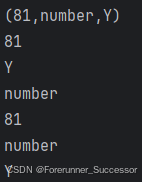
From the above Codes, we know the process of tuple type defined. Through subscript couldn't gain value at the previous relase. In 3.6.4 relase, the reason is like the below pictures:

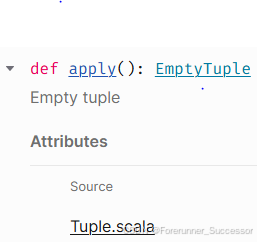
It's use apply() function, it's like List type, so it could use subscript to gain the tuple value.
Next, the example is set type declared, codes like the below program:
scala
    var capital = Set("Beijing","Tokyo","London");
    capital += "Paris";
    System.out.println(capital);
    System.out.println(capital.contains("Washington"));

    val exam = Set("123","456");
    System.out.println(exam);
Output Result:
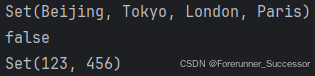
From the Output Result, we know var type could let set type mutable , contains() function, it could judge data in the set. Val type couldn't change the set element.
Then, we look the mutable set, it like the below codes:
scala
 	val Musicset = mutable.Set("One day","Lemon Tree");
    Musicset += "Tomorrow will be better";
    System.out.println(Musicset);

    Musicset.+=("Waiting for love");
    System.out.println(Musicset);
    Musicset.+=("MoonLight");
    System.out.println(Musicset);
    Musicset += "Oblivion";
    System.out.println(Musicset);

    var video = mutable.Set("KaSha","Hero");
    System.out.println(video);
//    Musicset = video;
Output Result:

From the above program, we know val type couldn't limit the mutable set , the reason is mutable set is change itself , isn't change the Musicset Object. if we uncomment, then new Object video will assign value to Musicset Object, but the val type couldn't permit the operation and pop error. And set is disordered.
After, we watch the example about immutable set, like the below codes:
scala
 	var Name = HashSet("Tom","Sam");
    System.out.println("HashSet:");
    Name += "Amy";
    System.out.println(Name);
    Name += "Pan"
    System.out.println(Name);

    val letters = HashSet("ABC","DEF","RTF");
    System.out.println(letters);
Output Result:
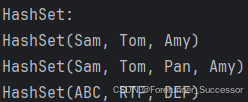
From the result, we know var type could effect the immutable set, it also could add element to set.
At last, we look this codes:
scala
	val MAP = mutable.Map[String,String]();
    MAP += ("music" -> "后来");
    MAP += ("movie" -> "第一滴血")
    MAP += ("game" -> "war3");
    System.out.println(MAP);
    System.out.println(MAP("game"));
    System.out.println(MAP("music"));
    System.out.println(MAP("movie"));

    val Mapper = Map(1 -> "A",2 -> "B",3 -> "C");
    System.out.println(Mapper);
    System.out.println(Mapper(1));
    System.out.println(Mapper(2));
    System.out.println(Mapper(3));
Output Result:
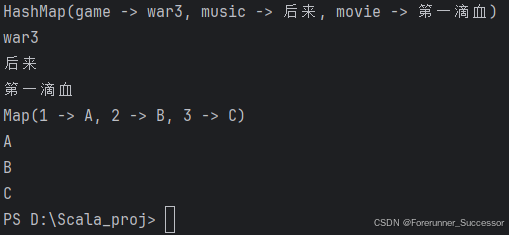
From the program result, we know map type has two ways to create it. One is obviously point itself all types and haven't put datas , anthor is directly put datas, it could identify these datas corresponding itselves types.
In the end
I gratitude for your watch my articles, if you still learn the Scala, you are excellent, I admire you, I hope you could point some mistakes in my passages. The reason is I'm not a smart man. Please you remember: anything, you must insist do it at last that you will become winner in this game. Your Pan.【One human low-quality male】