在构建高并发、多任务的 Python 应用时,线程安全(Thread Safety) 是保证程序稳定性与正确性的重要基础。本篇文章将从原理、机制、常用工具、典型场景和最佳实践五个方面系统讲解 Python 中的线程安全,帮助你在实际开发中正确地识别并解决多线程冲突问题。
一、什么是线程安全?
线程安全 是指在多线程环境下 ,对共享数据的访问不导致数据竞争(race condition)或状态不一致的程序行为。
当多个线程同时读写同一变量、对象或资源时,如果没有适当的同步机制,可能会出现:
- 读到部分更新的数据
- 丢失写入
- 应用崩溃或死锁
例如以下一些非线程安全的代码
- 共享变量的自增操作(经典)
python
import threading

counter = 0

def increment():
    global counter
    for _ in range(100000):
        counter += 1

threads = [threading.Thread(target=increment) for _ in range(5)]
[t.start() for t in threads]
[t.join() for t in threads]

print("期望值:", 5 * 100000)
print("实际值:", counter)
counter += 1实际是读取、加一、写入的组合操作(非原子)- 多线程中会产生丢失写入的现象
- 对象属性的非安全访问
python
import threading


class User:
    def __init__(self):
        self.name = "guest"


user = User()


def change_name():
    for i in range(100000):
        user.name = f"admin"  # 非线程安全


threads = [threading.Thread(target=change_name) for _ in range(5)]
[t.start() for t in threads]
[t.join() for t in threads]

print(user.name) # 最终值可能是任意线程写入的user.name在并发写入中状态不可预测- 会造成业务逻辑混乱,比如权限错误等
- 懒加载资源时的重复初始化
python
import threading
import time


class LazyInit:
    def __init__(self):
        self._obj = None

    def get(self):
        if self._obj is None:
            time.sleep(0.1)  # 模拟初始化耗时
            self._obj = object()
        return self._obj


resource = LazyInit()


def init_resource():
    obj = resource.get()
    print(f"对象ID: {id(obj)}")


threads = [threading.Thread(target=init_resource) for _ in range(5)]
[t.start() for t in threads]
[t.join() for t in threads]
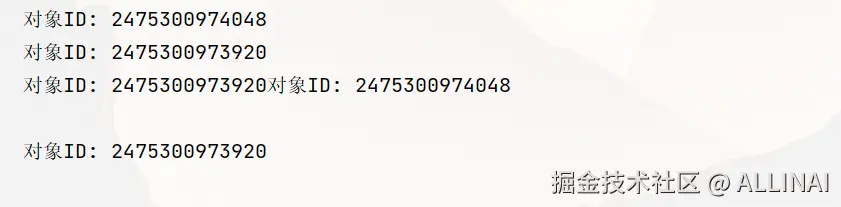
if self._obj is None判断后,在多线程间竞态,可能创建多个对象- 应该加锁来确保只初始化一次(双重检查锁)
- 缓存读写并发导致数据不一致
python
cache = {}

def writer():
    for i in range(1000):
        cache["data"] = i  # 写入缓存

def reader():
    for _ in range(1000):
        val = cache.get("data")
        if val is None:
            print("读取到空值")
        elif val < 0:
            print("读取到非法值")

t1 = threading.Thread(target=writer)
t2 = threading.Thread(target=reader)

t1.start()
t2.start()
t1.join()
t2.join()dict本身在读写之间不是线程安全的- 会出现
KeyError或读取到未完整写入的值
- 文件写操作非线程安全
python
import threading


def write_file():
    with open("output.txt", "a") as f:
        for _ in range(100):
            f.write("hello\n")


threads = [threading.Thread(target=write_file) for _ in range(5)]
[t.start() for t in threads]
[t.join() for t in threads]- 文件追加操作并不是原子性的
- 多线程下会导致写入冲突、文件内容交错、乱码等
- 日志或终端打印输出错乱
python
import threading


def log():
    for i in range(10):
        print(f"[{threading.current_thread().name}] log {i}")


threads = [threading.Thread(target=log, name=f"T{i}") for i in range(3)]
[t.start() for t in threads]
[t.join() for t in threads]print()本身是线程安全的,但输出顺序是非确定性的- 日志文件中可能交错、难以追踪
- 类变量竞争
python
import threading
import time


class Singleton:
    instance = None

    @classmethod
    def get_instance(cls):
        if cls.instance is None:
            time.sleep(0.1)  # 模拟实例化耗时
            cls.instance = object()
        return cls.instance


def create():
    print(id(Singleton.get_instance()))


threads = [threading.Thread(target=create) for _ in range(10)]
[t.start() for t in threads]
[t.join() for t in threads]- 多线程中可能返回多个
object()实例 - 违反单例设计意图
二、Python 的线程模型与 GIL
Python(特别是 CPython 实现)中使用了 全局解释器锁(GIL) 来控制同一时间只有一个线程执行字节码。这意味着:
- GIL 简化了 C 扩展的线程安全实现
- 但 不能保证共享数据层面的线程安全
- GIL 并不阻止你自己"作死"地读写共享数据
特别是在涉及 I/O、数据库、文件、socket 或外部资源 时,线程之间的竞争是真实存在的。
三、实现线程安全的常用工具
🔐 1. threading.Lock:最基础的互斥锁
✅ 适用场景
- 多线程访问或修改 共享变量 或 对象状态
🔧 示例:加锁保护共享计数器
python
import threading

counter = 0
lock = threading.Lock()

def worker():
    global counter
    for _ in range(100000):
        with lock:
            counter += 1  # 临界区

threads = [threading.Thread(target=worker) for _ in range(5)]
[t.start() for t in threads]
[t.join() for t in threads]

print("最终计数值:", counter)
✅ 说明
with lock:是最佳实践,确保异常时也会自动释放锁counter += 1是非原子操作,必须加锁保护
🔁 2. threading.RLock:可重入锁(Reentrant Lock)
🧠 类比说明:可重入锁 vs 普通锁(Lock)
- 普通锁(Lock):你上锁之后就不能再进去,即使你自己还在里面,你打不开第二道门,被"自己锁死"了。
- 可重入锁(RLock):你上锁之后,如果还是你自己想再进去,你能继续进去并正常出来,每进一次就记一次,出来也要解锁同样的次数。
✅ 适用场景
- 同一线程递归或重复获取锁时不会死锁
- 多层函数都加了锁
🔧 示例1:同一线程重复操作数据结构时加锁
- 你在函数 A 中获取了锁,但 A 调用了 B,B 又尝试获取锁,会死锁
python
import threading

lock = threading.Lock()

def func_b():
    print("func_b 试图加锁")
    with lock:  # ❌ 死锁发生在这里
        print("func_b 获得锁")

def func_a():
    print("func_a 加锁中")
    with lock:
        print("func_a 获得锁,调用 func_b")
        func_b()

t = threading.Thread(target=func_a)
t.start()
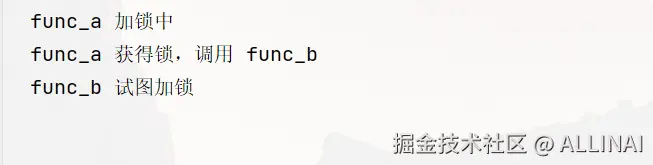
t.join()Lock死锁原因分析:func_a获得了锁- 调用
func_b,它也试图获得锁 - 但锁已经被当前线程占有
Lock不允许同一线程再次获取,所以死锁
- 使用
RLock解决同线程死锁
python
import threading

lock = threading.RLock()

def func_b():
    print("func_b 试图加锁")
    with lock:
        print("func_b 获得锁")

def func_a():
    print("func_a 加锁中")
    with lock:
        print("func_a 获得锁,调用 func_b")
        func_b()

t = threading.Thread(target=func_a)
t.start()
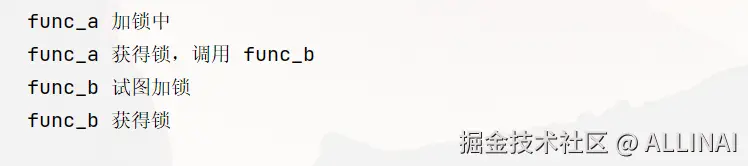
t.join()RLock如何防止死锁?RLock在内部维护了:当前拥有锁的线程ID 和 一个计数器- 第一次加锁:如果锁是空闲的,线程获得它,计数器设为 1
- 如果同一个线程再次加锁:允许加锁,计数器加 1
- 每次
release()都会减 1,直到计数器变为 0,真正释放锁
🔧 示例2:递归锁场景
python
import threading


class Counter:
    def __init__(self):
        self._value = 0
        self._lock = threading.RLock()

    def increment(self):
        with self._lock:
            self._value += 1
            self.log()  # 这里再次用到锁

    def log(self):
        with self._lock:
            print(f"当前值: {self._value}")


counter = Counter()
counter.increment()
如果你用 Lock 而不是 RLock,调用 increment() 会死锁,因为它又调用了 log(),而 log() 也试图获取相同的锁。
⏳ 3. threading.Event:线程间信号机制
✅ 适用场景
- 主线程等待子线程完成任务
- 多个线程协调某个阶段
🔧 示例:等待"准备完毕"后再启动多个线程
python
import threading
import time

event = threading.Event()

def worker():
    print(f"{threading.current_thread().name} 等待信号中...")
    event.wait()
    print(f"{threading.current_thread().name} 开始工作")

threads = [threading.Thread(target=worker) for _ in range(3)]
[t.start() for t in threads]

time.sleep(2)
print("主线程发出开始信号")
event.set()  # 所有等待线程开始执行
✅ 输出
scss
Thread-1 (worker) 等待信号中...
Thread-2 (worker) 等待信号中...
Thread-3 (worker) 等待信号中...
主线程发出开始信号
Thread-1 (worker) 开始工作
Thread-3 (worker) 开始工作
Thread-2 (worker) 开始工作
🧺 4. queue.Queue:线程安全的队列(生产者-消费者模型)
✅ 适用场景
- 多线程任务分发
- 数据缓冲、任务池、日志队列等
🔧 示例:生产者-消费者模型
python
import threading
import queue
import time
import random

# 创建线程安全的队列
q = queue.Queue()


# 消费者函数
def consumer():
    while True:
        item = q.get()  # 阻塞式获取任务
        if item is None:  # 特殊标志,表示退出
            q.task_done()
            break
        print(f"消费:{item}")
        time.sleep(random.uniform(0.2, 0.5))  # 模拟处理时间
        q.task_done()  # 告诉队列任务处理完了


# 生产者函数
def producer():
    for i in range(10):
        print(f"生产:{i}")
        q.put(i)  # 放入任务
        time.sleep(random.uniform(0.1, 0.3))  # 模拟生成时间

    # 发送退出信号给所有消费者(一个 None 表示一个消费者应退出)
    for _ in range(2):
        q.put(None)


# 启动多个消费者线程
consumers = [threading.Thread(target=consumer) for _ in range(2)]
for t in consumers:
    t.start()

# 启动生产者线程
producer_thread = threading.Thread(target=producer)
producer_thread.start()

# 等待所有生产者任务放入队列
producer_thread.join()

# 阻塞主线程直到所有任务被处理完成
q.join()

print("所有任务处理完毕。")
✅ 输出
生产:0
消费:0
生产:1
消费:1
生产:2
消费:2
生产:3
消费:3
生产:4
消费:4
生产:5
消费:5
生产:6
消费:6
生产:7
消费:7
生产:8
消费:8
生产:9
消费:9
所有任务处理完毕。
✅ 说明
queue.Queue内部加锁,天然线程安全task_done()+q.join()可实现阻塞等待所有任务完成- 忘记
task_done()将导致join()永远阻塞
🧮 5. threading.Semaphore:限制同时运行线程数量
Semaphore: 信号,
/ˈsem.ə.fɔː/,发音近似为:"塞-么-阔"
✅ 适用场景
- 限制并发线程数量
- 控制对数据库连接、API 调用、I/O 的并发访问
🔧 示例:最多允许 3 个线程同时访问资源
python
import threading
import time

sema = threading.Semaphore(3)

def worker(i):
    with sema:
        print(f"线程 {i} 获取到资源")
        time.sleep(2)
        print(f"线程 {i} 释放资源")

threads = [threading.Thread(target=worker, args=(i,)) for i in range(6)]
[t.start() for t in threads]
[t.join() for t in threads]
✅ 输出(可观察到并发控制)
bash
线程 0 获取到资源
线程 1 获取到资源
线程 2 获取到资源

# 等待2秒前3个释放后,才会进入下3个

线程 0 释放资源
线程 3 获取到资源
线程 2 释放资源
线程 4 获取到资源
线程 1 释放资源
线程 5 获取到资源
线程 3 释放资源
线程 5 释放资源
线程 4 释放资源
🧩 6. threading.Condition:更复杂的等待-通知模型
✅ 适用场景
-
有条件触发的资源等待,如:
- 缓冲区为空等待写入
- 数据可用时通知读取
🔧 示例:等待缓冲区非空后消费
python
import threading
import time

buffer = []
condition = threading.Condition()

def producer():
    with condition:
        print("生产者准备生产数据...")
        buffer.append(1)
        condition.notify()  # 通知消费者
        print("生产者完成")

def consumer():
    with condition:
        while not buffer:
            print("消费者等待数据...")
            condition.wait()
        buffer.pop()
        print("消费者取走数据")

threading.Thread(target=consumer).start()
time.sleep(1)
threading.Thread(target=producer).start()
✅ 输出
erlang
消费者等待数据...
生产者准备生产数据...
生产者完成
消费者取走数据
✅ 说明
Condition是线程同步的一种高级工具- 一般用于线程等待"某个条件成立"时再继续执行
- 常配合
Lock使用,提供wait-notify机制
python
condition = threading.Condition()

# 线程等待条件满足
with condition:
    condition.wait()  # 阻塞,直到 condition.notify() 被调用

# 另一个线程发出通知
with condition:
    condition.notify()
🔗 7. threading.Barrier:所有线程准备就绪后统一继续
✅ 适用场景
- 所有线程需要在某个阶段同步后再继续运行
🔧 示例:模拟赛跑起跑线
python
import threading
import time
import random

barrier = threading.Barrier(3)

def runner(i):
    print(f"选手 {i} 准备中...")
    time.sleep(random.uniform(0.5, 2))
    print(f"选手 {i} 准备就绪")
    barrier.wait()
    print(f"选手 {i} 起跑!")

threads = [threading.Thread(target=runner, args=(i,)) for i in range(3)]
[t.start() for t in threads]
[t.join() for t in threads]
✅ 输出
- 所有线程都会"卡在"
barrier.wait(),直到所有人准备好后才一起继续执行。
erlang
选手 0 准备中...
选手 1 准备中...
选手 2 准备中...

# 等待所有选手准备完毕后起跑

选手 2 准备就绪
选手 1 准备就绪
选手 0 准备就绪
选手 0 起跑!选手 2 起跑!

选手 1 起跑!
✅ 总结对比表
| 工具 | 功能/用途 | 适合场景 |
|---|---|---|
Lock |
互斥访问资源 | 修改全局变量、对象属性 |
RLock |
支持重入锁 | 多层调用、递归结构 |
Event |
信号通知 | 同步加载、启动控制 |
Queue |
线程安全队列 | 任务池、生产者消费者模型 |
Semaphore |
限制并发量 | 限制数据库/API/I/O并发 |
Condition |
等待特定条件 | 数据准备通知、复杂通信 |
Barrier |
所有线程达到同步点再继续 | 多线程阶段统一推进 |
四、线程安全设计的几种策略
✅ 避免共享:无状态设计
尽可能让每个线程操作独立的数据(如局部变量、不可变对象),不共享即安全。
✅ 使用锁控制访问范围
对共享资源加锁,只在必要的临界区中访问共享数据。
python
def update_data():
    with lock:
        # 修改共享变量
✅ 使用线程安全的数据结构
如 queue.Queue, collections.deque(thread-safe append/pop)等。
✅ 使用线程安全包装类
创建类似 ThreadSafeObject 的包装器,隐藏锁逻辑,提升可维护性。
- 例如
chatchat\server\knowledge_base\kb_cache\base.py中的ThreadSafeObject类
python
class ThreadSafeObject:
    def __init__(
        self, key: Union[str, Tuple], obj: Any = None, pool: "CachePool" = None
    ):
        self._obj = obj
        self._key = key
        self._pool = pool
        self._lock = threading.RLock()
        self._loaded = threading.Event()

    def __repr__(self) -> str:
        cls = type(self).__name__
        return f"<{cls}: key: {self.key}, obj: {self._obj}>"

    @property
    def key(self):
        return self._key

    @contextmanager
    def acquire(self, owner: str = "", msg: str = "") -> Generator[None, None, FAISS]:
        owner = owner or f"thread {threading.get_native_id()}"
        try:
            self._lock.acquire()
            if self._pool is not None:
                self._pool._cache.move_to_end(self.key)
            logger.debug(f"{owner} 开始操作:{self.key}。{msg}")
            yield self._obj
        finally:
            logger.debug(f"{owner} 结束操作:{self.key}。{msg}")
            self._lock.release()

    def start_loading(self):
        self._loaded.clear()

    def finish_loading(self):
        self._loaded.set()

    def wait_for_loading(self):
        self._loaded.wait()

    @property
    def obj(self):
        return self._obj

    @obj.setter
    def obj(self, val: Any):
        self._obj = val
✅ 原子操作场景使用 atomic 工具(第三方)
如使用 atomicwrites 写文件,或 concurrent.futures 提供的线程池管理。
- atomic 是一个第三方 Python 库,用于实现原子变量操作(atomic operations),从而在多线程中实现线程安全的共享变量修改,不需要显式使用锁(如 threading.Lock)。
python
from atomic import AtomicLong
import threading

counter = AtomicLong(0)

def worker():
    for _ in range(100000):
        counter += 1  # 实际是原子加法

threads = [threading.Thread(target=worker) for _ in range(5)]
[t.start() for t in threads]
[t.join() for t in threads]

print("最终计数值:", counter.value)concurrent.futures是 Python 标准库中一个非常实用的并发模块,它提供了高级接口来执行异步任务,封装了线程池(ThreadPoolExecutor)和进程池(ProcessPoolExecutor),使并发编程更简单、易读且强大。
python
from concurrent.futures import ThreadPoolExecutor
import time

def task(name):
    print(f"开始任务 {name}")
    time.sleep(1)
    return f"任务 {name} 完成"

with ThreadPoolExecutor(max_workers=3) as executor:
    futures = [executor.submit(task, i) for i in range(5)]

    for future in futures:
        result = future.result()  # 阻塞直到任务完成
        print(result)
五、常见线程安全问题及解决示例
1. 自增计数器丢失写入
python
counter = 0
lock = threading.Lock()

def increase():
    global counter
    with lock:
        counter += 1
2. 资源初始化竞态
多个线程并发访问对象初始化可能重复或失败。
python
class LazyResource:
    def __init__(self):
        self._lock = threading.Lock()
        self._resource = None

    def get(self):
        if self._resource is None:
            with self._lock:
                if self._resource is None:
                    self._resource = self._expensive_load()
        return self._resource
3. 阻塞等待加载完成
适合模型加载、缓存预热等:
python
import threading

class ResourceLoader:
    def __init__(self):
        # 创建一个 Event 对象,用于线程同步
        # 表示资源是否已经加载完成
        self._loaded = threading.Event()

        # 用于保存实际加载的数据
        self._data = None

    def load(self):
        # 实际加载资源(假设是耗时操作)
        self._data = self._expensive_init()

        # 加载完成后,通知所有等待的线程继续执行
        self._loaded.set()

    def get(self):
        # 如果资源还没加载,当前线程会在此阻塞等待
        self._loaded.wait()

        # 加载完成后,返回数据
        return self._data
✅ 说明
- Event 是一种线程同步原语,相当于一个"信号灯":
wait():如果灯没亮(未 set),就阻塞等待set():亮灯,唤醒所有在等待的线程
- 多线程协作中,常用于:
- 加载完成通知
- 阻止早于准备好的访问
六、线程安全与异步的区别
- 线程安全处理的是多线程共享资源问题
- 异步 (如
asyncio)处理的是并发控制和协程调度 - 两者可以结合使用,如线程池中异步调度加载任务,但共享数据仍需加锁
七、最佳实践总结
| 建议 | 描述 |
|---|---|
| 优先避免共享 | 无共享则无线程安全问题 |
| 用上下文封装锁 | 减少锁忘记释放的问题 |
| 日志记录关键操作 | 便于排查死锁与并发 bug |
| 封装为线程安全类 | 如 ThreadSafeObject, SafeCache |
| 不滥用锁 | 锁太多会死锁或性能低下 |
熟练使用 Queue |
解耦任务生产与消费逻辑 |
八、结语
虽然 Python 的 GIL 在一定程度上缓解了多线程中的部分问题,但线程安全始终是并发编程中的核心挑战。理解其底层机制、合理使用 同步原语(并发编程专业术语,用来协调多个线程/进程对共享资源访问的最基本的工具或机制),并形成良好的编码规范,才能在实际项目中编写出高性能且可靠的多线程程序。