1. 源码及框架分析
SGI-STL30版本源代码中没有unordered_map和unordered_set,SGI-STL30版本是C++11之前的STL版本,这两个容器是C++11之后才更新的。但是SGI-STL30实现了哈希表,只容器的名字是hash_map和hash_set,他是作为⾮标准的容器出现的,非标准是指非C++标准规定必须实现的,源代码在hash_map/hash_set/stl_hash_map/stl_hash_set/stl_hashtable.h中
hash_map和hash_set的实现结构框架核⼼部分截取出来如下:
stl_hash_set:
cpp
template <class Value, class HashFcn = hash<Value>,
	class EqualKey = equal_to<Value>,
	class Alloc = alloc>
class hash_set
{
private:
	typedef hashtable<Value, Value, HashFcn, identity<Value>,
		EqualKey, Alloc> ht;
	ht rep;
public:
	typedef typename ht::key_type key_type;
	typedef typename ht::value_type value_type;
	typedef typename ht::hasher hasher;
	typedef typename ht::key_equal key_equal;
	typedef typename ht::const_iterator iterator;
	typedef typename ht::const_iterator const_iterator;
	hasher hash_funct() const { return rep.hash_funct(); }
	key_equal key_eq() const { return rep.key_eq(); }
};
stl_hash_map:
cpp
template <class Key, class T, class HashFcn = hash<Key>,
	class EqualKey = equal_to<Key>,
	class Alloc = alloc>
class hash_map
{
private:
	typedef hashtable<pair<const Key, T>, Key, HashFcn,
		select1st<pair<const Key, T> >, EqualKey, Alloc> ht;
	ht rep;
public:
	typedef typename ht::key_type key_type;
	typedef T data_type;
	typedef T mapped_type;
	typedef typename ht::value_type value_type;
	typedef typename ht::hasher hasher;
	typedef typename ht::key_equal key_equal;
	typedef typename ht::iterator iterator;
	typedef typename ht::const_iterator const_iterator;
};
// stl_hashtable.h
template <class Value, class Key, class HashFcn,
	class ExtractKey, class EqualKey,
	class Alloc>
class hashtable {
public:
	typedef Key key_type;
	typedef Value value_type;
	typedef HashFcn hasher;
	typedef EqualKey key_equal;
private:
	hasher hash;
	key_equal equals;
	ExtractKey get_key;
	typedef __hashtable_node<Value> node;
	vector<node*, Alloc> buckets;
	size_type num_elements;
public:
	typedef __hashtable_iterator<Value, Key, HashFcn, ExtractKey, EqualKey,
		Alloc> iterator;
	pair<iterator, bool> insert_unique(const value_type& obj);
	const_iterator find(const key_type& key) const;
};
template <class Value>
struct __hashtable_node
{
	__hashtable_node* next;
	Value val;
};- 这⾥我们就不再画图分析了,通过源码可以看到,结构上hash_map和hash_set跟map和set的完全类似,复⽤同⼀个hashtable实现key和key/value结构,hash_set传给hash_table的是两个
key,hash_map传给hash_table的是pair<const key, value> - 需要注意的是源码⾥⾯跟map/set源码类似,命名⻛格⽐较乱,这⾥比map和set还乱,hash_set模板参数居然⽤的Value命名,hash_map⽤的是Key和T命名,可⻅⼤佬有时写代码也不规范,乱弹琴。下⾯我们模拟⼀份自己的出来,就按自己的风格走了。
2. 模拟实现unordered_map和unordered_set
2.1 实现出复用哈希表的框架,并支持insert
- 参考源码框架,unordered_map和unordered_set复⽤之前我们实现的哈希表。
- 我们这里相比源码调整⼀下,key参数就用K,value参数就⽤V,哈希表中的数据类型,我们使用T。
- 其次跟map和set相比而言unordered_map和unordered_set的模拟实现类结构更复杂⼀点,但是大框架和思路是完全类似的。因为HashTable实现了泛型不知道T参数导致是K,还是pair<K, V>,那么insert内部进⾏插⼊时要⽤K对象转换成整形取模和K⽐较相等,因为pair的value不参与计算取模,且默认支持的是key和value⼀起比较相等,我们需要时的任何时候只需要⽐较K对象,所以我们在unordered_map和unordered_set层分别实现⼀个MapKeyOfT和SetKeyOfT的仿函数传给HashTable的KeyOfT,然后HashTable中通过KeyOfT仿函数取出T类型对象中的K对象,再转换成整形取模和K比较相等,具体细节参考如下代码实现。
实现步骤:
- 实现哈希表
- 封装unordered_map和unordered_set的框架 解决KeyOfT
- iterator
- const_iterator
- key不支持修改的问题
- perator\[\]
UnorderedSet.h:
cpp
#pragma once
#include"HashTable.h"

namespace xiaohan
{
	template<class K, class Hash = HashFunc<K>>
	class unordered_map
	{
		// 仿函数,set(K)和map(pair)比较大小时不一样
		struct SetKeyOfT
		{
			const K& operator()(const K& key)
			{
				return key;
			}
		};

	public:
		bool insert(const K& key)
		{
			return _ht.Insert(key);
		}
	private:
		hash_bucket::HashTable<K, K, SetKeyOfT, Hash> _ht;
	};
}
UnorderedMap.h:
cpp
#pragma once
#include"HashTable.h"

namespace xiaohan
{
	template<class K, class Hash = HashFunc<K>>
	class unordered_map
	{
		// 仿函数,set(K)和map(pair)比较大小时不一样
		struct SetKeyOfT
		{
			const K& operator()(const K& key)
			{
				return key;
			}
		};

	public:
		bool insert(const K& key)
		{
			return _ht.Insert(key);
		}
	private:
		hash_bucket::HashTable<K, K, SetKeyOfT, Hash> _ht;
	};
}
HashTable.h:
与上一章介绍的HashTable.h区别:用T替代了K,V,解决了KeyOfT问题
cpp
#pragma once

#pragma once
#include<vector>
#include<string>
using namespace std;

static const int __stl_num_primes = 28;
static const unsigned long __stl_prime_list[__stl_num_primes] =
{
  53,         97,         193,       389,       769,
  1543,       3079,       6151,      12289,     24593,
  49157,      98317,      196613,    393241,    786433,
  1572869,    3145739,    6291469,   12582917,  25165843,
  50331653,   100663319,  201326611, 402653189, 805306457,
  1610612741, 3221225473, 4294967291
};

inline unsigned long __stl_next_prime(unsigned long n)
{
	const unsigned long* first = __stl_prime_list;
	const unsigned long* last = __stl_prime_list + __stl_num_primes;
	// >= n
	const unsigned long* pos = lower_bound(first, last, n);
	return pos == last ? *(last - 1) : *pos;
}

template<class K>
struct HashFunc
{
	size_t operator()(const K& key)
	{
		return (size_t)key;
	}
};

//特化
template<>
struct HashFunc<string>
{
	/*	字符串转换成整形,可以把字符ascii码相加即可
		但是直接相加的话,类似"abcd"和"bcad"这样的字符串计算出是相同的
		这⾥我们使⽤BKDR哈希的思路,用上次的计算结果去乘以⼀个质数,这个质数⼀般取31,131
		等效果会比较好*/
	size_t operator()(const string& key)
	{
		// abcd
		size_t hash = 0;
		for (auto e : key)
		{
			hash = hash + e;
			hash = hash * 131;
		}
		return hash;
	}
};

namespace hash_bucket
{
	template<class T>
	struct HashNode
	{
		T _data;
		HashNode<T>* _next;

		HashNode(const T data)
			:_data(data)
			, _next(nullptr)
		{}
	};

	// hash_bucket::HashTable<K, pair<K, V>, MapKeyOfT> _ht;
	// hash_bucket::HashTable<K, K, SetKeyOfT> _ht;
	template<class K, class T, class KeyOfT, class Hash>
	class HashTable
	{
		typedef HashNode<T> Node;
	public:
		HashTable()
			:_tables(__stl_next_prime(1), nullptr)
			, _n(0)
		{}

		~HashTable()
		{
			for (size_t i = 0; i < _tables.size(); i++)
			{
				Node* cur = _tables[i];
				while (cur)
				{
					Node* next = cur->_next;
					delete cur;
					cur = next;
				}
				_tables[i] = nullptr;
			}
			_n = 0;
		}

		bool Insert(const T& data)
		{
			KeyOfT kot;
			if (Find(kot(data)))
				return false;

			Hash hs;

			// 负载因子 == 1就开始扩容
			if (_n == _tables.size())
			{
				// 方法二, 只创建vector表,直接将旧表的结点链接到新表中
				vector<Node*> newtables(__stl_next_prime(_tables.size() + 1), nullptr);
				for (size_t i = 0; i < _tables.size(); i++)
				{
					//遍历旧表,旧表结点重新映射,挪动到新表
					Node* cur = _tables[i];
					while (cur)
					{
						Node* next = cur->_next;

						// 头插法
						size_t hashi = hs(kot(cur->_data)) % newtables.size();
						cur->_next = newtables[hashi];
						newtables[hashi] = cur;

						cur = next;
					}
					_tables[i] = nullptr;
				}
				_tables.swap(newtables);
			}

			size_t hashi = hs(kot(data)) % _tables.size();

			// 头插法
			Node* newnode = new Node(kv);
			newnode->_next = _tables[hashi];
			_tables[hashi] = newnode;

			++_n;
			return true;
		}

		Node* Find(const K& key)
		{
			KeyofT kot;
			Hash hs;
			size_t hashi = hs(key) % _tables.size();
			Node* cur = _tables[hashi];
			while (cur)
			{
				if (kot(cur->_data) == key)
				{
					return cur;
				}

				cur = cur->_next;
			}
			return nullptr;
		}

		bool Erase(const K& key)
		{
			KeyOfT kot;
			Hash hs;
			size_t hashi = hs(key) % _tables.size();

			Node* pre = nullptr;
			Node* cur = _tables[hashi];

			while (cur)
			{
				// 删除
				if (kot(cur->_data) == key)
				{
					// 桶中第一个结点
					if (pre == nullptr)
					{
						_tables[hashi] = cur->_next;
					}
					else
					{
						pre->_next = cur->_next;
					}

					--_n;
					delete cur;
					return true;
				}

				pre = cur;
				cur = cur->_next;
			}
			return false;
		}

	private:
		vector<Node*> _tables; // 指针数组
		size_t _n;
	};
}
2.2 支持iterator的实现
iterator实现思路分析:
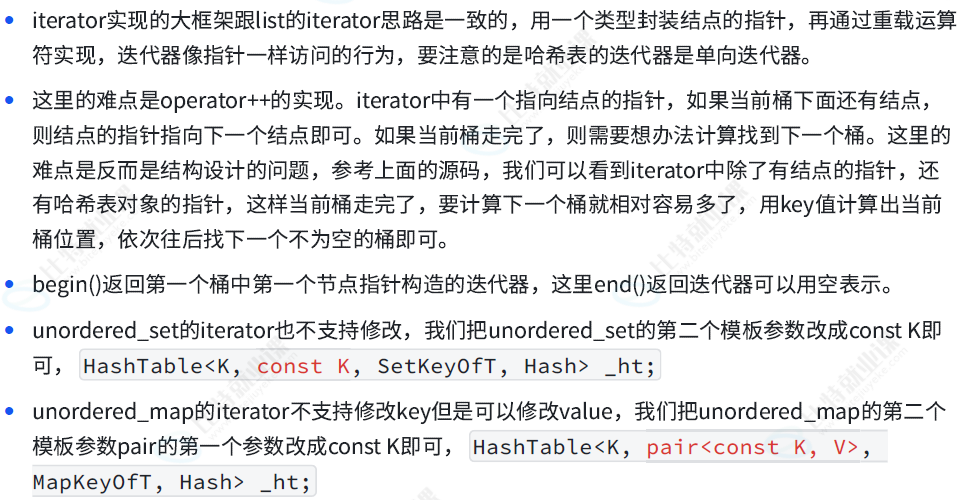
begin()返回第一个桶中第一个节点指针构造的迭代器,这里end()返回迭代器可以用空表示。
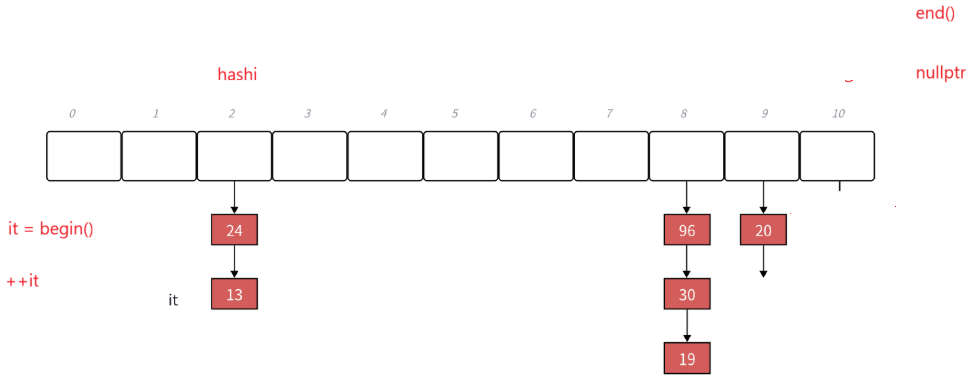
由于HTIterator的类定义在HashTable之前,而且两者类内都有对方,所以HTIterator前面要添加前置声明

cpp
	// 前置声明
	template<class K, class T, class KeyOfT, class Hash>
	class HashTable;

	template<class K, class T, class Ref, class Ptr, class KeyOfT, class Hash>
	struct HTIterator
	{
		typedef HashNode<T> Node;
		typedef HashTable<K, T, KeyOfT, Hash> HT;
		typedef HTIterator<K, T, Ref, Ptr, KeyOfT, Hash> Self;

		Node* _node;
		const HT* _pht;  // 哈希表的指针

		HTIterator(Node* node, const HT* pht)
			:_node(node)
			, _pht(pht)
		{}

		Ref operator*()
		{
			return _node->_data;
		}

		Ptr operator->()
		{
			return &_node->_data;
		}

		Self& operator++()
		{
			KeyOfT kot;
			Hash hs;
			if (_node->_next) // 当前桶没走完
			{
				_node = _node->_next;
			}
			else  // 当前桶走完了,找到下一个桶的第一个节点
			{
				// 算出当前桶的位置
				size_t hashi = hs(kot(_node->_data)) % _pht->_tables.size();
				++hashi;
				while(hashi < _pht->_tables.size())
				{
					if (_pht->_tables[hashi]) // 找到下一个不为空的桶
					{
						_node = _pht->_tables[hashi];
						break;
					}
					else
					{
						++hashi;
					}
				}
				if (hashi == _pht->_tables.size()) // 最后一个桶走完了,要++到end()位置
				{
					// end()中_node是空
					return nullptr;
				}
			}
			return *this;
		}

		bool operator!=(const Self& s) const
		{
			return _node != s._node;
		}

		bool operator==(const Self& s) const
		{
			return _node == s._node;
		}
	};
注意:HashTable中的HTIterator也要有友元声明

cpp
	class HashTable
	{
		// 友元声明
		template<class K, class T, class Ref, class Ptr, class KeyOfT, class Hash>
		friend struct HIIterator;

		typedef HashNode<T> Node;
	public:
		typedef HTIterator<K, T, T&, T*, KeyOfT, Hash> Iterator;
		typedef HTIterator<K, T, const T&, const T*, KeyOfT, Hash> ConstIterator;

		Iterator Begin()
		{
			if (_n == 0)
			{
				return End();
			}

			for (size_t i = 0; i < _tables.size(); i++)
			{
				if (_tables[i])
				{
					return Iterator(_tables[i], this);
				}
			}
			return End();
		}

		Iterator End()
		{
			return Iterator(nullptr, this);
		}

		ConstIterator Begin() const
		{
			if (_n == 0)
			{
				return End();
			}

			for (size_t i = 0; i < _tables.size(); i++)
			{
				if (_tables[i])
				{
					return ConstIterator(_tables[i], this);
				}
			}
			return End();
		}

		ConstIterator End() const
		{
			return ConstIterator(nullptr, this);
		}

		HashTable()
			:_tables(__stl_next_prime(1), nullptr)
			, _n(0)
		{}

        ...
unordered_set的迭代器也不支持修改,把unordered_set的第二个模板参数改成const K即可:

unordered_map的iterator不支持修改key但是可以修改value,我们把unordered_map的第二个
模板参数pair的第一个参数改成const K即可

2.3 map支持\[\]
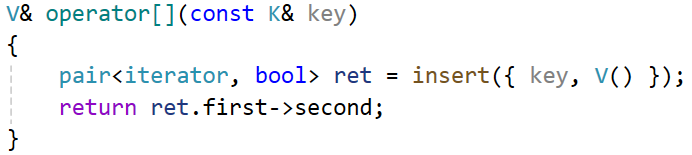
2.4 unordered_map和unordered_set代码实现
UnorderedSet.h:
cpp
#pragma once
#include"HashTable.h"

namespace xiaohan
{
	template<class K, class Hash = HashFunc<K>>
	class unordered_set
	{
		// 仿函数,set(K)和map(pair)比较大小时不一样
		struct SetKeyOfT
		{
			const K& operator()(const K& key)
			{
				return key;
			}
		};

	public:
		typedef typename hash_bucket::HashTable<K, const K, SetKeyOfT, Hash>::Iterator iterator;
		typedef typename hash_bucket::HashTable<K, const K, SetKeyOfT, Hash>::ConstIterator const_iterator;

		iterator begin()
		{
			return _ht.Begin();
		}

		iterator end()
		{
			return _ht.End();
		}

		const_iterator begin() const
		{
			return _ht.Begin();
		}

		const_iterator end() const
		{
			return _ht.End();
		}

		pair<iterator, bool> insert(const K& key)
		{
			return _ht.Insert(key);
		}

		iterator find(const K& key)
		{
			return _ht.Find(key);
		}

		bool erase(const K& key)
		{
			return _ht.Erase(key);
		}
	private:
		hash_bucket::HashTable<K, const K, SetKeyOfT, Hash> _ht;
	};
}
UnorderedMap.h:
cpp
#pragma once
#include"HashTable.h"

namespace xiaohan
{
	template<class K, class V, class Hash = HashFunc<K>>
	class unordered_map
	{
		struct MapKeyOfT
		{
			const K& operator()(const pair<K, V>& kv)
			{
				return kv.first;
			}
		};
	public:
		typedef typename hash_bucket::HashTable<K, pair<const K, V>, MapKeyOfT, Hash>::Iterator iterator;
		typedef typename hash_bucket::HashTable<K, pair<const K, V>, MapKeyOfT, Hash>::ConstIterator const_iterator;

		iterator begin()
		{
			return _ht.Begin();
		}

		iterator end()
		{
			return _ht.End();
		}

		const_iterator begin() const
		{
			return _ht.Begin();
		}

		const_iterator end() const
		{
			return _ht.End();
		}

		pair<iterator, bool> insert(const pair<K, V>& kv)
		{
			return _ht.Insert(kv);
		}

		V& operator[](const K& key)
		{
			pair<iterator, bool> ret = insert({ key, V() });
			return ret.first->second;
		}

		iterator find(const K& key)
		{
			return _ht.Find(key);
		}

		bool erase(const K& key)
		{
			return _ht.Erase(key);
		}

	private:
		hash_bucket::HashTable<K, pair<const K, V>, MapKeyOfT, Hash> _ht;
	};
}
HashTable.h:
cpp
#pragma once

#pragma once
#include<vector>
#include<string>
using namespace std;

static const int __stl_num_primes = 28;
static const unsigned long __stl_prime_list[__stl_num_primes] =
{
  53,         97,         193,       389,       769,
  1543,       3079,       6151,      12289,     24593,
  49157,      98317,      196613,    393241,    786433,
  1572869,    3145739,    6291469,   12582917,  25165843,
  50331653,   100663319,  201326611, 402653189, 805306457,
  1610612741, 3221225473, 4294967291
};

inline unsigned long __stl_next_prime(unsigned long n)
{
	const unsigned long* first = __stl_prime_list;
	const unsigned long* last = __stl_prime_list + __stl_num_primes;
	// >= n
	const unsigned long* pos = lower_bound(first, last, n);
	return pos == last ? *(last - 1) : *pos;
}

template<class K>
struct HashFunc
{
	size_t operator()(const K& key)
	{
		return (size_t)key;
	}
};

//特化
template<>
struct HashFunc<string>
{
	/*	字符串转换成整形,可以把字符ascii码相加即可
		但是直接相加的话,类似"abcd"和"bcad"这样的字符串计算出是相同的
		这⾥我们使⽤BKDR哈希的思路,用上次的计算结果去乘以⼀个质数,这个质数⼀般取31,131
		等效果会比较好*/
	size_t operator()(const string& key)
	{
		// abcd
		size_t hash = 0;
		for (auto e : key)
		{
			hash = hash + e;
			hash = hash * 131;
		}
		return hash;
	}
};

namespace hash_bucket
{
	template<class T>
	struct HashNode
	{
		T _data;
		HashNode<T>* _next;

		HashNode(const T& data)
			:_data(data)
			, _next(nullptr)
		{}
	};

	// 前置声明
	template<class K, class T, class KeyOfT, class Hash>
	class HashTable;

	template<class K, class T, class Ref, class Ptr, class KeyOfT, class Hash>
	struct HTIterator
	{
		typedef HashNode<T> Node;
		typedef HashTable<K, T, KeyOfT, Hash> HT;
		typedef HTIterator<K, T, Ref, Ptr, KeyOfT, Hash> Self;

		Node* _node;
		const HT* _pht;  // 哈希表的指针

		HTIterator(Node* node, const HT* pht)
			:_node(node)
			, _pht(pht)
		{}

		Ref operator*()
		{
			return _node->_data;
		}

		Ptr operator->()
		{
			return &_node->_data;
		}

		Self& operator++()
		{
			KeyOfT kot;
			Hash hs;
			if (_node->_next) // 当前桶没走完
			{
				_node = _node->_next;
			}
			else  // 当前桶走完了,找到下一个桶的第一个节点
			{
				// 算出当前桶的位置
				size_t hashi = hs(kot(_node->_data)) % _pht->_tables.size();
				++hashi;
				while(hashi < _pht->_tables.size())
				{
					if (_pht->_tables[hashi]) // 找到下一个不为空的桶
					{
						_node = _pht->_tables[hashi];
						break;
					}
					else
					{
						++hashi;
					}
				}
				if (hashi == _pht->_tables.size()) // 最后一个桶走完了,要++到end()位置
				{
					// end()中_node是空
					_node = nullptr;
				}
			}
			return *this;
		}

		bool operator!=(const Self& s) const
		{
			return _node != s._node;
		}

		bool operator==(const Self& s) const
		{
			return _node == s._node;
		}
	};


	// hash_bucket::HashTable<K, pair<K, V>, MapKeyOfT> _ht;
	// hash_bucket::HashTable<K, K, SetKeyOfT> _ht;
	template<class K, class T, class KeyOfT, class Hash>
	class HashTable
	{
		// 友元声明
		template<class K, class T, class Ref, class Ptr, class KeyOfT, class Hash>
		friend struct HTIterator;

		typedef HashNode<T> Node;
	public:
		typedef HTIterator<K, T, T&, T*, KeyOfT, Hash> Iterator;
		typedef HTIterator<K, T, const T&, const T*, KeyOfT, Hash> ConstIterator;

		Iterator Begin()
		{
			if (_n == 0)
			{
				return End();
			}

			for (size_t i = 0; i < _tables.size(); i++)
			{
				if (_tables[i])
				{
					return Iterator(_tables[i], this);
				}
			}
			return End();
		}

		Iterator End()
		{
			return Iterator(nullptr, this);
		}

		ConstIterator Begin() const
		{
			if (_n == 0)
			{
				return End();
			}

			for (size_t i = 0; i < _tables.size(); i++)
			{
				if (_tables[i])
				{
					return ConstIterator(_tables[i], this);
				}
			}
			return End();
		}

		ConstIterator End() const
		{
			return ConstIterator(nullptr, this);
		}

		HashTable()
			:_tables(__stl_next_prime(1), nullptr)
			, _n(0)
		{}

		~HashTable()
		{
			for (size_t i = 0; i < _tables.size(); i++)
			{
				Node* cur = _tables[i];
				while (cur)
				{
					Node* next = cur->_next;
					delete cur;
					cur = next;
				}
				_tables[i] = nullptr;
			}
			_n = 0;
		}

		pair<Iterator, bool> Insert(const T& data)
		{
			KeyOfT kot;
			auto it = Find(kot(data));
			if (it != End())
				return { it, false };

			Hash hs;

			// 负载因子 == 1就开始扩容
			if (_n == _tables.size())
			{
				// 方法二, 只创建vector表,直接将旧表的结点链接到新表中
				vector<Node*> newtables(__stl_next_prime(_tables.size() + 1), nullptr);
				for (size_t i = 0; i < _tables.size(); i++)
				{
					//遍历旧表,旧表结点重新映射,挪动到新表
					Node* cur = _tables[i];
					while (cur)
					{
						Node* next = cur->_next;

						// 头插法
						size_t hashi = hs(kot(cur->_data)) % newtables.size();
						cur->_next = newtables[hashi];
						newtables[hashi] = cur;

						cur = next;
					}
					_tables[i] = nullptr;
				}
				_tables.swap(newtables);
			}

			size_t hashi = hs(kot(data)) % _tables.size();

			// 头插法
			Node* newnode = new Node(data);
			newnode->_next = _tables[hashi];
			_tables[hashi] = newnode;

			++_n;
			return {Iterator(newnode, this), true};
		}

		Iterator Find(const K& key)
		{
			KeyOfT kot;
			Hash hs;
			size_t hashi = hs(key) % _tables.size();
			Node* cur = _tables[hashi];
			while (cur)
			{
				if (kot(cur->_data) == key)
				{
					return {cur, this};  // {}初始化
				}

				cur = cur->_next;
			}
			return {nullptr, this};
		}

		bool Erase(const K& key)
		{
			KeyOfT kot;
			Hash hs;
			size_t hashi = hs(key) % _tables.size();

			Node* pre = nullptr;
			Node* cur = _tables[hashi];

			while (cur)
			{
				// 删除
				if (kot(cur->_data) == key)
				{
					// 桶中第一个结点
					if (pre == nullptr)
					{
						_tables[hashi] = cur->_next;
					}
					else
					{
						pre->_next = cur->_next;
					}

					--_n;
					delete cur;
					return true;
				}

				pre = cur;
				cur = cur->_next;
			}
			return false;
		}

	private:
		vector<Node*> _tables; // 指针数组
		size_t _n;
		// std::vector<std::list<K, V>> _tables;
	};
}
测试代码:
cpp
#define _CRT_SECURE_NO_WARNINGS 1

#include<iostream>
#include<unordered_map>
using namespace std;

#include"UnorderedSet.h"
#include"UnorderedMap.h"

void Print(const xiaohan::unordered_set<int>& s)
{
	xiaohan::unordered_set<int>::const_iterator it = s.begin();
	while (it != s.end())
	{
		// *it = 1;

		cout << *it << " ";
		++it;
	}
	cout << endl;
}

int main()
{
	xiaohan::unordered_set<int> us;
	us.insert(3);
	us.insert(1000);
	us.insert(2);
	us.insert(102);
	us.insert(2111);
	us.insert(22);

	xiaohan::unordered_set<int>::iterator it = us.begin();
	while (it != us.end())
	{
		//*it = 1;
		cout << *it << " ";
		++it;
	}
	cout << endl;

	Print(us);

	xiaohan::unordered_map<string, string> dict;
	dict.insert({ "string", "ַ字符串" });
	dict.insert({ "string", "ַ字符串1" });
	dict.insert({ "left", "左边" });
	dict.insert({ "right", "右边" });
	// 可修改
	dict["left"] = "左边,剩余";

	//
	dict["insert"];

	//
	dict["map"] = "地图";

	for (auto& [k, v] : dict)
	{
		//k += 'x';
		//v += 'x';

		cout << k << ":" << v << endl;
	}

	return 0;
}
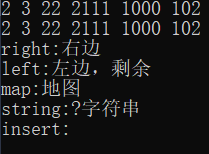
结果: