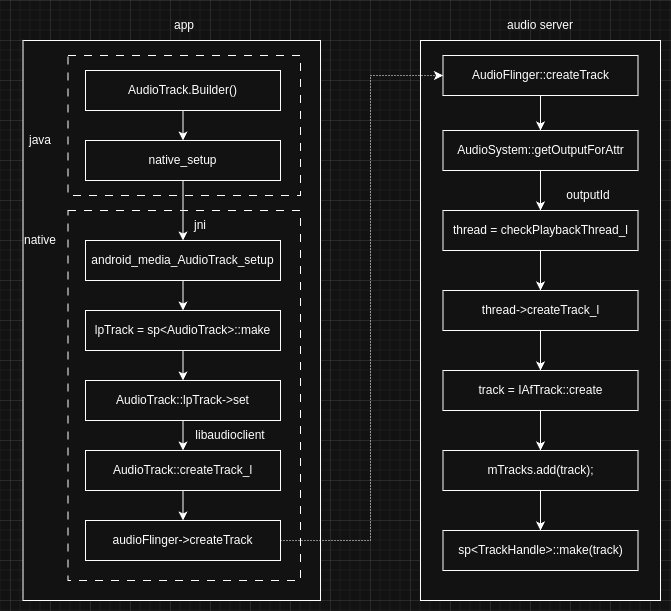
java
app侧调用的api是
Kotlin
private val audioTrack: AudioTrack = AudioTrack.Builder()base/media/java/android/media/AudioTrack.java
先看下 streamType 是如何从老版本转向新版本的。这里调用了 setLegacyStreamType
java
public AudioTrack(int streamType, int sampleRateInHz, int channelConfig, int audioFormat,
        int bufferSizeInBytes, int mode, int sessionId)
throws IllegalArgumentException {
    // mState already == STATE_UNINITIALIZED
    this((new AudioAttributes.Builder())
                .setLegacyStreamType(streamType)
                .build(),
            (new AudioFormat.Builder())
                .setChannelMask(channelConfig)
                .setEncoding(audioFormat)
                .setSampleRate(sampleRateInHz)
                .build(),
            bufferSizeInBytes,
            mode, sessionId);
    deprecateStreamTypeForPlayback(streamType, "AudioTrack", "AudioTrack()");
}
base/media/java/android/media/AudioAttributes.java setLegacyStreamType
这里可以看出,老版本的 streamType 被转换为新的
mContentType = CONTENT_TYPE_UNKNOWN;
mUsage = USAGE_UNKNOWN;
接下来调用 getAudioAttributesForStrategyWithLegacyStreamType
这个方法就是使用 LegacyStreamType 根据策略获取 mUsage
这里的策略可以使用dumpsys media.audio_policy查看
java
public Builder setLegacyStreamType(int streamType) {
//...
    setInternalLegacyStreamType(streamType);
    return this;
}

@UnsupportedAppUsage
public Builder setInternalLegacyStreamType(int streamType) {
    mContentType = CONTENT_TYPE_UNKNOWN;
    mUsage = USAGE_UNKNOWN;
    if (AudioProductStrategy.getAudioProductStrategies().size() > 0) {
        AudioAttributes attributes =
                AudioProductStrategy.getAudioAttributesForStrategyWithLegacyStreamType(
                        streamType);
        if (attributes != null) {
            mUsage = attributes.mUsage;
//...
        }
    }
    switch (streamType) {
        case AudioSystem.STREAM_VOICE_CALL:
            mContentType = CONTENT_TYPE_SPEECH;
            break;
//...
        default:
            Log.e(TAG, "Invalid stream type " + streamType + " for AudioAttributes");
    }
    if (mUsage == USAGE_UNKNOWN) {
        mUsage = usageForStreamType(streamType);
    }
    return this;
}
dumpsys media.audio_policy
看 Attributes 标签
每个的 stream: AUDIO_STREAM_VOICE_CALL 就对应 streamType
返回的就是 Usage
java
Policy Engine dump:
  Product Strategies dump:
    -STRATEGY_PHONE (id: 0)
      Selected Device: {AUDIO_DEVICE_OUT_EARPIECE, @:}
       Group: 13 stream: AUDIO_STREAM_VOICE_CALL
        Attributes: { Content type: AUDIO_CONTENT_TYPE_UNKNOWN Usage: AUDIO_USAGE_VOICE_COMMUNICATION Source: AUDIO_SOURCE_INVALID Flags: 0x0 Tags:  }
       Group: 3 stream: AUDIO_STREAM_BLUETOOTH_SCO
        Attributes: { Content type: AUDIO_CONTENT_TYPE_UNKNOWN Usage: AUDIO_USAGE_UNKNOWN Source: AUDIO_SOURCE_INVALID Flags: 0x4 Tags:  }


//...

    -STRATEGY_MEDIA (id: 5)
      Selected Device: {AUDIO_DEVICE_OUT_SPEAKER, @:}
       Group: 14 stream: AUDIO_STREAM_ASSISTANT
        Attributes: { Content type: AUDIO_CONTENT_TYPE_SPEECH Usage: AUDIO_USAGE_ASSISTANT Source: AUDIO_SOURCE_INVALID Flags: 0x0 Tags:  }
       Group: 6 stream: AUDIO_STREAM_MUSIC
        Attributes: { Content type: AUDIO_CONTENT_TYPE_UNKNOWN Usage: AUDIO_USAGE_MEDIA Source: AUDIO_SOURCE_INVALID Flags: 0x0 Tags:  }
       Group: 6 stream: AUDIO_STREAM_MUSIC
        Attributes: { Content type: AUDIO_CONTENT_TYPE_UNKNOWN Usage: AUDIO_USAGE_GAME Source: AUDIO_SOURCE_INVALID Flags: 0x0 Tags:  }
       Group: 6 stream: AUDIO_STREAM_MUSIC
        Attributes: { Content type: AUDIO_CONTENT_TYPE_UNKNOWN Usage: AUDIO_USAGE_ASSISTANT Source: AUDIO_SOURCE_INVALID Flags: 0x0 Tags:  }
       Group: 6 stream: AUDIO_STREAM_MUSIC
        Attributes: { Content type: AUDIO_CONTENT_TYPE_UNKNOWN Usage: AUDIO_USAGE_ASSISTANCE_NAVIGATION_GUIDANCE Source: AUDIO_SOURCE_INVALID Flags: 0x0 Tags:  }
       Group: 6 stream: AUDIO_STREAM_MUSIC
        Attributes: { Any }
       Group: 11 stream: AUDIO_STREAM_SYSTEM
        Attributes: { Content type: AUDIO_CONTENT_TYPE_UNKNOWN Usage: AUDIO_USAGE_ASSISTANCE_SONIFICATION Source: AUDIO_SOURCE_INVALID Flags: 0x0 Tags:  }
//...
base/media/java/android/media/AudioTrack.java
在这里 mStreamType 最后被赋值为 STREAM_DEFAULT
创建了一个 AttributionSource 用来记录 uid pid packageName 等信息
最终调用了 native_setup 进入到 native 层
java
private AudioTrack(@Nullable Context context, AudioAttributes attributes, AudioFormat format,
        int bufferSizeInBytes, int mode, int sessionId, boolean offload, int encapsulationMode,
        @Nullable TunerConfiguration tunerConfiguration)
                throws IllegalArgumentException {
    super(attributes, AudioPlaybackConfiguration.PLAYER_TYPE_JAM_AUDIOTRACK);

//...
    mStreamType = AudioSystem.STREAM_DEFAULT;
//...

    AttributionSource attributionSource = context == null
            ? AttributionSource.myAttributionSource() : context.getAttributionSource();

    // native initialization
    try (ScopedParcelState attributionSourceState = attributionSource.asScopedParcelState()) {
        int initResult = native_setup(new WeakReference<AudioTrack>(this), mAttributes,
                sampleRate, mChannelMask, mChannelIndexMask, mAudioFormat,
                mNativeBufferSizeInBytes, mDataLoadMode, session,
                attributionSourceState.getParcel(), 0 /*nativeTrackInJavaObj*/, offload,
                encapsulationMode, tunerConfiguration, getCurrentOpPackageName());
        if (initResult != SUCCESS) {
            loge("Error code " + initResult + " when initializing AudioTrack.");
            return; // with mState == STATE_UNINITIALIZED
        }
    }
//...
    native_setPlayerIId(mPlayerIId); // mPlayerIId now ready to send to native AudioTrack.
}
base/core/java/android/content/AttributionSource.java
java
public AttributionSource(int uid, int pid, @Nullable String packageName,
        @Nullable String attributionTag, @NonNull IBinder token) {
    this(uid, pid, packageName, attributionTag, token, /*renouncedPermissions*/ null,
            Context.DEVICE_ID_DEFAULT, /*next*/ null);
}
native
base/core/jni/android_media_AudioTrack.cpp native_setup****AudioTrack_setup
jaa 这个参数就是 java 层传递的 mAttributes
构造 native 层的 AudioTrack 名为 lpTrack
lpTrack = sp<AudioTrack>::make(attributionSource);
根据 jaa 构造 paa (mAttributes)
auto paa = JNIAudioAttributeHelper::makeUnique();
jint jStatus = JNIAudioAttributeHelper::nativeFromJava(env, jaa, paa.get());
将 java 层传递过来的参数设置进去
lpTrack->set
cpp
// ----------------------------------------------------------------------------
static jint android_media_AudioTrack_setup(JNIEnv *env, jobject thiz, jobject weak_this,
                                           jobject jaa, jintArray jSampleRate,
                                           jint channelPositionMask, jint channelIndexMask,
                                           jint audioFormat, jint buffSizeInBytes, jint memoryMode,
                                           jintArray jSession, jobject jAttributionSource,
                                           jlong nativeAudioTrack, jboolean offload,
                                           jint encapsulationMode, jobject tunerConfiguration,
                                           jstring opPackageName) {
//...
    sp<AudioTrack> lpTrack;
    const auto lpJniStorage = sp<AudioTrackJniStorage>::make(clazz, weak_this, offload);
    if (nativeAudioTrack == 0) {
//...
        android::content::AttributionSourceState attributionSource;
        attributionSource.readFromParcel(parcelForJavaObject(env, jAttributionSource));
        lpTrack = sp<AudioTrack>::make(attributionSource);

        // read the AudioAttributes values
        auto paa = JNIAudioAttributeHelper::makeUnique();
        jint jStatus = JNIAudioAttributeHelper::nativeFromJava(env, jaa, paa.get());
        if (jStatus != (jint)AUDIO_JAVA_SUCCESS) {
            return jStatus;
        }
        ALOGV("AudioTrack_setup for usage=%d content=%d flags=0x%#x tags=%s",
                paa->usage, paa->content_type, paa->flags, paa->tags);

//...
        status_t status = NO_ERROR;
        switch (memoryMode) {
        case MODE_STREAM:
            status = lpTrack->set(AUDIO_STREAM_DEFAULT, // stream type, but more info conveyed
                                                        // in paa (last argument)
                                  sampleRateInHertz,
                                  format, // word length, PCM
                                  nativeChannelMask, offload ? 0 : frameCount,
                                  offload ? AUDIO_OUTPUT_FLAG_COMPRESS_OFFLOAD
                                          : AUDIO_OUTPUT_FLAG_NONE,
                                  lpJniStorage,
                                  0,    // notificationFrames == 0 since not using EVENT_MORE_DATA
                                        // to feed the AudioTrack
                                  0,    // shared mem
                                  true, // thread can call Java
                                  sessionId, // audio session ID
                                  offload ? AudioTrack::TRANSFER_SYNC_NOTIF_CALLBACK
                                          : AudioTrack::TRANSFER_SYNC,
                                  (offload || encapsulationMode) ? &offloadInfo : NULL,
                                  attributionSource, // Passed from Java
                                  paa.get());
            break;

//...
    }
//...
    return (jint) AUDIOTRACK_ERROR_SETUP_NATIVEINITFAILED;
}
libaudioclient
av/media/libaudioclient/AudioTrack.cpp lpTrack->set
这里主要调用了 createTrack_l
cpp
status_t AudioTrack::set(
        audio_stream_type_t streamType,
        uint32_t sampleRate,
        audio_format_t format,
        audio_channel_mask_t channelMask,
        size_t frameCount,
        audio_output_flags_t flags,
        const wp<IAudioTrackCallback>& callback,
        int32_t notificationFrames,
        const sp<IMemory>& sharedBuffer,
        bool threadCanCallJava,
        audio_session_t sessionId,
        transfer_type transferType,
        const audio_offload_info_t *offloadInfo,
        const AttributionSourceState& attributionSource,
        const audio_attributes_t* pAttributes,
        bool doNotReconnect,
        float maxRequiredSpeed,
        audio_port_handle_t selectedDeviceId)
{
//...
    // create the IAudioTrack
    {
        AutoMutex lock(mLock);
        status = createTrack_l();
    }
//...

    return logIfErrorAndReturnStatus(status, "");
}


status_t AudioTrack::createTrack_l()
{
//...
    const sp<IAudioFlinger>& audioFlinger = AudioSystem::get_audio_flinger();
//...  下面继续分析,这里先分析 get_audio_flinger
}
av/media/libaudioclient/AudioSystem.cpp get_audio_flinger
cpp
sp<IAudioFlinger> AudioSystem::get_audio_flinger() {
    return AudioFlingerServiceTraits::getService();
}


static sp<IAudioFlinger> getService(
        std::chrono::milliseconds waitMs = std::chrono::milliseconds{-1}) {
    //...

    // mediautils::getService() installs a persistent new service notification.
    auto service = mediautils::getService<
        media::IAudioFlingerService>(waitMs);
    ALOGD("%s: checking for service %s: %p", __func__, getServiceName(), service.get());

    ul.lock();
    // return the IAudioFlinger interface which is adapted
    // from the media::IAudioFlingerService.
    return mService;
}
av/media/utils/include/mediautils/ServiceSingleton.h getService
serviceHandler->template get<Service>
checkServicePassThrough
cpp
template<typename Service>
auto getService(std::chrono::nanoseconds waitNs = {}) {
    const auto serviceHandler = details::ServiceHandler::getInstance(Service::descriptor);
    return interfaceFromBase<Service>(serviceHandler->template get<Service>(
            waitNs, true /* useCallback */));
}

template <typename Service>
auto get(std::chrono::nanoseconds waitNs, bool useCallback) {
//...

    for (bool first = true; true; first = false) {
        // we may have released mMutex, so see if service has been obtained.
        if (mSkipMode == SkipMode::kImmediate || (service && mValid))  return service;

        int options = 0;
        if (mSkipMode == SkipMode::kNone) {
            const auto traits = getTraits_l<Service>();

            // first time or not using callback, check the service.
            if (first || !useCallback) {
                auto service_new = checkServicePassThrough<Service>(
                        traits->getServiceName());
                if (service_new) {
                    mValid = true;
                    service = std::move(service_new);

                    const auto service_fixed = service;
//...
                    return service_fixed;
                }
            }
            // install service callback if needed.
            if (useCallback && !mServiceNotificationHandle) {
                setServiceNotifier_l<Service>();
            }
            options = static_cast<int>(traits->options());
        }
//...
    }
}
av/media/utils/include/mediautils/BinderGenericUtils.h checkServicePassThrough
很明显这里调用了defaultServiceManager()->checkService(serviceName);
cpp
template<typename Service>
auto checkServicePassThrough(const char *const name = "") {
    if constexpr(is_ndk<Service>)
    {
        const auto serviceName = fullyQualifiedServiceName<Service>(name);
        return Service::fromBinder(
                ::ndk::SpAIBinder(AServiceManager_checkService(serviceName.c_str())));
    } else /* constexpr */ {
        const auto serviceName = fullyQualifiedServiceName<Service>(name);
        auto binder = defaultServiceManager()->checkService(serviceName);
        return interface_cast<Service>(binder);
    }
}
获取到 audioFlinger 服务之后,接着 createTrack_l 分析
av/media/libaudioclient/include/media/AudioTrack.h
media::IAudioTrack
av/media/libaudioclient/aidl/android/media/IAudioTrack.aidl
cpp
sp<media::IAudioTrack> mAudioTrack;av/media/libaudioclient/AudioTrack.cpp
创建 CreateTrackInput 将 java 传递上来的赋值
调用 audioFlinger 的 createTrack 传递了两个 aidl parcelable, 函数会返回一个 parcelable
通过返回的这个output.audioTrack 对 mAudioTrack进行赋值
in
media::CreateTrackResponse
av/media/libaudioclient/aidl/android/media/CreateTrackResponse.aidl
media::CreateTrackRequest
av/media/libaudioclient/aidl/android/media/CreateTrackRequest.aidl
out
media::IAudioTrack
av/media/libaudioclient/aidl/android/media/IAudioTrack.aidl
cpp
status_t AudioTrack::createTrack_l()
{
//...
    const sp<IAudioFlinger>& audioFlinger = AudioSystem::get_audio_flinger();
//...
    IAudioFlinger::CreateTrackInput input;
//...
    input.config.sample_rate = mSampleRate;
    input.config.channel_mask = mChannelMask;
//...
    media::CreateTrackResponse response;
    auto aidlInput = input.toAidl();
//...
    status = audioFlinger->createTrack(aidlInput.value(), response);
//...
    IAudioFlinger::CreateTrackOutput output{};
    if (status == NO_ERROR) {
        auto trackOutput = IAudioFlinger::CreateTrackOutput::fromAidl(response);
//...
        output = trackOutput.value();
    }
//...
    mSessionId = output.sessionId;
    mStreamType = output.streamType;

    mSampleRate = output.sampleRate;
//...
    mAudioTrack = output.audioTrack;

}
av/media/libaudioclient/IAudioFlinger.cpp input.toAidl();
主要是将 CreateTrackInput 包装成 media::CreateTrackRequest
av/media/libaudioclient/aidl/android/media/CreateTrackRequest.aidl
cpp
ConversionResult<media::CreateTrackRequest> IAudioFlinger::CreateTrackInput::toAidl() const {
    media::CreateTrackRequest aidl;
    aidl.attr = VALUE_OR_RETURN(legacy2aidl_audio_attributes_t_AudioAttributes(attr));
    // Do not be mislead by 'Input'--this is an input to 'createTrack', which creates output tracks.
    aidl.config = VALUE_OR_RETURN(legacy2aidl_audio_config_t_AudioConfig(
                    config, false /*isInput*/));
    aidl.clientInfo = VALUE_OR_RETURN(legacy2aidl_AudioClient_AudioClient(clientInfo));
    aidl.sharedBuffer = VALUE_OR_RETURN(legacy2aidl_NullableIMemory_SharedFileRegion(sharedBuffer));
    aidl.notificationsPerBuffer = VALUE_OR_RETURN(convertIntegral<int32_t>(notificationsPerBuffer));
    aidl.speed = speed;
    aidl.audioTrackCallback = audioTrackCallback;
    aidl.flags = VALUE_OR_RETURN(legacy2aidl_audio_output_flags_t_int32_t_mask(flags));
    aidl.frameCount = VALUE_OR_RETURN(convertIntegral<int64_t>(frameCount));
    aidl.notificationFrameCount = VALUE_OR_RETURN(convertIntegral<int64_t>(notificationFrameCount));
    aidl.selectedDeviceId = VALUE_OR_RETURN(
            legacy2aidl_audio_port_handle_t_int32_t(selectedDeviceId));
    aidl.sessionId = VALUE_OR_RETURN(legacy2aidl_audio_session_t_int32_t(sessionId));
    return aidl;
}
audio server
调用到 AudioFlinger 服务中的 createTrack
av/services/audioflinger/AudioFlinger.cpp createTrack
getOutputForAttr 获取输出通道ID output.outputId
根据 output.outputId 匹配 PlaybackThread
使用 PlaybackThread 创建track createTrack_l
最后使用 createTrack_l 创建的 track 给 output.audioTrack 赋值,这个就跟上文中 libaudioclient AudioTrack.cpp 最后获取的是一个
cpp
status_t AudioFlinger::createTrack(const media::CreateTrackRequest& _input,
                                   media::CreateTrackResponse& _output)
{
//... 又转回来了
    CreateTrackInput input = VALUE_OR_RETURN_STATUS(CreateTrackInput::fromAidl(_input));
//...

    sp<IAfTrack> track;

//...

    output.sessionId = sessionId;
    output.outputId = AUDIO_IO_HANDLE_NONE;

//...

    lStatus = AudioSystem::getOutputForAttr(&localAttr, &output.outputId, sessionId, &streamType,
                                            adjAttributionSource, &input.config, input.flags,
                                            &selectedDeviceIds, &portId, &secondaryOutputs,
                                            &isSpatialized, &isBitPerfect, &volume, &muted);

//...

    {
        audio_utils::lock_guard _l(mutex());
        IAfPlaybackThread* thread = checkPlaybackThread_l(output.outputId);

//...

        track = thread->createTrack_l(client, streamType, localAttr, &output.sampleRate,
                                      input.config.format, input.config.channel_mask,
                                      &output.frameCount, &output.notificationFrameCount,
                                      input.notificationsPerBuffer, input.speed,
                                      input.sharedBuffer, sessionId, &output.flags,
                                      callingPid, adjAttributionSource, input.clientInfo.clientTid,
                                      &lStatus, portId, input.audioTrackCallback, isSpatialized,
                                      isBitPerfect, &output.afTrackFlags, volume, muted);

//... 赋值

        output.afFrameCount = thread->frameCount();
        output.afSampleRate = thread->sampleRate();
        output.afChannelMask = static_cast<audio_channel_mask_t>(thread->channelMask() |
                                                                 thread->hapticChannelMask());
        output.afFormat = thread->format();
        output.afLatencyMs = thread->latency();
        output.portId = portId;

//... 音效相关

if (lStatus == NO_ERROR) {
            audio_utils::lock_guard _dl(thread->mutex());

            updateSecondaryOutputsForTrack_l(track.get(), thread, secondaryOutputs);

            if (effectThread != nullptr) {
                // No thread safety analysis: double lock on a thread capability.
                audio_utils::lock_guard_no_thread_safety_analysis _sl(effectThread->mutex());
                if (moveEffectChain_ll(sessionId, effectThread, thread) == NO_ERROR) {
                    effectThreadId = thread->id();
                    effectIds = thread->getEffectIds_l(sessionId);
                }
            }
            if (effectChain != nullptr) {
                if (moveEffectChain_ll(sessionId, nullptr, thread, effectChain.get())
                        == NO_ERROR) {
                    effectThreadId = thread->id();
                    effectIds = thread->getEffectIds_l(sessionId);
                }
            }
        }
    }
//...

    output.audioTrack = IAfTrack::createIAudioTrackAdapter(track);

}


// checkPlaybackThread_l() must be called with AudioFlinger::mutex() held
IAfPlaybackThread* AudioFlinger::checkPlaybackThread_l(audio_io_handle_t output) const
{
    return mPlaybackThreads.valueFor(output).get();
}
output.outputId 可以使用 dumpsys media.audio_flinger
I/O handle: 53 这一项就是outputId
cpp
Output thread 0x79895a7760, name AudioOut_35, tid 2177, type 0 (MIXER):
  I/O handle: 53
  Standby: yes
  Sample rate: 48000 Hz
  HAL frame count: 768
//...
av/services/audioflinger/Tracks.cpp createIAudioTrackAdapter
这个 TrackHandle 就是 bn 端,传过去的就是 bp 端
class TrackHandle : public android::media::BnAudioTrack
**sp<TrackHandle>::make(track);**最终返回的就是这个
cpp
sp<media::IAudioTrack> IAfTrack::createIAudioTrackAdapter(const sp<IAfTrack>& track) {
    return sp<TrackHandle>::make(track);
}
av/services/audioflinger/Threads.cpp createTrack_l
调用 IAfTrack::create 这里面实际上就是创建了一个Track 对象,跟应用端的是一一对应的
创建好的 track 添加到 Threads 的 mTracks 中
然后回到 AudioFlinger 的 createTrack ↑
cpp
// PlaybackThread::createTrack_l() must be called with AudioFlinger::mutex() held
sp<IAfTrack> PlaybackThread::createTrack_l(
        const sp<Client>& client,
        audio_stream_type_t streamType,
        const audio_attributes_t& attr,
        uint32_t *pSampleRate,
        audio_format_t format,
        audio_channel_mask_t channelMask,
        size_t *pFrameCount,
        size_t *pNotificationFrameCount,
        uint32_t notificationsPerBuffer,
        float speed,
        const sp<IMemory>& sharedBuffer,
        audio_session_t sessionId,
        audio_output_flags_t *flags,
        pid_t creatorPid,
        const AttributionSourceState& attributionSource,
        pid_t tid,
        status_t *status,
        audio_port_handle_t portId,
        const sp<media::IAudioTrackCallback>& callback,
        bool isSpatialized,
        bool isBitPerfect,
        audio_output_flags_t *afTrackFlags,
        float volume,
        bool muted)
{
//...

    sp<IAfTrack> track;

//...
    { // scope for mutex()
        audio_utils::lock_guard _l(mutex());

//...
        track = IAfTrack::create(this, client, streamType, attr, sampleRate, format,
                          channelMask, frameCount,
                          nullptr /* buffer */, (size_t)0 /* bufferSize */, sharedBuffer,
                          sessionId, creatorPid, attributionSource, trackFlags,
                          IAfTrackBase::TYPE_DEFAULT, portId, SIZE_MAX /*frameCountToBeReady*/,
                          speed, isSpatialized, isBitPerfect, volume, muted);

//...

        mTracks.add(track);
//...  音效相关
        sp<IAfEffectChain> chain = getEffectChain_l(sessionId);
//...

    }

//...

}
流程图