介绍
xllm是使用c++语言构建的大模型推理服务器。
代码地址:https://gitee.com/mirrors/xllm
技术报告:https://arxiv.org/html/2510.14686v1
启动流程
https://gitee.com/mirrors/xllm/blob/main/xllm/xllm.cpp
cpp
std::unique_ptr<Master> create_master(const std::string& backend,
                                      const Options& options) {
  if (backend == "llm") {
    return std::make_unique<LLMMaster>(options);
  } else if (backend == "vlm") {
    return std::make_unique<VLMMaster>(options);
  } else if (backend == "dit") {
    LOG(INFO) << "creating dit master";
    return std::make_unique<DiTMaster>(options);
  } else if (backend == "rec") {
    LOG(INFO) << "creating rec master";
    return std::make_unique<RecMaster>(options);
  } else {
    LOG(FATAL) << "Failed to create master, backend is" << backend;
    return nullptr;
  }
}

int run() {
  // working node
  if (options.node_rank() != 0) {
    auto master = std::make_unique<LLMAssistantMaster>(options);
    master->run();
    return 0;
  } else {
    if (FLAGS_random_seed < 0) {
      FLAGS_random_seed = std::random_device{}() % (1 << 30);
    }
  }

  // master node
  auto master = create_master(FLAGS_backend, options);
  master->run();

  // supported models
  std::vector<std::string> model_names = {FLAGS_model_id};
  std::string model_version;
  if (model_path.has_filename()) {
    model_version = std::filesystem::path(FLAGS_model).filename();
  } else {
    model_version = std::filesystem::path(FLAGS_model).parent_path().filename();
  }
  std::vector<std::string> model_versions = {model_version};

  auto api_service =
      std::make_unique<APIService>(master.get(), model_names, model_versions);
  auto xllm_server =
      ServerRegistry::get_instance().register_server("HttpServer");

  // start brpc server
  if (!xllm_server->start(std::move(api_service))) {
    LOG(ERROR) << "Failed to start brpc server on port " << FLAGS_port;
    return -1;
  }

  return 0;
}

int main(int argc, char** argv) {
  FLAGS_alsologtostderr = true;
  FLAGS_minloglevel = 0;
  google::ParseCommandLineFlags(&argc, &argv, true);

  google::InitGoogleLogging("xllm");

  return run();
}
主结点,rank为0时,xllm调用create_master创建Master。否则,xllm创建LLMAssistantMaster。
Master
LLMAssistantMaster和LLMMaster继承Master。
cpp
class LLMAssistantMaster : public Master {
 public:
  LLMAssistantMaster(const Options& options);
  ~LLMAssistantMaster() = default;
  void run() override;

  static void handle_signal(int signum) { running_ = false; }
};
class LLMMaster : public Master {
 public:
  explicit LLMMaster(const Options& options);
  ~LLMMaster();

  // handle a request, the engine will execute the request asynchronously
  // completion/encode
  void handle_request(std::string prompt,
                      std::optional<std::vector<int>> prompt_tokens,
                      RequestParams sp,
                      std::optional<Call*> call,
                      OutputCallback callback);

  // chat
  void handle_request(std::vector<Message> messages,
                      std::optional<std::vector<int>> prompt_tokens,
                      RequestParams sp,
                      std::optional<Call*> call,
                      OutputCallback callback);

  // batch completion
  void handle_batch_request(std::vector<std::string> prompts,
                            std::vector<RequestParams> sp,
                            BatchOutputCallback callback);

  // batch chat
  void handle_batch_request(std::vector<std::vector<Message>> conversations,
                            std::vector<RequestParams> sp,
                            BatchOutputCallback callback);

  // start running loop
  void run() override;

  // generate will run all request done at once,
  // this is a blocking call
  void generate();

  void get_cache_info(std::vector<uint64_t>& cluster_ids,
                      std::vector<std::string>& addrs,
                      std::vector<int64_t>& k_cache_ids,
                      std::vector<int64_t>& v_cache_ids);

  bool link_cluster(const std::vector<uint64_t>& cluster_ids,
                    const std::vector<std::string>& addrs,
                    const std::vector<std::string>& device_ips,
                    const std::vector<uint16_t>& ports,
                    const int32_t dp_size);

  bool unlink_cluster(const std::vector<uint64_t>& cluster_ids,
                      const std::vector<std::string>& addrs,
                      const std::vector<std::string>& device_ips,
                      const std::vector<uint16_t>& ports,
                      const int32_t dp_size);
};
Master中创建engine
cpp
Master::Master(const Options& options, EngineType type) : options_(options) {
    else if (type == EngineType::LLM) {
    if (options_.task_type() == "embed") {
      options_.enable_schedule_overlap(false);
      LOG(WARNING) << "Force to disable schedule overlap for embedding model, "
                      "avoiding performance degradation.";
    }
    runtime::Options eng_options;
    eng_options.model_path(options_.model_path())
        .devices(devices)
        .backend(options_.backend())
        .block_size(options_.block_size())
        .max_cache_size(options_.max_cache_size())
        .max_memory_utilization(options_.max_memory_utilization())
        .enable_prefix_cache(options_.enable_prefix_cache())
        .task_type(options_.task_type())
        .enable_mla(options_.enable_mla())
        .master_node_addr(options_.master_node_addr())
        .nnodes(options_.nnodes())
        .node_rank(options_.node_rank())
        .dp_size(options_.dp_size())
        .ep_size(options_.ep_size())
        .enable_chunked_prefill(options_.enable_chunked_prefill())
        .max_seqs_per_batch(options_.max_seqs_per_batch())
        .max_tokens_per_chunk_for_prefill(
            options_.max_tokens_per_chunk_for_prefill())
        .instance_role(options_.instance_role())
        .kv_cache_transfer_mode(options_.kv_cache_transfer_mode())
        .transfer_listen_port(options_.transfer_listen_port())
        .enable_disagg_pd(options_.enable_disagg_pd())
        .enable_service_routing(options_.enable_service_routing())
        .enable_schedule_overlap(options_.enable_schedule_overlap())
        .enable_cache_upload(options_.enable_cache_upload())
        .host_blocks_factor(options_.host_blocks_factor())
        .enable_kvcache_store(options_.enable_kvcache_store())
        .store_protocol(options_.store_protocol())
        .store_master_server_address(options_.store_master_server_address())
        .store_metadata_server(options_.store_metadata_server())
        .store_local_hostname(options_.store_local_hostname())
        .prefetch_bacth_size(options_.prefetch_bacth_size())
        .layers_wise_copy_batchs(options_.layers_wise_copy_batchs())
        .enable_continuous_kvcache(options_.enable_continuous_kvcache())
        .enable_offline_inference(options_.enable_offline_inference())
        .spawn_worker_path(options_.spawn_worker_path())
        .enable_shm(options_.enable_shm())
        .is_local(options_.is_local())
        .server_idx(options_.server_idx());

    if (options_.device_ip().has_value()) {
      eng_options.device_ip(options_.device_ip().value());
    }
    engine_ = std::make_unique<LLMEngine>(eng_options);
    }
}
以LLMEngine为例,进行分析。
LLMEngine
cpp
LLMEngine::LLMEngine(const runtime::Options& options,
                     std::shared_ptr<DistManager> dist_manager)
    : options_(options), dist_manager_(dist_manager) {
  InterruptionBus::get_instance().subscribe([this](bool interrupted) {
    this->layer_forward_interrupted_ = interrupted;
  });
  auto master_node_addr = options.master_node_addr().value_or("");
  CHECK(!master_node_addr.empty())
      << " LLM need to set master node addr, Please set --master_node_addr.";
  const auto& devices = options_.devices();
  // initialize device monitor
  DeviceMonitor::get_instance().initialize(devices);
  CHECK_GT(devices.size(), 0) << "At least one device is required";

  CHECK(!devices[0].is_cpu()) << "CPU device is not supported";
  const auto device_type = devices[0].type();
  for (const auto device : devices) {
    CHECK_EQ(device.type(), device_type)
        << "All devices should be the same type";
#if defined(USE_NPU)
    FLAGS_enable_atb_comm_multiprocess =
        options.enable_offline_inference() || (options.nnodes() > 1);
#endif
  }

  // setup all workers and create worker clients in nnode_rank=0 engine side.
  setup_workers(options);

  dp_size_ = options_.dp_size();
  worker_clients_num_ = worker_clients_.size();
  dp_local_tp_size_ = worker_clients_num_ / dp_size_;

  // create ThreadPool for link cluster
  link_threadpool_ = std::make_unique<ThreadPool>(worker_clients_num_);

  process_group_test();

  // init thread pool
  threadpool_ = std::make_unique<ThreadPool>(16);
}

void LLMEngine::setup_workers(const runtime::Options& options) {
  if (!dist_manager_) {
    dist_manager_ = std::make_shared<DistManager>(options);
  }
  worker_clients_ = dist_manager_->get_worker_clients();
}
LLMEngine的构造函数中调用setup_workers,创建DistManager。
当node_rank !=0, worker_clients_为空指针。
cpp
void LLMEngine::setup_workers(const runtime::Options& options) {
  if (!dist_manager_) {
    dist_manager_ = std::make_shared<DistManager>(options);
  }
  worker_clients_ = dist_manager_->get_worker_clients();
}
DistManager
cpp
DistManager::DistManager(const runtime::Options& options)
    : server_name_("CollectiveServer") {
  auto master_node_addr = options.master_node_addr().value_or("");
  if (!master_node_addr.empty()) {
    server_name_.append(std::to_string(options.server_idx()));
    setup_multi_node_workers(options, master_node_addr);
  } else {
    LOG(FATAL) << "master_node_addr is empty.";
  }
}

void DistManager::setup_multi_node_workers(
    const runtime::Options& options,
    const std::string& master_node_addr) {
  const auto& devices = options.devices();

  // Process/Thread Worker Mode, we use it in multi-nodes serving.

  // Here, we assume that all node use same index devices. That is, if we set
  // device='1,2,3,4' and nnodes=2, then both machine nodes will use the
  // devices '1,2,3,4'. Therefore, the total world size is 2 * 4 = 8. This
  // means that each of the two nodes will utilize four devices (specifically
  // devices 1, 2, 3, and 4), resulting in a total of 8 devices being used
  // across the entire distributed setup.

  // To maintain interface consistency, we have implemented a new WorkerImpl
  // class. In this class, we create processes, initialize NCCL ProcessGroup,
  // set up GRPC servers, and so on.

  std::vector<std::atomic<bool>> dones(devices.size());
  for (size_t i = 0; i < devices.size(); ++i) {
    dones[i].store(false, std::memory_order_relaxed);
  }

  // create local workers
  for (size_t i = 0; i < devices.size(); ++i) {
    // worldsize = 8
    // Node1: 0, 1, 2, 3
    // Node2: 0+4, 1+4, 2+4, 3+4
    const int32_t rank = static_cast<int32_t>(i) + base_rank;

    // we use spawn process worker to launch a xllm instance
    // when start a offline inference task with multi-gpu/npu/mpu/...
    bool use_spawn_worker = options.enable_offline_inference() && i > 0;
    ParallelArgs parallel_args(rank, world_size, dp_size, nullptr, ep_size);

    servers_.emplace_back(std::make_unique<WorkerServer>(i,
                                                         master_node_addr,
                                                         // done,
                                                         dones[i],
                                                         parallel_args,
                                                         devices[i],
                                                         worker_server_options,
                                                         worker_type,
                                                         use_spawn_worker));
  }

  // Master node need to wait all workers done
  if (options.node_rank() == 0) {
    // if dp_size equals 1, use global process group directly
    // if dp_size equals world_size, distributed communication is not required
    auto dp_local_process_group_num =
        (dp_size > 1 && dp_size < world_size) ? dp_size : 0;

    // create collective server to sync all workers.
    std::shared_ptr<CollectiveService> collective_service =
        std::make_shared<CollectiveService>(
            dp_local_process_group_num, world_size, devices[0].index());
    XllmServer* collective_server =
        ServerRegistry::get_instance().register_server(server_name_);
    if (!collective_server->start(collective_service, master_node_addr)) {
      LOG(ERROR) << "failed to start collective server on address: "
                 << master_node_addr;
      return;
    }

    auto worker_addrs_map = collective_service->wait();

    // check if all workers connected
    // and then create worker clients
    for (size_t r = 0; r < world_size; ++r) {
      if (worker_addrs_map.find(r) == worker_addrs_map.end()) {
        LOG(FATAL) << "Not all worker connect to engine server. Miss rank is "
                   << r;
        return;
      }
      auto channel =
          create_channel(worker_addrs_map[r], r, dp_local_tp_size, options);
      worker_clients_.emplace_back(
          std::make_unique<RemoteWorker>(r,
                                         worker_addrs_map[r],
                                         devices[r % each_node_ranks],
                                         std::move(channel)));
    }
  }
}
DistManager的构造函数调用setup_multi_node_workers。
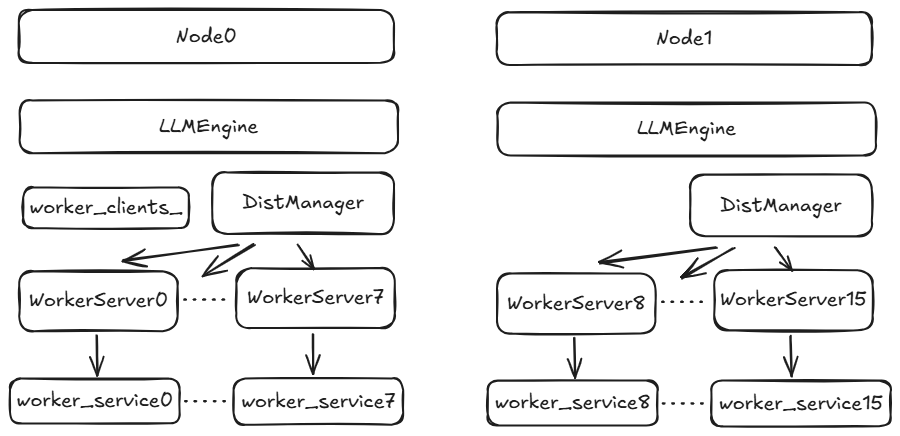
在每个node中,setup_multi_node_workers为每一个device创建一个WorkerServer。
WorkerServer将绑定的ip:port,通知master node。
master node通过collective_service->wait()获取相应的端口信息。
options.node_rank() == 0之后的代码逻辑,就可以获取WorkerServer对应的ip:port信息。
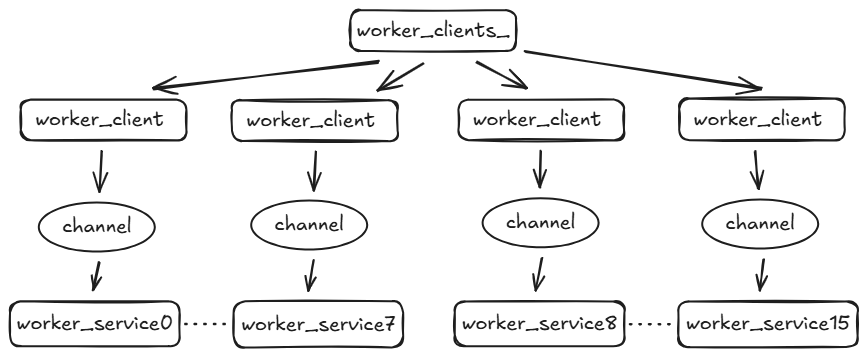
create_channel创建channel,用于远程调用。注意这里的RemoteWorker。
cpp
std::unique_ptr<CommChannel> create_channel(const std::string& worker_addrs,
                                            int r,
                                            int dp_local_tp_size,
                                            const runtime::Options& options) {
  std::unique_ptr<CommChannel> channel;

  if (net::extract_ip(options.master_node_addr().value_or("")) ==
          net::extract_ip(worker_addrs) &&
      options.enable_shm()) {
    // create shared memory manager for local rank
    bool is_driver = false;
    int dp_group = r / dp_local_tp_size;
    if (r % dp_local_tp_size == 0) {
      is_driver = true;
    }
    channel = std::make_unique<ShmChannel>(dp_group, r, is_driver, options);
  } else {
    channel = std::make_unique<CommChannel>();
  }

  channel->init_brpc(worker_addrs);

  return channel;
}
WorkerServer
cpp
WorkerServer::WorkerServer(int local_worker_idx,
                           const std::string& master_node_addr,
                           std::atomic<bool>& done,
                           const ParallelArgs& parallel_args,
                           const torch::Device& d,
                           const runtime::Options& options,
                           WorkerType worker_type,
                           bool use_spawn_worker)
    : server_name_("DistributeWorkerServer") {
      prepare_shm(
          parallel_args, options, input_shm_manager, output_shm_manager);
      // start worker in a thread.
      worker_thread_ =
          std::make_unique<std::thread>(&WorkerServer::create_server,
                                        this,
                                        std::cref(options),
                                        std::ref(done),
                                        std::cref(master_node_addr),
                                        std::cref(d),
                                        parallel_args.world_size(),
                                        parallel_args.rank(),
                                        parallel_args.dp_size(),
                                        local_worker_idx,
                                        parallel_args.ep_size(),
                                        worker_type,
                                        std::move(input_shm_manager),
                                        std::move(output_shm_manager));
}

void WorkerServer::create_server(
    const runtime::Options& options,
    std::atomic<bool>& done,
    const std::string& master_node_addr,
    const torch::Device& d,
    int world_size,
    int global_rank,
    int32_t dp_size,
    int local_rank,
    int32_t ep_size,
    WorkerType worker_type,
    std::unique_ptr<ForwardSharedMemoryManager> input_shm_manager,
    std::unique_ptr<ForwardSharedMemoryManager> output_shm_manager) {
  Device device(d);
  device.set_device();
  auto worker_service = std::make_shared<WorkerService>(options, device);

  auto addr = net::get_local_ip_addr();
  auto worker_server =
      ServerRegistry::get_instance().register_server(server_name_);
  if (!worker_server->start(worker_service, addr + ":0")) {
    LOG(ERROR) << "failed to start distribute worker server on address: "
               << addr;
    return;
  }

  auto worker_server_addr =
      addr + ":" + std::to_string(worker_server->listen_port());
  LOG(INFO) << "Worker " << worker_global_rank
            << ": server address: " << worker_server_addr;

  // Sync with master node
  proto::AddressInfo addr_info;
  addr_info.set_address(worker_server_addr);
  addr_info.set_global_rank(worker_global_rank);
  proto::CommUniqueIdList uids;
  sync_master_node(master_node_addr, addr_info, uids);

  CollectiveCommunicator comm(worker_global_rank, world_size, dp_size, ep_size);
  const ParallelArgs* parallel_args = comm.parallel_args();
  comm.create_process_groups(master_node_addr, device);

  std::unique_ptr<Worker> worker =
      std::make_unique<Worker>(*parallel_args, device, options, worker_type);
  worker_service->set_worker(std::move(worker));
  if (options.enable_shm() && input_shm_manager && output_shm_manager) {
    worker_service->create_polling_shm_thread(std::move(input_shm_manager),
                                              std::move(output_shm_manager));
  }

  done.store(true);

  // Wait until Ctrl-C is pressed, then Stop() and Join() the server.
  worker_server->run();
}

bool WorkerServer::sync_master_node(const std::string& master_node_addr,
                                    proto::AddressInfo& addr_info,
                                    proto::CommUniqueIdList& uids) {
  if (channel.Init(master_node_addr.c_str(), "", &options) != 0) {
    LOG(ERROR) << "Failed to initialize BRPC channel to " << master_node_addr;
    return false;
  }
  proto::Collective_Stub stub(&channel);
  while (try_count < FLAGS_max_reconnect_count) {
    cntl.Reset();
    stub.Sync(&cntl, &addr_info, &uids, NULL);
    if (cntl.Failed()) {
      LOG(WARNING) << "Worker#" << addr_info.global_rank()
                   << " try connect to engine server error, try again."
                   << " Error message: " << cntl.ErrorText();
      std::this_thread::sleep_for(std::chrono::seconds(sleep_time_second));
    } else {
      LOG(INFO) << "Worker#" << addr_info.global_rank() << " connect to "
                << master_node_addr << " success.";
      break;
    }
    try_count++;
  }
}
sync_master_node向master node发送ip:port信息。
WorkerService中的函数,实现proto::DistributeWorker定义的rpc接口。
https://gitee.com/mirrors/xllm/blob/main/xllm/proto/worker.proto
cpp
// Worker receive action from master engine.
service DistributeWorker {
  rpc Hello (Status) returns (Status);
  rpc InitModel (InitModelRequest) returns (Status);
  rpc ProcessGroupTest (Empty) returns (Status);
  rpc ProfileDeviceMemory (Empty) returns (DeviceMemory);
  rpc AllocateKVCache (KVCacheShape) returns (Status);
  rpc AllocateContinuousKVCache (XTensorOptionsVec) returns (Status);
  rpc AllocateKVCacheWithTransfer(AllocateKVCacheWithTransferRequest) returns (Status) {}
  rpc PullKVCache(PullKVCacheRequest) returns (Status) {}
  rpc GetDeviceInfo(Empty) returns (DeviceInfo) {}
  rpc GetCacheInfo(Empty) returns (CacheInfo) {}
  rpc LinkCluster(ClusterInfo) returns (Status) {}
  rpc UnlinkCluster(ClusterInfo) returns (Status) {}
  rpc ExecuteModel (ForwardInput) returns (ForwardOutput);
  rpc GetLastStepResult (Empty) returns (ForwardOutput);
  rpc GetActiveActivationMemory (Empty) returns (ActivationMemory);
  rpc TransferBlocks(BlockTransferInfos) returns (TransferStatus) {}
  rpc PrefetchFromStorage(BlockTransferInfos) returns (Status) {}
}
WorkerService中对应的函数定义:
cpp
class WorkerService : public proto::DistributeWorker {
 public:
  WorkerService(runtime::Options options, const torch::Device& device);
  WorkerService(runtime::Options options,
                const torch::Device& device,
                std::unique_ptr<Worker> worker);

  virtual ~WorkerService();

  void set_worker(std::unique_ptr<Worker> worker);

  void create_polling_shm_thread(
      std::unique_ptr<ForwardSharedMemoryManager> input_shm_manager,
      std::unique_ptr<ForwardSharedMemoryManager> output_shm_manager);

  // service functions
  void Hello(::google::protobuf::RpcController* controller,
             const proto::Status* request,
             proto::Status* response,
             ::google::protobuf::Closure* done) override;

  void InitModel(::google::protobuf::RpcController* controller,
                 const proto::InitModelRequest* request,
                 proto::Status* response,
                 ::google::protobuf::Closure* done) override;

  void ProcessGroupTest(::google::protobuf::RpcController* controller,
                        const proto::Empty* request,
                        proto::Status* response,
                        ::google::protobuf::Closure* done) override;

  void ProfileDeviceMemory(::google::protobuf::RpcController* controller,
                           const proto::Empty* request,
                           proto::DeviceMemory* response,
                           ::google::protobuf::Closure* done) override;

  void AllocateKVCache(::google::protobuf::RpcController* controller,
                       const proto::KVCacheShape* request,
                       proto::Status* response,
                       ::google::protobuf::Closure* done) override;

  void AllocateContinuousKVCache(::google::protobuf::RpcController* controller,
                                 const proto::XTensorOptionsVec* request,
                                 proto::Status* response,
                                 ::google::protobuf::Closure* done) override;

  void AllocateKVCacheWithTransfer(
      ::google::protobuf::RpcController* controller,
      const proto::AllocateKVCacheWithTransferRequest* req,
      proto::Status* resp,
      ::google::protobuf::Closure* done) override;

  void PullKVCache(::google::protobuf::RpcController* controller,
                   const proto::PullKVCacheRequest* req,
                   proto::Status* resp,
                   ::google::protobuf::Closure* done) override;

  void TransferBlocks(::google::protobuf::RpcController* controller,
                      const proto::BlockTransferInfos* req,
                      proto::TransferStatus* resp,
                      ::google::protobuf::Closure* done) override;

  void PrefetchFromStorage(google::protobuf::RpcController* controller,
                           const proto::BlockTransferInfos* req,
                           proto::Status* resp,
                           google::protobuf::Closure* done) override;

  void GetDeviceInfo(::google::protobuf::RpcController* controller,
                     const proto::Empty* req,
                     proto::DeviceInfo* resp,
                     ::google::protobuf::Closure* done) override;

  void GetCacheInfo(::google::protobuf::RpcController* controller,
                    const proto::Empty* req,
                    proto::CacheInfo* resp,
                    ::google::protobuf::Closure* done) override;

  void LinkCluster(::google::protobuf::RpcController* controller,
                   const proto::ClusterInfo* req,
                   proto::Status* resp,
                   ::google::protobuf::Closure* done) override;

  void UnlinkCluster(::google::protobuf::RpcController* controller,
                     const proto::ClusterInfo* req,
                     proto::Status* resp,
                     ::google::protobuf::Closure* done) override;

  void ExecuteModel(::google::protobuf::RpcController* controller,
                    const proto::ForwardInput* pb_fwd_input,
                    proto::ForwardOutput* pb_forward_output,
                    ::google::protobuf::Closure* done) override;

  void GetLastStepResult(::google::protobuf::RpcController* controller,
                         const proto::Empty* req,
                         proto::ForwardOutput* pb_forward_output,
                         ::google::protobuf::Closure* done) override;

  void GetActiveActivationMemory(::google::protobuf::RpcController* controller,
                                 const proto::Empty* req,
                                 proto::ActivationMemory* resp,
                                 ::google::protobuf::Closure* done) override;
};
框架图例
假设系统中有两台机器(node0, node1),每台机器上有8张卡。
master node的LLMEngine使用WorkerClient,发起远程调用。
以init_model为例:
cpp
bool LLMEngine::init_model() {
  // init model for each worker in parallel
  // multiple workers, call async init
  std::vector<folly::SemiFuture<bool>> futures;
  futures.reserve(worker_clients_num_);
  for (auto& worker : worker_clients_) {
    futures.push_back(worker->init_model_async(model_path, FLAGS_random_seed));
  }
  // wait for all futures to complete
  auto results = folly::collectAll(futures).get();
  for (const auto& result : results) {
    if (!result.value()) {
      return false;
    }
  }

  return true;
}

folly::SemiFuture<bool> RemoteWorker::init_model_async(
    const std::string& model_weights_path,
    int32_t random_seed) {
  folly::Promise<bool> promise;
  auto future = promise.getSemiFuture();
  threadpool_.schedule([this,
                        model_weights_path,
                        random_seed,
                        promise = std::move(promise)]() mutable {
    // call InitModel with callback
    channel_->init_model_async(model_weights_path, random_seed, promise);
  });
  return future;
}

bool CommChannel::init_model_async(const std::string& model_weights_path,
                                   int32_t random_seed,
                                   folly::Promise<bool>& promise) {
  proto::InitModelRequest request;

  request.set_model_weights_path(model_weights_path);
  request.set_random_seed(random_seed);
  auto done = new InitModelClosure();
  done->promise = std::move(promise);
  stub_->InitModel(&done->cntl, &request, &done->response, done);

  return true;
}
远端服务器会调用WorkerService::InitModel。
cpp
void WorkerService::InitModel(::google::protobuf::RpcController* controller,
                              const proto::InitModelRequest* request,
                              proto::Status* response,
                              ::google::protobuf::Closure* done) {
  threadpool_->schedule([this, controller, request, response, done]() mutable {
    brpc::ClosureGuard done_guard(done);
    auto model_weights_path = request->model_weights_path();
    auto random_seed = request->random_seed();
    auto init_future =
        worker_->init_model_async(model_weights_path, random_seed);
    bool status = std::move(init_future).get();
    if (!status) {
      response->set_ok(false);
      return;
    }

    response->set_ok(true);
  });
  return;
}