注:本文为 "开源软件" 相关合辑。
英文引文,机翻未校。
中文引文,略作重排。
如有内容异常,请看原文。
The Evolution of Open Source Software -- A Comprehensive History
开源软件的演进------一部完整的发展史
Post author By admin-science
Post date 11.01.2024
Open source software, or OSS, has become an integral part of the modern technological landscape. With its roots dating back to the early days of computer development, the history of open source software is both fascinating and inspiring.
开源软件(简称 OSS)已成为现代技术领域不可或缺的一部分。其起源可追溯至计算机发展的早期阶段,开源软件的发展史既引人入胜又颇具启发性。
The development of open source software can be traced back to the advent of the free software movement in the 1980s. This movement was led by passionate individuals who believed that software should be freely available to everyone. They championed the idea of open source, where the source code of a program is made available to the public, allowing anyone to study, modify, and distribute it.
开源软件的发展可追溯至20世纪80年代自由软件运动的兴起。这场运动由一群充满热情的人士引领,他们认为软件应向所有人免费开放。他们倡导开源理念------即程序的源代码向公众公开,任何人都可以研究、修改和分发它。
This concept of openness and collaboration paved the way for the evolution of open source software. As more developers began to embrace the power of the open source model, a vast ecosystem of software projects began to emerge. From operating systems like Linux and FreeBSD to web servers like Apache, open source software has become the backbone of countless industries and organizations worldwide.
这种开放与协作的理念为开源软件的演进铺平了道路。随着越来越多的开发者开始接纳开源模式的优势,一个庞大的软件项目生态系统逐渐形成。从 Linux、FreeBSD 这样的操作系统,到 Apache 这样的网页服务器,开源软件已成为全球无数行业和组织的技术支柱。
Over the years, the open source movement has gained momentum, driven by the collective efforts of a global community of developers. Today, open source software has come a long way from its humble beginnings. It has not only revolutionized the world of software development but has also influenced various areas such as artificial intelligence, blockchain technology, and internet of things, to name a few. The evolution of open source software continues to shape the way we interact with technology and holds immense potential for the future.
多年来,在全球开发者社区的共同努力推动下,开源运动的影响力不断扩大。如今,开源软件已从最初的不起眼状态发展壮大。它不仅彻底改变了软件开发领域,还影响了人工智能、区块链技术、物联网等多个领域(仅举几例)。开源软件的演进持续塑造着我们与技术互动的方式,也为未来蕴藏着巨大潜力。
Overview of Open Source Software
开源软件概述
Open source software has a rich and fascinating history, tracing its evolution from the early days of computing to the modern era. The development of open-source software has drastically changed the software industry, revolutionizing the way software is created and distributed.
开源软件拥有丰富且引人入胜的发展史,其演进轨迹从计算技术的早期阶段一直延伸至现代。开源软件的发展彻底改变了软件行业,重塑了软件的创建与分发方式。
Open-source software refers to software that is made available with its source code, allowing users to view, modify, and distribute the software as per their needs. This concept of sharing software source code freely has opened up numerous possibilities and has fostered collaboration and innovation.
开源软件是指附带源代码发布的软件,用户可根据自身需求查看、修改和分发该软件。这种自由共享软件源代码的理念开启了无数可能性,也促进了协作与创新。
History of Open Source Software
开源软件的发展历程
The history of open-source software dates back to the 1950s when computer programs were first being developed. Initially, software was distributed freely, but with the rise of proprietary software in the 1970s and 1980s, the idea of open-source software started to gain traction.
开源软件的历史可追溯至20世纪50年代计算机程序初步开发的时期。最初,软件是免费分发的,但随着20世纪70至80年代专有软件的兴起,开源软件的理念开始受到关注。
One of the most significant milestones in the history of open-source software was the release of the GNU Project in 1983 by Richard Stallman. This initiative aimed to develop a free and open-source operating system, which eventually led to the development of the GNU/Linux operating system.
开源软件发展史上最重大的里程碑之一,是理查德·斯托曼在1983年发起的 GNU 项目。该计划旨在开发一套免费的开源操作系统,最终促成了 GNU/Linux 操作系统的诞生。
Evolution of Open Source Software
开源软件的演进
Over the years, open-source software has evolved and gained popularity, especially with the rise of the internet and the spread of the World Wide Web. The open-source movement flourished in the 1990s with the development of popular open-source projects such as the Apache web server and the Linux operating system.
多年来,开源软件不断演进并日益普及,尤其是随着互联网和万维网的兴起。20世纪90年代,随着 Apache 网页服务器、Linux 操作系统等热门开源项目的开发,开源运动迎来了蓬勃发展。
Today, open-source software plays a crucial role in various industries, including web development, data analysis, artificial intelligence, and more. Companies and organizations worldwide rely on open-source software to develop innovative solutions, benefiting from the collaborative nature of its development and the free availability of source code.
如今,开源软件在网页开发、数据分析、人工智能等多个行业中发挥着关键作用。全球各地的企业和组织都依赖开源软件开发创新解决方案,得益于其协作式开发模式以及源代码的免费可得性。
In conclusion, open-source software has come a long way since its early days, thanks to its collaborative development model, free and open source code, and widespread adoption. The evolution of open-source software has undoubtedly revolutionized the software industry and continues to shape the future of technology.
总而言之,得益于协作式开发模式、免费开放的源代码以及广泛的采用,开源软件从早期发展至今已取得了长足进步。开源软件的演进无疑彻底改变了软件行业,并持续塑造着技术的未来。
Origins of Free Software
自由软件的起源
The development and evolution of open source software can be traced back to the origins of free software . Understanding the history of free and open source software is important in grasping the principles and values that continue to shape the software industry today.
开源软件 的发展与演进 可追溯至自由软件 的起源 。了解自由与开源软件的历史,对于理解如今仍在塑造软件行业的原则与价值观至关重要。
Free software refers to software that is not only available for use without cost, but also provides users with the freedom to study, modify, and distribute the source code. This concept of freedom is at the core of the open source movement, which emerged as a response to the proprietary nature of much of the software industry.
自由软件不仅指可免费使用的软件,还赋予用户研究、修改和分发源代码的自由。这种自由理念是开源运动的核心,而开源运动正是为了回应软件行业中普遍存在的专有属性而兴起的。
Richard Stallman and the GNU Project
理查德·斯托曼与GNU项目
In the early 1980s, Richard Stallman, a prominent computer programmer and activist, recognized the need for software that granted users the freedom to use, modify, and distribute their own software. Stallman's frustration with the increasing restrictions being placed on software led him to create the GNU Project in 1983.
20世纪80年代初,著名计算机程序员兼活动家理查德·斯托曼意识到,需要开发一种能赋予用户使用、修改和分发自身软件自由的软件。斯托曼对软件上日益增多的限制感到不满,这促使他在1983年发起了 GNU 项目。
The goal of the GNU Project was to develop a complete operating system composed entirely of free software. Stallman and his fellow developers worked tirelessly to create the necessary tools and components, including the GNU Compiler Collection and the GNU General Public License, which became one of the most widely used open source licenses.
GNU 项目的目标是开发一套完全由自由软件组成的完整操作系统。斯托曼和他的开发者同伴们不懈努力,创建了所需的工具与组件,包括 GNU 编译器集合(GCC)和 GNU 通用公共许可证(GPL)------后者成为了应用最广泛的开源许可证之一。
The Birth of Open Source
开源的诞生
In the late 1990s, the term "open source" was coined to better describe the principles and benefits of free software. The Open Source Initiative (OSI) was founded in 1998 to promote and advocate for open source software. The OSI's definition of open source software highlights the importance of not only the freedom to use, modify, and distribute, but also the accessibility of the source code.
20世纪90年代末,人们创造了"开源"这一术语,以便更好地描述自由软件的原则与优势。开源促进会(OSI)于1998年成立,旨在推广和倡导开源软件。OSI 对开源软件的定义不仅强调了使用、修改和分发的自由,还突出了源代码的可获取性。
The term "open source" quickly gained popularity and became synonymous with the values and principles of free software. Open source software has since become a dominant force in the software industry, with countless projects and communities working to create and maintain high-quality software that is freely available to all.
"开源"一词迅速流行起来,成为自由软件价值观与原则的代名词。此后,开源软件成为软件行业的主导力量,无数项目和社区致力于创建并维护可供所有人免费使用的高质量软件。
Today, the development and evolution of free and open source software continues to drive innovation and democratize the software industry. The source of open source software can be traced back to the origins of free software , and its impact is felt by individuals, businesses, and communities worldwide.
如今,自由与开源软件 的发展与演进 持续推动着创新,并让软件行业走向民主化。开源软件 的源头 可追溯至自由软件 的起源,其影响遍及全球的个人、企业与社区。
Early Developments in Open-Source Software
开源软件的早期发展
Open-source software has a long and rich history that traces back to the early days of computer development. In the early 1950s, as computers started to become more widespread, software was often shared freely among programmers. This open environment encouraged collaboration and the exchange of ideas, giving rise to the concept of open-source software.
开源软件拥有悠久而丰富的历史,可追溯至计算机发展的早期阶段。20世纪50年代初,随着计算机开始普及,软件通常在程序员之间自由共享。这种开放的环境促进了协作与思想交流,催生了开源软件的概念。
During this period, the collaborative nature of software development began to take shape. Programmers freely shared their source code, allowing others to modify and improve upon it. This culture of openness and collaboration laid the foundation for the open-source movement that would emerge decades later.
在此期间,软件开发的协作属性开始形成。程序员们自由共享源代码,让他人可以修改和改进。这种开放与协作的文化,为数十年后兴起的开源运动奠定了基础。
One of the earliest examples of open-source software is the development of the Free Software Foundation by Richard Stallman in the 1980s. Stallman believed that software should be free, both in terms of cost and freedom to modify and distribute the source code. This philosophy led to the creation of the GNU Project, which aimed to develop a complete, free operating system.
开源软件最早的案例之一,是理查德·斯托曼在20世纪80年代创立的自由软件基金会。斯托曼认为,软件应是自由的------既指免费使用,也指拥有修改和分发源代码的自由。这一理念促成了 GNU 项目的诞生,该项目旨在开发一套完整的免费操作系统。
Another important milestone in the early development of open-source software was the release of the Linux kernel by Linus Torvalds in 1991. Torvalds's decision to make the Linux kernel open-source sparked a revolution in the software industry. Programmers from around the world began contributing to its development, resulting in a powerful and versatile operating system that is still widely used today.
开源软件早期发展的另一个重要里程碑,是林纳斯·托瓦兹在1991年发布的Linux 内核。托瓦兹将 Linux 内核开源的决定,在软件行业掀起了一场革命。全球各地的程序员开始参与其开发,最终形成了一套功能强大、用途广泛的操作系统,至今仍被广泛使用。
The early developments in open-source software laid the groundwork for the evolution and success of the open-source movement. The collaborative nature of development, the sharing of source code, and the belief in free and open software have shaped the history of open-source software and continue to drive its growth and impact.
开源软件的早期发展为开源运动的演进与成功奠定了基础。开发的协作属性、源代码的共享,以及对自由开放软件的信念,塑造了开源软件的历史,并持续推动其发展与影响力的扩大。
Rise of the Open-Source Movement
开源运动的兴起
The history and evolution of open-source software development can be traced back to the rise of the open-source movement. This movement was driven by the desire to create software that was free, in terms of both cost and restrictions. It aimed to promote collaboration, transparency, and community-driven development.
开源软件开发的历史与演进可追溯至开源运动的兴起。这场运动的驱动力是创造既免费又无使用限制的软件,旨在推动协作、透明和社区驱动的开发模式。
Before the open-source movement gained momentum, software development was primarily dominated by closed-source or proprietary software. This meant that the source code, which is the underlying instructions that make up a program, was not freely available to users and developers. This lack of accessibility hindered innovation and limited the ability of users to customize the software to their needs.
在开源运动兴起之前,软件开发主要由闭源或专有软件主导。这意味着构成程序的底层指令------源代码,并未向用户和开发者自由开放。这种可获取性的缺失阻碍了创新,也限制了用户根据自身需求定制软件的能力。
The open-source movement aimed to change this by promoting the sharing and collaboration of source code. It emphasized the importance of community-driven development, where developers could openly contribute to projects and collectively improve the software. By making the source code freely available, anyone could modify, study, and distribute the software, leading to the development of a vibrant ecosystem of open-source projects.
开源运动旨在通过推广源代码的共享与协作来改变这一现状。它强调社区驱动开发的重要性------开发者可以公开为项目贡献代码,共同改进软件。通过将源代码免费开放,任何人都可以修改、研究和分发软件,从而形成了充满活力的开源项目生态系统。
The rise of the open-source movement can be attributed to the increasing popularity of the internet and the growth of online communities. The internet facilitated the easy sharing and distribution of software, enabling developers from around the world to collaborate on projects. Online forums, mailing lists, and version control systems became key tools for communication and collaboration.
开源运动的兴起可归功于互联网的日益普及和在线社区的发展。互联网让软件的共享与分发变得更加便捷,使全球开发者能够协作开发项目。在线论坛、邮件列表和版本控制系统成为了沟通与协作的关键工具。
Open-source software development also gained recognition and support from influential organizations and individuals. The Free Software Foundation, founded by Richard Stallman in 1985, played a crucial role in advocating for the principles of free software. The Open Source Initiative, established in 1998, helped formalize the concept of open-source software and promoted its benefits to the business and commercial sectors.
开源软件开发也获得了有影响力的组织和个人的认可与支持。理查德·斯托曼于1985年创立的自由软件基金会,在倡导自由软件原则方面发挥了关键作用。1998年成立的开源促进会,则帮助规范了开源软件的概念,并向商业领域推广其优势。
As the open-source movement gained traction, it sparked a shift in the software industry. Many companies, including giants like IBM and Google, embraced open-source software and actively contributed to open-source projects. This collaborative approach to software development has led to the creation of widely used and highly successful projects such as Linux, Apache, and MySQL.
随着开源运动的影响力扩大,它在软件行业引发了变革。包括 IBM、谷歌等巨头在内的许多企业开始接纳开源软件,并积极为开源项目贡献代码。这种协作式的软件开发方式,催生了 Linux、Apache、MySQL 等被广泛使用且极为成功的项目。
In conclusion, the rise of the open-source movement has played a significant role in the history and evolution of software development. It has challenged the dominance of closed-source software and promoted collaboration, transparency, and community-driven development. The impact of the open-source movement can be seen in the widespread adoption of open-source software and the vibrant ecosystem of projects that continue to evolve and innovate.
总而言之,开源运动的兴起在软件开发的历史与演进中发挥了重要作用。它挑战了闭源软件的主导地位,推动了协作、透明和社区驱动的开发模式。开源运动的影响体现在开源软件的广泛采用,以及持续演进和创新的充满活力的项目生态系统中。
The Birth of the GNU Project
GNU项目的诞生
The birth of the GNU Project marked a revolutionary moment in the history of open-source software development. The GNU Project, initiated by Richard Stallman in 1983, aimed to create a complete, free, and open-source operating system. Stallman was motivated by his belief that software should be a shared resource, accessible and modifiable by all.
GNU 项目的诞生,标志着开源软件开发史上的一个革命性时刻。该项目由理查德·斯托曼于1983年发起,旨在创建一套完整、免费的开源操作系统。斯托曼的动机源于他的信念:软件应是一种共享资源,供所有人访问和修改。
At the time, software development was predominantly closed-source, meaning that the source code was proprietary and not accessible to users. This limited users' ability to understand, modify, and distribute software according to their needs. Stallman wanted to challenge this status quo by creating a system where the source code for all software would be freely available.
当时,软件开发主要是闭源的,即源代码是专有的,无法被用户获取。这限制了用户根据自身需求理解、修改和分发软件的能力。斯托曼希望通过创建一个所有软件源代码都能免费获取的系统,来挑战这种现状。
Stallman realized that he needed a powerful kernel to build his operating system upon, so he started developing the GNU kernel, which would eventually become known as the GNU Hurd. This kernel, combined with other free and open-source software components, would form the basis of the GNU operating system.
斯托曼意识到,他需要一个强大的内核来构建操作系统,因此开始开发 GNU 内核------即后来的 GNU Hurd。这个内核与其他自由开源软件组件相结合,构成了 GNU 操作系统的基础。
To encourage collaboration and community involvement, Stallman established the Free Software Foundation (FSF) in 1985. The FSF provided a platform for developers to share their work and contributed to the growing ecosystem of open-source software. The FSF also promoted the concept of copyleft, which allowed users to freely use, modify, and distribute software under certain conditions.
为了鼓励协作和社区参与,斯托曼于1985年成立了自由软件基金会(FSF)。FSF 为开发者提供了分享作品的平台,助力开源软件生态系统的发展。FSF 还推广了"copyleft"(著佐权)概念,允许用户在特定条件下自由使用、修改和分发软件。
The birth of the GNU Project and the establishment of the FSF laid the foundation for the open-source movement as we know it today. It paved the way for the development of countless open-source projects and initiatives, leading to the widespread adoption of open-source software across various domains and industries.
GNU 项目的诞生与 FSF 的成立,为我们如今所知的开源运动奠定了基础。它为无数开源项目和计划的开发铺平了道路,推动开源软件在各个领域和行业的广泛采用。
Impact of the GNU Project
GNU项目的影响
The GNU Project had a profound impact on the evolution of open-source software. It challenged the traditional closed-source model and introduced the idea of freely accessible and modifiable source code. This philosophy paved the way for increased transparency, collaboration, and innovation in the software development process.
GNU 项目对开源软件的演进产生了深远影响。它挑战了传统的闭源模式,引入了源代码自由获取与修改的理念。这一理念为软件开发过程中更高的透明度、协作性和创新性铺平了道路。
The GNU Project also influenced the development of the Linux kernel, which eventually became the core component of the GNU/Linux operating system. The combination of the GNU tools and the Linux kernel created a powerful and widely used open-source operating system that has become a mainstay in many industries.
GNU 项目还影响了 Linux 内核的开发,而 Linux 内核最终成为了 GNU/Linux 操作系统的核心组件。GNU 工具与 Linux 内核的结合,创造了一套功能强大、被广泛使用的开源操作系统,如今已成为许多行业的支柱。
Furthermore, the GNU Project and the FSF played a crucial role in shaping the legal and philosophical framework of open-source software. Through the promotion of copyleft licenses, such as the GNU General Public License (GPL), they ensured that the principles of freedom and openness would be preserved even as the software evolved and grew in popularity.
此外,GNU 项目与 FSF 在塑造开源软件的法律和哲学框架方面发挥了关键作用。通过推广 GNU 通用公共许可证(GPL)等著佐权许可证,它们确保了即使软件不断演进并日益流行,自由与开放的原则也能得到保留。
Overall, the birth of the GNU Project laid the groundwork for the open-source revolution, empowering individuals, organizations, and communities to collaborate and innovate in ways that were previously unimaginable. It continues to inspire and drive the development of open-source software to this day.
总体而言,GNU 项目的诞生为开源革命奠定了基础,让个人、组织和社区能够以前所未有的方式协作与创新。直至今日,它仍在启发并推动着开源软件的发展。
Free Software Foundation's Role
自由软件基金会的作用
The Free Software Foundation (FSF) has played a pivotal role in the evolution and history of open source software. Founded in 1985 by Richard Stallman, FSF has been at the forefront of promoting the development and distribution of free and open source software.
自由软件基金会(FSF)在开源软件的演进与历史中扮演了关键角色。该基金会由理查德·斯托曼于1985年创立,一直处于推广自由开源软件开发与分发的前沿。
One of the key goals of FSF is to ensure that software users have the freedom to study, modify, and distribute the software as they see fit. This philosophy, known as the "four freedoms," has been the driving force behind the development of free and open source software.
FSF 的核心目标之一,是确保软件用户拥有按照自身需求研究、修改和分发软件的自由。这一被称为"四项自由"的理念,是自由开源软件开发的驱动力。
FSF has been instrumental in developing and promoting the GNU operating system, which is an open source software project that provides a complete set of free software tools and applications. The GNU project, along with the Linux kernel, has formed the basis for many popular open source operating systems, such as Linux distributions.
FSF 在开发和推广 GNU 操作系统方面发挥了重要作用------GNU 是一个开源软件项目,提供了一整套免费的软件工具和应用程序。GNU 项目与 Linux 内核相结合,构成了许多热门开源操作系统(如各类 Linux 发行版)的基础。
The GNU General Public License
GNU通用公共许可证
One of the most significant contributions of FSF is the development of the GNU General Public License (GPL). The GPL is a free software license that ensures that the software remains free and open source. It allows users to freely use, modify, and distribute the software, as long as they also distribute any modifications they make under the same license.
FSF 最重大的贡献之一,是开发了 GNU 通用公共许可证(GPL)。GPL 是一种自由软件许可证,确保软件保持免费开源。它允许用户自由使用、修改和分发软件,前提是用户所做的任何修改也需按照相同许可证进行分发。
The GPL has been widely adopted by the open source community and has helped to create a vibrant ecosystem of free and open source software. Many popular software projects, such as the Linux kernel, MySQL, and the Apache web server, are released under the GPL.
GPL 已被开源社区广泛采用,助力构建了充满活力的自由开源软件生态系统。许多热门软件项目,如 Linux 内核、MySQL、Apache 网页服务器,均是基于 GPL 发布的。
The Free Software Movement
自由软件运动
FSF's advocacy and promotion of free and open source software has also played a crucial role in the success and growth of the movement. Through initiatives like the "Defective by Design" campaign and the "Play Ogg" campaign, FSF has raised awareness about the importance of software freedom and has encouraged users to embrace free and open source alternatives.
FSF 对自由开源软件的倡导与推广,也在该运动的成功与发展中发挥了关键作用。通过"天生缺陷"(Defective by Design)运动、"使用 Ogg"(Play Ogg)运动等倡议,FSF 提高了人们对软件自由重要性的认知,并鼓励用户采用自由开源的替代方案。
FSF's commitment to software freedom continues to influence the development and adoption of open source software. The organization's efforts have paved the way for collaboration, innovation, and the democratization of technology.
FSF 对软件自由的坚持,持续影响着开源软件的开发与采用。该组织的努力为协作、创新以及技术民主化铺平了道路。
Development of the Open-Source Community
开源社区的发展
The development of the open-source community has been a cornerstone in the evolution of free software. It has revolutionized the way software is developed, distributed, and improved.
开源社区的发展是自由软件演进的基石,它彻底改变了软件的开发、分发与改进方式。
Open-source software refers to software that is available for anyone to inspect, modify, and distribute. This concept of open-source development emerged in the early history of software development when the source code of software was freely shared.
开源软件是指可供任何人检查、修改和分发的软件。这种开源开发的概念,诞生于软件开发的早期历史阶段------当时软件源代码是自由共享的。
Initially, the concept of open-source development was not well-known or widely adopted. However, as the internet became more accessible and open, the open-source community started to gain momentum. Online forums and platforms emerged where developers could collaborate, share ideas, and work collectively on projects.
起初,开源开发的概念并不为人熟知,也未被广泛采用。但随着互联网变得更加可访问和开放,开源社区开始发展壮大。在线论坛和平台应运而生,开发者可以在这些平台上协作、分享想法,并共同开发项目。
The open-source community played a pivotal role in advancing the development of free software. It fostered a culture of collaboration and transparency where developers could freely exchange knowledge and ideas. This resulted in the rapid growth of the open-source ecosystem and the creation of numerous high-quality software projects.
开源社区在推动自由软件发展方面发挥了关键作用。它培育了协作与透明的文化,开发者可以自由交流知识与想法。这促成了开源生态系统的快速发展,以及众多高质量软件项目的诞生。
The open-source community thrived as developers realized the benefits of participating in this collaborative environment. It allowed them to contribute to projects they were passionate about, gain exposure to new concepts and technologies, and improve their skills by working alongside other experienced developers.
随着开发者意识到参与这种协作环境的好处,开源社区蓬勃发展起来。它让开发者能够为自己热爱的项目贡献力量,接触新的概念与技术,并通过与其他资深开发者合作提升自身技能。
Over time, open-source development practices became more formalized, with established processes and guidelines for contributing to projects. Version control systems such as Git further facilitated collaboration by allowing developers to track changes and merge contributions seamlessly.
随着时间的推移,开源开发实践变得更加规范化,形成了参与项目的既定流程与指南。Git 等版本控制系统让开发者能够跟踪变更并无缝合并贡献,进一步促进了协作。
Today, the open-source community continues to flourish, with countless projects being developed and maintained by a diverse group of contributors worldwide. The open-source movement has had a profound impact on the software industry, shaping the way software is both developed and consumed.
如今,开源社区持续蓬勃发展,全球各地不同背景的贡献者开发并维护着无数项目。开源运动对软件行业产生了深远影响,塑造了软件的开发与使用方式。
Through the development of the open-source community, free software has evolved from a niche concept to a mainstream force that powers many of the technologies we rely on every day.
通过开源社区的发展,自由软件已从一个小众概念,演变为支撑我们日常依赖的众多技术的主流力量。
The Cathedral and the Bazaar
《大教堂与集市》
"The Cathedral and the Bazaar" is a famous essay written by Eric S. Raymond in 1997 that explores the contrasting styles of software development: the cathedral, representing the traditional closed and centralized approach, and the bazaar, representing the more open and decentralized approach. This essay played a significant role in shaping the open-source movement and has become a cornerstone for understanding the history and evolution of open-source software.
《大教堂与集市》是埃里克·S·雷蒙德于1997年撰写的一篇著名随笔,探讨了两种截然不同的软件开发风格:"大教堂"代表传统的闭源、集中式开发方式,"集市"代表更开放的分布式开发方式。这篇随笔在塑造开源运动方面发挥了重要作用,如今已成为理解开源软件历史与演进的基石。
In the software development history, there has been a shift from the closed and proprietary model to the open and collaborative model. The closed model often referred to as "the cathedral," is characterized by a centralized development approach led by a small group of experts who control the entire development process. This closed approach limits access to the source code, restricts contributions, and inhibits innovation and evolution.
在软件开发史上,曾发生过从闭源专有模式向开放协作模式的转变。常被称为"大教堂"的闭源模式,其特点是由一小群专家主导的集中式开发方式,他们控制着整个开发流程。这种闭源方式限制了源代码的访问权限,约束了贡献,也阻碍了创新与演进。
On the other hand, the open model or "the bazaar," embraces a decentralized and collaborative development approach. It encourages transparency, community participation, and open access to the source code. Open-source software development has its roots in the early hacker culture where programmers freely shared their code and worked together to improve it. The bazaar approach allows for continuous improvement and innovation as anyone can contribute to the project, enabling a more rapid and organic evolution of the software.
另一方面,被称为"集市"的开放模式,采用分布式、协作式的开发方式。它鼓励透明、社区参与和源代码的开放访问。开源软件开发源于早期的黑客文化------当时程序员们自由共享代码,并共同改进代码。集市方式允许持续的改进与创新,因为任何人都可以为项目贡献代码,使软件能够更快速、更自然地演进。
The Evolution of Open Source Software
开源软件的演进
The history of open-source software can be traced back to the late 1970s and early 1980s when the concept of free software started gaining traction. Richard Stallman, a computer scientist and activist, founded the Free Software Foundation (FSF) in 1985 and developed the GNU Project. The GNU Project aimed to create a complete free operating system by developing a set of essential software components.
开源软件的历史可追溯至20世纪70年代末至80年代初,当时自由软件的概念开始受到关注。计算机科学家兼活动家理查德·斯托曼于1985年创立了自由软件基金会(FSF),并发起了 GNU 项目。该项目旨在通过开发一套核心软件组件,创建一套完整的免费操作系统。
In the 1990s, the open-source movement gained momentum with the emergence of the Linux operating system. Linus Torvalds, a Finnish computer science student, released the first version of the Linux kernel in 1991 as an open-source project. The Linux kernel became the foundation for numerous Linux distributions and brought the benefits of open-source development to a wider audience.
20世纪90年代,随着 Linux 操作系统的出现,开源运动的影响力不断扩大。芬兰计算机科学学生林纳斯·托瓦兹于1991年将首个 Linux 内核版本作为开源项目发布。Linux 内核成为了众多 Linux 发行版的基础,也让开源开发的优势惠及了更广泛的受众。
With the rise of the internet, open-source software development became even more accessible and efficient. Collaboration tools such as version control systems and online repositories made it easier for developers to contribute and share their code. The open-source model proved its value in various domains, including web servers, databases, programming languages, and many other software applications.
随着互联网的兴起,开源软件开发变得更加便捷高效。版本控制系统、在线代码仓库等协作工具,让开发者更容易贡献和共享代码。开源模式在网页服务器、数据库、编程语言等多个软件应用领域证明了其价值。
Over time, the open-source movement has grown, and open-source software has become integral to the modern technology ecosystem. Organizations and developers around the world continue to embrace and contribute to open-source projects, fostering innovation, transparency, and collaboration in software development.
随着时间的推移,开源运动不断发展,开源软件已成为现代技术生态系统不可或缺的一部分。全球各地的组织和开发者持续接纳并贡献开源项目,在软件开发中促进创新、透明与协作。
Growing Popularity of Open Source
开源软件的日益普及
As the development of open-source software continued, it gained traction and became an integral part of the software industry. With its emphasis on collaboration and community-driven development, open source provided an alternative to proprietary software that was often expensive and restricted in terms of accessibility and freedom.
随着开源软件的持续发展,它逐渐受到关注,成为软件行业不可或缺的一部分。开源软件强调协作与社区驱动的开发模式,为通常价格高昂、在可访问性与自由性方面受限的专有软件提供了替代方案。
The open-source movement allowed developers to freely access and modify the source code of software, leading to a vast ecosystem of free and open solutions to a wide range of problems. This evolution enabled individuals and organizations to customize software to their specific needs, improve its functionality, and contribute back to the larger community.
开源运动让开发者能够自由访问和修改软件源代码,形成了一个庞大的生态系统------其中包含针对各类问题的免费开源解决方案。这种演进让个人和组织能够根据自身特定需求定制软件、提升其功能,并回馈给更广泛的社区。
One of the key factors behind the growing popularity of open source was the internet and its ability to connect developers from all around the world. Online communities and platforms provided a space for collaboration, knowledge sharing, and the exchange of ideas. This created a global network of open-source developers who worked together to create innovative software solutions.
开源软件日益普及的关键因素之一是互联网------它能够连接全球各地的开发者。在线社区和平台为协作、知识共享与思想交流提供了空间,形成了一个由开源开发者组成的全球网络,他们共同开发创新的软件解决方案。
The open-source philosophy also played a significant role in the evolution of open-source software. It emphasized transparency, inclusivity, and the power of collective intelligence. By allowing anyone to contribute to a project, regardless of their background or affiliation, open source broadened the pool of talent and fostered a culture of innovation and collaboration.
开源理念在开源软件的演进中也发挥了重要作用。它强调透明、包容和集体智慧的力量。通过允许任何人(无论背景或所属组织)为项目贡献代码,开源软件扩大了人才库,培育了创新与协作的文化。
Today, open-source software is not only prevalent but also widely embraced by businesses, governments, and individuals. Its popularity is driven by the many benefits it offers, including cost savings, security, flexibility, and the ability to adapt to changing needs. The open-source movement continues to evolve, and its impact on the software industry and society as a whole is undeniable.
如今,开源软件不仅普及,还被企业、政府和个人广泛接纳。它的受欢迎程度源于其带来的诸多益处,包括成本节约、安全性、灵活性,以及适应不断变化的需求的能力。开源运动持续演进,其对软件行业乃至整个社会的影响是不可否认的。
Open Source in the Enterprise
企业中的开源软件
The development of open source software has a rich history that can be traced back to the early days of computing. It has its roots in the free and open-source software (FOSS) movement, which emerged in the 1980s. FOSS advocates for the use of software that is freely available, can be modified and distributed, and provides access to its source code.
开源软件的发展拥有丰富的历史,可追溯至计算技术的早期阶段。它源于20世纪80年代兴起的自由开源软件(FOSS)运动。FOSS 倡导使用可免费获取、可修改分发且能访问其源代码的软件。
Over the years, open source software has gained significant popularity and acceptance in the enterprise world. Its benefits, such as cost savings, flexibility, and security, have made it an attractive choice for businesses of all sizes.
多年来,开源软件在企业界获得了广泛的普及与认可。其成本节约、灵活性、安全性等优势,使其成为各类规模企业的热门选择。
Open source software is developed collaboratively by a community of developers, who work together to create, improve, and maintain the software. This collaborative approach allows for faster innovation and a higher quality of code. It also means that businesses using open source software can tap into a vast pool of talent and expertise.
开源软件由开发者社区协作开发,他们共同创建、改进和维护软件。这种协作方式实现了更快的创新和更高的代码质量,也意味着使用开源软件的企业可以利用庞大的人才库和专业知识。
Another key advantage of open source software is its transparency. Due to the availability of the source code, businesses can easily review, analyze, and modify the software to meet their specific needs. This level of customization and control is crucial for enterprises that require tailored solutions.
开源软件的另一个关键优势是透明性。由于源代码可获取,企业可以轻松审查、分析和修改软件,以满足自身特定需求。这种定制化和控制权的程度,对于需要定制解决方案的企业而言至关重要。
In addition, open source software has a proven track record of reliability and security. The collaborative nature of its development ensures that bugs and vulnerabilities are quickly identified and fixed. Furthermore, the vast community of users and developers provides ongoing support and updates for the software.
此外,开源软件拥有可靠的稳定性与安全性记录。其协作式开发的特性确保漏洞和安全隐患能被快速识别并修复。而且,庞大的用户与开发者社区会为软件提供持续的支持与更新。
Open source software also has the advantage of being vendor-neutral. This means that businesses are not tied to any specific vendor or proprietary software. They can choose the tools and technologies that best suit their needs, without being locked into a single provider.
开源软件还具有供应商中立的优势。这意味着企业不会被绑定到特定供应商或专有软件上,他们可以选择最适合自身需求的工具与技术,而无需受限于单一提供商。
In conclusion, open source software has revolutionized the way enterprises develop and use software. Its rich history, development approach, cost-saving benefits, and flexibility make it an ideal choice for businesses of all sizes. Open source software provides enterprises with the freedom, transparency, and reliability they need to thrive in a rapidly changing digital landscape.
总而言之,开源软件彻底改变了企业开发和使用软件的方式。其丰富的历史、开发方式、成本节约优势以及灵活性,使其成为各类规模企业的理想选择。开源软件为企业提供了在快速变化的数字环境中蓬勃发展所需的自由、透明与可靠性。
The Apache Software Foundation
阿帕奇软件基金会
The Apache Software Foundation is a non-profit organization that plays a significant role in the open-source software development community. It is known for its commitment to providing high-quality, reliable, and open software solutions.
阿帕奇软件基金会是一家非营利组织,在开源软件开发社区中发挥着重要作用。它以提供高质量、可靠的开源软件解决方案而闻名。
With a rich history that spans over two decades, the Apache Software Foundation has contributed immensely to the evolution of open-source software. It has nurtured and supported numerous software projects, establishing itself as a driving force in the development of the open-source movement.
阿帕奇软件基金会拥有超过20年的丰富历史,为开源软件的演进做出了巨大贡献。它培育并支持了众多软件项目,成为开源运动发展的驱动力之一。
One of the key aspects of the Apache Software Foundation is its dedication to the principles of open-source development. The foundation embraces the idea of transparency, collaboration, and community-driven innovation. This approach has led to the creation of some of the most widely used and respected open-source software projects in the world.
阿帕奇软件基金会的核心特点之一,是其对开源开发原则的坚守。该基金会秉持透明、协作和社区驱动创新的理念,这种方式催生了全球一些最广泛使用且备受尊重的开源软件项目。
Open Collaboration
开放协作
The Apache Software Foundation operates under a unique meritocratic governance model. This model ensures that all contributors have a voice in the decision-making process and that decisions are made based on consensus rather than individual authority. This open collaboration fosters an environment of trust and encourages the sharing of knowledge and expertise.
阿帕奇软件基金会采用独特的精英治理模式。这种模式确保所有贡献者在决策过程中都有发言权,且决策基于共识而非个人权威。这种开放协作培育了信任的环境,鼓励知识与专业技能的共享。
Furthermore, the Apache Software Foundation actively encourages developers from all backgrounds to contribute to its projects. This inclusiveness has helped to cultivate a diverse and vibrant community of developers who are passionate about creating high-quality open-source software.
此外,阿帕奇软件基金会积极鼓励不同背景的开发者为其项目贡献代码。这种包容性帮助培育了多元化且充满活力的开发者社区,他们热衷于创建高质量的开源软件。
Strong and Stable Software
强大稳定的软件
The Apache Software Foundation is renowned for its commitment to producing software that is not only open but also reliable and robust. With a rigorous development process and a strong focus on quality assurance, the foundation ensures that its software meets the needs of its users.
阿帕奇软件基金会以开发不仅开源、而且可靠健壮的软件而闻名。通过严格的开发流程和对质量保证的高度重视,该基金会确保其软件满足用户的需求。
Additionally, the Apache Software Foundation follows a "release early, release often" philosophy, which allows for frequent updates and bug fixes. This approach ensures that users have access to the latest improvements and helps to maintain the stability and security of the software.
此外,阿帕奇软件基金会遵循"早发布、常发布"的理念,允许频繁更新和修复漏洞。这种方式确保用户能够获取最新的改进,同时帮助维持软件的稳定性与安全性。
In conclusion, the Apache Software Foundation has played a vital role in the evolution of open-source software. Through its commitment to open collaboration, strong governance, and the production of high-quality software, it has helped to shape the history of the open-source movement. The foundation continues to be a driving force in the development of open-source software, empowering developers worldwide to create free and innovative solutions.
总而言之,阿帕奇软件基金会在开源软件的演进中发挥了重要作用。通过对开放协作、健全治理和高质量软件开发的坚守,它帮助塑造了开源运动的历史。该基金会仍是开源软件开发的驱动力之一,赋能全球开发者创建免费的创新解决方案。
Open Source Tools and Technologies
开源工具与技术
Throughout the development and evolution of open-source software, various tools and technologies have played a significant role. These tools and technologies have contributed to the growth and success of the open-source movement, shaping the history of open-source software.
在开源软件的开发与演进过程中,各类工具与技术发挥了重要作用。这些工具与技术推动了开源运动的发展与成功,塑造了开源软件的历史。
Version Control Systems
版本控制系统
One of the key tools that have revolutionized open-source software development is version control systems. These systems, such as Git and Subversion, enable developers to easily track changes made to code, collaborate with others, and roll back to previous versions if needed.
彻底改变开源软件开发的关键工具之一是版本控制系统。Git、Subversion 等系统让开发者能够轻松跟踪代码变更、与他人协作,必要时还能回滚到之前的版本。
Build and Integration Tools
构建与集成工具
Build and integration tools like Maven and Jenkins have greatly simplified the process of building, testing, and deploying open-source software. These tools automate repetitive tasks and ensure the quality and stability of the software.
Maven、Jenkins 等构建与集成工具,极大简化了开源软件的构建、测试与部署流程。这些工具自动化了重复任务,确保了软件的质量与稳定性。
Package Managers
包管理器
Package managers, such as npm for JavaScript and pip for Python, have made it easier for developers to discover, install, and manage dependencies in open-source software projects. They provide a centralized repository of libraries and modules, enabling developers to quickly integrate external code into their projects.
npm(适用于 JavaScript)、pip(适用于 Python)等包管理器,让开发者更容易发现、安装和管理开源软件项目中的依赖项。它们提供了集中的库和模块仓库,使开发者能够快速将外部代码集成到自己的项目中。
Continuous Integration and Deployment
持续集成与部署
Continuous integration and deployment tools, like Travis CI and CircleCI, have revolutionized the way open-source software is developed and delivered. These tools automate the build, test, and deployment processes, allowing for faster and more efficient development cycles.
Travis CI、CircleCI 等持续集成与部署工具,彻底改变了开源软件的开发与交付方式。这些工具自动化了构建、测试与部署流程,实现了更快、更高效的开发周期。
- Testing Frameworks: Testing is a crucial aspect of open-source software development. Testing frameworks like JUnit for Java and pytest for Python help developers write test cases and ensure the reliability and functionality of their code.
测试框架:测试是开源软件开发的关键环节。JUnit(适用于 Java)、pytest(适用于 Python)等测试框架,帮助开发者编写测试用例,确保代码的可靠性与功能完整性。 - Code Editors and IDEs: Code editors and integrated development environments (IDEs), such as Visual Studio Code and Eclipse, provide developers with powerful tools for writing, editing, and debugging code. These tools enhance productivity and make the development process more efficient.
代码编辑器与集成开发环境:Visual Studio Code、Eclipse 等代码编辑器和集成开发环境(IDE),为开发者提供了编写、编辑和调试代码的强大工具。这些工具提升了生产力,让开发过程更高效。
These tools and technologies, along with many others, have contributed to the growth and success of open-source software. They have empowered developers to collaborate, innovate, and create high-quality software that is freely available to everyone.
这些工具与技术(以及其他许多工具)推动了开源软件的发展与成功。它们赋能开发者协作、创新,创建可供所有人免费使用的高质量软件。
Open Source Licensing
开源许可证
In the development and evolution of open-source software, the concept of free and open source licensing has played a crucial role. Open-source software can be defined as software with a license that allows users to access, modify, and distribute the source code. This model of licensing promotes collaboration and encourages software development by a diverse community of developers.
在开源软件的开发与演进中,自由开源许可证的概念发挥了关键作用。开源软件可定义为带有许可证的软件------该许可证允许用户访问、修改和分发源代码。这种许可模式促进了协作,鼓励不同背景的开发者社区参与软件开发。
The history of open-source licensing dates back to the early days of software development. In the early 1980s, Richard Stallman launched the Free Software Foundation and introduced the concept of copyleft. Copyleft was a licensing approach that aimed to ensure that the freedoms associated with free software would be preserved. It required that any modified version of the software be released under the same terms as the original.
开源许可证的历史可追溯至软件开发的早期阶段。20世纪80年代初,理查德·斯托曼发起了自由软件基金会,并引入了"著佐权"(copyleft)概念。著佐权是一种许可方式,旨在确保自由软件相关的自由得以保留------它要求软件的任何修改版本都需按照与原始版本相同的条款发布。
As the open-source movement gained traction in the late 1990s, various licenses emerged to address the specific needs of the community. The most notable of these licenses is the General Public License (GPL), which was developed by Stallman and the Free Software Foundation. The GPL ensures that any software derived from a GPL-licensed program must also be released under the same terms, thus promoting the continued growth and development of open-source software.
20世纪90年代末,随着开源运动的影响力扩大,各类许可证应运而生,以满足社区的特定需求。其中最著名的是由斯托曼和自由软件基金会开发的通用公共许可证(GPL)。GPL 确保任何基于 GPL 许可程序衍生的软件,也必须按照相同条款发布,从而促进开源软件的持续发展。
Types of Open Source Licenses
开源许可证类型
Over time, the number of open-source licenses grew, each catering to different requirements and objectives. Some of the most widely used open-source licenses include:
随着时间的推移,开源许可证的数量不断增加,每种许可证都针对不同的需求与目标。以下是一些应用最广泛的开源许可证:
| License | Description |
|---|---|
| MIT License | A permissive license that allows users to freely use, modify, and distribute the software while also maintaining the original license. 一种宽松的许可证,允许用户自由使用、修改和分发软件,同时保留原始许可证。 |
| Apache License | A business-friendly license that grants users the right to use, modify, and distribute the software, under certain conditions. 一种对企业友好的许可证,在特定条件下授予用户使用、修改和分发软件的权利。 |
| BSD License | A flexible license that allows users to do almost anything with the source code, including redistributing it under a different license. 一种灵活的许可证,允许用户对源代码进行几乎任何操作,包括按照不同许可证重新分发。 |
| GNU Lesser General Public License (LGPL) | A modified version of the GPL that allows for linking with proprietary software under certain conditions. GPL 的修改版本,在特定条件下允许与专有软件链接使用。 |
The Impact of Open Source Licensing
开源许可证的影响
The adoption of open-source licensing has had a significant impact on the software industry. By making source code freely available, open-source licensing has fostered innovation and collaboration among developers. It has enabled businesses to build upon existing software and create new products without the need to reinvent the wheel.
开源许可证的采用对软件行业产生了重大影响。通过将源代码免费开放,开源许可证促进了开发者之间的创新与协作。它让企业能够基于现有软件进行开发,创建新产品,而无需从零开始。
Additionally, open-source licensing has helped to democratize access to software. It has provided individuals, organizations, and even governments with the ability to use and modify software according to their specific needs, without the constraints of proprietary licensing agreements.
此外,开源许可证帮助实现了软件访问的民主化。它让个人、组织甚至政府能够根据自身特定需求使用和修改软件,而不受专有许可协议的限制。
Overall, open-source licensing has played a pivotal role in the development and evolution of open-source software, shaping the history of software and empowering a global community of developers.
总体而言,开源许可证在开源软件的开发与演进中扮演了关键角色,塑造了软件的历史,并赋能全球开发者社区。
Impact of Open Source on Innovation
开源软件对创新的影响
The development of open source software has had a profound impact on innovation in the tech industry. By providing free access to the source code of software, the open source movement has allowed developers from all over the world to collaborate and build upon existing projects. This collaborative approach has led to the evolution of software in ways that were previously unimaginable.
开源软件的发展对科技行业的创新产生了深远影响。通过免费开放软件源代码,开源运动让全球开发者能够协作并基于现有项目进行开发。这种协作方式让软件以之前难以想象的方式演进。
Greater Flexibility and Customization
更高的灵活性与定制化
One of the key advantages of open source software is the ability for developers to customize and modify the code to suit their specific needs. This has led to the creation of countless software projects that tackle diverse problems and challenges. Additionally, the open nature of the source code allows developers to gain a deeper understanding of how software works, which encourages experimentation and innovation.
开源软件的关键优势之一,是开发者能够定制和修改代码以满足自身特定需求。这催生了无数应对各类问题与挑战的软件项目。此外,源代码的开放属性让开发者能够更深入地理解软件的工作原理,从而鼓励实验与创新。
Accelerated Development Cycles
加速的开发周期
With open source software, development cycles can be significantly accelerated. The collaborative nature of open source projects means that bugs and issues can be identified and fixed more quickly, leading to faster releases and updates. This rapid development cycle enables software to evolve at a faster pace, keeping up with the ever-changing demands of the tech industry.
借助开源软件,开发周期可以大幅缩短。开源项目的协作属性意味着漏洞和问题能被更快识别并修复,从而实现更快的版本发布与更新。这种快速的开发周期让软件能够更快速地演进,以适应科技行业不断变化的需求。
| Advantages 优势 | Disadvantages 劣势 |
|---|---|
| Increased transparency 更高的透明度 | Potential security vulnerabilities 潜在的安全漏洞 |
| Community support and collaboration 社区支持与协作 | Less control over software development 对软件开发的控制力较弱 |
| Reduction in software costs 软件成本降低 | Challenges with compatibility 兼容性方面的挑战 |
Overall, the impact of open source software on innovation has been transformative. It has allowed for greater flexibility, customization, and accelerated development cycles. While there may be some challenges and disadvantages associated with open source software, the benefits far outweigh the drawbacks. The evolution and history of open source software continue to shape the future of software development.
总体而言,开源软件对创新的影响是变革性的。它带来了更高的灵活性、定制化能力和加速的开发周期。尽管开源软件可能存在一些挑战与劣势,但益处远大于弊端。开源软件的演进与历史持续塑造着软件开发的未来。
Open Source and Government
开源软件与政府
The advent of open-source software has had a profound impact on various sectors, including the government. Over the course of its history, open-source software has provided government organizations with a means to access and develop software in a collaborative, transparent, and cost-effective manner.
开源软件的出现对包括政府在内的多个领域产生了深远影响。在其发展历程中,开源软件为政府组织提供了一种协作、透明且经济高效的软件访问与开发方式。
Collaborative Development
协作开发
One of the key benefits of open-source software for government entities is the ability to collaborate on the development of software. Open-source projects usually involve a community of developers who contribute to the codebase and work together to improve the software. This collaborative approach allows government agencies to pool their resources and expertise, resulting in the development of high-quality software solutions.
对于政府机构而言,开源软件的关键益处之一是能够协作开发软件。开源项目通常涉及一个开发者社区,他们为代码库贡献代码并共同改进软件。这种协作方式让政府机构能够集中资源与专业知识,开发出高质量的软件解决方案。
By adopting open-source software, government organizations can tap into the collective knowledge and experience of the open-source community. This enables them to leverage existing solutions and build upon them, rather than starting from scratch. Additionally, open-source communities often have strict quality control measures in place, ensuring that the software meets high standards of security and reliability.
通过采用开源软件,政府组织可以利用开源社区的集体知识与经验。这让他们能够借助现有解决方案并在此基础上开发,而非从零开始。此外,开源社区通常有严格的质量控制措施,确保软件满足高安全与可靠性标准。
Transparency and Cost-effectiveness
透明性与成本效益
Open-source software offers government organizations transparency throughout the software development process. The source code of open-source projects is freely available for anyone to inspect, modify, or enhance. This transparency ensures that there are no hidden functionalities or vulnerabilities in the software, making it a trusted choice for government agencies concerned about data security and privacy.
开源软件为政府组织提供了软件开发全过程的透明性。开源项目的源代码可供任何人检查、修改或增强。这种透明性确保软件中没有隐藏的功能或漏洞,使其成为关注数据安全与隐私的政府机构的可靠选择。
Moreover, open-source software is often available for free, eliminating licensing costs that can be a significant burden on government budgets. Government entities can freely access, use, modify, and distribute open-source software without any licensing restrictions. This allows them to allocate budget resources to other critical areas while still benefiting from high-quality software.
此外,开源软件通常是免费的,消除了可能给政府预算带来沉重负担的许可成本。政府机构可以自由访问、使用、修改和分发开源软件,不受任何许可限制。这让他们能够将预算资源分配到其他关键领域,同时仍能受益于高质量软件。
In conclusion, the open-source software movement has revolutionized the way government organizations approach software development. By embracing open-source principles, governments can collaborate with the community, benefit from transparency, and reduce costs. Open-source software has become an integral component in the history and evolution of software development in the government sector.
总而言之,开源软件运动彻底改变了政府组织进行软件开发的方式。通过接纳开源原则,政府可以与社区协作、受益于透明性并降低成本。开源软件已成为政府部门软件开发历史与演进中不可或缺的组成部分。
Open Source in Education
教育领域的开源软件
The evolution of open source software has had a significant impact on the field of education. Open source development has provided educators and students with access to a wide range of software tools and resources that were previously inaccessible or prohibitively expensive.
开源软件的演进对教育领域产生了重大影响。开源开发为教育工作者和学生提供了广泛的软件工具与资源------这些资源此前要么无法获取,要么成本过高。
Benefits for Educators
对教育工作者的益处
- Increased flexibility: Open source software allows educators to customize and adapt tools to meet the specific needs of their students and curriculum.
更高的灵活性:开源软件让教育工作者能够定制和调整工具,以满足学生和课程的特定需求。 - Cost savings: By utilizing open source software, educational institutions can save money on licensing fees and expensive proprietary software.
成本节约:通过使用开源软件,教育机构可以节省许可费用和昂贵的专有软件成本。 - Collaboration: Open source projects encourage collaboration among educators, allowing them to share resources, lesson plans, and best practices.
协作:开源项目鼓励教育工作者之间的协作,让他们能够共享资源、教案和最佳实践。 - Community support: Open source communities provide support and assistance to educators, ensuring that they have access to resources and troubleshooting help.
社区支持:开源社区为教育工作者提供支持与帮助,确保他们能够获取资源并解决问题。
Benefits for Students
对学生的益处
- Access to cutting-edge technology: Open source software gives students the opportunity to work with the latest tools and technologies, preparing them for future careers.
接触前沿技术:开源软件让学生有机会使用最新的工具与技术,为未来的职业发展做准备。 - Creative freedom: Open source projects encourage students to explore and experiment with software development, fostering creativity and innovation.
创作自由:开源项目鼓励学生探索和实验软件开发,培育创造力与创新能力。 - Collaborative learning: Students can collaborate on open source projects, gaining valuable teamwork and communication skills.
协作学习:学生可以协作参与开源项目,获得宝贵的团队合作与沟通技能。 - Empowerment: Open source software empowers students to take control of their own learning and become active contributors to the digital world.
赋能:开源软件让学生能够掌控自己的学习,并成为数字世界的积极贡献者。
Overall, the use of open source software in education has revolutionized the teaching and learning process, providing access to powerful tools and fostering a culture of collaboration and innovation.
总体而言,教育领域中开源软件的使用彻底改变了教与学的过程,提供了强大的工具访问权限,并培育了协作与创新的文化。
Open Source in Science and Research
科研领域的开源软件
The use of open-source software in science and research has become increasingly prevalent in recent years. This is due to the benefits that open-source software provides, such as being freely accessible and modifiable by anyone who uses it.
近年来,开源软件在科研领域的使用日益普遍。这得益于开源软件的优势------例如可供任何使用者自由访问和修改。
Open-source software, as the name suggests, is software whose source code is openly available to the public. This means that anyone can view, edit, and distribute the code without any restrictions. In the context of science and research, this openness is particularly valuable.
顾名思义,开源软件是源代码向公众公开的软件。这意味着任何人都可以不受限制地查看、编辑和分发代码。在科研背景下,这种开放性尤为宝贵。
Scientists and researchers often rely on complex software applications to analyze data, develop models, and simulate experiments. By using open-source software, they can access and modify the underlying code to suit their specific needs. This allows for greater flexibility and customization, ultimately leading to more accurate and reliable results.
科学家和研究人员通常依赖复杂的软件应用来分析数据、开发模型和模拟实验。通过使用开源软件,他们可以访问并修改底层代码以满足自身特定需求。这带来了更高的灵活性与定制化能力,最终得到更准确可靠的结果。
Furthermore, the open nature of open-source software encourages collaboration and knowledge sharing among scientists and researchers. They can freely share their modifications and improvements to the software, allowing others to benefit from their work. This collaborative approach fosters innovation and accelerates the pace of scientific discovery.
此外,开源软件的开放属性鼓励科学家和研究人员之间的协作与知识共享。他们可以自由分享对软件的修改与改进,让他人受益于自己的工作。这种协作方式培育了创新,加快了科学发现的步伐。
The history of open-source software development is also closely tied to the scientific and academic communities. The concept of open-source software originated with the free software movement in the 1980s, spearheaded by Richard Stallman. This movement emphasized the importance of freedom and openness in software development.
开源软件开发的历史也与科研和学术社区密切相关。开源软件的概念源于20世纪80年代的自由软件运动,该运动由理查德·斯托曼牵头,强调了软件开发中自由与开放的重要性。
Over the years, open-source software has gained widespread recognition and acceptance in the scientific community. Many scientific institutions and organizations rely on open-source software for their research activities. Numerous open-source software projects have also emerged specifically to address the needs of scientists and researchers in various fields.
多年来,开源软件在科研社区获得了广泛的认可与接纳。许多科研机构和组织依赖开源软件开展研究活动。众多开源软件项目也应运而生,专门满足不同领域科学家和研究人员的需求。
In conclusion, open-source software has become an integral part of scientific and research endeavors. Its free and open nature, coupled with its history of development, makes it an ideal choice for scientists and researchers who require flexible and customizable software tools.
总而言之,开源软件已成为科研工作不可或缺的一部分。其免费开放的属性,加上其发展历史,使其成为需要灵活且可定制软件工具的科学家和研究人员的理想选择。
Open Source Ecosystem
开源生态系统
The evolution and development of open-source software has a rich and fascinating history. It all began in the late 1970s, when the concept of "free software" started gaining traction. This concept emphasized the importance of making source code openly available and allowing anyone to modify and distribute it.
开源软件的演进与发展拥有丰富且引人入胜的历史。这一切始于20世纪70年代末,当时"自由软件"的概念开始受到关注。这一概念强调将源代码公开,并允许任何人修改和分发的重要性。
Over the years, the open-source movement grew steadily, attracting more and more developers who believed in the power of collaboration and sharing. This led to the formation of a vibrant ecosystem that spans across different industries and communities.
多年来,开源运动稳步发展,吸引了越来越多相信协作与共享力量的开发者。这促成了一个充满活力的生态系统的形成,该系统涵盖了不同行业与社区。
The Evolution of Open Source
开源软件的演进
Open source software has come a long way since its inception. In the early days, developers relied on mailing lists and Usenet groups to communicate and collaborate. The advent of the internet and tools like version control systems revolutionized the way open source projects were managed.
开源软件自诞生以来已取得了长足进步。早期,开发者依赖邮件列表和 Usenet 群组进行沟通与协作。互联网的出现以及版本控制系统等工具,彻底改变了开源项目的管理方式。
Furthermore, the rise of platforms such as GitHub and GitLab made it easier for developers to contribute to open-source projects, thereby fostering a sense of community and collaboration. Today, open source has become a key driver of innovation in the technology industry.
此外,GitHub、GitLab 等平台的兴起,让开发者更容易为开源项目贡献代码,从而培育了社区与协作的氛围。如今,开源已成为科技行业创新的关键驱动力。
The History of Open Source
开源软件的历史
The history of open source is filled with notable milestones and influential projects. One of the most significant moments was the release of the GNU Project by Richard Stallman in 1983. This project laid the foundation for the modern open-source movement and introduced the concept of copyleft licenses.
开源软件的历史充满了重要的里程碑和有影响力的项目。其中最重大的时刻之一,是理查德·斯托曼在1983年发起的 GNU 项目。该项目为现代开源运动奠定了基础,并引入了著佐权许可证的概念。
In the 1990s, the Linux operating system gained prominence, thanks to Linus Torvalds and his decision to release the kernel under an open-source license. This move sparked the widespread adoption of open-source software and helped create a thriving ecosystem of developers and organizations.
20世纪90年代,得益于林纳斯·托瓦兹将内核以开源许可证发布的决定,Linux 操作系统声名鹊起。这一举措引发了开源软件的广泛采用,助力形成了一个由开发者和组织组成的繁荣生态系统。
Since then, numerous open-source projects have emerged, ranging from web development frameworks like Ruby on Rails to operating systems like Android. The open-source ecosystem continues to expand, with new projects and contributors joining the community every day.
从那以后,众多开源项目应运而生,涵盖了 Ruby on Rails 这样的网页开发框架,到 Android 这样的操作系统。开源生态系统持续扩张,每天都有新的项目和贡献者加入社区。
| Benefits of Open Source | Challenges of Open Source |
|---|---|
| 1. Increased transparency and security. 更高的透明度与安全性。 | 1. Managing the coordination and contributions from a large number of developers. 管理大量开发者的协作与贡献。 |
| 2. Cost savings for businesses and individuals. 企业与个人的成本节约。 | 2. Ensuring proper maintenance and support for open-source projects. 确保开源项目的适当维护与支持。 |
| 3. Flexibility and customization. 灵活性与定制化能力。 | 3. Addressing licensing and intellectual property concerns. 解决许可证与知识产权相关问题。 |
Overall, the open-source ecosystem has had a profound impact on the software industry and beyond. It has democratized access to technology, fostered innovation, and empowered communities to collaborate and create together.
总体而言,开源生态系统对软件行业及其他领域产生了深远影响。它让技术访问民主化,培育了创新,并赋能社区共同协作与创造。
Business Models for Open Source
开源软件的商业模式
With the development of free and open-source software (FOSS), the business landscape has undergone a significant transformation. Traditional proprietary software models, where companies controlled all aspects of software development and distribution, have given way to new approaches that leverage the power of open source.
随着自由开源软件(FOSS)的发展,商业格局发生了重大变革。传统的专有软件模式(企业控制软件开发与分发的所有环节)已被利用开源力量的新方式所取代。
Collaborative Development
协作开发
One of the key features of open-source software is the collaborative development process. Instead of relying solely on in-house developers, open-source projects draw on a global community of contributors. This allows for a more diverse range of perspectives and expertise, ultimately leading to stronger and more innovative software.
开源软件的关键特征之一是协作开发流程。开源项目不依赖内部开发者,而是利用全球贡献者社区的力量。这带来了更多元的视角与专业知识,最终形成更强大、更具创新性的软件。
Support and Services
支持与服务
A common business model for open-source software companies is to provide support and services around the core software product. While the software itself may be freely available, companies can charge for additional features, customizations, training, and technical support. By offering these services, companies can generate revenue while still maintaining the open-source nature of the software.
开源软件企业的常见商业模式是围绕核心软件产品提供支持与服务。虽然软件本身可以免费获取,但企业可以对额外功能、定制化服务、培训和技术支持收费。通过提供这些服务,企业可以产生收入,同时仍保持软件的开源属性。
Subscription-based models are another popular approach. Companies can offer premium features or support to users who subscribe to a monthly or annual plan.
订阅制模式是另一种流行的方式。企业可以向按月或按年订阅的用户提供高级功能或支持。
Commercial Licensing
商业许可
Another business model for open-source software is commercial licensing. In this model, the software is available for free under an open-source license, but companies can also offer a commercial license for organizations that require additional rights or features. This allows companies to monetize their software while still providing a free and open option for individual users.
开源软件的另一种商业模式是商业许可。在这种模式下,软件基于开源许可证免费提供,但企业也可以为需要额外权利或功能的组织提供商业许可。这让企业能够通过软件获利,同时仍为个人用户提供免费开放的选项。
Additionally, companies can offer dual licensing options, where different versions of the software are available under different licenses. This allows companies to provide a more permissive open-source license for individual users while selling a more restrictive license to organizations.
此外,企业可以提供双重许可选项------软件的不同版本基于不同许可证发布。这让企业能够为个人用户提供更宽松的开源许可证,同时向组织出售更严格的许可证。
Overall, the evolution of open-source software has opened up a variety of business models. Companies can generate revenue by providing support and services, offering premium features through subscription-based models, or licensing the software for commercial use. These models allow for the continued development and growth of open-source software while also providing sustainable business opportunities.
总体而言,开源软件的演进催生了多种商业模式。企业可以通过提供支持与服务、通过订阅制模式提供高级功能,或通过商业许可软件来产生收入。这些模式既支持开源软件的持续开发与发展,也提供了可持续的商业机会。
Open Source Contributions to Software Development
开源软件对软件开发的贡献
The history and evolution of open source software has had a profound impact on the development of the software industry. Open source software, which refers to software that is released with its source code available for modification and sharing, has played a pivotal role in shaping the way software is developed, distributed, and used.
开源软件的历史与演进对软件行业的发展产生了深远影响。开源软件是指附带可修改、可共享源代码发布的软件,它在塑造软件的开发、分发与使用方式方面发挥了关键作用。
Collaborative Development Model
协作开发模式
One of the key contributions of open source software to software development is the collaborative development model it promotes. Instead of being developed by a single company or individual, open source projects are worked on by a community of developers who come together to contribute their expertise and ideas. This collaborative approach fosters innovation and allows the software to evolve rapidly through peer review and constant improvement.
开源软件对软件开发的核心贡献之一,是其倡导的协作开发模式。开源项目并非由单一企业或个人独立开发,而是由开发者社区共同参与------开发者们汇聚各自的专业知识与想法参与项目。这种协作模式通过同行评审与持续改进,促进了创新,并使软件得以快速演进。
History of Innovation
创新历程
Open source software has a long history of fostering innovation in the software industry. Many groundbreaking technologies and frameworks have been developed by the open source community. For example, the Linux operating system, Apache web server, and the MySQL database system are all open source projects that have had a significant impact on the software industry. These innovations have not only provided free alternatives to proprietary software but have also pushed the boundaries of what is possible in software development.
开源软件在软件行业的创新历程源远流长。开源社区已开发出众多突破性技术与框架,例如 Linux 操作系统、Apache 网页服务器、MySQL 数据库系统等开源项目,均对软件行业产生了深远影响。这些创新不仅为专有软件提供了免费替代方案,还拓展了软件开发的可能性边界。
The open-source movement has also influenced the development of programming languages and tools. Programming languages like Python, Ruby, and PHP have gained popularity in part due to their open-source nature. Additionally, development tools such as Git, which is a version control system, and Docker, a containerization platform, have revolutionized the way software is developed and deployed.
开源运动还影响了编程语言与开发工具的发展。Python、Ruby、PHP 等编程语言的普及,部分归功于其开源属性。此外,Git(版本控制系统)、Docker(容器化平台)等开发工具,彻底改变了软件的开发与部署方式。
Furthermore, open source software has also contributed to the democratization of software development by making high-quality software accessible to developers and users around the world. The availability of open source software has allowed developers to learn from and build upon existing projects, eliminating the need to reinvent the wheel and enabling rapid development.
此外,开源软件通过向全球开发者与用户提供高质量软件,推动了软件开发的民主化进程。开源软件的可获取性让开发者能够借鉴现有项目并在此基础上拓展,无需重复开发,进而实现快速迭代。
In conclusion, open source software has made significant contributions to the development of the software industry. Its collaborative development model, history of innovation, and democratization of software development have shaped the way software is created, distributed, and utilized. The open-source movement continues to evolve and push the boundaries of what is possible in the world of software development.
总而言之,开源软件为软件行业的发展作出了重要贡献。其协作开发模式、创新历程以及软件开发民主化的推动,重塑了软件的创建、分发与应用方式。开源运动持续演进,不断拓展软件开发领域的可能性边界。
Open Source and Security
开源软件与安全性
The evolution of open-source software development has greatly influenced the security landscape in the history of software. Open source software refers to software that is freely available and can be modified and redistributed by anyone. This open nature has led to the development of a vibrant and diverse community of developers and contributors.
开源软件开发的演进,对软件历史上的安全领域产生了深远影响。开源软件指可自由获取、任何人可修改并重新分发的软件,其开放属性催生了充满活力且多元化的开发者与贡献者社区。
One of the key benefits of open-source software is its transparency. With the source code freely available to the public, vulnerabilities and security issues can be identified and resolved more quickly. This collaborative approach to development ensures that software is continuously improved and made more secure over time.
开源软件的核心优势之一是透明性。源代码向公众公开,使得漏洞与安全问题能够被更快识别并修复。这种协作开发模式确保软件通过持续优化不断提升安全性。
Another aspect that contributes to the security of open-source software is the involvement of the community. The open-source community consists of developers and users who contribute to the software's development and share their knowledge and insights. This collective effort helps in identifying and addressing security flaws, as well as providing solutions to improve the overall security of the software.
社区参与是提升开源软件安全性的另一重要因素。开源社区由参与软件开发、分享知识与见解的开发者和用户组成,通过集体力量识别并修复安全漏洞,同时提供提升软件整体安全性的解决方案。
Open source software development also benefits from the peer review process. Since the source code is accessible to anyone, experts from various fields can review the code and identify potential security vulnerabilities. This extensive peer review process helps ensure that the software is reliable and secure, as any weaknesses or flaws are discovered early on.
开源软件开发还受益于同行评审机制。由于源代码可被任何人访问,不同领域的专家均可参与代码评审,识别潜在安全漏洞。这种广泛的同行评审确保软件的可靠性与安全性,早期发现并解决各类缺陷。
Furthermore, the open-source development model allows for faster response times to security incidents. With a wide network of developers and contributors, security patches and updates can be released more rapidly compared to closed-source software. This helps protect users from potential threats and keeps the software up to date with the latest security practices.
此外,开源开发模式能够更快响应安全事件。依托广泛的开发者与贡献者网络,相比闭源软件,开源软件的安全补丁与更新发布速度更快,有效保护用户免受潜在威胁,并确保软件与最新安全实践保持同步。
In conclusion, the evolution of open-source software development has had a significant impact on the security of software. The open nature of open-source software allows for transparency, community involvement, peer review, and faster response times to security incidents. These factors contribute to the overall security and reliability of open-source software, making it a popular choice for many developers and organizations.
总而言之,开源软件开发的演进对软件安全性产生了重要影响。开源软件的开放属性带来了透明性、社区参与、同行评审以及安全事件快速响应等优势,这些因素共同提升了开源软件的整体安全性与可靠性,使其成为众多开发者与组织的首选。
The Future of Open Source
开源软件的未来
Open source software has come a long way since its inception, and its evolution shows no signs of slowing down. As technology continues to advance, the future of open source looks promising.
开源软件自诞生以来已取得长足发展,其演进势头未有放缓迹象。随着技术持续进步,开源软件的未来前景广阔。
One of the key trends in the future of open source is the increasing emphasis on collaboration and community-driven development. Open source projects thrive on the contributions of developers from around the world, who work together to improve and enhance software. As more and more developers recognize the benefits of open source, we can expect to see even greater collaboration and innovation.
开源软件未来的核心趋势之一,是对协作与社区驱动开发的重视不断提升。开源项目依赖全球开发者的贡献,他们共同协作优化软件。随着越来越多开发者认识到开源的优势,预计将出现更广泛的协作与创新。
Another important aspect of the future of open source is the growing recognition of its value in enterprise software. Many companies are realizing that open source software provides them with a cost-effective and flexible alternative to proprietary solutions. As a result, we can expect to see a continued increase in the adoption of open source software in the business world.
开源软件未来的另一重要发展方向,是其在企业软件领域的价值日益得到认可。众多企业逐渐意识到,开源软件为专有解决方案提供了经济高效且灵活的替代选择,预计企业对开源软件的采用率将持续上升。
The future of open source also holds the potential for exciting advancements in technology. With the advent of emerging technologies such as artificial intelligence, machine learning, and blockchain, open source software has the opportunity to play a significant role in shaping the future of technology. These technologies rely on collaborative development and open standards, making open source an ideal platform for their development.
开源软件的未来还蕴藏着令人振奋的技术突破潜力。随着人工智能、机器学习、区块链等新兴技术的兴起,开源软件有望在塑造技术未来方面发挥重要作用。这些技术依赖协作开发与开放标准,使得开源成为其理想的开发平台。
Furthermore, as the history of open-source software has shown, the power of collective intelligence and community-driven development is a force to be reckoned with. The future of open source will likely see an even greater emphasis on transparency, accessibility, and inclusivity, as developers continue to strive for a more equitable and diverse software ecosystem.
此外,开源软件的发展历程表明,集体智慧与社区驱动开发的力量不容小觑。未来,开源软件将进一步强调透明性、可获取性与包容性,开发者将持续致力于构建更公平、更多元的软件生态系统。
In conclusion, the future of open source is bright and promising. As software evolves and development methodologies continue to evolve, open source will continue to be at the forefront of innovation. The history of open source has shown that the power of free and open collaboration can lead to remarkable advancements. With its rich history and ongoing evolution, open source software is poised to continue shaping the future of technology.
总而言之,开源软件的未来前景光明。随着软件与开发方法的持续演进,开源将始终处于创新前沿。开源软件的发展历程证明,自由开放的协作能够催生卓越的技术突破。凭借其丰富的历史积淀与持续演进,开源软件将继续塑造技术的未来。
Open Source in the Internet of Things
物联网中的开源软件
The Internet of Things (IoT) is a rapidly growing network of connected devices, ranging from smart appliances to industrial machinery. As the IoT expands, the need for open source software becomes increasingly vital to ensure interoperability and collaboration among different devices and platforms.
物联网(IoT)是由智能家电、工业设备等各类联网设备组成的快速发展的网络。随着物联网的扩张,开源软件的重要性日益凸显,成为确保不同设备与平台间互操作性及协作的关键。
A Brief History of Open Source Software
开源软件简史
The history of open source software can be traced back to the early days of computing. In the 1950s, software was typically developed and distributed by hardware manufacturers. However, this changed in the 1960s with the advent of the concept of "shareware," which allowed users to freely distribute and modify software.
开源软件的历史可追溯至计算技术的早期阶段。20世纪50年代,软件通常由硬件制造商开发并分发;但到了20世纪60年代,"共享软件"概念出现,允许用户自由分发与修改软件,这一局面随之改变。
The term "open source" itself was coined in the late 90s to describe a development model that promotes open collaboration and transparency. Open source software is built upon the principles of free access to source code, allowing anyone to view, modify, and distribute the software.
"开源"这一术语诞生于20世纪90年代末,用于描述倡导开放协作与透明的开发模式。开源软件基于源代码自由获取的原则构建,任何人均可查看、修改并分发软件。
The Evolution of Open Source Software
开源软件的演进
Over the years, open source software has evolved significantly. In the early days, open source projects were primarily driven by a small group of developers. However, as the community grew, projects became more collaborative and diverse.
多年来,开源软件发生了显著演进。早期,开源项目主要由少数开发者主导;随着社区发展,项目逐渐走向多元化协作。
Today, open source software powers a wide range of applications and technologies, including operating systems like Linux, web servers like Apache, and databases like MySQL. These technologies have become the backbone of the modern internet and have been instrumental in driving innovation.
如今,开源软件为众多应用与技术提供支撑,包括 Linux 操作系统、Apache 网页服务器、MySQL 数据库等,这些技术已成为现代互联网的核心支柱,对创新起到了关键推动作用。
The growth of open source software can be attributed to several factors. Firstly, the collaborative nature of open source development allows for faster iteration and improvement. Bugs and security vulnerabilities can be identified and fixed quickly, leading to more robust and secure software.
开源软件的发展得益于多个因素:其一,协作开发模式实现了更快的迭代与改进,漏洞与安全隐患能够被快速识别并修复,从而打造更健壮、更安全的软件;
Secondly, the open source model encourages innovation. Developers are free to experiment and build upon existing code, leading to the development of new features and functionalities. This collaborative approach has led to the rapid evolution and adoption of open source software.
其二,开源模式鼓励创新,开发者可自由基于现有代码进行实验与拓展,开发新功能与新特性,这种协作方式推动了开源软件的快速演进与普及。
The open source movement has also played a crucial role in the IoT. With the proliferation of connected devices, interoperability and standardization are essential. Open source software provides a common foundation that enables different devices to communicate and work together seamlessly.
开源运动在物联网领域也发挥了关键作用。随着联网设备的普及,互操作性与标准化至关重要,开源软件提供了统一基础,使不同设备能够无缝通信与协同工作。
Open source projects like the Eclipse IoT initiative and the Linux Foundation's EdgeX Foundry are driving the development of open source software for the IoT. These initiatives aim to create a robust ecosystem of interoperable software and tools that will enable the widespread adoption of the IoT.
Eclipse IoT 计划、Linux 基金会的 EdgeX Foundry 等开源项目,正推动物联网领域开源软件的开发。这些计划旨在构建稳健的互操作软件与工具生态系统,助力物联网的广泛应用。
In conclusion, open source software has become a critical component of the Internet of Things. Its history, evolution, and principles of openness and collaboration have made it an essential part of the technology landscape. As the IoT continues to expand, open source software will continue to play a vital role in powering the connected devices of the future.
总而言之,开源软件已成为物联网的关键组成部分。其历史、演进以及开放协作的原则,使其成为技术领域的核心要素。随着物联网的持续扩张,开源软件将继续为未来的联网设备提供重要支撑。
Open Source in Artificial Intelligence
人工智能中的开源软件
Open source software has played a crucial role in the evolution and history of artificial intelligence (AI). The concept of open source, where the source code of a program is made freely available to the public, has allowed for the collaborative development and improvement of AI algorithms and tools. This has led to advancements in AI research and applications that have greatly benefited society.
开源软件在人工智能(AI)的演进与历史中扮演了关键角色。开源理念------即程序源代码向公众自由开放------促成了人工智能算法与工具的协作开发与优化,推动了人工智能研究与应用的进步,为社会带来了诸多益处。
In the early days of AI, proprietary software dominated the field. However, with the rise of open source software, developers and researchers were able to freely access and modify existing AI algorithms, as well as share their own contributions. This open collaboration and exchange of ideas allowed for rapid progress in AI, as developers from around the world were able to build upon each other's work.
人工智能发展初期,专有软件占据主导地位;但随着开源软件的兴起,开发者与研究人员能够自由获取并修改现有人工智能算法,同时分享自身贡献。这种开放协作与思想交流实现了人工智能的快速发展,全球开发者得以在彼此的研究基础上持续拓展。
The availability of open source AI software has also democratized the field, making it more accessible to people from diverse backgrounds. Researchers and students can now freely access and experiment with state-of-the-art AI algorithms, allowing for the widespread development and application of AI technologies in various domains.
开源人工智能软件的普及还推动了该领域的民主化,使其更容易被不同背景的人群接触。研究人员与学生如今可自由获取并实验最先进的人工智能算法,促进了人工智能技术在多个领域的广泛开发与应用。
Open Source AI Libraries and Frameworks
开源人工智能库与框架
One of the key contributions of open source to AI has been the development of various libraries and frameworks. These tools provide developers with a set of pre-built functions and components that can be used to build AI systems more efficiently. Examples of popular open source AI libraries and frameworks include TensorFlow, PyTorch, and scikit-learn.
开源对人工智能的核心贡献之一,是各类库与框架的开发。这些工具为开发者提供了预构建的函数与组件,助力更高效地构建人工智能系统。热门开源人工智能库与框架包括 TensorFlow、PyTorch、scikit-learn 等。
These open source libraries and frameworks have greatly accelerated the development of AI applications. They provide developers with a solid foundation on which they can build their own algorithms and models, without having to start from scratch. This has resulted in a wide range of AI applications being developed, from natural language processing to computer vision to robotics.
这些开源库与框架极大地加速了人工智能应用的开发进程。它们为开发者提供了坚实的基础,使其能够在此之上构建自身的算法与模型,无需从零开始。这催生了从自然语言处理、计算机视觉到机器人技术等多个领域的人工智能应用。
Open Source AI Models and Datasets
开源人工智能模型与数据集
In addition to libraries and frameworks, open source has also facilitated the sharing and distribution of AI models and datasets. Many AI researchers and practitioners release their trained models and datasets to the public, allowing others to benefit from their work. This has created a culture of collaboration and knowledge sharing in the AI community.
除库与框架外,开源还促进了人工智能模型与数据集的共享与分发。众多人工智能研究人员与从业者将训练后的模型与数据集公之于众,让他人能够受益于自身研究成果,这在人工智能社区中形成了协作与知识共享的文化。
The availability of open source AI models and datasets enables developers to quickly prototype and experiment with different AI techniques. It also allows for benchmarking and comparison of different algorithms and models, helping to drive further innovation in the field.
开源人工智能模型与数据集的可获取性,使开发者能够快速构建原型并实验不同的人工智能技术,同时支持不同算法与模型的基准测试与比较,助力推动该领域的进一步创新。
| Benefits of Open Source in AI 人工智能领域开源的优势 |
|---|
| 1. Collaboration and knowledge sharing 协作与知识共享 |
| 2. Accessibility and democratization of AI 人工智能的可获取性与民主化 |
| 3. Rapid development and innovation 快速开发与创新 |
| 4. Benchmarking and comparison of AI techniques 人工智能技术的基准测试与比较 |
Open Source in Healthcare
医疗健康领域的开源软件
Open source software has had a significant impact on the evolution of the healthcare industry. Its history can be traced back to the early days of open-source development, when software was free and accessible to anyone with the skill and knowledge to contribute to its development.
开源软件对医疗健康行业的演进产生了重要影响。其历史可追溯至开源开发的早期阶段,当时软件免费开放,任何具备相关技能与知识的人都可参与开发并获取软件。
The concept of open source in healthcare has grown alongside the wider adoption of open-source software in various industries. As healthcare systems across the globe continue to face challenges in terms of cost and efficiency, many organizations have turned to open-source solutions to address these issues.
医疗健康领域的开源理念,随着开源软件在多个行业的广泛采用而不断发展。全球医疗健康系统在成本与效率方面持续面临挑战,众多组织已开始采用开源解决方案应对这些问题。
One of the key benefits of open source software in healthcare is its accessibility. By making the source code freely available, developers can collaborate and improve upon existing solutions, creating a more robust and versatile software ecosystem for the industry. This has led to the emergence of numerous open-source electronic health record systems, clinical decision support tools, and other software applications that are tailored to the specific needs of healthcare providers.
医疗健康领域开源软件的核心优势之一是可获取性。通过免费开放源代码,开发者能够协作优化现有解决方案,为行业构建更健壮、更多元的软件生态系统。这催生了众多开源电子健康记录系统、临床决策支持工具以及其他贴合医疗服务提供者特定需求的软件应用。
In addition to increased accessibility, open-source software in healthcare also offers cost savings. Traditional proprietary software can be expensive to implement and maintain, especially for smaller healthcare organizations with limited budgets. Open-source alternatives provide a more cost-effective solution, allowing healthcare providers to allocate their resources towards patient care and other critical areas.
除提升可获取性外,医疗健康领域的开源软件还能实现成本节约。传统专有软件的部署与维护成本高昂,对预算有限的小型医疗健康组织而言尤为如此。开源替代方案提供了更具成本效益的选择,使医疗服务提供者能够将资源投入到患者护理及其他关键领域。
Furthermore, the open-source model promotes innovation and collaboration within the healthcare industry. By fostering an environment of sharing and transparency, developers can work together to address common challenges and find new ways to improve healthcare delivery. This has led to the development of innovative solutions such as telemedicine platforms, wearable devices, and data analytics tools that have the potential to revolutionize patient care.
此外,开源模式促进了医疗健康行业内部的创新与协作。通过营造共享与透明的环境,开发者能够共同应对共性挑战,探索改善医疗服务提供方式的新途径。这催生了远程医疗平台、可穿戴设备、数据分析工具等创新解决方案,有望彻底改变患者护理模式。
| Benefits of Open Source Software in Healthcare 医疗领域开源软件的优势 |
|---|
| Increased accessibility 提升可获取性 |
| Cost savings 成本节约 |
| Promotes innovation and collaboration 促进创新与协作 |
In conclusion, open-source software has played a significant role in the evolution of healthcare. Its free and accessible nature has empowered developers to create innovative solutions that address the unique challenges of the industry. As the healthcare industry continues to evolve, open-source software will likely continue to play a crucial role in driving innovation and improving patient care.
总而言之,开源软件在医疗健康行业的演进中发挥了重要作用。其免费开放的属性赋能开发者创造创新解决方案,应对行业特有的挑战。随着医疗健康行业的持续演进,开源软件有望继续在推动创新与改善患者护理方面发挥关键作用。
Open Source and Sustainability
开源软件与可持续性
One of the key benefits of open-source software is its sustainability. The open-source development model allows the source code of a software to be freely available to anyone who wants to use, modify, or distribute it. This means that the software can be continuously improved and updated by a community of developers, ensuring its long-term viability.
开源软件的核心优势之一是可持续性。开源开发模式允许软件源代码向任何希望使用、修改或分发的人自由开放,这意味着软件能够通过开发者社区的持续优化与更新,确保其长期可用性。
Open-source software is often created by passionate individuals or organizations who believe in the power of open collaboration and the democratization of technology. They see software as a public good that should be accessible to all, and they are committed to creating high-quality, free alternatives to proprietary software.
开源软件通常由充满热情的个人或组织开发,他们坚信开放协作与技术民主化的力量,将软件视为应面向所有人开放的公共产品,并致力于打造高质量、免费的专有软件替代方案。
The open-source model also promotes sustainability by fostering innovation and competition. When source code is freely available, it encourages developers to build on each other's work, leading to rapid innovation and the emergence of new ideas and technologies. This open and collaborative development process ensures that open-source software continues to evolve and adapt to changing needs.
开源模式还通过促进创新与竞争提升可持续性。源代码自由开放鼓励开发者在彼此的研究基础上拓展,催生快速创新与新思想、新技术的涌现。这种开放协作的开发流程确保开源软件能够持续演进,适应不断变化的需求。
Furthermore, the open-source model provides a level playing field for developers and organizations of all sizes. Small developers can contribute to open-source projects and gain recognition for their skills and expertise. Large organizations can benefit from the shared development efforts of the open-source community, reducing development costs and accelerating time to market.
此外,开源模式为各类规模的开发者与组织提供了公平的竞争环境。小型开发者可参与开源项目,凭借自身技能与专业知识获得认可;大型组织则能受益于开源社区的共享开发成果,降低开发成本并加快产品上市速度。
Overall, open-source software has proven to be sustainable and resilient, thanks to the commitment and passion of its community. It has revolutionized the software industry by providing high-quality, reliable, and free alternatives to proprietary software. As technology continues to evolve, the open-source model will undoubtedly play a pivotal role in shaping the future of software development.
总体而言,得益于社区的投入与热情,开源软件已被证明具有可持续性与韧性。它通过提供高质量、可靠且免费的专有软件替代方案,彻底改变了软件行业。随着技术的持续演进,开源模式无疑将在塑造软件开发未来方面发挥关键作用。
Q&A:
问答环节:
What is open-source software?
什么是开源软件?
Open-source software refers to computer software that is distributed with its source code, allowing users to view, modify, and distribute the software as per their requirements.
开源软件指附带源代码分发的计算机软件,允许用户根据自身需求查看、修改和分发该软件。
When did the concept of open-source software emerge?
开源软件的概念何时出现?
The concept of open-source software emerged in the late 1990s with the rise of the Internet and the increased accessibility of software development tools.
开源软件的概念于20世纪90年代末随着互联网的兴起以及软件开发工具可获取性的提升而出现。
What was the motivation behind the development of open-source software?
开源软件的开发动机是什么?
The motivation behind the development of open-source software was to foster collaboration and collective problem-solving by allowing users to contribute to the improvement of software and fix any bugs or issues they encounter.
开源软件的开发动机是通过允许用户参与软件改进、修复遇到的漏洞与问题,促进协作与集体解决问题。
Can you give an example of a well-known open-source software project?
能否举例说明一个知名的开源软件项目?
One example of a well-known open-source software project is the Linux operating system, which was first released in 1991 by Linus Torvalds and has since become a popular alternative to proprietary operating systems.
Linux 操作系统是知名的开源软件项目之一,由林纳斯·托瓦兹于1991年首次发布,如今已成为专有操作系统的热门替代选择。
How has the development of open-source software influenced the software industry?
开源软件的发展对软件行业产生了怎样的影响?
The development of open-source software has had a significant impact on the software industry by promoting collaboration, innovation, and the democratization of software development. It has also led to the rise of various open-source software communities and business models.
开源软件的发展通过促进协作、创新与软件开发民主化,对软件行业产生了重大影响,同时催生了各类开源软件社区与商业模式。
What is the history of open-source software?
开源软件的历史是怎样的?
The history of open-source software dates back several decades. It began with the Free Software Movement in the 1980s, led by Richard Stallman and the creation of the GNU Project. The movement focused on the idea of giving users the freedom to run, study, modify, and distribute software. This eventually led to the development of the GNU General Public License (GPL), which became the foundation for open-source software.
开源软件的历史可追溯至数十年前,始于20世纪80年代的自由软件运动------由理查德·斯托曼发起并创立 GNU 项目。该运动聚焦于赋予用户运行、研究、修改和分发软件的自由,最终促成了 GNU 通用公共许可证(GPL)的开发,成为开源软件的基础。
How has open-source software evolved over time?
开源软件如何随时间演进?
Open-source software has evolved significantly over time. In the early days, it mostly consisted of individual developers sharing code and collaborating on projects. However, as the popularity of open-source software grew, communities started to form around specific projects, with developers and users contributing to the development and improvement of the software. Today, open-source software is widely used in various industries, and many large companies and organizations actively support and contribute to open-source projects.
开源软件随时间发生了显著演进。早期主要是个体开发者共享代码、协作开发项目;随着开源软件的普及,围绕特定项目的社区逐渐形成,开发者与用户共同参与软件的开发与改进。如今,开源软件已在多个行业广泛应用,众多大型企业与组织积极支持并贡献开源项目。
What is the difference between free software and open-source software?
自由软件与开源软件的区别是什么?
The terms "free software" and "open-source software" are often used interchangeably, but there is a subtle difference between them. Free software focuses on the user's freedom to use, study, modify, and distribute software, whereas open-source software emphasizes the collaborative development and sharing of source code. In essence, free software is a matter of freedom, while open-source software is a development methodology.
"自由软件"与"开源软件"这两个术语常被互换使用,但二者存在细微区别。自由软件聚焦于用户使用、研究、修改和分发软件的自由,而开源软件强调协作开发与源代码共享。本质上,自由软件关乎"自由",而开源软件是一种开发方法学。
How important is open-source software in today's technology landscape?
开源软件在当今技术领域的重要性如何?
Open-source software has become incredibly important in today's technology landscape. It powers a vast range of systems and applications, ranging from the Linux operating system to web servers, databases, and development frameworks. Open-source software enables innovation, collaboration, and community-driven development, allowing for rapid advancements and increased reliability. Its widespread adoption has also led to a more secure and transparent software ecosystem.
开源软件在当今技术领域的重要性不言而喻。它为从 Linux 操作系统到网页服务器、数据库、开发框架等众多系统与应用提供支撑,赋能创新、协作与社区驱动开发,实现快速进步与更高可靠性。其广泛采用还促成了更安全、更透明的软件生态系统。
A Comprehensive Guide to Open Source Software -- What It Is and How It Works
开源软件综合指南------定义与工作原理
Post author By admin-science
Post date 11.01.2024
Open source software is a term that is often heard in the tech world, but what does it actually mean? To put it simply, open source software refers to computer programs that are made freely available to the public, allowing anyone to use, modify, and distribute them. This is in contrast to proprietary software, which is owned by a company or individual and cannot be freely accessed or modified by others.
开源软件是科技领域中经常听到的术语,但它的具体含义是什么?简而言之,开源软件指的是向公众免费提供的计算机程序,任何人都可以使用、修改和分发这些程序。这与专有软件形成对比,专有软件由公司或个人拥有,他人无法自由访问或修改。
So, what is the definition of open source software? One widely accepted definition comes from the Open Source Initiative (OSI), an organization that promotes open source software. According to the OSI, open source software is characterized by the availability of the source code, the freedom to redistribute and modify the software, and the absence of restrictions on the use of the software.
那么,开源软件的定义是什么?一个被广泛认可的定义来自开源促进会(Open Source Initiative, OSI)------一个致力于推广开源软件的组织。根据 OSI 的定义,开源软件的特征包括源代码可获取、有权重新分发和修改软件,以及对软件的使用无限制。
Understanding open source software is important because it has become an integral part of the modern tech ecosystem. Some of the most popular and widely used software, such as the Linux operating system and the Apache web server, are open source. This means that anyone can contribute to their development, ensuring that they are constantly improving and evolving. Open source software also fosters collaboration and innovation, as developers from around the world can work together to solve problems and create new solutions.
了解开源软件具有重要意义,因为它已成为现代科技生态系统中不可或缺的一部分。一些最受欢迎且广泛使用的软件(如 Linux 操作系统和 Apache 网页服务器)均为开源软件。这意味着任何人都可以为其开发做出贡献,确保软件不断改进和发展。开源软件还能促进协作与创新,来自世界各地的开发者可以共同合作解决问题并创造新的解决方案。
Understanding open source software
了解开源软件
Open source software is a term that refers to any program or application whose source code is freely available to the public. It allows users to view, modify, and distribute the software as they see fit. But what exactly does it mean? Let's break it down.
开源软件指的是任何源代码向公众免费开放的程序或应用。它允许用户根据自身需求查看、修改和分发软件。但这究竟意味着什么?我们来详细解析。
The term "open source" is often used interchangeably with "free software," but they do have subtle differences. Open source software is all about the accessibility of the source code, which can be viewed, modified, and distributed freely. This accessibility fosters collaboration and innovation among developers and users.
"开源"一词常与"自由软件"互换使用,但二者存在细微差异。开源软件的核心在于源代码的可访问性------源代码可被自由查看、修改和分发。这种可访问性促进了开发者与用户之间的协作与创新。
Definition of open source software
开源软件的定义
Open source software is software that is released with a license that meets the criteria set by the Open Source Initiative (OSI). The OSI defines open source software as having certain key characteristics:
开源软件是指以符合开源促进会(OSI)设定标准的许可证发布的软件。OSI 将开源软件定义为具备以下特定特征的软件:
-
Free distribution: The software can be freely distributed by anyone.
自由分发:任何人都可以自由分发该软件。
-
Source code availability: The source code is available for anyone to view and modify.
源代码可获取:任何人都可以查看和修改源代码。
-
Derived works: Users can create and distribute modified versions of the software.
衍生作品:用户可以创建并分发软件的修改版本。
-
Integrity of the author's source code: The license ensures that the original author's intent is maintained.
作者源代码的完整性:许可证确保原作者的意图得以保留。
-
No discrimination against persons or groups: The license cannot discriminate against anyone or any group.
不歧视个人或群体:许可证不得歧视任何个人或群体。
-
No discrimination against fields of endeavor: The license cannot restrict the software from being used for specific purposes.
不歧视应用领域:许可证不得限制软件用于特定用途。
-
Distribution of license: The rights and obligations granted by the license must apply to all recipients of the software.
许可证的分发:许可证赋予的权利和义务必须适用于所有软件接收者。
-
License must be technology-neutral: The license cannot restrict the software based on the technology used.
许可证必须技术中立:许可证不得基于所使用的技术对软件施加限制。
What is open source software?
什么是开源软件?
Open source software encompasses a wide range of applications, from operating systems like Linux to web browsers like Firefox. It allows users to have control over their computing experience and encourages collaboration and sharing.
开源软件涵盖了广泛的应用程序,从 Linux 等操作系统到 Firefox 等网页浏览器。它让用户能够掌控自己的计算体验,并鼓励协作与共享。
Open source software is developed by a community of contributors who voluntarily work together to improve the software. This community-driven approach helps identify and fix bugs faster, resulting in more stable and secure software.
开源软件由一群自愿合作的贡献者开发,他们共同致力于改进软件。这种社区驱动的方式有助于更快地发现和修复漏洞,从而产出更稳定、更安全的软件。
In summary, open source software is all about transparency, collaboration, and freedom. By understanding its definition and the benefits it offers, we can better appreciate the power and impact of open source software.
总之,开源软件的核心在于透明、协作和自由。通过理解其定义和带来的益处,我们能更充分地认识到开源软件的力量与影响。
What is open source software?
什么是开源软件?
Open source software, often abbreviated as OSS, refers to computer software whose source code is available to the public. But what does that mean exactly?
开源软件(常缩写为 OSS)指的是源代码向公众开放的计算机软件。但这具体意味着什么?
To understand what open source software is, it is crucial to have a clear understanding of two key terms: "source code" and "open."
要理解开源软件的含义,首先需要明确两个关键术语:"源代码"和"开放"。
Source Code
源代码
The source code of a software application is the human-readable instructions that are written by programmers. It is the underlying code that makes software programs function.
软件应用的源代码是由程序员编写的人类可读指令,是使软件程序能够运行的底层代码。
Source code is typically written in programming languages such as C, Java, Python, or Ruby. It is usually not accessible to users as it is compiled into machine code or binaries that computers can execute directly.
源代码通常使用 C、Java、Python 或 Ruby 等编程语言编写。由于源代码会被编译为计算机可直接执行的机器码或二进制文件,因此用户通常无法直接访问。
Open
开放
When something is described as "open," it means it is accessible, transparent, and available for scrutiny. Open source software follows these same principles.
当某事物被描述为"开放"时,意味着它可访问、透明且可供审查。开源软件遵循相同的原则。
In the case of open source software, the source code is made available to anyone who wants to view, modify, or distribute it. This openness allows individuals and communities to study, improve, and share the software.
对于开源软件而言,源代码向任何希望查看、修改或分发它的人开放。这种开放性使个人和社区能够研究、改进和共享该软件。
Additionally, open source software often benefits from collaboration, as developers from around the world can contribute to its development and improvement.
此外,开源软件通常能从协作中获益,来自世界各地的开发者都可以为其开发和改进做出贡献。
It is important to note that open source software is not synonymous with free software. While many open source programs are available for free, some may have associated costs for support or other services.
需要注意的是,开源软件与自由软件并非同义词。虽然许多开源程序是免费提供的,但有些可能会收取支持或其他服务的相关费用。
Overall, open source software empowers users with the freedom to use, modify, and distribute the software according to their needs. It promotes collaboration, transparency, and innovation, making it a popular choice in many industries.
总体而言,开源软件赋予用户根据自身需求使用、修改和分发软件的自由。它促进了协作、透明和创新,因此成为许多行业的热门选择。
Definition of open source software
开源软件的定义
Open source software is a type of software that is free and available for anyone to use, modify, and distribute. It is based on the understanding that the source code, which is the underlying instructions of the software, is made available to the public.
开源软件是一种免费且可供任何人使用、修改和分发的软件类型。其核心是将软件的底层指令(即源代码)向公众开放。
In traditional software, the source code is kept private and controlled by the company or individual who developed it. This means that users are limited in how they can use the software and are unable to make any modifications or improvements on their own.
在传统软件中,源代码被私有化,由开发该软件的公司或个人控制。这意味着用户对软件的使用方式受到限制,无法自行进行任何修改或改进。
With open source software, on the other hand, the source code is open and accessible to everyone. This allows users to not only use the software, but also to understand how it works and make any necessary changes to fit their specific needs. It encourages collaboration and innovation, as developers from around the world can contribute to improving the software.
而在开源软件中,源代码是开放且可被所有人访问的。这使得用户不仅可以使用软件,还能了解其工作原理,并根据自身特定需求进行必要的修改。它鼓励协作与创新,来自世界各地的开发者都可以为软件的改进做出贡献。
Open source software is often distributed under licenses, such as the GNU General Public License (GPL), that ensure the continued openness of the software. These licenses provide freedom to users, allowing them to use, distribute, and modify the software without any restrictions.
开源软件通常依据许可证(如 GNU 通用公共许可证,GPL)进行分发,这些许可证确保软件的开放性得以持续。这些许可证赋予用户自由,允许他们无限制地使用、分发和修改软件。
Benefits of open source software
开源软件的优势
-
Cost savings: Open source software is usually free to use, which can lead to significant cost savings for individuals and organizations.
成本节约:开源软件通常可免费使用,这能为个人和组织带来显著的成本节约。
-
Flexibility and customization: Since the source code is available, users can tailor the software to meet their specific needs and make any desired modifications.
灵活性与可定制性:由于源代码可获取,用户可以根据自身特定需求定制软件,并进行任何期望的修改。
-
Security and reliability: With a global community of developers constantly reviewing and improving the software, open source software is often considered more secure and reliable.
安全性与可靠性:全球开发者社区不断审查和改进软件,因此开源软件通常被认为更安全、更可靠。
-
Transparency and trust: Open source software promotes transparency and trust by allowing users to inspect the source code and understand how the software works.
透明性与可信度:开源软件允许用户检查源代码并了解其工作原理,从而提升了透明性和可信度。
Examples of open source software
开源软件示例
- Linux operating system
Linux 操作系统 - Apache web server
Apache 网页服务器 - MySQL database management system
MySQL 数据库管理系统 - WordPress content management system
WordPress 内容管理系统 - Firefox web browser
Firefox 网页浏览器
Advantages of open source software
开源软件的优势
Open source software offers numerous advantages for individuals and organizations alike. Here are some of the key benefits:
开源软件为个人和组织带来了诸多优势。以下是其中的一些主要方面:
1. Flexibility and Control
1. 灵活性与控制权
One of the greatest advantages of open source software is the freedom it provides. As the source code is openly available, users have the ability to modify, customize, and adapt the software to fit their specific needs. This level of flexibility and control sets open source software apart from proprietary alternatives.
开源软件最显著的优势之一是它所提供的自由度。由于源代码公开可用,用户能够修改、定制和调整软件以满足自身特定需求。这种灵活性和控制权使开源软件有别于专有软件。
2. Cost Savings
2. 成本节约
Open source software is typically free to download and use, which can result in significant cost savings for individuals and businesses. By avoiding licensing fees and subscriptions, organizations can allocate their resources to other critical areas of their operations. Additionally, open source software often comes with a community of developers who provide support and updates at no additional cost.
开源软件通常可免费下载和使用,这能为个人和企业带来显著的成本节约。通过避免许可费用和订阅费用,组织可以将资源分配到运营中的其他关键领域。此外,开源软件通常有一个开发者社区提供支持和更新,且不收取额外费用。
3. Enhanced Security
3. 更高的安全性
Open source software is subject to constant review and scrutiny by a vast community of developers. This collaborative approach to development helps identify and address security vulnerabilities more effectively. With transparency and accountability at the core, security flaws can be identified and fixed promptly, making open source software potentially more secure than proprietary alternatives.
开源软件受到广大开发者社区的持续审查和监督。这种协作式开发方法有助于更有效地识别和解决安全漏洞。以透明性和问责制为核心,安全缺陷能够被及时发现和修复,因此开源软件可能比专有软件更安全。
By gaining a thorough understanding of what open source software is, individuals and organizations can take advantage of its numerous benefits. From flexibility and cost savings to enhanced security, open source software empowers users to create, customize, and innovate.
通过深入理解开源软件的本质,个人和组织可以充分利用其众多优势。从灵活性、成本节约到更高的安全性,开源软件赋予用户创造、定制和创新的能力。
Better security
更高的安全性
One of the key advantages of open source software is its enhanced security compared to proprietary software. The source code of open source software is freely available for anyone to view, analyze, and modify. This transparency allows for a collective effort to identify and fix security vulnerabilities, making it less likely for malicious actors to exploit them.
与专有软件相比,开源软件的一个关键优势是其更高的安全性。开源软件的源代码可自由供任何人查看、分析和修改。这种透明性使得社区能够集体识别和修复安全漏洞,从而降低恶意攻击者利用这些漏洞的可能性。
With proprietary software, the source code is kept secret, which means that only the developers have a full understanding of how the software works and what security measures are in place. This lack of transparency makes it difficult to identify vulnerabilities and can create a single point of failure if the software is not properly maintained by its developers.
而在专有软件中,源代码被保密,这意味着只有开发者才能完全了解软件的工作原理和所采取的安全措施。这种缺乏透明性的特点使得漏洞难以被发现,并且如果开发者未能妥善维护软件,可能会导致单点故障。
On the other hand, open source software benefits from a community of developers who can contribute their expertise and knowledge to improve the security of the software. This collective effort often results in faster identification and resolution of security vulnerabilities, as well as the development of best practices for secure coding.
相反,开源软件受益于一个开发者社区,他们可以贡献自己的专业知识和技能来提升软件的安全性。这种集体努力通常能更快地识别和解决安全漏洞,并制定安全编码的最佳实践。
Furthermore, the open nature of open source software encourages peer reviews and audits, which can help to ensure that the software is reliable, secure, and free of backdoors or malicious code. Any developer or user can review the source code and report potential security issues, helping to maintain a high level of security.
此外,开源软件的开放性鼓励同行评审和审计,这有助于确保软件可靠、安全,且不包含后门或恶意代码。任何开发者或用户都可以审查源代码并报告潜在的安全问题,从而有助于维持较高的安全水平。
Overall, the availability of source code and the collaborative nature of open source development provide a strong foundation for better security in open source software. The transparency, peer reviews, and collective effort contribute to a more secure and reliable software ecosystem.
总体而言,源代码的可获取性和开源开发的协作性质为开源软件的更高安全性奠定了坚实基础。透明性、同行评审和集体努力共同构建了一个更安全、更可靠的软件生态系统。
Cost-effective solution
高性价比的解决方案
Open source software is a cost-effective solution for businesses and individuals alike. But what exactly is open source software?
开源软件是企业和个人的高性价比解决方案。但开源软件究竟是什么?
Open source software, by definition, is a type of software that allows anyone to view, use, and modify its source code. This means that the source code is open and accessible to all, not just the creators or owners of the software. It promotes a collaborative and transparent development process, where developers from all around the world can contribute to the improvement of the software.
根据定义,开源软件是一种允许任何人查看、使用和修改其源代码的软件类型。这意味着源代码是开放且可被所有人访问的,而不仅仅是软件的创建者或所有者。它促进了协作式和透明的开发过程,来自世界各地的开发者都可以为软件的改进做出贡献。
So, what makes open source software a cost-effective solution? Well, first of all, it's freely available to download and use. This means that businesses and individuals can save a significant amount of money on software licensing fees. Additionally, because the source code is open, users have the freedom to modify and customize the software to fit their specific needs.
那么,是什么让开源软件成为高性价比的解决方案?首先,它可以免费下载和使用。这意味着企业和个人可以在软件许可费用上节省大量资金。此外,由于源代码开放,用户可以自由修改和定制软件以满足自身特定需求。
This flexibility is especially beneficial for businesses, as they can tailor the software to their unique requirements, without having to develop a custom solution from scratch. This not only saves time and money but also allows businesses to have full control over the software they use.
这种灵活性对企业尤为有利,因为他们可以根据自身独特需求定制软件,而无需从零开始开发定制解决方案。这不仅节省了时间和金钱,还让企业能够完全掌控所使用的软件。
Furthermore, open source software is often supported by active communities of developers and users. This means that if you encounter any issues or need assistance, you can reach out to the community for help. This support network is invaluable and can save businesses from costly downtime or the need to hire expensive consultants.
此外,开源软件通常有活跃的开发者和用户社区提供支持。这意味着如果遇到任何问题或需要帮助,你可以向社区寻求支持。这个支持网络非常宝贵,可以帮助企业避免高昂的停机成本或聘请昂贵顾问的需求。
In conclusion, open source software is a cost-effective solution that offers businesses and individuals a flexible and customizable alternative to proprietary software. It promotes collaboration, transparency, and provides access to a worldwide community of developers and users. Choosing open source software can lead to significant cost savings while still ensuring high-quality and reliable software.
总之,开源软件是一种高性价比的解决方案,为企业和个人提供了一种灵活且可定制的专有软件替代方案。它促进了协作和透明,并让用户能够接触到全球范围内的开发者和用户社区。选择开源软件可以带来显著的成本节约,同时仍能确保软件的高质量和可靠性。
Flexibility and customization
灵活性与可定制性
One of the key benefits of open source software is its flexibility and customization options. Unlike proprietary software, which is restricted by licensing agreements and locked source code, open source software allows users to modify, adapt, and tailor it to their specific needs and requirements.
开源软件的主要优势之一是其灵活性和可定制性。与受许可协议和封闭源代码限制的专有软件不同,开源软件允许用户修改、调整和定制它,以满足自身特定的需求和要求。
The openness of the source code is what makes this level of flexibility possible. Open source software is typically distributed with its source code freely available, which means that anyone can view, modify, and redistribute the code. This open nature not only promotes transparency and collaboration but also empowers users to take control of their software and make it work exactly the way they want it to.
源代码的开放性是实现这种灵活性的关键。开源软件通常会随附可自由获取的源代码进行分发,这意味着任何人都可以查看、修改和重新分发代码。这种开放性不仅促进了透明性和协作,还赋予用户掌控软件的能力,使其完全按照自己的意愿运行。
This flexibility is particularly valuable for developers and organizations who need to customize their software to suit their unique workflows and processes. By having access to the source code, developers can make changes, introduce new features, fix bugs, and optimize performance to meet their specific needs.
这种灵活性对需要定制软件以适应其独特工作流程和流程的开发者和组织尤为宝贵。通过获取源代码,开发者可以进行修改、添加新功能、修复漏洞并优化性能,以满足自身特定需求。
Understanding the source code
理解源代码
To fully leverage the flexibility offered by open source software, it is important to have a good understanding of the source code. This may require knowledge of programming languages and development tools, as well as familiarity with the software's underlying architecture and design principles.
要充分利用开源软件提供的灵活性,深入理解源代码至关重要。这可能需要掌握编程语言和开发工具的相关知识,以及熟悉软件的底层架构和设计原则。
Expanding the definition of software
拓展软件的定义
The ability to customize open source software extends beyond just modifying the code. It also includes the freedom to integrate the software with other tools and systems, create plugins and extensions, and incorporate additional functionalities. This flexibility allows users to extend the capabilities of the software and adapt it to their specific requirements, resulting in a highly customized and tailored solution.
开源软件的可定制性不仅限于修改代码。它还包括将软件与其他工具和系统集成、创建插件和扩展以及纳入额外功能的自由。这种灵活性使用户能够扩展软件的功能,并使其适应自身特定需求,从而形成高度定制化的解决方案。
Community-driven development
社区驱动的开发
One of the key aspects of open source software is its community-driven development process. But what does this term actually mean and how does it affect the understanding of open source software?
开源软件的一个关键特征是其社区驱动的开发过程。但这个术语的具体含义是什么,它又如何影响对开源软件的理解?
Definition of Community-driven development:
社区驱动开发的定义:
Community-driven development refers to the collaborative and participatory approach to software development, where the users and developers of the software actively participate in the decision-making process. It is a way of involving the community in the development, testing, and improvement of the software.
社区驱动开发指的是一种协作式和参与式的软件开发方法,软件的用户和开发者积极参与决策过程。它是一种让社区参与软件开发、测试和改进的方式。
In the context of open source software, the community is a collective group of individuals who are passionate about the software and are willing to contribute their skills and knowledge to its development. This community includes developers, users, and other stakeholders who work together to create and maintain the software.
在开源软件的背景下,社区是一群对软件充满热情并愿意贡献自己的技能和知识参与其开发的人组成的集体。这个社区包括开发者、用户和其他利益相关者,他们共同合作创建和维护软件。
Understanding the concept:
对概念的理解:
Community-driven development is based on the belief that the collective intelligence and efforts of the community can lead to better software. By involving a diverse group of individuals with different backgrounds and perspectives, the software can benefit from a wide range of ideas, innovations, and insights.
社区驱动开发基于这样一种信念:社区的集体智慧和努力能够催生更好的软件。通过让具有不同背景和视角的多样化人群参与其中,软件可以从广泛的想法、创新和见解中获益。
This collaborative approach also fosters transparency, as the development process and discussions are often conducted in the open, allowing anyone to participate and contribute. This openness promotes accountability and ensures that decisions are made collectively and in the best interest of the software and its users.
这种协作式方法还促进了透明性,因为开发过程和讨论通常是公开进行的,允许任何人参与和贡献。这种开放性提升了问责制,并确保决策是集体做出的,且符合软件及其用户的最佳利益。
Benefits of community-driven development:
社区驱动开发的优势:
There are several benefits to community-driven development in open source software:
开源软件中的社区驱动开发具有以下几个优势:
-
Innovation: The involvement of a diverse community brings fresh ideas and perspectives, leading to innovative solutions and features.
创新:多样化社区的参与带来了新颖的想法和视角,催生了创新的解决方案和功能。 -
Quality: The continuous feedback and testing from the community help identify and fix bugs and issues, resulting in higher-quality software.
质量:社区的持续反馈和测试有助于发现和修复漏洞及问题,从而产出更高质量的软件。 -
Support: The community provides support and documentation, making the software more accessible and user-friendly.
支持:社区提供支持和文档,使软件更易于使用和上手。 -
Flexibility: The community-driven development process allows the software to adapt and evolve based on the changing needs of the users.
灵活性:社区驱动的开发过程使软件能够根据用户不断变化的需求进行调整和发展。
In conclusion, community-driven development is an integral part of the open source software ecosystem. It encourages collaboration, innovation, and transparency, ultimately leading to better software that benefits a wider community of users.
总之,社区驱动开发是开源软件生态系统中不可或缺的一部分。它鼓励协作、创新和透明,最终产出能够惠及更广泛用户群体的更优质软件。
Popular open source software projects
热门开源软件项目
Understanding what open source software is can be a bit complex, but once you grasp the definition, it opens a whole new world of possibilities. Open source software is software that is available with its source code, allowing users to modify, distribute, and even sell the software. The open source community has contributed to the development of many popular software projects that are widely used today.
理解开源软件的含义可能有些复杂,但一旦掌握其定义,就会开启一个全新的可能性世界。开源软件是一种提供源代码的软件,允许用户修改、分发甚至销售该软件。开源社区为许多如今广泛使用的热门软件项目的开发做出了贡献。
One of the most well-known open source projects is the Linux operating system. Linux is a free and open source software that was first released in 1991. It has since become a popular choice for operating systems, powering everything from smartphones to servers.
最著名的开源项目之一是 Linux 操作系统。Linux 是一款免费的开源软件,于 1991 年首次发布。此后,它已成为一种受欢迎的操作系统选择,为从智能手机到服务器的各种设备提供支持。
Another popular open source project is the Apache web server. Apache is a widely used web server software that powers websites around the world. It is known for its stability and performance, and it is often the top choice for hosting websites.
另一个热门开源项目是 Apache 网页服务器。Apache 是一款广泛使用的网页服务器软件,为全球各地的网站提供支持。它以稳定性和性能著称,通常是网站托管的首选。
MySQL is another widely used open source project. It is a relational database management system that is known for its speed and scalability. Many websites and applications rely on MySQL for storing and retrieving data efficiently.
MySQL 是另一个广泛使用的开源项目。它是一种关系型数据库管理系统,以速度和可扩展性著称。许多网站和应用程序依靠 MySQL 高效地存储和检索数据。
WordPress, the popular content management system, is also an open source project. It allows users to easily create and manage websites, making it a top choice for bloggers, small businesses, and even large enterprises.
热门的内容管理系统 WordPress 也是一个开源项目。它允许用户轻松创建和管理网站,因此成为博主、小型企业甚至大型企业的首选。
These are just a few examples of the many popular open source software projects that exist. The open source community continues to grow and innovate, creating new and exciting software that is available to everyone. Whether you are a developer or an end user, open source software has something to offer.
这些只是众多热门开源软件项目中的几个例子。开源社区不断发展和创新,创造出可供所有人使用的全新且令人兴奋的软件。无论你是开发者还是终端用户,开源软件都能为你提供所需的功能。
Linux operating system
Linux 操作系统
Linux is an open-source operating system that is based on the Unix concept. What sets Linux apart from other operating systems is its open-source nature. But what is the definition of software? Software is a set of programs, instructions, and data that tell a computer how to perform specific tasks. Understanding what open source means is crucial to understanding Linux.
Linux 是一款基于 Unix 理念的开源操作系统。使 Linux 有别于其他操作系统的是其开源特性。但软件的定义是什么?软件是一组程序、指令和数据,用于告知计算机如何执行特定任务。理解开源的含义是理解 Linux 的关键。
Open source refers to software that is freely available and can be modified and distributed by anyone. This means that the source code, which is the underlying code of the software, is accessible to everyone. Linux embodies this open-source philosophy, allowing users to access, modify, and distribute the operating system according to their needs and preferences.
开源指的是可免费获取、且任何人都可以修改和分发的软件。这意味着软件的底层代码(即源代码)可被所有人访问。Linux 体现了这种开源理念,允许用户根据自身需求和偏好访问、修改和分发该操作系统。
Due to its open-source nature, Linux has a vast community of developers and users worldwide. They collaborate to improve and enhance the operating system, fixing bugs, adding new features, and ensuring its security. This results in a robust and reliable operating system that is constantly evolving and adapting to the needs of its users.
由于其开源特性,Linux 在全球拥有庞大的开发者和用户社区。他们协作改进和增强该操作系统,修复漏洞、添加新功能并确保其安全性。这使得 Linux 成为一个强大且可靠的操作系统,并不断发展以适应用户的需求。
One of the advantages of Linux being open source is its increased security. With the source code available for scrutiny, potential vulnerabilities and backdoors can be identified and patched quickly. This transparency also allows users to customize and configure Linux to suit their specific requirements without relying on proprietary software.
Linux 作为开源软件的优势之一是其更高的安全性。由于源代码可供审查,潜在的漏洞和后门能够被快速识别和修补。这种透明性还允许用户定制和配置 Linux,以满足自身特定需求,而无需依赖专有软件。
In addition to being highly customizable, Linux is known for its stability, scalability, and performance. It is widely used in a variety of devices, from servers to smartphones, due to its versatility and efficiency. The Linux operating system has become an essential part of the technology landscape, powering many critical infrastructure and devices.
除了高度可定制性外,Linux 还以稳定性、可扩展性和性能著称。由于其多功能性和高效性,它被广泛应用于从服务器到智能手机的各种设备中。Linux 操作系统已成为技术领域的重要组成部分,为许多关键基础设施和设备提供支持。
Overall, the Linux operating system is a prime example of open-source software, showcasing the benefits of transparency, collaboration, and customization. Its widespread adoption and continuous development demonstrate the strength and resilience of the open-source community.
总体而言,Linux 操作系统是开源软件的典范,展示了透明性、协作和定制化带来的优势。它的广泛采用和持续发展证明了开源社区的力量和韧性。
Apache web server
Apache 网页服务器
The Apache web server is an example of open source software. But what is open source software? To have a better understanding, let's start with the definition of software. Software is a collection of programs and data that provide instructions to a computer on how to perform specific tasks. Now, open source software is a type of software that is freely available to the public. It allows users to view, modify, and distribute the source code. So, what is the source code? The source code is the human-readable version of the software that programmers write. It is through the source code that developers can understand how the software works and make changes to it.
Apache 网页服务器是开源软件的一个例子。但什么是开源软件?为了更好地理解,我们先从软件的定义开始。软件是一组程序和数据的集合,为计算机提供执行特定任务的指令。而开源软件是一种向公众免费提供的软件类型。它允许用户查看、修改和分发源代码。那么,什么是源代码?源代码是程序员编写的软件的人类可读版本。开发者正是通过源代码了解软件的工作原理并对其进行修改。
The Apache web server is an open source software that is used to serve web pages over the internet. It is developed and maintained by a community of developers around the world. Being open source, anyone can download the Apache software, view its source code, and modify it to suit their needs. This has led to the creation of various versions and distributions of the Apache web server, tailored for different operating systems and requirements.
Apache 网页服务器是一款用于通过互联网提供网页服务的开源软件。它由全球各地的开发者社区开发和维护。作为开源软件,任何人都可以下载 Apache 软件、查看其源代码并根据自身需求进行修改。这促成了多种 Apache 网页服务器版本和发行版的诞生,以适应不同的操作系统和需求。
The Apache web server has gained popularity due to its stability, reliability, and security. It is widely used by websites and web applications to handle incoming requests and deliver web content to users. Its open source nature has also allowed a vibrant ecosystem of plugins and extensions to be developed, expanding its functionality and enhancing its performance.
Apache 网页服务器因其稳定性、可靠性和安全性而受到欢迎。它被网站和网页应用程序广泛用于处理传入请求并向用户提供网页内容。其开源特性还催生了一个充满活力的插件和扩展生态系统,扩展了其功能并提升了其性能。
In conclusion, the Apache web server exemplifies the power of open source software. It demonstrates the collaborative efforts of developers worldwide, who contribute their time and expertise to create and improve a piece of software that is freely available to all. By understanding what open source is and how it works, we can appreciate the value and potential of open source software in various domains.
总之,Apache 网页服务器体现了开源软件的力量。它展示了全球开发者的协作努力,他们贡献自己的时间和专业知识,创建并改进一款可供所有人免费使用的软件。通过理解开源的含义及其工作原理,我们可以认识到开源软件在各个领域的价值和潜力。
WordPress content management system
WordPress 内容管理系统
WordPress is an example of open-source software that has gained immense popularity in recent years. It is a content management system (CMS) that allows users to create and manage websites easily. But what exactly does open source mean in the context of WordPress?
WordPress 是近年来广受欢迎的开源软件示例。它是一种内容管理系统(CMS),允许用户轻松创建和管理网站。但在 WordPress 的背景下,开源的具体含义是什么?
Open-source software refers to software that is freely available for anyone to use, modify, and distribute. The source code, which is the underlying programming instructions of the software, is open and accessible to anyone who wants to understand it.
开源软件指的是可供任何人免费使用、修改和分发的软件。其底层编程指令(即源代码)是开放的,任何希望了解它的人都可以访问。
In the case of WordPress, its source code is open, meaning that anyone can view, study, modify, and distribute it. This openness provides several advantages. Firstly, it encourages collaboration and community participation, as developers from all over the world can contribute to the project. This results in a constantly evolving and improving software.
对于 WordPress 而言,其源代码是开放的,这意味着任何人都可以查看、研究、修改和分发它。这种开放性带来了多个优势。首先,它鼓励协作和社区参与,来自世界各地的开发者都可以为该项目做出贡献。这使得软件能够不断发展和改进。
Furthermore, open source software allows users to have a deeper understanding of how the software works. They are not limited by the functionalities provided by the developers. They can customize the software to suit their specific needs and preferences.
此外,开源软件让用户能够更深入地了解软件的工作原理。他们不受开发者提供的功能限制,可以根据自身特定需求和偏好定制软件。
Definition of CMS
内容管理系统(CMS)的定义
A content management system (CMS) is a software application that allows users to create, edit, and publish content on a website without the need for technical knowledge or HTML coding skills. It provides a user-friendly interface and a set of tools that simplify the process of website management.
内容管理系统(CMS)是一种软件应用程序,允许用户在网站上创建、编辑和发布内容,而无需具备技术知识或 HTML 编码技能。它提供了用户友好的界面和一组工具,简化了网站管理流程。
WordPress is a powerful CMS that enables users to easily create and manage websites, even if they have no prior experience in web development. It offers a wide range of features, including customizable themes, plugins, and a robust editor for creating and formatting content.
WordPress 是一款功能强大的 CMS,即使用户没有网页开发经验,也能轻松创建和管理网站。它提供了广泛的功能,包括可定制的主题、插件以及用于创建和格式化内容的强大编辑器。
Overall, WordPress is a prime example of open-source software and a popular choice for individuals and businesses looking for a flexible and user-friendly content management system.
总体而言,WordPress 是开源软件的典范,也是寻求灵活且用户友好的内容管理系统的个人和企业的热门选择。
| Advantages 优势 | Disadvantages 劣势 |
|---|---|
| Free to use and modify 可免费使用和修改 | May require technical expertise for advanced customization 高级定制可能需要技术专业知识 |
| Large and active community of developers 庞大且活跃的开发者社区 | Limited official support 官方支持有限 |
| Constant updates and improvements 持续的更新和改进 | Potential security vulnerabilities 可能存在安全漏洞 |
Conclusion
结论
Understanding the open-source nature of WordPress is crucial to grasp its power and potential. It allows users to take control of their websites and encourages a community-driven approach to software development. Whether you are a beginner or an experienced developer, WordPress offers a flexible and customizable platform for managing online content.
理解 WordPress 的开源特性对于掌握其力量和潜力至关重要。它让用户能够掌控自己的网站,并鼓励社区驱动的软件开发方法。无论你是初学者还是经验丰富的开发者,WordPress 都能提供一个灵活且可定制的平台,用于管理在线内容。
MySQL database management system
MySQL 数据库管理系统
In understanding the definition of open source software, it is important to explore specific examples of such software. One prominent example is the MySQL database management system.
在理解开源软件的定义时,探索此类软件的具体示例至关重要。MySQL 数据库管理系统是一个典型的例子。
MySQL is an open source software that provides a relational database management system (RDBMS) for users to efficiently store, manage, and retrieve their data. It is one of the most popular and widely used databases in the world, due to its reliability, performance, and ease of use.
MySQL 是一款开源软件,提供关系型数据库管理系统(RDBMS),供用户高效存储、管理和检索数据。由于其可靠性、性能和易用性,它是世界上最受欢迎且广泛使用的数据库之一。
The key characteristics of MySQL as an open source software are:
MySQL 作为开源软件的关键特征如下:
1. Open Source:
1. 开源性:
MySQL is licensed under the GNU General Public License (GPL), which means that anyone can freely use, modify, and distribute the software. This allows for a collaborative development model, where the community of developers can contribute to its ongoing improvement.
MySQL 依据 GNU 通用公共许可证(GPL)授权,这意味着任何人都可以自由使用、修改和分发该软件。这促成了协作式开发模式,开发者社区可以为其持续改进做出贡献。
2. Database Management System:
2. 数据库管理系统:
MySQL acts as a powerful database management system that allows users to create, modify, and interact with databases. It provides a secure and efficient platform for storing and manipulating large amounts of data.
MySQL 是一款功能强大的数据库管理系统,允许用户创建、修改和操作数据库。它为存储和处理大量数据提供了安全且高效的平台。
With its SQL-based language, users can easily write queries to retrieve specific data from their databases, perform data manipulation tasks, and even create complex data structures for their applications.
通过其基于 SQL 的语言,用户可以轻松编写查询语句,从数据库中检索特定数据、执行数据操作任务,甚至为其应用程序创建复杂的数据结构。
Overall, MySQL exemplifies the essence of open source software, as it provides a high-quality, reliable, and accessible database management system to users worldwide.
总体而言,MySQL 体现了开源软件的本质,为全球用户提供了高质量、可靠且易于访问的数据库管理系统。
Open source software licensing
开源软件许可
An understanding of open source software licensing is essential to grasp the definition and nature of open source software. When we say that software is "open source," it means that the source code is made available to the public, giving users the freedom to view, modify, and distribute the software as they wish. However, this does not mean that open source software has no restrictions or licensing requirements.
理解开源软件许可对于掌握开源软件的定义和本质至关重要。当我们说某软件是"开源"的时,意味着其源代码向公众开放,用户有权根据自身意愿查看、修改和分发该软件。但这并不意味着开源软件没有任何限制或许可要求。
Open source software licenses are legal agreements that govern the terms and conditions under which the software is distributed. These licenses ensure that the freedoms associated with open source software are preserved and protected. They also provide guidelines on how the software can be used, modified, and redistributed.
开源软件许可是规范软件分发条款和条件的法律协议。这些许可证确保与开源软件相关的自由得以保留和保护,并为软件的使用、修改和重新分发提供指导原则。
What sets open source software licensing apart from other software licenses is its focus on the freedom to use, study, modify, and distribute the software. It emphasizes collaboration and community-driven development, allowing developers and users to freely share their improvements and modifications with each other.
开源软件许可与其他软件许可的区别在于,它侧重于使用、研究、修改和分发软件的自由。它强调协作和社区驱动的开发,允许开发者和用户自由分享各自的改进和修改成果。
There are various open source software licenses available, each with its own specific conditions and requirements. Some of the most well-known open source licenses include the GNU General Public License (GPL), the MIT License, and the Apache License. These licenses differ in their level of copyleft, which determines whether modifications to the open source software must also be released as open source.
目前存在多种开源软件许可证,每种都有其特定的条件和要求。一些最著名的开源许可证包括 GNU 通用公共许可证(GPL)、MIT 许可证和 Apache 许可证。这些许可证的区别在于其copyleft(copyleft 指要求修改后的软件仍需以开源形式发布的条款)程度,这决定了对开源软件的修改是否也必须以开源形式发布。
Understanding open source software licensing is crucial when working with open source software. Developers need to ensure that they comply with the terms and conditions of the chosen license when using, modifying, or distributing open source software. Users, on the other hand, benefit from the freedom and flexibility provided by open source software licenses.
在使用开源软件时,理解开源软件许可是至关重要的。开发者在使用、修改或分发开源软件时,需要确保遵守所选许可证的条款和条件。而用户则能从开源软件许可证提供的自由和灵活性中获益。
GNU General Public License (GPL)
GNU 通用公共许可证(GPL)
When it comes to understanding open source software, one of the most important licenses to consider is the GNU General Public License (GPL). The GPL is a widely used license that ensures that the source code of a software is made freely available to the public, which gives users the freedom to study, modify, distribute, and even sell the software.
在理解开源软件时,需要考虑的最重要许可证之一是 GNU 通用公共许可证(GPL)。GPL 是一种广泛使用的许可证,它确保软件的源代码向公众免费开放,从而赋予用户研究、修改、分发甚至销售该软件的自由。
The GPL is often described as a copyleft license, meaning that it guarantees the freedom for users to share and modify the software, as long as the same freedoms are granted to others. This ensures that any modifications or improvements made to the software are also shared back with the community, thus benefiting everyone.
GPL 通常被描述为一种 copyleft 许可证,这意味着它保证用户有权分享和修改软件,前提是其他人也能获得相同的自由。这确保了对软件的任何修改或改进都能回馈给社区,从而使所有人受益。
The GPL is a powerful tool for promoting and protecting open source software. By making the source code available, it enables users to understand how the software works and have full control over it. This allows for transparency, accountability, and the ability to customize the software to suit individual needs.
GPL 是推广和保护开源软件的有力工具。通过开放源代码,它使用户能够了解软件的工作原理并完全掌控它。这实现了透明性、问责制,并允许用户根据个人需求定制软件。
What sets the GPL apart is its strong stance on software freedom. It ensures that the rights of users are upheld and that they have the freedom to use, modify, and distribute the software without restrictions. This is in contrast to proprietary software, where users are often limited in their ability to modify or redistribute the software.
GPL 的独特之处在于其对软件自由的坚定立场。它确保用户的权利得到维护,并且用户有权不受限制地使用、修改和分发软件。这与专有软件形成对比,在专有软件中,用户修改或重新分发软件的能力通常受到限制。
In conclusion, the GNU General Public License (GPL) is an important license in the world of open source software. It defines the principles and rights that users have in relation to the software, allowing for a better understanding of what open source software is and the benefits it brings.
总之,GNU 通用公共许可证(GPL)是开源软件领域的重要许可证。它定义了用户相对于软件所拥有的原则和权利,有助于更好地理解开源软件的含义及其带来的益处。
MIT License
MIT 许可证
The MIT License is one of the most widely used open source licenses. It is a permissive license that allows you to use, modify, and distribute the source code of a software without any restrictions and without charging any fees. The MIT License is often used for open source projects because it is simple and easy to understand.
MIT 许可证是最广泛使用的开源许可证之一。它是一种宽松许可证,允许你无任何限制地使用、修改和分发软件的源代码,且不收取任何费用。由于其简洁易懂,MIT 许可证常被用于开源项目。
Definition of the MIT License
MIT 许可证的定义
The MIT License, also known as the Massachusetts Institute of Technology License, is a permissive free software license. It was developed by the Massachusetts Institute of Technology (MIT) and is one of the oldest open source licenses. The license allows users to freely use, modify, and distribute the software under certain conditions.
MIT 许可证,又称马萨诸塞理工学院许可证,是一种宽松的自由软件许可证。它由马萨诸塞理工学院(MIT)开发,是最古老的开源许可证之一。该许可证允许用户在特定条件下自由使用、修改和分发软件。
The MIT License is very popular among developers because it is considered to be one of the least restrictive open source licenses. It allows the software to be used in both commercial and non-commercial projects. It also allows modifications to be made to the software and those modifications can be distributed under different licenses.
MIT 许可证在开发者中非常受欢迎,因为它被认为是限制最少的开源许可证之一。它允许软件用于商业和非商业项目,也允许对软件进行修改,且修改后的版本可以依据不同的许可证进行分发。
What is Open Source Software?
什么是开源软件?
Open source software refers to software that is freely available to the public. It consists of the source code, which is the human-readable version of the instructions that make up the software. Open source software allows users to study, modify, and distribute the software, as well as to contribute to its development.
开源软件指的是向公众免费提供的软件。它包含源代码------即构成软件的指令的人类可读版本。开源软件允许用户研究、修改和分发软件,同时也可以为其开发做出贡献。
Open source software is often developed collaboratively by a community of developers who work together to improve the software. This collaborative approach allows for faster development and innovation, as well as greater transparency and accountability. Open source software is used in a wide range of applications, from operating systems like Linux to web servers like Apache.
开源软件通常由开发者社区协作开发,他们共同致力于改进软件。这种协作式方法有助于加快开发和创新速度,并提高透明性和问责制。开源软件被广泛应用于各种领域,从 Linux 等操作系统到 Apache 等网页服务器。
In conclusion, the MIT License is a widely used open source license that allows users to freely use, modify, and distribute software. Open source software refers to software that is freely available and allows for collaboration and innovation.
总之,MIT 许可证是一种广泛使用的开源许可证,允许用户自由使用、修改和分发软件。开源软件指的是免费提供且支持协作与创新的软件。
Apache License
Apache 许可证
The Apache License is one of the most widely used open source software licenses. It is a permissive license that allows individuals and organizations to use, modify, and distribute the licensed software with very few restrictions.
Apache 许可证是最广泛使用的开源软件许可证之一。它是一种宽松许可证,允许个人和组织使用、修改和分发受许可的软件,且限制极少。
What sets the Apache License apart is that it is considered to be a business-friendly license. This means that it is well-suited for commercial use and can be easily incorporated into both proprietary and open source projects. The Apache License offers a balance between the freedom to use the software and the protection of the original developers' rights.
Apache 许可证的独特之处在于它被认为是一种商业友好型许可证。这意味着它非常适合商业用途,并且可以轻松整合到专有项目和开源项目中。Apache 许可证在使用软件的自由与保护原开发者权利之间取得了平衡。
One of the key aspects of the Apache License is its emphasis on community. It encourages collaboration and understanding among developers and users of the licensed software. The license requires users to acknowledge any modifications made to the code, and to distribute those modifications under the same license. This helps to ensure that improvements and bug fixes are shared back with the community.
Apache 许可证的一个关键方面是其对社区的重视。它鼓励受许可软件的开发者和用户之间进行协作和相互理解。该许可证要求用户承认对代码所做的任何修改,并依据相同的许可证分发这些修改版本。这有助于确保改进和漏洞修复成果能够回馈给社区。
The Apache License is often used for software that is part of the Apache Software Foundation, a non-profit organization that promotes the development of open source software. However, it is not limited to Apache projects and can be used for any kind of software.
Apache 许可证通常用于 Apache 软件基金会旗下的软件------该基金会是一个致力于推广开源软件开发的非营利组织。但它并不仅限于 Apache 项目,可用于任何类型的软件。
Key points of the Apache License:
Apache 许可证的要点:
-
Allows individuals and organizations to use, modify, and distribute the software
允许个人和组织使用、修改和分发软件
-
Business-friendly and suitable for commercial projects
商业友好型,适合商业项目
-
Encourages collaboration and sharing of improvements
鼓励协作和分享改进成果
-
Requires acknowledgement and distribution of modifications
要求承认修改并依据许可证分发修改版本
-
Used by the Apache Software Foundation and other projects
被 Apache 软件基金会和其他项目采用
In conclusion, the Apache License is a popular choice for open source software due to its flexibility, business-friendly nature, and focus on community collaboration. It provides a framework that encourages both the use and improvement of the software, while respecting the rights of the original developers.
总之,Apache 许可证因其灵活性、商业友好性以及对社区协作的重视,成为开源软件的热门选择。它提供了一个框架,既鼓励软件的使用和改进,又尊重原开发者的权利。
BSD License
BSD 许可证
When it comes to open source software, one of the most well-known and widely used licenses is the BSD License. Understanding the various licenses in the open source software world is essential for developers and users alike. But what exactly is the BSD License and how does it define open source software?
在开源软件领域,最著名且广泛使用的许可证之一是 BSD 许可证。理解开源软件世界中的各种许可证对开发者和用户都至关重要。但 BSD 许可证究竟是什么,它又如何定义开源软件?
The BSD License is a permissive open source license that allows users to freely use, modify, and distribute software. It is named after the Berkeley Software Distribution (BSD), which was a Unix operating system developed at the University of California, Berkeley.
BSD 许可证是一种宽松的开源许可证,允许用户自由使用、修改和分发软件。它以加州大学伯克利分校开发的 Unix 操作系统------伯克利软件分发版(BSD)命名。
One of the defining characteristics of the BSD License is its simplicity. It consists of a short and clear license text that grants users the freedom to do almost anything with the software. This simplicity has made the BSD License popular among developers and has contributed to its wide adoption in various software projects.
BSD 许可证的一个关键特征是其简洁性。它包含一段简短明了的许可文本,赋予用户几乎可以对软件进行任何操作的自由。这种简洁性使 BSD 许可证在开发者中广受欢迎,并促成了它在各种软件项目中的广泛采用。
Under the BSD License, users are not required to distribute the source code of modified versions of the software. This makes it different from copyleft licenses like the GNU General Public License (GPL) which require the distribution of the source code. However, if the distribution of the software includes the BSD License itself, users must include the license and copyright notices.
根据 BSD 许可证,用户无需分发软件修改版本的源代码。这与 GNU 通用公共许可证(GPL)等 copyleft 许可证不同,后者要求分发源代码。但如果软件的分发包含 BSD 许可证本身,用户必须附上许可证和版权声明。
The BSD License also includes a clause that disclaims any warranty, making it clear that the software is provided "as is" without any guarantees. This means that users must take responsibility for any consequences that may arise from using the software.
BSD 许可证还包含一个免责条款,明确软件是"按现状"提供的,不附带任何保证。这意味着用户必须对使用该软件可能产生的任何后果承担责任。
In summary, the BSD License is an open source software license that grants users the freedom to use, modify, and distribute the software. It is simple, permissive, and does not require the distribution of source code. However, it does come with a disclaimer of warranty, putting the responsibility on the users.
总之,BSD 许可证是一种开源软件许可证,赋予用户使用、修改和分发软件的自由。它简洁、宽松,且不要求分发源代码。但它包含免责条款,使用户承担相关责任。
Open source software in business
商业领域中的开源软件
Understanding the definition of open source software is essential for businesses that want to optimize their technology stack and embrace cost-effective solutions. But what exactly is open source software?
对于希望优化技术栈并采用高性价比解决方案的企业而言,理解开源软件的定义至关重要。但开源软件究竟是什么?
Open source software, often referred to as simply "open source", is a type of software that is released with its source code publicly available for anyone to view, modify, and distribute. This means that the inner workings of the software are open to scrutiny and improvement by individuals and communities of developers.
开源软件(常简称为"开源")是一种以源代码公开形式发布的软件类型,任何人都可以查看、修改和分发其源代码。这意味着软件的内部工作原理对个人和开发者社区开放,可供审查和改进。
What sets open source software apart from its proprietary counterparts is the level of transparency and collaboration it offers. With open source software, businesses have the freedom to use, customize, and enhance the software to suit their specific needs. They are not dependent on a single vendor for updates, bug fixes, or support.
开源软件与专有软件的区别在于它所提供的透明性和协作程度。借助开源软件,企业可以自由使用、定制和增强软件,以满足自身特定需求。它们无需依赖单一供应商提供更新、漏洞修复或支持服务。
The benefits of open source software in business
商业领域中开源软件的优势
Open source software brings numerous benefits to businesses of all sizes:
开源软件为各种规模的企业带来了诸多优势:
Cost savings:
成本节约:
One of the major advantages of open source software is its cost-effectiveness. Businesses can eliminate or reduce licensing fees associated with proprietary software. The upfront costs of acquiring and implementing open source software are typically lower, contributing to significant cost savings over time.
开源软件的主要优势之一是其高性价比。企业可以省去或减少与专有软件相关的许可费用。获取和部署开源软件的前期成本通常较低,长期来看能带来显著的成本节约。
Flexibility and customization:
灵活性与可定制性:
Open source software provides businesses with the flexibility and freedom to customize the software according to their unique requirements. It allows for easier integration with existing systems and can be tailored to fit specific business processes, resulting in improved efficiency and productivity.
开源软件为企业提供了根据自身独特需求定制软件的灵活性和自由度。它便于与现有系统集成,并且可以调整以适应特定的业务流程,从而提高效率和生产力。
Community support and innovation:
社区支持与创新:
With open source software, businesses can tap into a vast community of developers, who actively contribute to the improvement and development of the software. This community support ensures regular updates, bug fixes, and security enhancements, making open source software more reliable and secure over time.
借助开源软件,企业可以利用庞大的开发者社区资源,这些开发者积极参与软件的改进和开发。这种社区支持确保了软件的定期更新、漏洞修复和安全增强,使开源软件随着时间的推移变得更加可靠和安全。
Vendor independence:
供应商独立性:
By adopting open source software, businesses become less dependent on specific vendors. They are not tied to a single company for ongoing support and can choose from a wide range of service providers. This vendor independence provides businesses with greater flexibility and reduces the risk of vendor lock-in.
通过采用开源软件,企业减少了对特定供应商的依赖。它们无需依赖单一公司提供持续支持,而是可以从众多服务提供商中进行选择。这种供应商独立性为企业提供了更大的灵活性,并降低了供应商锁定的风险。
In conclusion, understanding the role and benefits of open source software is crucial for businesses looking to optimize their technology infrastructure. By embracing open source solutions, businesses can enjoy cost savings, customization options, community support, and independence from specific vendors.
总之,对于希望优化技术基础设施的企业而言,理解开源软件的作用和优势至关重要。通过采用开源解决方案,企业可以实现成本节约、获得定制选项、享受社区支持,并摆脱对特定供应商的依赖。
Reduced vendor lock-in
减少供应商锁定
Open source software, by its very definition, is software whose source code is openly available for anyone to view, modify, and distribute. This open nature allows for a greater understanding of what the software is and how it works.
根据其定义,开源软件是源代码公开供任何人查看、修改和分发的软件。这种开放性使人们能够更深入地了解该软件的本质及其工作原理。
One of the key benefits of open source software is the reduced vendor lock-in. Vendor lock-in refers to the situation where a user becomes dependent on a specific vendor for a product or service, making it difficult or costly to switch to an alternative.
开源软件的主要优势之一是减少了供应商锁定。供应商锁定指的是用户依赖于特定供应商的产品或服务,导致切换到其他替代方案变得困难或成本高昂的情况。
With open source software, users have the freedom to access and modify the source code, which means they are not tied to a particular vendor for software updates or support. This reduces the risk of being locked into a single vendor and provides users with the flexibility to switch vendors or make modifications as needed.
借助开源软件,用户有权访问和修改源代码,这意味着他们无需依赖特定供应商提供软件更新或支持。这降低了被单一供应商锁定的风险,并为用户提供了根据需要切换供应商或进行修改的灵活性。
Additionally, open source software often has a vibrant community of developers and users who contribute to its development and provide support. This means that even if a particular vendor ceases to support the software, users can still rely on the community for assistance and updates.
此外,开源软件通常拥有活跃的开发者和用户社区,他们为软件的开发做出贡献并提供支持。这意味着即使某个特定供应商停止支持该软件,用户仍然可以依靠社区获得帮助和更新。
Reduced vendor lock-in can result in several benefits for organizations. It gives them more control over their software systems and allows them to make changes or enhancements without relying on a specific vendor. This can lead to cost savings, as organizations are not tied to expensive licensing fees or proprietary solutions.
减少供应商锁定能为组织带来多个好处。它使组织能够更好地控制自己的软件系统,并允许他们在不依赖特定供应商的情况下进行更改或增强。这可以带来成本节约,因为组织无需受制于高昂的许可费用或专有解决方案。
Furthermore, reduced vendor lock-in promotes healthy competition among vendors, as users have the freedom to choose the best solution for their needs without being limited to a specific vendor. This can drive innovation and improve the quality of the software available.
此外,减少供应商锁定促进了供应商之间的良性竞争,因为用户可以自由选择最适合自身需求的解决方案,而不受特定供应商的限制。这可以推动创新并提高现有软件的质量。
In conclusion, open source software offers reduced vendor lock-in by providing users with the freedom to access, modify, and distribute the source code. This promotes flexibility, control, and innovation, making open source software an attractive option for organizations seeking to avoid vendor lock-in.
总之,开源软件通过赋予用户访问、修改和分发源代码的自由,减少了供应商锁定。这促进了灵活性、控制权和创新,使开源软件成为希望避免供应商锁定的组织的理想选择。
Innovation and collaboration
创新与协作
Open source software is a definition of software that is distributed with its source code, allowing people to understand and modify the software. But what is the source code? The source code is the human-readable version of the software, written in programming languages, that programmers use to create and modify programs. When software is open source, it means that the source code is available for anyone to access, study, modify, and distribute.
开源软件的定义是:以源代码形式分发的软件,允许人们理解和修改该软件。但什么是源代码?源代码是软件的人类可读版本,由程序员使用编程语言编写,用于创建和修改程序。当软件为开源时,意味着任何人都可以访问、研究、修改和分发其源代码。
One of the key benefits of open source software is the level of innovation and collaboration it fosters. When source code is open, it allows individuals and communities of programmers to work together to improve the software, fix bugs, add new features, and create entirely new applications. This collaborative approach encourages creativity and the exchange of ideas, leading to faster development and innovation.
开源软件的主要优势之一是它所促进的创新和协作水平。当源代码开放时,个人和程序员社区可以共同合作改进软件、修复漏洞、添加新功能并创建全新的应用程序。这种协作式方法鼓励创造力和思想交流,从而加快开发速度和创新进程。
Open source software also promotes a deeper understanding of how software works. By having access to the source code, individuals can analyze and learn from it, gaining insights and knowledge that can be applied in their own projects. This transparency and openness contribute to a culture of learning and sharing, providing opportunities for growth and improvement within the software development community.
开源软件还促进了对软件工作原理的深入理解。通过获取源代码,个人可以对其进行分析和学习,获得可应用于自身项目的见解和知识。这种透明性和开放性促成了学习和共享的文化,为软件开发社区内的成长和改进提供了机会。
The Power of Collaboration
协作的力量
In the open source world, collaboration is a fundamental principle. The power of collaboration lies in the collective intelligence and expertise of the community. Developers from different backgrounds and skill sets can come together, share their knowledge, and contribute to a common goal. This diverse collaboration brings together a wide range of perspectives, ideas, and experiences, resulting in higher quality software and more innovative solutions.
在开源领域,协作是一项基本原则。协作的力量在于社区的集体智慧和专业知识。来自不同背景和具备不同技能的开发者可以聚集在一起,分享知识并为共同的目标做出贡献。这种多样化的协作汇集了广泛的视角、想法和经验,从而产出更高质量的软件和更具创新性的解决方案。
The Role of Innovation
创新的作用
Innovation is at the core of open source software. The open nature of the source code allows for experimentation and exploration, pushing the boundaries of what is possible. With the ability to view and modify the source code, developers have the freedom to implement new ideas and solutions, driving innovation forward. Open source software has been responsible for some of the most groundbreaking advancements in technology, from the creation of the Linux operating system to the development of the Apache web server.
创新是开源软件的核心。源代码的开放性允许进行实验和探索,突破可能性的边界。凭借查看和修改源代码的能力,开发者可以自由实施新的想法和解决方案,推动创新向前发展。开源软件促成了多项技术领域的突破性进展,从 Linux 操作系统的创建到 Apache 网页服务器的开发均是如此。
In conclusion, open source software promotes innovation and collaboration by providing access to the source code and encouraging participation from developers around the world. This collaborative approach leads to faster development, higher quality software, and innovative solutions that benefit the entire software development community.
总之,开源软件通过提供源代码访问权限并鼓励全球开发者参与,促进了创新和协作。这种协作式方法加快了开发速度,产出了更高质量的软件,并形成了惠及整个软件开发社区的创新解决方案。
Cost savings
成本节约
One of the key advantages of open source software is the potential for significant cost savings. But what exactly is open source software? Understanding the definition of open source software is crucial to grasping why it can be so cost-effective.
开源软件的主要优势之一是可能带来显著的成本节约。但开源软件究竟是什么?理解开源软件的定义对于掌握其高性价比的原因至关重要。
Open source software is, simply put, software with source code that is freely available and can be modified and redistributed by anyone. This stands in contrast to proprietary software, where the source code is usually kept secret and can only be modified by the original developers or authorized individuals.
简而言之,开源软件是源代码可自由获取、且任何人都可以修改和重新分发的软件。这与专有软件形成对比,在专有软件中,源代码通常被保密,只能由原开发者或授权人员修改。
With open source software, there are no upfront costs for purchasing licenses or subscriptions. Businesses and individuals can simply download the software and start using it right away. This can result in substantial savings, especially for organizations that rely heavily on software applications.
使用开源软件无需支付前期的许可购买费用或订阅费用。企业和个人可以直接下载软件并立即使用。这可以带来大量节约,尤其是对于严重依赖软件应用程序的组织而言。
Furthermore, the open source community often provides support and updates for the software. This means that instead of paying for expensive technical support or software updates, users can rely on the community for assistance. The open source community is known for its collaboration and willingness to help, which can greatly reduce costs for users.
此外,开源社区通常会为软件提供支持和更新。这意味着用户无需支付昂贵的技术支持费用或软件更新费用,而是可以依靠社区获得帮助。开源社区以其协作精神和乐于助人的态度而闻名,这可以大大降低用户的成本。
In addition, open source software allows for customization and flexibility. Since the source code is freely available, developers can modify the software to suit their specific needs. This means businesses can create tailored solutions without having to rely on costly proprietary software or third-party vendors.
此外,开源软件还具备可定制性和灵活性。由于源代码可自由获取,开发者可以修改软件以满足自身特定需求。这意味着企业可以创建定制化解决方案,而无需依赖昂贵的专有软件或第三方供应商。
Overall, the cost savings associated with open source software can be significant. By eliminating the need for upfront licensing fees, expensive technical support, and vendor lock-in, businesses and individuals can save money and allocate their resources more efficiently.
总体而言,开源软件带来的成本节约可能是显著的。通过消除前期许可费用、昂贵的技术支持费用和供应商锁定的需求,企业和个人可以节省资金,并更高效地分配资源。
| Advantages of Open Source Software 开源软件的优势 |
|---|
| Cost savings 成本节约 |
| Flexibility and customization 灵活性与可定制性 |
| Security and transparency 安全性与透明性 |
| Community support 社区支持 |
Support and maintenance
支持与维护
Understanding the source code of open source software is one of the key advantages of using it. The definition of open source software allows users to access and modify the code to meet their specific needs. However, this also means that support and maintenance responsibilities fall on the users themselves or the community.
理解开源软件的源代码是使用它的主要优势之一。开源软件的定义允许用户访问和修改代码,以满足自身特定需求。但这也意味着支持和维护责任由用户自身或社区承担。
When using open source software, it is important to consider the level of support and maintenance available.While using open source software, it is important to consider the level of support and maintenance available. While the open source community can be a great resource for troubleshooting and updates, it is essential to have a thorough understanding of the software and its code base to effectively maintain and address issues that may arise.
在使用开源软件时,需考量其可获得的支持与维护水平。尽管开源社区可成为故障排查和更新的重要资源,但要有效维护软件并解决可能出现的问题,就必须深入理解该软件及其代码库。
Community Support
社区支持
The open source community often provides support through forums, mailing lists, and online communities. These platforms allow users to ask questions, share experiences, and seek guidance from both experts and fellow users. The community-driven nature of open source software fosters collaboration and knowledge sharing, creating a supportive environment for users.
开源社区通常通过论坛、邮件列表和在线社区提供支持。这些平台允许用户提出问题、分享经验,并向专家和其他用户寻求指导。开源软件的社区驱动属性促成了协作与知识共享,为用户打造了互助的环境。
However, it is important to note that community support may vary depending on the popularity and size of the open source software project. Larger, more active communities tend to have a more extensive support network, while smaller projects may have limited resources for support.
但需要注意的是,社区支持的水平会因开源软件项目的受欢迎程度和规模而异。规模更大、活跃度更高的社区往往拥有更完善的支持网络,而小型项目的支持资源则可能相对有限。
Self-Maintenance
自主维护
For users who choose to utilize open source software, self-maintenance becomes an integral part of the process. This involves monitoring for updates, staying informed about security vulnerabilities, and actively contributing to the community when encountering issues. Additionally, users may need to invest time and effort in troubleshooting, debugging, and resolving problems that arise.
对于选择使用开源软件的用户而言,自主维护成为使用过程中不可或缺的一环。这包括关注软件更新、及时了解安全漏洞信息,以及在遇到问题时积极为社区做出贡献。此外,用户可能需要投入时间和精力进行故障排查、调试,并解决出现的各类问题。
To effectively maintain open source software, it is crucial to have a deep understanding of its codebase and the underlying technologies. Additionally, keeping track of updates and security patches is vital to ensure the stability and security of the software.
要有效维护开源软件,深入理解其代码库和底层技术至关重要。同时,及时关注更新和安全补丁,是保障软件稳定性和安全性的关键。
In conclusion, while open source software offers the benefits of accessibility and customization, it also places the responsibility of support and maintenance on the users. The open source community and self-maintenance play significant roles in ensuring the ongoing functionality and reliability of open source software.
总之,尽管开源软件带来了可访问性和定制化的优势,但也将支持与维护的责任转移到了用户身上。开源社区与自主维护,是保障开源软件持续发挥功能、保持可靠性的重要因素。
Open source software in education
教育领域中的开源软件
Open source software, as defined by its name, is software whose source code is freely available to the public. But what does it mean in the context of education? Open source software provides educators and students with the opportunity to access, use, study, and modify the software for educational purposes.
顾名思义,开源软件是源代码向公众免费开放的软件。但在教育领域,它的意义是什么?开源软件为教育工作者和学生提供了为教育目的访问、使用、研究和修改软件的机会。
What makes open source software different from proprietary software is that it allows users to not only understand how the software works but also contribute to its development. This understanding of the software and the ability to modify it can foster creativity and critical thinking among students.
开源软件与专有软件的不同之处在于,它不仅让用户能够理解软件的工作原理,还能让用户为软件的开发做出贡献。对软件的理解和修改能力,能够培养学生的创新思维和批判性思维。
In education, open source software can be used in a variety of ways. It can provide access to educational resources and tools, such as learning management systems, content management systems, and collaboration platforms. These software solutions can help schools and institutions manage and deliver educational content, facilitate communication and collaboration among students and teachers, and provide a personalized learning experience.
在教育领域,开源软件的应用形式多种多样。它能为使用者提供教育资源和工具的访问渠道,比如学习管理系统、内容管理系统和协作平台。这些软件解决方案能够帮助学校和教育机构管理、推送教学内容,促进师生间的沟通与协作,并为学生提供个性化的学习体验。
Open source software also promotes a culture of sharing and collaboration in education. Educators can share their own modified versions of software or create new educational applications based on existing open source software. This collaboration among educators can lead to the development of innovative teaching methods and resources.
开源软件还在教育领域推动了共享与协作的文化建设。教育工作者可以分享自己修改后的软件版本,或基于现有开源软件开发新的教育应用程序。教育工作者之间的这种协作,能够催生创新的教学方法和教学资源。
Additionally, open source software can help reduce costs in education. By using open source software, schools and institutions can avoid expensive licensing fees associated with proprietary software. This, in turn, can free up resources to invest in other areas of education.
此外,开源软件有助于降低教育领域的成本。学校和教育机构使用开源软件,可避免支付专有软件高昂的许可费用,从而将资源释放出来,投入到教育的其他领域。
Overall, open source software in education offers a unique and valuable opportunity for both educators and students. It allows for a deeper understanding of software, promotes collaboration and innovation, and helps reduce costs. By embracing open source software, the education sector can embrace a more inclusive, accessible, and flexible approach to teaching and learning.
总体而言,教育领域的开源软件为教育工作者和学生都提供了独特且宝贵的机会。它让使用者能够更深入地理解软件,推动协作与创新,还能帮助降低成本。教育行业接纳开源软件,便能采用更包容、更易获取、更灵活的方式开展教与学。
Access to affordable tools
获取高性价比工具
One of the key benefits of open source software is its affordability. The definition of open source software, as stated by the Open Source Initiative, is that it is "a type of software whose source code is made available to the public and is licensed under terms that allow anyone to freely use, modify, and distribute the software." This means that anyone can access and use open source software without any cost.
开源软件的主要优势之一是其高性价比。开源促进会对开源软件的定义为:"一类源代码向公众开放的软件,其授权条款允许任何人自由使用、修改和分发该软件。"这意味着任何人都可以免费访问和使用开源软件。
Unlike proprietary software, which often comes with a price tag, open source software provides individuals and businesses with a cost-effective solution. It allows individuals who may not have the financial means to purchase expensive software to access powerful tools for their work or personal use.
与通常需要付费的专有软件不同,开源软件为个人和企业提供了高性价比的解决方案。它让那些没有经济能力购买昂贵软件的人,也能获得工作或个人使用所需的高效工具。
The affordability of open source software is especially important for small businesses and startups that may have limited budgets. These organizations can leverage open source tools to build their infrastructure, develop their products, and compete with larger players in the market.
开源软件的高性价比,对于预算有限的小型企业和初创公司而言尤为重要。这些机构可以借助开源工具搭建自身的基础设施、开发产品,并与市场中的大型企业展开竞争。
Furthermore, the open source model provides the opportunity for users to contribute to the development of the software, improving its functionality and stability. This collaborative aspect of open source software ensures that the tools continue to evolve and remain relevant to the needs of the user community.
此外,开源模式为用户提供了参与软件开发的机会,助力软件提升功能、增强稳定性。开源软件的这一协作属性,确保了相关工具能够持续发展,始终贴合用户社区的需求。
In conclusion, open source software is a valuable resource that provides equal access to affordable tools for individuals and organizations of all sizes. The understanding of open source and its definition is essential for anyone looking to leverage the power of open source software.
总之,开源软件是一种宝贵的资源,为不同规模的个人和机构提供了平等获取高性价比工具的渠道。对于任何希望借助开源软件力量的人而言,理解开源的概念及其定义都是必不可少的。
Creative learning environment
创新学习环境
A creative learning environment is essential for understanding what open source software is and how it works. In such an environment, students are encouraged to explore the software on their own and participate in active learning experiences.
要理解开源软件的定义和工作原理,创新的学习环境至关重要。在这样的环境中,学生能得到鼓励,自主探索软件,并参与到主动式的学习体验中。
By engaging in hands-on activities, students can gain a deeper understanding of the source code and the collaborative nature of open source software development. They can experiment with modifying existing code, creating their own projects, and contributing to the open source community.
通过参与实践活动,学生能够更深入地理解源代码,以及开源软件开发的协作本质。他们可以尝试修改现有代码、打造自己的项目,并为开源社区做出贡献。
Through this process, students not only learn the technical aspects of open source software, but they also develop critical thinking, problem-solving, and teamwork skills. They become active participants in the software development process, rather than passive consumers.
在这一过程中,学生不仅能学到开源软件的技术知识,还能培养批判性思维、问题解决能力和团队协作能力。他们会成为软件开发过程中的主动参与者,而非被动的使用者。
Furthermore, a creative learning environment fosters an atmosphere of curiosity and innovation. Students are encouraged to think outside the box and explore new ideas and solutions. They are empowered to take risks and learn from their mistakes, which is crucial in the world of software development.
此外,创新学习环境能营造出充满好奇心和创新精神的氛围。学生会得到鼓励,跳出固有思维模式,探索新的想法和解决方案。他们能获得尝试的勇气,并从错误中学习,这在软件开发领域尤为重要。
In conclusion, a creative learning environment is instrumental in enhancing students' understanding of open source software. It allows them to explore, experiment, and engage in active learning experiences that go beyond traditional classroom instruction. By fostering creativity and innovation, such an environment prepares students for the dynamic and ever-evolving world of software development.
总之,创新学习环境对于加深学生对开源软件的理解起着关键作用。它让学生能够进行探索、尝试,并参与到超越传统课堂教学的主动式学习体验中。通过培养创新思维和创新能力,这样的环境能让学生更好地适应充满变化、不断发展的软件开发领域。
Customization for educational needs
针对教育需求的定制化
One of the advantages of open source software is its flexibility in customization to meet the specific needs of different industries and sectors, including education.
开源软件的优势之一,是其具备高度的定制灵活性,能够满足包括教育在内的不同行业和领域的特定需求。
When it comes to educational software, customization plays a crucial role in creating an effective learning environment. Open source software allows educators to tailor the tools and platforms to fit their teaching methodologies and the unique requirements of their students.
对于教育类软件而言,定制化是打造高效学习环境的关键。开源软件让教育工作者能够根据自身的教学方法和学生的独特需求,调整相关工具和平台。
With open source software, educators have the freedom to modify and adapt the software to align with the curriculum, learning objectives, and the individual needs of their students. This level of customization ensures that the software caters to the specific goals and requirements of the educational institution.
借助开源软件,教育工作者可以自由地修改和调整软件,使其与课程设置、学习目标以及学生的个性化需求相契合。这样的定制深度,能确保软件贴合教育机构的特定目标和需求。
Understanding the needs of educators
理解教育工作者的需求
Open source software provides an opportunity for educators and software developers to collaborate and create solutions that are specifically designed for educational purposes. By understanding the needs of educators, developers can customize the software to enhance the teaching and learning experience.
开源软件为教育工作者和软件开发人员提供了协作的机会,助力双方开发专为教育场景设计的解决方案。开发人员理解教育工作者的需求后,便能对软件进行定制,优化教与学的体验。
Whether it is creating a learning management system or developing educational apps, open source software allows developers to add features and functionalities that are relevant to the educational setting. This customization ensures that the software provides a seamless and intuitive experience for both educators and students.
无论是开发学习管理系统,还是打造教育类应用程序,开源软件都让开发人员能够添加与教育场景相适配的功能。这样的定制化,能确保软件为教育工作者和学生带来流畅、易用的使用体验。
The power of open source software in education
开源软件在教育领域的价值
Open source software not only enables customization but also promotes collaboration and knowledge sharing within the educational community. With the open nature of the software, educators can collaborate with other teachers, institutions, and developers to share best practices, resources, and ideas.
开源软件不仅支持定制化,还能推动教育社区内部的协作与知识共享。凭借软件的开放性,教育工作者可以与其他教师、教育机构和开发人员合作,分享最佳实践、教学资源和创意想法。
Furthermore, open source software fosters innovation in education by allowing educators to experiment with new teaching methods and technologies. It provides a platform for educators to contribute to the improvement and development of educational software, making it more effective and tailored to the needs of students.
此外,开源软件让教育工作者能够尝试新的教学方法和技术,从而推动教育领域的创新。它为教育工作者提供了参与教育软件优化和开发的平台,让教育软件变得更高效,更贴合学生的需求。
In conclusion, open source software offers unparalleled customization options for the educational sector. It allows educators to create personalized and effective learning experiences by adapting the software to meet the specific needs of their students and teaching methodologies. Through collaboration and innovation, open source software contributes to the continuous improvement of educational tools and platforms.
总之,开源软件为教育领域提供了无可比拟的定制化选择。教育工作者可以通过调整软件,满足学生的特定需求和自身的教学方法,打造个性化、高效的学习体验。借助协作与创新,开源软件助力教育工具和平台不断完善。
Collaborative research and development
协作研发
Open source software development is a prime example of collaborative research and development in the technology industry. By providing the source code openly, developers from around the world can contribute to the improvement and evolution of the software.
开源软件开发是科技行业中协作研发的典型范例。通过公开源代码,全球的开发人员都能为软件的优化和发展做出贡献。
With an open understanding and definition of software, what it is, and how it should be developed, open source projects enable a diverse community of programmers to come together and work collectively on building better software.
基于对软件的定义、本质以及开发方式的开放式理解,开源项目让背景多样的程序员社区能够凝聚在一起,共同开发更优质的软件。
This collaborative approach allows for a greater level of innovation, as developers with different perspectives and backgrounds can contribute their expertise, resulting in software that is more secure, reliable, and efficient.
这种协作模式能催生更高水平的创新,因为不同视角、不同背景的开发人员可以贡献各自的专业知识,最终打造出更安全、更可靠、更高效的软件。
Through open source software, developers can openly share their ideas, exchange knowledge, and learn from each other's experiences. This fosters a sense of community and promotes the spirit of collaboration, which is essential in pushing the boundaries of what software can achieve.
借助开源软件,开发人员可以公开分享想法、交流知识、相互学习经验。这能培养社区归属感,弘扬协作精神,而这一精神正是突破软件发展边界的关键。
Benefits of collaborative research and development in open source software:
开源软件领域中协作研发的优势:
1. Rapid Innovation: By leveraging the collective wisdom and experience of a global community of developers, open source projects can progress at a faster pace, allowing for the rapid introduction of new features and improvements.
创新提速:开源项目借助全球开发人员社区的集体智慧和经验,能够加快发展步伐,快速推出新功能、实现优化升级。
2. Quality Assurance: With countless eyes reviewing the source code, open source software benefits from continuous scrutiny and testing. Bugs and vulnerabilities can be identified and fixed quickly, resulting in higher-quality software.
质量保障:无数开发者共同审查源代码,让开源软件始终处于持续的监督和测试中。漏洞和安全隐患能被快速发现并修复,从而提升软件的质量。
3. Transparency and Trust: Open source software provides transparency by making the source code accessible to all. This fosters trust among users, as they can review the code for themselves and ensure it meets their requirements.
透明可信:开源软件向所有人开放源代码,实现了高度透明。用户可以自行审查代码,确认其符合自身需求,这也进一步增强了用户对软件的信任。
Overall, the collaborative research and development model in open source software has revolutionized the way software is created, shared, and improved. It has paved the way for a more inclusive and innovative approach to software development, benefitting developers and users alike.
总体而言,开源软件的协作研发模式彻底改变了软件的开发、共享和优化方式。它为软件开发打造了更包容、更具创新性的发展路径,让开发人员和用户均能从中获益。
Q&A:
问答环节:
What is open source software?
什么是开源软件?
Open source software refers to software that is released with a license that allows users to view, modify, and distribute the source code. It is a type of software that encourages collaboration and community involvement in its development.
开源软件指以特定许可证发布的软件,该许可证允许用户查看、修改和分发其源代码。这类软件鼓励协作,也倡导社区参与其开发过程。
Why is open source software important?
开源软件的重要性体现在哪里?
Open source software is important because it promotes transparency, flexibility, and innovation. It allows users to have control over their software and customize it to fit their specific needs. It also fosters collaboration among developers and enables the sharing of knowledge and resources.
开源软件的重要性在于它推动了透明、灵活和创新的发展。它让用户能够掌控自己使用的软件,并根据特定需求对其进行定制。同时,它还能促进开发人员之间的协作,实现知识和资源的共享。
What are the benefits of using open source software?
使用开源软件有哪些好处?
There are several benefits of using open source software. Firstly, it is often free, making it cost-effective for individuals and businesses. It also provides the ability to customize the software to meet specific requirements. Additionally, open source software tends to have a vibrant community of developers who continuously work on improving and updating it.
使用开源软件能带来诸多好处。首先,开源软件通常可以免费使用,对于个人和企业而言性价比极高。其次,用户可以根据特定需求对其进行定制。此外,开源软件大多拥有活跃的开发人员社区,社区会持续对软件进行优化和更新。
Is open source software secure?
开源软件是否安全?
Open source software can be just as secure as proprietary software, if not more so. Since the source code is available for anyone to inspect, vulnerabilities and security flaws can be identified and fixed quickly. The large community of developers also aids in ensuring the security of open source software through peer review and constant improvement.
开源软件的安全性不亚于专有软件,甚至在某些方面更优。由于源代码向所有人开放,任何人都可以对其进行审查,漏洞和安全隐患能被快速发现并修复。庞大的开发人员社区也会通过同行评审和持续优化,保障开源软件的安全性。
How can I contribute to open source software projects?
如何为开源软件项目做贡献?
There are various ways to contribute to open source software projects. You can start by finding a project that interests you and joining its community. You can contribute by submitting bug reports, suggesting improvements, writing documentation, or even contributing code. Many open source projects have guidelines on how to contribute, so it's best to familiarize yourself with those guidelines before getting started.
为开源软件项目做贡献的方式多种多样。你可以先找到自己感兴趣的项目,加入其社区。你可以通过提交漏洞报告、提出优化建议、编写文档,甚至贡献代码的方式参与其中。许多开源项目都有明确的贡献指南,建议你在开始贡献前先熟悉这些指南。
What is open source software?
什么是开源软件?
Open source software refers to computer programs with source code that is available to the public. This means that anyone can view, modify, or distribute the code for free. Open source software is typically developed collaboratively by a community of developers, who work together to improve and enhance the software. Examples of open source software include the Linux operating system, the Firefox web browser, and the WordPress content management system.
开源软件指源代码向公众开放的计算机程序,任何人都可以免费查看、修改或分发其代码。开源软件通常由开发人员社区协作开发,社区成员共同对软件进行优化和升级。开源软件的示例包括 Linux 操作系统、Firefox 网页浏览器和 WordPress 内容管理系统。
Why is open source software important?
开源软件的重要性体现在哪里?
Open source software is important for several reasons. Firstly, it promotes transparency and trust, as the source code is accessible to anyone. This allows users to review the code for security vulnerabilities or backdoors. Secondly, open source software encourages innovation and collaboration, as developers can freely modify and improve the software. It also fosters a sense of community, as developers from around the world can contribute to the project. Additionally, open source software often provides cost savings, as it is typically available for free.
开源软件的重要性体现在多个方面。首先,源代码向所有人开放,提升了软件的透明度和可信度,用户可以通过审查代码排查安全漏洞或后门程序。其次,开发人员可以自由地修改和优化开源软件,这推动了创新和协作的发展。同时,全球的开发人员都能为项目做贡献,培养了强烈的社区归属感。此外,开源软件通常可以免费使用,能为使用者节省成本。
如何选择开源许可证?
作者:阮一峰
日期:2011 年 5 月 2 日
一、引言
在开源软件开发中,选择合适的开源许可证是项目初期需解决的关键问题。开源许可证不仅定义了代码的使用范围、修改规则与分发要求,还直接影响项目的协作模式、生态扩展及法律合规性,对项目的长期发展具有重要意义。
二、开源许可证的现状与选择困境
据自由软件基金会(FSF)统计,目前全球公开的开源许可证约有上百种(详见 GNU 许可证列表)。各类许可证在权利限制、兼容性、适用场景等方面存在显著差异,多数开发者难以全面厘清其主要区别,导致选择困难。
即便聚焦于最主流的六种开源许可证------GPL(GNU 通用公共许可证)、BSD(伯克利软件分发许可证)、MIT 许可证、Mozilla 公共许可证(MPL)、Apache 许可证及 LGPL(GNU 宽通用公共许可证),其条款细节与适用边界仍较为复杂,给开发者的快速决策带来挑战。
三、简化选择的可视化工具
乌克兰程序员 Paul Bagwell 设计了一套简洁的分析框架,通过可视化图表清晰呈现六种主流许可证的主要差异。该图表以关键决策问题为导向(如"修改源码后是否可闭源""新增代码是否需采用相同许可证"等),帮助开发者在两分钟内快速定位符合自身需求的许可证类型。
以下为本文整理的中文版分析图:
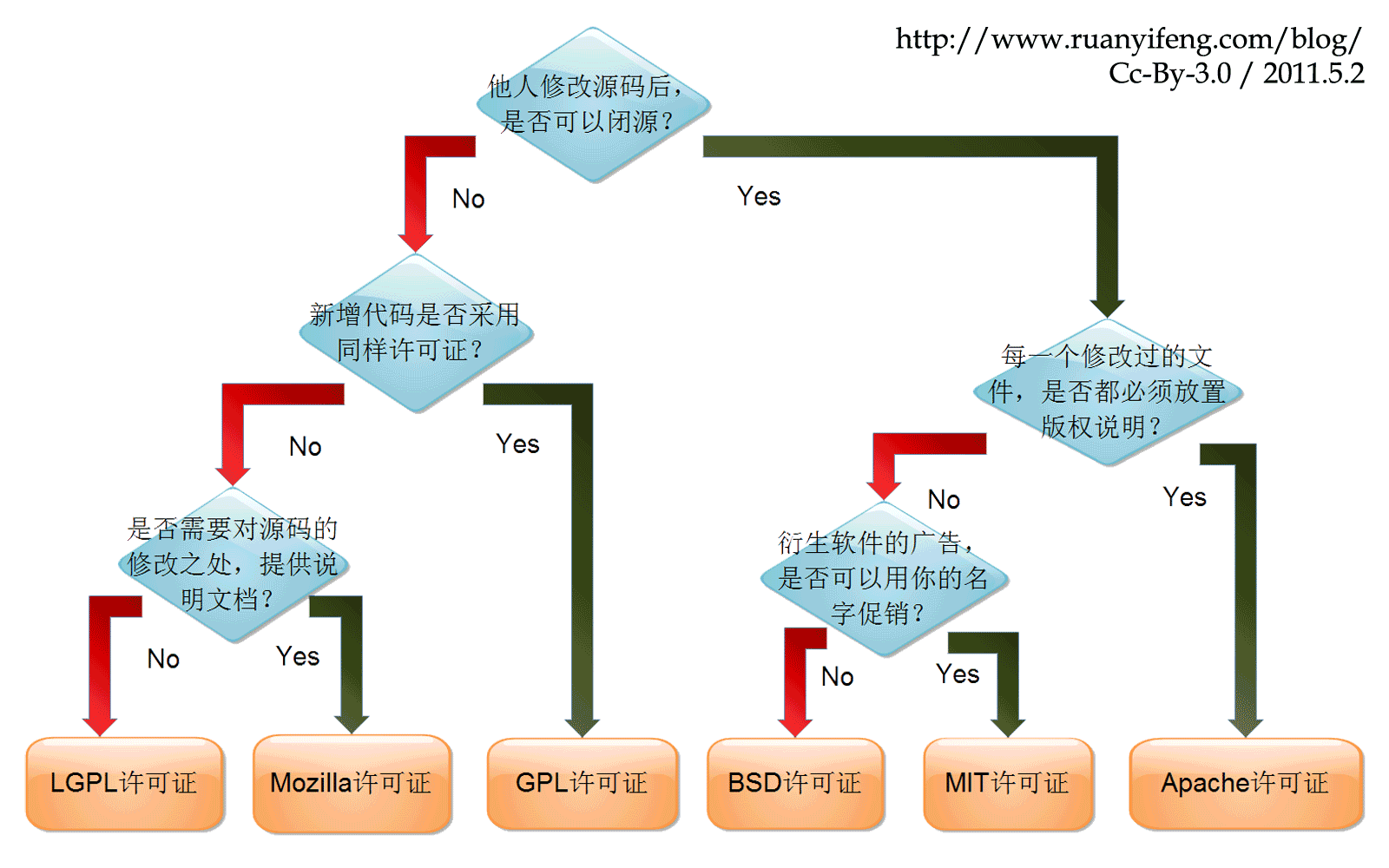
图表关键决策维度说明:
- 修改源码后是否可以闭源
- 新增代码是否需采用相同许可证
- 每个修改过的文件是否必须放置版权说明
- 是否需要为修改之处提供说明文档
- 是否可以使用原项目名称进行衍生软件的广告促销
四、结语
Paul Bagwell 设计的可视化分析图,以直观、简洁的方式提炼了主流开源许可证的主要差异,为开发者提供了高效的决策参考。通过该图表,开发者可快速匹配项目对"开源自由度""衍生作品限制""版权声明要求"等关键需求,降低许可证选择的复杂度与决策成本。
对于需要深入了解许可证细节(如兼容性、法律条款细则)的开发者,可参考自由软件基金会的官方许可证列表及说明,结合项目实际场景进行更精准的选择。
via:
- The Evolution of Open Source Software: A Brief History
https://open-innovation-projects.org/blog/the-evolution-of-open-source-software-a-comprehensive-history - Open Source Software - What Is It?
https://open-innovation-projects.org/blog/a-comprehensive-guide-to-open-source-software-what-it-is-and-how-it-works - 如何选择开源许可证? - 阮一峰
https://www.ruanyifeng.com/blog/2011/05/how_to_choose_free_software_licenses.html - 一文看懂开源许可证丨开源知识科普 - 知乎
https://zhuanlan.zhihu.com/p/424000982