目录
-
- 相关链接
- 环境准备:
- 关键函数:
- 完整RV3588模型推理模块实现:
- [rk3588 模型转换:](#rk3588 模型转换:)
相关链接
基于瑞芯微rv1126的C+±api的推理模块的cpython封装(比python-api提速5倍以上)
【Yolov5】基于瑞芯微rv1126 python-api的推理模块
环境准备:
硬件 :瑞芯微RK3588
系统 :ubuntu20.04
语言 :python3.8
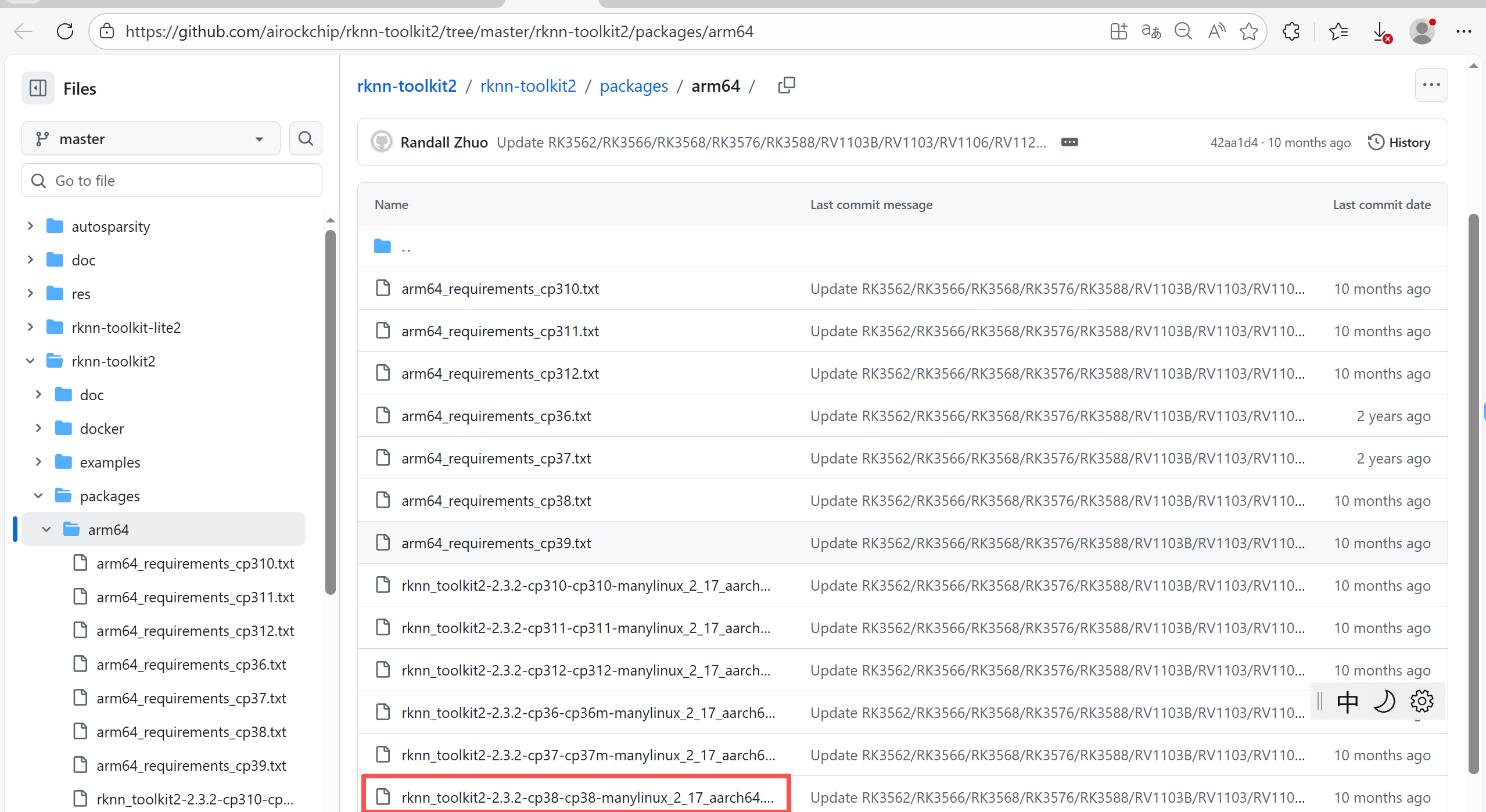
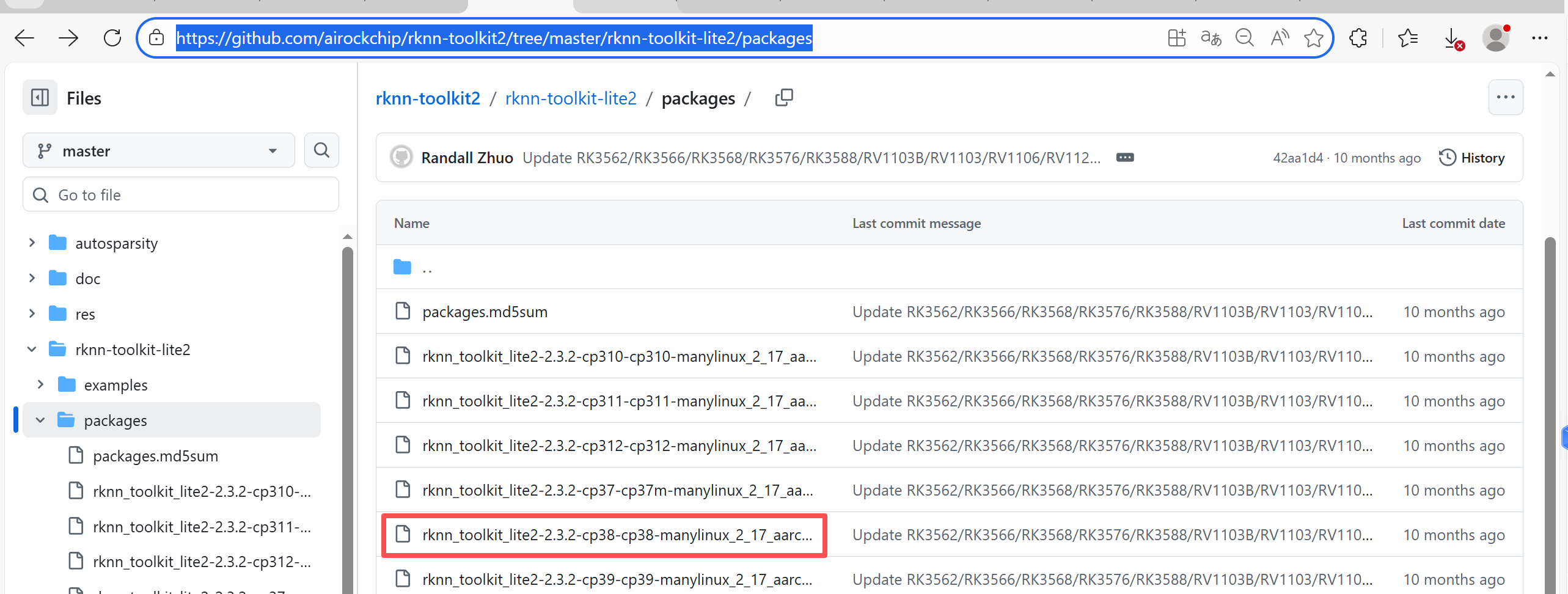
第三方依赖库 :rknn_toolkit_lite2,rknn_toolkit2
架构 :aarch64
依赖库下载链接 :
根据python版本合和架构(x86/arm64)选择对应版本
https://github.com/airockchip/rknn-toolkit2/tree/master/rknn-toolkit2/packages/arm64
https://github.com/airockchip/rknn-toolkit2/tree/master/rknn-toolkit-lite2/packages
关键函数:
引入依赖库:
python
from rknn.api import RKNNRKNN初始化:
python
rknn = RKNN()

# 加载RKNN模型
model_path = "xxxx/yyyy/zzz.rknn"
rknn.load_rknn(model_path)

# 运行环境初始化,可选择指定NPU芯片
if target==None:
    ret = rknn.init_runtime()
else:
    ret = rknn.init_runtime(target=target, device_id=device_id)
    # if device_id== 0:
    #     ret = rknn.init_runtime(target=target, core_mask=rknn.NPU_CORE_0)
    # elif device_id==1:
    #     ret = rknn.init_runtime(target=target, core_mask=rknn.NPU_CORE_1)
    # elif device_id == 2:
    #     ret = rknn.init_runtime(target=target, core_mask=rknn.NPU_CORE_2)
    # else:
    #     ret = rknn.init_runtime(target=target, core_mask=rknn.NPU_CORE_0_1_2)
if ret != 0:
    print('Init runtime environment failed')
    exit(ret)
print('done')
RKNN推理:
python
# 读取本地图片模拟
img_path = "aaa/bbb.jpg"
img = cv2.imread(img_path)

# letter_box调整img图像尺寸,此处略

# BGR转RGB
inputs  = cv2.cvtColor(img, cv2.COLOR_BGR2RGB)

# 输入图片必须以list或者tuple类型
if isinstance(inputs, list) or isinstance(inputs, tuple):
    pass
else:
    inputs = [inputs]
# rknn模型推理
result = self.rknn.inference(inputs=inputs)
完整RV3588模型推理模块实现:
python
from rknn.api import RKNN
import yaml
import os
import cv2
import threading

from coco_utils import COCO_test_helper


def calculate_iou(boxA, boxB):
    # 获取每个框的坐标
    xA = max(boxA[0], boxB[0])
    yA = max(boxA[1], boxB[1])
    xB = min(boxA[2], boxB[2])
    yB = min(boxA[3], boxB[3])

    # 计算交集矩形的宽高
    intersection_area = max(0, xB - xA + 1) * max(0, yB - yA + 1)

    # 计算每个框的面积
    boxAArea = (boxA[2] - boxA[0] + 1) * (boxA[3] - boxA[1] + 1)
    boxBArea = (boxB[2] - boxB[0] + 1) * (boxB[3] - boxB[1] + 1)

    # 计算IoU
    iou = intersection_area / float(boxAArea + boxBArea - intersection_area)
    return iou

class Yolov5RK3588():
    def __init__(self, model_path, device_id=None, target=None):
        rknn = RKNN()

        # Direct Load RKNN Model
        rknn.load_rknn(model_path)

        print('--> Init runtime environment')
        if target==None:
            ret = rknn.init_runtime()
        else:
            ret = rknn.init_runtime(target=target, device_id=device_id)
            # if device_id== 0:
            #     ret = rknn.init_runtime(target=target, core_mask=rknn.NPU_CORE_0)
            # elif device_id==1:
            #     ret = rknn.init_runtime(target=target, core_mask=rknn.NPU_CORE_1)
            # elif device_id == 2:
            #     ret = rknn.init_runtime(target=target, core_mask=rknn.NPU_CORE_2)
            # else:
            #     ret = rknn.init_runtime(target=target, core_mask=rknn.NPU_CORE_0_1_2)
        if ret != 0:
            print('Init runtime environment failed')
            exit(ret)
        print('done')

        self.model = rknn
        self.co_helper = COCO_test_helper(enable_letter_box=True)

        # 加载参数
        with open("model_rknn.yaml") as f:
            self.cfg_yolov5 = yaml.load(f, Loader=yaml.FullLoader)
        # Checks
        assert 0 <= self.conf_thres <= 1, f'Invalid Confidence threshold {self.conf_thres}, valid values are between 0.0 and 1.0'
        assert 0 <= self.iou_thres <= 1, f'Invalid IoU {self.iou_thres}, valid values are between 0.0 and 1.0'
        self.img_size = self.cfg_yolov5['img_size'] # [640, 384]
        anchors = self.cfg_yolov5["anchors"]
        self.anchors = np.array(anchors).reshape(3, -1, 2).tolist()
        self._modelLock = threading.Lock()

    def __call__(self, inputs):

        with self._modelLock:
            if self.model is None:
	            print("ERROR: rknn has been released")
	            return []

	        if isinstance(inputs, list) or isinstance(inputs, tuple):
	            pass
	        else:
	            inputs = [inputs]
        	result = self.model.inference(inputs=inputs)
        return pred

    def close(self):
        """显式释放NPU/GPU资源"""
        if not self._is_closed and hasattr(self, '_model'):
            with self._modelLock:  # 确保线程安全
                if hasattr(self._model, 'release'):  # 如果RKNN_model_container有释放方法
                    self._model.release()
                del self._model
            self._is_closed = True
            logger.info("RKNN model resources released.")

    def __del__(self):
        """析构函数(备用清理)"""
        if not self._is_closed:
            logger.info("Resource cleanup via __del__. Call close() explicitly instead!")
            self.close()

    def work(self, cv2_image):
        # 数据预处理
        img = self.preprocess(cv2_image)
        # 模型推理
        result = self.model(img)
        # 后处理
        boxes, classes, scores = self.postprocess(result,self.anchors)
        # 映射到原始图像
        pred_result = []
        if boxes is not None:
            boxes = self.co_helper.get_real_box(boxes)
            for nbox,nclasses,nscore in zip(boxes.tolist(),classes.tolist(),scores.tolist()):
                pred_result.append([int(nbox[0]), int(nbox[1]), int(nbox[2]), int(nbox[3]), nscore, int(nclasses)])
        return pred_result

    # 图像预处理
    def preprocess(self, im0):
        # Due to rga init with (0,0,0), we using pad_color (0,0,0) instead of (114, 114, 114)
        pad_color = (0,0,0)
        im0_copy = im0.copy()
        img = self.co_helper.letter_box(im= im0_copy, new_shape=(self.img_size[1], self.img_size[0]), pad_color=(0,0,0))
        img = cv2.cvtColor(img, cv2.COLOR_BGR2RGB)
        del im0_copy
        return img

    def postprocess(self,input_data, anchors):
        boxes, scores, classes_conf = [], [], []
        # 1*255*h*w -> 3*85*h*w
        # print("input_data.shape=", input_data.shape)
        # print("len(input_data)=", len(input_data))
        # print("len(input_data[0])=", len(input_data[0]))
        # print("len(input_data[0][0])=", len(input_data[0][0]))
        # print("len(input_data[0][0][0])=", len(input_data[0][0][0]))
        # print("----------------------------------")
        input_data = [_in.reshape([len(anchors[0]), -1] + list(_in.shape[-2:])) for _in in input_data]
        # print("len(input_data)=", len(input_data))
        # print("len(input_data[0])=", len(input_data[0]))
        # print("len(input_data[0][0])=", len(input_data[0][0]))
        # print("len(input_data[0][0][0])=", len(input_data[0][0][0]))
        for i in range(len(input_data)):
            boxes.append(self.box_process(input_data[i][:, :4, :, :], anchors[i]))
            scores.append(input_data[i][:, 4:5, :, :])
            classes_conf.append(input_data[i][:, 5:, :, :])

        def sp_flatten(_in):
            ch = _in.shape[1]
            _in = _in.transpose(0, 2, 3, 1)
            return _in.reshape(-1, ch)

        boxes = [sp_flatten(_v) for _v in boxes]
        classes_conf = [sp_flatten(_v) for _v in classes_conf]
        scores = [sp_flatten(_v) for _v in scores]

        boxes = np.concatenate(boxes)
        classes_conf = np.concatenate(classes_conf)
        scores = np.concatenate(scores)

        # filter according to threshold
        boxes, classes, scores = self.filter_boxes(boxes, scores, classes_conf)

        # nms
        nboxes, nclasses, nscores = [], [], []

        for c in set(classes):
            inds = np.where(classes == c)
            b = boxes[inds]
            c = classes[inds]
            s = scores[inds]
            keep = self.nms_boxes(b, s)

            if len(keep) != 0:
                nboxes.append(b[keep])
                nclasses.append(c[keep])
                nscores.append(s[keep])

        if not nclasses and not nscores:
            return None, None, None
        # 拼接

        boxes = np.concatenate(nboxes)
        classes = np.concatenate(nclasses)
        scores = np.concatenate(nscores)

        return boxes, classes, scores

    def filter_boxes(self,boxes, box_confidences, box_class_probs):
        """Filter boxes with object threshold.
        """
        box_confidences = box_confidences.reshape(-1)
        class_max_score = np.max(box_class_probs, axis=-1)
        classes = np.argmax(box_class_probs, axis=-1)

        _class_pos = np.where(class_max_score * box_confidences >= self.conf_thres)
        scores = (class_max_score * box_confidences)[_class_pos]

        boxes = boxes[_class_pos]
        classes = classes[_class_pos]

        return boxes, classes, scores

    def nms_boxes(self,boxes, scores):
        """Suppress non-maximal boxes.
        # Returns
            keep: ndarray, index of effective boxes.
        """
        x = boxes[:, 0]
        y = boxes[:, 1]
        w = boxes[:, 2] - boxes[:, 0]
        h = boxes[:, 3] - boxes[:, 1]

        areas = w * h
        order = scores.argsort()[::-1]

        keep = []
        while order.size > 0:
            i = order[0]
            keep.append(i)

            xx1 = np.maximum(x[i], x[order[1:]])
            yy1 = np.maximum(y[i], y[order[1:]])
            xx2 = np.minimum(x[i] + w[i], x[order[1:]] + w[order[1:]])
            yy2 = np.minimum(y[i] + h[i], y[order[1:]] + h[order[1:]])

            w1 = np.maximum(0.0, xx2 - xx1 + 0.00001)
            h1 = np.maximum(0.0, yy2 - yy1 + 0.00001)
            inter = w1 * h1

            ovr = inter / (areas[i] + areas[order[1:]] - inter)
            inds = np.where(ovr <= self.iou_thres)[0]
            order = order[inds + 1]
        keep = np.array(keep)
        return keep

    def box_process(self,position, anchors):
        grid_h, grid_w = position.shape[2:4]
        col, row = np.meshgrid(np.arange(0, grid_w), np.arange(0, grid_h))
        col = col.reshape(1, 1, grid_h, grid_w)
        row = row.reshape(1, 1, grid_h, grid_w)
        grid = np.concatenate((col, row), axis=1)
        stride = np.array([self.img_size[1] // grid_h, self.img_size[0] // grid_w]).reshape(1, 2, 1, 1)

        col = col.repeat(len(anchors), axis=0)
        row = row.repeat(len(anchors), axis=0)
        anchors = np.array(anchors)
        anchors = anchors.reshape(*anchors.shape, 1, 1)

        box_xy = position[:, :2, :, :] * 2 - 0.5
        box_wh = pow(position[:, 2:4, :, :] * 2, 2) * anchors

        box_xy += grid
        box_xy *= stride
        box = np.concatenate((box_xy, box_wh), axis=1)

        # Convert [c_x, c_y, w, h] to [x1, y1, x2, y2]
        xyxy = np.copy(box)
        xyxy[:, 0, :, :] = box[:, 0, :, :] - box[:, 2, :, :] / 2  # top left x
        xyxy[:, 1, :, :] = box[:, 1, :, :] - box[:, 3, :, :] / 2  # top left y
        xyxy[:, 2, :, :] = box[:, 0, :, :] + box[:, 2, :, :] / 2  # bottom right x
        xyxy[:, 3, :, :] = box[:, 1, :, :] + box[:, 3, :, :] / 2  # bottom right y

        return xyxy
依赖的python文件COCO_test_helper.py:
python
from copy import copy
import os
import cv2
import numpy as np
import json

class Letter_Box_Info():
    def __init__(self, shape, new_shape, w_ratio, h_ratio, dw, dh, pad_color) -> None:
        self.origin_shape = shape
        self.new_shape = new_shape
        self.w_ratio = w_ratio
        self.h_ratio = h_ratio
        self.dw = dw
        self.dh = dh
        self.pad_color = pad_color


def coco_eval_with_json(anno_json, pred_json):
    from pycocotools.coco import COCO
    from pycocotools.cocoeval import COCOeval
    anno = COCO(anno_json)
    pred = anno.loadRes(pred_json)
    eval = COCOeval(anno, pred, 'bbox')
    # eval.params.useCats = 0
    # eval.params.maxDets = list((100, 300, 1000))
    # a = np.array(list(range(50, 96, 1)))/100
    # eval.params.iouThrs = a
    eval.evaluate()
    eval.accumulate()
    eval.summarize()
    map, map50 = eval.stats[:2]  # update results (mAP@0.5:0.95, mAP@0.5)

    print('map  --> ', map)
    print('map50--> ', map50)
    print('map75--> ', eval.stats[2])
    print('map85--> ', eval.stats[-2])
    print('map95--> ', eval.stats[-1])

class COCO_test_helper():
    def __init__(self, enable_letter_box = False) -> None:
        self.record_list = []
        self.enable_ltter_box = enable_letter_box
        if self.enable_ltter_box is True:
            self.letter_box_info_list = []
        else:
            self.letter_box_info_list = None

    def letter_box(self, im, new_shape, pad_color=(0,0,0), info_need=False):
        # Resize and pad image while meeting stride-multiple constraints
        shape = im.shape[:2]  # current shape [height, width]
        if isinstance(new_shape, int):
            new_shape = (new_shape, new_shape)

        # Scale ratio
        r = min(new_shape[0] / shape[0], new_shape[1] / shape[1])

        # Compute padding
        ratio = r  # width, height ratios
        new_unpad = int(round(shape[1] * r)), int(round(shape[0] * r))
        dw, dh = new_shape[1] - new_unpad[0], new_shape[0] - new_unpad[1]  # wh padding

        dw /= 2  # divide padding into 2 sides
        dh /= 2

        if shape[::-1] != new_unpad:  # resize
            im = cv2.resize(im, new_unpad, interpolation=cv2.INTER_LINEAR)
        top, bottom = int(round(dh - 0.1)), int(round(dh + 0.1))
        left, right = int(round(dw - 0.1)), int(round(dw + 0.1))
        im = cv2.copyMakeBorder(im, top, bottom, left, right, cv2.BORDER_CONSTANT, value=pad_color)  # add border

        if self.enable_ltter_box is True:
            self.letter_box_info_list.append(Letter_Box_Info(shape, new_shape, ratio, ratio, dw, dh, pad_color))
        if info_need is True:
            return im, ratio, (dw, dh)
        else:
            return im

    def direct_resize(self, im, new_shape, info_need=False):
        shape = im.shape[:2]
        h_ratio = new_shape[0]/ shape[0]
        w_ratio = new_shape[1]/ shape[1]
        if self.enable_ltter_box is True:
            self.letter_box_info_list.append(Letter_Box_Info(shape, new_shape, w_ratio, h_ratio, 0, 0, (0,0,0)))
        im = cv2.resize(im, (new_shape[1], new_shape[0]))
        return im

    def get_real_box(self, box, in_format='xyxy'):
        bbox = copy(box)
        if self.enable_ltter_box == True:
        # unletter_box result
            if in_format=='xyxy':
                bbox[:,0] -= self.letter_box_info_list[-1].dw
                bbox[:,0] /= self.letter_box_info_list[-1].w_ratio
                bbox[:,0] = np.clip(bbox[:,0], 0, self.letter_box_info_list[-1].origin_shape[1])

                bbox[:,1] -= self.letter_box_info_list[-1].dh
                bbox[:,1] /= self.letter_box_info_list[-1].h_ratio
                bbox[:,1] = np.clip(bbox[:,1], 0, self.letter_box_info_list[-1].origin_shape[0])

                bbox[:,2] -= self.letter_box_info_list[-1].dw
                bbox[:,2] /= self.letter_box_info_list[-1].w_ratio
                bbox[:,2] = np.clip(bbox[:,2], 0, self.letter_box_info_list[-1].origin_shape[1])

                bbox[:,3] -= self.letter_box_info_list[-1].dh
                bbox[:,3] /= self.letter_box_info_list[-1].h_ratio
                bbox[:,3] = np.clip(bbox[:,3], 0, self.letter_box_info_list[-1].origin_shape[0])
        return bbox

    def get_real_seg(self, seg):
        #! fix side effect
        dh = int(self.letter_box_info_list[-1].dh)
        dw = int(self.letter_box_info_list[-1].dw)
        origin_shape = self.letter_box_info_list[-1].origin_shape
        new_shape = self.letter_box_info_list[-1].new_shape
        if (dh == 0) and (dw == 0) and origin_shape == new_shape:
            return seg
        elif dh == 0 and dw != 0:
            seg = seg[:, :, dw:-dw] # a[0:-0] = []
        elif dw == 0 and dh != 0 :
            seg = seg[:, dh:-dh, :]
        seg = np.where(seg, 1, 0).astype(np.uint8).transpose(1,2,0)
        seg = cv2.resize(seg, (origin_shape[1], origin_shape[0]), interpolation=cv2.INTER_LINEAR)
        if len(seg.shape) < 3:
            return seg[None,:,:]
        else:
            return seg.transpose(2,0,1)

    def add_single_record(self, image_id, category_id, bbox, score, in_format='xyxy', pred_masks = None):
        if self.enable_ltter_box == True:
        # unletter_box result
            if in_format=='xyxy':
                bbox[0] -= self.letter_box_info_list[-1].dw
                bbox[0] /= self.letter_box_info_list[-1].w_ratio

                bbox[1] -= self.letter_box_info_list[-1].dh
                bbox[1] /= self.letter_box_info_list[-1].h_ratio

                bbox[2] -= self.letter_box_info_list[-1].dw
                bbox[2] /= self.letter_box_info_list[-1].w_ratio

                bbox[3] -= self.letter_box_info_list[-1].dh
                bbox[3] /= self.letter_box_info_list[-1].h_ratio
                # bbox = [value/self.letter_box_info_list[-1].ratio for value in bbox]

        if in_format=='xyxy':
        # change xyxy to xywh
            bbox[2] = bbox[2] - bbox[0]
            bbox[3] = bbox[3] - bbox[1]
        else:
            assert False, "now only support xyxy format, please add code to support others format"

        def single_encode(x):
            from pycocotools.mask import encode
            rle = encode(np.asarray(x[:, :, None], order="F", dtype="uint8"))[0]
            rle["counts"] = rle["counts"].decode("utf-8")
            return rle

        if pred_masks is None:
            self.record_list.append({"image_id": image_id,
                                    "category_id": category_id,
                                    "bbox":[round(x, 3) for x in bbox],
                                    'score': round(score, 5),
                                    })
        else:
            rles = single_encode(pred_masks)
            self.record_list.append({"image_id": image_id,
                                    "category_id": category_id,
                                    "bbox":[round(x, 3) for x in bbox],
                                    'score': round(score, 5),
                                    'segmentation': rles,
                                    })

    def export_to_json(self, path):
        with open(path, 'w') as f:
            json.dump(self.record_list, f)
rk3588 模型转换:
参考官方github项目:
https://github.com/airockchip/rknn_model_zoo/tree/main/examples
选择对应的网络模型(yolov5)
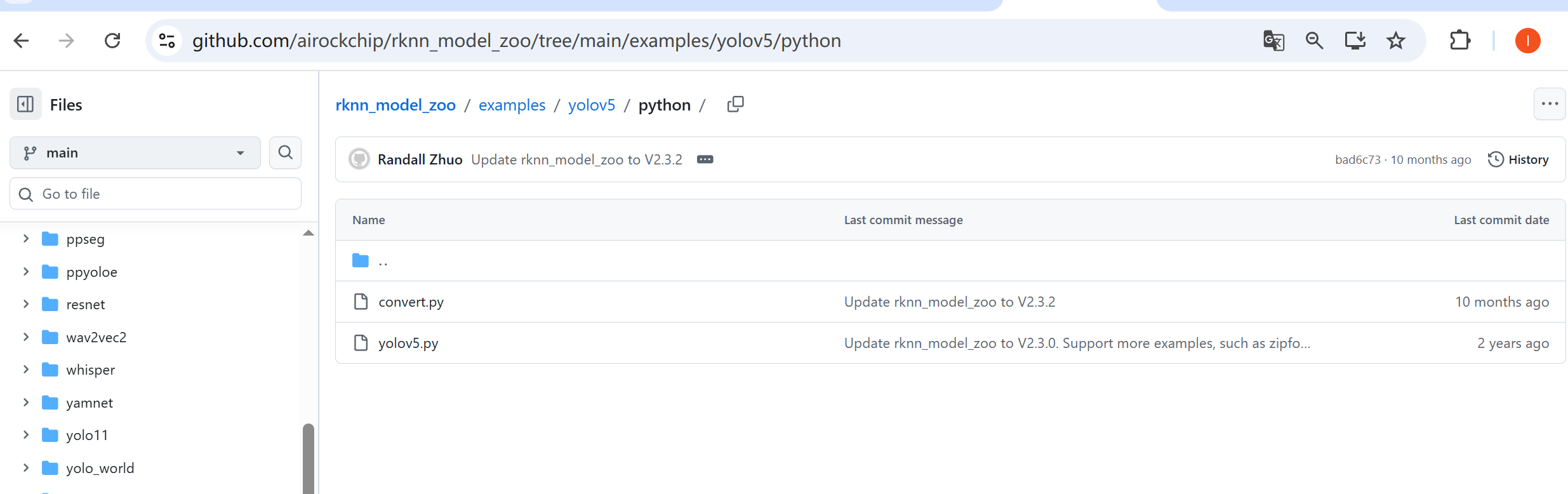
运行convert.py实现转换。
常用的模型转换方式:pt->onnx->rknn
在yolov5比较新的版本里,export.py存在--rknpu的参数:
如:
python
# YOLOv5 馃殌 by Ultralytics, GPL-3.0 license
"""
Export a YOLOv5 PyTorch model to other formats. TensorFlow exports authored by https://github.com/zldrobit
Format | `export.py --include` | Model
--- | --- | ---
PyTorch | - | yolov5s.pt
TorchScript | `torchscript` | yolov5s.torchscript
ONNX | `onnx` | yolov5s.onnx
OpenVINO | `openvino` | yolov5s_openvino_model/
TensorRT | `engine` | yolov5s.engine
CoreML | `coreml` | yolov5s.mlmodel
TensorFlow SavedModel | `saved_model` | yolov5s_saved_model/
TensorFlow GraphDef | `pb` | yolov5s.pb
TensorFlow Lite | `tflite` | yolov5s.tflite
TensorFlow Edge TPU | `edgetpu` | yolov5s_edgetpu.tflite
TensorFlow.js | `tfjs` | yolov5s_web_model/
PaddlePaddle | `paddle` | yolov5s_paddle_model/
Requirements:
$ pip install -r requirements.txt coremltools onnx onnx-simplifier onnxruntime openvino-dev tensorflow-cpu # CPU
$ pip install -r requirements.txt coremltools onnx onnx-simplifier onnxruntime-gpu openvino-dev tensorflow # GPU
Usage:
$ python export.py --weights yolov5s.pt --include torchscript onnx openvino engine coreml tflite ...
Inference:
$ python detect.py --weights yolov5s.pt # PyTorch
yolov5s.torchscript # TorchScript
yolov5s.onnx # ONNX Runtime or OpenCV DNN with --dnn
yolov5s_openvino_model # OpenVINO
yolov5s.engine # TensorRT
yolov5s.mlmodel # CoreML (macOS-only)
yolov5s_saved_model # TensorFlow SavedModel
yolov5s.pb # TensorFlow GraphDef
yolov5s.tflite # TensorFlow Lite
yolov5s_edgetpu.tflite # TensorFlow Edge TPU
yolov5s_paddle_model # PaddlePaddle
TensorFlow.js:
$ cd .. && git clone https://github.com/zldrobit/tfjs-yolov5-example.git && cd tfjs-yolov5-example
$ npm install
$ ln -s ../../yolov5/yolov5s_web_model public/yolov5s_web_model
$ npm start
"""
import argparse
import contextlib
import json
import os
import platform
import re
import subprocess
import sys
import time
import warnings
from pathlib import Path
# activate rknn hack
if '--rknpu' in sys.argv:
os.environ['RKNN_model_hack'] = "1"
import pandas as pd
import torch
from torch.utils.mobile_optimizer import optimize_for_mobile
FILE = Path(__file__).resolve()
ROOT = FILE.parents[0] # YOLOv5 root directory
if str(ROOT) not in sys.path:
sys.path.append(str(ROOT)) # add ROOT to PATH
if platform.system() != 'Windows':
ROOT = Path(os.path.relpath(ROOT, Path.cwd())) # relative
from models.experimental import attempt_load
from models.yolo import ClassificationModel, Detect, DetectionModel, SegmentationModel, Segment
from utils.dataloaders import LoadImages
from utils.general import (LOGGER, Profile, check_dataset, check_img_size, check_requirements, check_version,
check_yaml, colorstr, file_size, get_default_args, print_args, url2file, yaml_save)
from utils.torch_utils import select_device, smart_inference_mode
MACOS = platform.system() == 'Darwin' # macOS environment
def export_formats():
# YOLOv5 export formats
x = [
['PyTorch', '-', '.pt', True, True],
['TorchScript', 'torchscript', '.torchscript', True, True],
['ONNX', 'onnx', '.onnx', True, True],
['OpenVINO', 'openvino', '_openvino_model', True, False],
['TensorRT', 'engine', '.engine', False, True],
['CoreML', 'coreml', '.mlmodel', True, False],
['TensorFlow SavedModel', 'saved_model', '_saved_model', True, True],
['TensorFlow GraphDef', 'pb', '.pb', True, True],
['TensorFlow Lite', 'tflite', '.tflite', True, False],
['TensorFlow Edge TPU', 'edgetpu', '_edgetpu.tflite', False, False],
['TensorFlow.js', 'tfjs', '_web_model', False, False],
['PaddlePaddle', 'paddle', '_paddle_model', True, True],]
return pd.DataFrame(x, columns=['Format', 'Argument', 'Suffix', 'CPU', 'GPU'])
def try_export(inner_func):
# YOLOv5 export decorator, i..e @try_export
inner_args = get_default_args(inner_func)
def outer_func(*args, **kwargs):
prefix = inner_args['prefix']
try:
with Profile() as dt:
f, model = inner_func(*args, **kwargs)
LOGGER.info(f'{prefix} export success 鉁?{dt.t:.1f}s, saved as {f} ({file_size(f):.1f} MB)')
return f, model
except Exception as e:
LOGGER.info(f'{prefix} export failure 鉂?{dt.t:.1f}s: {e}')
return None, None
return outer_func
@try_export
def export_torchscript(model, im, file, optimize, prefix=colorstr('TorchScript:')):
# YOLOv5 TorchScript model export
LOGGER.info(f'\n{prefix} starting export with torch {torch.__version__}...')
f = file.with_suffix('.torchscript')
ts = torch.jit.trace(model, im, strict=False)
d = {"shape": im.shape, "stride": int(max(model.stride)), "names": model.names}
extra_files = {'config.txt': json.dumps(d)} # torch._C.ExtraFilesMap()
if optimize: # https://pytorch.org/tutorials/recipes/mobile_interpreter.html
optimize_for_mobile(ts)._save_for_lite_interpreter(str(f), _extra_files=extra_files)
else:
ts.save(str(f), _extra_files=extra_files)
return f, None
@try_export
def export_onnx(model, im, file, opset, dynamic, simplify, prefix=colorstr('ONNX:')):
# YOLOv5 ONNX export
check_requirements('onnx')
import onnx
LOGGER.info(f'\n{prefix} starting export with onnx {onnx.__version__}...')
f = file.with_suffix('.onnx')
output_names = ['output0', 'output1'] if isinstance(model, SegmentationModel) else ['output0']
if dynamic:
dynamic = {'images': {0: 'batch', 2: 'height', 3: 'width'}} # shape(1,3,640,640)
if isinstance(model, SegmentationModel):
dynamic['output0'] = {0: 'batch', 1: 'anchors'} # shape(1,25200,85)
dynamic['output1'] = {0: 'batch', 2: 'mask_height', 3: 'mask_width'} # shape(1,32,160,160)
elif isinstance(model, DetectionModel):
dynamic['output0'] = {0: 'batch', 1: 'anchors'} # shape(1,25200,85)
torch.onnx.export(
model.cpu() if dynamic else model, # --dynamic only compatible with cpu
im.cpu() if dynamic else im,
f,
verbose=False,
opset_version=opset,
do_constant_folding=True,
input_names=['images'],
output_names=output_names,
dynamic_axes=dynamic or None)
# Checks
model_onnx = onnx.load(f) # load onnx model
onnx.checker.check_model(model_onnx) # check onnx model
# Metadata
d = {'stride': int(max(model.stride)), 'names': model.names}
for k, v in d.items():
meta = model_onnx.metadata_props.add()
meta.key, meta.value = k, str(v)
onnx.save(model_onnx, f)
# Simplify
if simplify:
try:
cuda = torch.cuda.is_available()
check_requirements(('onnxruntime-gpu' if cuda else 'onnxruntime', 'onnx-simplifier>=0.4.1'))
import onnxsim
LOGGER.info(f'{prefix} simplifying with onnx-simplifier {onnxsim.__version__}...')
model_onnx, check = onnxsim.simplify(model_onnx)
assert check, 'assert check failed'
onnx.save(model_onnx, f)
except Exception as e:
LOGGER.info(f'{prefix} simplifier failure: {e}')
return f, model_onnx
@try_export
def export_openvino(file, metadata, half, prefix=colorstr('OpenVINO:')):
# YOLOv5 OpenVINO export
check_requirements('openvino-dev') # requires openvino-dev: https://pypi.org/project/openvino-dev/
import openvino.inference_engine as ie
LOGGER.info(f'\n{prefix} starting export with openvino {ie.__version__}...')
f = str(file).replace('.pt', f'_openvino_model{os.sep}')
cmd = f"mo --input_model {file.with_suffix('.onnx')} --output_dir {f} --data_type {'FP16' if half else 'FP32'}"
subprocess.run(cmd.split(), check=True, env=os.environ) # export
yaml_save(Path(f) / file.with_suffix('.yaml').name, metadata) # add metadata.yaml
return f, None
@try_export
def export_paddle(model, im, file, metadata, prefix=colorstr('PaddlePaddle:')):
# YOLOv5 Paddle export
check_requirements(('paddlepaddle', 'x2paddle'))
import x2paddle
from x2paddle.convert import pytorch2paddle
LOGGER.info(f'\n{prefix} starting export with X2Paddle {x2paddle.__version__}...')
f = str(file).replace('.pt', f'_paddle_model{os.sep}')
pytorch2paddle(module=model, save_dir=f, jit_type='trace', input_examples=[im]) # export
yaml_save(Path(f) / file.with_suffix('.yaml').name, metadata) # add metadata.yaml
return f, None
@try_export
def export_coreml(model, im, file, int8, half, prefix=colorstr('CoreML:')):
# YOLOv5 CoreML export
check_requirements('coremltools')
import coremltools as ct
LOGGER.info(f'\n{prefix} starting export with coremltools {ct.__version__}...')
f = file.with_suffix('.mlmodel')
ts = torch.jit.trace(model, im, strict=False) # TorchScript model
ct_model = ct.convert(ts, inputs=[ct.ImageType('image', shape=im.shape, scale=1 / 255, bias=[0, 0, 0])])
bits, mode = (8, 'kmeans_lut') if int8 else (16, 'linear') if half else (32, None)
if bits < 32:
if MACOS: # quantization only supported on macOS
with warnings.catch_warnings():
warnings.filterwarnings("ignore", category=DeprecationWarning) # suppress numpy==1.20 float warning
ct_model = ct.models.neural_network.quantization_utils.quantize_weights(ct_model, bits, mode)
else:
print(f'{prefix} quantization only supported on macOS, skipping...')
ct_model.save(f)
return f, ct_model
@try_export
def export_engine(model, im, file, half, dynamic, simplify, workspace=4, verbose=False, prefix=colorstr('TensorRT:')):
# YOLOv5 TensorRT export https://developer.nvidia.com/tensorrt
assert im.device.type != 'cpu', 'export running on CPU but must be on GPU, i.e. `python export.py --device 0`'
try:
import tensorrt as trt
except Exception:
if platform.system() == 'Linux':
check_requirements('nvidia-tensorrt', cmds='-U --index-url https://pypi.ngc.nvidia.com')
import tensorrt as trt
if trt.__version__[0] == '7': # TensorRT 7 handling https://github.com/ultralytics/yolov5/issues/6012
grid = model.model[-1].anchor_grid
model.model[-1].anchor_grid = [a[..., :1, :1, :] for a in grid]
export_onnx(model, im, file, 12, dynamic, simplify) # opset 12
model.model[-1].anchor_grid = grid
else: # TensorRT >= 8
check_version(trt.__version__, '8.0.0', hard=True) # require tensorrt>=8.0.0
export_onnx(model, im, file, 12, dynamic, simplify) # opset 12
onnx = file.with_suffix('.onnx')
LOGGER.info(f'\n{prefix} starting export with TensorRT {trt.__version__}...')
assert onnx.exists(), f'failed to export ONNX file: {onnx}'
f = file.with_suffix('.engine') # TensorRT engine file
logger = trt.Logger(trt.Logger.INFO)
if verbose:
logger.min_severity = trt.Logger.Severity.VERBOSE
builder = trt.Builder(logger)
config = builder.create_builder_config()
config.max_workspace_size = workspace * 1 << 30
# config.set_memory_pool_limit(trt.MemoryPoolType.WORKSPACE, workspace << 30) # fix TRT 8.4 deprecation notice
flag = (1 << int(trt.NetworkDefinitionCreationFlag.EXPLICIT_BATCH))
network = builder.create_network(flag)
parser = trt.OnnxParser(network, logger)
if not parser.parse_from_file(str(onnx)):
raise RuntimeError(f'failed to load ONNX file: {onnx}')
inputs = [network.get_input(i) for i in range(network.num_inputs)]
outputs = [network.get_output(i) for i in range(network.num_outputs)]
for inp in inputs:
LOGGER.info(f'{prefix} input "{inp.name}" with shape{inp.shape} {inp.dtype}')
for out in outputs:
LOGGER.info(f'{prefix} output "{out.name}" with shape{out.shape} {out.dtype}')
if dynamic:
if im.shape[0] <= 1:
LOGGER.warning(f"{prefix} WARNING 鈿狅笍 --dynamic model requires maximum --batch-size argument")
profile = builder.create_optimization_profile()
for inp in inputs:
profile.set_shape(inp.name, (1, *im.shape[1:]), (max(1, im.shape[0] // 2), *im.shape[1:]), im.shape)
config.add_optimization_profile(profile)
LOGGER.info(f'{prefix} building FP{16 if builder.platform_has_fast_fp16 and half else 32} engine as {f}')
if builder.platform_has_fast_fp16 and half:
config.set_flag(trt.BuilderFlag.FP16)
with builder.build_engine(network, config) as engine, open(f, 'wb') as t:
t.write(engine.serialize())
return f, None
@try_export
def export_saved_model(model,
im,
file,
dynamic,
tf_nms=False,
agnostic_nms=False,
topk_per_class=100,
topk_all=100,
iou_thres=0.45,
conf_thres=0.25,
keras=False,
prefix=colorstr('TensorFlow SavedModel:')):
# YOLOv5 TensorFlow SavedModel export
try:
import tensorflow as tf
except Exception:
check_requirements(f"tensorflow{'' if torch.cuda.is_available() else '-macos' if MACOS else '-cpu'}")
import tensorflow as tf
from tensorflow.python.framework.convert_to_constants import convert_variables_to_constants_v2
from models.tf import TFModel
LOGGER.info(f'\n{prefix} starting export with tensorflow {tf.__version__}...')
f = str(file).replace('.pt', '_saved_model')
batch_size, ch, *imgsz = list(im.shape) # BCHW
tf_model = TFModel(cfg=model.yaml, model=model, nc=model.nc, imgsz=imgsz)
im = tf.zeros((batch_size, *imgsz, ch)) # BHWC order for TensorFlow
_ = tf_model.predict(im, tf_nms, agnostic_nms, topk_per_class, topk_all, iou_thres, conf_thres)
inputs = tf.keras.Input(shape=(*imgsz, ch), batch_size=None if dynamic else batch_size)
outputs = tf_model.predict(inputs, tf_nms, agnostic_nms, topk_per_class, topk_all, iou_thres, conf_thres)
keras_model = tf.keras.Model(inputs=inputs, outputs=outputs)
keras_model.trainable = False
keras_model.summary()
if keras:
keras_model.save(f, save_format='tf')
else:
spec = tf.TensorSpec(keras_model.inputs[0].shape, keras_model.inputs[0].dtype)
m = tf.function(lambda x: keras_model(x)) # full model
m = m.get_concrete_function(spec)
frozen_func = convert_variables_to_constants_v2(m)
tfm = tf.Module()
tfm.__call__ = tf.function(lambda x: frozen_func(x)[:4] if tf_nms else frozen_func(x), [spec])
tfm.__call__(im)
tf.saved_model.save(tfm,
f,
options=tf.saved_model.SaveOptions(experimental_custom_gradients=False) if check_version(
tf.__version__, '2.6') else tf.saved_model.SaveOptions())
return f, keras_model
@try_export
def export_pb(keras_model, file, prefix=colorstr('TensorFlow GraphDef:')):
# YOLOv5 TensorFlow GraphDef *.pb export https://github.com/leimao/Frozen_Graph_TensorFlow
import tensorflow as tf
from tensorflow.python.framework.convert_to_constants import convert_variables_to_constants_v2
LOGGER.info(f'\n{prefix} starting export with tensorflow {tf.__version__}...')
f = file.with_suffix('.pb')
m = tf.function(lambda x: keras_model(x)) # full model
m = m.get_concrete_function(tf.TensorSpec(keras_model.inputs[0].shape, keras_model.inputs[0].dtype))
frozen_func = convert_variables_to_constants_v2(m)
frozen_func.graph.as_graph_def()
tf.io.write_graph(graph_or_graph_def=frozen_func.graph, logdir=str(f.parent), name=f.name, as_text=False)
return f, None
@try_export
def export_tflite(keras_model, im, file, int8, data, nms, agnostic_nms, prefix=colorstr('TensorFlow Lite:')):
# YOLOv5 TensorFlow Lite export
import tensorflow as tf
LOGGER.info(f'\n{prefix} starting export with tensorflow {tf.__version__}...')
batch_size, ch, *imgsz = list(im.shape) # BCHW
f = str(file).replace('.pt', '-fp16.tflite')
converter = tf.lite.TFLiteConverter.from_keras_model(keras_model)
converter.target_spec.supported_ops = [tf.lite.OpsSet.TFLITE_BUILTINS]
converter.target_spec.supported_types = [tf.float16]
converter.optimizations = [tf.lite.Optimize.DEFAULT]
if int8:
from models.tf import representative_dataset_gen
dataset = LoadImages(check_dataset(check_yaml(data))['train'], img_size=imgsz, auto=False)
converter.representative_dataset = lambda: representative_dataset_gen(dataset, ncalib=100)
converter.target_spec.supported_ops = [tf.lite.OpsSet.TFLITE_BUILTINS_INT8]
converter.target_spec.supported_types = []
converter.inference_input_type = tf.uint8 # or tf.int8
converter.inference_output_type = tf.uint8 # or tf.int8
converter.experimental_new_quantizer = True
f = str(file).replace('.pt', '-int8.tflite')
if nms or agnostic_nms:
converter.target_spec.supported_ops.append(tf.lite.OpsSet.SELECT_TF_OPS)
tflite_model = converter.convert()
open(f, "wb").write(tflite_model)
return f, None
@try_export
def export_edgetpu(file, prefix=colorstr('Edge TPU:')):
# YOLOv5 Edge TPU export https://coral.ai/docs/edgetpu/models-intro/
cmd = 'edgetpu_compiler --version'
help_url = 'https://coral.ai/docs/edgetpu/compiler/'
assert platform.system() == 'Linux', f'export only supported on Linux. See {help_url}'
if subprocess.run(f'{cmd} >/dev/null', shell=True).returncode != 0:
LOGGER.info(f'\n{prefix} export requires Edge TPU compiler. Attempting install from {help_url}')
sudo = subprocess.run('sudo --version >/dev/null', shell=True).returncode == 0 # sudo installed on system
for c in (
'curl https://packages.cloud.google.com/apt/doc/apt-key.gpg | sudo apt-key add -',
'echo "deb https://packages.cloud.google.com/apt coral-edgetpu-stable main" | sudo tee /etc/apt/sources.list.d/coral-edgetpu.list',
'sudo apt-get update', 'sudo apt-get install edgetpu-compiler'):
subprocess.run(c if sudo else c.replace('sudo ', ''), shell=True, check=True)
ver = subprocess.run(cmd, shell=True, capture_output=True, check=True).stdout.decode().split()[-1]
LOGGER.info(f'\n{prefix} starting export with Edge TPU compiler {ver}...')
f = str(file).replace('.pt', '-int8_edgetpu.tflite') # Edge TPU model
f_tfl = str(file).replace('.pt', '-int8.tflite') # TFLite model
cmd = f"edgetpu_compiler -s -d -k 10 --out_dir {file.parent} {f_tfl}"
subprocess.run(cmd.split(), check=True)
return f, None
@try_export
def export_tfjs(file, prefix=colorstr('TensorFlow.js:')):
# YOLOv5 TensorFlow.js export
check_requirements('tensorflowjs')
import tensorflowjs as tfjs
LOGGER.info(f'\n{prefix} starting export with tensorflowjs {tfjs.__version__}...')
f = str(file).replace('.pt', '_web_model') # js dir
f_pb = file.with_suffix('.pb') # *.pb path
f_json = f'{f}/model.json' # *.json path
cmd = f'tensorflowjs_converter --input_format=tf_frozen_model ' \
f'--output_node_names=Identity,Identity_1,Identity_2,Identity_3 {f_pb} {f}'
subprocess.run(cmd.split())
json = Path(f_json).read_text()
with open(f_json, 'w') as j: # sort JSON Identity_* in ascending order
subst = re.sub(
r'{"outputs": {"Identity.?.?": {"name": "Identity.?.?"}, '
r'"Identity.?.?": {"name": "Identity.?.?"}, '
r'"Identity.?.?": {"name": "Identity.?.?"}, '
r'"Identity.?.?": {"name": "Identity.?.?"}}}', r'{"outputs": {"Identity": {"name": "Identity"}, '
r'"Identity_1": {"name": "Identity_1"}, '
r'"Identity_2": {"name": "Identity_2"}, '
r'"Identity_3": {"name": "Identity_3"}}}', json)
j.write(subst)
return f, None
def add_tflite_metadata(file, metadata, num_outputs):
# Add metadata to *.tflite models per https://www.tensorflow.org/lite/models/convert/metadata
with contextlib.suppress(ImportError):
# check_requirements('tflite_support')
from tflite_support import flatbuffers
from tflite_support import metadata as _metadata
from tflite_support import metadata_schema_py_generated as _metadata_fb
tmp_file = Path('/tmp/meta.txt')
with open(tmp_file, 'w') as meta_f:
meta_f.write(str(metadata))
model_meta = _metadata_fb.ModelMetadataT()
label_file = _metadata_fb.AssociatedFileT()
label_file.name = tmp_file.name
model_meta.associatedFiles = [label_file]
subgraph = _metadata_fb.SubGraphMetadataT()
subgraph.inputTensorMetadata = [_metadata_fb.TensorMetadataT()]
subgraph.outputTensorMetadata = [_metadata_fb.TensorMetadataT()] * num_outputs
model_meta.subgraphMetadata = [subgraph]
b = flatbuffers.Builder(0)
b.Finish(model_meta.Pack(b), _metadata.MetadataPopulator.METADATA_FILE_IDENTIFIER)
metadata_buf = b.Output()
populator = _metadata.MetadataPopulator.with_model_file(file)
populator.load_metadata_buffer(metadata_buf)
populator.load_associated_files([str(tmp_file)])
populator.populate()
tmp_file.unlink()
@smart_inference_mode()
def run(
data=ROOT / 'data/coco128.yaml', # 'dataset.yaml path'
weights=ROOT / 'yolov5s.pt', # weights path
imgsz=(640, 640), # image (height, width)
batch_size=1, # batch size
device='cpu', # cuda device, i.e. 0 or 0,1,2,3 or cpu
include=('torchscript', 'onnx'), # include formats
half=False, # FP16 half-precision export
inplace=False, # set YOLOv5 Detect() inplace=True
keras=False, # use Keras
optimize=False, # TorchScript: optimize for mobile
int8=False, # CoreML/TF INT8 quantization
dynamic=False, # ONNX/TF/TensorRT: dynamic axes
simplify=False, # ONNX: simplify model
opset=12, # ONNX: opset version
verbose=False, # TensorRT: verbose log
workspace=4, # TensorRT: workspace size (GB)
nms=False, # TF: add NMS to model
agnostic_nms=False, # TF: add agnostic NMS to model
topk_per_class=100, # TF.js NMS: topk per class to keep
topk_all=100, # TF.js NMS: topk for all classes to keep
iou_thres=0.45, # TF.js NMS: IoU threshold
conf_thres=0.25, # TF.js NMS: confidence threshold
):
t = time.time()
include = [x.lower() for x in include] # to lowercase
fmts = tuple(export_formats()['Argument'][1:]) # --include arguments
flags = [x in include for x in fmts]
assert sum(flags) == len(include), f'ERROR: Invalid --include {include}, valid --include arguments are {fmts}'
jit, onnx, xml, engine, coreml, saved_model, pb, tflite, edgetpu, tfjs, paddle = flags # export booleans
file = Path(url2file(weights) if str(weights).startswith(('http:/', 'https:/')) else weights) # PyTorch weights
# Load PyTorch model
device = select_device(device)
if half:
assert device.type != 'cpu' or coreml, '--half only compatible with GPU export, i.e. use --device 0'
assert not dynamic, '--half not compatible with --dynamic, i.e. use either --half or --dynamic but not both'
model = attempt_load(weights, device=device, inplace=True, fuse=True) # load FP32 model
# Checks
imgsz *= 2 if len(imgsz) == 1 else 1 # expand
if optimize:
assert device.type == 'cpu', '--optimize not compatible with cuda devices, i.e. use --device cpu'
# Input
gs = int(max(model.stride)) # grid size (max stride)
imgsz = [check_img_size(x, gs) for x in imgsz] # verify img_size are gs-multiples
im = torch.zeros(batch_size, 3, *imgsz).to(device) # image size(1,3,320,192) BCHW iDetection
# Update model
model.eval()
for k, m in model.named_modules():
if isinstance(m, Detect):
m.inplace = inplace
m.dynamic = dynamic
m.export = True
if os.getenv('RKNN_model_hack', '0') in ['1']:
from models.common import Focus
from models.common import Conv
from models.common_rk_plug_in import surrogate_focus
if isinstance(model.model[0], Focus):
# For yolo v5 version
surrogate_focous = surrogate_focus(int(model.model[0].conv.conv.weight.shape[1]/4),
model.model[0].conv.conv.weight.shape[0],
k=tuple(model.model[0].conv.conv.weight.shape[2:4]),
s=model.model[0].conv.conv.stride,
p=model.model[0].conv.conv.padding,
g=model.model[0].conv.conv.groups,
act=True)
surrogate_focous.conv.conv.weight = model.model[0].conv.conv.weight
surrogate_focous.conv.conv.bias = model.model[0].conv.conv.bias
surrogate_focous.conv.act = model.model[0].conv.act
temp_i = model.model[0].i
temp_f = model.model[0].f
model.model[0] = surrogate_focous
model.model[0].i = temp_i
model.model[0].f = temp_f
model.model[0].eval()
elif isinstance(model.model[0], Conv) and model.model[0].conv.kernel_size == (6, 6):
# For yolo v6 version
surrogate_focous = surrogate_focus(model.model[0].conv.weight.shape[1],
model.model[0].conv.weight.shape[0],
k=(3,3), # 6/2, 6/2
s=1,
p=(1,1), # 2/2, 2/2
g=model.model[0].conv.groups,
act=hasattr(model.model[0], 'act'))
surrogate_focous.conv.conv.weight[:,:3,:,:] = model.model[0].conv.weight[:,:,::2,::2]
surrogate_focous.conv.conv.weight[:,3:6,:,:] = model.model[0].conv.weight[:,:,1::2,::2]
surrogate_focous.conv.conv.weight[:,6:9,:,:] = model.model[0].conv.weight[:,:,::2,1::2]
surrogate_focous.conv.conv.weight[:,9:,:,:] = model.model[0].conv.weight[:,:,1::2,1::2]
surrogate_focous.conv.conv.bias = model.model[0].conv.bias
surrogate_focous.conv.act = model.model[0].act
temp_i = model.model[0].i
temp_f = model.model[0].f
model.model[0] = surrogate_focous
model.model[0].i = temp_i
model.model[0].f = temp_f
model.model[0].eval()
if os.getenv('RKNN_model_hack', '0') in ['1']:
if isinstance(model.model[-1], Detect):
# save anchors
print('---> save anchors for RKNN')
RK_anchors = model.model[-1].stride.reshape(3,1).repeat(1,3).reshape(-1,1)* model.model[-1].anchors.reshape(9,2)
with open('RK_anchors.txt', 'w') as anf:
# anf.write(str(model.model[-1].na)+'\n')
for _v in RK_anchors.numpy().flatten():
anf.write(str(_v)+'\n')
RK_anchors = RK_anchors.tolist()
print(RK_anchors)
if isinstance(model.model[-1], Segment):
print("export segment model for RKNPU")
model.model[-1]._register_seg_seperate(True)
else:
print("export detect model for RKNPU")
model.model[-1]._register_detect_seperate(True)
for _ in range(2):
y = model(im) # dry runs
if half and not coreml:
im, model = im.half(), model.half() # to FP16
shape = tuple((y[0] if (isinstance(y, tuple) or (isinstance(y, list))) else y).shape) # model output shape
metadata = {'stride': int(max(model.stride)), 'names': model.names} # model metadata
LOGGER.info(f"\n{colorstr('PyTorch:')} starting from {file} with output shape {shape} ({file_size(file):.1f} MB)")
# Exports
f = [''] * len(fmts) # exported filenames
warnings.filterwarnings(action='ignore', category=torch.jit.TracerWarning) # suppress TracerWarning
if jit: # TorchScript
f[0], _ = export_torchscript(model, im, file, optimize)
if engine: # TensorRT required before ONNX
f[1], _ = export_engine(model, im, file, half, dynamic, simplify, workspace, verbose)
if onnx or xml: # OpenVINO requires ONNX
f[2], _ = export_onnx(model, im, file, opset, dynamic, simplify)
if xml: # OpenVINO
f[3], _ = export_openvino(file, metadata, half)
if coreml: # CoreML
f[4], _ = export_coreml(model, im, file, int8, half)
if any((saved_model, pb, tflite, edgetpu, tfjs)): # TensorFlow formats
assert not tflite or not tfjs, 'TFLite and TF.js models must be exported separately, please pass only one type.'
assert not isinstance(model, ClassificationModel), 'ClassificationModel export to TF formats not yet supported.'
f[5], s_model = export_saved_model(model.cpu(),
im,
file,
dynamic,
tf_nms=nms or agnostic_nms or tfjs,
agnostic_nms=agnostic_nms or tfjs,
topk_per_class=topk_per_class,
topk_all=topk_all,
iou_thres=iou_thres,
conf_thres=conf_thres,
keras=keras)
if pb or tfjs: # pb prerequisite to tfjs
f[6], _ = export_pb(s_model, file)
if tflite or edgetpu:
f[7], _ = export_tflite(s_model, im, file, int8 or edgetpu, data=data, nms=nms, agnostic_nms=agnostic_nms)
if edgetpu:
f[8], _ = export_edgetpu(file)
add_tflite_metadata(f[8] or f[7], metadata, num_outputs=len(s_model.outputs))
if tfjs:
f[9], _ = export_tfjs(file)
if paddle: # PaddlePaddle
f[10], _ = export_paddle(model, im, file, metadata)
# Finish
f = [str(x) for x in f if x] # filter out '' and None
if any(f):
cls, det, seg = (isinstance(model, x) for x in (ClassificationModel, DetectionModel, SegmentationModel)) # type
dir = Path('segment' if seg else 'classify' if cls else '')
h = '--half' if half else '' # --half FP16 inference arg
s = "# WARNING 鈿狅笍 ClassificationModel not yet supported for PyTorch Hub AutoShape inference" if cls else \
"# WARNING 鈿狅笍 SegmentationModel not yet supported for PyTorch Hub AutoShape inference" if seg else ''
LOGGER.info(f'\nExport complete ({time.time() - t:.1f}s)'
f"\nResults saved to {colorstr('bold', file.parent.resolve())}"
f"\nDetect: python {dir / ('detect.py' if det else 'predict.py')} --weights {f[-1]} {h}"
f"\nValidate: python {dir / 'val.py'} --weights {f[-1]} {h}"
f"\nPyTorch Hub: model = torch.hub.load('ultralytics/yolov5', 'custom', '{f[-1]}') {s}"
f"\nVisualize: https://netron.app")
return f # return list of exported files/dirs
def parse_opt():
parser = argparse.ArgumentParser()
parser.add_argument('--data', type=str, default=ROOT / 'data/coco128.yaml', help='dataset.yaml path')
parser.add_argument('--weights', nargs='+', type=str, default=ROOT / 'yolov5s.pt', help='model.pt path(s)')
parser.add_argument('--imgsz', '--img', '--img-size', nargs='+', type=int, default=[640, 640], help='image (h, w)')
parser.add_argument('--batch-size', type=int, default=1, help='batch size')
parser.add_argument('--device', default='cpu', help='cuda device, i.e. 0 or 0,1,2,3 or cpu')
parser.add_argument('--half', action='store_true', help='FP16 half-precision export')
parser.add_argument('--inplace', action='store_true', help='set YOLOv5 Detect() inplace=True')
parser.add_argument('--keras', action='store_true', help='TF: use Keras')
parser.add_argument('--optimize', action='store_true', help='TorchScript: optimize for mobile')
parser.add_argument('--int8', action='store_true', help='CoreML/TF INT8 quantization')
parser.add_argument('--dynamic', action='store_true', help='ONNX/TF/TensorRT: dynamic axes')
parser.add_argument('--simplify', action='store_true', help='ONNX: simplify model')
parser.add_argument('--opset', type=int, default=12, help='ONNX: opset version')
parser.add_argument('--verbose', action='store_true', help='TensorRT: verbose log')
parser.add_argument('--workspace', type=int, default=4, help='TensorRT: workspace size (GB)')
parser.add_argument('--nms', action='store_true', help='TF: add NMS to model')
parser.add_argument('--agnostic-nms', action='store_true', help='TF: add agnostic NMS to model')
parser.add_argument('--topk-per-class', type=int, default=100, help='TF.js NMS: topk per class to keep')
parser.add_argument('--topk-all', type=int, default=100, help='TF.js NMS: topk for all classes to keep')
parser.add_argument('--iou-thres', type=float, default=0.45, help='TF.js NMS: IoU threshold')
parser.add_argument('--conf-thres', type=float, default=0.25, help='TF.js NMS: confidence threshold')
parser.add_argument('--include',
nargs='+',
default=['onnx'],
help='torchscript, onnx, openvino, engine, coreml, saved_model, pb, tflite, edgetpu, tfjs')
parser.add_argument('--rknpu', action='store_true', help='RKNN npu platform')
opt = parser.parse_args()
print_args(vars(opt))
return opt
def main(opt):
for opt.weights in (opt.weights if isinstance(opt.weights, list) else [opt.weights]):
run(**vars(opt))
if __name__ == "__main__":
opt = parse_opt()
del opt.rknpu
main(opt)然后运行指令将yolov5训练的pt模型转换为onnx模型:
python
python export.py --rknpu --weight /YOLOv5_demo.pt --img 384 640--img后面放入参数分别表示高和宽,按实际情况进行设置。
然后在rknn_model_zoo项目中的rknn_model_zoo/examples/yolov5/python/子目录下:
python
vim convert.py 修改保存的rknn模型路径,以及量化数据集的txt索引文件。

txt量化数据集的索引文件: 将量化数据集上传至convert_rknn_demo/yolov5目录下,将所有量化数据集的文件相对路径写在txt索引文件即可。
然后运行模型转换指令:
python
python convert.py ./YOLOv5_demo.onnx rk3588