目录
[1. list的介绍及使用](#1. list的介绍及使用)
[1.1 list的介绍](#1.1 list的介绍)
[1.2 list的使用](#1.2 list的使用)
[1.2.1 list的构造](#1.2.1 list的构造)
[1.2.2 list iterator的使用](#1.2.2 list iterator的使用)
[1.2.3 list capacity](#1.2.3 list capacity)
[1.2.4 list element access](#1.2.4 list element access)
[1.2.5 list modifiers](#1.2.5 list modifiers)
[1.2.6 list的迭代器失效](#1.2.6 list的迭代器失效)
[2. list的模拟实现](#2. list的模拟实现)
[2.1 模拟实现list](#2.1 模拟实现list)
[2.2 list的反向迭代器](#2.2 list的反向迭代器)
[3. list与vector的对比](#3. list与vector的对比)
1. list的介绍及使用
1.1 list的介绍
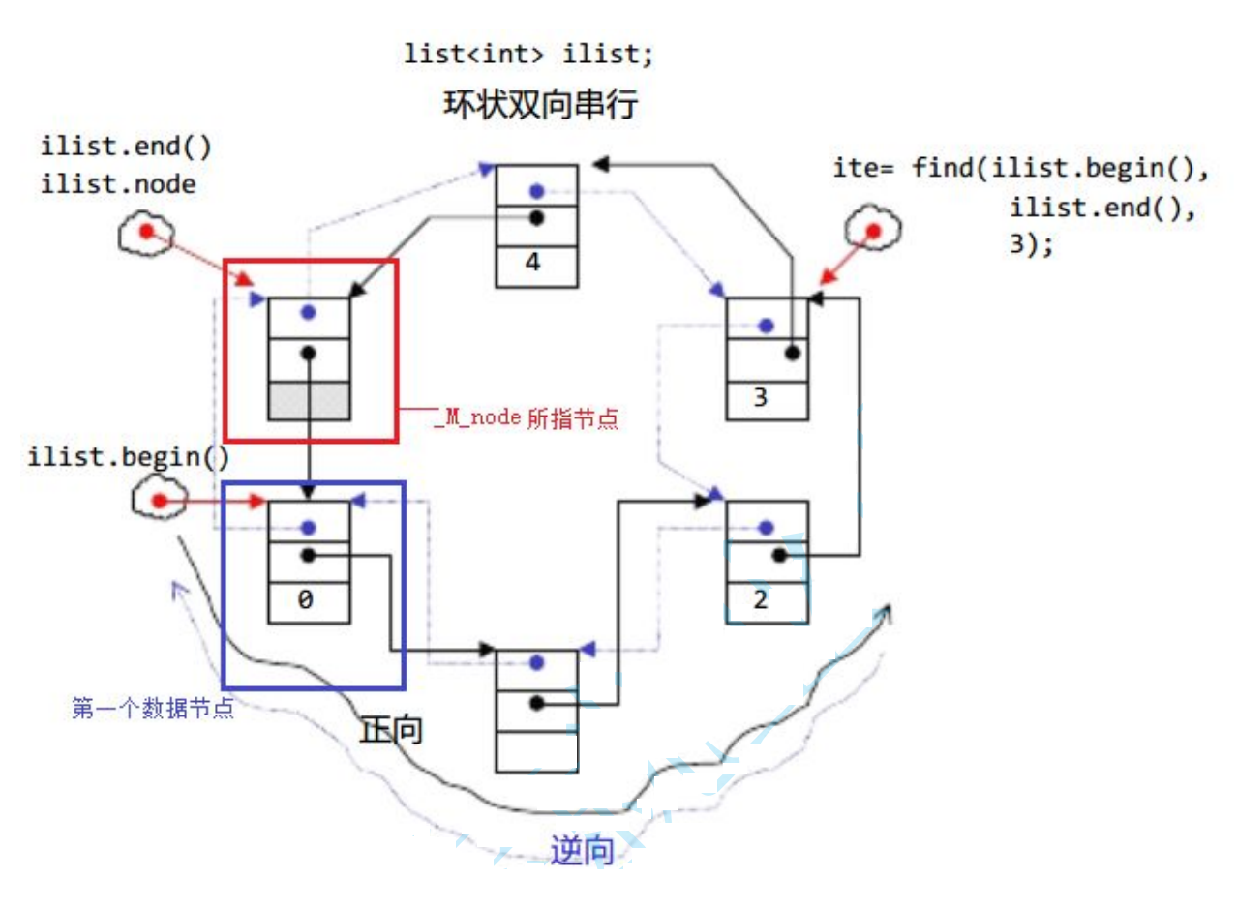
std::list是 C++ 标准模板库(STL)中双向链表 实现的线性容器 ------ 你可以把它理解为「一串首尾相连的节点」,每个节点包含数据、指向前一个节点的指针和指向后一个节点的指针。它和std::vector(数组实现)是 STL 中最常用的线性容器,但设计目标完全不同:list主打任意位置的高效增删 ,而vector主打随机访问。
- std::list 的核心特性
特性 说明 双向链表结构 每个节点有 prev/next指针,支持向前 / 向后遍历,无连续内存要求无随机访问 不能通过索引(如 list[0])直接访问元素,需遍历才能找到目标位置高效增删 已知位置(迭代器)下,增删元素的时间复杂度为 O(1)(仅修改指针) 动态内存 元素按需分配 / 释放内存,无预分配 / 扩容开销(对比 vector 的扩容拷贝) 不支持容量预留 没有 reserve()方法,因为链表无需连续内存迭代器稳定性 增删元素时,除了被操作的节点,其他节点的迭代器 / 指针 / 引用都不会失效
1.2 list的使用
list 中的接口比较多,此处类似,只需要掌握如何正确的使用,然后再去深入研究背后的原理,已达到可扩展的能力。以下为list 中一些 常见的重要接口 。
1.2.1 list的构造
构造函数(constructor) 接口说明 list (size_type n, const value_type& val = value_type())构造的 list中包含n个值为val的元素(若未提供val,则使用类型默认值)list()构造空的 listlist (const list& x)拷贝构造函数,用已有的 list对象x初始化新的listlist (InputIterator first, InputIterator last)用迭代器区间 [first, last)中的元素构造list(左闭右开,包含first,不包含last)代码示例:
#include <iostream>
#include <list>
#include <vector>
int main() {
// 1. 空列表
std::list<int> l1;
// 2. 填充值构造
std::list<int> l2(3, 100);
// 3. 拷贝构造
std::list<int> l3(l2);
// 4. 迭代器区间构造(从vector初始化)
std::vector<int> v = {1,2,3,4};
std::list<int> l4(v.begin(), v.end());
// 打印验证
for (int x : l4) std::cout << x << " "; // 输出: 1 2 3 4
return 0;
}
1.2.2 list iterator的使用
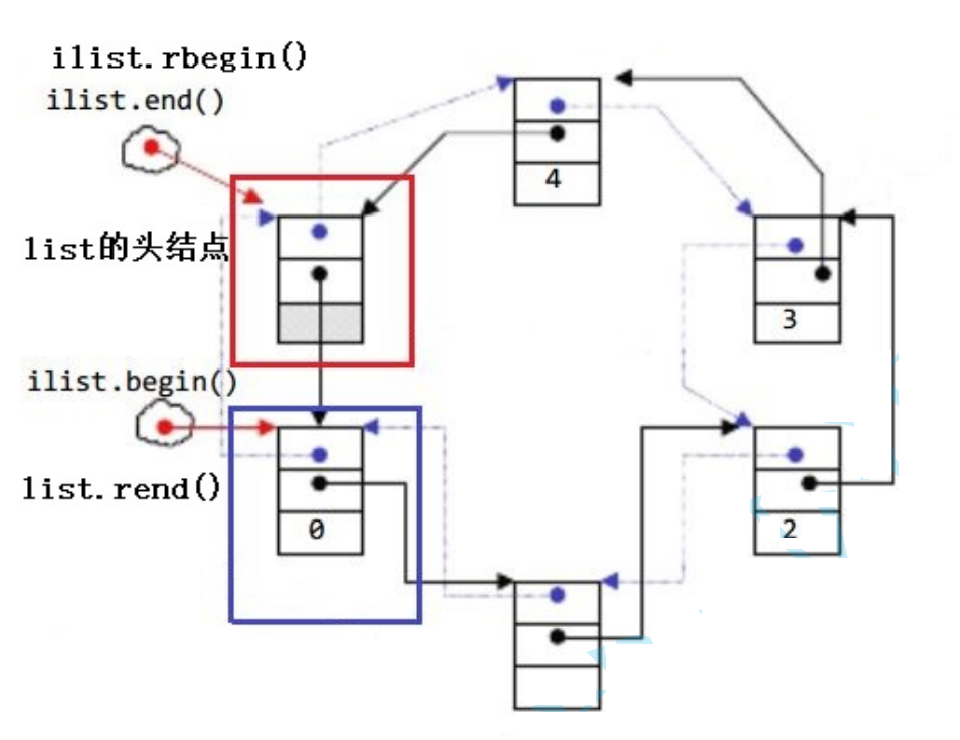
函数声明 接口说明 begin()+end()begin()返回指向第一个元素 的迭代器;end()返回指向最后一个元素下一个位置的迭代器(不指向有效元素,作为遍历结束标记)rbegin()+rend()rbegin()返回指向最后一个元素 的反向迭代器;rend()返回指向第一个元素前一个位置的反向迭代器(反向遍历结束标记)
【注意】
- begin 与 end 为正向迭代器,对迭代器执行 ++ 操作,迭代器向后移动
- rbegin(end) 与 rend(begin) 为反向迭代器,对迭代器执行 ++ 操作,迭代器向前移动
代码示例:
#include <iostream>
#include <list>
using namespace std;
int main() {
// 1. 初始化 list
list<int> myList = {10, 20, 30, 40, 50};
// 2. 正向遍历(使用 begin() + end())
cout << "正向遍历: ";
for (auto it = myList.begin(); it != myList.end(); ++it) {
cout << *it << " "; // 解包迭代器获取元素值,10,20,30,40,50
}
cout << endl;
// 3. 反向遍历(使用 rbegin() + rend())
cout << "反向遍历: ";
for (auto it = myList.rbegin(); it != myList.rend(); ++it) {
cout << *it << " "; // 反向迭代器同样可以解包,50,40,30,20,10
}
cout << endl;
// 4. 利用迭代器修改元素
auto it = myList.begin();
++it; // 移动到第二个元素(20)
*it = 200; // 修改该元素值
cout << "修改后正向遍历: ";
for (int num : myList) { // 范围for循环底层也是迭代器
cout << num << " ";
}
cout << endl;
return 0;
}
1.2.3 list capacity
函数声明 接口说明 empty()检测 list是否为空,是返回true,否则返回falsesize()返回 list中有效节点的个数代码示例:
#include <iostream>
#include <list>
using namespace std;
int main() {
list<int> l;
// 初始状态:空列表
cout << "是否为空: " << (l.empty() ? "是" : "否") << endl;
cout << "元素个数: " << l.size() << endl;
// 添加元素
l.push_back(1);
l.push_back(2);
l.push_back(3);
cout << "添加元素后是否为空: " << (l.empty() ? "是" : "否") << endl;
cout << "添加元素后元素个数: " << l.size() << endl;
// 删除一个元素
l.pop_back();
cout << "删除后元素个数: " << l.size() << endl;
// 清空列表
l.clear();
cout << "清空后是否为空: " << (l.empty() ? "是" : "否") << endl;
cout << "清空后元素个数: " << l.size() << endl;
return 0;
}
1.2.4 list element access
函数声明 接口说明 front()返回 list的第一个节点中值的引用back()返回 list的最后一个节点中值的引用代码示例:
#include <iostream>
#include <list>
using namespace std;
int main() {
list<int> l = {10, 20, 30, 40, 50};
// 访问首尾元素
cout << "第一个元素: " << l.front() << endl;//10
cout << "最后一个元素: " << l.back() << endl;//50
// 修改首尾元素(因为返回的是引用)
l.front() = 100;
l.back() = 500;
cout << "修改后第一个元素: " << l.front() << endl;//100
cout << "修改后最后一个元素: " << l.back() << endl;//500
// 遍历验证
cout << "遍历所有元素: ";
for (int num : l) {
cout << num << " ";//100 20 30 40 500
}
cout << endl;
return 0;
}
1.2.5 list modifiers
函数声明 接口说明 push_front在 list首元素前插入值为val的元素pop_front删除 list中第一个元素push_back在 list尾部插入值为val的元素pop_back删除 list中最后一个元素insert在 listposition位置插入值为val的元素erase删除 listposition位置的元素swap交换两个 list中的元素clear清空 list中的有效元素代码示例:
#include <iostream>
#include <list>
using namespace std;// 辅助函数:打印 list
void printList(const list<int>& l, const string& desc) {
cout << desc << ": ";
for (int num : l) {
cout << num << " ";
}
cout << endl;
}int main() {
list<int> l1;// 1. 首尾插入
l1.push_back(10); // 尾部插入 10
l1.push_front(20); // 头部插入 20
printList(l1, "push_back/push_front 后");//push_back/push_front 后: 20 10// 2. 首尾删除
l1.pop_back(); // 删除尾部
l1.pop_front(); // 删除头部
printList(l1, "pop_back/pop_front 后");// 3. 重新填充数据
l1.push_back(30);
l1.push_back(40);
l1.push_back(50);
printList(l1, "重新填充后");//重新填充后: 30 40 50// 4. insert 插入(在第二个位置插入 35)
auto it = l1.begin();
++it; // 移动到第二个元素(40)之前
l1.insert(it, 35);
printList(l1, "insert 插入 35 后");//insert 插入 35 后: 30 35 40 50// 5. erase 删除(删除刚才插入的 35)
--it; // 回到 35 的位置
l1.erase(it);
printList(l1, "erase 删除 35 后");//erase 删除 35 后: 30 40 50// 6. swap 交换两个 list
list<int> l2 = {100, 200, 300};
l1.swap(l2);
printList(l1, "swap 后 l1");//swap 后 l1: 100 200 300
printList(l2, "swap 后 l2");//swap 后 l2: 30 40 50// 7. clear 清空
l1.clear();
printList(l1, "clear 后 l1");return 0;
}
1.2.6 list的迭代器失效
前面说过,此处大家可将迭代器暂时理解成类似于指针, 迭代器失效即迭代器所指向的节点的无 效,即该节点被删除了 。因为 list 的底层结构为带头结点的双向循环链表 ,因此 在 list 中进行插入 时是不会导致 list 的迭代器失效的,只有在删除时才会失效,并且失效的只是指向被删除节点的迭 代器,其他迭代器不会受到影响 。
void TestListIterator1 ()
{
int array \[\] = { 1 , 2 , 3 , 4 , 5 , 6 , 7 , 8 , 9 , 0 };
list < int > l ( array , array + sizeof ( array ) / sizeof ( array 0 ));
auto it = l . begin ();
while ( it != l . end ())
{
// erase()函数执行后,it 所指向的节点已被删除,因此 it 无效,在下一次使用 it 时,必须先给其赋值
l . erase ( it );
++ it ;
}
}
// 改正
void TestListIterator ()
{
int array \[\] = { 1 , 2 , 3 , 4 , 5 , 6 , 7 , 8 , 9 , 0 };
list < int > l ( array , array + sizeof ( array ) / sizeof ( array 0 ));
auto it = l . begin ();
while ( it != l . end ())
{
l . erase ( it ++ ); // it = l.erase(it);
}
}
写法 1(l.erase(it++)) :后置++的特性是「先返回it的旧值(传给erase),再将it移动到下一个节点」。此时erase销毁的是旧值指向的节点,而it已经提前移动到了下一个有效节点,避免失效。写法 2(
it = l.erase(it)) :list::erase的返回值是「被删除节点的下一个有效迭代器」,直接用这个返回值更新it,逻辑更清晰,是工业界推荐写法。
2. list的模拟实现
2.1 模拟实现list
#pragma once
#include<assert.h>//惯例
//如果一个类全部公有用struct
namespace bit
{
template<class T>
struct list_node
{
T _data;
list_node<T>* _next;
list_node<T>* _prev;list_node(const T& x = T())
:_data(x)
, _next(nullptr)
, _prev(nullptr)
{}
};//typedef list_iterator<T, T&, T*> iterator;
//typedef list_iterator<T, const T&, const T*> const_iterator;
//T:迭代器指向的节点数据类型(比如int/string/ 自定义类型);//Ref:解引用(
operator*())返回值的类型(T&或const T&,控制是否可修改数据);//
Ptr:箭头访问(operator->())返回值的类型(T*或const T*,控制指针访问权限);
template<class T,class Ref,class Ptr>
struct list_iterator
{
typedef list_node<T> Node;//链表节点类型起别名Node
typedef list_iterator<T,Ref,Ptr> Self;//迭代器类型list_iterator<T, Ref, Ptr>起别名Self
Node* _node;list_iterator(Node* node)
:_node(node)
{}//解引用(获取节点数据)
Ref operator*()
{
return _node->_data;
}//箭头访问(针对自定义类型)
Ptr operator->()
{
return &_node->_data;
}//前置,迭代器后移(指向后继节点)
Self& operator++()
{
_node = _node->_next;
return *this;
}//迭代器前移(指向前驱节点)
Self& operator--()
{
_node = _node->_prev;
return *this;
}//后置,迭代器后移(先返回旧值)
Self operator++(int)
{
Self tmp(*this);
_node = _node->_next;
return tmp;
}//迭代器前移(先返回旧值)
Self operator--(int)
{
Self tmp(*this);
_node = _node->_prev;
return tmp;
}bool operator!=(const Self& s)
{
return _node != s._node;
}bool operator==(const Self& s)
{
return _node == s._node;
}
};template<class T>
class list
{
typedef list_node<T> Node;
public:
/*typedef list_iterator<T> iterator;
typedef list_const_iterator<T> const_iterator;*/typedef list_iterator<T, T&, T*> iterator;//可写迭代器
typedef list_iterator<T, const T&, const T*> const_iterator;//只读迭代器iterator begin()
{
return iterator(_head->_next);
}iterator end()
{
return iterator(_head);
}const_iterator begin() const
{
return const_iterator(_head->_next);
}const_iterator end() const
{
return const_iterator(_head);
}void empty_init()
{
_head = new Node();
_head->_next = _head;
_head->_prev = _head;
_size = 0;
}list()
{
empty_init();
}//lt2(lt1),拷贝构造
list(const list<T>& lt)
{
empty_init();
for (auto& e : lt)
{
push_back(e);
}
}//lt2=lt3,赋值重载
list<T>& operator=(list<T> lt)
{
swap(lt);
return *this;
}~list()
{
clear();
delete _head;
_head = nullptr;
}void swap(list<T>& tmp)
{
std::swap(_head, tmp._head);
std::swap(_size, tmp._size);
}void clear()
{
auto it = begin();
while (it != end())
{
it = erase(it);
}
}//填充值构造函数
list(size_t n,const T& val = T())
{
empty_init();
for (size_t i = 0; i < n; i++)
{
push_back(val);
}
}void push_back(const T& x)
{
/*Node* new_node = new Node(x);
Node* tail = _head->_prev;tail->_next = new_node;
new_node->_prev = tail;new_node->_next = _head;
_head->_prev = new_node;*/
insert(end(), x);
}void push_front(const T& x)
{
insert(begin(), x);
}void pop_back()
{
erase(begin());
}void pop_front()
{
erase(--end());
}iterator insert(iterator pos, const T& val)
{
Node* cur = pos._node;
Node* newnode = new Node(val);
Node* prev = cur->_prev;prev->_next = newnode;
newnode->_prev = prev;newnode->_next = cur;
cur->_prev = newnode;
++_size;return iterator(newnode);
}iterator erase(iterator pos)
{
assert(pos != end());Node* del = pos._node;
Node* prev = del->_prev;
Node* next = del->_next;prev->_next = next;
next->_prev = prev;
delete del;
--_size;return iterator(next);
}private:
Node* _head;
size_t _size;
};//通用模板版本
template <class T>
void swap(T& a, T& b)
{
T c(a); a = b; b = c;
}//
list特化版本template <class T>
void swap(list<T>& a, list<T>& b)
{
a.swap(b);
}
}
2.2 list的反向迭代器
通过前面例子知道,反向迭代器的 ++ 就是正向迭代器的 -- ,反向迭代器的 -- 就是正向迭代器的 ++ ,因此反向迭代器的实现可以借助正向迭代器,即:反向迭代器内部可以包含一个正向迭代器,对正向迭代器的接口进行包装即可。
template < class Iterator >
class ReverseListIterator
{
// 注意:此处 typename 的作用是明确告诉编译器, Ref 是 Iterator 类中的类型,而不是静态
成员变量
// 否则编译器编译时就不知道 Ref 是 Iterator 中的类型还是静态成员变量
// 因为静态成员变量也是按照 类名 :: 静态成员变量名 的方式访问的
public :
typedef typename Iterator::Ref Ref ;
typedef typename Iterator::Ptr Ptr ;
typedef ReverseListIterator < Iterator > Self ;
public :
//////////////////////////////////////////////
// 构造
ReverseListIterator ( Iterator it ): _it ( it ){}
//////////////////////////////////////////////
// 具有指针类似行为
Ref operator * ()
{
Iterator temp ( _it );
-- temp ;
return * temp ;
}
Ptr operator -> () { return & ( operator * ());}
//////////////////////////////////////////////
// 迭代器支持移动
Self & operator ++ ()
{
-- _it ;
return * this ;
}
Self operator ++ ( int )
{
Self temp ( * this );
-- _it ;
return temp ;
}
Self & operator -- ()
{
++ _it ;
return * this ;
}
Self operator -- ( int )
{
Self temp ( * this );
++ _it ;
return temp ;
}
//////////////////////////////////////////////
// 迭代器支持比较
bool operator != ( const Self & l ) const { return _it != l . _it ;}
bool operator == ( const Self & l ) const { return _it != l . _it ;}
Iterator _it ;
};
3. list与vector的对比
vector 与 list 都是 STL 中非常重要的序列式容器,由于两个容器的底层结构不同,导致其特性以及应用场景不同,其主要不同如下:
维度 vectorlist底层结构 动态顺序表,一段连续空间 带头结点的双向循环链表 随机访问 支持随机访问,访问某个元素效率 O(1) 不支持随机访问,访问某个元素效率 O(N) 插入和删除 任意位置插入和删除效率低,需要搬移元素,时间复杂度为 O(N);插入时有可能需要扩容,开辟新空间、拷贝元素、释放旧空间,导致效率更低 任意位置插入和删除效率高,不需要搬移元素,时间复杂度为 O(1) 空间利用率 底层为连续空间,不容易造成内存碎片,空间利用率高,缓存利用率高 底层节点动态开辟,小节点容易造成内存碎片,空间利用率低,缓存利用率低 迭代器 原生态指针 对原生态指针(节点指针)进行封装 迭代器失效 插入元素时,可能导致重新扩容,使原来迭代器失效;删除时,当前迭代器需要重新赋值否则会失效 插入元素不会导致迭代器失效;删除元素时,只会导致当前迭代器失效,其他迭代器不受影响 使用场景 需要高效存储,支持随机访问,不关心插入删除效率 大量插入和删除操作,不关心随机访问 ✨ 一句话记忆口诀
- vector:连续存、随机读、增删慢、迭代器脆
- list:分散存、遍历读、增删快、迭代器稳