Leveraging edge artificial intelligence for sustainable agriculture
来自 <https://www.nature.com/articles/s41893-024-01352-4>
Abstract:
Effectively feeding a burgeoning world population is one of the main goals of sustainable agricultural practices. Digital technology, such as edge artificial intelligence (AI), has the potential to introduce substantial benefits to agriculture by enhancing farming practices that can improve agricultural production efficiency, yield, quality and safety. However, the adoption of edge AI faces several challenges,including the need for innovative and efficient edge AI solutions and greater investment in infrastructure and training , all compounded by various environmental, social and economic constraints. Here weprovide a roadmap for leveraging edge AI at the intersection of food production and sustainability.
Intro:
However, sustainable agriculture is facing three major challenges, making the realization of the required increase in food production difficult, if not unobtainable.
The first challenge relates to the resources required for the food production process itself. Increasing agricultural production comes at a cost to nature and the environment, with habitat loss, environmental damage and exploitation being important threats to ecosystems and biodiversity3. For example, over the past decade, the rate of conversion of natural forests into other land uses, including agricultural systems, was approximately 13 million hectares per year4. Crop genetic diversity has been eroded, and currently 80% of threats to mammal and bird extinction are due to agriculture5,6, although technology-based intensification of agriculture often results in a net saving of land areas7. Agricultural water use accounts for approximately 72% of all freshwater withdrawals globally8, which can lead to unsustainable water use in water-stressed regions and exacerbates food insecurity. Moreover, intensification of agriculture increases fossil-fuel-based energy consumption by about five times compared with low-input agriculture, with concerns over local energy access in a world exposed to recurrent polycrises9.
The second challenge is linked to external factors, which most often are beyond farmers' control. The challenges consist of (1) environmental factors such as climate variability and change, soil degradation and loss of agricultural land10 and (2) economic and political factors, including political instability, government restrictions and inflation. For example, changes in weather patterns and in the frequency and intensity of extreme climate events are being experienced increasingly in several regions worldwide11, resulting in noticeable agricultural losses, increases in infestation of pests and epidemics of diseases or emergence of new ones, not to mention the introduction of exotic pathogens, which can negatively impact agricultural production in new areas.
The third challenge is centred around the users and consumers. This consists of human habits such as overconsumption, food waste, varying food preferences and dietary restrictions among consumers, as well as their willingness or reluctance to pay for certain agricultural products or services12,13. In addition, there may be cultural or societal factors that impact the consumption patterns and habits of individuals in different regions, posing unique challenges for growers and agricultural commodities distributors14.
Results:
Fig. 1: The agrifood supply chain and applications of AI.
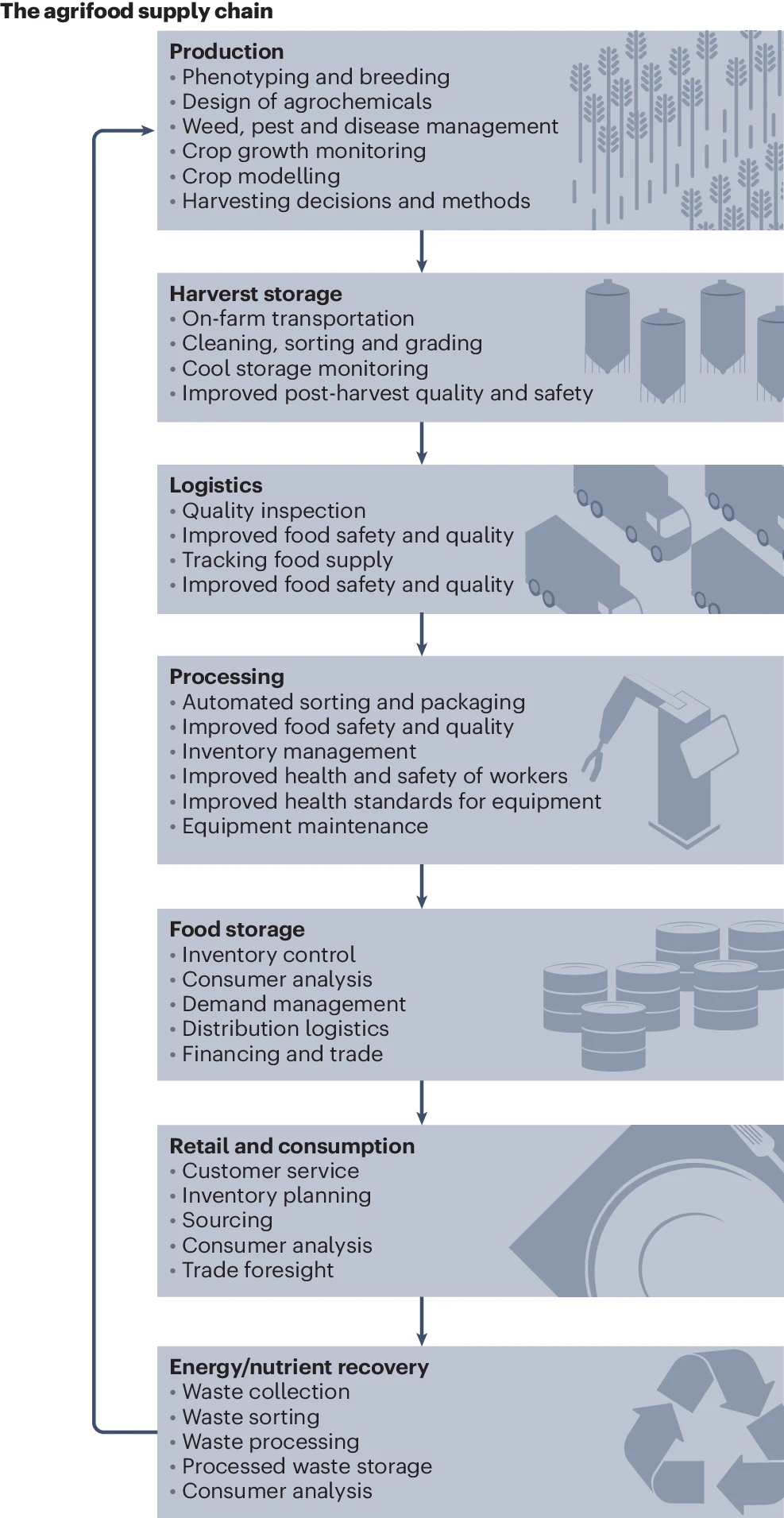
Fig. 2: History of AI deployment.
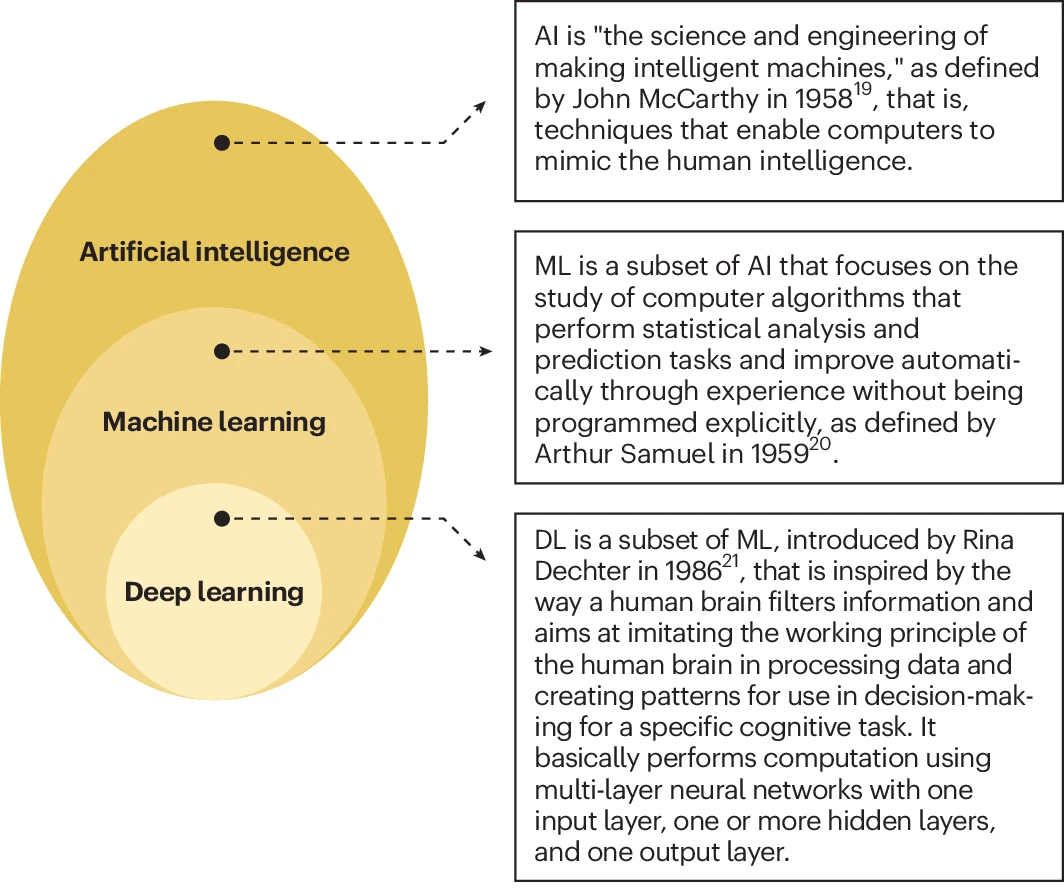
Fig. 3: The energy efficiencies (operations per watt) of state-of-the-art computing chips used for AI/DL applications.
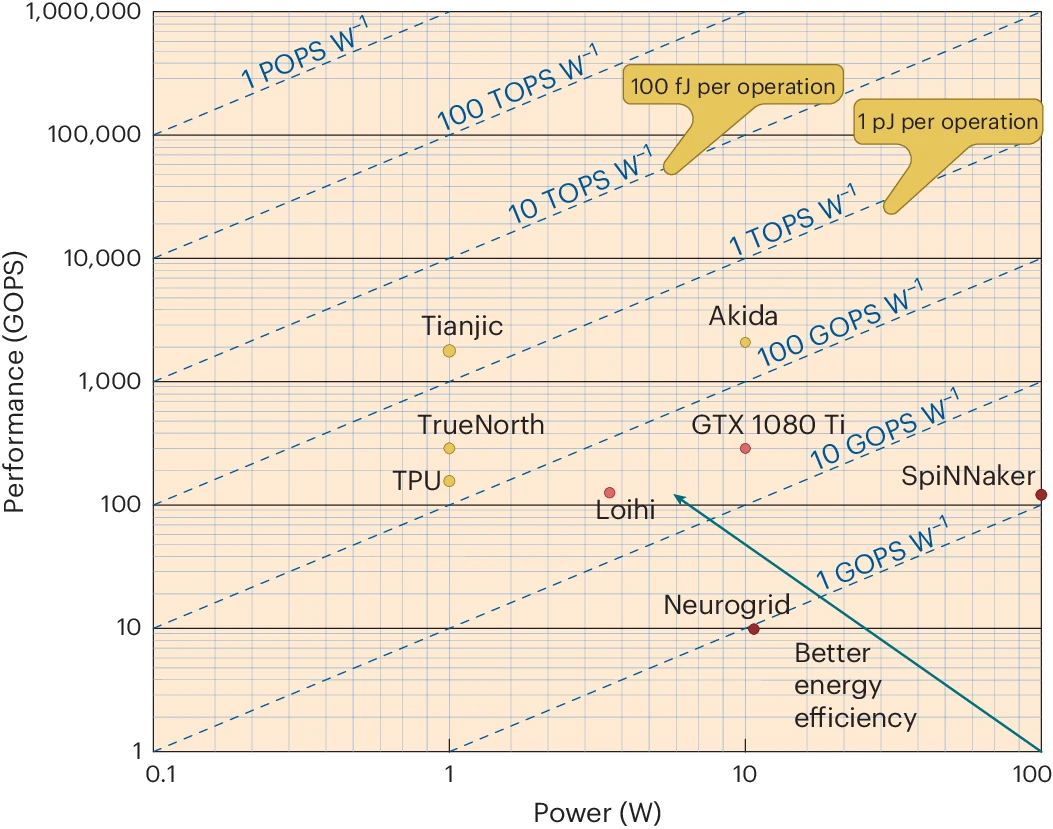
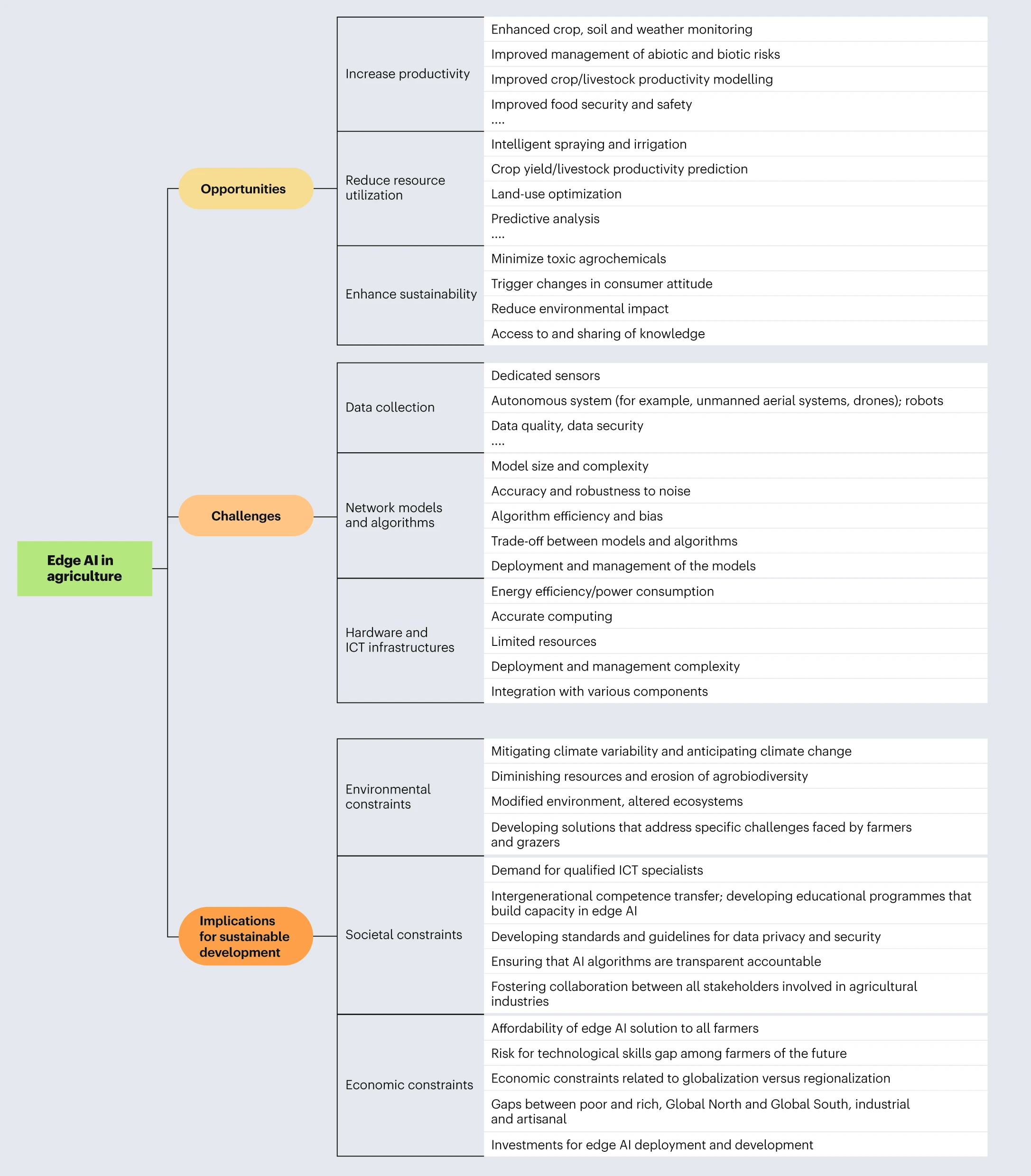
Fig. 4: Edge AI presents a range of opportunities, challenges and implications for sustainable agriculture.