CompletableFuture是Future接口的扩展和增强。CompletableFuture实现了Future接口,并在此基础上进行了丰富地扩展,完美地弥补了Future上述的种种问题。更为重要的是,CompletableFuture实现了对任务的编排能力。借助这项能力,我们可以轻松地组织不同任务的运行顺序、规则以及方式。
运用:
kotlin
public class CompletableFutureTest {

    public static void main(String[] args) throws Exception {
        //创建一个无输入值无返回值的异步子任务.
        CompletableFuture<Void> future = CompletableFuture.runAsync(() -> {
            try {
                Thread.sleep(1000);
                System.out.println("执行");
            } catch (InterruptedException e) {
                e.printStackTrace();
                System.out.println("运行结束");
            }
        });
        //等待异步任务执行完成.
        future.get(2, TimeUnit.SECONDS);

        //创建一个无输入有返回值的异步子任务.
        CompletableFuture<Long> future1 = CompletableFuture.supplyAsync(() -> {
            long start = System.currentTimeMillis();
            try {
                Thread.sleep(1000);
            } catch (InterruptedException e) {
                e.printStackTrace();
                System.out.println("运行结束");
            }
            return System.currentTimeMillis() - start;
        });
//        等待异步任务执行完成.
        Long aLong = future1.get(200, TimeUnit.SECONDS);
        System.out.println("异步执行耗时--" + aLong / 1000);
    }
}
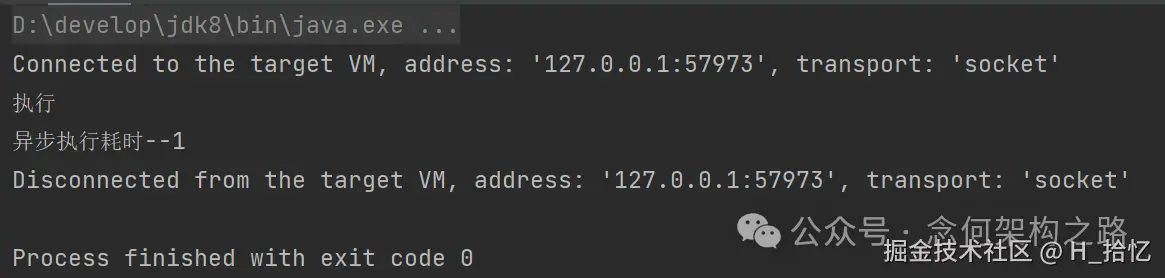
执行结果:
runAsync方法:
java
    /**
     * Returns a new CompletableFuture that is asynchronously completed
     * by a task running in the {@link ForkJoinPool#commonPool()} after
     * it runs the given action.
     *
     * @param runnable the action to run before completing the
     * returned CompletableFuture
     * @return the new CompletableFuture
     */
    public static CompletableFuture<Void> runAsync(Runnable runnable) {
        return asyncRunStage(asyncPool, runnable);
    }
runAsync方法理解:
1.传入的参数为一个Runnable类型.
2.asyncPool:默认使用的为ForkJoinPool.
asyncRunStage方法:
javascript
 static CompletableFuture<Void> asyncRunStage(Executor e, Runnable f) {
        if (f == null) throw new NullPointerException();
        CompletableFuture<Void> d = new CompletableFuture<Void>();
        e.execute(new AsyncRun(d, f));
        return d;
    }
asyncRunStage方法理解:
1:如果传入的任务为空,抛出空指针异常.
2.创建了一个CompletableFuture对象.
3.
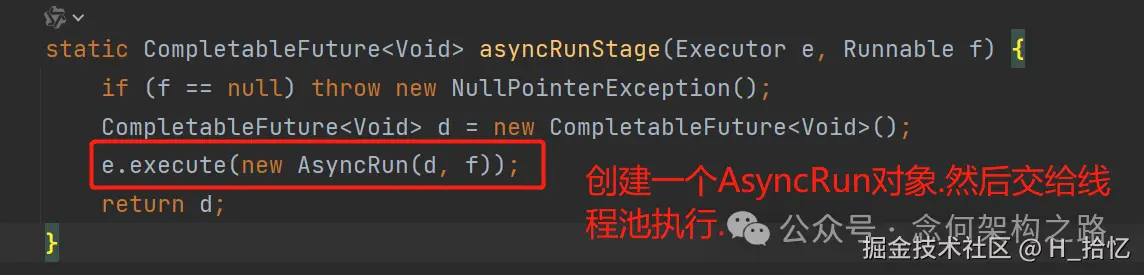
4.
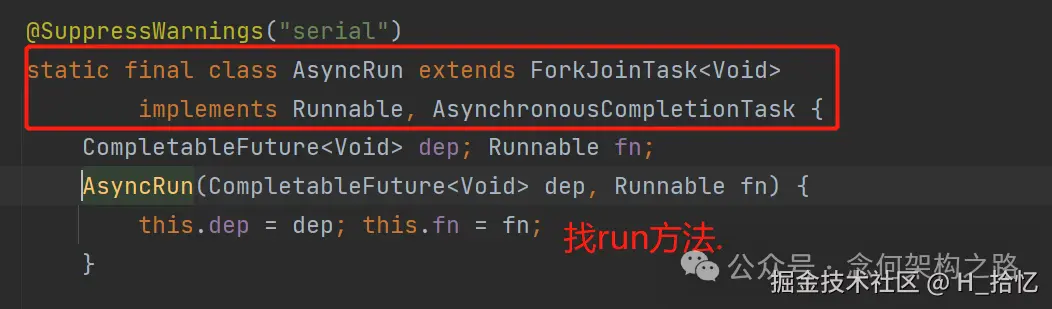
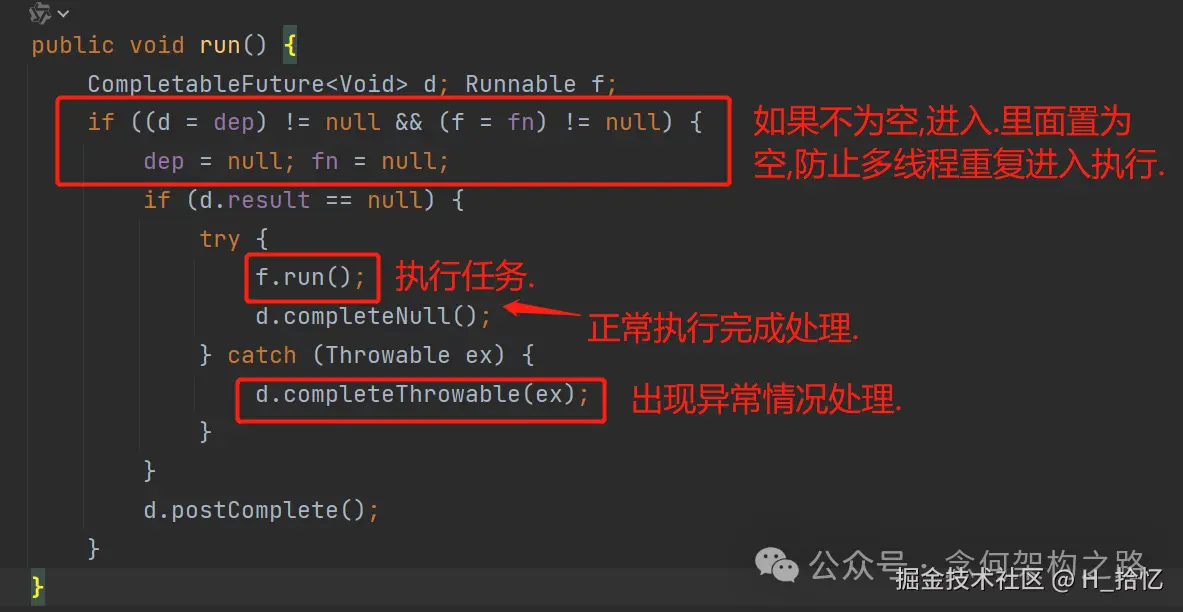
5.run方法
ini
   public void run() {
            CompletableFuture<Void> d; Runnable f;
            if ((d = dep) != null && (f = fn) != null) {
                dep = null; fn = null;
                if (d.result == null) {
                    try {
                        f.run();
                        d.completeNull();
                    } catch (Throwable ex) {
                        d.completeThrowable(ex);
                    }
                }
                d.postComplete();
            }
        }
6.
7.completeNull方法:
java
    /** Completes with the null value, unless already completed. */
    final boolean completeNull() {
        return UNSAFE.compareAndSwapObject(this, RESULT, null,
                                           NIL);
    }

        /** The encoding of the null value. */
    static final AltResult NIL = new AltResult(null);
通过cas操作,把result值从null值赋值为nil.
8.completeThrowable方法:
php
    /** Completes with an exceptional result, unless already completed. */
    final boolean completeThrowable(Throwable x) {
        return UNSAFE.compareAndSwapObject(this, RESULT, null,
                                           encodeThrowable(x));
    }

        /**
     * Returns the encoding of the given (non-null) exception as a
     * wrapped CompletionException unless it is one already.
     */
    static AltResult encodeThrowable(Throwable x) {
        return new AltResult((x instanceof CompletionException) ? x :
                             new CompletionException(x));
    }

        /**
     * Constructs a {@code CompletionException} with the specified cause.
     * The detail message is set to {@code (cause == null ? null :
     * cause.toString())} (which typically contains the class and
     * detail message of {@code cause}).
     *
     * @param  cause the cause (which is saved for later retrieval by the
     *         {@link #getCause()} method)
     */
    public CompletionException(Throwable cause) {
        super(cause);
    }
如果执行出现异常,就把异常包装一下放入到result中.
9.postComplete方法:
这个涉及到了链式调用.讲后面方法的时候在详细讲.
get方法:
java
    /**
     * Waits if necessary for at most the given time for this future
     * to complete, and then returns its result, if available.
     *
     * @param timeout the maximum time to wait
     * @param unit the time unit of the timeout argument
     * @return the result value
     * @throws CancellationException if this future was cancelled
     * @throws ExecutionException if this future completed exceptionally
     * @throws InterruptedException if the current thread was interrupted
     * while waiting
     * @throws TimeoutException if the wait timed out
     */
    public T get(long timeout, TimeUnit unit)
        throws InterruptedException, ExecutionException, TimeoutException {
        Object r;
        long nanos = unit.toNanos(timeout);
        return reportGet((r = result) == null ? timedGet(nanos) : r);
    }
get方法理解:
1.
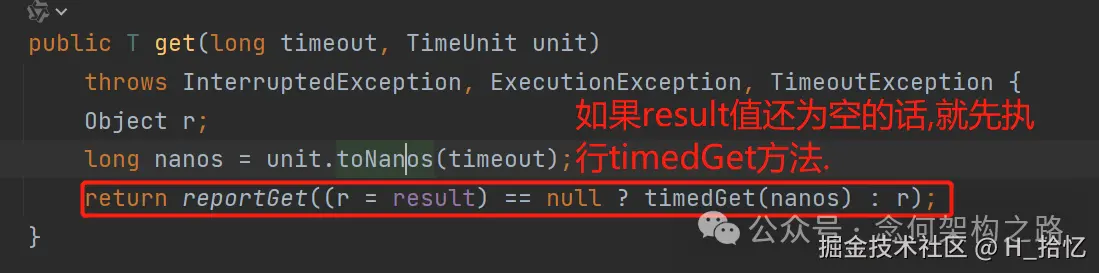
timedGet方法:
ini
    /**
     * Returns raw result after waiting, or null if interrupted, or
     * throws TimeoutException on timeout.
     */
    private Object timedGet(long nanos) throws TimeoutException {
        if (Thread.interrupted())
            return null;
        if (nanos <= 0L)
            throw new TimeoutException();
        long d = System.nanoTime() + nanos;
        Signaller q = new Signaller(true, nanos, d == 0L ? 1L : d); // avoid 0
        boolean queued = false;
        Object r;
        // We intentionally don't spin here (as waitingGet does) because
        // the call to nanoTime() above acts much like a spin.
        while ((r = result) == null) {
            if (!queued)
                queued = tryPushStack(q);
            else if (q.interruptControl < 0 || q.nanos <= 0L) {
                q.thread = null;
                cleanStack();
                if (q.interruptControl < 0)
                    return null;
                throw new TimeoutException();
            }
            else if (q.thread != null && result == null) {
                try {
                    ForkJoinPool.managedBlock(q);
                } catch (InterruptedException ie) {
                    q.interruptControl = -1;
                }
            }
        }
        if (q.interruptControl < 0)
            r = null;
        q.thread = null;
        postComplete();
        return r;
    }
2.
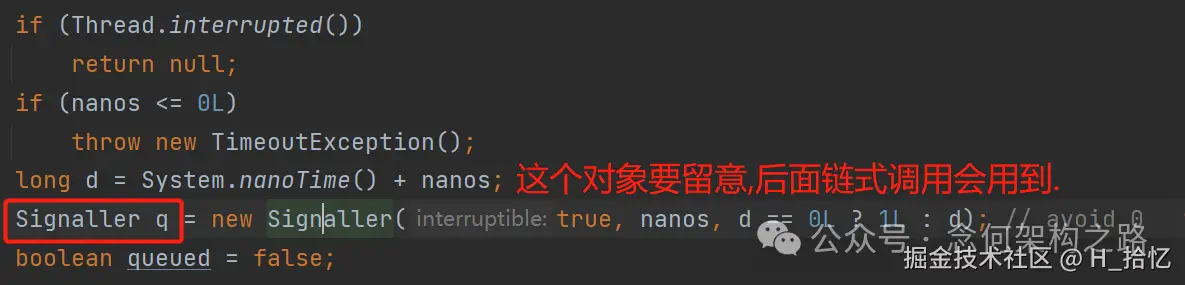
3.Signaller构造方法:
ini
 Signaller(boolean interruptible, long nanos, long deadline) {
            this.thread = Thread.currentThread();
            this.interruptControl = interruptible ? 1 : 0;
            this.nanos = nanos;
            this.deadline = deadline;
        }
4.
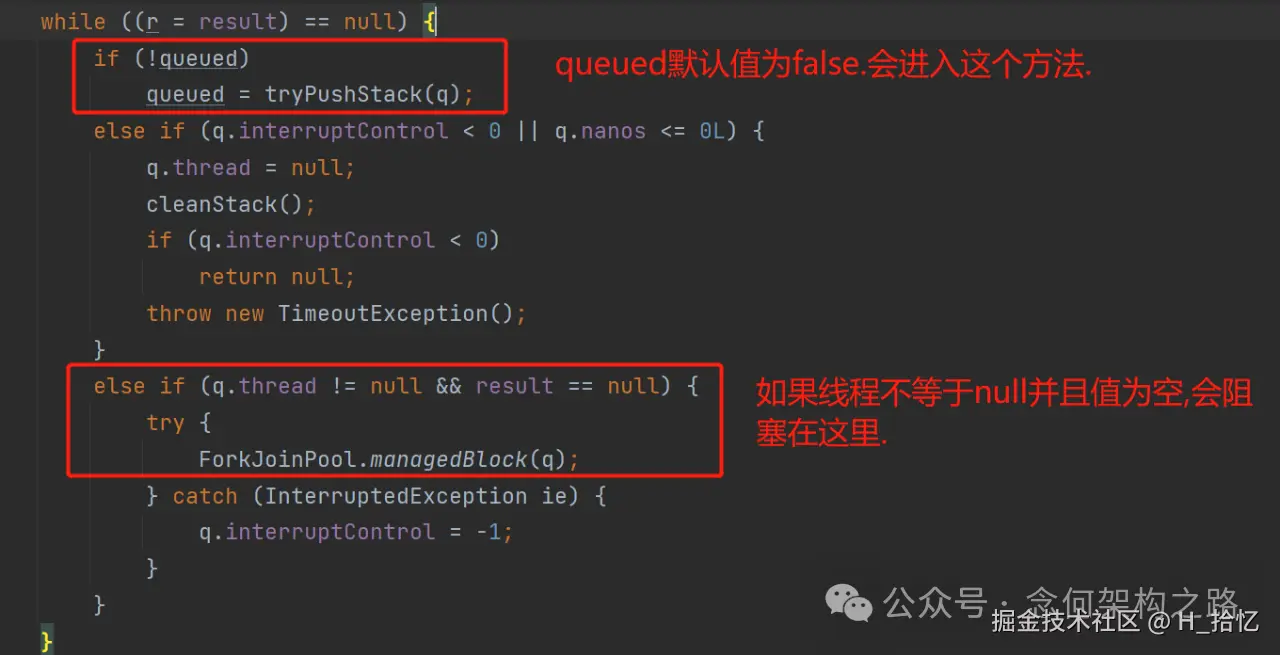
5.tryPushStack方法:
arduino
    /** Returns true if successfully pushed c onto stack. */
    final boolean tryPushStack(Completion c) {
        Completion h = stack;
        lazySetNext(c, h);
        return UNSAFE.compareAndSwapObject(this, STACK, h, c);
    }
把stack值设置为c.也就是我们创建的signaller对象.
6.ForkJoinPool.managedBlock(q)方法:
java
    /**
     * Runs the given possibly blocking task.  When {@linkplain
     * ForkJoinTask#inForkJoinPool() running in a ForkJoinPool}, this
     * method possibly arranges for a spare thread to be activated if
     * necessary to ensure sufficient parallelism while the current
     * thread is blocked in {@link ManagedBlocker#block blocker.block()}.
     *
     * <p>This method repeatedly calls {@code blocker.isReleasable()} and
     * {@code blocker.block()} until either method returns {@code true}.
     * Every call to {@code blocker.block()} is preceded by a call to
     * {@code blocker.isReleasable()} that returned {@code false}.
     *
     * <p>If not running in a ForkJoinPool, this method is
     * behaviorally equivalent to
     *  <pre> {@code
     * while (!blocker.isReleasable())
     *   if (blocker.block())
     *     break;}</pre>
     *
     * If running in a ForkJoinPool, the pool may first be expanded to
     * ensure sufficient parallelism available during the call to
     * {@code blocker.block()}.
     *
     * @param blocker the blocker task
     * @throws InterruptedException if {@code blocker.block()} did so
     */
    public static void managedBlock(ManagedBlocker blocker)
        throws InterruptedException {
        ForkJoinPool p;
        ForkJoinWorkerThread wt;
        Thread t = Thread.currentThread();
        if ((t instanceof ForkJoinWorkerThread) &&
            (p = (wt = (ForkJoinWorkerThread)t).pool) != null) {
            WorkQueue w = wt.workQueue;
            while (!blocker.isReleasable()) {
                if (p.tryCompensate(w)) {
                    try {
                        do {} while (!blocker.isReleasable() &&
                                     !blocker.block());
                    } finally {
                        U.getAndAddLong(p, CTL, AC_UNIT);
                    }
                    break;
                }
            }
        }
        else {
            do {} while (!blocker.isReleasable() &&
                         !blocker.block());
        }
    }
7.
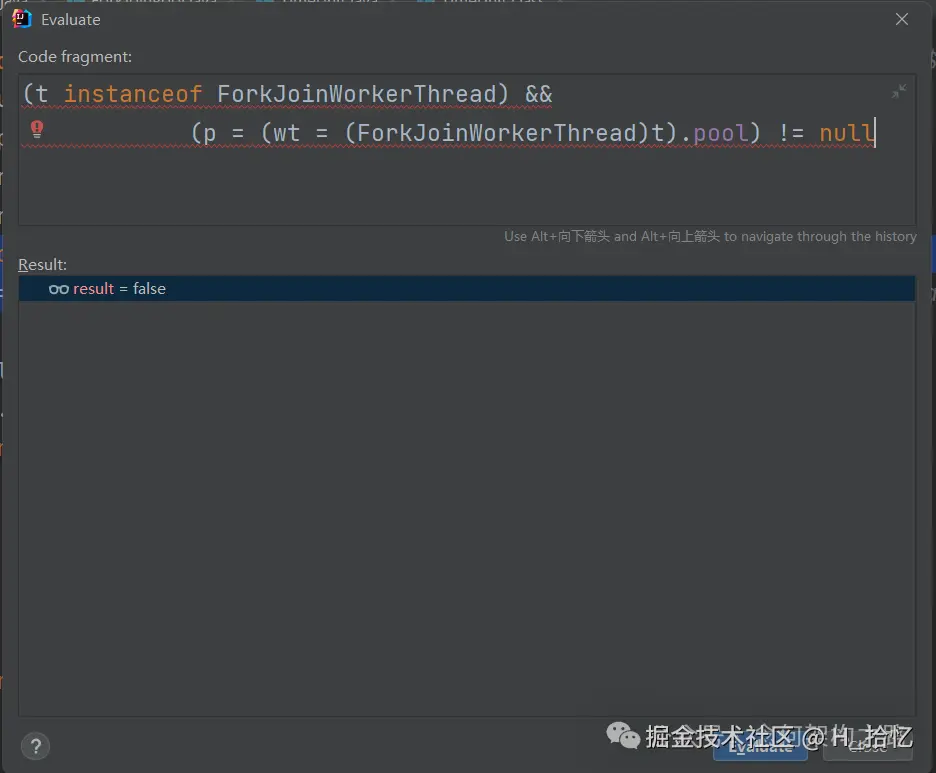
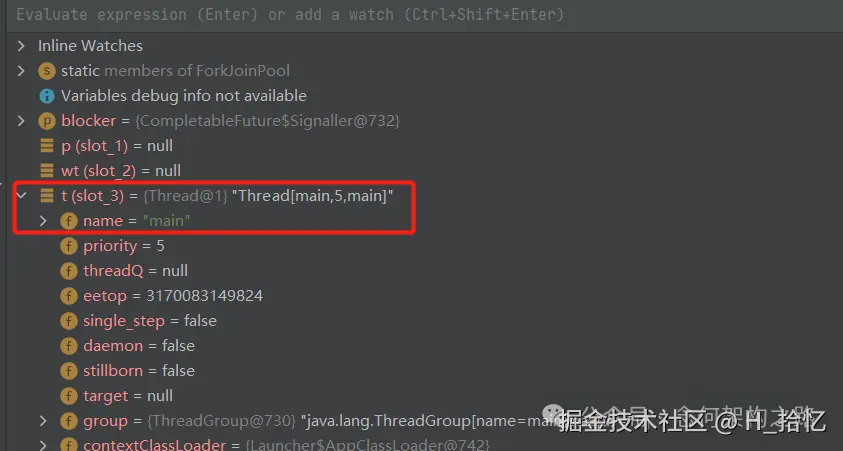
因为是主线程,不是forkjoinPool的线程.所以直接进入doWhile逻辑.
8.blocker.isReleasable()方法:
ini
  public boolean isReleasable() {
            if (thread == null)
                return true;
            if (Thread.interrupted()) {
                int i = interruptControl;
                interruptControl = -1;
                if (i > 0)
                    return true;
            }
            if (deadline != 0L &&
                (nanos <= 0L || (nanos = deadline - System.nanoTime()) <= 0L)) {
                thread = null;
                return true;
            }
            return false;
        }
因为我们没有设置那些值什么的,并且线程为主线程.所以会返回false.
9.blocker.block()方法:
kotlin
 public boolean block() {
            if (isReleasable())
                return true;
            else if (deadline == 0L)
                LockSupport.park(this);
            else if (nanos > 0L)
                LockSupport.parkNanos(this, nanos);
            return isReleasable();
        }
看到了park方法.所以会阻塞在这里.等待forkJoinPool执行完任务唤醒.
10.reportGet方法:
java
    /**
     * Reports result using Future.get conventions.
     */
    private static <T> T reportGet(Object r)
        throws InterruptedException, ExecutionException {
        if (r == null) // by convention below, null means interrupted
            throw new InterruptedException();
        if (r instanceof AltResult) {
            Throwable x, cause;
            if ((x = ((AltResult)r).ex) == null)
                return null;
            if (x instanceof CancellationException)
                throw (CancellationException)x;
            if ((x instanceof CompletionException) &&
                (cause = x.getCause()) != null)
                x = cause;
            throw new ExecutionException(x);
        }
        @SuppressWarnings("unchecked") T t = (T) r;
        return t;
    }
11.
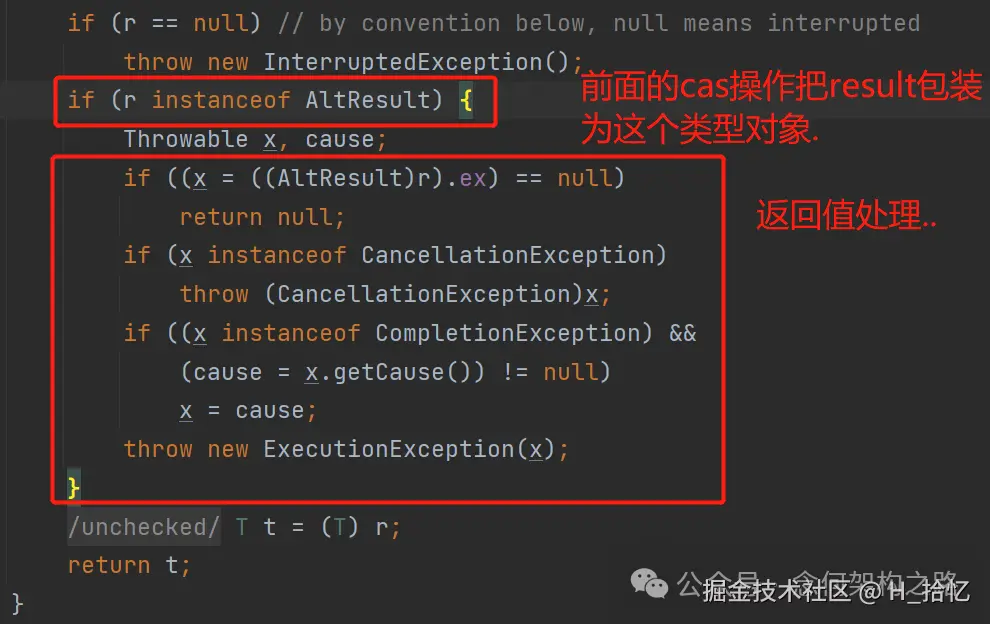
这就是无返回值的流程.
supplyAsync方法:
java
    /**
     * Returns a new CompletableFuture that is asynchronously completed
     * by a task running in the {@link ForkJoinPool#commonPool()} with
     * the value obtained by calling the given Supplier.
     *
     * @param supplier a function returning the value to be used
     * to complete the returned CompletableFuture
     * @param <U> the function's return type
     * @return the new CompletableFuture
     */
    public static <U> CompletableFuture<U> supplyAsync(Supplier<U> supplier) {
        return asyncSupplyStage(asyncPool, supplier);
    }
supplyAsync方法理解:
1.Supplier函数式接口:
vbnet
/**
 * Represents a supplier of results.
 *
 * <p>There is no requirement that a new or distinct result be returned each
 * time the supplier is invoked.
 *
 * <p>This is a <a href="package-summary.html">functional interface</a>
 * whose functional method is {@link #get()}.
 *
 * @param <T> the type of results supplied by this supplier
 *
 * @since 1.8
 */
@FunctionalInterface
public interface Supplier<T> {

    /**
     * Gets a result.
     *
     * @return a result
     */
    T get();
}
2.asyncSupplyStage方法:
javascript
 static <U> CompletableFuture<U> asyncSupplyStage(Executor e,
                                                     Supplier<U> f) {
        if (f == null) throw new NullPointerException();
        CompletableFuture<U> d = new CompletableFuture<U>();
        e.execute(new AsyncSupply<U>(d, f));
        return d;
    }
看到这个方法,老套路,直接找AsyncSupply对象的run方法.
3.run方法:
csharp
public void run() {
            CompletableFuture<T> d; Supplier<T> f;
            if ((d = dep) != null && (f = fn) != null) {
                dep = null; fn = null;
                if (d.result == null) {
                    try {
                        d.completeValue(f.get());
                    } catch (Throwable ex) {
                        d.completeThrowable(ex);
                    }
                }
                d.postComplete();
            }
        }
都是通过cas操作去设置发生异常的值或者返回值.completeValue方法和completeThrowable方法小伙伴们自己看下吧.
get方法可以参考上面无返回值的.