在 github 看到一个项目 all-agentic-architectures,实现的是关于 17 种 Agent 模式大全,我把 all-agentic-architectures 这个项目完整过了一遍。
它最有价值的地方,不是列了 17 中 Agent 代码,而是把 17 次系统升级拆解:上一个架构为什么不够、下一个架构到底多了什么控制能力、复杂度又是从哪里开始失控的。 这些信息真正决定一个 agent 系统能不能落地的,通常不是模型回答是不是够好,而是:
- 状态有没有被正确建模
- 控制流有没有被显式表达
- 错误能不能被局部截断
- 副作用能不能被关进闸门
- 系统知不知道自己什么时候该停
不过 all-agentic-architectures 是用 langchain 和 langgraph 实现的,但是 agno 框架更加简洁,于是 用 agno 把这 17 种控制流从头写一遍。
为了说明一件事:
Agent architecture 的本质不是 prompt engineering,也不是某个框架的 DSL,而是控制流设计。 它应该能在任何体面的 agent 框架里复现,以下是 Agent 演化路径:
- 从单次生成 到反思闭环
- 从反思闭环 到工具交互
- 从工具交互 到观察-行动循环
- 从局部决策 到显式规划
- 从无验证执行 到验证驱动重规划
- 从单 agent 到多 agent 编排
- 从短期上下文 到长期记忆系统
- 从线性推理 到搜索、模拟与涌现计算
- 从能做事 到可信任
总演化图:

1. 统一分析框架
后面每一种架构,我都会用同一套问题来拆。
六个固定问题
- 它要解决什么问题? 上一代架构哪里不够。
- 它的 State 是什么? 新增了哪些字段,为什么必须存在。
- 它的拓扑是什么? 线性链、循环、分叉汇聚、共享黑板、树搜索还是网格涌现。
- 它的 Router 怎么工作? 固定边、条件边、动态调度、验证回路、人工审批。
- 它的失败模式是什么? 架构最容易在哪个环节坏掉。
- 什么时候该升级到下一种? 当前模式的能力边界在哪里。
2. 用 agno 看 Agent
这个项目几乎所有架构都能被 agno 的几个抽象表达清楚:
ini
from agno.agent import Agent
from agno.models.openai import OpenAIChat
from agno.workflow.v2 import Workflow, Step, Router, Loop

# 一个最简 Agent = 一次状态变换
agent = Agent(
    model=OpenAIChat(id="gpt-5-mini"),
    tools=[...],
    instructions="...",
    response_model=SomePydanticModel,  # 结构化输出
)

# 一个 Workflow = 显式控制流
wf = Workflow(
    name="my_flow",
    steps=[
        Step(name="plan", agent=planner_agent),
        Loop(
            name="execute_and_verify",
            steps=[executor_step, verifier_step],
            end_condition=lambda outputs: outputs[-1].content.is_done,
        ),
        Step(name="synthesize", agent=synthesizer_agent),
    ],
)
wf.run(message="...")
这段代码背后已经包含了一个 agent 系统的最小数学结构:
response_model定义状态空间Agent / tools / Step函数定义状态变换steps列表定义确定性转移Router / Condition定义条件转移Loop.end_condition定义终止条件wf.run()定义可执行系统
后面我几乎不把问题描述成"这个架构更聪明",而描述成:它新增了什么状态字段、什么 agent 或工具、什么路由逻辑、什么验证机制。
3. 总览:逐步添加控制能力
| 阶段 | 新增能力 | 一句话解释 | 代表架构 |
|---|---|---|---|
| 单次生成优化 | critique pass | 让模型先出一版,再自己挑毛病改掉,把"生成"拆成 generator + critic + refiner 三步。 | Reflection |
| 与世界交互 | tool interface | 把外部 API / 函数挂成结构化工具接口,打破参数知识边界和上下文封闭性。 | Tool Use |
| 基于观察持续行动 | observation loop | Thought → Action → Observation 滚动循环,上一步的观察决定下一步的动作。 | ReAct |
| 先生成控制流再执行 | explicit planning | 先让模型产出一份可检视的步骤清单(plan),再按清单逐步执行,把控制流本身做成可审计对象。 | Planning |
| 把验证接入主回路 | verification loop | 每一步执行完都强制过一次 verifier,失败就回到重规划,而不是把验证当成事后检查。 | PEV |
| 把认知任务拆成角色 | role decomposition | 不再让一个 agent 什么都干,把研究员 / 写作 / 审阅等角色拆开,用流水线或图把它们串起来。 | Multi-Agent |
| 把中间状态显式共享 | shared workspace | 把中间产物写到一块共享"黑板"上,一个 controller 根据黑板当前状态动态决定下一个该谁上场。 | Blackboard |
| 把入口做成路由系统 | entry routing | 在请求入口先分类一次,把任务路由到最合适的专家子 agent,避免一个 agent 背所有能力。 | Meta-Controller |
| 用冗余换可靠性 | parallel redundancy | 同一个问题同时交给多个独立 agent 处理,再由 aggregator 融合/投票,用冗余换稳定性和去偏。 | Ensemble |
| 把历史状态纳入系统 | long-term memory | 把对话片段放进向量库(episodic),把结构化事实放进图/KV(semantic),让系统记得住、查得到。 | Episodic + Semantic / Graph |
| 把推理变成搜索 | search tree | 不再是一条思路走到底,而是展开多条思路形成树,边展开边打分、剪枝,把"推理"变成"搜索"。 | ToT |
| 把行动前评估做成模拟 | counterfactual execution | 真正动手之前,先在内部世界模型里预演一遍,评估风险和收益,再决定是否真执行。 | Mental Loop |
| 把副作用关进闸门 | side-effect gating | 任何有副作用的动作必须先 dry-run + 审核(人或自动检查)通过后,才允许落到真实环境。 | Dry-Run |
| 把自我边界建模 | self-boundary reasoning | 系统维护一份自我模型,知道自己"擅长什么、不擅长什么",据此选择亲自做、调工具,还是交给人。 | Metacognitive |
| 把质量改进做成循环 | iterative refinement loop | editor agent 对输出打分并给出修改意见,writer 按意见改稿,高分样本沉淀下来用于持续改进。 | Self-Improve |
| 去中心化计算 | emergence | 没有中心 LLM 在推理,每个格子/单元只跑简单局部规则,全局行为(寻路、扩散等)从局部交互中涌现出来。 | Cellular Automata |
所谓"agent 架构演化",不是追求 AGI,而是解决一个老问题:怎样让系统在更复杂的环境里,依然保持可控、可解释、可恢复。
下面正式开始。为了篇幅,代码里我统一省略 from agno... import 的重复部分。
4. Reflection:最小质量闭环
Reflection 的价值不在于"模型会反思",而在于它第一次把生成过程拆成了两个不同职能的 pass:生成和评估,它是最小质量闭环,但还不是完整控制闭环。
它要解决什么问题?
单次 LLM 生成质量不稳定,Reflection 就是最小修复:先生成 → 再评估 → 再根据评估修改。这不是"增加智能",而是把单步生成改成三阶段控制流。
它的 State 是什么?
核心三个字段是 draft / critique / refined_code,在 agno 里直接用 Pydantic 把它们定义成结构化输出:
python
from pydantic import BaseModel, Field
from typing import List

class DraftCode(BaseModel):
    code: str = Field(description="Python code to solve the user's request.")
    explanation: str = Field(description="A brief explanation of how the code works.")

class Critique(BaseModel):
    has_errors: bool
    is_efficient: bool
    suggested_improvements: List[str]
    critique_summary: str

class RefinedCode(BaseModel):
    refined_code: str
    refinement_summary: str
系统第一次把"中间思考结果"显式写进 state,而不是埋在上下文里,response_model=... 让这件事几乎零成本。
它的拓扑是什么?
纯线性:

用 agno 写出来:
ini
from agno.agent import Agent
from agno.models.openai import OpenAIChat
from agno.workflow.v2 import Workflow, Step

model = OpenAIChat(id="gpt-5-mini")

generator = Agent(name="generator", model=model, response_model=DraftCode,
    instructions="You are an expert Python programmer. Write code and a brief explanation.")

critic = Agent(name="critic", model=model, response_model=Critique,
    instructions="You are a senior code reviewer. Analyze for bugs, inefficiencies and PEP8 issues.")

refiner = Agent(name="refiner", model=model, response_model=RefinedCode,
    instructions="Rewrite the code, incorporating every suggestion from the critique.")

def generator_step(step_input):
    draft = generator.run(step_input.message).content
    step_input.workflow_session_state["draft"] = draft
    return draft

def critic_step(step_input):
    draft: DraftCode = step_input.workflow_session_state["draft"]
    return critic.run(f"Review this code:\n```python\n{draft.code}\n```").content

def refiner_step(step_input):
    draft: DraftCode = step_input.workflow_session_state["draft"]
    critique: Critique = step_input.previous_step_output.content
    prompt = (f"Original code:\n```python\n{draft.code}\n```\n"
              f"Critique: {critique.model_dump_json(indent=2)}\nProduce the refined code.")
    return refiner.run(prompt).content

reflection_wf = Workflow(
    name="reflection",
    session_state={"draft": None},
    steps=[
        Step(name="generator_step", executor=generator_step),
        Step(name="critic_step", executor=critic_step),
        Step(name="refiner_step", executor=refiner_step),
    ],
)

reflection_wf.run(message="Write a Python function to find the nth Fibonacci number.")
Workflow.steps 列表里的顺序就是确定性边:上一步的输出自动作为下一步的 previous_step_output,每一步的 state 流动由 agno 托管------previous_step_output 是一个 StepOutput,它的 .content 才是上一步 response_model 的实例;跨非相邻步骤的数据用 workflow_session_state 显式传递。
Router 怎么工作?
没有 router。 这是 Reflection 很关键的技术边界:没有条件分支,没有失败恢复,系统默认三步走完直接结束。
它为什么比单次生成强?
因为它把一个模糊任务拆成了三个更明确的子任务:先尽量生成 → 再专门找问题 → 最后只解决问题。这里的核心经验判断是:LLM 作为 critic 往往比作为 generator 更稳定。
它的失败模式
最大的问题是:它不能验证 refiner 是否真的修好了 critic 提到的问题。 它有 critique,但没有闭环。
什么时候升级?
当你需要系统根据中间结果继续行动,就必须进入下一代:要么让它接触世界(Tool Use),要么形成持续观察-行动回路(ReAct)。
📎 参考实现:01_reflection.ipynb
5. Tool Use:文本世界到结构化世界的跨越
它要解决什么问题?
Reflection 解决"质量",但没解决"知识边界",一个不带工具的 LLM 再会反思也被困在参数里,Tool Use 要让系统突破上下文与知识截止日期的封闭性。
它的 State 是什么?
Tool Use 的 state 本质上是一条"事件日志":用户输入 → 模型输出 → 工具调用 → 工具返回 → 下一轮推理。
在 agno 里,这条日志是 Agent 内部自动维护的------一次 agent.run() 内部就完整地跑完这整个链路。
state 从"你需要自己维护的数据结构"变成了"框架托管的会话上下文",这也是 Tool Use 和 Reflection 在工程侧最显眼的差别。
它的关键代码
python
from agno.agent import Agent
from agno.models.openai import OpenAIChat
from agno.tools.duckduckgo import DuckDuckGoTools

def get_stock_price(symbol: str) -> str:
    """Return the latest stock price for a given symbol."""
    returnf"The current price of {symbol.upper()} is $172.35."

tool_agent = Agent(
    model=OpenAIChat(id="gpt-5-mini"),
    tools=[get_stock_price, DuckDuckGoTools()],
    instructions="Use tools to answer questions that need real-time data.",
    show_tool_calls=True,
)

tool_agent.run("What is Apple's current stock price?")
底层等价于:
vbscript
# 概念上 agno 内部循环
while True:
    response = llm_with_tools.invoke(messages)
    messages.append(response)
    if not response.tool_calls:
        break
    for call in response.tool_calls:
        observation = tool_registry[call.name](**call.args)
        messages.append(ToolMessage(observation, tool_call_id=call.id))
这个 while 循环是 agno Agent 帮你内置的。
它真正新增了什么能力?
不是"会调用函数",而是:文本控制流可以跨越到结构化世界,再返回文本世界。 这个跨越点是整个 agent engineering 的第一道硬边界。
失败模式
失败通常不来自 LLM 本身,而来自"边界层":工具名幻觉、参数类型错误、工具返回格式不对、工具结果被模型错误综合。Tool Use 的关键难点不是 prompt,而是序列化与反序列化。
它为什么还不够?
因为 Tool Use 没有显式规定"一定要循环",在最原始的实现里,模型可能只调一次工具就收尾,你需要真正的观察-行动闭环------这就是 ReAct。
📎 参考实现:02_tool_use.ipynb
6. ReAct:Agent 真正成形的地方
它要解决什么问题?
Tool Use 的控制流还太浅,ReAct 要让工具结果不只是被消费一次,而是进入下一轮决策 。
从这里开始,agent 不再只是"会用工具",而是"会根据新观察更新计划"。
State 还是消息序列,为什么语义却变了?
在 ReAct 里 agent 的消息序列不再只是对话历史,而是行动轨迹(trace) :当前问题 → 上一步推理 → 工具调用 → 工具观测 → 新一轮判断。
你可以把它看成隐式的工作记忆带,在 agno 里,这条 trace 是 Agent 内部自动维护的------一次 agent.run() 内部就包含用户输入、模型输出、工具调用、工具返回、二次推理,你不需要手写任何状态容器。
它的关键代码
agno 内置的 reasoning=True 会把 ReAct 的"Thought / Action / Observation"显式写进 trace:
ini
from agno.agent import Agent
from agno.models.openai import OpenAIChat
from agno.tools.duckduckgo import DuckDuckGoTools
from agno.tools.yfinance import YFinanceTools

react_agent = Agent(
    model=OpenAIChat(id="gpt-5-mini"),
    tools=[DuckDuckGoTools(), YFinanceTools(stock_price=True, company_news=True)],
    instructions=[
        "You are a research assistant.",
        "Think step by step. For each step decide whether to use a tool or answer.",
        "After each tool observation, re-evaluate what you still need before answering.",
    ],
    reasoning=True,
    markdown=True,
    show_tool_calls=True,
)

react_agent.print_response(
    "Based on the latest news, should I be worried about AAPL next quarter?",
    stream=True,
)
关键不是某一行代码,而是 agno 内部那条"回边":只要 model 回复里还有 tool_calls,就回到 model 再跑一次 。
这条 tool → model 的循环边,是整个 agent architecture 里最重要的回边之一------它把"单次调用"变成了"持续交互"。
拓扑本质
最小闭环:
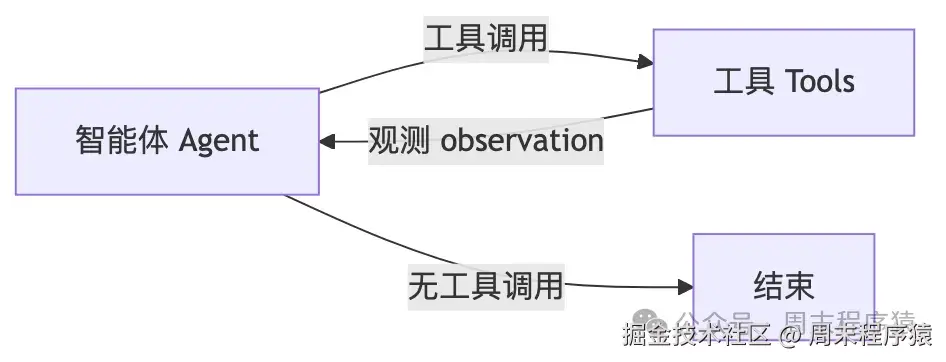
系统终于从"线性流程"进入"持续交互系统"。
它为什么是 80% 任务的起点?
因为大多数任务并不需要复杂规划,它们只需要:先看一眼 → 做个动作 → 根据反馈再决定下一步,已足够覆盖多轮搜索、多跳问答、网页研究、工具驱动的数据收集。
失败模式
局部贪心。 它每次只基于当前 observation 决策,容易走弯路、重复搜索、陷入局部最优、无法提前安排多步任务。
什么时候升级?
当任务需要显式的步骤顺序控制,就该上 Planning。
📎 参考实现:03_ReAct.ipynb
7. Planning:把控制流本身变成模型输出
它要解决什么问题?
ReAct 本质是在线贪心策略,对需要顺序约束、步骤依赖和过程可追踪的任务,它开始不够用。Planning 要把原本隐式存在模型脑子里的执行顺序,显式拿出来,写进 state。
系统第一次把"控制流"对象化了。
State 新增了什么?
arduino
class Plan(BaseModel):
    steps: List[str] = Field(description="Ordered list of tool/sub-questions.")
workflow 的 session_state 里还要带上中间结果:
ini
session_state = {"plan": [], "intermediate": []}在 ReAct 里下一步做什么是临时决定的,在 Planning 里下一步做什么先被生成出来,然后才执行。
关键代码
agno 的 Workflow 提供 Loop step,天然表达"循环执行直到 plan 空":
ini
from agno.workflow.v2 import Workflow, Step, Loop
from agno.tools.duckduckgo import DuckDuckGoTools

planner = Agent(name="planner", model=OpenAIChat(id="gpt-5-mini"), response_model=Plan,
    instructions="Decompose the user request into a list of atomic tool-queryable steps.")

executor = Agent(name="executor", model=OpenAIChat(id="gpt-5-mini"),
    tools=[DuckDuckGoTools()],
    instructions="Answer exactly one sub-question using tools.")

synthesizer = Agent(name="synthesizer", model=OpenAIChat(id="gpt-5-mini"),
    instructions="Combine intermediate findings into a final answer.")

def plan_step(step_input):
    plan: Plan = planner.run(step_input.message).content
    step_input.workflow_session_state["plan"] = list(plan.steps)
    step_input.workflow_session_state["intermediate"] = []
    return plan

def execute_step(step_input):
    state = step_input.workflow_session_state
    next_q = state["plan"].pop(0)
    obs = executor.run(next_q).content
    state["intermediate"].append(f"Q: {next_q}\nA: {obs}")
    return obs

def synth_step(step_input):
    state = step_input.workflow_session_state
    notes = "\n\n".join(state["intermediate"])
    return synthesizer.run(
        f"Question: {step_input.message}\nNotes:\n{notes}\nFinal answer:"
    ).content

def plan_is_empty(_outputs) -> bool:
    """Loop 终止条件:agno 的 end_condition 只接收一个参数(StepOutput 列表)。"""
    return len(planning_wf.session_state["plan"]) == 0

planning_wf = Workflow(
    name="planning",
    session_state={"plan": [], "intermediate": []},
    steps=[
        Step(name="plan", executor=plan_step),
        Loop(
            name="execute_all",
            steps=[Step(name="execute_one", executor=execute_step)],
            end_condition=plan_is_empty,
        ),
        Step(name="synthesize", executor=synth_step),
    ],
)

planning_wf.run(message="Compare the latest revenue of AAPL and MSFT and explain the gap.")
路由逻辑从"LLM 在 prompt 里决定下一步"变成了"一个数据结构是否还有剩余项"------这才是 Planning 真正的结构变化。

新增的核心能力
Planning 新增的不是"更聪明的思考",而是:把未来控制流提前 materialize 成一个数据结构。 你现在可以可视化计划、检查计划、修改计划、追踪执行进度。
失败模式
它过于乐观,一旦 plan 错了,后面每一步都可能是错的。可预测性增强了,适应性下降了。
什么时候升级?
当你不再相信工具会稳定成功,就必须上 PEV。
📎 参考实现:04_planning.ipynb
8. PEV:把"验证"提升为控制流的一等公民
它要解决什么问题?
Planning 默认世界是稳定的,但真实世界不是:API 会失败、搜索会返回噪音、数据会缺失、工具会超时。
PEV(Plan → Execute → Verify)解决的是:不要把执行结果默认为真,而要显式验证。 系统现在不再把执行视为"完成了一步",而是把执行视为"生成了一个待验证结果"。
State 新增了什么?
ini
class VerificationResult(BaseModel):
    is_successful: bool = Field(description="True if the tool execution was successful and the data is valid.")
    reasoning: str = Field(description="Reasoning for the verification decision.")
verifier 不是随便说一句"好像不对",而是输出一个结构化 verdict。verification_result 字段一出现,图结构就不再是 plan -> execute -> next step,而是 plan -> execute -> verify -> (continue | replan | finish)。
关键代码
为了演示为什么需要验证,故意放了一个会失败的工具:
python
def flaky_web_search(query: str) -> str:
    """Search the web. This tool is intentionally unreliable."""
    if"employee count"in query.lower():
        return"Error: Could not retrieve data. The API endpoint is currently unavailable."
    returnf"Mock search result for: {query}"

verifier = Agent(
    name="verifier",
    model=OpenAIChat(id="gpt-5-mini"),
    response_model=VerificationResult,
    instructions=(
        "Given a sub-question and the raw tool observation, decide if the "
        "observation actually answers the sub-question. Treat 'Error', "
        "'unavailable', empty strings and obviously irrelevant text as failures."
    ),
)

pev_executor = Agent(
    name="pev_executor",
    model=OpenAIChat(id="gpt-5-mini"),
    tools=[flaky_web_search],
    instructions="Answer exactly one sub-question using tools.",
)

def pev_execute(step_input):
    state = step_input.workflow_session_state
    next_q = state["plan"][0]
    obs = pev_executor.run(next_q).content
    state["last_obs"] = obs
    state["last_q"] = next_q
    return obs

def pev_verify(step_input):
    state = step_input.workflow_session_state
    verdict: VerificationResult = verifier.run(
        f"Sub-question: {state['last_q']}\nObservation:\n{state['last_obs']}"
    ).content
    if verdict.is_successful:
        state["plan"].pop(0)
        state["intermediate"].append(f"Q: {state['last_q']}\nA: {state['last_obs']}")
        state["retries"] = 0
    else:
        state["retries"] = state.get("retries", 0) + 1
    state["last_verdict"] = verdict
    return verdict

from agno.workflow.v2 import Router

# 先把所有可能用到的 Step 物化一次------Router selector 只能返回 workflow 已知的 Step
replan_step = Step(name="replan", executor=plan_step)
noop_step = Step(name="noop", executor=lambda si: "continue")

def pev_router(step_input):
    """根据本轮 verdict 决定下一轮是否需要重规划;不需要就放 noop,交给 Loop 判断是否再来一轮。"""
    state = step_input.workflow_session_state
    ifnot state["plan"]:
        return [noop_step]  # 外层 Loop 的 end_condition 会看到 plan 空,直接终止
    ifnot state["last_verdict"].is_successful and state["retries"] >= 2:
        state["retries"] = 0
        return [replan_step]
    return [noop_step]

def pev_loop_done(_outputs) -> bool:
    """所有子任务都通过验证后,退出 Loop。"""
    return len(pev_wf.session_state["plan"]) == 0

pev_wf = Workflow(
    name="pev",
    session_state={"plan": [], "intermediate": [], "retries": 0,
                   "last_q": "", "last_obs": "", "last_verdict": None},
    steps=[
        Step(name="plan", executor=plan_step),
        Loop(
            name="pev_loop",
            steps=[
                Step(name="pev_execute", executor=pev_execute),
                Step(name="pev_verify", executor=pev_verify),
                Router(name="decide_next", selector=pev_router),
            ],
            end_condition=pev_loop_done,
        ),
        Step(name="synthesize", executor=synth_step),
    ],
)
拓扑变成:

它真正带来的系统收益
PEV 的本质是:让错误不再静默传播。 在普通 Planning 里,一次失败可能污染整个剩余流程;在 PEV 里,失败在局部被识别,并被重定向回 re-plan 路径。
失败模式
- 额外成本高
- verifier 本身可能误判
- 过度验证会拖慢系统
- 某些任务里"验证"本身比"执行"更难
什么时候升级?
如果你接下来的问题不是"执行步骤会不会失败",而是"一个 agent 根本不该包揽所有认知角色",那就该进入多 agent 时代。
📎 参考实现:06_PEV.ipynb
9. Multi-Agent Collaboration:把认知分工写进图里
多 agent 的核心不是"多个模型一起跑",而是把认知分工、调度策略和冗余机制显式写进图结构,真正要分清三件事:固定分工、动态调度、并行冗余。
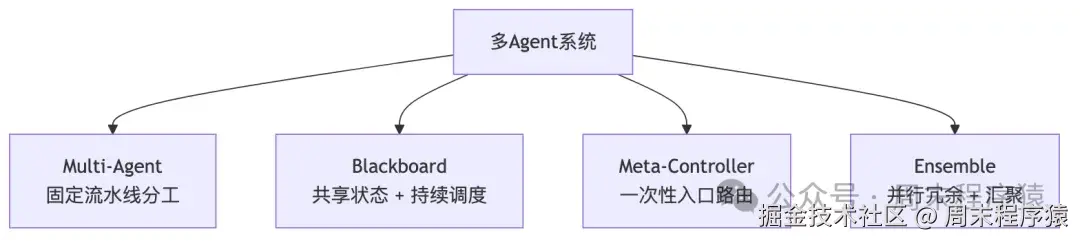
它要解决什么问题?
当单个 agent 的 prompt 同时容纳太多角色时,系统就会变形,最典型的问题不是 token 不够,而是角色冲突 ,Multi-Agent 的核心价值是:把认知分工编码到架构里。
State 是什么?
在 agno 里它就是 workflow_session_state 里按角色划分的几块区域:
python
wf = Workflow(
    name="multi_agent",
    session_state={
        "user_request": None,
        "news": None,        # 由 news_analyst 写入
        "tech": None,        # 由 technical_analyst 写入
        "fin": None,         # 由 financial_analyst 写入
        "final_report": None, # 由 report_writer 写入
    },
    steps=[...],
)
不同角色写入不同字段------state 不再只是"共享上下文",而开始体现角色边界。
关键代码
agno 表达这种固定流水线,有两条路:用 Workflow 拼,或者用 Team(mode="coordinate") 让一个 leader 固定地调度,这里选最直接的做法------Workflow + 多个 Agent:
ini
news_analyst = Agent(
    name="news_analyst",
    model=OpenAIChat(id="gpt-5-mini"),
    tools=[DuckDuckGoTools()],
    instructions="You are a financial news analyst. Produce a concise markdown section on recent news.",
)

technical_analyst = Agent(
    name="technical_analyst",
    model=OpenAIChat(id="gpt-5-mini"),
    tools=[YFinanceTools()],
    instructions="You are a technical analyst. Produce a concise markdown section on price action and indicators.",
)

financial_analyst = Agent(
    name="financial_analyst",
    model=OpenAIChat(id="gpt-5-mini"),
    tools=[YFinanceTools(income_statements=True, key_financial_ratios=True)],
    instructions="You are a financial analyst. Produce a concise markdown section on fundamentals.",
)

report_writer = Agent(
    name="report_writer",
    model=OpenAIChat(id="gpt-5-mini"),
    instructions="Compose a final investment memo from the three sub-reports.",
)

def news_step(si):
    out = news_analyst.run(si.message).content
    si.workflow_session_state["news"] = out
    return out

def tech_step(si):
    out = technical_analyst.run(si.message).content
    si.workflow_session_state["tech"] = out
    return out

def fin_step(si):
    out = financial_analyst.run(si.message).content
    si.workflow_session_state["fin"] = out
    return out

def write_step(si):
    s = si.workflow_session_state
    return report_writer.run(
        f"News:\n{s['news']}\n\nTechnical:\n{s['tech']}\n\nFinancial:\n{s['fin']}"
    ).content

multi_wf = Workflow(
    name="multi_agent",
    session_state={},
    steps=[
        Step(name="news", executor=news_step),
        Step(name="tech", executor=tech_step),
        Step(name="fin", executor=fin_step),
        Step(name="write", executor=write_step),
    ],
)
或者,如果你想让"编排也能省掉",直接用 Team 的 coordinate 模式:
ini
from agno.team import Team

analysts_team = Team(
    name="analysts",
    mode="coordinate",
    model=OpenAIChat(id="gpt-5-mini"),
    members=[news_analyst, technical_analyst, financial_analyst],
    instructions=[
        "Route each relevant sub-question to the right analyst.",
        "Collect their outputs and synthesize a final investment memo.",
    ],
    markdown=True,
)

analysts_team.print_response("Write an investment memo about AAPL.", stream=True)
新增的能力
把一个大 prompt 内部的隐式角色切换,变成多个显式节点。 这带来非常大的工程收益:你可以单独调试某个角色、替换某个角色的 prompt、单独评估某个角色输出、给不同角色不同工具。
失败模式
最大问题是:流程固定。 如果执行到一半发现还需要更多新闻背景,固定流水线不会自动返回新闻分析师;如果发现技术分析其实不必要,也不会跳过,解决了"认知拆分",但没有解决"动态调度"。
什么时候升级?
当多个角色之间的先后顺序本身也需要动态决定时,你需要 Blackboard。
📎 参考实现:05_multi_agent.ipynb
10. Blackboard:共享状态成为系统中心
它要解决什么问题?
Multi-Agent 里角色有了,但顺序还是硬编码的。Blackboard 解决的是:不要预先写死专家的调用顺序,而是让共享工作区的当前状态来决定下一步应该激活谁。
State 是什么?
python
class BlackboardState(BaseModel):
    user_request: str
    blackboard: dict
    next_agent: Optional[str] = None
    is_complete: bool = False
之前的 state 更像"按字段分区的结果容器";现在的 state 变成了一个共享工作台。所有专家都围绕这块黑板读写。
关键代码
python
import json

class ControllerDecision(BaseModel):
    next_agent: str = Field(description="One of ['news', 'technical', 'financial', 'writer', 'FINISH'].")
    reasoning: str = Field(description="A brief reason for choosing the next agent.")

controller = Agent(
    name="controller",
    model=OpenAIChat(id="gpt-5-mini"),
    response_model=ControllerDecision,
    instructions=(
        "You are the controller of a blackboard system. "
        "Inspect what is currently on the blackboard and decide which specialist "
        "should be called next, or FINISH if the report is ready."
    ),
)

SPECIALISTS = {
    "news": news_analyst,
    "technical": technical_analyst,
    "financial": financial_analyst,
    "writer": report_writer,
}

def controller_step(si):
    s = si.workflow_session_state
    bb_snapshot = json.dumps(s["blackboard"], indent=2, ensure_ascii=False)
    decision = controller.run(
        f"Original request: {s['user_request']}\n\nBlackboard so far:\n{bb_snapshot}"
    ).content
    s["next_agent"] = decision.next_agent
    return decision

def specialist_step(si):
    s = si.workflow_session_state
    if s["next_agent"] == "FINISH":
        return"finished"
    agent = SPECIALISTS[s["next_agent"]]
    piece = agent.run(
        f"Request: {s['user_request']}\nBlackboard:\n{json.dumps(s['blackboard'])}"
    ).content
    s["blackboard"][s["next_agent"]] = piece
    return piece

def bb_loop_done(_outputs) -> bool:
    """controller 选出 FINISH 就终止循环。"""
    return blackboard_wf.session_state["next_agent"] == "FINISH"

blackboard_wf = Workflow(
    name="blackboard",
    session_state={"user_request": "", "blackboard": {}, "next_agent": None},
    steps=[
        Loop(
            name="bb_loop",
            steps=[
                Step(name="controller", executor=controller_step),
                Step(name="specialist", executor=specialist_step),
            ],
            end_condition=bb_loop_done,
        ),
    ],
)拓扑不是固定链,而是一个持续调度回路:
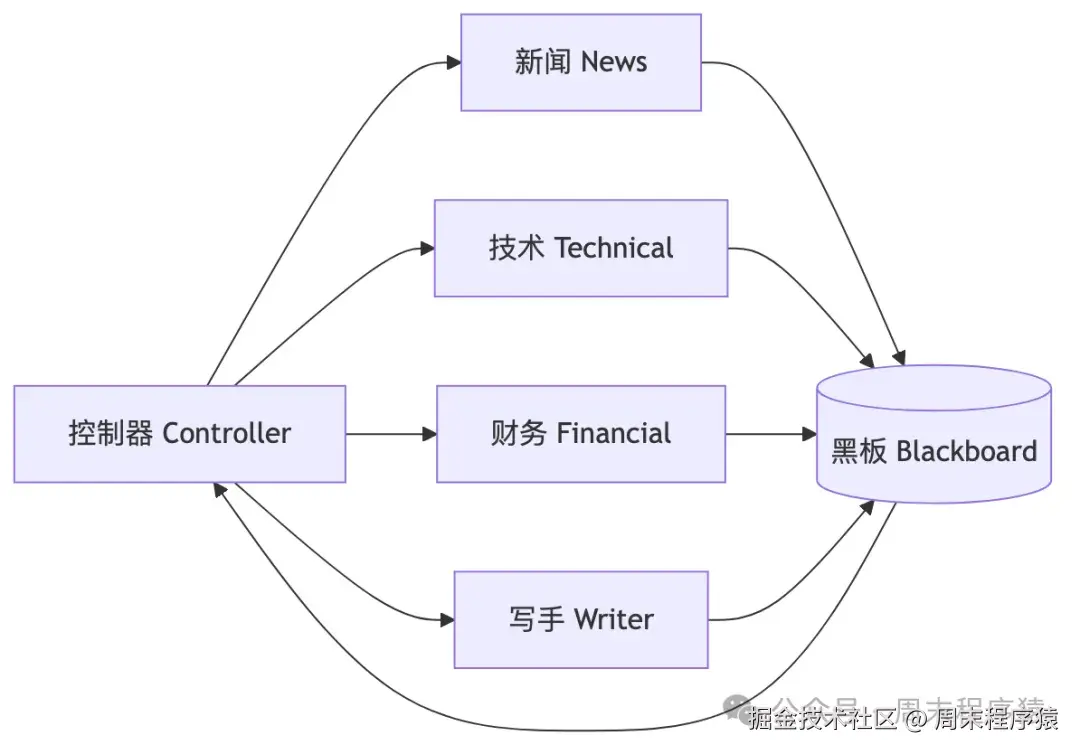
系统控制中心从 "预定义工作流" 转向 "共享状态 + 调度器"。
新增的能力
持续的、基于中间状态的动态编排。
失败模式
- controller 决策不稳定
- blackboard 结构变脏,信息冲突
- 专家之间重复劳动
- 系统容易过度循环
Blackboard 用灵活性换来了调度复杂度。
什么时候升级/降级?
如果问题的顺序本来就很固定,用 Blackboard 反而是过度设计,但如果你真正需要的不是持续调度,而只是"请求进来时先分诊一次",那就该看 Meta-Controller。
📎 参考实现:07_blackboard.ipynb
11. Meta-Controller:一次性路由,而不是持续编排
它要解决什么问题?
很多系统并不需要 Blackboard 那种持续调度,它们的问题更像是:这条请求是研究类,还是编码类,还是通用问答?
Meta-Controller 解决的是:入口分诊。
State 是什么?
python
class MetaAgentState(BaseModel):
    user_request: str
    selected_agent: Optional[str] = None
    result: Optional[str] = None
状态最小而明确:请求是什么、被路由给谁、返回了什么。
关键代码
agno 里这是 Team(mode="route") 的原生场景------leader 只做选择,不做任务:
ini
from agno.team import Team

generalist = Agent(
    name="generalist",
    model=OpenAIChat(id="gpt-5-mini-mini"),
    role="Handles general Q&A.",
    instructions="Answer general knowledge questions directly.",
)

researcher = Agent(
    name="researcher",
    model=OpenAIChat(id="gpt-5-mini"),
    role="Handles research-heavy queries.",
    tools=[DuckDuckGoTools()],
    instructions="Do multi-step research using search.",
)

coder = Agent(
    name="coder",
    model=OpenAIChat(id="gpt-5-mini"),
    role="Handles Python coding tasks.",
    instructions="Write, explain and debug Python code.",
)

meta = Team(
    name="meta_controller",
    mode="route",                      # 关键:一次性路由
    model=OpenAIChat(id="gpt-5-mini"),
    members=[generalist, researcher, coder],
    instructions=(
        "Choose exactly one member based on the request type: "
        "generalist for general Q&A, researcher for research-heavy queries, "
        "coder for Python coding tasks. Do not do the work yourself."
    ),
)

meta.print_response("Write a Python function to compute the LCM of two numbers.")
mode="route" 的精髓不在 graph 多复杂,而在于:controller 自己不做任务,只做选择。
拓扑
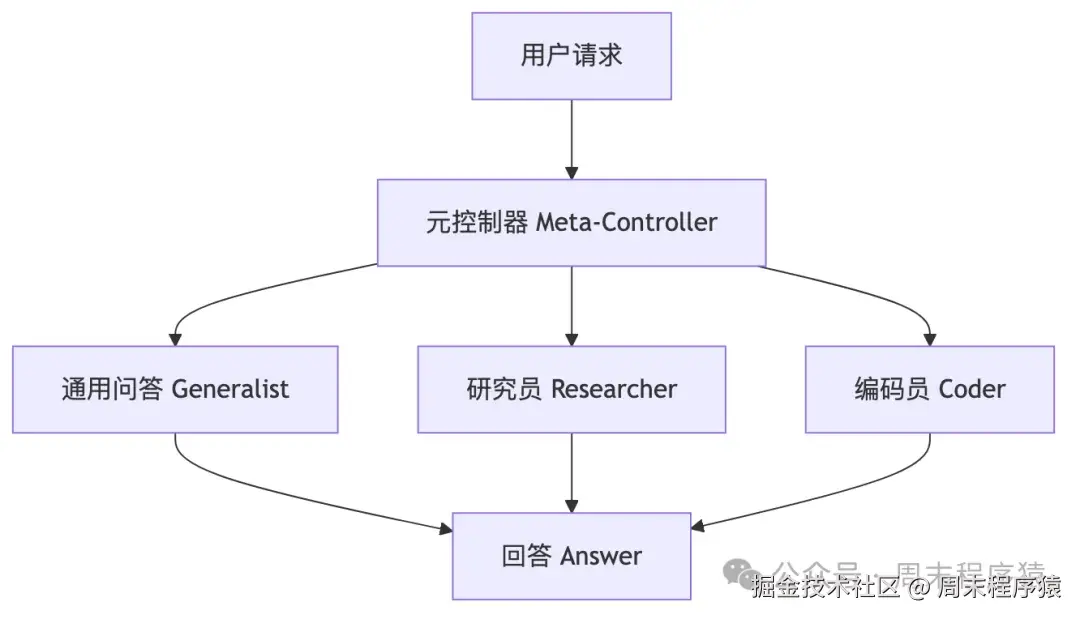
它和 Blackboard 的本质区别
Meta-Controller:一次性路由Blackboard:持续调度
前者像"分诊台",后者像"总控台"。
失败模式
最核心的就是路由错误,因为它只路由一次,所以一旦第一跳错了,整个请求路径就错了,而且这类错误常常不是显式报错,而是"回答得像那么回事,但方向错了"。
它为什么在生产里特别常见?
因为它足够简单,也足够有效,如果让我在生产系统里给多 agent 设计一个起步架构,我通常会先选 Meta-Controller,而不是一上来就上 Blackboard。
📎 参考实现:11_meta_controller.ipynb
12. Ensemble:它不是分工,而是冗余
它要解决什么问题?
前面的多 agent 基本都在解决"分工"问题,Ensemble 解决的是另一类问题:同一个问题,单个 agent 的结论不够可靠。
你不是担心"一个 agent 做不完",而是担心"一个 agent 看法太单一、偏差太大、幻觉太重"。
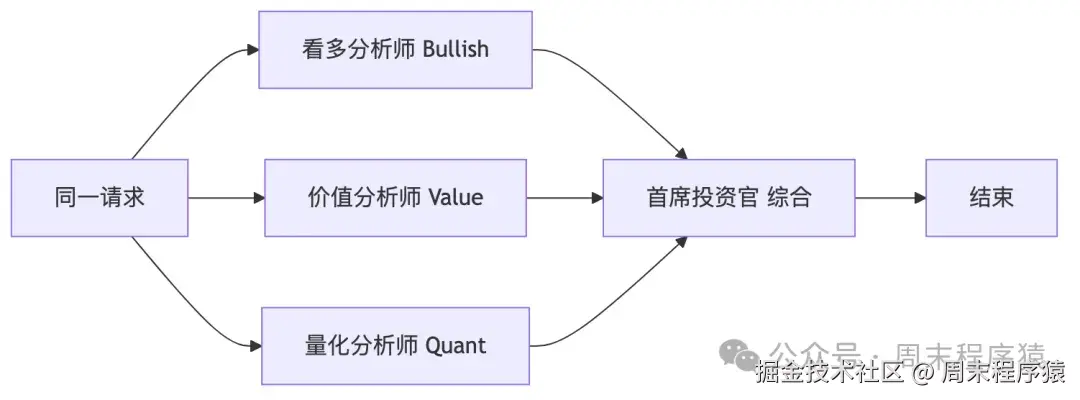
拓扑
标准 fan-out / fan-in:
关键代码
agno 的 Workflow 支持 Parallel step 做 fan-out,再用一个 aggregator step 做 fan-in:
ini
from agno.workflow.v2 import Workflow, Step, Parallel

class FinalRecommendation(BaseModel):
    final_recommendation: str
    confidence_score: float
    synthesis_summary: str
    identified_opportunities: List[str]
    identified_risks: List[str]

bullish = Agent(name="bullish", model=OpenAIChat(id="gpt-5-mini"),
    instructions="You are a growth-oriented bullish analyst. Argue why to invest.")
value = Agent(name="value", model=OpenAIChat(id="gpt-5-mini"),
    instructions="You are a value analyst. Focus on margin of safety.")
quant = Agent(name="quant", model=OpenAIChat(id="gpt-5-mini"),
    instructions="You are a quantitative analyst. Focus on ratios and trends.")

cio = Agent(name="cio", model=OpenAIChat(id="gpt-5-mini"),
    response_model=FinalRecommendation,
    instructions=("You are the CIO. Synthesize three analyst views into one final "
                  "recommendation. Do NOT hide disagreement --- explicitly list risks."))

def run_one(agent):
    def _step(si):
        out = agent.run(si.message).content
        # Parallel 各分支并发写入共享 dict
        si.workflow_session_state.setdefault("views", {})[agent.name] = out
        return out
    return _step

def aggregate_step(si):
    views = si.workflow_session_state.get("views", {})
    body = "\n\n".join(f"[{name}]\n{view}"for name, view in views.items())
    return cio.run(f"Question: {si.message}\nAnalyst views:\n{body}").content

ensemble_wf = Workflow(
    name="ensemble",
    session_state={"views": {}},
    steps=[
        Parallel(
            name="analysts",
            steps=[
                Step(name="bullish", executor=run_one(bullish)),
                Step(name="value", executor=run_one(value)),
                Step(name="quant", executor=run_one(quant)),
            ],
        ),
        Step(name="cio_synth", executor=aggregate_step),
    ],
)

ensemble_wf.run(message="Should I buy AAPL right now?")
它和 Multi-Agent 到底差在哪?
Multi-Agent:不同 agent 做不同子任务Ensemble:不同 agent 分析同一个问题
前者是分工 ,后者是冗余。
新增的能力
用多视角和冗余来降低单次推理偏差。 和机器学习里的 ensemble 很像:不是因为单个模型不能输出,而是因为多个模型的误差不完全相关。
失败模式
- 成本线性增长
- 多个 agent 可能共享同样的偏见
- aggregator 可能强行合并不该合并的冲突
- 最终"综合意见"可能掩盖关键分歧
所以 ensemble 的关键不是"取平均",而是保留冲突信息并解释冲突 ,这就是为什么 FinalRecommendation 里必须有 identified_risks。
什么时候用?
高风险判断、事实核查、投资建议、复杂研究结论------凡是你不想把决定押在一次输出上的场景。
📎 参考实现:13_ensemble.ipynb
13. Episodic + Semantic Memory:记忆不是把对话塞回上下文
记忆系统不是"外挂知识库",而是 state 的外延扩展,真正重要的不是存了多少,而是系统如何区分事件、事实,以及如何避免错误长期固化。
它要解决什么问题?
前面的架构都默认一个前提:当前对话结束后,系统基本失忆,用户要的是:记得我的偏好、记得我们之前讨论过什么、记得哪些事实在长期上是稳定的。
这里有两种记忆:
- Episodic memory:记住发生过什么(事件摘要 → 向量库)
- Semantic memory:记住什么是真的(实体关系 → 图结构/结构化存储)
关键代码
agno 的 Memory 负责长期用户偏好/事件,AgentKnowledge 负责向量检索,两者结合可以直接落出一套双记忆系统:
ini
from agno.agent import Agent
from agno.memory.v2.memory import Memory
from agno.memory.v2.db.sqlite import SqliteMemoryDb
from agno.knowledge.text import TextKnowledgeBase
from agno.vectordb.lancedb import LanceDb, SearchType
from agno.embedder.openai import OpenAIEmbedder
from agno.storage.sqlite import SqliteStorage

# Episodic:用户层长期记忆,自动从对话中抽取
memory = Memory(
    db=SqliteMemoryDb(table_name="user_memories", db_file="tmp/memory.db"),
    model=OpenAIChat(id="gpt-5-mini"),
)

# Semantic:结构化知识库(这里以文本 + 向量库为例)
knowledge = TextKnowledgeBase(
    path="data/facts",
    vector_db=LanceDb(
        table_name="facts",
        uri="tmp/lancedb",
        search_type=SearchType.hybrid,
        embedder=OpenAIEmbedder(id="text-embedding-3-small"),
    ),
)
knowledge.load(recreate=False)

mem_agent = Agent(
    name="memorized",
    model=OpenAIChat(id="gpt-5-mini"),
    memory=memory,
    enable_agentic_memory=True,          # agent 可以主动写入/检索 episodic
    enable_user_memories=True,
    knowledge=knowledge,                 # semantic
    search_knowledge=True,
    add_history_to_messages=True,
    num_history_responses=5,
    storage=SqliteStorage(table_name="sessions", db_file="tmp/sessions.db"),
    markdown=True,
)

mem_agent.print_response(
    "I'm allergic to peanuts and prefer low-carb meals. Remember that.",
    user_id="alice",
)

# 下一次,即使换了新 session
mem_agent.print_response(
    "Suggest a dinner plan for me.",
    user_id="alice",
)
新增的能力
系统的 state 从"图内字段"扩展成:图内状态 + 图外可检索历史状态。 agent 的能力不再只依赖当前上下文窗口,而依赖它如何从历史里提取相关信息。
工作流
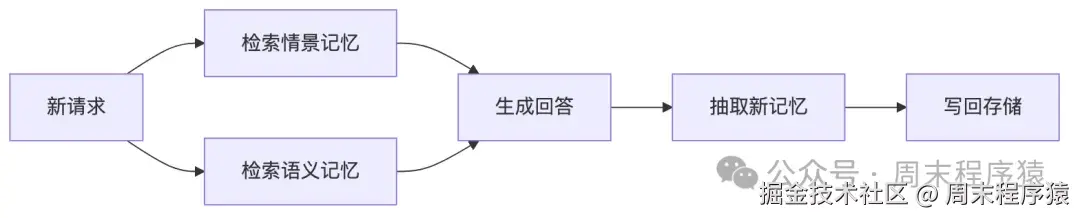
memory 不再是附加模块,而是主控制流的一部分,agno 的 enable_agentic_memory=True 就是把这一整条写回链路自动接上。
失败模式
- 错误记忆被写入,造成长期污染
- episodic recall 召回了相似但不相关的信息
- semantic graph 存入过时事实
- 抽取质量差导致记忆结构脏化
memory 让系统更强,但也让错误变得持久。
什么时候还不够?
当你发现向量检索只能"找相似",却不能做"关系推理"时,就需要 Graph / World-Model Memory。
📎 参考实现:08_episodic_with_semantic.ipynb
14. Graph / World-Model Memory:当你需要的不是回忆,而是关系推理
它要解决什么问题?
向量检索能回答"哪段历史最像现在的问题",但不能天然回答"这个实体和那个实体之间隔了几跳关系"。
Graph Memory 解决的是:把知识从 chunk 组织提升到关系结构。
技术核心
两步:
- 从非结构化文本里抽实体和关系
- 让自然语言问题转成图查询
Text -> Knowledge Graph -> Text-to-Cypher -> Query -> Answer
关键代码
ini
class Node(BaseModel):
    id: str = Field(description="Unique name or identifier for the entity.")
    type: str = Field(description="Entity type, e.g., Person, Company.")

class Relationship(BaseModel):
    source: Node
    target: Node
    type: str = Field(description="Relationship verb in ALL_CAPS, e.g., WORKS_FOR, ACQUIRED.")

class KnowledgeGraph(BaseModel):
    relationships: List[Relationship]

graph_maker = Agent(
    name="graph_maker",
    model=OpenAIChat(id="gpt-5-mini"),
    response_model=KnowledgeGraph,
    instructions=(
        "Extract entities (nodes) and relationships from the given text. "
        "Relationship type should be an ALL_CAPS verb."
    ),
)

# agno 的 Neo4j 工具可以直接做图查询
from agno.tools.neo4j import Neo4jTools

graph_query_agent = Agent(
    name="graph_query",
    model=OpenAIChat(id="gpt-5-mini"),
    tools=[Neo4jTools(url="bolt://localhost:7687", user="neo4j", password="...")],
    instructions=(
        "You answer questions over a Neo4j knowledge graph. "
        "First generate a Cypher query, run it, then synthesize a natural answer. "
        "If the first query returns nothing, rewrite and retry once."
    ),
)

# 1) 抽取
kg = graph_maker.run("Tim Cook is the CEO of Apple. Apple acquired Beats in 2014.").content
# 2) 写入图库(省略 write_triples),然后查询
graph_query_agent.print_response("Which companies did Apple acquire and in which year?")
新增的能力
核心变化是:从"相似性召回"升级到"结构性推理"。 这在企业知识问答、组织关系分析、并购链条追踪这类问题上非常关键。
失败模式
- 抽取错误导致图污染
- schema 设计不佳导致图不可用
- Text-to-Cypher 生成错误查询
- 图查询结果正确,但 synthesis 层误读
Graph Memory 的关键不只是 LLM,而是整个知识建模链条。
📎 参考实现:12_graph.ipynb
15. Tree-of-Thoughts:不是让模型"想更多",而是让系统"搜更多"
它要解决什么问题?
真正困难的问题不是"链不够长",而是"路径会分叉,而且需要回溯",ToT 解决的是:把推理从单路径生成,升级成对候选路径空间的搜索。
State 是什么?
python
class ToTState(BaseModel):
    problem: str
    active_paths: List[List["PuzzleState"]]
    solution: Optional[List["PuzzleState"]] = None
state 的单位已经不是"一个当前答案",而是"多条候选路径"。
关键代码
经典的 wolf-goat-cabbage 谜题------标准 BFS 回溯场景,在 agno 里,LLM 负责 生成候选动作 ,程序化代码负责 搜索树的扩展和剪枝 。
这是 ToT 里重要的架构判断:不要把搜索控制交给 LLM,交给代码。
ini
import copy

class PuzzleState(BaseModel):
    left_bank: frozenset = Field(default_factory=lambda: frozenset({"wolf", "goat", "cabbage"}))
    right_bank: frozenset = Field(default_factory=frozenset)
    boat_location: str = "left"
    move_description: str = "Initial state."

    class Config:
        arbitrary_types_allowed = True

    def is_valid(self) -> bool:
        dangerous = [("wolf", "goat"), ("goat", "cabbage")]
        unguarded = self.left_bank if self.boat_location == "right"else self.right_bank
        returnnot any({a, b}.issubset(unguarded) for a, b in dangerous)

    def is_goal(self) -> bool:
        return self.right_bank == frozenset({"wolf", "goat", "cabbage"})

class Proposal(BaseModel):
    moves: List[str] = Field(description="Candidate next moves.")

proposer = Agent(
    name="proposer",
    model=OpenAIChat(id="gpt-5-mini"),
    response_model=Proposal,
    instructions="Given the current state, propose up to 3 distinct next moves.",
)

def expand(state: PuzzleState) -> List[PuzzleState]:
    # 纯程序化展开:LLM 只提供建议,代码保证搜索的正确性
    ...

def tot_solve(initial: PuzzleState, max_depth: int = 10):
    active_paths = [[initial]]
    for _ in range(max_depth):
        new_paths = []
        for path in active_paths:
            for nxt in expand(path[-1]):
                if nxt in path:
                    continue
                new_path = path + [nxt]
                if nxt.is_goal():
                    return new_path
                new_paths.append(new_path)
        active_paths = new_paths
    returnNone
新增的能力
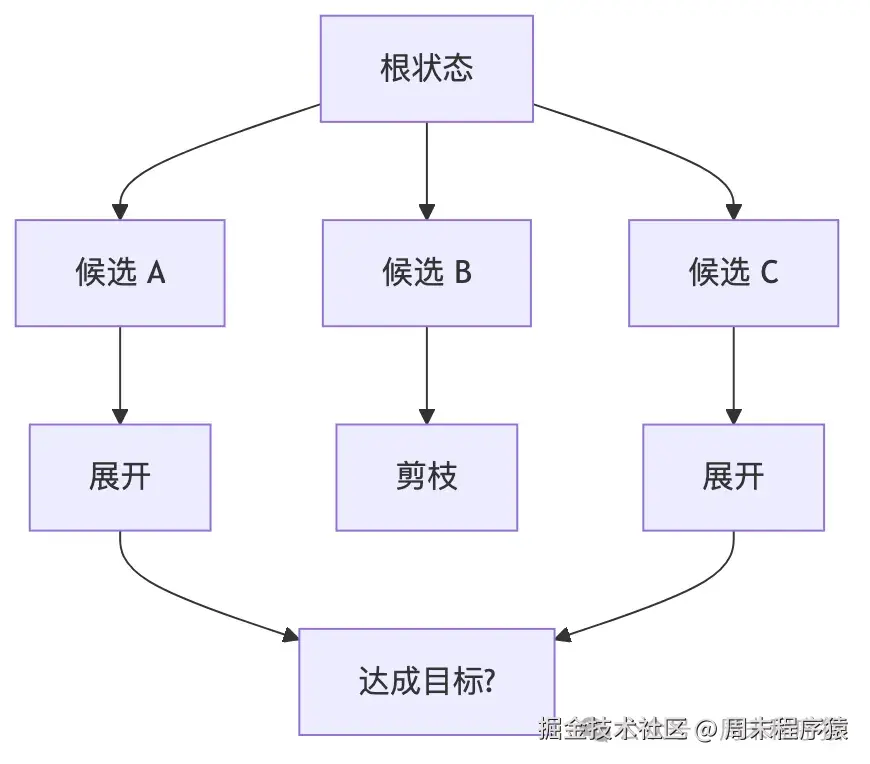
ToT 新增的是:把推理问题转写成搜索问题。 这和 ReAct、Planning 都不一样。前者做控制流设计,ToT 做搜索空间设计。
失败模式
组合爆炸,ToT 不是通用架构,只该用于"必须回溯和搜索"的专用场景。
📎 参考实现:09_tree_of_thoughts.ipynb
16. Mental Loop / Simulator:行动之前,先在内部世界里试错
它要解决什么问题?
在机器人、交易、生产系统配置变更这类任务里,试错有代价。
Mental Loop 要把试错从真实世界搬进模拟世界。
关键代码
模拟器就是一个普通 Python 对象,决策 agent 通过工具把它当成"可以快照 / 可以推进 / 可以回滚"的沙箱:
python
import copy
import numpy as np

class Portfolio(BaseModel):
    cash: float = 10000.0
    shares: int = 0
    def value(self, price: float) -> float:
        return self.cash + self.shares * price

class MarketSimulator(BaseModel):
    day: int = 0
    price: float = 100.0
    volatility: float = 0.1
    drift: float = 0.01
    portfolio: Portfolio = Field(default_factory=Portfolio)

    class Config:
        arbitrary_types_allowed = True

    def step(self, action: str, amount: float = 0.0):
        if action == "buy":
            n = int(amount); cost = n * self.price
            if self.portfolio.cash >= cost:
                self.portfolio.shares += n; self.portfolio.cash -= cost
        elif action == "sell":
            n = min(int(amount), self.portfolio.shares)
            self.portfolio.shares -= n; self.portfolio.cash += n * self.price
        self.price *= 1 + float(np.random.normal(self.drift, self.volatility))
        self.day += 1

REAL = MarketSimulator()

def simulate_action(action: str, amount: float, horizon: int = 5) -> str:
    """Roll out an action on a forked copy of the market for `horizon` days."""
    sim = copy.deepcopy(REAL)
    sim.step(action, amount)
    for _ in range(horizon - 1):
        sim.step("hold")
    returnf"Simulated value after {horizon} days: ${sim.portfolio.value(sim.price):.2f}"

def execute_action(action: str, amount: float) -> str:
    """Commit the action to the REAL market."""
    REAL.step(action, amount)
    returnf"Executed: {action} {amount}. Portfolio now ${REAL.portfolio.value(REAL.price):.2f}."

trader = Agent(
    model=OpenAIChat(id="gpt-5-mini"),
    tools=[simulate_action, execute_action],
    instructions=[
        "Before committing any action with execute_action, first call simulate_action.",
        "If the simulated outcome is worse than holding, do not execute.",
    ],
    show_tool_calls=True,
)

trader.print_response("Decide whether to buy AAPL today, and how much.")
新增的能力
反事实执行(counterfactual execution)。 系统不再直接问"下一步做什么",而是先问:如果我这么做会发生什么?
失败模式
simulation-reality gap,模拟器越不真实,agent 越可能做出"模拟里完美,现实里灾难"的决定,这个架构的上限往往不是 LLM,而是 simulator 的保真度。
📎 参考实现:10_mental_loop.ipynb
17. Dry-Run Harness:真正把副作用关进闸门里
安全架构的核心,不是让 agent 更保守,而是把"是否允许执行"做成显式控制流。
Dry-Run 解决外部副作用,Metacognitive 解决内部边界感知,它们最好一起出现。

它要解决什么问题?
如果一个 agent 会发邮件、发帖、下单、改配置、删数据,核心问题是:它在执行前能不能被拦住。
Dry-Run Harness 把所有真实动作都拆成两种模式:preview 和 execute。
关键代码
agno 里实现 dry-run 有两个关键设计:工具本身带 dry_run 参数;Workflow 里显式插入一个人工审批 step:
python
import datetime, hashlib

def publish_post(content: str, hashtags: List[str], dry_run: bool = True) -> str:
    """Publish a social media post. If dry_run=True, only preview; no side effects."""
    ts = datetime.datetime.now().isoformat()
    full = f"{content}\n\n" + " ".join(f"#{h}"for h in hashtags)
    if dry_run:
        returnf"[DRY RUN @ {ts}] Would publish:\n---\n{full}\n---"
    post_id = hashlib.md5(full.encode()).hexdigest()[:8]
    returnf"[LIVE @ {ts}] Published id={post_id}"

proposer = Agent(
    name="proposer",
    model=OpenAIChat(id="gpt-5-mini"),
    tools=[publish_post],
    instructions=[
        "When asked to post, FIRST call publish_post with dry_run=True to preview.",
        "After the preview, stop and wait for human approval. Do NOT call dry_run=False yourself.",
    ],
    show_tool_calls=True,
)

def propose_step(si):
    return proposer.run(si.message).content

def approve_step(si):
    preview = si.previous_step_output
    print(f"\n--- PREVIEW ---\n{preview}\n---")
    decision = input("Approve and go live? (y/n): ").strip().lower()
    si.workflow_session_state["approved"] = (decision == "y")
    return decision

def commit_step(si):
    ifnot si.workflow_session_state.get("approved"):
        return"Rejected by human reviewer. Nothing was published."
    return proposer.run(
        "Now actually publish the same post by calling publish_post with dry_run=False."
    ).content

dryrun_wf = Workflow(
    name="dryrun",
    steps=[
        Step(name="propose", executor=propose_step),
        Step(name="approve", executor=approve_step),
        Step(name="commit", executor=commit_step),
    ],
)
新增的能力
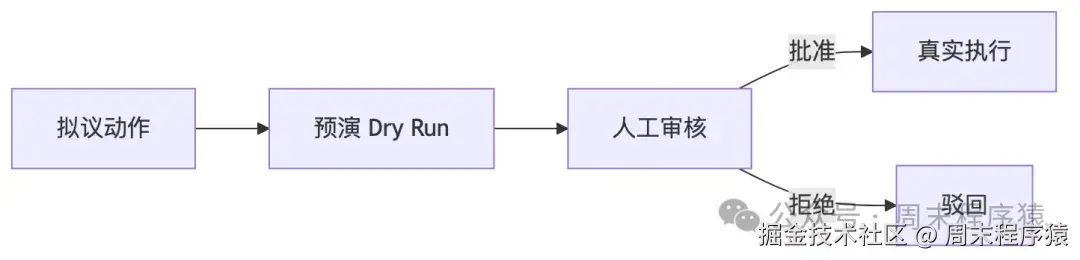
不是更智能,而是:让副作用在控制流上变成可审批对象。 很多 agent 系统的问题不在 reasoning,而在 side effects。Dry-Run 把它显式纳入架构。
失败模式
- 人工审批瓶颈
- 预演和真实执行环境不一致
- preview 足够详细反而带来信息泄漏风险
但即便如此,这种架构在真实生产系统里几乎是必须的。
📎 参考实现:14_dry_run.ipynb
18. Reflexive Metacognitive Agent:系统第一次显式思考自己的边界
它要解决什么问题?
前面的系统都在问"怎么把任务做完",Metacognitive agent 先问:这个任务我到底该不该做?
这是更高级的控制流,因为它不再只对外部世界建模,也开始对自身能力边界建模。
关键代码
python
class MetacognitiveAnalysis(BaseModel):
    confidence: float = Field(description="0.0~1.0, confidence in safely answering.")
    strategy: str = Field(description="'reason_directly' | 'use_tool' | 'escalate'.")
    reasoning: str
    tool_to_use: Optional[str] = None

AGENT_SELF_MODEL = {
    "knowledge_domains": ["general health", "nutrition", "exercise"],
    "tools_available": ["symptom_checker"],
    "confidence_threshold": 0.7,
    "high_risk_topics": ["prescription dosage", "emergency medical advice"],
}

self_model_agent = Agent(
    name="self_model",
    model=OpenAIChat(id="gpt-5-mini"),
    response_model=MetacognitiveAnalysis,
    instructions=(
        f"Your self-model is: {AGENT_SELF_MODEL}. "
        "For each user query, estimate confidence and pick a strategy: "
        "'reason_directly' if confidence >= threshold and topic is low-risk, "
        "'use_tool' if a matching tool exists, 'escalate' otherwise."
    ),
)

def symptom_checker(symptoms: str) -> str:
    returnf"Reference info for: {symptoms}"

responder = Agent(model=OpenAIChat(id="gpt-5-mini"), tools=[symptom_checker])

def meta_step(si):
    analysis: MetacognitiveAnalysis = self_model_agent.run(si.message).content
    si.workflow_session_state["analysis"] = analysis
    return analysis

def meta_router(si):
    analysis = si.workflow_session_state["analysis"]
    if analysis.strategy == "reason_directly":
        return [Step(name="answer", executor=lambda s: responder.run(s.message).content)]
    if analysis.strategy == "use_tool":
        return [Step(name="tool_answer",
                     executor=lambda s: responder.run(
                         f"Use the {analysis.tool_to_use} tool to help answer: {s.message}"
                     ).content)]
    return [Step(name="escalate",
                 executor=lambda s: "I'm not confident or allowed to answer this. Escalating to a human expert.")]

metacog_wf = Workflow(
    name="metacognitive",
    steps=[
        Step(name="self_model", executor=meta_step),
        Router(name="route_strategy", selector=meta_router),
    ],
)
新增的能力
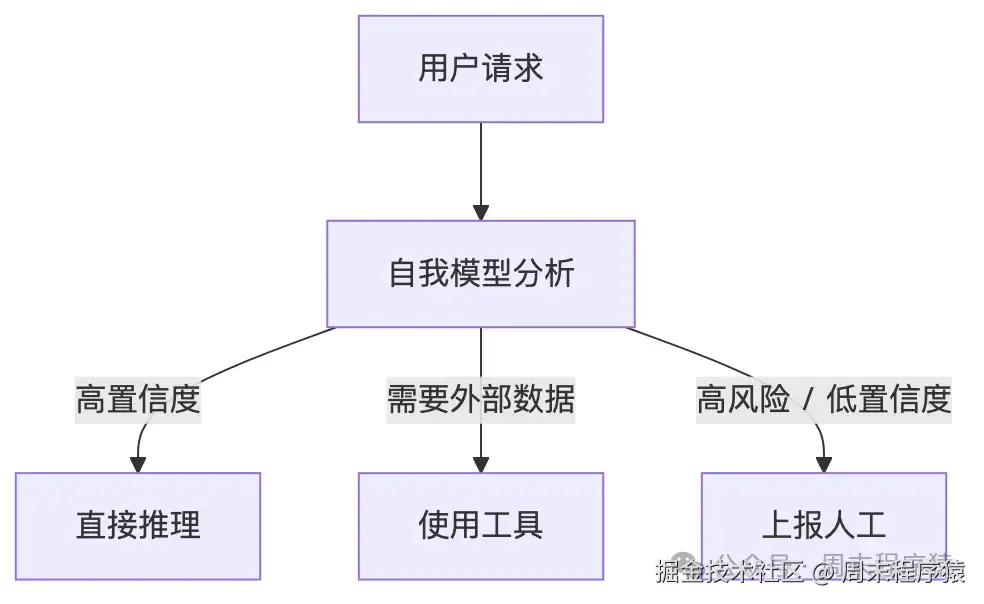
它新增的是:边界感知。 系统开始知道:我知道什么、不知道什么、需要什么工具、什么时候该把问题交给人类。
失败模式
置信度估计不准,低估自己会过度保守,高估自己会在高风险场景下危险地自信。
它为什么关键?
在医疗、法律、金融这种领域,agent 最强的能力不是"回答",而是"拒绝"。
📎 参考实现:17_reflexive_metacognitive.ipynb
19. Self-Improvement Loop:进化回路
它要解决什么问题?
Reflection 只有一次 critique pass,一个追求高质量输出的系统需要的是:生成 → 评估 → 修订 → 再评估 → 不达标继续,也就是把质量优化做成进化回路。
关键代码
最关键的是终止条件,agno 的 Loop.end_condition 天然支持这个:
python
class EmailCritique(BaseModel):
    is_approved: bool
    feedback: str

class MarketingEmail(BaseModel):
    subject: str
    body: str

generator = Agent(name="email_gen", model=OpenAIChat(id="gpt-5-mini"),
    response_model=MarketingEmail,
    instructions="Write a marketing email. Follow feedback if provided.")

critic = Agent(name="email_critic", model=OpenAIChat(id="gpt-5-mini"),
    response_model=EmailCritique,
    instructions="Approve only if subject is compelling AND body has a clear CTA AND tone is on-brand.")

# 跨任务:高质量样例库
class GoldStandardMemory:
    def __init__(self):
        self.examples: List[MarketingEmail] = []

    def few_shot_block(self) -> str:
        ifnot self.examples:
            return"No gold examples yet."
        return"\n\n---\n\n".join(
            f"Subject: {e.subject}\nBody:\n{e.body}"for e in self.examples[-3:]
        )

    def add(self, e: MarketingEmail):
        self.examples.append(e)

GOLD = GoldStandardMemory()

def gen_step(si):
    state = si.workflow_session_state
    prior = state.get("last_email")
    critique = state.get("last_critique")
    prompt = f"Task: {si.message}\nGold examples:\n{GOLD.few_shot_block()}\n\n"
    if prior and critique:
        prompt += (f"Previous draft:\nSubject: {prior.subject}\nBody:\n{prior.body}\n"
                   f"Critic feedback: {critique.feedback}\nRewrite to address the feedback.")
    email: MarketingEmail = generator.run(prompt).content
    state["last_email"] = email
    state["revision"] = state.get("revision", 0) + 1
    return email

def critic_step(si):
    email = si.workflow_session_state["last_email"]
    verdict: EmailCritique = critic.run(
        f"Review:\nSubject: {email.subject}\nBody:\n{email.body}"
    ).content
    si.workflow_session_state["last_critique"] = verdict
    if verdict.is_approved:
        GOLD.add(email)
    return verdict

def should_stop(_outputs) -> bool:
    """Loop 终止:critic 批准,或达到最大修订次数。"""
    state = self_improve_wf.session_state
    last = state.get("last_critique")
    if last isnotNoneand last.is_approved:
        returnTrue
    if state.get("revision", 0) >= 3:
        returnTrue
    returnFalse

self_improve_wf = Workflow(
    name="self_improve",
    session_state={"revision": 0},
    steps=[
        Loop(
            name="refine_loop",
            steps=[
                Step(name="gen", executor=gen_step),
                Step(name="critic", executor=critic_step),
            ],
            end_condition=should_stop,
        ),
    ],
)
新增的能力
两层:单次任务内迭代优化 + 跨任务积累高质量样例 (GoldStandardMemory 把批准过的结果注入未来生成),这是它和 Reflection 的本质区别。
失败模式
- critic 标准不稳
- revision 收益递减
- 记忆库积累低质量样本会反向污染未来生成
Self-Improve 不是"会自动越来越好",而是"有机会在严格约束下越来越好"。
📎 参考实现:15_RLHF.ipynb
20. Cellular Automata:LLM 退出主循环,智能从局部规则中涌现
它要解决什么问题?
前面所有架构都默认存在一个中心 agent、一个主控制流、一个 orchestrator。
Cellular Automata 彻底打破这个前提:有些问题根本不需要中心规划,而适合通过局部规则产生全局行为。
关键代码
python
class CellAgent(BaseModel):
    type: str  # 'EMPTY' | 'OBSTACLE' | 'GOAL'
    pathfinding_value: float = float("inf")

    def update(self, neighbors: List["CellAgent"]):
        if self.type == "OBSTACLE":
            return
        if self.type == "GOAL":
            self.pathfinding_value = 0
            return
        m = min((n.pathfinding_value for n in neighbors), default=float("inf"))
        self.pathfinding_value = min(self.pathfinding_value, m + 1)

def neighbors_of(snapshot, r, c):
    """四邻(上下左右),越界跳过。"""
    H, W = len(snapshot), len(snapshot[0])
    out = []
    for dr, dc in [(-1, 0), (1, 0), (0, -1), (0, 1)]:
        nr, nc = r + dr, c + dc
        if0 <= nr < H and0 <= nc < W:
            out.append(snapshot[nr][nc])
    return out

def run_ca(grid, steps=50):
    for _ in range(steps):
        snapshot = [[copy.deepcopy(c) for c in row] for row in grid]
        for r in range(len(grid)):
            for c in range(len(grid[0])):
                grid[r][c].update(neighbors_of(snapshot, r, c))
在 agno 里,LLM 退到了纯"规则设计者/解释者"的位置:
ini
rule_designer = Agent(
    name="rule_designer",
    model=OpenAIChat(id="gpt-5-mini"),
    instructions=(
        "You design local update rules for a cellular automaton. "
        "Given a high-level objective, propose a minimal Python update function "
        "that each cell will execute based only on its neighbors."
    ),
)

rule_designer.print_response(
    "Design a CA rule so that every empty cell eventually stores the shortest "
    "path length to the nearest GOAL, treating OBSTACLE as impassable."
)
新增的能力
这不是在现有控制流上加一个模块,而是整个范式切换:从中心控制转向分布式涌现。
它和前面所有架构最大的区别
LLM 退出了执行主回路,它最多负责规则设计、参数选择、系统解释,真正的求解过程由大量局部节点同步演化完成。
失败模式
- 局部规则设计不当
- 系统收敛慢
- 涌现出错误的全局结构
但一旦规则设计得对,它能解决很多用中央 planner 反而很笨重的问题。
📎 参考实现:16_cellular_automata.ipynb
21. Evaluator 不是可选项
这个项目反复提醒你:agent 不是只要能跑就行,必须能评估,至少有五类 evaluator:
- LLM-as-a-Judge:用独立 Agent 打分
- 内置 critic :直接控制循环是否继续(
Loop.end_condition) - 程序化验证 :像
is_valid()/is_goal()这种硬约束 - Human-in-the-Loop:用人工审批做最后闸门(Dry-Run)
- 演示式验证:用多场景运行验证系统行为
为什么 evaluator 是核心,不是附属?
因为一旦系统开始反思、重规划、继续迭代、决定是否执行、决定是否升级人类,你就进入"闭环系统"了。
闭环系统如果没有 evaluator,就不知道何时停、何时改、何时拒绝。
没有 evaluator 的 agent,大概率只是一个会循环的 prompt,不是一个可靠的系统。
22. 架构演化表

| 架构 | 新增的关键能力 | 解决的问题 | agno 对应能力 |
|---|---|---|---|
| Reflection | critique pass | 单次生成质量不稳 | 3 × Agent 串联成 Workflow |
| Tool Use | world interface | 模型无法触达真实世界 | Agent(tools=[...]) |
| ReAct | observation loop | 工具结果不能驱动下一步 | Agent(tools=..., reasoning=True) |
| Planning | explicit plan state | 缺少全局步骤控制 | Agent(response_model=Plan) + Loop |
| PEV | verification loop | 执行失败会静默传播 | Router + verifier Agent |
| Multi-Agent | role decomposition | 单 prompt 角色冲突 | 多 Agent 或 Team(mode="coordinate") |
| Blackboard | shared workspace + dynamic controller | 固定流水线不够灵活 | workflow_session_state + controller Router |
| Meta-Controller | entry routing | 请求类型不同需要分诊 | Team(mode="route") |
| Ensemble | parallel redundancy | 单一答案不够可靠 | Workflow(Parallel(...)) + aggregator |
| Episodic/Semantic Memory | long-term recall | 系统跨轮失忆 | Memory + AgentKnowledge |
| Graph Memory | relational reasoning | 相似召回不能做关系推理 | Neo4jTools + Cypher agent |
| ToT | search tree | 线性推理无法回溯 | 程序化搜索 + proposer Agent |
| Mental Loop | counterfactual execution | 真实试错成本太高 | 双工具 simulate_action / execute_action |
| Dry-Run | side-effect gating | 副作用动作不能直接执行 | 工具带 dry_run 参数 + approval Step |
| Metacognitive | self-boundary reasoning | 系统不知道自己不会什么 | response_model=MetacognitiveAnalysis + Router |
| Self-Improvement | iterative quality loop | 一次优化不足 | Loop(end_condition=...) + gold memory |
| Cellular Automata | decentralized emergence | 中央控制不适合某些问题 | LLM 只设计规则,程序化并行更新 |
23. 怎么选?问你缺哪种控制能力,不要问哪个架构好
| 你缺的能力 | 优先架构 | 为什么 |
|---|---|---|
| 输出质量不稳 | Reflection | 最小质量闭环 |
| 多步工具推理 | ReAct | 观察-行动循环最实用 |
| 全局步骤控制 | Planning | 把控制流显式化 |
| 工具容错 | PEV | 把验证接进主回路 |
| 角色分工 | Multi-Agent | 把认知拆开 |
| 动态编排 | Blackboard | 基于共享状态调度 |
| 请求分诊 | Meta-Controller | 一次路由最省复杂度 |
| 高可靠结论 | Ensemble | 用冗余降低偏差 |
| 跨轮记忆 | Episodic / Semantic Memory | 把历史纳入系统 |
| 关系推理 | Graph Memory | 支持多跳查询 |
| 回溯搜索 | ToT | 适合分支型解空间 |
| 行动前模拟 | Mental Loop | 降低真实试错成本 |
| 副作用审批 | Dry-Run | 先预演再执行 |
| 边界感知 | Metacognitive | 先判断能不能做 |
| 长期自我改进 | Self-Improvement | 质量循环 + 样例积累 |
| 去中心化求解 | Cellular Automata | 用局部规则换全局行为 |
如果你缺的是输出质量
- 先上
Reflection;需要多轮逼近和长期改进,上Self-Improvement
如果你缺的是与世界交互
- 简单任务上
Tool Use;多步动态任务上ReAct
如果你缺的是显式步骤控制
- 上
Planning;工具不可靠,再升级到PEV
如果你缺的是角色分工
- 固定分工:
Multi-Agent;动态持续调度:Blackboard;入口分诊:Meta-Controller;同题多视角冗余:Ensemble
如果你缺的是长期状态
- 记历史事件:
Episodic Memory;做关系推理:Graph / World-Model Memory
如果你缺的是求解范式
- 需要回溯搜索:
Tree-of-Thoughts;需要先模拟后执行:Mental Loop;需要去中心化求解:Cellular Automata
如果你缺的是安全边界
- 需要副作用审批:
Dry-Run Harness;需要知道自己不能做什么:Metacognitive Agent
24. 最终结论:Agent 架构的演化,本质上是在设计更好的控制流
看完整个项目并用 agno 重写一遍后,我最大的感受不是"agent 真多",而是一个更朴素的判断:
所谓 agent architecture,不是模型能力表,而是控制流设计史。
它在不断回答同一组问题:什么时候该停?什么时候该继续?什么时候该重试?什么时候该换角色?什么时候该查工具?什么时候该调用历史?什么时候该先模拟?什么时候该拒绝?什么时候该让人类接管?
这些问题不依赖某一个框架。无论你底层用什么 DSL,只要开始做真实的 agent 系统,就一定会亲手长出同一组抽象:
Workflow.steps 表达确定性边Router 表达条件路由Loop 表达循环与终止条件Parallel 表达并行冗余workflow_session_state 表达显式共享状态Agent(tools=...) 内置 tool loopTeam(mode="route") 把一整段分诊逻辑改为一个 Team 组合
但控制流本身没有变。这恰恰说明这些问题不是某个框架发明出来的,而是真实系统演化过程中必然会长出来的。
从这个角度看,这 17 种架构并不神秘。它们只是对同一个系统问题的 17 种不同回答。
如果让我把整篇文章压缩成三句话:
- 先别迷信"万能 agent",先把状态和控制流画清楚。
- 大多数系统从 ReAct 起步,但可靠系统一定会引入验证、记忆和边界控制。
- 真正高级的 agent,不是更敢做事,而是更知道什么时候不该做。
一旦你看懂这条路径,后面再看到任何新的"agent 架构名词",你都可以先问它三个问题:
- 它新增了什么 state?
- 它新增了什么 router?
- 它新增了什么 evaluator?
只要这三个问题答不出来,它大概率就不是一种新架构,只是旧架构换了个名字。