文章目录
- [1. 修改器](#1. 修改器)
-
- [1.1 追加内容](#1.1 追加内容)
-
- [1.1.1 operator+=](#1.1.1 operator+=)
- [1.1.2 append](#1.1.2 append)
- [1.1.3 push_back](#1.1.3 push_back)
- [1.2 赋值替代](#1.2 赋值替代)
- [1.3 插入与删除](#1.3 插入与删除)
-
- [1.3.1 insert](#1.3.1 insert)
- [1.3.2 erase](#1.3.2 erase)
- [1.3.3 pop_back](#1.3.3 pop_back)
- [1.4 交换](#1.4 交换)
-
- [成员函数 swap()](#成员函数 swap())
- [2. 字符串操作](#2. 字符串操作)
-
- [2.1 转换为 C 风格](#2.1 转换为 C 风格)
-
- [2.1.1 c_str 与 data](#2.1.1 c_str 与 data)
- [2.1.2 c_str 与 data的区别](#2.1.2 c_str 与 data的区别)
- [2.1.2 生命周期警告:](#2.1.2 生命周期警告:)
- [2.2 复制到缓冲区](#2.2 复制到缓冲区)
- [2.3 查找系列(find 家族)](#2.3 查找系列(find 家族))
-
- 2.2.1正向/反向查找子串
- [2.2.2 查找字符集合中任一字符](#2.2.2 查找字符集合中任一字符)
- [2.2.3 查找不在集合中的字符](#2.2.3 查找不在集合中的字符)
- [2.3 子串提取](#2.3 子串提取)
- [2.4 比较](#2.4 比较)
-
- [2.4.1 compare](#2.4.1 compare)
- [3. 成员常量(npos)](#3. 成员常量(npos))
- [4. 非成员函数重载](#4. 非成员函数重载)
-
- [4.1 拼接运算符](#4.1 拼接运算符)
- [4.2 关系运算符](#4.2 关系运算符)
- [4.3 输入输出](#4.3 输入输出)
-
- [4.3.1 输入](#4.3.1 输入)
- [4.3.2 输出](#4.3.2 输出)
- [4.4 全局 std::swap](#4.4 全局 std::swap)
-
- [4.4.1 全局 std::swap](#4.4.1 全局 std::swap)
- [4.4.2 全局 std::swap与成员函数 swap 的关系](#4.4.2 全局 std::swap与成员函数 swap 的关系)
1. 修改器
1.1 追加内容
1.1.1 operator+=

cpp
string s = "hello string";
string in = "123";


//+=	末尾插入
//插入string对象
s += in;
//s;hello string123
cout << s << endl;

s = "hello string";

//插入字符串
s += "hehe";
//s;hello stringhehe
cout << s << endl;

s = "hello string";

//插入字符
s += 'x';
//s;string
cout << s << endl;
1.1.2 append

cpp
	s = "hello string";

	//append	末尾插入
	//插入string对象
	s.append(in);
	//s;hello string123
	cout << s << endl;

	s = "hello string";

	//插入subpos位置开始,sublen长的string对象,sublen可省
	s.append(in, 1, 2);
	//s;hello string23
	cout << s << endl;

	s = "hello string";

	//插入字符串
	s.append("1234");
	//s;hello string1234
	cout << s << endl;

	s = "hello string";

	//插入字符串前n个
	s.append("12345", 2);
	//s;hello string12
	cout << s << endl;

	s = "hello string";

	//插入n个字符
	s.append(4, 's');
	//s;hello stringssss
	cout << s << endl;

	s = "hello string";
1.1.3 push_back

cpp
	s = "hello string";

	//push_back	尾插字符
	s.push_back('c');
	//s;hello stringc
	cout << s << endl;
1.2 赋值替代
assign

cpp
	string s = "hello string";
	string a = "456";

	//assign	重新分配	清元素重新赋值
	//原容量 < 新元素个数 扩容
	//原容量 > 新元素个数 容量不变

	//用string对象赋值
	s.assign(a);
	//s;456
	cout << s << endl;

	s = "hello string";

	//从subpos位置开始,sublen长的string对象赋值,sublen可省
	s.assign(a, 1, 2);
	//s;56
	cout << s << endl;

	s = "hello string";

	//用字符串赋值
	s.assign("1234");
	//s;1234
	cout << s << endl;

	s = "hello string";

	//用字符串前n个赋值
	s.assign("12345", 2);
	//s;12
	cout << s << endl;

	s = "hello string";

	//用n个字符赋值
	s.assign(4, 's');
	//s;ssss
	cout << s << endl;
1.3 插入与删除
1.3.1 insert

cpp
	string s = "hello string";
	string in = "123";

	//插入整个 string 对象
	s.insert(5, in);
	// s: hello123 string
	cout << s << endl;

	s = "hello string";

	//插入 string 对象的子串 ,从 subpos 开始,sublen 长
	s.insert(5, in, 1, 2);
	// s: hello23 string
	cout << s << endl;

	s = "hello string";

	//插入 C 风格字符串
	s.insert(5, "ABC");
	// s: helloABC string
	cout << s << endl;

	s = "hello string";

	//插入 C 风格字符串的前 n 个字符
	s.insert(5, "ABCDE", 3);
	// s: helloABC string
	cout << s << endl;

	s = "hello string";

	//插入 n 个重复字符
	s.insert(5, 3, '*');
	// s: hello*** string
	cout << s << endl;
1.3.2 erase

cpp
	//erase	删除元素
	//从pos位置,len长删除,都不给值全删
	s.erase(6, 7);
	//s;hello
1.3.3 pop_back

cpp
	//pop_back	尾删一个元素
	s.pop_back();
	//s;1234
1.4 交换
成员函数 swap()

cpp
	//swap		交换
	s.swap(h);
	//s;hello
	//h;string
	cout << s << endl;
	cout << h << endl;
2. 字符串操作
2.1 转换为 C 风格
2.1.1 c_str 与 data


cpp
	string s = "hello string";
	//c_str		转换为c风格只读字符串
	const char* carr = s.c_str();
	//carr;hello string
	cout << carr << endl;

	//data		同上
	const char* darr = s.c_str();
	//darr;hello string
	cout << darr << endl;
2.1.2 c_str 与 data的区别
C++ 11 前
- c_str(): 始终保证返回一个以空字符 (\0) 结尾的 C 风格字符串
- data(): 不保证返回的字符数组以空字符结尾
C++11后
两者完全等价,都返回带 \0 的指针
2.1.2 生命周期警告:
返回的指针在 string 对象修改或析构后立即失效
2.2 复制到缓冲区
copy

cpp
	//copy		从string对象的len长,从pos(可省,pos = 0)位置,
	// 拷贝到字符串
	char ch[4] = { 0 };
	//需初始化, 需多一个空间存\0,否则会越界
	s.copy(ch, 3, 6);
	//ch;str\0
	cout << ch << endl;
copy需手动补 \0
2.3 查找系列(find 家族)
2.2.1正向/反向查找子串
find

cpp
	string s = "hello string";
	string f = "o ";

	//find				正向查找,返回值size_t类型,
	//成功返回要查找的首元素在被找中对象对应的地址下标,
	//失败返回npos
	//用string对象,在pos位置(pos = 0)开始查找
	size_t i = s.find(f,1);
	//i;4
	cout << i << endl;

	//用字符串,在pos位置(pos = 0)开始查找
	i = s.find("st", 3);
	//i;6
	cout << i << endl;

	//用字符串,在pos位置(pos = 0),用字符串前n个查找
	i = s.find("lll", 1, 2);
	//i;2
	cout << i << endl;

	//用字符,在pos位置(pos = 0)查找
	i = s.find("i", 3);
	//i;9
	cout << i << endl;
rfind

cpp
	//rfind				反向查找,返回值size_t类型,
	//成功返回要查找的首元素在被找中对象对应的地址下标,
	//失败返回npos
	//用string对象,在pos位置(pos = npos)开始查找
	i = s.rfind(f, 1);
	//i;4
	cout << i << endl;

	//用字符串,在pos位置(pos = npos)开始查找
	i = s.rfind("st", 3);
	//i;6
	cout << i << endl;

	//用字符串,在pos位置(pos = npos),用字符串前n个查找
	i = s.rfind("lll", 1, 2);
	//i;2
	cout << i << endl;

	//用字符,在pos位置(pos = npos)查找
	i = s.rfind("i", 3);
	//i;9
	cout << i << endl;
2.2.2 查找字符集合中任一字符
find_first_of

find_first_of正向查找,返回值size_t类型,查找对象的每个元素在被找对象中第一次出现的下标
返回,同上
用法,同上find
find_last_of

find_last_of正向查找,返回值size_t类型,查找对象的每个元素在被找对象中最后一次出现的下标
返回,同上
用法,同上find
2.2.3 查找不在集合中的字符
find_first_not_of

find_first_not_of正向查找,返回值size_t类型,查找对象的每个元素在被找对象中第一次没出现的下标
返回,同上
用法,同上find
find_last_not_of

find_first_not_of正向查找,返回值size_t类型,查找对象的每个元素在被找对象中最后一次没出现的下标
返回,同上
用法,同上find
返回值处理:与 std::string::npos 比较(npos 为 static const size_t,值为 -1)
2.3 子串提取
substr

cpp
string s = "hello string";

//substr	返回从原对象pos位置(可省,pos = 0),
// npos长(可省,npos = -1)的string拷贝
string s1 = s.substr(6, 3);
//s1;str
cout << s1 << endl;
2.4 比较
2.4.1 compare

cpp
// compare:按ASCII码值比较字符串(可指定子串)
// 返回值:相等返回 0;小于返回负数;大于返回正数
	//......
3. 成员常量(npos)
static const size_t npos = -1;其值为无符号整型的最大值在string相关函数中常常用来访问末尾元素
4. 非成员函数重载
4.1 拼接运算符
operator+
cpp
	//+		拼接	可string对象\字符串\字符,返回拼接后string新对象,
	//......
4.2 关系运算符
4.2.1 ==、!=、<、<=、>、>=
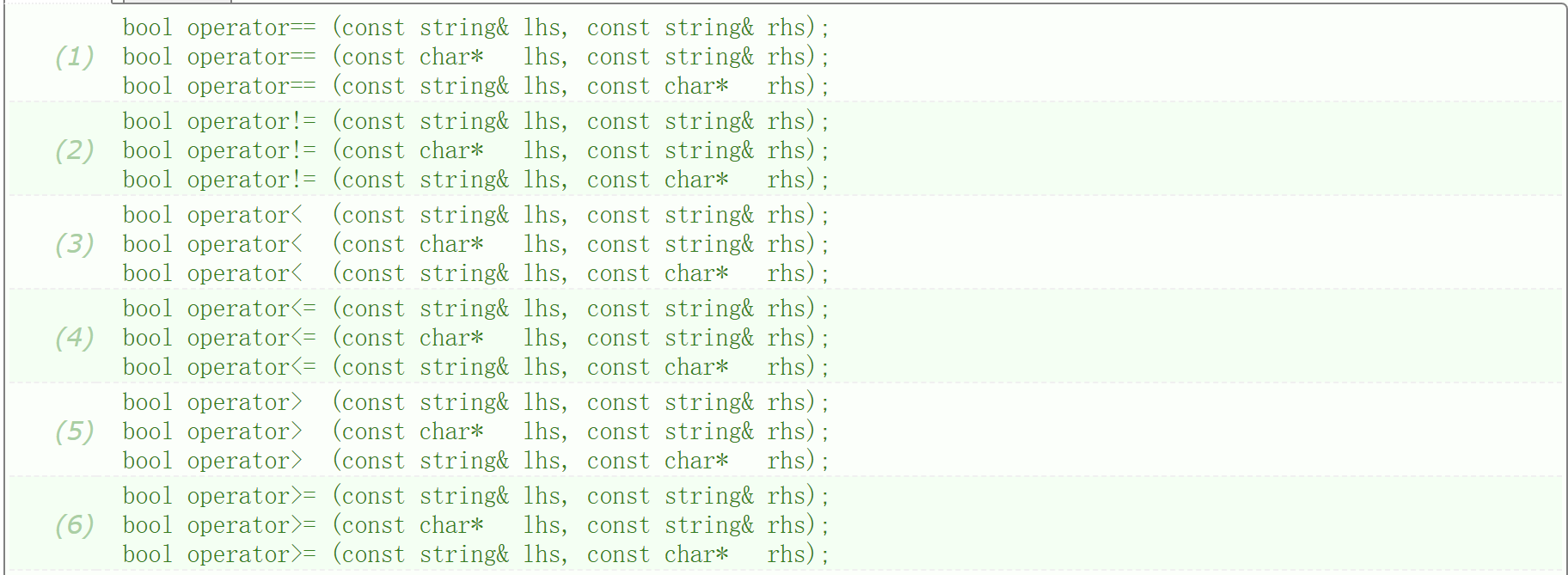
cpp
	//比较操作符重载	返回bool类
	//...
4.2.2 compare 和关系运算符的区别
| 对比项 | compare | 关系运算符 |
|---|---|---|
| 返回值 | 整数 (负数、零、正数) | 布尔值 (true / false) |
| 核心语义 | 判断"是或否" | 判断"顺序先后"或"相等程度" |
返回值不同
compare返回int,适合需要三路结果的场景(如排序、switch分支)。关系运算符返回
bool(true / false),适合直接写在if条件中。
子串支持不同
compare可以直接指定子串进行比较(如s.compare(pos, len, other)),避免创建临时对象。关系运算符只能比较整个字符串,要比较子串必须先调用
substr,会产生额外拷贝。
4.3 输入输出
4.3.1 输入
operator>>

cpp
	//流提取重载>>	输入字符 遇到空格或换行停终止
	string s;
	cin >> s;
std::getline

cpp
	//getline	自定义终止符(可省,默认为换行)
	getline(cin,s,'*');
	//遇到*停下
4.3.2 输出
operator<<

cpp
	//流插入重载<<	打印字符
	cout << s << endl;
4.4 全局 std::swap
4.4.1 全局 std::swap
cpp
	//非成员swap			用法同成员swap
	swap(s, a);
	//s;123
	//a;hello world
	cout << s << endl;
	cout << a << endl;
4.4.2 全局 std::swap与成员函数 swap 的关系
| 作用 | |
|---|---|
| 成员函数 swap | 直接操作内部成员,实现指针交换,运行高效 |
| 非成员函数 swap | 调用成员函数 swap,实现 swap(a,b) 方式 |
| 全局 std::swap | 泛型交换,实现所有同类型数据的交换 |