熟悉传统的Timer,它的优点以及却缺点,方便掌握现代化的
ScheduledThreadPoolExecutor
JDK17-Timer的文档 提到将ScheduledThreadPool配置为一个线程能够到达Timer同样的效果。

目标掌握
- Timer的基本使用(理解他的多生产与单消费的设计)
- 区分fixed-delay与fixed-rate的区别
- Timer的缺点
Timer
一个非常典型的多生产者,单一消费的案例。
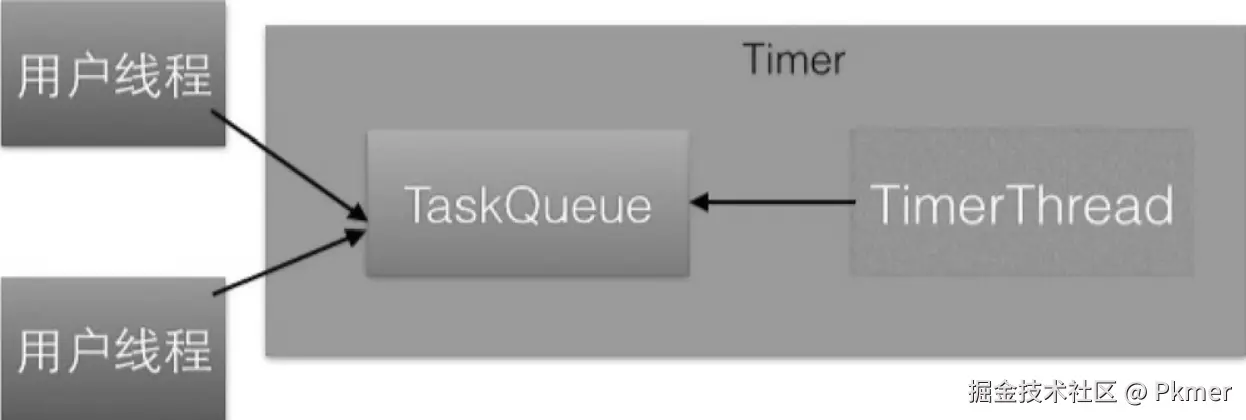
整体架构
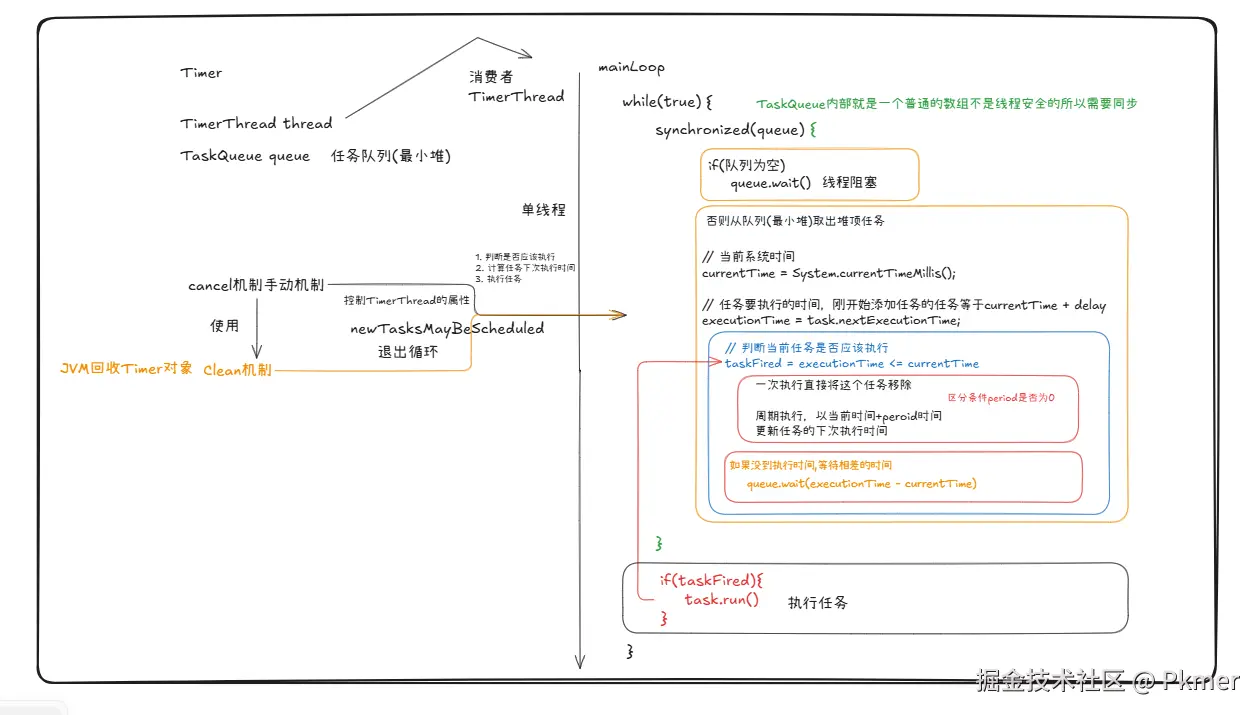
基础使用
在延迟1秒后执行,且只执行一次
java
public class TimerBaseUsage {
    private static final Logger LOGGER = Logger.getLogger(TimerBaseUsage.class.getName());
    public static void main(String[] args) {
        Timer timer = new Timer("【Pkmer-timer】");
        LOGGER.info("启动定时器");
        timer.schedule(new TimerTask() {
            @Override
            public void run() {
               LOGGER.info("执行任务中");
            }
        },1000);
    }
}可以很明显看到,在2026 12:16:38启动,在2026 12:16:39延迟了1秒启动。
python
4月 23, 2026 12:16:38 下午 cn.comicjava.ch06.timer.TimerBaseUsage main
信息: 启动定时器
4月 23, 2026 12:16:39 下午 cn.comicjava.ch06.timer.TimerBaseUsage$1 run
信息: 执行任务中
fixed-delay
fixed-delay(固定延迟): 以任务实际开始执行的时间为基准计算下次执行下一次执行时间 = 当前任务开始执行时间+peroid
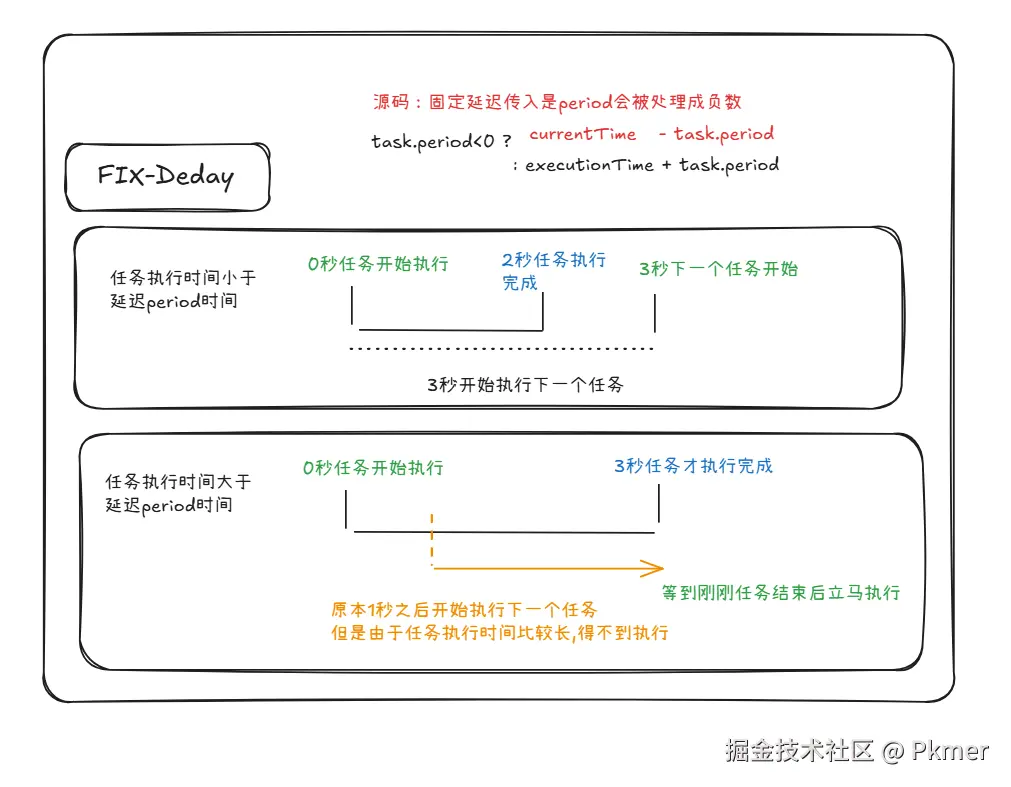
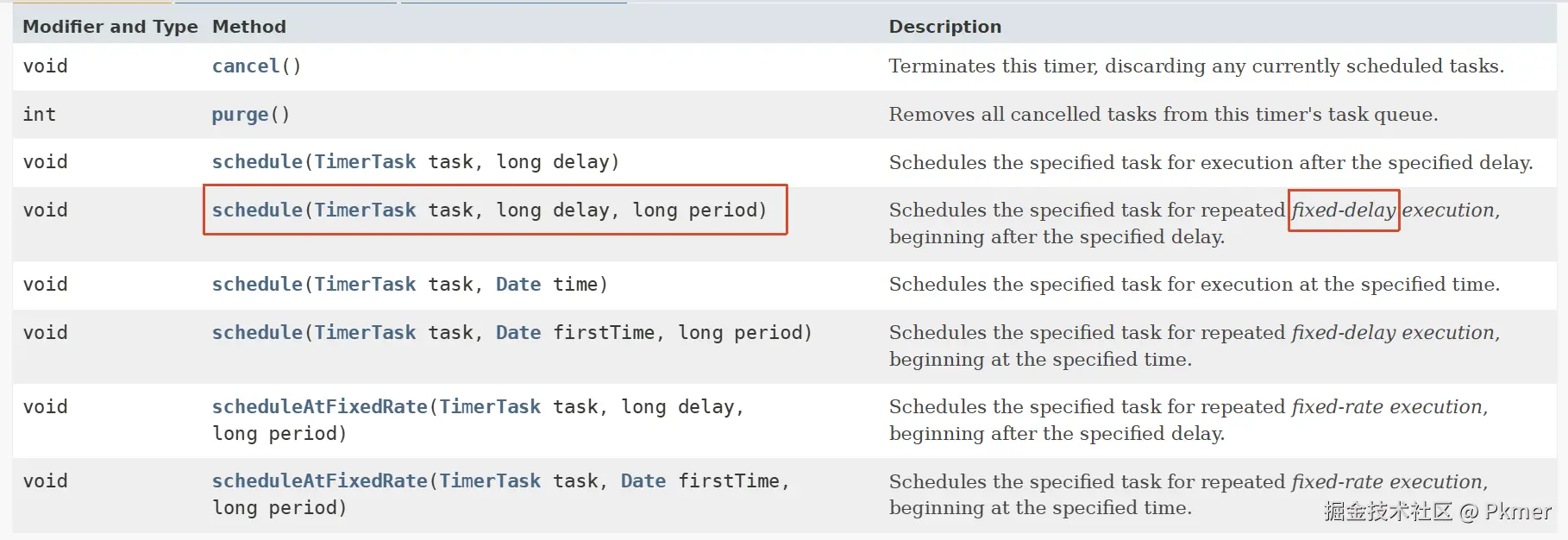
距离上次开始时间,经过period多久后,继续执行。无限多次。
任务执行时间小于peroid延迟时间
java
public class TimerFixDedayUsageV2 {
    private static final Logger LOGGER = Logger.getLogger(TimerFixDedayUsageV2.class.getName());
    public static void main(String[] args) {
        Timer timer = new Timer("【Pkmer-timer】");
        LOGGER.info("启动定时器");
        timer.schedule(new TimerTask() {
            @Override
            public void run() {
                LOGGER.info("开始执行任务");
                try {
                    Thread.sleep(2000L);
                } catch (InterruptedException e) {
                }
                LOGGER.info("执行任务结束");
            }
        },0,3000); // 0不延迟,立即执行。3000 之后执行后执行
    }
}
每次间隔3秒执行,可以看到任务执行了2秒,延迟peroid是3秒。是以任务开始的时间为基准来计算下一次执行的时间。
python
4月 23, 2026 1:31:35 下午 cn.comicjava.ch06.timer.TimerFixDedayUsageV2$1 run
信息: 开始执行任务
4月 23, 2026 1:31:37 下午 cn.comicjava.ch06.timer.TimerFixDedayUsageV2$1 run
信息: 执行任务结束
4月 23, 2026 1:31:38 下午 cn.comicjava.ch06.timer.TimerFixDedayUsageV2$1 run
信息: 开始执行任务
4月 23, 2026 1:31:40 下午 cn.comicjava.ch06.timer.TimerFixDedayUsageV2$1 run
信息: 执行任务结束
4月 23, 2026 1:31:41 下午 cn.comicjava.ch06.timer.TimerFixDedayUsageV2$1 run
信息: 开始执行任务
任务执行时间大于peroid延迟时间
现在任务执行时间为
java
public class TimerFixDedayUsageV3 {
    private static final Logger LOGGER = Logger.getLogger(TimerFixDedayUsageV3.class.getName());
    public static void main(String[] args) {
        Timer timer = new Timer("【Pkmer-timer】");
        LOGGER.info("启动定时器");
        timer.schedule(new TimerTask() {
            @Override
            public void run() {
                LOGGER.info("开始执行任务");
                try {
                    Thread.sleep(3000L);
                } catch (InterruptedException e) {
                }
                LOGGER.info("执行任务结束");
            }
        },0,1000); // 0不延迟,立即执行。1000 之后每次执行开始后,延迟1s,后执行
    }
}
任务执行完成后,立即执行下一个任务
python
4月 23, 2026 1:45:58 下午 cn.comicjava.ch06.timer.TimerFixDedayUsageV3$1 run
信息: 开始执行任务
4月 23, 2026 1:46:01 下午 cn.comicjava.ch06.timer.TimerFixDedayUsageV3$1 run
信息: 执行任务结束
4月 23, 2026 1:46:01 下午 cn.comicjava.ch06.timer.TimerFixDedayUsageV3$1 run
信息: 开始执行任务
4月 23, 2026 1:46:04 下午 cn.comicjava.ch06.timer.TimerFixDedayUsageV3$1 run
信息: 执行任务结束
4月 23, 2026 1:46:04 下午 cn.comicjava.ch06.timer.TimerFixDedayUsageV3$1 run
信息: 开始执行任务
🌅从源码角度理解
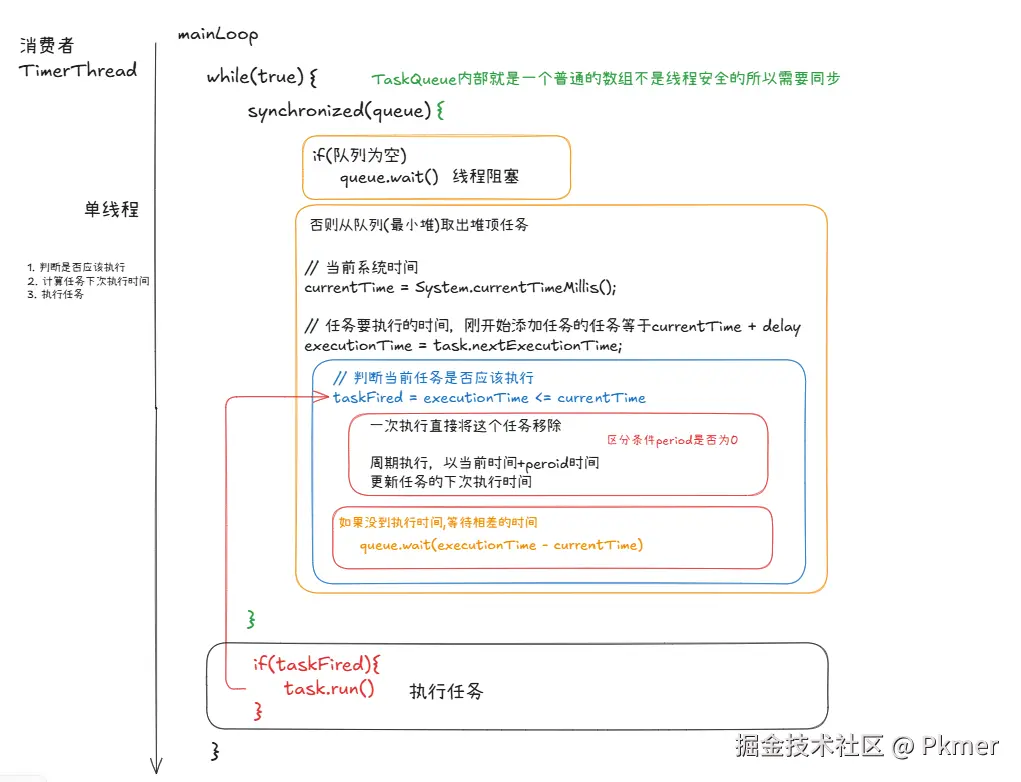
消费者也就是处理任务是单线处理,
这个单线程一直在一个while循环中,从一个任务队列中获取要执行的任务,如果队列为空这用jvm的监视器进行wait,否则从队列中取出任务(队列是一个最小堆,每次取出最小值),判断任务要执行的时间与当前时间,如果到了要执行了,创建一个新任务,并把新任务的下次执行的时间计算好,就是currentTime + period(源码中是currentTime - period是因为通过通过peroid的符号来区分是fix-delay还是fix-rate.fix-delay会把peroid处理成负数)
java
private void mainLoop() {
    while (true) {
        try {
            TimerTask task;
            boolean taskFired;
            synchronized(queue) {
                // Wait for queue to become non-empty
                while (queue.isEmpty() && newTasksMayBeScheduled)
                    queue.wait();
                if (queue.isEmpty())
                    break; // Queue is empty and will forever remain; die

                // Queue nonempty; look at first evt and do the right thing
                long currentTime, executionTime;
                task = queue.getMin();
                synchronized(task.lock) {
                    if (task.state == TimerTask.CANCELLED) {
                        queue.removeMin();
                        continue;  // No action required, poll queue again
                    }
                    currentTime = System.currentTimeMillis();
                    executionTime = task.nextExecutionTime;
                    if (taskFired = (executionTime<=currentTime)) {
                        if (task.period == 0) { // Non-repeating, remove
                            queue.removeMin();
                            task.state = TimerTask.EXECUTED;
                        } else { // Repeating task, reschedule
                            queue.rescheduleMin(
                              task.period<0 ? currentTime   - task.period
                                            : executionTime + task.period);
                        }
                    }
                }
                if (!taskFired) // Task hasn't yet fired; wait
                    queue.wait(executionTime - currentTime);
            }
            if (taskFired)  // Task fired; run it, holding no locks
                task.run();
        } catch(InterruptedException e) {
        }
    }
}
fixed-rate
fixed-rate(固定频率):以上次任务理论上开始执行的时间 为基准计算下次执行。会有任务堆积的现象产生
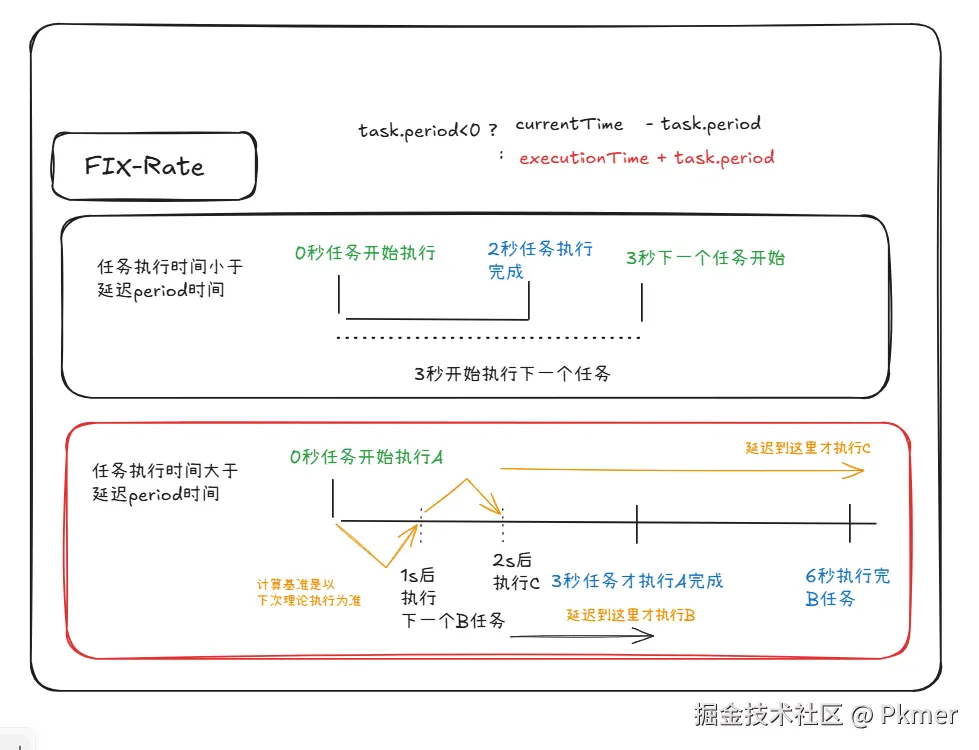
这里以任务运行时间超过peroid延迟时间来说明。
java
public class TimerFixRateV2 {
    private static final Logger LOGGER = Logger.getLogger(TimerFixRateV2.class.getName());
    public static void main(String[] args) {
        Timer timer = new Timer("【Pkmer-timer】");
        LOGGER.info("启动定时器");
        timer.scheduleAtFixedRate(new TimerTask() {
            @Override
            public void run() {
                LOGGER.info("开始执行任务");
                try {
                    Thread.sleep(3000L);
                } catch (InterruptedException e) {
                }
                LOGGER.info("执行任务结束");
            }
        },0,1000);
    }
}
python
4月 23, 2026 2:45:46 下午 cn.comicjava.ch06.timer.TimerFixRateV2$1 run
信息: 开始执行任务
4月 23, 2026 2:45:49 下午 cn.comicjava.ch06.timer.TimerFixRateV2$1 run
信息: 执行任务结束
4月 23, 2026 2:45:49 下午 cn.comicjava.ch06.timer.TimerFixRateV2$1 run
信息: 开始执行任务
4月 23, 2026 2:45:52 下午 cn.comicjava.ch06.timer.TimerFixRateV2$1 run
信息: 执行任务结束
4月 23, 2026 2:45:52 下午 cn.comicjava.ch06.timer.TimerFixRateV2$1 run
信息: 开始执行任务
4月 23, 2026 2:45:55 下午 cn.comicjava.ch06.timer.TimerFixRateV2$1 run
信息: 执行任务结束
4月 23, 2026 2:45:55 下午 cn.comicjava.ch06.timer.TimerFixRateV2$1 run
信息: 开始执行任务
小结
Timeer中的TimerThread的源码足以说明fixed-rate与fixed-delay的区别
ini
currentTime = System.currentTimeMillis();
executionTime = task.nextExecutionTime;

task.nextExecutionTime = task.period<0 ? currentTime - task.period
                  : executionTime + task.period
停止
主要是停止TimerThread这个线程,因为它是在一个f循环中运行的。本质上还是通过变量的可见性方式退出循环
- 通过手动调用
Timer.cancel方法停止 Timer没有任何强引用的时候被JVM回收,也要停止TimerThread线程。通过Clean
底层源码:
- 主要是通过设置
newTasksMayBeScheduled为false
java
this.cleanup = CleanerFactory.cleaner().register(this, threadReaper);

public void cancel() {
    synchronized(queue) {
        queue.clear();
        cleanup.clean();
    }
}

private static class ThreadReaper implements Runnable {
    private final TaskQueue queue;
    private final TimerThread thread;

    ThreadReaper(TaskQueue queue, TimerThread thread) {
        this.queue = queue;
        this.thread = thread;
    }

    public void run() {
        synchronized(queue) {
            thread.newTasksMayBeScheduled = false;
            queue.notify(); // In case queue is empty.
        }
    }
}- 变量
newTasksMayBeScheduled为false后TimerThread退出循环。说明JVM自动清理的时候,会等队列里面的任务全部处理完成。
java
while (queue.isEmpty() && newTasksMayBeScheduled)  // 不会等待
    queue.wait();
if (queue.isEmpty())  // 队列为空,退出
    break; // Queue is empty and will forever remain; die
缺点
霸占线程导致任务堆积
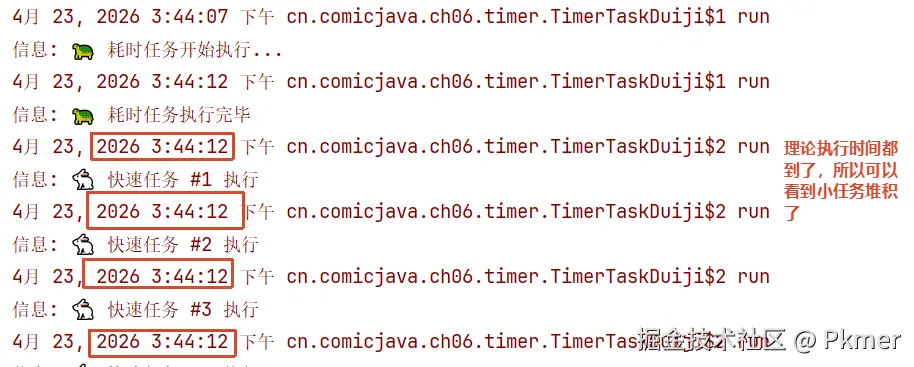
在上面的fixed-rate中我们知道,以固定速率执行一个任务(它的理论执行时间是以任务上次理论执行时间计算的)。由于消费者TimerThread是一个单线程。如果前面有大任务,或者自身任务执行过长,但是peroid又短。很容易造成任务堆积。
java
public class TimerTaskDuiji {

    private static final Logger log = Logger.getLogger(TimerTaskDuiji.class.getName());
    public static void main(String[] args) {
        Timer timer = new Timer();

        // 安排一个耗时任务(模拟处理大量数据)
        timer.schedule(new TimerTask() {
            @Override
            public void run() {
                log.info("🐢 耗时任务开始执行...");
                try {
                    Thread.sleep(5000); // 模拟耗时5秒的操作
                } catch (InterruptedException e) {
                    Thread.currentThread().interrupt();
                }
                log.info("🐢 耗时任务执行完毕");
            }
        }, 0); // 立即执行

        // 安排一个快速任务,预期每1秒执行一次
        timer.scheduleAtFixedRate(new TimerTask() {
            private int count = 0;

            @Override
            public void run() {
                count++;
                log.info("🐇 快速任务 #" + count + " 执行");
            }
        }, 0, 1000);

        // 程序运行8秒后退出
        try {
            Thread.sleep(8000);
        } catch (InterruptedException e) {
            Thread.currentThread().interrupt();
        }

        timer.cancel();
    }
}
任务异常导致整个 Timer 崩溃
从源码知道,TimerTask在一个while中不断循环,当任务代码抛出异常之后,它并没有catch住,导致退出循环线程结束。
java
while (true) {
    try{
        // ... ...
        if (taskFired)
            task.run();
    } catch(InterruptedException e) { // 只抓了中断
    }
}
案例
java
public class TimerExceptionDemo {
    public static void main(String[] args) {
        Timer timer = new Timer("【Timer-Pkmer】");
        // 任务1:会抛出异常
        timer.schedule(new TimerTask() {
            @Override
            public void run() {
                System.out.println("💥 即将抛出异常的任务开始执行");
                throw new RuntimeException("模拟任务执行异常");
            }
        }, 0);

        // 任务2:正常任务
        timer.schedule(new TimerTask() {
            @Override
            public void run() {
                System.out.println("✅ 我是正常任务,但我永远没机会执行了");
            }
        }, 2000);
    }
}