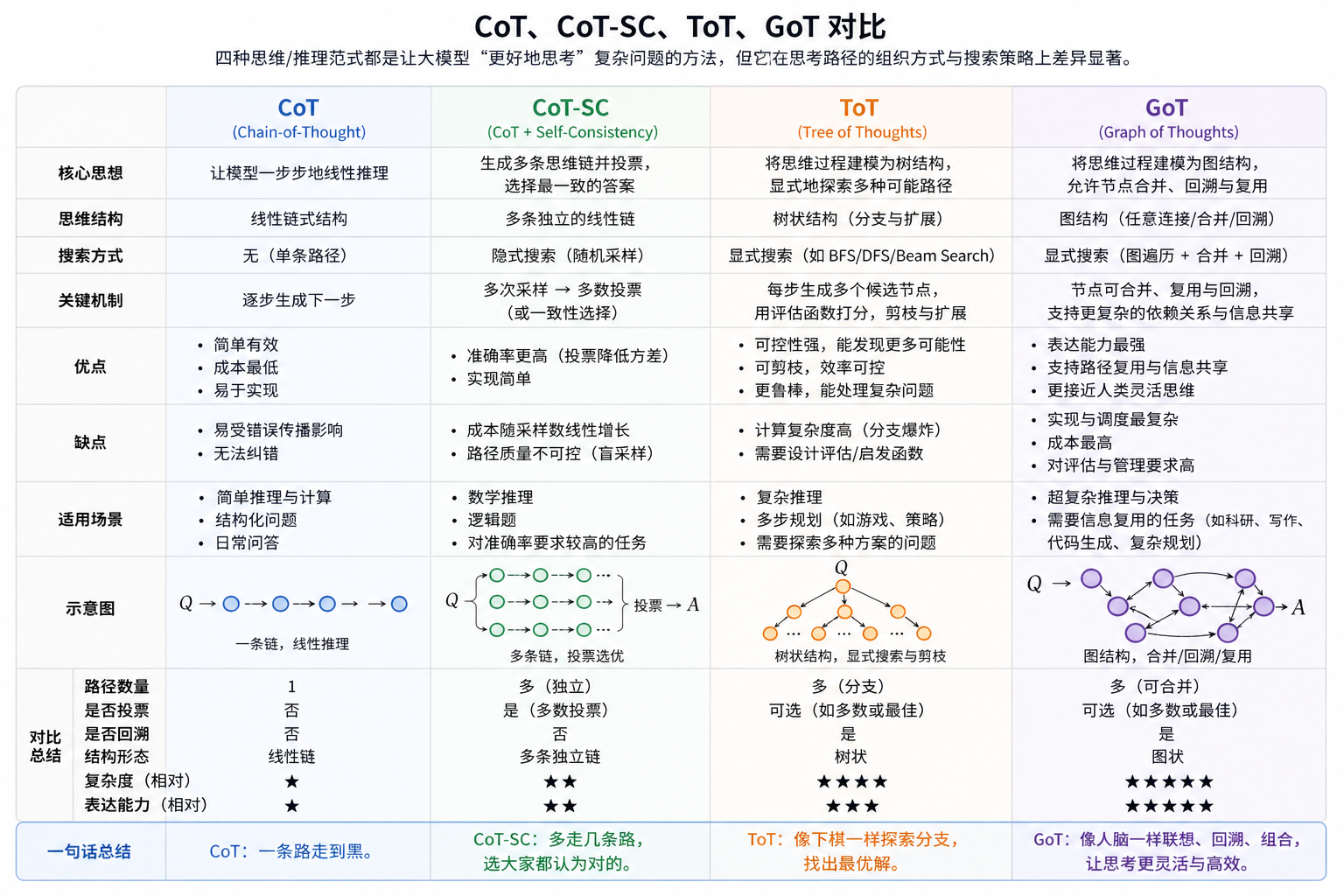
近年来,大语言模型(LLM)的能力提升不仅依赖模型规模,也越来越依赖 Prompt 设计范式。其中,"思维链"(Chain-of-Thought, CoT)相关方法的发展,几乎构成了一条清晰的演进路径:
线性(List) → 多路径采样 → 树结构(Tree) → 图结构(Graph)
CoT(Chain-of-Thought):线性思维链
核心思想
CoT(Chain-of-Thought)将推理过程显式化,把原本"黑盒"的推理变成:
<输入, 推理过程, 输出>
模型通过模仿示例中的推理步骤,生成中间 reasoning,再得出答案。
关键价值
- 分解复杂问题:将多步问题拆解为可处理的子步骤
- 提升可解释性:用户可以检查每一步推理
- 泛化能力强:数学、常识、符号推理均适用
- 易用性高:Few-shot 即可触发能力
本质抽象
👉 线性结构(List)
Step1 → Step2 → Step3 → Answer局限性
- 单路径推理
- 容易"一步错,步步错"
- 对随机性敏感
代码展示
👉 核心:在 prompt 里示范"推理过程"
python
from openai import OpenAI
client = OpenAI()

def cot(question):
    prompt = f"""
你需要一步一步推理再给出答案。

示例:
问:小明有3个苹果,又买了2个,一共有多少?
答:3 + 2 = 5,所以答案是5。

现在回答:
问:{question}
答:
"""

    resp = client.chat.completions.create(
        model="gpt-4o-mini",
        messages=[{"role": "user", "content": prompt}],
        temperature=0
    )
    return resp.choices[0].message.content


print(cot("一个袋子里有5个球,又放进去3个,现在有多少个?"))
CoT-SC(Self-Consistency):多路径投票
核心思想
Self-Consistency(SC)是对 CoT 的增强:
多次采样 CoT → 多条推理路径 → 投票选最一致答案
类比
"一题多解,结果一致才可信"
方法
-
多次生成 reasoning
-
使用:
- Majority Vote(最佳)
- Weighted Sum / Avg(略差)
优势
- 显著降低随机性带来的错误
- 提升准确率(特别是数学推理)
本质抽象
👉 多条 List + 聚合
Path1 → Answer A
Path2 → Answer B
Path3 → Answer A

→ 投票 → Answer A
局限性
- 计算成本高(多次采样)
- 推理仍是"独立路径",无交互
代码实现
👉 核心:多次生成 + 投票选答案
python
from collections import Counter

def extract_answer(text):
    # 简单提取最后的数字(实际可以更复杂)
    import re
    nums = re.findall(r'\d+', text)
    return nums[-1] if nums else text


def cot_sc(question, n=5):
    answers = []

    for _ in range(n):
        resp = client.chat.completions.create(
            model="gpt-4o-mini",
            messages=[{
                "role": "user",
                "content": f"请一步一步推理并回答:{question}"
            }],
            temperature=0.7  # 关键:提高随机性
        )
        output = resp.choices[0].message.content
        answers.append(extract_answer(output))

    # 投票
    final = Counter(answers).most_common(1)[0][0]
    return final, answers


result, paths = cot_sc("一个人有10元,花了3元,又赚了5元,还剩多少?")
print("所有路径:", paths)
print("最终答案:", result)
三、ToT(Tree of Thoughts):树状思维
核心思想
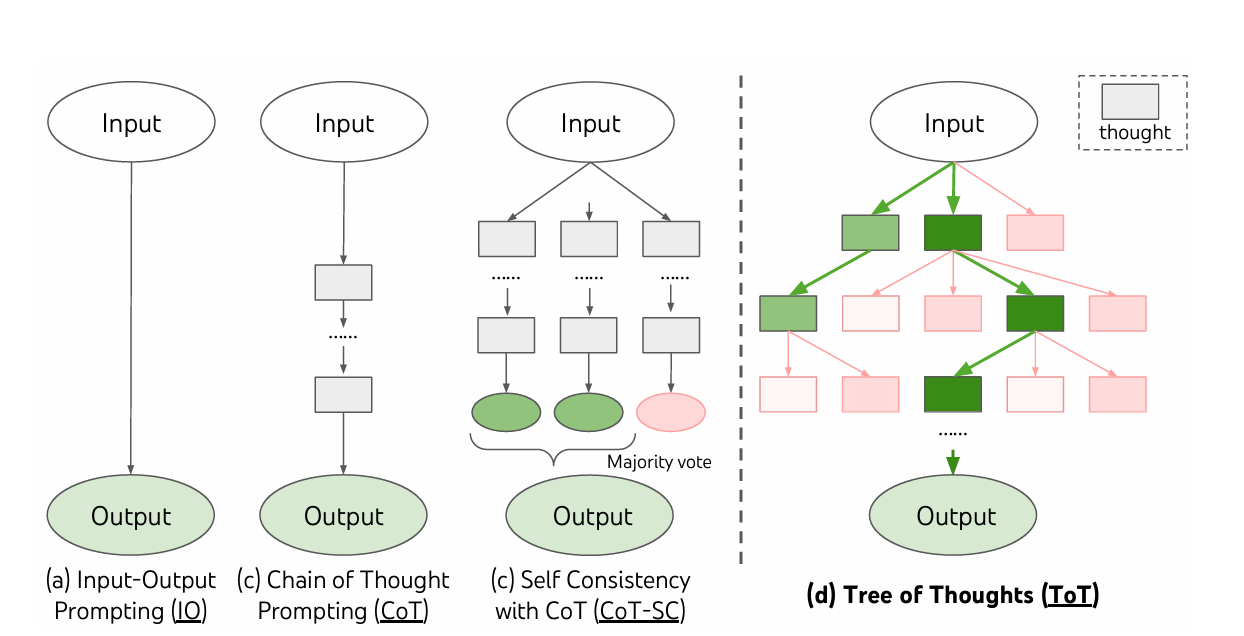
ToT(Tree of Thoughts)认为:
LLM 不擅长探索和规划 → 需要显式搜索过程
因此引入:多分支思考、状态评估、搜索策略(BFS / DFS)
四个核心问题
- 思维拆解(Thought Decomposition):将问题拆成多个"思考单元"
- 思维生成(Thought Generation):Sampling(多样性)+ Proposal(受约束生成)
- 状态评估(Evaluation):Value function + Voting(通常由 LLM 自评)
- 搜索算法:BFS(广度优先)+ DFS(深度优先 + 回溯)
本质抽象
👉 树结构(Tree)
关键突破
- 引入"搜索"概念
- 支持回溯(Backtracking)
- 模拟 System 2 思维
局限性
- 搜索空间爆炸
- 控制策略复杂
- 仍然是"层级结构",表达能力有限
代码实现
👉 核心:多路径展开 + 评估 + 剪枝
python
def generate_thoughts(state, k=3):
    prompt = f"""
当前问题状态:{state}
请给出接下来{ k }种可能的思路(简短)。
"""

    resp = client.chat.completions.create(
        model="gpt-4o-mini",
        messages=[{"role": "user", "content": prompt}],
        temperature=0.7
    )

    thoughts = resp.choices[0].message.content.split("\n")
    return thoughts[:k]


def evaluate_state(state):
    prompt = f"""
请评估以下思路是否有助于解决问题(0-10分):
{state}
只输出分数。
"""

    resp = client.chat.completions.create(
        model="gpt-4o-mini",
        messages=[{"role": "user", "content": prompt}],
        temperature=0
    )

    return float(resp.choices[0].message.content.strip())


def tot(question, depth=3, beam_width=2):
    states = [question]

    for _ in range(depth):
        candidates = []

        for state in states:
            thoughts = generate_thoughts(state)

            for t in thoughts:
                new_state = state + " -> " + t
                score = evaluate_state(new_state)
                candidates.append((new_state, score))

        # 保留最好的几个
        candidates.sort(key=lambda x: x[1], reverse=True)
        states = [c[0] for c in candidates[:beam_width]]

    return states


print(tot("用四个4得到24"))
GoT(Graph of Thoughts):图状思维
核心思想
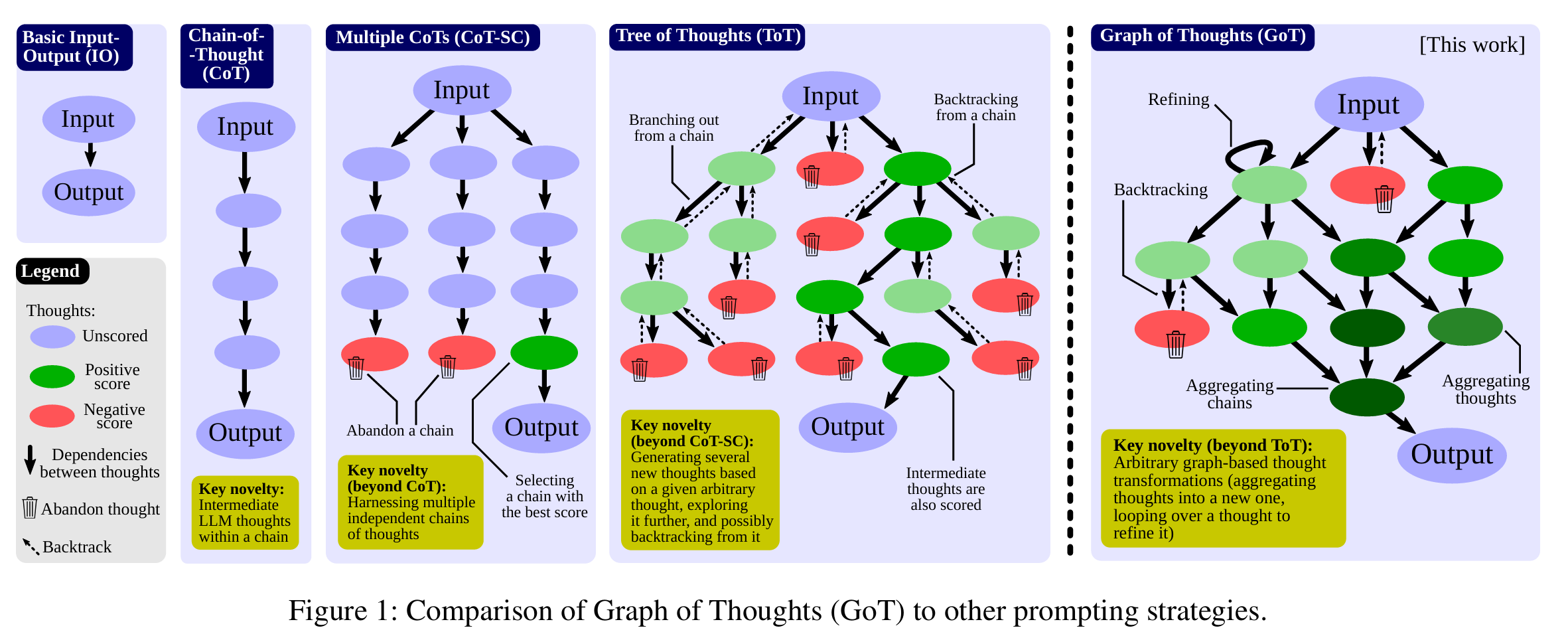
GoT(Graph of Thoughts)进一步提出:
人类思维不是线性或树状,而是网络结构
不同想法之间:可以交叉、可以合并、可以反复修正
核心操作
- Generation(生成) :
A → B, C - Aggregation(融合) :
A + B → D - Refinement(反思) :
A → A'
结构特征
- 有向图(Directed Graph)
- 异构节点(不同类型 thoughts)
- 节点间依赖关系
框架模块
- Prompter(图编码)
- Parser(解析 thoughts)
- Scoring & Validation(评估)
- Controller(决策控制)
- GRS(状态记录)
本质抽象
👉 图结构(Graph)
优势
- 更接近真实思维
- 支持信息复用
- 支持循环优化
局限性
- 实现复杂度高
- 强依赖任务设计(metric)
- 工程成本大
代码实现
👉 核心:图结构 + 多操作(生成 / 融合 / 反思)
python
class ThoughtGraph:
    def __init__(self):
        self.nodes = []
        self.edges = []

    def add_node(self, content):
        node_id = len(self.nodes)
        self.nodes.append(content)
        return node_id

    def add_edge(self, a, b):
        self.edges.append((a, b))


def generate(graph, node_id):
    content = graph.nodes[node_id]

    prompt = f"""
基于以下思路,生成2个新的想法:
{content}
"""

    resp = client.chat.completions.create(
        model="gpt-4o-mini",
        messages=[{"role": "user", "content": prompt}],
        temperature=0.7
    )

    new_thoughts = resp.choices[0].message.content.split("\n")[:2]

    new_ids = []
    for t in new_thoughts:
        nid = graph.add_node(t)
        graph.add_edge(node_id, nid)
        new_ids.append(nid)

    return new_ids


def refine(graph, node_id):
    content = graph.nodes[node_id]

    prompt = f"""
优化这个思路,让它更清晰:
{content}
"""

    resp = client.chat.completions.create(
        model="gpt-4o-mini",
        messages=[{"role": "user", "content": prompt}],
        temperature=0
    )

    improved = resp.choices[0].message.content
    new_id = graph.add_node(improved)
    graph.add_edge(node_id, new_id)

    return new_id


def merge(graph, id1, id2):
    prompt = f"""
融合以下两个思路:
A: {graph.nodes[id1]}
B: {graph.nodes[id2]}
"""

    resp = client.chat.completions.create(
        model="gpt-4o-mini",
        messages=[{"role": "user", "content": prompt}],
        temperature=0
    )

    merged = resp.choices[0].message.content
    new_id = graph.add_node(merged)
    graph.add_edge(id1, new_id)
    graph.add_edge(id2, new_id)

    return new_id


def got(question):
    graph = ThoughtGraph()

    root = graph.add_node(question)

    # 生成
    children = generate(graph, root)

    # refine
    refined = refine(graph, children[0])

    # merge
    final = merge(graph, refined, children[1])

    return graph


g = got("如何提高学习效率?")
print("节点:", g.nodes)
print("边:", g.edges)
方法对比
| 方法 | 结构 | 复杂度 | 核心创新 | 主要问题 |
|---|---|---|---|---|
| CoT | List | ⭐ | 显式推理链 | 单路径 |
| CoT-SC | 多 List | ⭐⭐ | 多路径投票 | 成本高 |
| ToT | Tree | ⭐⭐⭐ | 搜索+回溯 | 搜索爆炸 |
| GoT | Graph | ⭐⭐⭐⭐ | 非线性思维建模 | 实现复杂 |
总结:CoT 让模型"会解释",ToT 让模型"会探索",GoT 让模型"会思考"。
相关资料
CoT: https://export.arxiv.org/pdf/2201.11903v6
CoT-SC: https://export.arxiv.org/pdf/2203.11171v4