1.习题5.4
有 3 个整数 a、b、c,由键盘输入,输出其中最大的数。
c
#include<stdio.h>

void main() {
    int a, b, c, max;
    printf("input a,b,c: \n");
    scanf("%d,%d,%d", &a, &b, &c);

    if (a < b) {
        max = b;
    }else {
        max = a;
    }
    if (max < c) {
        max = c;
    }
    printf("max=%d\n", max);
}
2.习题5.5
有一个函数:
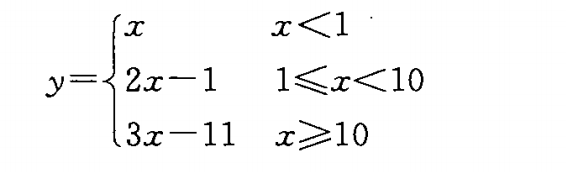
写一段程序,输入想x,输出y。
c
#include<stdio.h>

void main() {
    int x, y;
    printf("input x:\n");
    scanf("%d", &x);
    y = x < 1 ? x : x < 10 ? 2 * x - 1 : 3 * x - 11;
    printf("y=%d\n", y);
}
3.习题5.6

c
#include<stdio.h>

void main() {
    float score;
    char grade;
    printf("input score:");
    scanf("%f", &score);
    switch ((int) (score / 10)) {
        case 10:
        case 9: grade = 'A';
            break;
        case 8: grade = 'B';
            break;
        case 7: grade = 'C';
            break;
        case 6: grade = 'D';
            break;
        default: grade = 'E';
    }
    printf("score=%f\ngrade=%c\n", score, grade);
}
4.习题5.7
给一个不多于 5 位的正整数,要求:
① 求出它是几位数;
② 分别输出每一位数字;
③ 按逆序输出各位数字,例如原数为 321,应输出 123。
c
#include<stdio.h>

void main() {
    long int number;
    int ge, shi, bai, qian, wan, wei;
    printf("input number:\n");
    scanf("%ld", &number);
    wei = number > 9999 ? 5 : number > 999 ? 4 : number > 99 ? 3 : number > 9 ? 2 : 1;
    wan = number / 10000;
    qian = number % 10000 / 1000;
    bai = number % 1000 / 100;
    shi = number % 100 / 10;
    ge = number % 10;
    switch (wei) {
        case 5: printf("%d %d %d %d %d\n", wan, qian, bai, shi, ge);
            printf("逆序:");
            printf("%d%d%d%d%d\n", ge, shi, bai, qian, wan);
            break;
        case 4: printf("%d %d %d %d\n", qian, bai, shi, ge);
            printf("逆序:");
            printf("%d%d%d%d\n", ge, shi, bai, qian);
            break;
        case 3: printf("%d %d %d\n", bai, shi, ge);
            printf("逆序:");
            printf("%d%d%d\n", ge, shi, bai);
            break;
        case 2: printf("%d %d\n", shi, ge);
            printf("逆序:");
            printf("%d%d\n", ge, shi);
            break;
        case 1: printf("%d\n", ge);
            printf("逆序:");
            printf("%d\n", ge);
            break;
    }
}
5.习题5.8
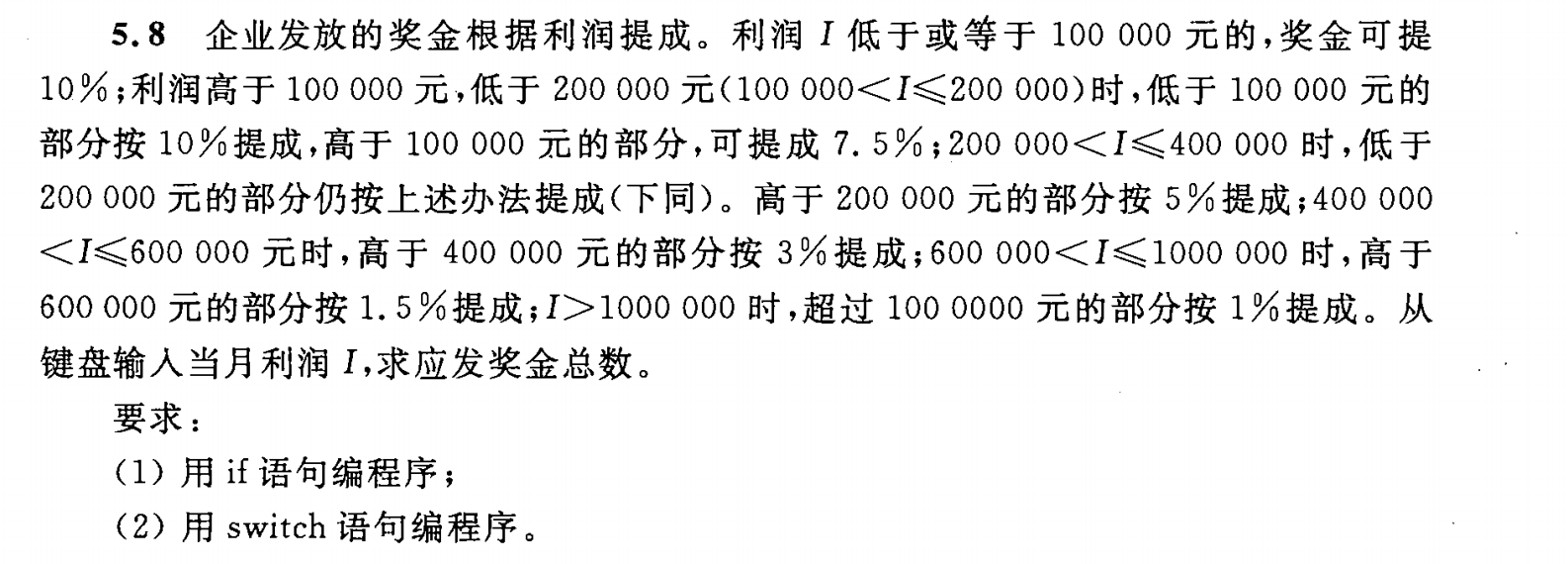
c
#include<stdio.h>

void main() {
    long i;
    float bonus, bon1, bon2, bon4, bon6, bon10;
    long c;
    bon1 = 100000 * 0.1;
    bon2 = bon1 + 100000 * 0.075;
    bon4 = bon2 + 200000 * 0.05;
    bon6 = bon4 + 200000 * 0.03;
    bon10 = bon6 + 400000 * 0.015;
    printf("input i:");
    scanf("%ld", &i);
#if(0)
    c = i / 100000;
    if (c > 10) {
        c = 10;
    }

    switch (c) {
        case 0: bonus = i * 0.1;
            break;
        case 1: bonus = bon1 + (i - 100000) * 0.075;
            break;
        case 2:
        case 3: bonus = bon2 + (i - 200000) * 0.05;
            break;
        case 4:
        case 5: bonus = bon4 + (i - 400000) * 0.03;
            break;
        case 6:
        case 7:
        case 8:
        case 9: bonus = bon6 + (i - 600000) * 0.015;
            break;
        case 10:
            bonus = bon10 + (i - 1000000) * 0.01;
    }
#endif
    if (i <= 100000)
        bonus = i * 0.1;
    else if (i <= 200000)
        bonus = bon1 + (i - 100000) * 0.075;
    else if (i <= 400000)
        bonus = bon2 + (i - 200000) * 0.05;
    else if (i <= 600000)
        bonus = bon4 + (i - 400000) * 0.03;
    else if (i <= 1000000)
        bonus = bon6 + (i - 600000) * 0.015;
    else
        bonus = bon10 + (i - 1000000) * 0.01;
    printf("奖金:%f\n", bonus);
}
6.习题5.9
输入4个整数,要求按由小到大的顺序输出
c
#include<stdio.h>

void main() {
    int t, a, b, c, d;
    printf("input:\n");
    scanf("%d%d%d%d", &a, &b, &c, &d);
    printf("a=%d\nb=%d\nc=%d\nd=%d\n", a, b, c, d);
    // 选择排序
    if (a > b) {
        t = a;
        a = b;
        b = t;
    }
    if (a > c) {
        t = a;
        a = c;
        c = t;
    }
    if (a > d) {
        t = a;
        a = d;
        d = t;
    }
    if (b > c) {
        t = b;
        b = c;
        c = t;
    }
    if (b > d) {
        t = b;
        b = d;
        d = t;
    }
    if (c > d) {
        t = c;
        c = d;
        d = t;
    }
    printf("%d-->%d-->%d-->%d", a, b, c, d);
}
6.习题5.10
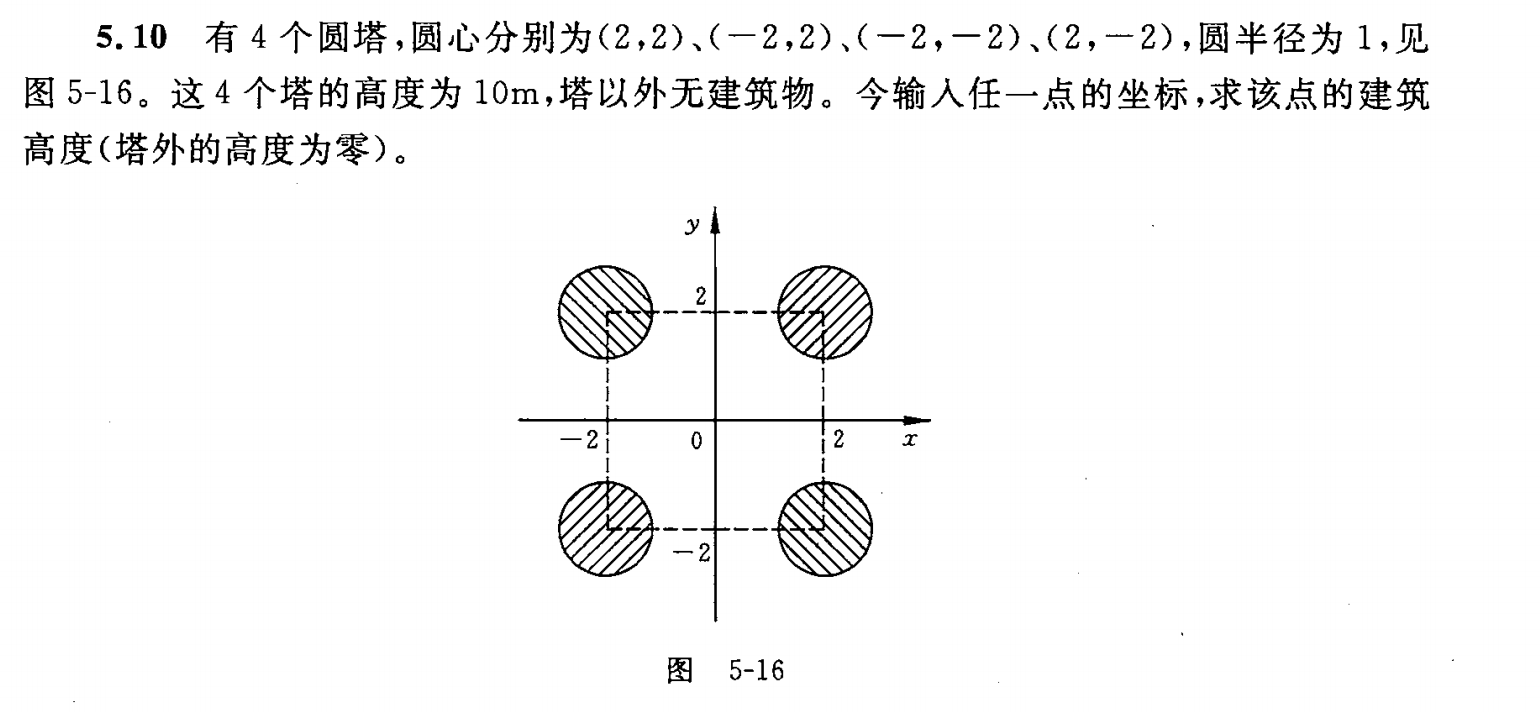
c
#include <stdio.h>

int main() {
    int h = 10;
    float x, y, d1, d2, d3, d4;
    const float r_sq = 1.0; // 半径平方(r=1,r²=1)

    printf("input x y:\n");
    scanf("%f%f", &x, &y);

    // 计算到四个圆心的距离平方
    d1 = (x - 2) * (x - 2) + (y - 2) * (y - 2);    // (2,2)
    d2 = (x + 2) * (x + 2) + (y - 2) * (y - 2);    // (-2,2)
    d3 = (x + 2) * (x + 2) + (y + 2) * (y + 2);    // (-2,-2)
    d4 = (x - 2) * (x - 2) + (y + 2) * (y + 2);    // (2,-2)

    // 只要在任意一个圆内(距离平方 ≤ 半径平方),高度为10
    if (d1 > r_sq && d2 > r_sq && d3 > r_sq && d4 > r_sq) {
        h = 0;
    }

    printf("h=%d\n", h);
    return 0;
}