DelayQueue 是一个支持延时获取元素的阻塞队列, 内部采用优先队列 PriorityQueue 存储元素,同时元素必须实现 Delayed 接口;在创建元素时可以指定多久才可以从队列中获取当前元素,只有在延迟期满时才能从队列中提取元素。延迟队列的特点是:不是先进先出,而是会按照延迟时间的长短来排序,下一个即将执行的任务会排到队列的最前面。
DelayQueue运用:
java
public class DelayQueueDemo {

    public static void main(String[] args) throws InterruptedException {

        //实例化一个DelayQueue
        BlockingQueue<DelayObject> blockingQueue = new DelayQueue<>();

        //向DelayQueue添加四个元素对象,注意延时时间不同
        blockingQueue.put(new DelayObject("A", 1000 * 10));  //延时10秒
        blockingQueue.put(new DelayObject("B", 4000 * 10));  //延时40秒
        blockingQueue.put(new DelayObject("C", 3000 * 10));  //延时30秒
        blockingQueue.put(new DelayObject("D", 2000 * 10));  //延时20秒


        //将对象从DelayQueue取出,注意取出的顺序与延时时间有关
        System.out.println(blockingQueue.take());  //取出A
        System.out.println(blockingQueue.take());  //取出D
        System.out.println(blockingQueue.take());  //取出C
        System.out.println(blockingQueue.take());  //取出B
    }

}


class DelayObject implements Delayed {
    private String name;
    private long time;   //延时时间

    public DelayObject(String name, long delayTime) {
        this.name = name;
        this.time = System.currentTimeMillis() + delayTime;
    }

    @Override
    public long getDelay(TimeUnit unit) {
        long diff = time - System.currentTimeMillis();
        return unit.convert(diff, TimeUnit.MILLISECONDS);
    }

    @Override
    public int compareTo(Delayed obj) {
        if (this.time < ((DelayObject) obj).time) {
            return -1;
        }
        if (this.time > ((DelayObject) obj).time) {
            return 1;
        }
        return 0;
    }

    @Override
    public String toString() {
        Date date = new Date(time);
        SimpleDateFormat sd = new SimpleDateFormat("yyyy-MM-dd HH:mm:ss");

        return "\nDelayObject:{"
                + "name=" + name
                + ", time=" + sd.format(date)
                + "}";
    }
}
运行结果:
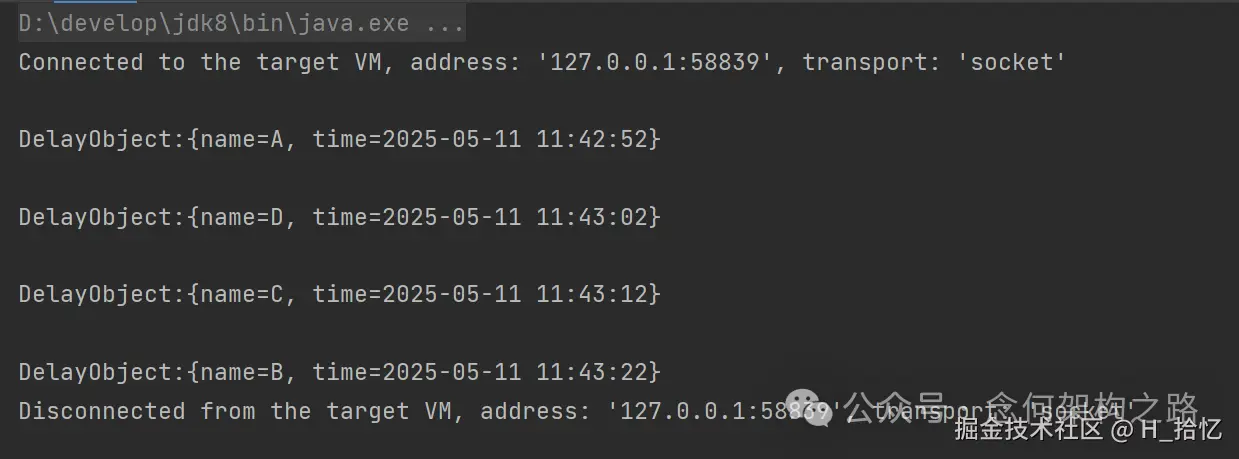
从打印的时间可以看出每隔十秒输出一次.实现了延迟的效果.
构造方法:
java
    /**
     * Creates a new {@code DelayQueue} that is initially empty.
     */
    public DelayQueue() {}

    /**
     * Creates a {@code DelayQueue} initially containing the elements of the
     * given collection of {@link Delayed} instances.
     *
     * @param c the collection of elements to initially contain
     * @throws NullPointerException if the specified collection or any
     *         of its elements are null
     */
    public DelayQueue(Collection<? extends E> c) {
        this.addAll(c);
}一个是无参数构造方法,另一个构造方法是传入一个集合.
addAll方法:
typescript
    /**
     * Adds all of the elements in the specified collection to this
     * queue.  Attempts to addAll of a queue to itself result in
     * <tt>IllegalArgumentException</tt>. Further, the behavior of
     * this operation is undefined if the specified collection is
     * modified while the operation is in progress.
     *
     * <p>This implementation iterates over the specified collection,
     * and adds each element returned by the iterator to this
     * queue, in turn.  A runtime exception encountered while
     * trying to add an element (including, in particular, a
     * <tt>null</tt> element) may result in only some of the elements
     * having been successfully added when the associated exception is
     * thrown.
     *
     * @param c collection containing elements to be added to this queue
     * @return <tt>true</tt> if this queue changed as a result of the call
     * @throws ClassCastException if the class of an element of the specified
     *         collection prevents it from being added to this queue
     * @throws NullPointerException if the specified collection contains a
     *         null element and this queue does not permit null elements,
     *         or if the specified collection is null
     * @throws IllegalArgumentException if some property of an element of the
     *         specified collection prevents it from being added to this
     *         queue, or if the specified collection is this queue
     * @throws IllegalStateException if not all the elements can be added at
     *         this time due to insertion restrictions
     * @see #add(Object)
     */
    public boolean addAll(Collection<? extends E> c) {
        if (c == null)
            throw new NullPointerException();
        if (c == this)
            throw new IllegalArgumentException();
        boolean modified = false;
        for (E e : c)
            if (add(e))
                modified = true;
        return modified;
    }
如果集合为空抛出空指针异常.如果集合相等,抛出参数一样.都不满足条件.会挨个调用add方法加入.
数据结构:
java
 private final transient ReentrantLock lock = new ReentrantLock();
    private final PriorityQueue<E> q = new PriorityQueue<E>();

    /**
     * Thread designated to wait for the element at the head of
     * the queue.  This variant of the Leader-Follower pattern
     * (http://www.cs.wustl.edu/~schmidt/POSA/POSA2/) serves to
     * minimize unnecessary timed waiting.  When a thread becomes
     * the leader, it waits only for the next delay to elapse, but
     * other threads await indefinitely.  The leader thread must
     * signal some other thread before returning from take() or
     * poll(...), unless some other thread becomes leader in the
     * interim.  Whenever the head of the queue is replaced with
     * an element with an earlier expiration time, the leader
     * field is invalidated by being reset to null, and some
     * waiting thread, but not necessarily the current leader, is
     * signalled.  So waiting threads must be prepared to acquire
     * and lose leadership while waiting.
     */
    private Thread leader = null;

    /**
     * Condition signalled when a newer element becomes available
     * at the head of the queue or a new thread may need to
     * become leader.
     */
    private final Condition available = lock.newCondition();
1.lock:通过锁来保证线程安全.
2.q:优先级队列,存储元素,保证延迟低的优先出队执行.
3.leader:用于标记当前是否有线程在排队(仅用于取元素时) leader 指向的是第一个从队列获取元素阻塞的线程.
4.available:条件队列.
put方法:
java
    /**
     * Inserts the specified element into this queue, waiting if necessary
     * for space to become available.
     *
     * @param e the element to add
     * @throws InterruptedException if interrupted while waiting
     * @throws ClassCastException if the class of the specified element
     *         prevents it from being added to this queue
     * @throws NullPointerException if the specified element is null
     * @throws IllegalArgumentException if some property of the specified
     *         element prevents it from being added to this queue
     */
    void put(E e) throws InterruptedException;

        /**
     * Inserts the specified element into this delay queue. As the queue is
     * unbounded this method will never block.
     *
     * @param e the element to add
     * @throws NullPointerException {@inheritDoc}
     */
    public void put(E e) {
        offer(e);
    }
offer方法:
java
    /**
     * Inserts the specified element into this delay queue.
     *
     * @param e the element to add
     * @return {@code true}
     * @throws NullPointerException if the specified element is null
     */
    public boolean offer(E e) {
        final ReentrantLock lock = this.lock;
        lock.lock();
        try {
            q.offer(e);
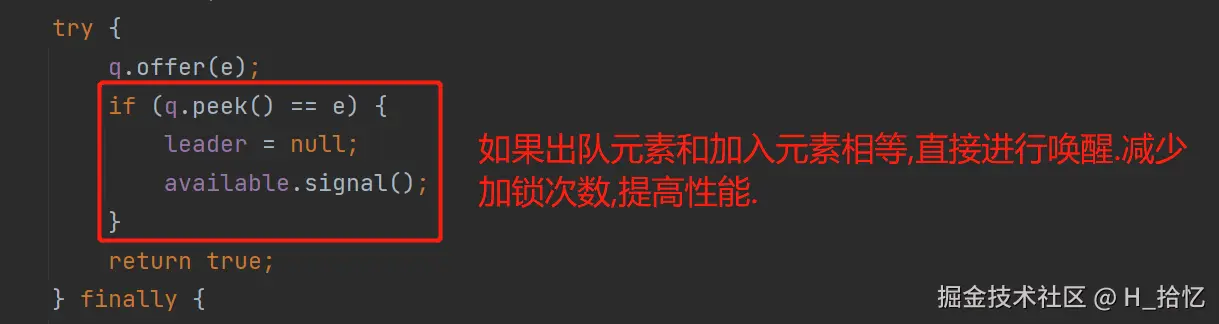
            if (q.peek() == e) {
                leader = null;
                available.signal();
            }
            return true;
        } finally {
            lock.unlock();
        }
    }
方法理解:
1.老套路,加锁解锁.保证并发下的线程安全.
2.offer方法:
java
    /**
     * Inserts the specified element into this priority queue.
     *
     * @return {@code true} (as specified by {@link Queue#offer})
     * @throws ClassCastException if the specified element cannot be
     *         compared with elements currently in this priority queue
     *         according to the priority queue's ordering
     * @throws NullPointerException if the specified element is null
     */
    public boolean offer(E e) {
        if (e == null)
            throw new NullPointerException();
        modCount++;
        int i = size;
        if (i >= queue.length)
            grow(i + 1);
        size = i + 1;
        if (i == 0)
            queue[0] = e;
        else
            siftUp(i, e);
        return true;
    }
1.:如果添加的元素为空,抛出空指针异常.
2.:如果是第一次添加元素进来,直接给数组零号位置放入.
3.:不是第一次添加元素,进行入队比较逻辑.
4.:如果放入元素数量超过初始容量大小进行扩容.
3.grow方法:
arduino
    /**
     * Increases the capacity of the array.
     *
     * @param minCapacity the desired minimum capacity
     */
    private void grow(int minCapacity) {
        int oldCapacity = queue.length;
        // Double size if small; else grow by 50%
        int newCapacity = oldCapacity + ((oldCapacity < 64) ?
                                         (oldCapacity + 2) :
                                         (oldCapacity >> 1));
        // overflow-conscious code
        if (newCapacity - MAX_ARRAY_SIZE > 0)
            newCapacity = hugeCapacity(minCapacity);
        queue = Arrays.copyOf(queue, newCapacity);
    }
扩容大致和优先级阻塞队列相似.可以参考上一篇文章.
3.1hugeCapacity方法:
arduino
 private static int hugeCapacity(int minCapacity) {
        if (minCapacity < 0) // overflow
            throw new OutOfMemoryError();
        return (minCapacity > MAX_ARRAY_SIZE) ?
            Integer.MAX_VALUE :
            MAX_ARRAY_SIZE;
    }
根据当前数组容量进行加一来判断扩容的具体值是多少.
4:siftUp方法:
java
    /**
     * Inserts item x at position k, maintaining heap invariant by
     * promoting x up the tree until it is greater than or equal to
     * its parent, or is the root.
     *
     * To simplify and speed up coercions and comparisons. the
     * Comparable and Comparator versions are separated into different
     * methods that are otherwise identical. (Similarly for siftDown.)
     *
     * @param k the position to fill
     * @param x the item to insert
     */
    private void siftUp(int k, E x) {
        if (comparator != null)
            siftUpUsingComparator(k, x);
        else
            siftUpComparable(k, x);
    }
如果比较器为空,就进入siftUpUsingComparator方法,不为空进入siftUpComparable方法.
4.1:siftUpUsingComparator方法:
ini
 private void siftUpUsingComparator(int k, E x) {
        while (k > 0) {
            int parent = (k - 1) >>> 1;
            Object e = queue[parent];
            if (comparator.compare(x, (E) e) >= 0)
                break;
            queue[k] = e;
            k = parent;
        }
        queue[k] = x;
    }
4.2:siftUpComparable方法:
ini
 private void siftUpComparable(int k, E x) {
        Comparable<? super E> key = (Comparable<? super E>) x;
        while (k > 0) {
            int parent = (k - 1) >>> 1;
            Object e = queue[parent];
            if (key.compareTo((E) e) >= 0)
                break;
            queue[k] = e;
            k = parent;
        }
        queue[k] = key;
    }
take方法:
ini
    /**
     * Retrieves and removes the head of this queue, waiting if necessary
     * until an element becomes available.
     *
     * @return the head of this queue
     * @throws InterruptedException if interrupted while waiting
     */
    E take() throws InterruptedException;

        /**
     * Retrieves and removes the head of this queue, waiting if necessary
     * until an element with an expired delay is available on this queue.
     *
     * @return the head of this queue
     * @throws InterruptedException {@inheritDoc}
     */
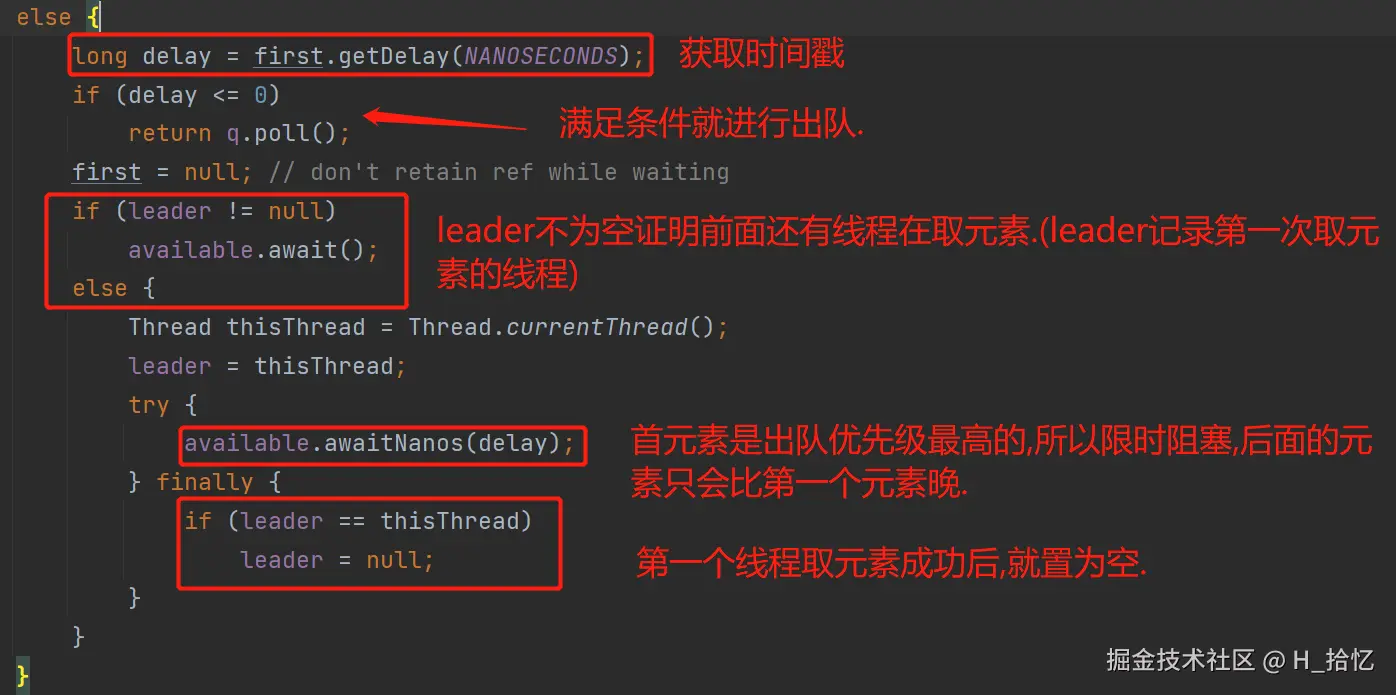
    public E take() throws InterruptedException {
        final ReentrantLock lock = this.lock;
        lock.lockInterruptibly();
        try {
            for (;;) {
                E first = q.peek();
                if (first == null)
                    available.await();
                else {
                    long delay = first.getDelay(NANOSECONDS);
                    if (delay <= 0)
                        return q.poll();
                    first = null; // don't retain ref while waiting
                    if (leader != null)
                        available.await();
                    else {
                        Thread thisThread = Thread.currentThread();
                        leader = thisThread;
                        try {
                            available.awaitNanos(delay);
                        } finally {
                            if (leader == thisThread)
                                leader = null;
                        }
                    }
                }
            }
        } finally {
            if (leader == null && q.peek() != null)
                available.signal();
            lock.unlock();
        }
    }
方法理解:

1.peek方法:
arduino
 public E peek() {
        return (size == 0) ? null : (E) queue[0];
    }
2.poll方法 :
ini
 public E poll() {
        if (size == 0)
            return null;
        int s = --size;
        modCount++;
        E result = (E) queue[0];
        E x = (E) queue[s];
        queue[s] = null;
        if (s != 0)
            siftDown(0, x);
        return result;
    }
1.:如果size为0的话,证明没有元素了.返回空.
2.:取出0号索引位置的元素.进行返回.
3.:取出最后一个元素,然后将其置为空,进行下沉.
3.siftDown方法:
java
    /**
     * Inserts item x at position k, maintaining heap invariant by
     * demoting x down the tree repeatedly until it is less than or
     * equal to its children or is a leaf.
     *
     * @param k the position to fill
     * @param x the item to insert
     */
    private void siftDown(int k, E x) {
        if (comparator != null)
            siftDownUsingComparator(k, x);
        else
            siftDownComparable(k, x);
    }
4:.siftDownUsingComparator方法:
ini
  private void siftDownUsingComparator(int k, E x) {
        int half = size >>> 1;
        while (k < half) {
            int child = (k << 1) + 1;
            Object c = queue[child];
            int right = child + 1;
            if (right < size &&
                comparator.compare((E) c, (E) queue[right]) > 0)
                c = queue[child = right];
            if (comparator.compare(x, (E) c) <= 0)
                break;
            queue[k] = c;
            k = child;
        }
        queue[k] = x;
    }
siftDownComparable方法:
ini
private void siftDownComparable(int k, E x) {
        Comparable<? super E> key = (Comparable<? super E>)x;
        int half = size >>> 1;        // loop while a non-leaf
        while (k < half) {
            int child = (k << 1) + 1; // assume left child is least
            Object c = queue[child];
            int right = child + 1;
            if (right < size &&
                ((Comparable<? super E>) c).compareTo((E) queue[right]) > 0)
                c = queue[child = right];
            if (key.compareTo((E) c) <= 0)
                break;
            queue[k] = c;
            k = child;
        }
        queue[k] = key;
}语雀地址www.yuque.com/itbosunmian...?
《Go.》 密码:xbkk 欢迎大家访问.提意见.