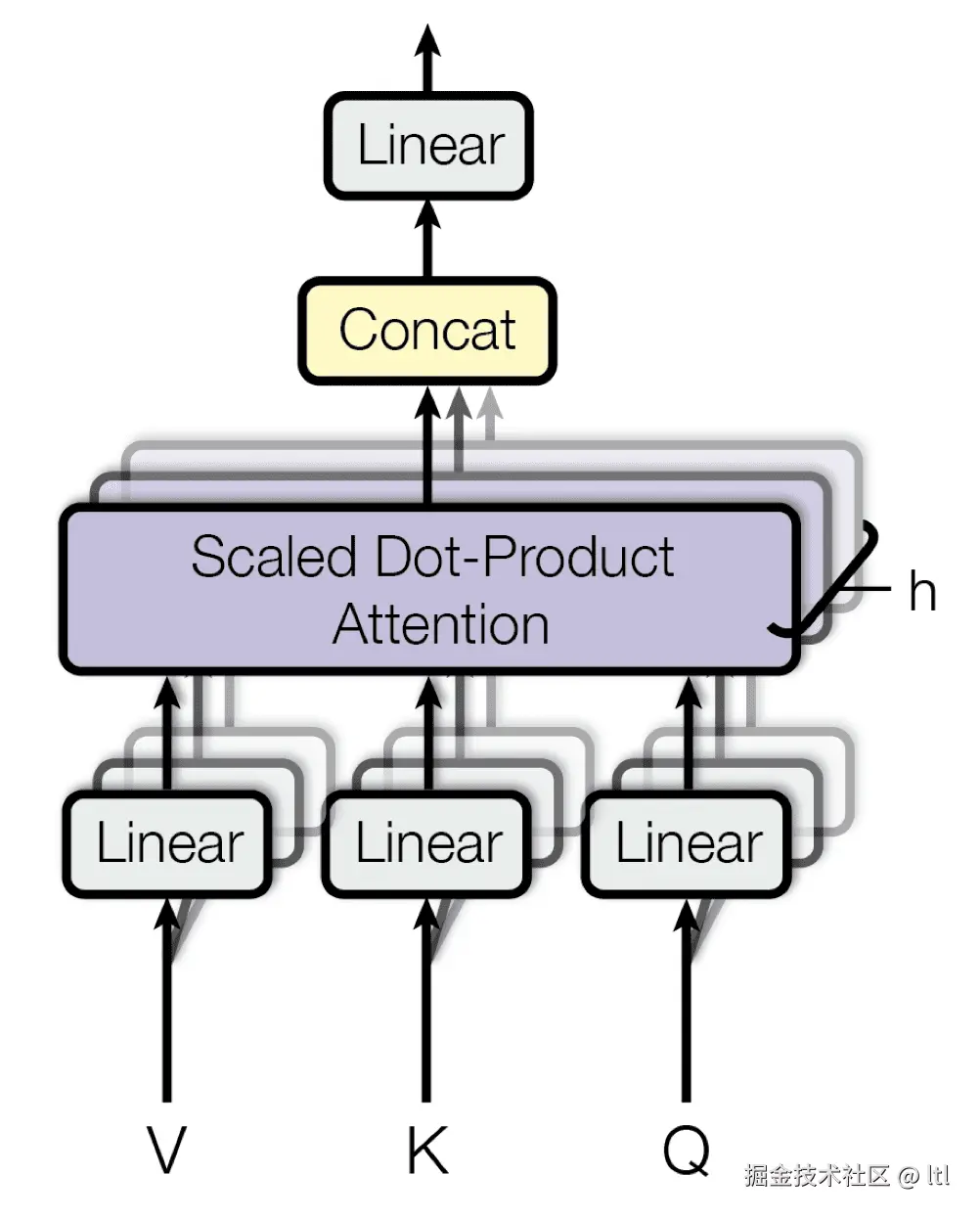
如果你只读本系列的一篇,这一篇的优先级最高。
Q、K、V 这三个字母,是从 Bahdanau 的 additive attention 抽象出来的「三件套」。一旦把这三件套立起来,Transformer、cross-attention、multi-head、causal mask、KV cache、FlashAttention------后面所有 attention 相关的概念,都只是「三件套的不同排列组合」。
这一篇会用最长的篇幅、最具体的数字,把 Q/K/V 讲透。读完之后你应该能做到:
- 看到 <math xmlns="http://www.w3.org/1998/Math/MathML"> s o f t m a x ( Q K ⊤ / d k ) V softmax(QK^\top/\sqrt{d_k})V </math>softmax(QK⊤/dk )V 这一行,立刻在脑子里把每一项的语义、形状、来历说清楚;
- 理解为什么 K 和 V 要分开(即使它们经常用同一份输入投影出来);
- 在草稿纸上手算一个三 token、d_k=2 的最小例子,且每一步的形状都对得上。
先把这条主公式贴出来,然后我们一节一节地拆它:
<math xmlns="http://www.w3.org/1998/Math/MathML" display="block"> Attention ( Q , K , V ) = softmax ( Q K ⊤ d k ) V \text{Attention}(Q, K, V) = \text{softmax}\left(\frac{QK^\top}{\sqrt{d_k}}\right) V </math>Attention(Q,K,V)=softmax(dk QK⊤)V
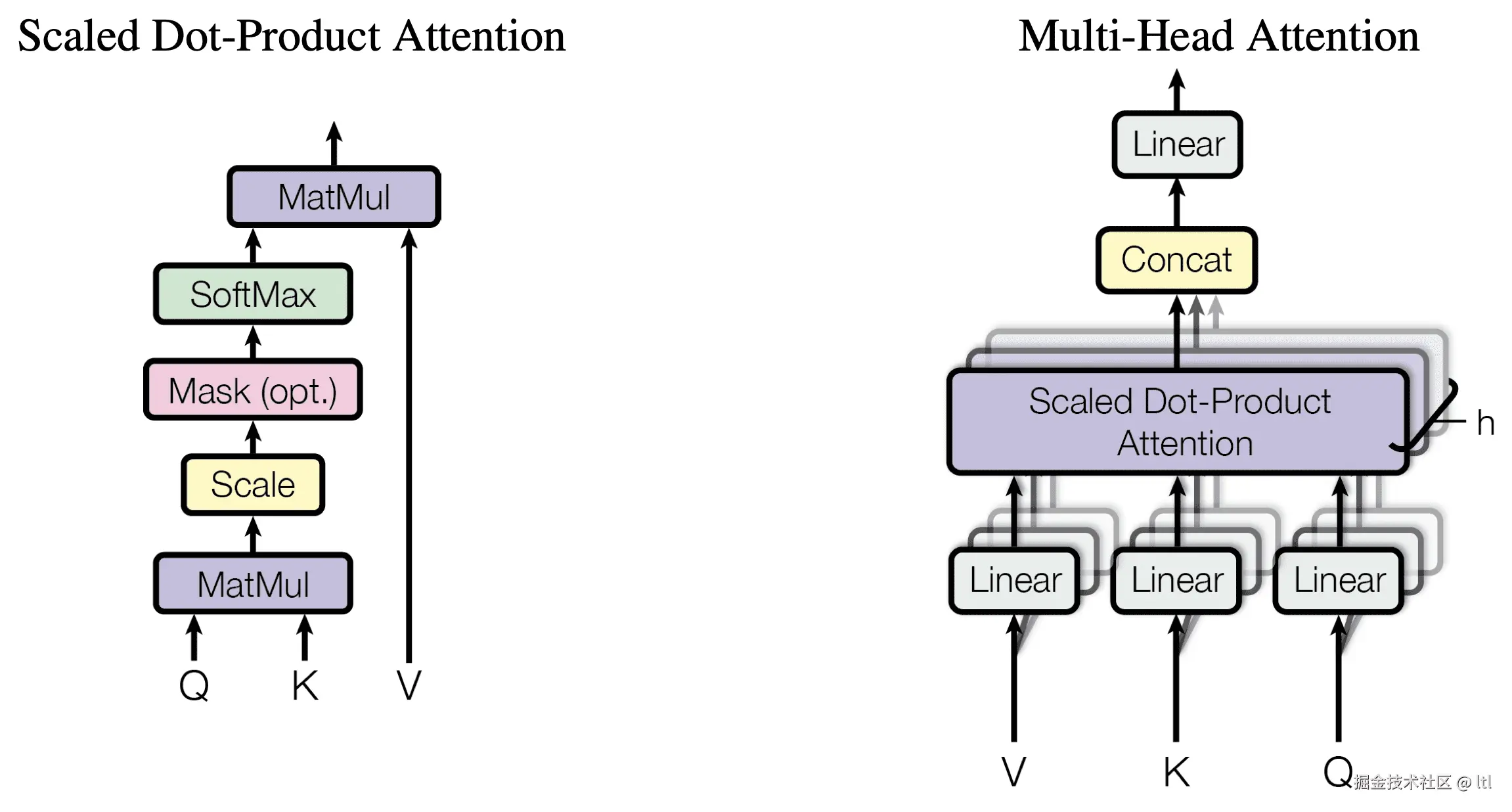
0、先看两张经典图
下面两张图可以先建立一个整体直觉,再继续读后面的逐项拆解:
第一张是 Scaled Dot-Product Attention(展示 <math xmlns="http://www.w3.org/1998/Math/MathML"> Q K ⊤ / d k QK^\top / \sqrt{d_k} </math>QK⊤/dk 与 softmax 后再乘 <math xmlns="http://www.w3.org/1998/Math/MathML"> V V </math>V 的主流程)。

第二张是 Transformer 总体结构图(标出 encoder/decoder 内的 attention 模块位置)。 
一、信息检索:从硬命中到软加权
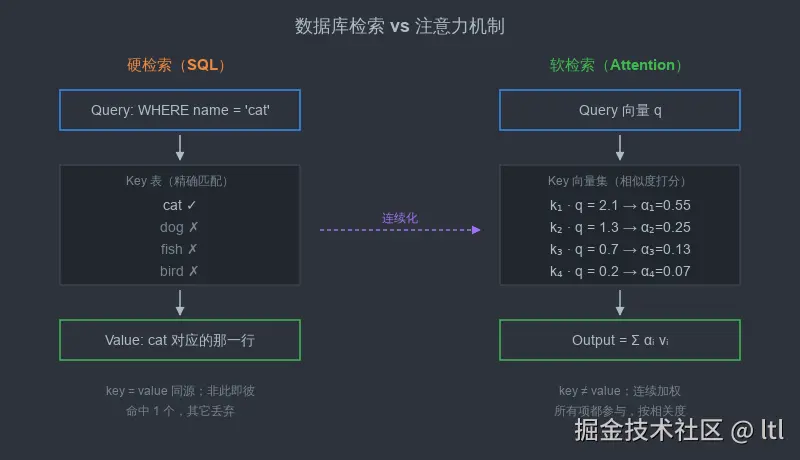
1.1 一个数据库查询
先抛开神经网络,回到 SQL。
你有一张 animals 表,三列:id、name、description。
你跑一条查询:
sql
SELECT description FROM animals WHERE name = 'cat';
数据库做了三件事:
第一,把你输入的 'cat' 当成 Query(查询条件)。
第二,遍历表里每一行的 name 字段,作为 Key,与 Query 比较是否相等。
第三,对命中 的那一行,返回它的 description 字段------也就是 Value。
注意这里 Key 和 Value 来自同一张表的不同列:name 是「索引」,description 是「内容」。
它们刻意分开,就是为了让「索引」和「内容」可以独立设计------你用 name 找,但拿回的是 description。
1.2 硬检索的局限
SQL 的检索是「硬」的:
- 命中 = 1,没命中 = 0;
- 一次查询要么返回一行、要么返回零行(精确匹配);
- 多个候选若都满足条件,结果是它们的并集,不是「按相关度加权」。
这套范式在结构化数据上完美无瑕,但对自然语言、图像、连续表示来说,不行。
name = 'cat' 这种相等判断,对 「kitty」、「feline」、「the cat sat on the mat」都会失败。
我们需要一种相似度查询:「query 与 key 有多像?相似度越高,权重越大。」
而且「权重」最好是连续的、可微的------这样神经网络能反向传播。
1.3 软检索的形式化
把硬检索软化,结果就是 attention:
| 概念 | 硬检索 | 软检索(attention) |
|---|---|---|
| Query | 一个值 | 一个向量 <math xmlns="http://www.w3.org/1998/Math/MathML"> q q </math>q |
| Key | 字段(精确匹配) | 一组向量 <math xmlns="http://www.w3.org/1998/Math/MathML"> { k 1 , ... , k M } \{k_1, \ldots, k_M\} </math>{k1,...,kM} |
| Value | 命中行的另一个字段 | 一组向量 <math xmlns="http://www.w3.org/1998/Math/MathML"> { v 1 , ... , v M } \{v_1, \ldots, v_M\} </math>{v1,...,vM} |
| 相似度 | 等号判断( <math xmlns="http://www.w3.org/1998/Math/MathML"> 0 / 1 0/1 </math>0/1) | 内积或 MLP 打分(实数) |
| 选择 | 命中即返回 | <math xmlns="http://www.w3.org/1998/Math/MathML"> softmax \operatorname{softmax} </math>softmax 归一化为权重,所有候选都参与加权 |
| 输出 | 单条记录 | <math xmlns="http://www.w3.org/1998/Math/MathML"> ∑ i α i v i \sum_i \alpha_i v_i </math>∑iαivi,所有 value 的加权和 |
如果把「软检索」正式写成公式,单个 query 的 attention 就是:
<math xmlns="http://www.w3.org/1998/Math/MathML" display="block"> s i = score ( q , k i ) α i = exp ( s i ) ∑ j = 1 M exp ( s j ) o = ∑ i = 1 M α i v i \begin{aligned} s_i &= \operatorname{score}(q, k_i) \\ \alpha_i &= \frac{\exp(s_i)}{\sum_{j=1}^{M} \exp(s_j)} \\ o &= \sum_{i=1}^{M} \alpha_i v_i \end{aligned} </math>siαio=score(q,ki)=∑j=1Mexp(sj)exp(si)=i=1∑Mαivi
其中, <math xmlns="http://www.w3.org/1998/Math/MathML"> q q </math>q 是 query, <math xmlns="http://www.w3.org/1998/Math/MathML"> k i k_i </math>ki 是第 <math xmlns="http://www.w3.org/1998/Math/MathML"> i i </math>i 个 key, <math xmlns="http://www.w3.org/1998/Math/MathML"> v i v_i </math>vi 是与之配对的 value, <math xmlns="http://www.w3.org/1998/Math/MathML"> s i s_i </math>si 是 query 对第 <math xmlns="http://www.w3.org/1998/Math/MathML"> i i </math>i 个候选打出的相关度分数, <math xmlns="http://www.w3.org/1998/Math/MathML"> α i \alpha_i </math>αi 是 softmax 后得到的权重, <math xmlns="http://www.w3.org/1998/Math/MathML"> o o </math>o 是最终输出。
如果要和硬检索并排看,差别其实只有一句话:硬检索用的是 0/1 命中函数,软检索用的是连续分数再归一化。写成式子就是
<math xmlns="http://www.w3.org/1998/Math/MathML" display="block"> m i = 1 [ q = k i ] , α i = exp ( score ( q , k i ) ) ∑ j exp ( score ( q , k j ) ) m_i = \mathbf{1}[q = k_i], \qquad \alpha_i = \frac{\exp(\operatorname{score}(q, k_i))}{\sum_j \exp(\operatorname{score}(q, k_j))} </math>mi=1[q=ki],αi=∑jexp(score(q,kj))exp(score(q,ki))
也就是说,硬检索是「只取命中的那一项」,软检索是「所有候选都参与,但按相关度分配权重」。
这张对照表是「Q/K/V 是什么」的终极答案。
剩下的所有讨论,都是在这张表里塞各种实现细节。
1.4 一个反复被问的问题:Key 和 Value 真的需要分开吗
如果你在 SQL 里见过「name = description」的表,那它的 K 和 V 就是同一列。
attention 里同样允许这种退化情况------Bahdanau 2014 就是 <math xmlns="http://www.w3.org/1998/Math/MathML"> K = V = encoder hidden h i K = V = \text{encoder hidden } h_i </math>K=V=encoder hidden hi。
但允许 K 和 V 不同,比强制 K = V 更通用:
- K 可以专门为「打分」设计(比如关注语法位置);
- V 可以专门为「贡献信息」设计(比如关注语义内容)。
两者解耦后,模型有更大的表达空间。
Transformer 把这件事做绝了: <math xmlns="http://www.w3.org/1998/Math/MathML"> W K W_K </math>WK 和 <math xmlns="http://www.w3.org/1998/Math/MathML"> W V W_V </math>WV 是两个完全独立的矩阵,从同一个输入投影出两份不同的向量。
至于「同一个输入怎么会投出两份不同的向量」、「这两份向量为什么有意义」------后面有几节专门讲。
二、从 Bahdanau 到 Q/K/V
2.1 重写 Bahdanau 公式
第 12 篇里,我们写过 Bahdanau 的 additive attention:
<math xmlns="http://www.w3.org/1998/Math/MathML" display="block"> e t , i = v ⊤ tanh ( W 1 s t − 1 + W 2 h i ) α t , i = softmax ( e t , i ) c t = ∑ α t , i h i \begin{aligned} e_{t,i} &= v^\top \tanh(W_1 s_{t-1} + W_2 h_i) \\ \alpha_{t,i} &= \text{softmax}(e_{t,i}) \\ c_t &= \sum \alpha_{t,i} h_i \end{aligned} </math>et,iαt,ict=v⊤tanh(W1st−1+W2hi)=softmax(et,i)=∑αt,ihi
把它翻译成 Q/K/V 语言:
- <math xmlns="http://www.w3.org/1998/Math/MathML"> s t − 1 s_{t-1} </math>st−1 在每个时间步只有一个,是 decoder 的当前状态------Query(提问者)。
- <math xmlns="http://www.w3.org/1998/Math/MathML"> h i h_i </math>hi 是 encoder 每个 source 位置的 hidden state------同时是 Key (被打分的对象)和 Value(被加权求和的内容)。
- <math xmlns="http://www.w3.org/1998/Math/MathML"> e t , i e_{t,i} </math>et,i 是「Query 与第 i 个 Key 的相似度」------score。
- <math xmlns="http://www.w3.org/1998/Math/MathML"> α t , i \alpha_{t,i} </math>αt,i 是 score 经 softmax 归一化后的权重。
- <math xmlns="http://www.w3.org/1998/Math/MathML"> c t c_t </math>ct 是「权重 × Value 的加和」------output。
把这些代号塞回去:
<math xmlns="http://www.w3.org/1998/Math/MathML" display="block"> score i = f ( q , k i ) 其中 f ( ⋅ , ⋅ ) = v ⊤ tanh ( W 1 q + W 2 k i ) α i = softmax ( score i ) output = ∑ α i v i 其中 v i = k i (在 Bahdanau 里) \begin{aligned} \text{score}_i &= f(q, k_i) \quad \text{其中 } f(\cdot, \cdot) = v^\top \tanh(W_1 q + W_2 k_i) \\ \alpha_i &= \text{softmax}(\text{score}_i) \\ \text{output} &= \sum \alpha_i v_i \quad \text{其中 } v_i = k_i \text{(在 Bahdanau 里)} \end{aligned} </math>scoreiαioutput=f(q,ki)其中 f(⋅,⋅)=v⊤tanh(W1q+W2ki)=softmax(scorei)=∑αivi其中 vi=ki(在 Bahdanau 里)
形状对一对: <math xmlns="http://www.w3.org/1998/Math/MathML"> q ∈ R d s q \in \mathbb{R}^{d_s} </math>q∈Rds, <math xmlns="http://www.w3.org/1998/Math/MathML"> { k i , v i } ∈ R d h \{k_i, v_i\} \in \mathbb{R}^{d_h} </math>{ki,vi}∈Rdh(M 个), <math xmlns="http://www.w3.org/1998/Math/MathML"> output ∈ R d h \text{output} \in \mathbb{R}^{d_h} </math>output∈Rdh。
这就是把 Bahdanau 装进 Q/K/V 框架的样子。
2.2 三个独立的「演化」步骤
从 Bahdanau 到 Transformer 的 attention,本质上做了三件独立的事:
第一步:把 K 和 V 解耦 。Bahdanau 里 <math xmlns="http://www.w3.org/1998/Math/MathML"> k = v = h k = v = h </math>k=v=h;Transformer 里 <math xmlns="http://www.w3.org/1998/Math/MathML"> k = x W K k = xW_K </math>k=xWK, <math xmlns="http://www.w3.org/1998/Math/MathML"> v = x W V v = xW_V </math>v=xWV,是两个不同的投影。
第二步:把打分函数从 additive 换成 scaled dot-product 。 <math xmlns="http://www.w3.org/1998/Math/MathML"> v ⊤ tanh ( W 1 q + W 2 k ) v^\top \tanh(W_1 q + W_2 k) </math>v⊤tanh(W1q+W2k) → <math xmlns="http://www.w3.org/1998/Math/MathML"> q ⊤ k / d k q^\top k / \sqrt{d_k} </math>q⊤k/dk 。
第三步:把 query 也投影一次 。Bahdanau 直接拿 <math xmlns="http://www.w3.org/1998/Math/MathML"> s t − 1 s_{t-1} </math>st−1 当 <math xmlns="http://www.w3.org/1998/Math/MathML"> q q </math>q;Transformer 里 <math xmlns="http://www.w3.org/1998/Math/MathML"> q = x W Q q = xW_Q </math>q=xWQ,是又一个投影。
每一步都是独立可解的:第一步给了模型解耦索引和内容的能力;第二步换了一个 GPU 友好的相似度函数;第三步让 query 也在自己的子空间里学习。
把三步合起来,就有了 Transformer 的 attention。
2.3 为什么我们要 W_Q
Bahdanau 没有 W_Q。
那为什么 Transformer 要给 query 也加一层投影?
直觉理由:在 self-attention 里,同一个 token 既要当 query 又要当 key 又要当 value------如果不投影,三种角色用同一个向量,模型没法在三种角色上分别学习。
更严格地说: <math xmlns="http://www.w3.org/1998/Math/MathML"> W Q W_Q </math>WQ、 <math xmlns="http://www.w3.org/1998/Math/MathML"> W K W_K </math>WK、 <math xmlns="http://www.w3.org/1998/Math/MathML"> W V W_V </math>WV 把同一个 <math xmlns="http://www.w3.org/1998/Math/MathML"> x x </math>x 拉到三个不同的子空间,让 <math xmlns="http://www.w3.org/1998/Math/MathML"> q ⋅ k q \cdot k </math>q⋅k 的相似度不再受限于 <math xmlns="http://www.w3.org/1998/Math/MathML"> x ⋅ x x \cdot x </math>x⋅x 的几何(那个相似度永远等于 <math xmlns="http://www.w3.org/1998/Math/MathML"> ∥ x ∥ 2 \lVert x \rVert^2 </math>∥x∥2,平凡到没意义)。
这件事到第十四篇 self-attention 那里会再讲一次,但你现在就可以记住:self-attention 里没有 W_Q,attention 就退化成 trivial 的「每个 token 跟自己最像」。
三、Q/K/V 的几何与语义
3.1 三种角色
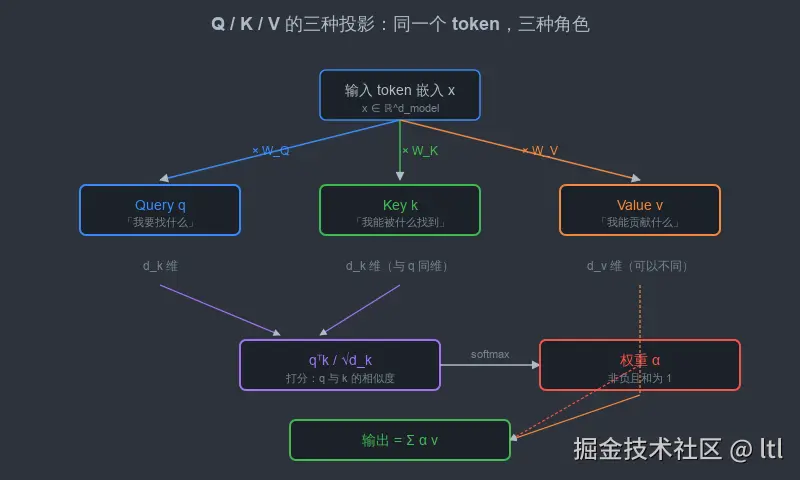
把同一个 token <math xmlns="http://www.w3.org/1998/Math/MathML"> x x </math>x 投影成 <math xmlns="http://www.w3.org/1998/Math/MathML"> q q </math>q、 <math xmlns="http://www.w3.org/1998/Math/MathML"> k k </math>k、 <math xmlns="http://www.w3.org/1998/Math/MathML"> v v </math>v 三份,可以理解为给它戴上三顶帽子:
- 戴 Query 帽:「我此刻在找什么样的信息?」
- 戴 Key 帽:「我能被什么样的提问命中?」
- 戴 Value 帽:「如果被命中,我能贡献什么内容?」
这三个问题在语义上完全不同。
举个例子,当前 token 是「sat」(动词)。
它当 Query 时可能在找主语(「谁在 sat」),所以 <math xmlns="http://www.w3.org/1998/Math/MathML"> q q </math>q 应该编码一种「主语指向」的信号。
它当 Key 时可能希望被「找动词」的提问命中,所以 <math xmlns="http://www.w3.org/1998/Math/MathML"> k k </math>k 应该编码「我是动词」的信号。
它当 Value 时贡献的是「这个动作的语义」,所以 <math xmlns="http://www.w3.org/1998/Math/MathML"> v v </math>v 应该编码动作的具体信息(时态、语态、语义角色等)。
<math xmlns="http://www.w3.org/1998/Math/MathML"> W Q W_Q </math>WQ、 <math xmlns="http://www.w3.org/1998/Math/MathML"> W K W_K </math>WK、 <math xmlns="http://www.w3.org/1998/Math/MathML"> W V W_V </math>WV 就是把同一个 <math xmlns="http://www.w3.org/1998/Math/MathML"> x x </math>x 拉到这三种语义空间的三个投影。
3.2 投影矩阵学到了什么
这是经验观察,不是定理:
- <math xmlns="http://www.w3.org/1998/Math/MathML"> W Q W_Q </math>WQ 学到的方向常常对应「这个 token 在找什么」------比如代词「it」的 <math xmlns="http://www.w3.org/1998/Math/MathML"> W Q W_Q </math>WQ 行为强烈倾向于找「最近的、可指代的名词」。
- <math xmlns="http://www.w3.org/1998/Math/MathML"> W K W_K </math>WK 学到的方向常常对应「这个 token 适合被什么找到」------名词的 <math xmlns="http://www.w3.org/1998/Math/MathML"> W K W_K </math>WK 容易被指代代词找到、动词的 <math xmlns="http://www.w3.org/1998/Math/MathML"> W K W_K </math>WK 容易被主语/宾语找到。
- <math xmlns="http://www.w3.org/1998/Math/MathML"> W V W_V </math>WV 学到的内容更接近「token 的语义指纹」------既要能被加权求和,又要在多层叠加下保持信息可分。
不同 head(multi-head attention)会学到不同的 <math xmlns="http://www.w3.org/1998/Math/MathML"> W Q / W K / W V W_Q/W_K/W_V </math>WQ/WK/WV,对应不同的「语法/语义关注模式」------有的 head 专门做指代消解,有的 head 专门做语法依存,有的 head 专门做局部上下文。
到第十六篇 multi-head 那里我们会把这件事拆开讲。
3.3 为什么是「投影」而不是别的非线性
<math xmlns="http://www.w3.org/1998/Math/MathML"> Q / K / V Q/K/V </math>Q/K/V 的投影是线性的( <math xmlns="http://www.w3.org/1998/Math/MathML"> W Q ⋅ x W_Q \cdot x </math>WQ⋅x,没有激活函数),这是个有趣的设计选择。
Bahdanau 是非线性的( <math xmlns="http://www.w3.org/1998/Math/MathML"> tanh \tanh </math>tanh),Transformer 是线性的(直接矩阵乘)。
线性投影的好处:
- 计算便宜、GPU 极友好;
- 多层堆叠时,前一层的非线性(FFN 里的 ReLU/GeLU)已经提供了表达力;
- 投影后 <math xmlns="http://www.w3.org/1998/Math/MathML"> q ⋅ k q \cdot k </math>q⋅k 是双线性(关于 <math xmlns="http://www.w3.org/1998/Math/MathML"> q q </math>q 和 <math xmlns="http://www.w3.org/1998/Math/MathML"> k k </math>k 都是线性),变量分离让分析更容易。
代价:单层的 <math xmlns="http://www.w3.org/1998/Math/MathML"> Q / K / V Q/K/V </math>Q/K/V 投影本身没有非线性,所有非线性来自 FFN 模块。
Vaswani 等人的设计逻辑:「让 attention 专心做加权和、把非线性留给 FFN」------一种功能拆分。
到第二十篇 Transformer 整体架构那里,这种拆分会被重新强调。
四、公式逐项拆解
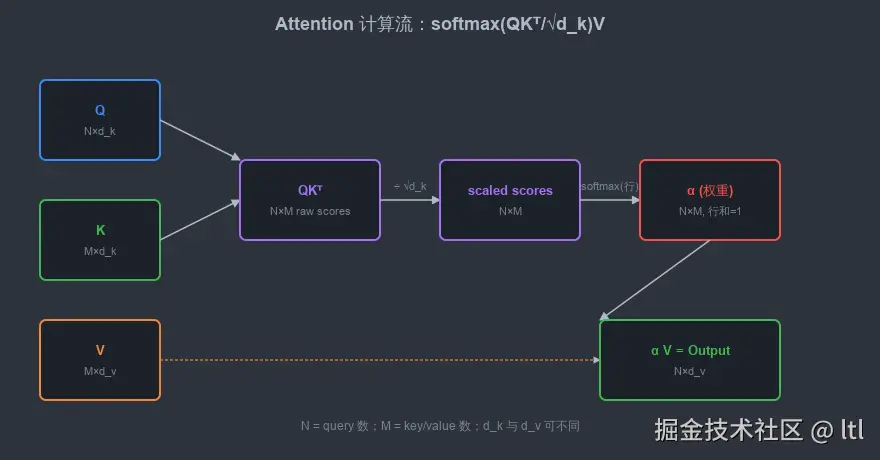
把主公式贴回来:
<math xmlns="http://www.w3.org/1998/Math/MathML" display="block"> Attention ( Q , K , V ) = softmax ( Q K ⊤ d k ) V \text{Attention}(Q, K, V) = \text{softmax}\left(\frac{QK^\top}{\sqrt{d_k}}\right) V </math>Attention(Q,K,V)=softmax(dk QK⊤)V
4.1 形状
| Q | N × d_k |
| K | M × d_k |
| V | M × d_v |
| <math xmlns="http://www.w3.org/1998/Math/MathML"> Q K ⊤ QK^\top </math>QK⊤ | N × M |
| <math xmlns="http://www.w3.org/1998/Math/MathML"> softmax ( Q K ⊤ / d k ) \operatorname{softmax}(QK^\top / \sqrt{d_k}) </math>softmax(QK⊤/dk ) | N × M(每行和=1) |
| Output | N × d_v |
N = query 的个数;M = key/value 的个数;d_k = query/key 的维度;d_v = value 的维度。
cross-attention 时,N 和 M 可以不同(decoder 长度 vs encoder 长度)。
self-attention 时,N = M。
实践中,d_k 和 d_v 几乎总是相等(都等于 d_model / h,h 是 head 数)。
4.2 <math xmlns="http://www.w3.org/1998/Math/MathML"> Q K ⊤ QK^\top </math>QK⊤:所有 query 跟所有 key 的两两点积
<math xmlns="http://www.w3.org/1998/Math/MathML"> Q K ⊤ QK^\top </math>QK⊤ 这个操作是 attention 的灵魂。
直觉:把每个 query 跟每个 key 内积一次,得到 N×M 的「相似度矩阵」。
第 i 行第 j 列的元素 <math xmlns="http://www.w3.org/1998/Math/MathML"> ( Q K ⊤ ) i j = q i ⋅ k j (QK^\top)_{ij} = q_i \cdot k_j </math>(QK⊤)ij=qi⋅kj,表示「第 i 个 query 与第 j 个 key 的相似度」。
为什么用内积?
第一,便宜------一次矩阵乘搞定所有两两相似度,GPU 极快。
第二,几何意义清楚------内积 = 模长 × 模长 × cos 夹角,是「方向匹配 + 强度匹配」的自然组合。
第三,线性可微------对 q、k 都是线性函数,反向传播简单。
代价:内积没有「对称的非线性融合」,表达力比 additive attention 弱(虽然实际任务上几乎追平)。
4.3 <math xmlns="http://www.w3.org/1998/Math/MathML"> / d k / \sqrt{d_k} </math>/dk :那个看似奇怪的缩放
为什么除以 <math xmlns="http://www.w3.org/1998/Math/MathML"> d k \sqrt{d_k} </math>dk ?
简短答案:当 d_k 增大时,q 与 k 的内积方差也线性增大;不缩放会导致 softmax 进入饱和区,梯度趋零。
详细推导留到下一篇(第十五篇),那里会用「两个 iid 单位方差向量内积的方差等于 d_k」这个事实正面推一遍。
这里你需要记住的是:<math xmlns="http://www.w3.org/1998/Math/MathML"> d k \sqrt{d_k} </math>dk 不是装饰,缺了它,d_k=64/128 这种规模的 attention 根本训不起来。
4.4 softmax:把分数变成权重分布
softmax 沿 N×M 矩阵的最后一维(也就是 M 维,每个 query 对所有 key 的分数)取,每一行都归一化为一个分布。
输出仍然是 N×M,但每行和为 1,每个元素 ∈ [0, 1]。
softmax 给我们带来三件好东西:
第一,所有 value 都被加权------没有信息被「argmax 砍掉」,hard alignment 学不到的多对一/多对多关系都能被表达。
第二,可微------softmax 是平滑函数,反向传播没有不连续点。
第三,自动归一 ------和为 1 让输出 <math xmlns="http://www.w3.org/1998/Math/MathML"> = ∑ i α i v i = \sum_i \alpha_i v_i </math>=∑iαivi 在数值范围上稳定,不会随 M 爆炸。
代价:softmax 有「赢者通吃」的倾向。当某个分数远高于其它时,对应权重接近 1,其它接近 0。这件事在「分数差异不大时」会让 attention 变得几乎均匀(等权),有时不够 sharp。
这是 sparsemax(Martins 2016)等替代方案出现的动机,但实践中 softmax 仍然是默认选择。
4.5 <math xmlns="http://www.w3.org/1998/Math/MathML"> ⋅ V \cdot V </math>⋅V:加权求和
最后一步是矩阵乘法:
<math xmlns="http://www.w3.org/1998/Math/MathML" display="block"> ( N × M ) ⋅ ( M × d v ) = ( N × d v ) (N \times M) \cdot (M \times d_v) = (N \times d_v) </math>(N×M)⋅(M×dv)=(N×dv)
每一行对应一个 query 的输出,是所有 value 按本行权重的加权平均。
直觉:「这个 query 此刻看 source(或 self)时,得到的混合信息」。
到这里 attention 就算完了。
整套流程:投影出 <math xmlns="http://www.w3.org/1998/Math/MathML"> Q / K / V Q/K/V </math>Q/K/V → 算两两相似度 → 缩放 → softmax → 加权求和。
简洁得几乎不像深度学习------它更像一个「可微的检索」。
五、维度走一遍:把所有矩阵乘法的形状都对一对
为了让公式真正「立」起来,我们用一组具体数字走一次整个流程。
设输入序列长度 <math xmlns="http://www.w3.org/1998/Math/MathML"> L = 8 L = 8 </math>L=8, <math xmlns="http://www.w3.org/1998/Math/MathML"> d m o d e l = 64 d_{model} = 64 </math>dmodel=64,head 数 <math xmlns="http://www.w3.org/1998/Math/MathML"> h = 8 h = 8 </math>h=8,每个 head 的 <math xmlns="http://www.w3.org/1998/Math/MathML"> d k = d v = 64 / 8 = 8 d_k = d_v = 64/8 = 8 </math>dk=dv=64/8=8。
5.1 单 head 的形状
输入 <math xmlns="http://www.w3.org/1998/Math/MathML"> X X </math>X: <math xmlns="http://www.w3.org/1998/Math/MathML"> L × d m o d e l = 8 × 64 L \times d_{model} = 8 \times 64 </math>L×dmodel=8×64
投影矩阵:
- <math xmlns="http://www.w3.org/1998/Math/MathML"> W Q : d m o d e l × d k = 64 × 8 W_Q: d_{model} \times d_k = 64 \times 8 </math>WQ:dmodel×dk=64×8
- <math xmlns="http://www.w3.org/1998/Math/MathML"> W K : d m o d e l × d k = 64 × 8 W_K: d_{model} \times d_k = 64 \times 8 </math>WK:dmodel×dk=64×8
- <math xmlns="http://www.w3.org/1998/Math/MathML"> W V : d m o d e l × d v = 64 × 8 W_V: d_{model} \times d_v = 64 \times 8 </math>WV:dmodel×dv=64×8
投影后:
- <math xmlns="http://www.w3.org/1998/Math/MathML"> Q = X ⋅ W Q : 8 × 8 Q = X \cdot W_Q: 8 \times 8 </math>Q=X⋅WQ:8×8
- <math xmlns="http://www.w3.org/1998/Math/MathML"> K = X ⋅ W K : 8 × 8 K = X \cdot W_K: 8 \times 8 </math>K=X⋅WK:8×8
- <math xmlns="http://www.w3.org/1998/Math/MathML"> V = X ⋅ W V : 8 × 8 V = X \cdot W_V: 8 \times 8 </math>V=X⋅WV:8×8
打分:
- <math xmlns="http://www.w3.org/1998/Math/MathML"> Q K ⊤ QK^\top </math>QK⊤: <math xmlns="http://www.w3.org/1998/Math/MathML"> 8 × 8 8 \times 8 </math>8×8
- 缩放后仍 <math xmlns="http://www.w3.org/1998/Math/MathML"> 8 × 8 8 \times 8 </math>8×8
- softmax 后仍 <math xmlns="http://www.w3.org/1998/Math/MathML"> 8 × 8 8 \times 8 </math>8×8(每行和 = 1)
加权求和:
- <math xmlns="http://www.w3.org/1998/Math/MathML"> α ⋅ V : 8 × 8 \alpha \cdot V: 8 \times 8 </math>α⋅V:8×8
单 head 输出形状: <math xmlns="http://www.w3.org/1998/Math/MathML"> 8 × 8 8 \times 8 </math>8×8(与 <math xmlns="http://www.w3.org/1998/Math/MathML"> X X </math>X 的 <math xmlns="http://www.w3.org/1998/Math/MathML"> d m o d e l = 64 d_{model} = 64 </math>dmodel=64 不同!)
5.2 多 head 的拼接
multi-head 把 <math xmlns="http://www.w3.org/1998/Math/MathML"> h h </math>h 个 head 的输出沿最后一维 concat:
- concat 后: <math xmlns="http://www.w3.org/1998/Math/MathML"> 8 × ( 8 ⋅ 8 ) = 8 × 64 8 \times (8 \cdot 8) = 8 \times 64 </math>8×(8⋅8)=8×64
再过一个输出投影:
- <math xmlns="http://www.w3.org/1998/Math/MathML"> W O : d m o d e l × d m o d e l = 64 × 64 W_O: d_{model} \times d_{model} = 64 \times 64 </math>WO:dmodel×dmodel=64×64
- 最终输出: <math xmlns="http://www.w3.org/1998/Math/MathML"> ( 8 × 64 ) ⋅ ( 64 × 64 ) = 8 × 64 (8 \times 64) \cdot (64 \times 64) = 8 \times 64 </math>(8×64)⋅(64×64)=8×64
终于回到 <math xmlns="http://www.w3.org/1998/Math/MathML"> d m o d e l d_{model} </math>dmodel 维度,与输入 <math xmlns="http://www.w3.org/1998/Math/MathML"> X X </math>X 形状一致------可以接入残差连接。
5.3 batch 维度
实际训练时, <math xmlns="http://www.w3.org/1998/Math/MathML"> X X </math>X 形状是 <math xmlns="http://www.w3.org/1998/Math/MathML"> ( B , L , d m o d e l ) (B, L, d_{model}) </math>(B,L,dmodel), <math xmlns="http://www.w3.org/1998/Math/MathML"> B B </math>B 是 batch 大小。
所有矩阵乘法都加一个 batch 维度做 broadcast: <math xmlns="http://www.w3.org/1998/Math/MathML"> ( B , L , d k ) ⋅ ( B , d k , L ) → ( B , L , L ) (B, L, d_k) \cdot (B, d_k, L) \to (B, L, L) </math>(B,L,dk)⋅(B,dk,L)→(B,L,L)。
PyTorch 的 torch.matmul 自动处理 batch;einops 库可以让形状操作更可读。
5.4 cross-attention 时的形状不对称
cross-attention 里, <math xmlns="http://www.w3.org/1998/Math/MathML"> Q Q </math>Q 来自 decoder, <math xmlns="http://www.w3.org/1998/Math/MathML"> K / V K/V </math>K/V 来自 encoder:
- <math xmlns="http://www.w3.org/1998/Math/MathML"> Q : B × L t g t × d k Q: B \times L_{tgt} \times d_k </math>Q:B×Ltgt×dk
- <math xmlns="http://www.w3.org/1998/Math/MathML"> K , V : B × L s r c × d k K, V: B \times L_{src} \times d_k </math>K,V:B×Lsrc×dk
<math xmlns="http://www.w3.org/1998/Math/MathML"> Q K ⊤ QK^\top </math>QK⊤: <math xmlns="http://www.w3.org/1998/Math/MathML"> B × L t g t × L s r c B \times L_{tgt} \times L_{src} </math>B×Ltgt×Lsrc,不再是方阵。
<math xmlns="http://www.w3.org/1998/Math/MathML"> L t g t L_{tgt} </math>Ltgt 和 <math xmlns="http://www.w3.org/1998/Math/MathML"> L s r c L_{src} </math>Lsrc 可以不同------这正是 attention 跨语言、跨模态的灵活性来源。
六、自注意力时的特殊性:Q/K/V 同源
self-attention 的特别之处在于 Q/K/V 都来自同一个输入 X:
<math xmlns="http://www.w3.org/1998/Math/MathML" display="block"> Q = X W Q K = X W K V = X W V \begin{aligned} Q &= X W_Q \\ K &= X W_K \\ V &= X W_V \end{aligned} </math>QKV=XWQ=XWK=XWV
虽然来源同源,但 <math xmlns="http://www.w3.org/1998/Math/MathML"> W Q W_Q </math>WQ、 <math xmlns="http://www.w3.org/1998/Math/MathML"> W K W_K </math>WK、 <math xmlns="http://www.w3.org/1998/Math/MathML"> W V W_V </math>WV 是三个独立学习的矩阵,所以 <math xmlns="http://www.w3.org/1998/Math/MathML"> Q ≠ K ≠ V Q \neq K \neq V </math>Q=K=V(一般情况下)。
这件事容易让人误以为 self-attention「让每个 token 跟自己最像」,但实际不是这样。
如果 <math xmlns="http://www.w3.org/1998/Math/MathML"> W Q = W K = I W_Q = W_K = I </math>WQ=WK=I(单位矩阵),那么 <math xmlns="http://www.w3.org/1998/Math/MathML"> q i ⊤ k j = x i ⊤ x j q_i^\top k_j = x_i^\top x_j </math>qi⊤kj=xi⊤xj,对角线( <math xmlns="http://www.w3.org/1998/Math/MathML"> i = j i = j </math>i=j)确实最大。
但学过的 <math xmlns="http://www.w3.org/1998/Math/MathML"> W Q ≠ W K W_Q \neq W_K </math>WQ=WK 几乎总是把对角线打散,模型学到的注意力模式经常不是 self-loop 主导,而是「跨位置的语法/语义关联」。
「it」会强烈 attend「cat」,不是「it」自己;动词 attend 主语和宾语;定语 attend 中心词。
第 14 篇会把这件事讲得更具体。
七、玩具示例:3 token、d_k = 2,从头算到尾
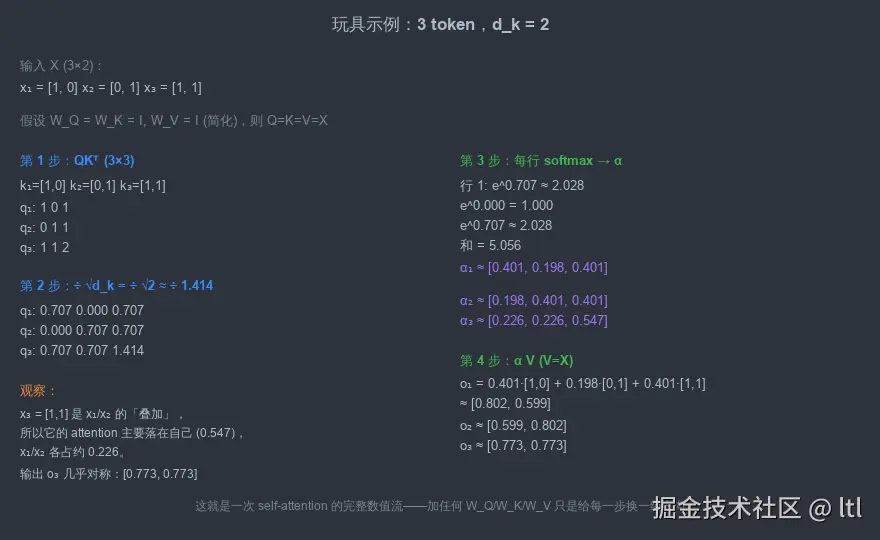
接下来是一个手算环节------这是这篇文章的核心实操段落。
7.1 设置
输入序列三个 token,每个嵌入向量 2 维:
<math xmlns="http://www.w3.org/1998/Math/MathML" display="block"> x 1 = [ 1 , 0 ] x 2 = [ 0 , 1 ] x 3 = [ 1 , 1 ] \begin{aligned} x_1 &= [1, 0] \\ x_2 &= [0, 1] \\ x_3 &= [1, 1] \end{aligned} </math>x1x2x3=[1,0]=[0,1]=[1,1]
为了简化,我们设 <math xmlns="http://www.w3.org/1998/Math/MathML"> W Q = W K = W V = I W_Q = W_K = W_V = I </math>WQ=WK=WV=I(单位矩阵),所以 <math xmlns="http://www.w3.org/1998/Math/MathML"> Q = K = V = X Q = K = V = X </math>Q=K=V=X。
实际模型当然不是单位矩阵,但这个简化让我们专注于「计算流」本身。
7.2 第一步: <math xmlns="http://www.w3.org/1998/Math/MathML"> Q K ⊤ QK^\top </math>QK⊤
<math xmlns="http://www.w3.org/1998/Math/MathML"> Q K ⊤ QK^\top </math>QK⊤ 是一个 <math xmlns="http://www.w3.org/1998/Math/MathML"> 3 × 3 3 \times 3 </math>3×3 矩阵,第 <math xmlns="http://www.w3.org/1998/Math/MathML"> ( i , j ) (i, j) </math>(i,j) 个元素是 <math xmlns="http://www.w3.org/1998/Math/MathML"> q i ⋅ k j q_i \cdot k_j </math>qi⋅kj:
<math xmlns="http://www.w3.org/1998/Math/MathML" display="block"> q 1 ⋅ k 1 = [ 1 , 0 ] ⋅ [ 1 , 0 ] = 1 q 1 ⋅ k 2 = [ 1 , 0 ] ⋅ [ 0 , 1 ] = 0 q 1 ⋅ k 3 = [ 1 , 0 ] ⋅ [ 1 , 1 ] = 1 q 2 ⋅ k 1 = [ 0 , 1 ] ⋅ [ 1 , 0 ] = 0 q 2 ⋅ k 2 = [ 0 , 1 ] ⋅ [ 0 , 1 ] = 1 q 2 ⋅ k 3 = [ 0 , 1 ] ⋅ [ 1 , 1 ] = 1 q 3 ⋅ k 1 = [ 1 , 1 ] ⋅ [ 1 , 0 ] = 1 q 3 ⋅ k 2 = [ 1 , 1 ] ⋅ [ 0 , 1 ] = 1 q 3 ⋅ k 3 = [ 1 , 1 ] ⋅ [ 1 , 1 ] = 2 \begin{aligned} q_1 \cdot k_1 &= [1,0]\cdot[1,0] = 1 \\ q_1 \cdot k_2 &= [1,0]\cdot[0,1] = 0 \\ q_1 \cdot k_3 &= [1,0]\cdot[1,1] = 1 \\[1ex] q_2 \cdot k_1 &= [0,1]\cdot[1,0] = 0 \\ q_2 \cdot k_2 &= [0,1]\cdot[0,1] = 1 \\ q_2 \cdot k_3 &= [0,1]\cdot[1,1] = 1 \\[1ex] q_3 \cdot k_1 &= [1,1]\cdot[1,0] = 1 \\ q_3 \cdot k_2 &= [1,1]\cdot[0,1] = 1 \\ q_3 \cdot k_3 &= [1,1]\cdot[1,1] = 2 \end{aligned} </math>q1⋅k1q1⋅k2q1⋅k3q2⋅k1q2⋅k2q2⋅k3q3⋅k1q3⋅k2q3⋅k3=[1,0]⋅[1,0]=1=[1,0]⋅[0,1]=0=[1,0]⋅[1,1]=1=[0,1]⋅[1,0]=0=[0,1]⋅[0,1]=1=[0,1]⋅[1,1]=1=[1,1]⋅[1,0]=1=[1,1]⋅[0,1]=1=[1,1]⋅[1,1]=2
矩阵形式:
<math xmlns="http://www.w3.org/1998/Math/MathML" display="block"> Q K ⊤ = [ 1 0 1 0 1 1 1 1 2 ] QK^\top = \begin{bmatrix} 1 & 0 & 1 \\ 0 & 1 & 1 \\ 1 & 1 & 2 \end{bmatrix} </math>QK⊤= 101011112
观察: <math xmlns="http://www.w3.org/1998/Math/MathML"> x 3 = x 1 + x 2 x_3 = x_1 + x_2 </math>x3=x1+x2,所以 <math xmlns="http://www.w3.org/1998/Math/MathML"> q 3 q_3 </math>q3 与所有 <math xmlns="http://www.w3.org/1998/Math/MathML"> k k </math>k 的相似度都更高,对角线 <math xmlns="http://www.w3.org/1998/Math/MathML"> q 3 ⋅ k 3 = 2 q_3 \cdot k_3 = 2 </math>q3⋅k3=2 是全场最大。
7.3 第二步:除以 <math xmlns="http://www.w3.org/1998/Math/MathML"> d k \sqrt{d_k} </math>dk = <math xmlns="http://www.w3.org/1998/Math/MathML"> 2 \sqrt{2} </math>2 ≈ 1.414
<math xmlns="http://www.w3.org/1998/Math/MathML" display="block"> [ 0.707 0.000 0.707 0.000 0.707 0.707 0.707 0.707 1.414 ] \begin{bmatrix} 0.707 & 0.000 & 0.707 \\ 0.000 & 0.707 & 0.707 \\ 0.707 & 0.707 & 1.414 \end{bmatrix} </math> 0.7070.0000.7070.0000.7070.7070.7070.7071.414
7.4 第三步:每行 softmax
<math xmlns="http://www.w3.org/1998/Math/MathML" display="block"> α 1 = softmax ( [ 0.707 , 0.000 , 0.707 ] ) = [ e 0.707 e 0.707 + e 0 + e 0.707 , e 0 e 0.707 + e 0 + e 0.707 , e 0.707 e 0.707 + e 0 + e 0.707 ] ≈ [ 2.028 5.056 , 1.000 5.056 , 2.028 5.056 ] ≈ [ 0.401 , 0.198 , 0.401 ] \begin{aligned} \alpha_1 &= \operatorname{softmax}([0.707, 0.000, 0.707]) \\ &= \left[\frac{e^{0.707}}{e^{0.707}+e^{0}+e^{0.707}},\; \frac{e^{0}}{e^{0.707}+e^{0}+e^{0.707}},\; \frac{e^{0.707}}{e^{0.707}+e^{0}+e^{0.707}}\right] \\ &\approx \left[\frac{2.028}{5.056},\; \frac{1.000}{5.056},\; \frac{2.028}{5.056}\right] \\ &\approx [0.401,\; 0.198,\; 0.401] \end{aligned} </math>α1=softmax([0.707,0.000,0.707])=[e0.707+e0+e0.707e0.707,e0.707+e0+e0.707e0,e0.707+e0+e0.707e0.707]≈[5.0562.028,5.0561.000,5.0562.028]≈[0.401,0.198,0.401]
<math xmlns="http://www.w3.org/1998/Math/MathML" display="block"> α 2 = softmax ( [ 0.000 , 0.707 , 0.707 ] ) ≈ [ 0.198 , 0.401 , 0.401 ] \alpha_2 = \operatorname{softmax}([0.000, 0.707, 0.707]) \approx [0.198,\; 0.401,\; 0.401] </math>α2=softmax([0.000,0.707,0.707])≈[0.198,0.401,0.401]
<math xmlns="http://www.w3.org/1998/Math/MathML" display="block"> α 3 = softmax ( [ 0.707 , 0.707 , 1.414 ] ) = [ e 0.707 e 0.707 + e 0.707 + e 1.414 , e 0.707 e 0.707 + e 0.707 + e 1.414 , e 1.414 e 0.707 + e 0.707 + e 1.414 ] ≈ [ 2.028 8.169 , 2.028 8.169 , 4.113 8.169 ] ≈ [ 0.248 , 0.248 , 0.503 ] \begin{aligned} \alpha_3 &= \operatorname{softmax}([0.707, 0.707, 1.414]) \\ &= \left[\frac{e^{0.707}}{e^{0.707}+e^{0.707}+e^{1.414}},\; \frac{e^{0.707}}{e^{0.707}+e^{0.707}+e^{1.414}},\; \frac{e^{1.414}}{e^{0.707}+e^{0.707}+e^{1.414}}\right] \\ &\approx \left[\frac{2.028}{8.169},\; \frac{2.028}{8.169},\; \frac{4.113}{8.169}\right] \\ &\approx [0.248,\; 0.248,\; 0.503] \end{aligned} </math>α3=softmax([0.707,0.707,1.414])=[e0.707+e0.707+e1.414e0.707,e0.707+e0.707+e1.414e0.707,e0.707+e0.707+e1.414e1.414]≈[8.1692.028,8.1692.028,8.1694.113]≈[0.248,0.248,0.503]
(注:我用更精确的数取整,写得更细致;论文里通常给三位有效数字。)
7.5 第四步:α · V(V = X)
<math xmlns="http://www.w3.org/1998/Math/MathML" display="block"> o 1 = 0.401 ⋅ [ 1 , 0 ] + 0.198 ⋅ [ 0 , 1 ] + 0.401 ⋅ [ 1 , 1 ] = [ 0.401 , 0 ] + [ 0 , 0.198 ] + [ 0.401 , 0.401 ] = [ 0.802 , 0.599 ] o 2 = 0.198 ⋅ [ 1 , 0 ] + 0.401 ⋅ [ 0 , 1 ] + 0.401 ⋅ [ 1 , 1 ] = [ 0.599 , 0.802 ] o 3 = 0.248 ⋅ [ 1 , 0 ] + 0.248 ⋅ [ 0 , 1 ] + 0.503 ⋅ [ 1 , 1 ] = [ 0.751 , 0.751 ] \begin{aligned} o_1 &= 0.401 \cdot [1,0] + 0.198 \cdot [0,1] + 0.401 \cdot [1,1] \\ &= [0.401, 0] + [0, 0.198] + [0.401, 0.401] \\ &= [0.802, 0.599] \\[1ex] o_2 &= 0.198 \cdot [1,0] + 0.401 \cdot [0,1] + 0.401 \cdot [1,1] \\ &= [0.599, 0.802] \\[1ex] o_3 &= 0.248 \cdot [1,0] + 0.248 \cdot [0,1] + 0.503 \cdot [1,1] \\ &= [0.751, 0.751] \end{aligned} </math>o1o2o3=0.401⋅[1,0]+0.198⋅[0,1]+0.401⋅[1,1]=[0.401,0]+[0,0.198]+[0.401,0.401]=[0.802,0.599]=0.198⋅[1,0]+0.401⋅[0,1]+0.401⋅[1,1]=[0.599,0.802]=0.248⋅[1,0]+0.248⋅[0,1]+0.503⋅[1,1]=[0.751,0.751]
最终输出三个新 token:
<math xmlns="http://www.w3.org/1998/Math/MathML" display="block"> o 1 ≈ [ 0.802 , 0.599 ] o 2 ≈ [ 0.599 , 0.802 ] o 3 ≈ [ 0.751 , 0.751 ] \begin{aligned} o_1 &\approx [0.802, 0.599] \\ o_2 &\approx [0.599, 0.802] \\ o_3 &\approx [0.751, 0.751] \end{aligned} </math>o1o2o3≈[0.802,0.599]≈[0.599,0.802]≈[0.751,0.751]
7.6 观察
第一,o_1 和 o_2 不对称:o_1 第一维更大(因为 x_1 主导),o_2 第二维更大(因为 x_2 主导)。
这说明 self-attention 让每个 token 仍然保留了自己的「身份」,但混入了与其它 token 的相关信息。
第二,o_3 几乎对称:[0.751, 0.751],因为 x_3 跟 x_1、x_2 都同等相关,所以加权和被「抹平」了。
第三,所有输出向量都比输入「更接近彼此」------self-attention 是一种信息融合操作,会让 token 之间的差异减小。
这是为什么 Transformer 要堆 N 层 self-attention:单层的「融合」不够,需要多层迭代地把信息打散又重组。
7.7 把 W_Q/W_K/W_V 加进来会发生什么
如果 W_Q ≠ W_K(即使都是随机的小矩阵),上面的 <math xmlns="http://www.w3.org/1998/Math/MathML"> Q K T QK^T </math>QKT 矩阵会变样------可能 q_3·k_3 不再最大,可能某个 (i, j) 跨位置的相似度反而最高。
这就是模型「学」出来的注意力模式:不再是「自己最像自己」,而是「按学到的语义匹配」。
到第十四篇我们会用一个真实例子("The cat sat on the mat. It was tired.")演示这件事。
八、Additive 还是 Multiplicative:scaled dot-product 为什么赢
第 12 篇里讨论过 additive (Bahdanau) vs multiplicative (Luong) 的区别。
到 Transformer 时代,scaled dot-product attention(multiplicative 的一种)成为绝对主流。
为什么?
8.1 GPU 友好
<math xmlns="http://www.w3.org/1998/Math/MathML"> Q K T QK^T </math>QKT 是一个矩阵乘法,可以用 cuBLAS、cuDNN、TensorCore 等加速到极致。
additive attention 需要逐对算 <math xmlns="http://www.w3.org/1998/Math/MathML"> v ⊤ tanh ( W 1 q + W 2 k ) v^\top \tanh(W_1 q + W_2 k) </math>v⊤tanh(W1q+W2k)------虽然也可以批处理,但常数开销大、内存访问模式不规则。
在 d_k = 64 的规模下,scaled dot-product 的速度大约是 additive 的 3-5 倍(不带 <math xmlns="http://www.w3.org/1998/Math/MathML"> d k \sqrt{d_k} </math>dk 缩放时)。
8.2 参数更少
additive: <math xmlns="http://www.w3.org/1998/Math/MathML"> W 1 ∈ R d × d q W_1 \in \mathbb{R}^{d \times d_q} </math>W1∈Rd×dq, <math xmlns="http://www.w3.org/1998/Math/MathML"> W 2 ∈ R d × d k W_2 \in \mathbb{R}^{d \times d_k} </math>W2∈Rd×dk, <math xmlns="http://www.w3.org/1998/Math/MathML"> v ∈ R d v \in \mathbb{R}^{d} </math>v∈Rd,三组参数。
scaled dot-product:W_Q、W_K、W_V,但 W_Q/W_K/W_V 在多头里也是 query/key/value 的投影矩阵------它们的参数会被 multi-head 复用。
实际比较时,scaled dot-product 的「打分专用参数」是 0(投影本身已经摊销在 Q/K/V 的生成里)。
8.3 在大 d_k 下,缩放后差距小
Vaswani 2017 论文 §3.2.1 直接对比了 additive 和 dot-product。
不带 <math xmlns="http://www.w3.org/1998/Math/MathML"> d k \sqrt{d_k} </math>dk 缩放时,dot-product 在 d_k 大时显著差于 additive(softmax 饱和)。
加了 <math xmlns="http://www.w3.org/1998/Math/MathML"> d k \sqrt{d_k} </math>dk 缩放后,两者性能接近,但 dot-product 速度快得多。
这就是 Transformer 选 scaled dot-product 的核心论点:性能接近,速度更快,参数更少。
8.4 Additive 还活着的场景
不要以为 additive 已死。
第 12 篇里讲过,Tacotron、pointer networks、GAT(Graph Attention Network)这些场景仍然广泛使用 additive。
原因主要是:小模型 + 短序列 + 强先验需求时,additive 的稳定性更好。
到 LLM 规模才需要 scaled dot-product 的所有优势。
九、几个常被忽略的细节
9.1 W_Q/W_K/W_V 的初始化
实践中,W_Q/W_K/W_V 用 Xavier(Glorot)初始化或 Kaiming 初始化。
不能用全零------会让所有 q/k 都是零向量, <math xmlns="http://www.w3.org/1998/Math/MathML"> Q K T QK^T </math>QKT 全零,softmax 退化成均匀分布。
不能用过大方差------会让 q·k 的方差远超 d_k,softmax 立刻饱和。
Vaswani 2017 用的是 fan_in 标准差的 Xavier,配合 <math xmlns="http://www.w3.org/1998/Math/MathML"> d k \sqrt{d_k} </math>dk 缩放,让训练初期 softmax 输入接近 N(0, 1)。
9.2 在多 head 情形下,W_Q 的「真实形状」
很多教材写 W_Q ∈ ℝ^{d_model × d_k}(单 head),但实际实现里 W_Q 是 ℝ^{d_model × d_model}:
- d_model = h × d_k;
- W_Q 是把所有 h 个 head 的投影矩阵拼在一起的一个大矩阵;
- 投影后 reshape 成 (B, L, h, d_k),再 transpose 成 (B, h, L, d_k) 进 attention。
这样实现的好处:一次矩阵乘搞定 h 个 head 的投影,不用循环。
PyTorch 的 nn.MultiheadAttention 内部就是这么做的。
9.3 attention 不是单射
注意:从 (Q, K, V) 到 attention 的输出,是一个满射而不是单射。
不同的 (Q, K, V) 可以产生相同的 output(α 的对称性、value 的可加性)。
也就是说,attention 输出本身丢失了一些信息------所以 Transformer 要靠残差连接保住原始输入。
去掉残差后 Transformer 几乎训不起来------这是经验法则,不是理论必然。
9.4 Numerical stability:log-sum-exp trick
<math xmlns="http://www.w3.org/1998/Math/MathML"> softmax ( x i ) = exp ( x i ) / ∑ j exp ( x j ) \operatorname{softmax}(x_i) = \exp(x_i) / \sum_j \exp(x_j) </math>softmax(xi)=exp(xi)/∑jexp(xj) 在 <math xmlns="http://www.w3.org/1998/Math/MathML"> x i x_i </math>xi 很大时会数值溢出。
实现时通常用 log-sum-exp trick:先把所有 x_i 减去 max(x),再 softmax。
这件事每个深度学习框架都自动处理,但你写自定义 attention(比如调试自定义 mask)时要记得。
9.5 Mask 怎么加进 attention
causal mask(防止看到未来)通常通过把对应位置的 score 设为 <math xmlns="http://www.w3.org/1998/Math/MathML"> − ∞ -\infty </math>−∞ 实现:
<math xmlns="http://www.w3.org/1998/Math/MathML" display="block"> S = Q K ⊤ d k S i j = − ∞ (mask 位置) α = softmax ( S ) \begin{aligned} S &= \frac{QK^\top}{\sqrt{d_k}} \\ S_{ij} &= -\infty \quad \text{(mask 位置)} \\ \alpha &= \operatorname{softmax}(S) \end{aligned} </math>SSijα=dk QK⊤=−∞(mask 位置)=softmax(S)
<math xmlns="http://www.w3.org/1998/Math/MathML"> softmax ( − ∞ ) = 0 \operatorname{softmax}(-\infty) = 0 </math>softmax(−∞)=0,所以 mask 位置的权重为零。
这件事到第十七篇 causal mask 那里会专门讲。
十、一些 attention 的「不变量」
无论 attention 怎么变,下面几件事永远成立:
第一,softmax 输出一定是一个概率分布------非负、和为 1。
第二,输出 <math xmlns="http://www.w3.org/1998/Math/MathML"> = ∑ i α i v i = \sum_i \alpha_i v_i </math>=∑iαivi ,输出的 <math xmlns="http://www.w3.org/1998/Math/MathML"> d v d_v </math>dv 维度等于 V 的 <math xmlns="http://www.w3.org/1998/Math/MathML"> d v d_v </math>dv。
第三,改变 query 顺序,不影响其它 query 的输出------attention 沿 query 轴是 row-wise 独立的。
第四,改变 key/value 的顺序(同步改),不影响最终输出------attention 关于 (key, value) 的排列是不变的(permutation-equivariant)。
第三、第四点合起来:attention 本身不知道位置。这正是 Transformer 必须配位置编码的原因------下一节、下一篇会反复讲。
十一、一个常见的实现陷阱: <math xmlns="http://www.w3.org/1998/Math/MathML"> Q K ⊤ QK^\top </math>QK⊤ 的内存
<math xmlns="http://www.w3.org/1998/Math/MathML"> Q K ⊤ QK^\top </math>QK⊤ 的形状是 <math xmlns="http://www.w3.org/1998/Math/MathML"> ( B , h , N , M ) (B, h, N, M) </math>(B,h,N,M)。
当 <math xmlns="http://www.w3.org/1998/Math/MathML"> N = M = L N = M = L </math>N=M=L(self-attention)且 <math xmlns="http://www.w3.org/1998/Math/MathML"> L = 8192 L = 8192 </math>L=8192 时,单个 head 的 <math xmlns="http://www.w3.org/1998/Math/MathML"> Q K ⊤ QK^\top </math>QK⊤ 矩阵是 <math xmlns="http://www.w3.org/1998/Math/MathML"> 8192 × 8192 = 6700 8192 \times 8192 = 6700 </math>8192×8192=6700 万个 float,单 head 仅需 256 MB(fp32);32 head 一起就是 8 GB。
这就是 Transformer 在长上下文下「显存爆炸」的来源------ <math xmlns="http://www.w3.org/1998/Math/MathML"> Q K ⊤ QK^\top </math>QK⊤ 矩阵本身的大小是 <math xmlns="http://www.w3.org/1998/Math/MathML"> O ( L 2 ) O(L^2) </math>O(L2)。
FlashAttention(Dao et al. 2022)的核心 trick 就是不显式存储 <math xmlns="http://www.w3.org/1998/Math/MathML"> Q K ⊤ QK^\top </math>QK⊤ ,而是把它分块、流式地计算 softmax 和加权和,避免把 <math xmlns="http://www.w3.org/1998/Math/MathML"> N × M N \times M </math>N×M 矩阵写到显存。
到第十八篇 attention 复杂度那里会讨论这件事。
但现在你需要知道的是: <math xmlns="http://www.w3.org/1998/Math/MathML"> Q K ⊤ QK^\top </math>QK⊤ 的存在让 attention 在长序列上不便宜------这是后续所有「线性 attention」「稀疏 attention」研究的原始动机。
十二、几种常见的「Q/K/V 变体」速览
主公式只有一种,但围绕它衍生出大量变体。这一节用最短篇幅勾勒几个高频名字,让你后面看论文时不发懵。
12.1 Multi-Query / Grouped-Query Attention
标准 Transformer 里每个 head 都有自己的 K、V。
Multi-Query Attention(MQA, Shazeer 2019)让所有 head 共享同一组 K、V,只 query 各自不同。
参数减少 h 倍,KV cache 也减少 h 倍------推理时极其重要。
代价是表达力略降。
Grouped-Query Attention(GQA, Ainslie 2023)是折中方案:把 h 个 head 分成 g 组,每组共享一份 K/V。
LLaMA-2 70B、Mistral 7B 等都在用 GQA。
到 2026 年,几乎所有大模型推理时都至少用 GQA,纯 MHA 已经退出大模型设计。
12.2 Cross-Attention
Q 来自一个序列,K/V 来自另一个序列。
经典场景:
- 机器翻译 decoder:Q 来自目标语言,K/V 来自源语言;
- T5、BART 等 encoder-decoder 模型;
- 多模态:Q 来自文本,K/V 来自图像(或反之);
- Stable Diffusion 的 U-Net 里 text → image 的 cross-attention。
cross-attention 在 Q/K/V 框架里只是「Q 和 K/V 来源不同」这一件事,公式完全不变。
12.3 Encoder-only Self-Attention
BERT 类模型只有 encoder,里面是双向 self-attention:每个 token 可以 attend 所有 token(包括未来)。
没有 causal mask,因此可以并行做完整双向上下文建模。
代价:不能用来做生成(看到了未来 token)。
12.4 Decoder-only Causal Self-Attention
GPT 类模型只有 decoder,里面是 causal self-attention:每个 token 只能 attend 到自己和左侧。
通过加一个上三角的 -∞ mask 实现。
适合自回归生成。
到 2026 年,绝大多数大模型(GPT-4、Claude、Gemini、LLaMA、Qwen)都是 decoder-only 架构。
12.5 Linear / Kernel Attention
Performer(Choromanski 2020)、Linformer(Wang 2020)等把 <math xmlns="http://www.w3.org/1998/Math/MathML"> softmax ( Q K ⊤ ) \operatorname{softmax}(QK^\top) </math>softmax(QK⊤) 近似成 <math xmlns="http://www.w3.org/1998/Math/MathML"> ϕ ( Q ) ϕ ( K ) ⊤ \phi(Q) \phi(K)^\top </math>ϕ(Q)ϕ(K)⊤,让 attention 退化成 <math xmlns="http://www.w3.org/1998/Math/MathML"> O ( N ) O(N) </math>O(N) 而不是 <math xmlns="http://www.w3.org/1998/Math/MathML"> O ( N 2 ) O(N^2) </math>O(N2)。
代价:精度损失,长序列上常见但 LLM 主流尚未采用。
12.6 Sliding Window / Local Attention
每个 query 只 attend 邻近 <math xmlns="http://www.w3.org/1998/Math/MathML"> W W </math>W 个 key( <math xmlns="http://www.w3.org/1998/Math/MathML"> W ≪ N W \ll N </math>W≪N),复杂度是 <math xmlns="http://www.w3.org/1998/Math/MathML"> O ( N ⋅ W ) O(N \cdot W) </math>O(N⋅W)。
Longformer、Mistral 都用过这种结构。
12.7 Sparse Attention
按某种 pattern(块、稀疏、随机)让大部分 (i, j) 对被 mask 掉。
BigBird、Sparse Transformer 是代表。
复杂度可降到 <math xmlns="http://www.w3.org/1998/Math/MathML"> O ( N log N ) O(N \log N) </math>O(NlogN) 或 <math xmlns="http://www.w3.org/1998/Math/MathML"> O ( N N ) O(N \sqrt{N}) </math>O(NN )。
12.8 Mixture of Attention Heads
不同输入用不同的 head(类似 MoE 那种 gating)。
代表:MoH(2024 年开始流行)。
十三、把 Q/K/V 写成 PyTorch 代码
光讲公式不够,看一段最简实现能让公式立得更稳。
下面是 self-attention(单 head)的最小可运行代码:
python
import torch
import torch.nn as nn
import torch.nn.functional as F
class SelfAttention(nn.Module):
def __init__(self, d_model, d_k):
super().__init__()
self.d_k = d_k
self.W_Q = nn.Linear(d_model, d_k, bias=False)
self.W_K = nn.Linear(d_model, d_k, bias=False)
self.W_V = nn.Linear(d_model, d_k, bias=False)
def forward(self, x, mask=None):
# x: (B, L, d_model)
Q = self.W_Q(x) # (B, L, d_k)
K = self.W_K(x)
V = self.W_V(x)
scores = Q @ K.transpose(-2, -1) / (self.d_k ** 0.5) # (B, L, L)
if mask is not None:
scores = scores.masked_fill(mask == 0, float('-inf'))
alpha = F.softmax(scores, dim=-1)
out = alpha @ V # (B, L, d_k)
return out, alpha
这段代码就是 attention 的全部------加上残差、LayerNorm、FFN、multi-head 投影、causal mask 之后,就成了 Transformer。
你可以试着跑一下:
python
torch.manual_seed(42)
attn = SelfAttention(d_model=8, d_k=8)
x = torch.randn(1, 5, 8)
out, alpha = attn(x)
print(alpha.shape) # (1, 5, 5)
print(alpha.sum(dim=-1)) # 每行接近 1
第一次跑通这段代码,你对 attention 的直觉会从「公式上的事」变成「指尖上的事」。
13.1 工程实现里几个常见错误
第一,忘了 <math xmlns="http://www.w3.org/1998/Math/MathML"> d k \sqrt{d_k} </math>dk 。直接 Q @ K.transpose(-2, -1), <math xmlns="http://www.w3.org/1998/Math/MathML"> d k = 64 d_k = 64 </math>dk=64 时基本训不起来。
第二,softmax 的轴搞错。要在「key 轴」(最后一维)上 softmax,不是在 query 轴。
第三,mask 的方向搞反 。causal mask 是「不能看到未来」,对应 mask 的上三角应该被填 <math xmlns="http://www.w3.org/1998/Math/MathML"> − ∞ -\infty </math>−∞。
第四,用 <math xmlns="http://www.w3.org/1998/Math/MathML"> m a s k = 0 \mathrm{mask}=0 </math>mask=0 表示「保留」、 <math xmlns="http://www.w3.org/1998/Math/MathML"> m a s k = 1 \mathrm{mask}=1 </math>mask=1 表示「屏蔽」时 ,masked_fill 要对应着写。PyTorch 默认 masked_fill(mask, value) 是「mask 为 True 的位置填 value」------容易写反。
第五,dropout 的位置 。Vaswani 原版在 softmax 后、加权和前对 <math xmlns="http://www.w3.org/1998/Math/MathML"> α \alpha </math>α 做 dropout。这个细节经常被省略,但会影响训练动力学。
十四、Q/K/V 的训练动态:模型怎么学到这三个矩阵
理论上 <math xmlns="http://www.w3.org/1998/Math/MathML"> W Q / W K / W V W_Q/W_K/W_V </math>WQ/WK/WV 是可学习参数,初始化时是随机的。
那模型怎么把它们「学」成有意义的语义投影?
14.1 起点:完全随机的 Q/K/V
训练初期, <math xmlns="http://www.w3.org/1998/Math/MathML"> W Q / W K / W V W_Q/W_K/W_V </math>WQ/WK/WV 都是随机小矩阵。
<math xmlns="http://www.w3.org/1998/Math/MathML"> Q K ⊤ QK^\top </math>QK⊤ 接近随机噪声,softmax 后 <math xmlns="http://www.w3.org/1998/Math/MathML"> α \alpha </math>α 几乎均匀(每个 query 对所有 key 大致等权)。
这时 attention 的输出 ≈ 所有 V 的均值------本质上是「每个 token 都在看所有 token 的平均」。
这件事看起来很糟糕,但实际上是合理的起点:模型先学到「token 的全局上下文均值」,然后逐步学会 sharpen attention。
14.2 中期:sharpening 与 specialization
随着训练进行,反向传播会推动 <math xmlns="http://www.w3.org/1998/Math/MathML"> W Q / W K / W V W_Q/W_K/W_V </math>WQ/WK/WV 朝「让 loss 下降」的方向更新。
这时模型开始发现:「对某些 query,应该 attend 到特定 key」会让预测更准。
<math xmlns="http://www.w3.org/1998/Math/MathML"> α \alpha </math>α 开始 sharpen------某些权重显著大于其它。
不同 head 开始 specialize:head 1 关注语法依存,head 3 关注共指消解,head 7 关注下一个 token------这些都是 BERT/GPT 训练后被实证观察到的模式。
14.3 末期:稳定的 attention pattern
充分训练后,每个 head 的 attention pattern 大致稳定。
不同输入会激活不同的 pattern,但每个 head 对「自己关注什么」是稳定的。
这种稳定性让 attention 可视化变得有意义------也是 BertViz、Attention is not Explanation 等可视化/解释工具的基础。
14.4 一些训练失败的模式
attention head collapse:所有 head 学到了几乎一样的 pattern。
attention oversmoothing:所有 token 的输出都趋同,模型失去区分能力。
attention degenerate to one position:所有 query 都 attend 到第一个或最后一个 token(通常是 BOS / EOS)。
这些都是真实存在的失败模式,到 LLM 工程实践里有专门技术(warmup 长度、label smoothing、gradient clipping、attention dropout)来缓解。
十五、关键概念回顾
走到这里,我们把 Q/K/V 拆得彻底了。最该带走的几句话:
Q/K/V 是软检索的三件套:Query 提问、Key 被打分、Value 被加权求和。
主公式 <math xmlns="http://www.w3.org/1998/Math/MathML"> Attention ( Q , K , V ) = softmax ( Q K ⊤ / d k ) V \text{Attention}(Q,K,V) = \text{softmax}(QK^\top/\sqrt{d_k}) V </math>Attention(Q,K,V)=softmax(QK⊤/dk )V 一行包含五件事:投影、内积打分、缩放、归一化、加权求和。
K 和 V 解耦让模型可以独立优化「索引」和「内容」------这是从 Bahdanau 到 Transformer 最关键的设计跳跃。
<math xmlns="http://www.w3.org/1998/Math/MathML"> W Q / W K / W V W_Q/W_K/W_V </math>WQ/WK/WV 是三个独立学习的线性投影,把同一个输入拉到三种不同的语义空间。
self-attention 时 Q/K/V 同源但形态不同------投影矩阵让「同一 token 的三种角色」可以分别学习。
<math xmlns="http://www.w3.org/1998/Math/MathML"> d k \sqrt{d_k} </math>dk 缩放是为了让 softmax 不饱和------缺了它,d_k 一上 64 训练就崩。
attention 不知道位置------它对 key/value 的排列等变,必须靠位置编码或 causal mask 注入位置信息。
十六、常见误解
13.1 Q/K/V 必须从同一个输入投影
不对。
cross-attention 里 Q 来自 decoder,K/V 来自 encoder,是两个不同输入。
「同源」是 self-attention 的特例。
13.2 K 和 V 可以省掉一个
不可以------除非你愿意接受 Bahdanau 的限制(K = V = h)。
K 和 V 解耦才让模型有能力区分「索引信号」和「内容信号」,省掉一个会显著降低表达力。
13.3 d_k 必须等于 d_v
不必。
虽然 Transformer 默认 d_k = d_v = d_model / h,但理论上 d_k 和 d_v 可以独立设。
实践中保持一致是为了简洁和参数对称。
13.4 attention 的本质是「相似度」
部分对。
<math xmlns="http://www.w3.org/1998/Math/MathML"> Q K ⊤ QK^\top </math>QK⊤ 是相似度,softmax 是归一化,但「Q/K/V 三件套」的本质更准确地说是软检索------不是单纯比相似度,而是「按相似度加权地从 Value 池里取信息」。
13.5 attention 是 O(1) 的
完全不对。
attention 是 <math xmlns="http://www.w3.org/1998/Math/MathML"> O ( N ⋅ M ⋅ d k ) O(N \cdot M \cdot d_k) </math>O(N⋅M⋅dk)(计算 <math xmlns="http://www.w3.org/1998/Math/MathML"> Q K ⊤ QK^\top </math>QK⊤) <math xmlns="http://www.w3.org/1998/Math/MathML"> + O ( N ⋅ M ⋅ d v ) +\;O(N \cdot M \cdot d_v) </math>+O(N⋅M⋅dv)(加权和),关于序列长度是平方复杂度。
「O(1) 路径长度」是另一回事------指任意两个 token 在一层内可以直接交互(不像 RNN 要走 N 步),这是「路径」上的 O(1),不是「计算」上的 O(1)。
13.6 softmax 之前一定要除以 <math xmlns="http://www.w3.org/1998/Math/MathML"> d k \sqrt{d_k} </math>dk
几乎是的。
不除会让训练在 <math xmlns="http://www.w3.org/1998/Math/MathML"> d k > 16 d_k > 16 </math>dk>16 时基本崩溃。但有些工作(如 LayerNorm 在 score 上的 attention)可以代替缩放------这是变体,不是默认。
13.7 W_Q 和 W_K 是「对称」的
不是。
<math xmlns="http://www.w3.org/1998/Math/MathML"> W Q W_Q </math>WQ 学到的方向不等于 <math xmlns="http://www.w3.org/1998/Math/MathML"> W K W_K </math>WK 学到的方向。query 和 key 在同一 head 里学到的子空间可以差很远------这正是为什么模型能学到「跨语义」的 attention 模式。
13.8 KV cache 是 K 和 V 的简单缓存
部分对------KV cache 确实是把已经算过的 K、V 缓存下来,避免重复计算。
但「KV」这个名字常被误读为「Key-Value 数据库」------实际上它是 attention 里的 K 矩阵和 V 矩阵,与数据库 KV store 没有任何关系。
到第二十二篇 KV cache 那里我们会专门讲它的形状、占用与优化。
13.9 attention 输出维度等于 Q 的维度
不是。
attention 输出维度等于 <math xmlns="http://www.w3.org/1998/Math/MathML"> V V </math>V 的维度( <math xmlns="http://www.w3.org/1998/Math/MathML"> d v d_v </math>dv)。
只是实践中 <math xmlns="http://www.w3.org/1998/Math/MathML"> d q = d k = d v d_q = d_k = d_v </math>dq=dk=dv 让人产生这个错觉。
如果你设 <math xmlns="http://www.w3.org/1998/Math/MathML"> d v ≠ d k d_v \neq d_k </math>dv=dk,attention 输出形状就会是 <math xmlns="http://www.w3.org/1998/Math/MathML"> ( N , d v ) (N, d_v) </math>(N,dv) 而不是 <math xmlns="http://www.w3.org/1998/Math/MathML"> ( N , d k ) (N, d_k) </math>(N,dk)。
十七、下一步
下一篇 14|Self-Attention 会把 Q/K/V 框架进一步特化到「同一序列内 token 互相 attend」的情形。
我们会展示:
- 当 Q/K/V 都来自同一序列时,attention 退化成什么样子;
- 为什么 self-attention 能在 O(1) 跳数内让任意两 token 交互;
- 为什么它对位置完全无知------这是位置编码登场的原因;
- 一个具体例子:「The cat sat on the mat. It was tired.」中 "it" 怎么 attend 到 "cat"。
再往后:15|Scaled Dot-Product 会用方差推导讲清 <math xmlns="http://www.w3.org/1998/Math/MathML"> d k \sqrt{d_k} </math>dk 这个奇怪的常数为什么必要。
第 16 篇会讲 multi-head------为什么一个 attention 不够,要 8 个或更多并行。
到时候你会看到:multi-head 不是「多算几遍取平均」,而是每个 head 学一个不同的 Q/K/V 子空间------这才是性能提升的真正来源。
如果你想动手验证今天讲的所有内容,最快的方式是:拿 PyTorch 写一个 SelfAttention 类(就是十三节的代码),用三 token、d_k=2 的输入跑一次,把每一步打印出来,跟手算的结果对一对。
只要数值能对上,你对 attention 的直觉就立住了------后面所有变种、所有论文,都只是这个基础上的加减法。
十八、参考文献
下面按相关度排序,列出本篇直接引用与延伸阅读,每条附一句话提示其在本篇中的角色。
- Vaswani, A. et al. "Attention Is All You Need." NeurIPS 2017. Q/K/V 三件套与 scaled dot-product 公式的源头。
- Bahdanau, D., Cho, K., Bengio, Y. "Neural Machine Translation by Jointly Learning to Align and Translate." ICLR 2015 (arXiv:1409.0473, 2014). Q/K/V 的「前身」------additive attention。
- Luong, M.-T., Pham, H., Manning, C. D. "Effective Approaches to Attention-based Neural Machine Translation." EMNLP 2015. multiplicative attention 的代表,Vaswani 论文 §3.2.1 与之直接对照。
- Dao, T. et al. "FlashAttention: Fast and Memory-Efficient Exact Attention with IO-Awareness." NeurIPS 2022 . <math xmlns="http://www.w3.org/1998/Math/MathML"> Q K ⊤ QK^\top </math>QK⊤ 不显式落盘的工程突破。
- Martins, A. F. T., Astudillo, R. F. "From Softmax to Sparsemax: A Sparse Model of Attention and Multi-Label Classification." ICML 2016. softmax 的稀疏化替代。
- Vinyals, O. et al. "Pointer Networks." NeurIPS 2015. K = position 的特殊场景,理解 K/V 解耦的对照。
- Veličković, P. et al. "Graph Attention Networks." ICLR 2018. additive 在图结构上的应用。
- Wang, Y. et al. "Tacotron." Interspeech 2017. additive attention 在语音对齐上仍占优的代表。
- Brown, P. F. et al. "The Mathematics of Statistical Machine Translation: Parameter Estimation." Computational Linguistics, 1993. K/V 解耦在 SMT 时代的「前身」(IBM Models 的 alignment vs translation 模型分离)。
- Glorot, X., Bengio, Y. "Understanding the difficulty of training deep feedforward neural networks." AISTATS 2010. Xavier 初始化的源头,关系到 W_Q/W_K/W_V 的 std。
- He, K. et al. "Delving Deep into Rectifiers." ICCV 2015. Kaiming 初始化的源头。
- Jain, S., Wallace, B. C. "Attention is not Explanation." NAACL 2019. 把 α 当成「注意力解释」时常被忽略的陷阱(与第 52 篇预告呼应)。
- Shazeer, N. "Fast Transformer Decoding: One Write-Head is All You Need." arXiv:1911.02150, 2019. Multi-Query Attention 提出。
- Ainslie, J. et al. "GQA: Training Generalized Multi-Query Transformer Models from Multi-Head Checkpoints." EMNLP 2023. Grouped-Query Attention 提出。
- Choromanski, K. et al. "Rethinking Attention with Performers." ICLR 2021. linear attention 的代表。
- Wang, S. et al. "Linformer: Self-Attention with Linear Complexity." arXiv:2006.04768, 2020.
- Zaheer, M. et al. "Big Bird: Transformers for Longer Sequences." NeurIPS 2020. sparse attention 代表。
- Beltagy, I. et al. "Longformer: The Long-Document Transformer." arXiv:2004.05150, 2020. sliding window attention 代表。
- Vig, J. "A Multiscale Visualization of Attention in the Transformer Model." ACL 2019 demo. BertViz 工具。
- Clark, K. et al. "What Does BERT Look At? An Analysis of BERT's Attention." BlackBoxNLP 2019. 对 attention head 的实证分析。
← 上一篇:12|Bahdanau Attention | 下一篇:14|Self-Attention →