引言
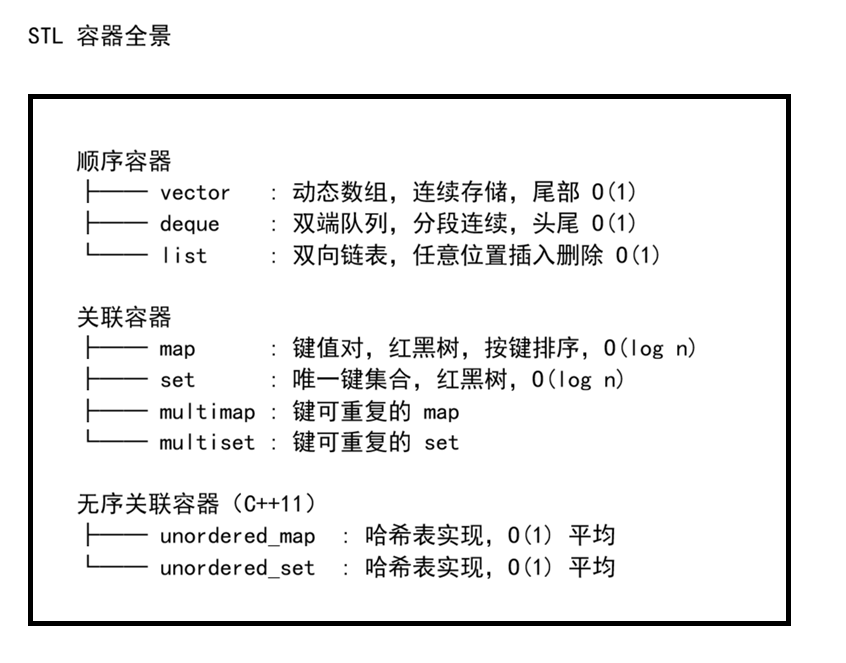
在前两篇文章中,我们学习了 vector 和 stringstream。vector 是连续存储的动态数组,尾部操作高效但在中间和头部操作代价高昂。实际开发中,我们还需要在不同场景下选择更合适的容器:
-
需要在头部和尾部都能高效操作 ?→
deque(双端队列) -
需要在任意位置高效插入删除 ?→
list(双向链表) -
需要按键值快速查找 ?→
map(红黑树实现的有序映射)
本文将深入讲解这三个容器的底层原理、核心操作和适用场景。
第一部分:deque 双端队列
一、底层结构
deque(double-ended queue,双端队列)由多个固定大小的连续空间 组成,通过一个**中控器(Map 数组)**管理这些空间的地址。
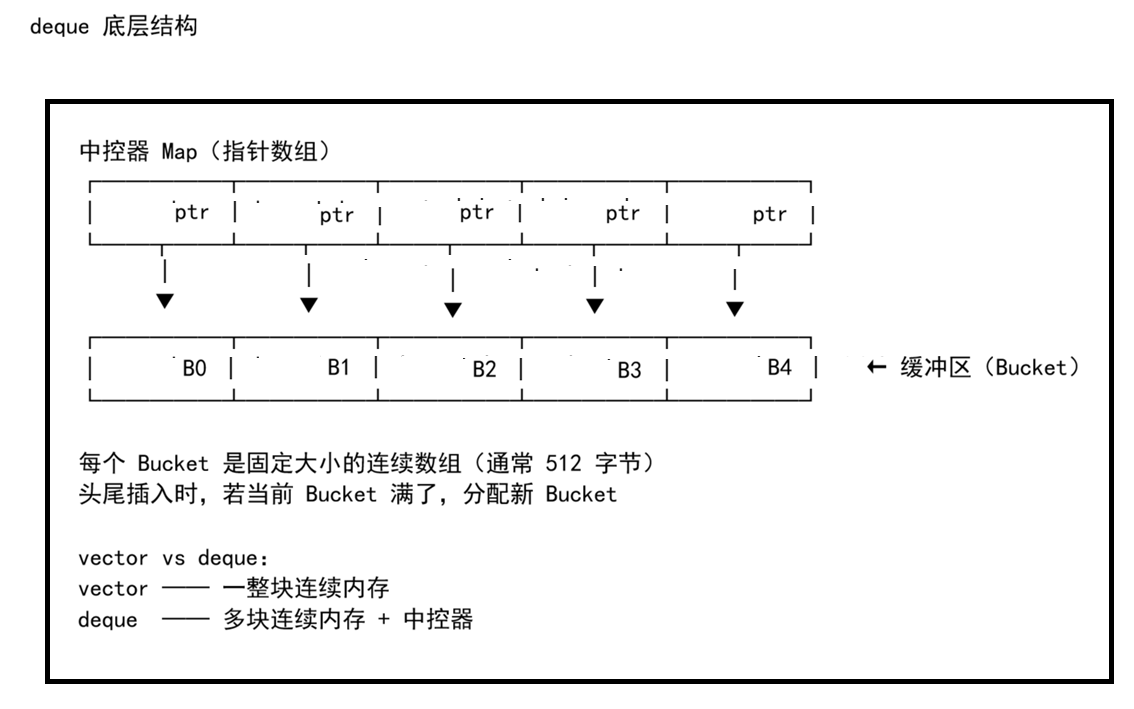
为什么 deque 支持头尾高效操作?
-
push_front:在第一个 Bucket 的前面写入,如果满了就分配新 Bucket 挂到中控器前面 -
push_back:在最后一个 Bucket 的后面写入,如果满了就分配新 Bucket 挂到中控器后面 -
不需要像
vector那样移动所有元素
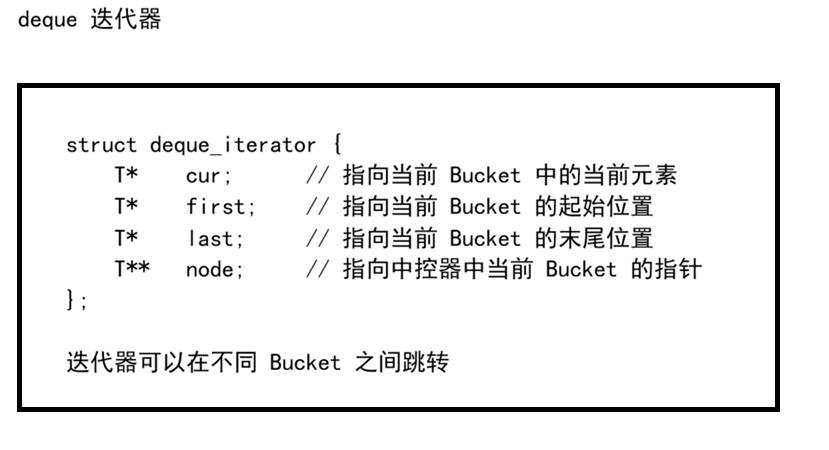
deque 的迭代器结构:
二、创建与初始化
cpp
#include <deque>
#include <iostream>
using namespace std;

int main() {
    // 1. 默认构造
    deque<int> d1;

    // 2. 初始化列表
    deque<int> d2 = {1, 9, 2, 0, 8, 7};

    // 3. 指定大小和初始值
    deque<int> d3(10);       // 10 个 0
    deque<int> d4(10, 42);   // 10 个 42

    // 4. 从其他容器构造
    deque<int> d5(d2.begin(), d2.begin() + 3);  // {1, 9, 2}

    return 0;
}
三、元素添加
cpp
deque<int> d = {1, 2, 3};

// 头尾添加(最常用,O(1))
d.push_back(10);       // 尾部追加 → {1, 2, 3, 10}
d.push_front(4);       // 头部追加 → {4, 1, 2, 3, 10}

// 原地构造(C++11,更高效)
d.emplace_back(8);     // 尾部原地构造
d.emplace_front(6);    // 头部原地构造

// 指定位置插入
d.insert(d.begin() + 2, 99);               // 在第3个位置插入 99
d.insert(d.begin(), {11, 21, 33});         // 在开头插入多个
d.emplace(d.begin(), 22);                   // 在开头原地构造
push_back vs emplace_back 的区别:
cpp
struct Point {
    int x, y;
    Point(int a, int b) : x(a), y(b) {}
};

deque<Point> dq;

// push_back:先构造临时对象,再拷贝到 deque
dq.push_back(Point(3, 4));

// emplace_back:直接在 deque 内部构造,省去拷贝
dq.emplace_back(5, 6);
四、元素删除
cpp
deque<int> d = {1, 2, 3, 4, 5, 6, 7, 8, 9, 10};

// 头尾删除
d.pop_back();     // 删除最后一个 → 10
d.pop_front();    // 删除第一个 → 1

// 删除指定位置
d.erase(d.begin() + 2);                      // 删除第三个元素
d.erase(d.begin(), d.begin() + 3);           // 删除前三个
d.erase(d.end() - 3, d.end());               // 删除后三个

// 清空
d.clear();
五、元素访问
cpp
deque<int> d = {10, 20, 30, 40, 50};

// 下标访问(支持随机访问!)
int a = d[0];        // 10
int b = d[2];        // 30

// at() 带越界检查
int c = d.at(1);     // 20

// 头尾元素
int first = d.front();  // 10
int last  = d.back();   // 50
六、完整示例
cpp
#include <iostream>
#include <deque>
using namespace std;

// 重载 << 操作符,方便打印 deque
template<class T>
ostream& operator<<(ostream& cout, deque<T>& d) {
    for (auto it = d.begin(); it != d.end(); ++it) {
        cout << *it << " ";
    }
    cout << endl;
    return cout;
}

// 查找指定元素,返回迭代器
deque<int>::iterator findInDeque(deque<int>& deq, int item) {
    auto it = deq.begin();
    while (it != deq.end()) {
        if (*it == item) return it;
        ++it;
    }
    return it;  // 返回 end() 表示未找到
}

int main() {
    deque<int> d = {1, 9, 2, 0, 8, 7};

    d.push_back(10);
    d.push_front(4);
    d.emplace_back(8);
    d.emplace_front(6);
    d.insert(d.begin() + 2, {11, 21, 33});

    cout << "size: " << d.size() << endl;
    cout << d;

    // 删除前3和后3
    d.erase(d.begin(), d.begin() + 3);
    d.erase(d.end() - 3, d.end());
    cout << d;

    // 交互式删除
    int v;
    while (true) {
        cout << "删除的元素(-1结束): ";
        cin >> v;
        if (v == -1) break;

        auto it = findInDeque(d, v);
        if (it != d.end()) {
            d.erase(it);
            cout << "删除成功" << endl;
        } else {
            cout << "查无此元素" << endl;
        }
    }

    cout << "最终: " << d;
    cout << "头部: " << d.front() << ", 尾部: " << d.back() << endl;

    return 0;
}
七、deque vs vector 对比
| 对比项 | vector | deque |
|---|---|---|
| 底层结构 | 一块连续内存 | 多块连续内存 + 中控器 |
头部插入 push_front |
❌ O(n) | ✅ O(1) |
尾部插入 push_back |
✅ O(1) | ✅ O(1) |
随机访问 [i] |
✅ O(1) | ✅ O(1)(稍慢) |
中间插入 insert |
O(n) | O(n) |
| 内存释放 | shrink_to_fit() |
自动回收空闲 Bucket |
| 迭代器失效 | 扩容时全部失效 | 只在当前 Bucket 失效 |
选择建议:
| 场景 | 推荐 |
|---|---|
| 只需尾部操作 | vector(更简单,缓存更友好) |
| 需要头尾操作 | deque |
| 需要随机访问 + 头部操作 | deque |
| 频繁随机访问 | vector(连续内存,缓存命中率高) |
第二部分:list 双向链表
一、底层结构
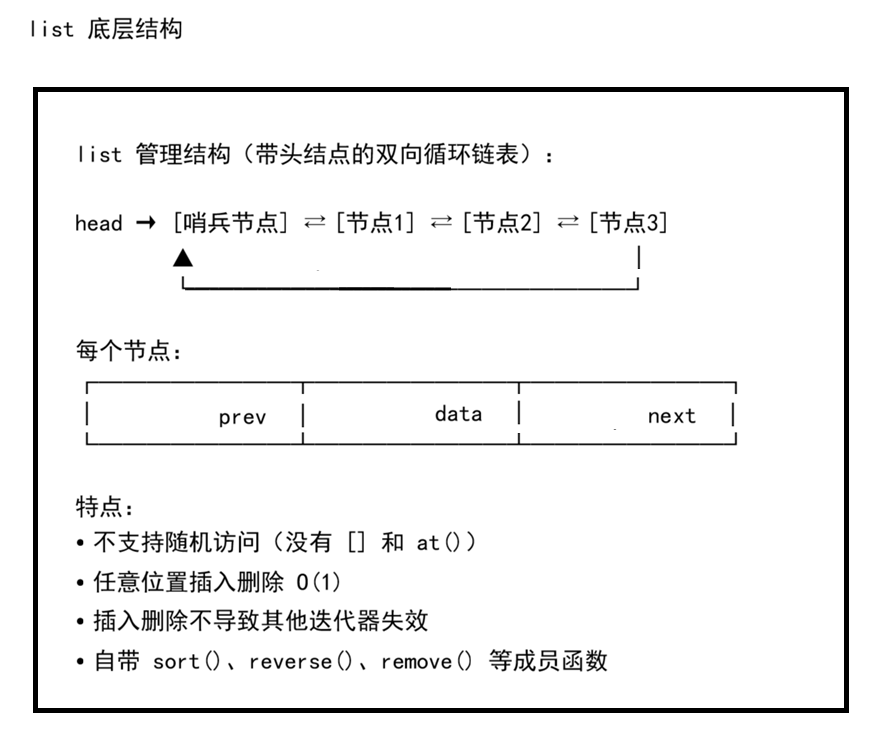
list 是双向循环链表 ,每个节点有 prev 和 next 两个指针。C++11 标准保证了 list 的节点在内存中独立分配,插入删除不会导致迭代器失效(被删除的那个除外)。
二、创建与初始化
cpp
#include <list>
#include <iostream>
using namespace std;

int main() {
    // 默认构造
    list<int> l1;

    // 初始化列表
    list<int> l2 = {9, 2, 1, 3, 4};

    // 指定大小
    list<int> l3(10);        // 10 个 0
    list<int> l4(10, 42);    // 10 个 42

    return 0;
}
三、元素添加
cpp
list<int> l = {1, 2, 3};

// 头尾添加
l.push_back(20);       // 尾部
l.push_front(12);      // 头部

// 原地构造
l.emplace_back(8);     // 尾部原地构造
l.emplace_front(22);   // 头部原地构造

// 指定位置插入
l.insert(l.begin(), 99);               // 在开头插入
l.insert(l.begin(), {10, 11, 12});     // 插入多个
四、元素删除
cpp
list<int> l = {1, 2, 3, 4, 5, 6, 7, 8};

// 头尾删除
l.pop_back();     // 删尾部
l.pop_front();    // 删头部

// 删除指定位置
auto it = l.begin();
++it;  ++it;      // 移到第三个元素
l.erase(it);

// 按值删除(list 特有的高效操作)
l.remove(2);      // 删除所有值为 2 的元素

// 条件删除
l.remove_if([](int x) { return x < 5; });  // 删除所有小于 5 的元素
为什么 list 的 remove() 是 O(n) 但比 vector 高效?
-
vector的erase + remove需要移动元素 -
list的remove()只修改指针,不需要移动元素
五、list 特有操作
cpp
list<int> l = {5, 2, 8, 1, 9, 3};

// 排序(list 自带 sort,不需要用 std::sort)
l.sort();                // 升序:1 2 3 5 8 9
l.sort(greater<>());     // 降序:9 8 5 3 2 1

// 反转
l.reverse();             // 链表原地反转

// 去重(需要先排序)
l.sort();
l.unique();              // 删除连续重复的元素

// 合并两个有序链表
list<int> l2 = {4, 6, 10};
l.merge(l2);             // l2 被清空,合并到 l
为什么 list 自带 sort()?
-
std::sort()需要随机访问迭代器 (支持it + n) -
list只有双向迭代器 (只支持++和--),不能用于std::sort() -
list::sort()内部使用归并排序,专为链表设计
六、仿函数与条件操作
cpp
// 仿函数:重载了 operator() 的类
class LessFive {
private:
    int threshold;
public:
    LessFive(int t) : threshold(t) {}
    bool operator()(int item) {
        return item < threshold;
    }
};

int main() {
    list<int> l = {9, 2, 1, 8, 3, 4, 7};

    // 删除所有小于 5 的元素
    l.remove_if(LessFive(5));
    // 结果:9, 8, 7

    return 0;
}
仿函数 vs 函数指针 vs Lambda:
| 方式 | 代码 | 特点 |
|---|---|---|
| 函数指针 | remove_if(func) |
简单但无法保存状态 |
| 仿函数 | remove_if(LessFive(5)) |
可以保存状态(threshold) |
| Lambda | remove_if([](int x){return x<5;}) |
C++11,最简洁 |
七、完整示例
cpp
#include <iostream>
#include <list>
#include <functional>
using namespace std;

int main() {
    list<int> l = {9, 2, 1, 3, 4};

    // 添加
    l.push_back(20);
    l.push_front(12);
    l.emplace_front(22);
    l.emplace_back(8);
    l.insert(l.begin(), {10, 11});

    // 遍历
    for (int item : l) cout << item << " ";
    cout << endl;

    // 删除前三个元素(list 迭代器不支持 +n,只能循环 ++)
    auto it = l.begin();
    int count = 3;
    while (count > 0) {
        auto delIt = it;
        ++it;
        l.erase(delIt);
        --count;
    }

    for (int item : l) cout << item << " ";
    cout << endl;
    cout << "头部: " << l.front() << endl;

    // 按值删除
    l.remove(2);

    // 排序
    l.sort(greater<>());
    for (int item : l) cout << item << " ";
    cout << endl;

    // 反转
    l.reverse();
    for (int item : l) cout << item << " ";
    cout << endl;

    // 条件删除
    l.remove_if([](int x) { return x < 5; });
    for (int item : l) cout << item << " ";
    cout << endl;

    return 0;
}
八、list vs vector vs deque 对比
| 对比项 | vector | deque | list |
|---|---|---|---|
| 底层 | 连续数组 | 分段连续 | 双向链表 |
随机访问 [i] |
✅ O(1) | ✅ O(1) | ❌ |
| 头部插入 | ❌ O(n) | ✅ O(1) | ✅ O(1) |
| 尾部插入 | ✅ O(1) | ✅ O(1) | ✅ O(1) |
| 任意插入删除 | O(n) | O(n) | ✅ O(1) |
| 内存占用 | 最小 | 中等 | 最大(每节点2指针) |
| 缓存友好 | ✅ 最好 | 较好 | ❌ 最差 |
| 迭代器失效 | 扩容时全失效 | 部分失效 | 仅删除的失效 |
| 自带排序 | ❌ 用 std::sort | ❌ 用 std::sort | ✅ list::sort |
第三部分:map 有序映射
一、底层结构
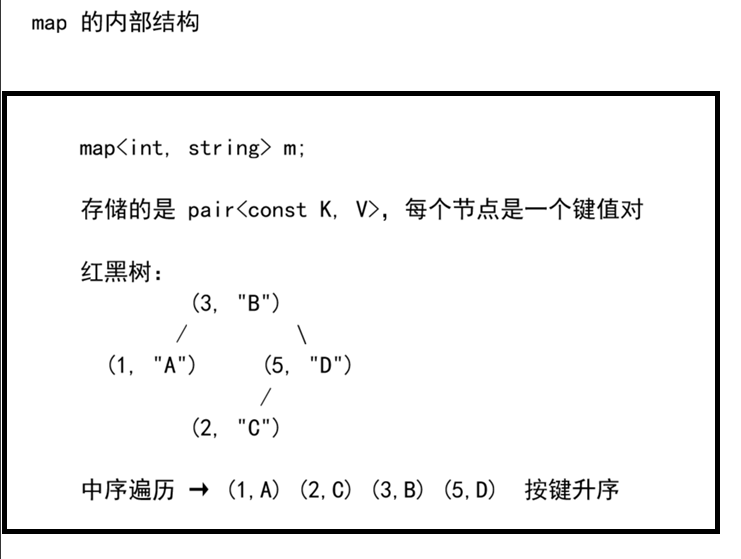
map 的底层是红黑树(一种自平衡二叉搜索树),保证了:
-
元素按键值自动排序(默认升序)
-
查找、插入、删除都是 O(log n)
-
遍历得到有序序列
二、pair 键值对
cpp
#include <map>
#include <string>
using namespace std;

int main() {
    // 创建 pair 的方式
    pair<int, string> p1;
    p1.first = 1001;
    p1.second = "disen";

    pair<int, string> p2(1002, "Lucy");

    pair<int, string> p3 = {1003, "Mike"};    // C++11

    auto p4 = make_pair(1004, "Tom");         // 自动推导类型

    cout << "K:" << p1.first << ", V:" << p1.second << endl;

    return 0;
}
三、创建与插入
cpp
#include <map>
#include <string>
#include <iostream>
using namespace std;

int main() {
    // 1. 初始化列表
    map<int, string> m1 = {
        {1, "A"}, {2, "C"}, {5, "D"}, {3, "B"}
    };

    // 2. 指定排序规则(greater 降序)
    map<int, string, greater<>> m2 = {
        {1, "A"}, {2, "C"}, {5, "D"}, {3, "B"}
    };

    // 3. 插入元素
    m1.insert({4, "Lucy"});
    m1.insert(make_pair(6, "Tom"));
    m1.emplace(7, "Jerry");      // 原地构造,最高效

    // 4. [] 操作符(最方便)
    m1[1] = "Mack";    // key=1 已存在,更新 value
    m1[6] = "Jack";    // key=6 不存在,插入新元素

    return 0;
}
[] 操作符 vs insert vs emplace:
| 操作 | key 存在时 | key 不存在时 |
|---|---|---|
m[k] = v |
更新 value | 插入新元素 |
insert({k, v}) |
忽略,不插入 | 插入 |
emplace(k, v) |
忽略,不插入 | 插入(最高效) |
四、遍历与查找
cpp
map<int, string> m = {{1,"A"}, {2,"C"}, {5,"D"}, {3,"B"}};

// 遍历(按键升序)
for (auto it = m.begin(); it != m.end(); ++it) {
    cout << "K:" << it->first << ", V:" << it->second << endl;
}
// 输出顺序:1:A, 2:C, 3:B, 5:D(自动按键排序!)

// 范围 for
for (const auto& kv : m) {
    cout << kv.first << " → " << kv.second << endl;
}

// 查找
auto it = m.find(3);
if (it != m.end()) {
    cout << "找到: " << it->second << endl;
} else {
    cout << "不存在" << endl;
}
五、完整示例
cpp
#include <iostream>
#include <map>
#include <string>
#include <functional>
using namespace std;

int main() {
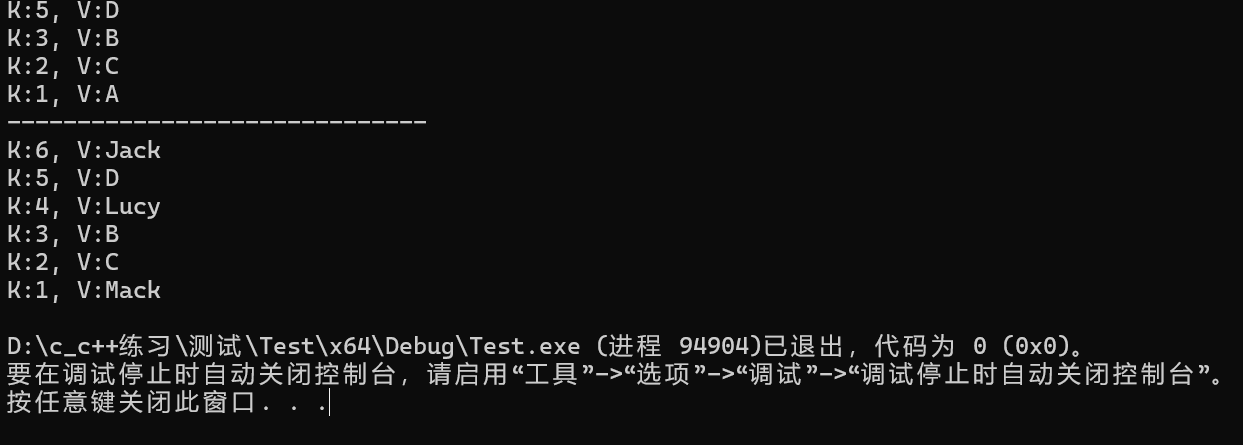
    map<int, string, greater<>> m = {
        {1, "A"}, {2, "C"}, {5, "D"}, {3, "B"}
    };

    // 遍历
    for (auto it = m.begin(); it != m.end(); ++it) {
        cout << "K:" << it->first << ", V:" << it->second << endl;
    }

    cout << string(30, '-') << endl;

    // 插入测试
    m.emplace(make_pair(2, "BC"));  // key=2 已存在,不会插入
    m.insert({{5, "Disen"}, {4, "Lucy"}});  // 5 存在不插入,4 插入

    m[1] = "Mack";    // 更新 key=1
    m[6] = "Jack";    // 插入 key=6

    // 再次遍历
    for (auto it = m.begin(); it != m.end(); ++it) {
        cout << "K:" << it->first << ", V:" << it->second << endl;
    }

    return 0;
}运行结果:
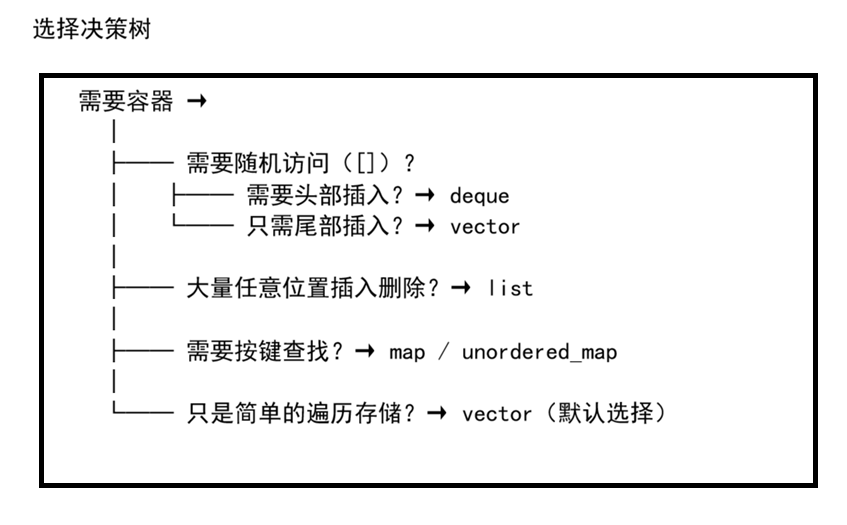
第四部分:三大顺序容器选择指南
总结
一、核心操作速查
| 操作 | vector | deque | list | map |
|---|---|---|---|---|
| 头部插入 | ❌ | ✅ push_front | ✅ push_front | --- |
| 尾部插入 | ✅ push_back | ✅ push_back | ✅ push_back | --- |
| 随机访问 | ✅ i | ✅ i | ❌ | ✅ k |
| 任意插入 | insert | insert | insert | insert/emplace |
| 排序 | std::sort | std::sort | list::sort | 自动排序 |
| 底层 | 数组 | 分段数组 | 双向链表 | 红黑树 |
二、一句话记忆
-
vector:动态数组,尾插尾删快,随机访问,扩容代价高
-
deque:多数组组合,头尾都快,支持随机访问,适合双端操作
-
list:双向链表,任意位置 O(1) 插入删除,不支持随机访问,自带 sort
-
map:红黑树实现的键值对容器,按键自动排序,查找 O(log n)