文章目录
- [一. SOEM2.0编译](#一. SOEM2.0编译)
- [二. Qt调用](#二. Qt调用)
SOEM官方编译教程:https://docs.rt-labs.com/soem/tutorials/building.html
一. SOEM2.0编译
环境:vs2019+CMake3.26.0
-
官网下载源代码
GitHub - OpenEtherCATsociety/SOEM: Simple Open Source EtherCAT Master · GitHub
-
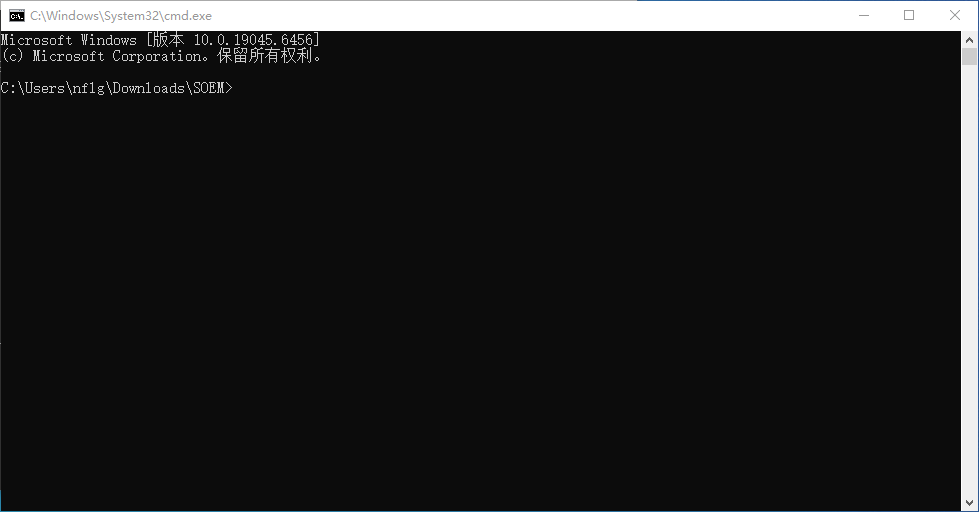
CMD进入源代码目录
-
CMD运行以下命令
- 设置编译器和安装位置
Bash
cmake --preset default -G "Visual Studio 16 2019" -DCMAKE_INSTALL_PREFIX=C:\Users\nflg\Downloads\SOEM\install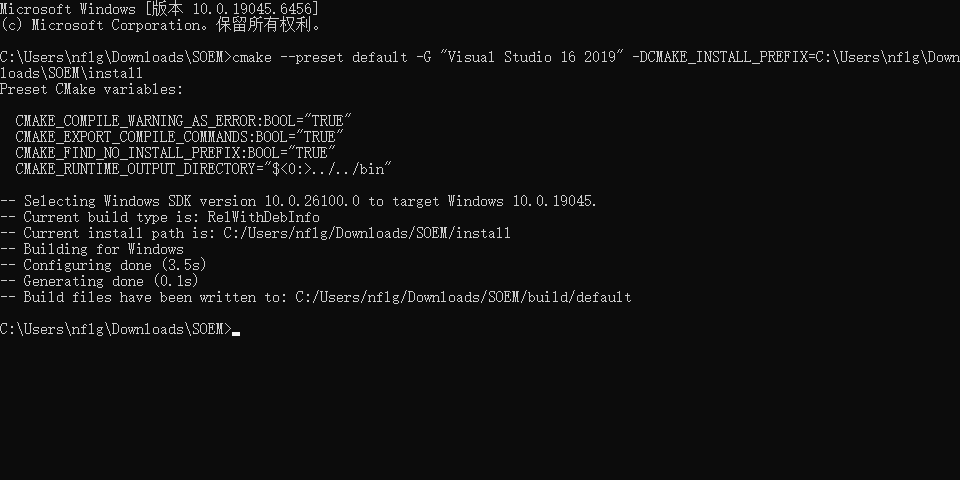
2. 编译与安装
Bash
cmake --build --preset default --target install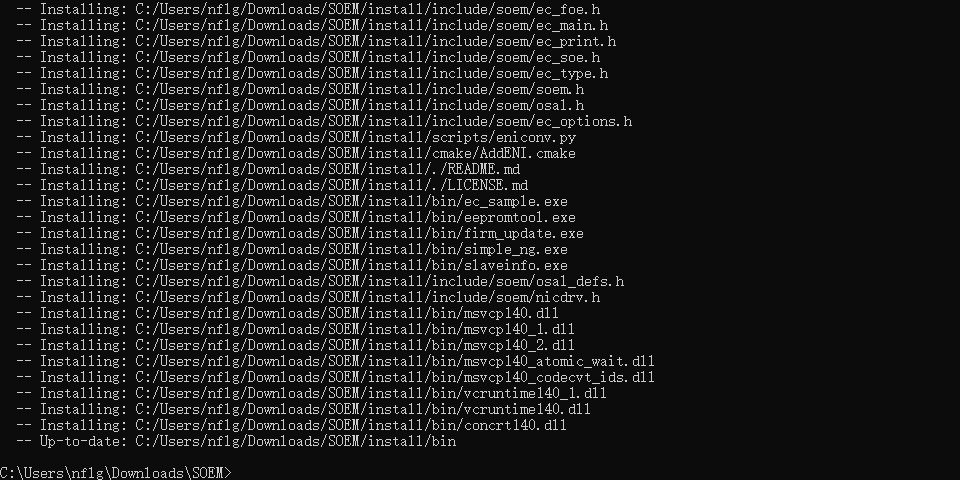
- 测试示例代码
-
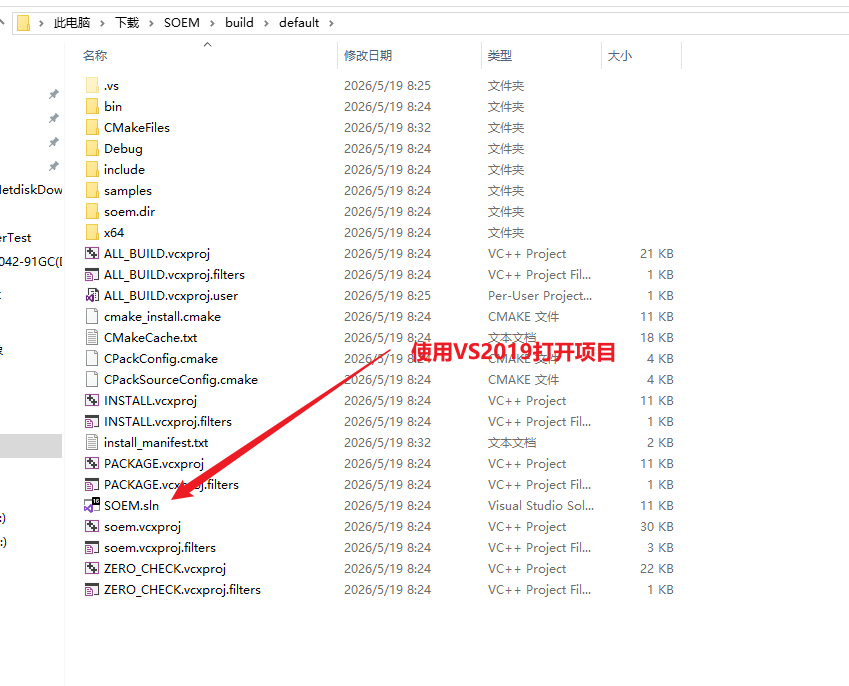
使用VS2019打开项目
-
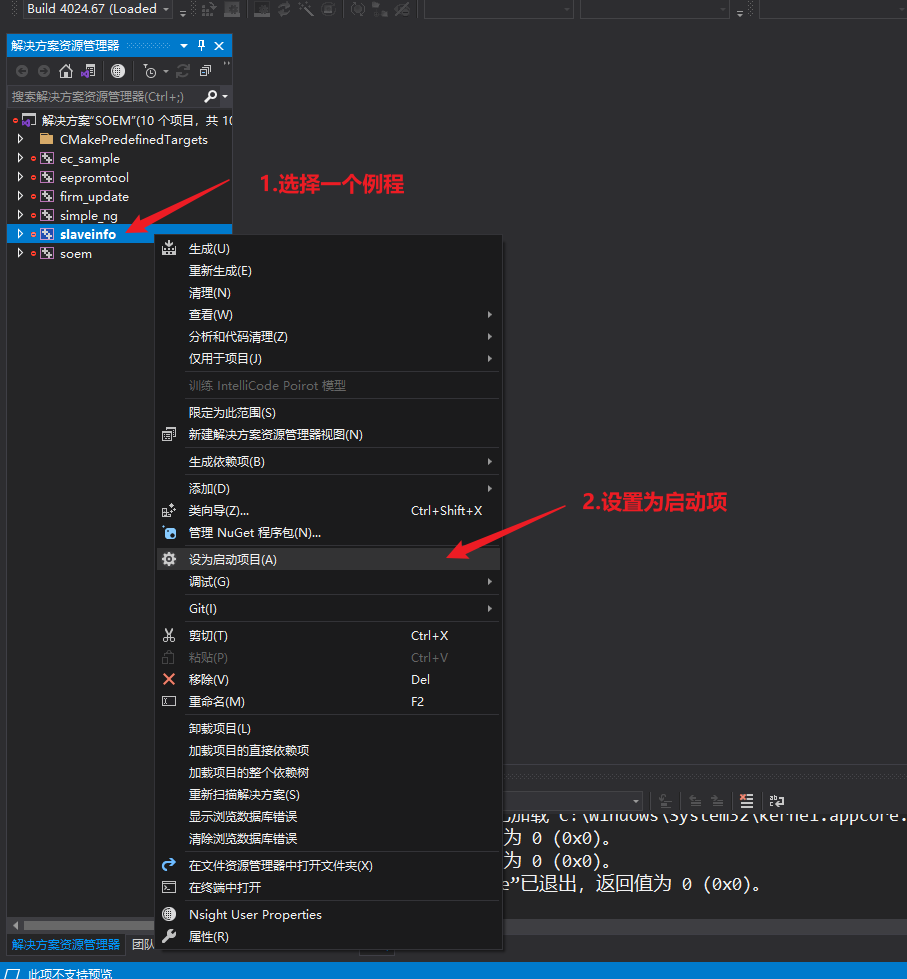
选择一个项目,设置为启动项
-
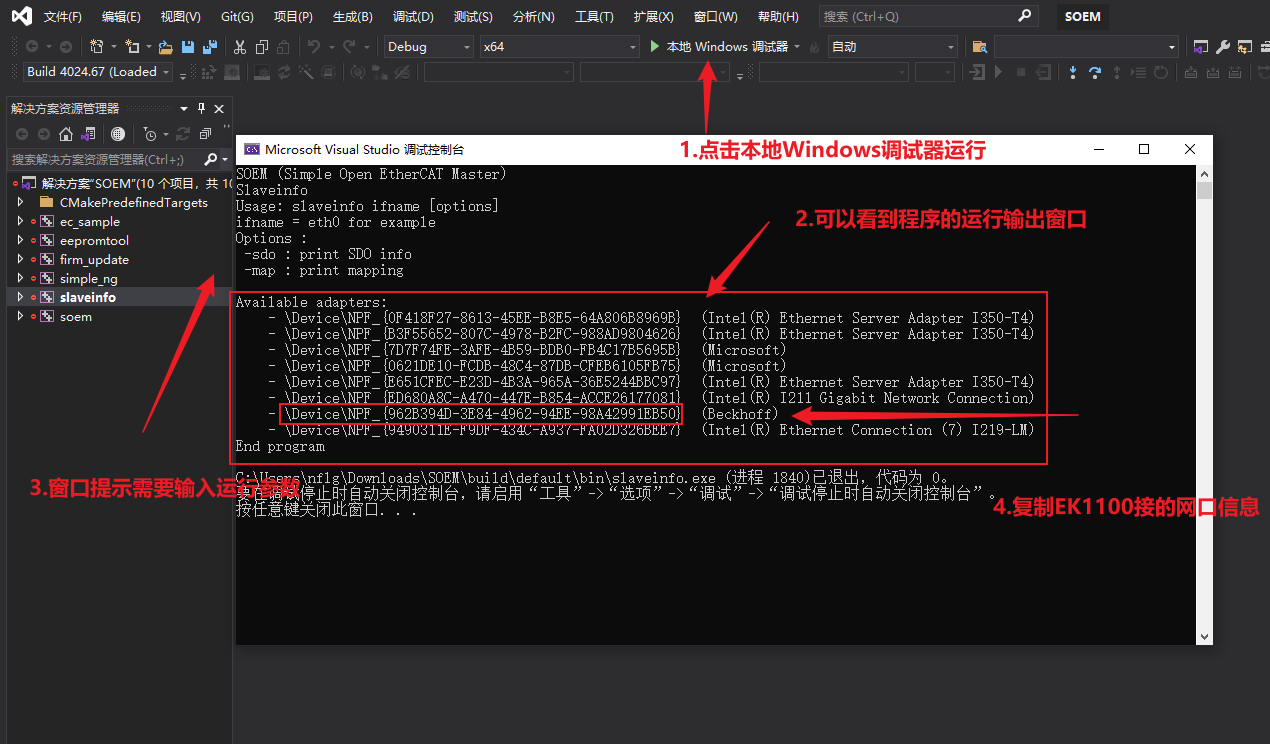
运行项目,查看输出窗口
-
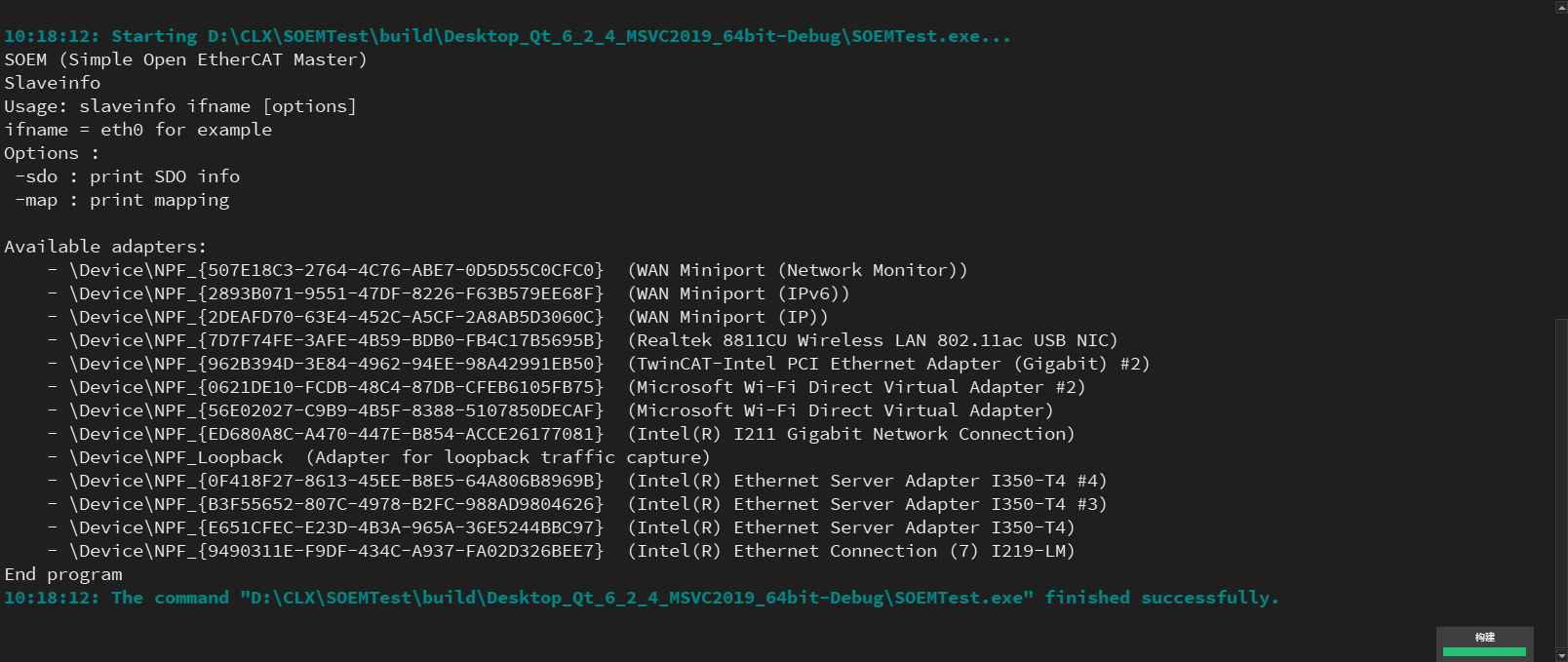
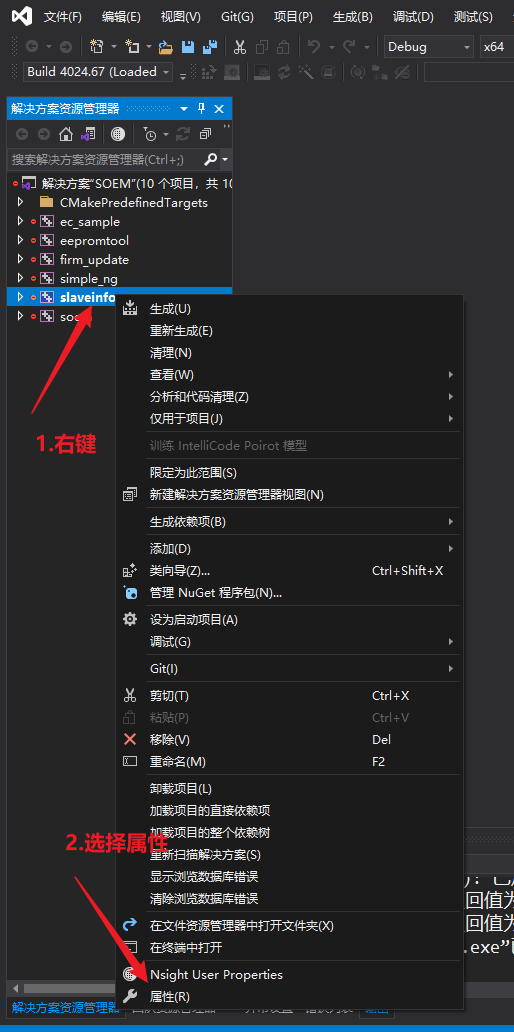
设置运行参数,重新运行程序,可以看到设备信息
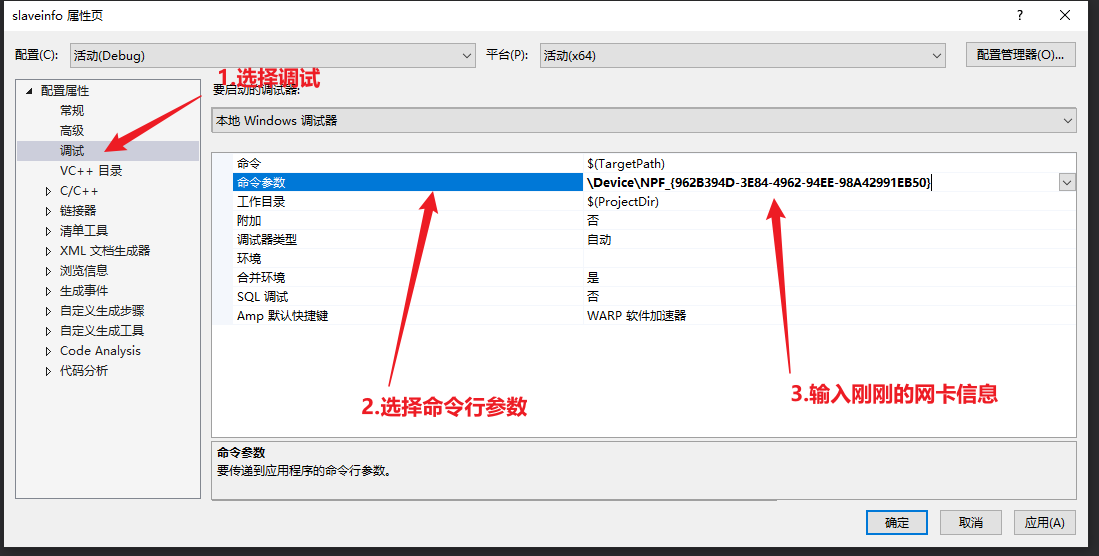
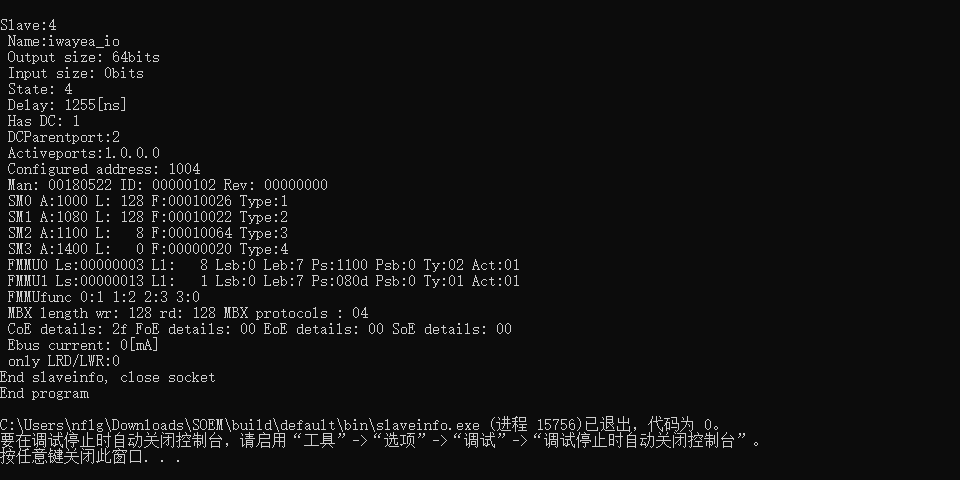
-
二. Qt调用
- cmakeList.txt
Bash
cmake_minimum_required(VERSION 3.16)

project(SOEMTest LANGUAGES CXX)

set(CMAKE_CXX_STANDARD 17)
set(CMAKE_CXX_STANDARD_REQUIRED ON)

# winpcap库目录
set(WINPCAP_DIR "D:\\Program Files\\wpcap\\")
include_directories(${WINPCAP_DIR}\\Include\\)
link_directories(${WINPCAP_DIR}\\Lib\\x64\\)

# SOEM2.0库目录
set(CMAKE_PREFIX_PATH "D:\\Program Files\\soem2\\" ${CMAKE_PREFIX_PATH})
find_package(soem REQUIRED)

add_executable(SOEMTest main.cpp)

target_link_libraries(SOEMTest PUBLIC soem wpcap)

include(GNUInstallDirs)
install(TARGETS SOEMTest
    LIBRARY DESTINATION ${CMAKE_INSTALL_LIBDIR}
    RUNTIME DESTINATION ${CMAKE_INSTALL_BINDIR}
)注意:winpcap直接复制源代码目录下的SOEM\oshw\win32\wpcap即可,这里我将SOEM\oshw\win32\wpcap这个目录移动到了D:\\Program Files\\wpcap,SOEM\install移动到了D:\\Program Files\\soem2- 主代码
C
/*
* This software is dual-licensed under GPLv3 and a commercial
* license. See the file LICENSE.md distributed with this software for
* full license information.
*/
#include <stdio.h>
#include <string.h>
#include <inttypes.h>
#include "soem/soem.h"
static uint8 IOmap[4096];
static ec_ODlistt ODlist;
static ec_OElistt OElist;
static boolean printSDO = FALSE;
static boolean printMAP = FALSE;
static char usdo[128];
static ecx_contextt ctx;
#define OTYPE_VAR 0x0007
#define OTYPE_ARRAY 0x0008
#define OTYPE_RECORD 0x0009
#define ATYPE_Rpre 0x01
#define ATYPE_Rsafe 0x02
#define ATYPE_Rop 0x04
#define ATYPE_Wpre 0x08
#define ATYPE_Wsafe 0x10
#define ATYPE_Wop 0x20
char *dtype2string(uint16 dtype, uint16 bitlen)
{
static char str[32] = {0};
switch (dtype)
{
case ECT_BOOLEAN:
snprintf(str, sizeof(str), "BOOLEAN");
break;
case ECT_INTEGER8:
snprintf(str, sizeof(str), "INTEGER8");
break;
case ECT_INTEGER16:
snprintf(str, sizeof(str), "INTEGER16");
break;
case ECT_INTEGER32:
snprintf(str, sizeof(str), "INTEGER32");
break;
case ECT_INTEGER24:
snprintf(str, sizeof(str), "INTEGER24");
break;
case ECT_INTEGER64:
snprintf(str, sizeof(str), "INTEGER64");
break;
case ECT_UNSIGNED8:
snprintf(str, sizeof(str), "UNSIGNED8");
break;
case ECT_UNSIGNED16:
snprintf(str, sizeof(str), "UNSIGNED16");
break;
case ECT_UNSIGNED32:
snprintf(str, sizeof(str), "UNSIGNED32");
break;
case ECT_UNSIGNED24:
snprintf(str, sizeof(str), "UNSIGNED24");
break;
case ECT_UNSIGNED64:
snprintf(str, sizeof(str), "UNSIGNED64");
break;
case ECT_REAL32:
snprintf(str, sizeof(str), "REAL32");
break;
case ECT_REAL64:
snprintf(str, sizeof(str), "REAL64");
break;
case ECT_BIT1:
snprintf(str, sizeof(str), "BIT1");
break;
case ECT_BIT2:
snprintf(str, sizeof(str), "BIT2");
break;
case ECT_BIT3:
snprintf(str, sizeof(str), "BIT3");
break;
case ECT_BIT4:
snprintf(str, sizeof(str), "BIT4");
break;
case ECT_BIT5:
snprintf(str, sizeof(str), "BIT5");
break;
case ECT_BIT6:
snprintf(str, sizeof(str), "BIT6");
break;
case ECT_BIT7:
snprintf(str, sizeof(str), "BIT7");
break;
case ECT_BIT8:
snprintf(str, sizeof(str), "BIT8");
break;
case ECT_VISIBLE_STRING:
snprintf(str, sizeof(str), "VISIBLE_STR(%d)", bitlen);
break;
case ECT_OCTET_STRING:
snprintf(str, sizeof(str), "OCTET_STR(%d)", bitlen);
break;
default:
snprintf(str, sizeof(str), "dt:0x%4.4X (%d)", dtype, bitlen);
}
return str;
}
char *otype2string(uint16 otype)
{
static char str[32] = {0};
switch (otype)
{
case OTYPE_VAR:
snprintf(str, sizeof(str), "VAR");
break;
case OTYPE_ARRAY:
snprintf(str, sizeof(str), "ARRAY");
break;
case OTYPE_RECORD:
snprintf(str, sizeof(str), "RECORD");
break;
default:
snprintf(str, sizeof(str), "ot:0x%4.4X", otype);
}
return str;
}
char *access2string(uint16 access)
{
static char str[32] = {0};
snprintf(str, sizeof(str), "%s%s%s%s%s%s",
((access & ATYPE_Rpre) != 0 ? "R" : "_"),
((access & ATYPE_Wpre) != 0 ? "W" : "_"),
((access & ATYPE_Rsafe) != 0 ? "R" : "_"),
((access & ATYPE_Wsafe) != 0 ? "W" : "_"),
((access & ATYPE_Rop) != 0 ? "R" : "_"),
((access & ATYPE_Wop) != 0 ? "W" : "_"));
return str;
}
char *SDO2string(uint16 slave, uint16 index, uint8 subidx, uint16 dtype)
{
int l = sizeof(usdo) - 1, i;
uint8 *u8;
int8 *i8;
uint16 *u16;
int16 *i16;
uint32 *u32;
int32 *i32;
uint64 *u64;
int64 *i64;
float *sr;
double *dr;
char *p;
size_t size;
memset(&usdo, 0, sizeof(usdo));
ecx_SDOread(&ctx, slave, index, subidx, FALSE, &l, &usdo, EC_TIMEOUTRXM);
if (ctx.ecaterror)
{
return ecx_elist2string(&ctx);
}
else
{
static char str[sizeof(usdo) + 3] = {0};
switch (dtype)
{
case ECT_BOOLEAN:
u8 = (uint8 *)&usdo[0];
if (*u8)
snprintf(str, sizeof(str), "TRUE");
else
snprintf(str, sizeof(str), "FALSE");
break;
case ECT_INTEGER8:
i8 = (int8 *)&usdo[0];
snprintf(str, sizeof(str), "0x%2.2x / %d", *i8, *i8);
break;
case ECT_INTEGER16:
i16 = (int16 *)&usdo[0];
snprintf(str, sizeof(str), "0x%4.4x / %d", *i16, *i16);
break;
case ECT_INTEGER32:
case ECT_INTEGER24:
i32 = (int32 *)&usdo[0];
snprintf(str, sizeof(str), "0x%8.8x / %d", *i32, *i32);
break;
case ECT_INTEGER64:
i64 = (int64 *)&usdo[0];
snprintf(str, sizeof(str), "0x%16.16" PRIx64 " / %" PRId64, *i64, *i64);
break;
case ECT_UNSIGNED8:
u8 = (uint8 *)&usdo[0];
snprintf(str, sizeof(str), "0x%2.2x / %u", *u8, *u8);
break;
case ECT_UNSIGNED16:
u16 = (uint16 *)&usdo[0];
snprintf(str, sizeof(str), "0x%4.4x / %u", *u16, *u16);
break;
case ECT_UNSIGNED32:
case ECT_UNSIGNED24:
u32 = (uint32 *)&usdo[0];
snprintf(str, sizeof(str), "0x%8.8x / %u", *u32, *u32);
break;
case ECT_UNSIGNED64:
u64 = (uint64 *)&usdo[0];
snprintf(str, sizeof(str), "0x%16.16" PRIx64 " / %" PRIu64, *u64, *u64);
break;
case ECT_REAL32:
sr = (float *)&usdo[0];
snprintf(str, sizeof(str), "%f", *sr);
break;
case ECT_REAL64:
dr = (double *)&usdo[0];
snprintf(str, sizeof(str), "%f", *dr);
break;
case ECT_BIT1:
case ECT_BIT2:
case ECT_BIT3:
case ECT_BIT4:
case ECT_BIT5:
case ECT_BIT6:
case ECT_BIT7:
case ECT_BIT8:
u8 = (uint8 *)&usdo[0];
snprintf(str, sizeof(str), "0x%x / %u", *u8, *u8);
break;
case ECT_VISIBLE_STRING:
snprintf(str, sizeof(str), "\"%s\"", usdo);
break;
case ECT_OCTET_STRING:
p = str;
size = sizeof(str);
for (i = 0; i < l && i < (int)sizeof(usdo); i++)
{
int n = snprintf(p, size, "0x%2.2x ", usdo[i]);
if (n > (int)size)
break;
p += n;
size -= n;
}
break;
default:
snprintf(str, sizeof(str), "Unknown type");
}
str[sizeof(str) - 1] = 0;
return str;
}
}
/** Read PDO assign structure */
int si_PDOassign(uint16 slave, uint16 PDOassign, int mapoffset, int bitoffset)
{
uint16 idxloop, nidx, subidxloop, rdat, idx, subidx;
uint8 subcnt;
int wkc, bsize = 0, rdl;
int32 rdat2;
uint8 bitlen, obj_subidx;
uint16 obj_idx;
int abs_offset, abs_bit;
rdl = sizeof(rdat);
rdat = 0;
/* read PDO assign subindex 0 ( = number of PDO's) */
wkc = ecx_SDOread(&ctx, slave, PDOassign, 0x00, FALSE, &rdl, &rdat, EC_TIMEOUTRXM);
rdat = etohs(rdat);
/* positive result from slave ? */
if ((wkc > 0) && (rdat > 0))
{
/* number of available sub indexes */
nidx = rdat;
bsize = 0;
/* read all PDO's */
for (idxloop = 1; idxloop <= nidx; idxloop++)
{
rdl = sizeof(rdat);
rdat = 0;
/* read PDO assign */
wkc = ecx_SDOread(&ctx, slave, PDOassign, (uint8)idxloop, FALSE, &rdl, &rdat, EC_TIMEOUTRXM);
/* result is index of PDO */
idx = etohs(rdat);
if (idx > 0)
{
rdl = sizeof(subcnt);
subcnt = 0;
/* read number of subindexes of PDO */
wkc = ecx_SDOread(&ctx, slave, idx, 0x00, FALSE, &rdl, &subcnt, EC_TIMEOUTRXM);
subidx = subcnt;
/* for each subindex */
for (subidxloop = 1; subidxloop <= subidx; subidxloop++)
{
rdl = sizeof(rdat2);
rdat2 = 0;
/* read SDO that is mapped in PDO */
wkc = ecx_SDOread(&ctx, slave, idx, (uint8)subidxloop, FALSE, &rdl, &rdat2, EC_TIMEOUTRXM);
rdat2 = etohl(rdat2);
/* extract bitlength of SDO */
bitlen = LO_BYTE(rdat2);
bsize += bitlen;
obj_idx = (uint16)(rdat2 >> 16);
obj_subidx = (uint8)((rdat2 >> 8) & 0x000000ff);
abs_offset = mapoffset + (bitoffset / 8);
abs_bit = bitoffset % 8;
ODlist.Slave = slave;
ODlist.Index[0] = obj_idx;
OElist.Entries = 0;
wkc = 0;
/* read object entry from dictionary if not a filler (0x0000:0x00) */
if (obj_idx || obj_subidx)
wkc = ecx_readOEsingle(&ctx, 0, obj_subidx, &ODlist, &OElist);
printf(" [0x%4.4X.%1d] 0x%4.4X:0x%2.2X 0x%2.2X", abs_offset, abs_bit, obj_idx, obj_subidx, bitlen);
if ((wkc > 0) && OElist.Entries)
{
printf(" %-12s %s\n", dtype2string(OElist.DataType[obj_subidx], bitlen), OElist.Name[obj_subidx]);
}
else
printf("\n");
bitoffset += bitlen;
};
};
};
};
/* return total found bitlength (PDO) */
return bsize;
}
int si_map_sdo(int slave)
{
int wkc, rdl;
int retVal = 0;
uint8 nSM, iSM, tSM;
int Tsize, outputs_bo, inputs_bo;
uint8 SMt_bug_add;
printf("PDO mapping according to CoE :\n");
SMt_bug_add = 0;
outputs_bo = 0;
inputs_bo = 0;
rdl = sizeof(nSM);
nSM = 0;
/* read SyncManager Communication Type object count */
wkc = ecx_SDOread(&ctx, slave, ECT_SDO_SMCOMMTYPE, 0x00, FALSE, &rdl, &nSM, EC_TIMEOUTRXM);
/* positive result from slave ? */
if ((wkc > 0) && (nSM > 2))
{
/* make nSM equal to number of defined SM */
nSM--;
/* limit to maximum number of SM defined, if true the slave can't be configured */
if (nSM > EC_MAXSM)
nSM = EC_MAXSM;
/* iterate for every SM type defined */
for (iSM = 2; iSM <= nSM; iSM++)
{
rdl = sizeof(tSM);
tSM = 0;
/* read SyncManager Communication Type */
wkc = ecx_SDOread(&ctx, slave, ECT_SDO_SMCOMMTYPE, iSM + 1, FALSE, &rdl, &tSM, EC_TIMEOUTRXM);
if (wkc > 0)
{
if ((iSM == 2) && (tSM == 2)) // SM2 has type 2 == mailbox out, this is a bug in the slave!
{
SMt_bug_add = 1; // try to correct, this works if the types are 0 1 2 3 and should be 1 2 3 4
printf("Activated SM type workaround, possible incorrect mapping.\n");
}
if (tSM)
tSM += SMt_bug_add; // only add if SMt > 0
if (tSM == 3) // outputs
{
/* read the assign RXPDO */
printf(" SM%1d outputs\n addr b index: sub bitl data_type name\n", iSM);
Tsize = si_PDOassign(slave, ECT_SDO_PDOASSIGN + iSM, (int)(ctx.slavelist[slave].outputs - IOmap), outputs_bo);
outputs_bo += Tsize;
}
if (tSM == 4) // inputs
{
/* read the assign TXPDO */
printf(" SM%1d inputs\n addr b index: sub bitl data_type name\n", iSM);
Tsize = si_PDOassign(slave, ECT_SDO_PDOASSIGN + iSM, (int)(ctx.slavelist[slave].inputs - IOmap), inputs_bo);
inputs_bo += Tsize;
}
}
}
}
/* found some I/O bits ? */
if ((outputs_bo > 0) || (inputs_bo > 0))
retVal = 1;
return retVal;
}
int si_siiPDO(uint16 slave, uint8 t, int mapoffset, int bitoffset)
{
uint16 a, w, c, e, er;
uint8 eectl;
uint16 obj_idx;
uint8 obj_subidx;
uint8 obj_name;
uint8 obj_datatype;
uint8 bitlen;
int totalsize;
ec_eepromPDOt eepPDO;
ec_eepromPDOt *PDO;
int abs_offset, abs_bit;
char str_name[EC_MAXNAME + 1];
eectl = ctx.slavelist[slave].eep_pdi;
totalsize = 0;
PDO = &eepPDO;
PDO->nPDO = 0;
PDO->Length = 0;
PDO->Index[1] = 0;
for (c = 0; c < EC_MAXSM; c++)
PDO->SMbitsize[c] = 0;
if (t > 1)
t = 1;
PDO->Startpos = ecx_siifind(&ctx, slave, ECT_SII_PDO + t);
if (PDO->Startpos > 0)
{
a = PDO->Startpos;
w = ecx_siigetbyte(&ctx, slave, a++);
w += (ecx_siigetbyte(&ctx, slave, a++) << 8);
PDO->Length = w;
c = 1;
/* traverse through all PDOs */
do
{
PDO->nPDO++;
PDO->Index[PDO->nPDO] = ecx_siigetbyte(&ctx, slave, a++);
PDO->Index[PDO->nPDO] += (ecx_siigetbyte(&ctx, slave, a++) << 8);
PDO->BitSize[PDO->nPDO] = 0;
c++;
/* number of entries in PDO */
e = ecx_siigetbyte(&ctx, slave, a++);
PDO->SyncM[PDO->nPDO] = ecx_siigetbyte(&ctx, slave, a++);
a++;
obj_name = ecx_siigetbyte(&ctx, slave, a++);
a += 2;
c += 2;
if (PDO->SyncM[PDO->nPDO] < EC_MAXSM) /* active and in range SM? */
{
str_name[0] = 0;
if (obj_name)
ecx_siistring(&ctx, str_name, slave, obj_name);
if (t)
printf(" SM%1d RXPDO 0x%4.4X %s\n", PDO->SyncM[PDO->nPDO], PDO->Index[PDO->nPDO], str_name);
else
printf(" SM%1d TXPDO 0x%4.4X %s\n", PDO->SyncM[PDO->nPDO], PDO->Index[PDO->nPDO], str_name);
printf(" addr b index: sub bitl data_type name\n");
/* read all entries defined in PDO */
for (er = 1; er <= e; er++)
{
c += 4;
obj_idx = ecx_siigetbyte(&ctx, slave, a++);
obj_idx += (ecx_siigetbyte(&ctx, slave, a++) << 8);
obj_subidx = ecx_siigetbyte(&ctx, slave, a++);
obj_name = ecx_siigetbyte(&ctx, slave, a++);
obj_datatype = ecx_siigetbyte(&ctx, slave, a++);
bitlen = ecx_siigetbyte(&ctx, slave, a++);
abs_offset = mapoffset + (bitoffset / 8);
abs_bit = bitoffset % 8;
PDO->BitSize[PDO->nPDO] += bitlen;
a += 2;
/* skip entry if filler (0x0000:0x00) */
if (obj_idx || obj_subidx)
{
str_name[0] = 0;
if (obj_name)
ecx_siistring(&ctx, str_name, slave, obj_name);
printf(" [0x%4.4X.%1d] 0x%4.4X:0x%2.2X 0x%2.2X", abs_offset, abs_bit, obj_idx, obj_subidx, bitlen);
printf(" %-12s %s\n", dtype2string(obj_datatype, bitlen), str_name);
}
bitoffset += bitlen;
totalsize += bitlen;
}
PDO->SMbitsize[PDO->SyncM[PDO->nPDO]] += PDO->BitSize[PDO->nPDO];
c++;
}
else /* PDO deactivated because SM is 0xff or > EC_MAXSM */
{
c += 4 * e;
a += 8 * e;
c++;
}
if (PDO->nPDO >= (EC_MAXEEPDO - 1)) c = PDO->Length; /* limit number of PDO entries in buffer */
} while (c < PDO->Length);
}
if (eectl) ecx_eeprom2pdi(&ctx, slave); /* if eeprom control was previously pdi then restore */
return totalsize;
}
int si_map_sii(int slave)
{
int retVal = 0;
int Tsize, outputs_bo, inputs_bo;
printf("PDO mapping according to SII :\n");
outputs_bo = 0;
inputs_bo = 0;
/* read the assign RXPDOs */
Tsize = si_siiPDO(slave, 1, (int)(ctx.slavelist[slave].outputs - IOmap), outputs_bo);
outputs_bo += Tsize;
/* read the assign TXPDOs */
Tsize = si_siiPDO(slave, 0, (int)(ctx.slavelist[slave].inputs - IOmap), inputs_bo);
inputs_bo += Tsize;
/* found some I/O bits ? */
if ((outputs_bo > 0) || (inputs_bo > 0))
retVal = 1;
return retVal;
}
void si_sdo(int cnt)
{
int i, j;
ODlist.Entries = 0;
memset(&ODlist, 0, sizeof(ODlist));
if (ecx_readODlist(&ctx, cnt, &ODlist))
{
printf(" CoE Object Description found, %d entries.\n", ODlist.Entries);
for (i = 0; i < ODlist.Entries; i++)
{
uint16_t max_sub;
char name[128] = {0};
ecx_readODdescription(&ctx, i, &ODlist);
while (ctx.ecaterror)
printf(" - %s\n", ecx_elist2string(&ctx));
snprintf(name, sizeof(name) - 1, "\"%s\"", ODlist.Name[i]);
if (ODlist.ObjectCode[i] == OTYPE_VAR)
{
printf("0x%04x %-40s [%s]\n", ODlist.Index[i], name,
otype2string(ODlist.ObjectCode[i]));
}
else
{
printf("0x%04x %-40s [%s maxsub(0x%02x / %d)]\n",
ODlist.Index[i], name, otype2string(ODlist.ObjectCode[i]),
ODlist.MaxSub[i], ODlist.MaxSub[i]);
}
memset(&OElist, 0, sizeof(OElist));
ecx_readOE(&ctx, i, &ODlist, &OElist);
while (ctx.ecaterror)
printf("- %s\n", ecx_elist2string(&ctx));
if (ODlist.ObjectCode[i] != OTYPE_VAR)
{
int l = sizeof(max_sub);
ecx_SDOread(&ctx, cnt, ODlist.Index[i], 0, FALSE, &l, &max_sub, EC_TIMEOUTRXM);
}
else
{
max_sub = ODlist.MaxSub[i];
}
for (j = 0; j < max_sub + 1; j++)
{
if ((OElist.DataType[j] > 0) && (OElist.BitLength[j] > 0))
{
snprintf(name, sizeof(name) - 1, "\"%s\"", OElist.Name[j]);
printf(" 0x%02x %-40s [%-16s %6s] ", j, name,
dtype2string(OElist.DataType[j], OElist.BitLength[j]),
access2string(OElist.ObjAccess[j]));
if ((OElist.ObjAccess[j] & 0x0007))
{
printf("%s", SDO2string(cnt, ODlist.Index[i], j, OElist.DataType[j]));
}
printf("\n");
}
}
}
}
else
{
while (ctx.ecaterror)
printf("%s", ecx_elist2string(&ctx));
}
}
void slaveinfo(char *ifname)
{
int cnt, i, j, nSM;
uint16 ssigen;
int expectedWKC;
printf("Starting slaveinfo\n");
/* initialise SOEM, bind socket to ifname */
if (ecx_init(&ctx, ifname))
{
printf("ecx_init on %s succeeded.\n", ifname);
/* find and auto-config slaves */
if (ecx_config_init(&ctx) > 0)
{
ec_groupt *group = &ctx.grouplist[0];
ecx_config_map_group(&ctx, IOmap, 0);
ecx_configdc(&ctx);
while (ctx.ecaterror)
printf("%s", ecx_elist2string(&ctx));
printf("%d slaves found and configured.\n", ctx.slavecount);
expectedWKC = (group->outputsWKC * 2) + group->inputsWKC;
printf("Calculated workcounter %d\n", expectedWKC);
/* wait for all slaves to reach SAFE_OP state */
ecx_statecheck(&ctx, 0, EC_STATE_SAFE_OP, EC_TIMEOUTSTATE * 3);
if (ctx.slavelist[0].state != EC_STATE_SAFE_OP)
{
printf("Not all slaves reached safe operational state.\n");
ecx_readstate(&ctx);
for (i = 1; i <= ctx.slavecount; i++)
{
if (ctx.slavelist[i].state != EC_STATE_SAFE_OP)
{
printf("Slave %d State=%2x StatusCode=%4x : %s\n",
i, ctx.slavelist[i].state, ctx.slavelist[i].ALstatuscode, ec_ALstatuscode2string(ctx.slavelist[i].ALstatuscode));
}
}
}
ecx_readstate(&ctx);
for (cnt = 1; cnt <= ctx.slavecount; cnt++)
{
printf("\nSlave:%d\n Name:%s\n Output size: %dbits\n Input size: %dbits\n State: %d\n Delay: %d[ns]\n Has DC: %d\n",
cnt, ctx.slavelist[cnt].name, ctx.slavelist[cnt].Obits, ctx.slavelist[cnt].Ibits,
ctx.slavelist[cnt].state, ctx.slavelist[cnt].pdelay, ctx.slavelist[cnt].hasdc);
if (ctx.slavelist[cnt].hasdc) printf(" DCParentport:%d\n", ctx.slavelist[cnt].parentport);
printf(" Activeports:%d.%d.%d.%d\n", (ctx.slavelist[cnt].activeports & 0x01) > 0,
(ctx.slavelist[cnt].activeports & 0x02) > 0,
(ctx.slavelist[cnt].activeports & 0x04) > 0,
(ctx.slavelist[cnt].activeports & 0x08) > 0);
printf(" Configured address: %4.4x\n", ctx.slavelist[cnt].configadr);
printf(" Man: %8.8x ID: %8.8x Rev: %8.8x\n", (int)ctx.slavelist[cnt].eep_man, (int)ctx.slavelist[cnt].eep_id, (int)ctx.slavelist[cnt].eep_rev);
for (nSM = 0; nSM < EC_MAXSM; nSM++)
{
if (ctx.slavelist[cnt].SM[nSM].StartAddr > 0)
printf(" SM%1d A:%4.4x L:%4d F:%8.8x Type:%d\n", nSM, etohs(ctx.slavelist[cnt].SM[nSM].StartAddr), etohs(ctx.slavelist[cnt].SM[nSM].SMlength),
etohl(ctx.slavelist[cnt].SM[nSM].SMflags), ctx.slavelist[cnt].SMtype[nSM]);
}
for (j = 0; j < ctx.slavelist[cnt].FMMUunused; j++)
{
printf(" FMMU%1d Ls:%8.8x Ll:%4d Lsb:%d Leb:%d Ps:%4.4x Psb:%d Ty:%2.2x Act:%2.2x\n", j,
etohl(ctx.slavelist[cnt].FMMU[j].LogStart), etohs(ctx.slavelist[cnt].FMMU[j].LogLength), ctx.slavelist[cnt].FMMU[j].LogStartbit,
ctx.slavelist[cnt].FMMU[j].LogEndbit, etohs(ctx.slavelist[cnt].FMMU[j].PhysStart), ctx.slavelist[cnt].FMMU[j].PhysStartBit,
ctx.slavelist[cnt].FMMU[j].FMMUtype, ctx.slavelist[cnt].FMMU[j].FMMUactive);
}
printf(" FMMUfunc 0:%d 1:%d 2:%d 3:%d\n",
ctx.slavelist[cnt].FMMU0func, ctx.slavelist[cnt].FMMU1func, ctx.slavelist[cnt].FMMU2func, ctx.slavelist[cnt].FMMU3func);
printf(" MBX length wr: %d rd: %d MBX protocols : %2.2x\n", ctx.slavelist[cnt].mbx_l, ctx.slavelist[cnt].mbx_rl, ctx.slavelist[cnt].mbx_proto);
ssigen = ecx_siifind(&ctx, cnt, ECT_SII_GENERAL);
/* SII general section */
if (ssigen)
{
ctx.slavelist[cnt].CoEdetails = ecx_siigetbyte(&ctx, cnt, ssigen + 0x07);
ctx.slavelist[cnt].FoEdetails = ecx_siigetbyte(&ctx, cnt, ssigen + 0x08);
ctx.slavelist[cnt].EoEdetails = ecx_siigetbyte(&ctx, cnt, ssigen + 0x09);
ctx.slavelist[cnt].SoEdetails = ecx_siigetbyte(&ctx, cnt, ssigen + 0x0a);
if ((ecx_siigetbyte(&ctx, cnt, ssigen + 0x0d) & 0x02) > 0)
{
ctx.slavelist[cnt].blockLRW = 1;
ctx.slavelist[0].blockLRW++;
}
ctx.slavelist[cnt].Ebuscurrent = ecx_siigetbyte(&ctx, cnt, ssigen + 0x0e);
ctx.slavelist[cnt].Ebuscurrent += ecx_siigetbyte(&ctx, cnt, ssigen + 0x0f) << 8;
ctx.slavelist[0].Ebuscurrent += ctx.slavelist[cnt].Ebuscurrent;
}
printf(" CoE details: %2.2x FoE details: %2.2x EoE details: %2.2x SoE details: %2.2x\n",
ctx.slavelist[cnt].CoEdetails, ctx.slavelist[cnt].FoEdetails, ctx.slavelist[cnt].EoEdetails, ctx.slavelist[cnt].SoEdetails);
printf(" Ebus current: %d[mA]\n only LRD/LWR:%d\n",
ctx.slavelist[cnt].Ebuscurrent, ctx.slavelist[cnt].blockLRW);
if ((ctx.slavelist[cnt].mbx_proto & ECT_MBXPROT_COE) && printSDO)
si_sdo(cnt);
if (printMAP)
{
if (ctx.slavelist[cnt].mbx_proto & ECT_MBXPROT_COE)
si_map_sdo(cnt);
else
si_map_sii(cnt);
}
}
}
else
{
printf("No slaves found!\n");
}
printf("End slaveinfo, close socket\n");
/* stop SOEM, close socket */
ecx_close(&ctx);
}
else
{
printf("No socket connection on %s\nExcecute as root\n", ifname);
}
}
char ifbuf[1024];
int main(int argc, char *argv[])
{
ec_adaptert *adapter = NULL;
ec_adaptert *head = NULL;
printf("SOEM (Simple Open EtherCAT Master)\nSlaveinfo\n");
if (argc > 1)
{
if ((argc > 2) && (strncmp(argv[2], "-sdo", sizeof("-sdo")) == 0)) printSDO = TRUE;
if ((argc > 2) && (strncmp(argv[2], "-map", sizeof("-map")) == 0)) printMAP = TRUE;
/* start slaveinfo */
strncpy(ifbuf, argv[1], sizeof(ifbuf) - 1);
ifbuf[sizeof(ifbuf) - 1] = '\0';
slaveinfo(ifbuf);
}
else
{
printf("Usage: slaveinfo ifname [options]\nifname = eth0 for example\nOptions :\n -sdo : print SDO info\n -map : print mapping\n");
printf("\nAvailable adapters:\n");
head = adapter = ec_find_adapters();
while (adapter != NULL)
{
printf(" - %s (%s)\n", adapter->name, adapter->desc);
adapter = adapter->next;
}
ec_free_adapters(head);
}
printf("End program\n");
return (0);
}