-
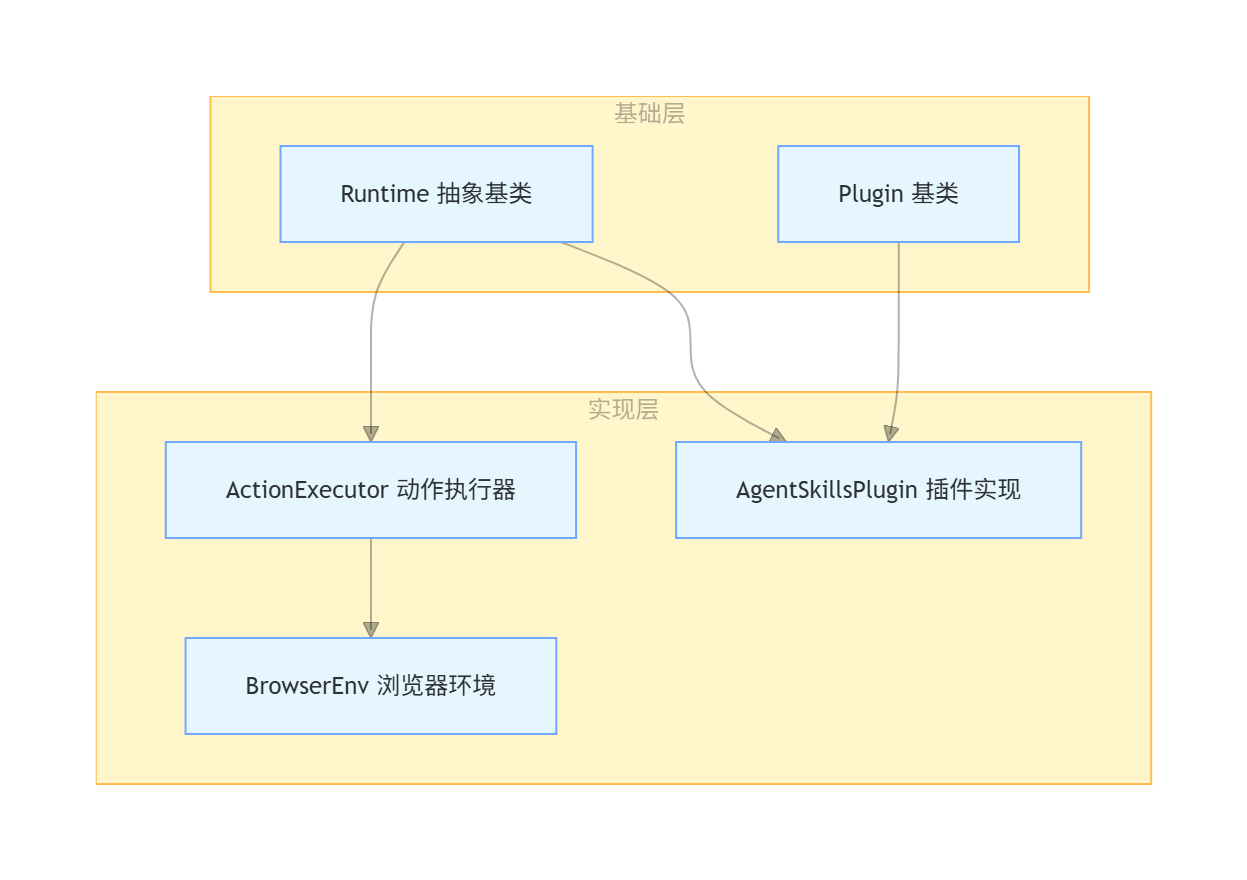
- 对于浏览动作,ActionExecutor 会使用 BrowserEnv 来处理。
- 如果涉及插件,ActionExecutor 会通过插件系统处理
- AgentSkillsPlugin:提供智能体技能功能的插件
- AgentSkillsPlugin 是一个插件,继承自 Plugin 基类。
- Runtime 初始化时,插件会被加载到插件字典中。 插件通过 PluginRequirement 机制被注册到系统中。
- 特定动作触发时调用相应插件功能。
- BrowserEnv:浏览器环境封装,使用 BrowserGym 库。https://modelscope.cn/learn/434066
- ActionExecutor 在初始化时根据配置决定是否启用浏览器环境。
- 当需要执行浏览相关的动作时,ActionExecutor 会调用 BrowserEnv 的方法。
- BrowserEnv 运行在一个独立的多进程环境中。
0x02 数据流https://modelscope.cn/learn/434066
Runtime 的数据流如下:
- Runtime 会发起动作请求 → ActionExecutor.run_action()
- ActionExecutor 根据动作类型调用相应的处理方法;
- 如果涉及插件,通过插件系统处理;
- 如果涉及浏览器,调用 BrowserEnv 处理;https://modelscope.cn/learn/434066
- 返回观察结果给智能体。
0x03 插件系统
Runtime会遇到如下问题:新增模块(如自定义工具、新 LLM 模型)时,需修改核心代码,扩展性差;多任务并发执行时,模块间交互频繁,易出现性能瓶颈;框架部署与运维复杂,难以适配不同环境(本地、云端、边缘端)。https://modelscope.cn/learn/434066
因此,业界大多采用微服务架构或插件化设计,模块间通过标准化接口通信,新增功能只需开发插件并注册。
3.1 sandbox_pluginshttps://modelscope.cn/learn/434066
sandbox_plugins 在 OpenHands 的 CodeActAgent 中起到了关键作用,主要用于定义和配置代理在沙箱环境中可以使用的工具和功能。这些插件是代理能够与环境交互并完成任务的基础工具集。
sandbox_plugins 的定义和作用https://modelscope.cn/learn/434066
在 CodeActAgent 类中,sandbox_plugins 是一个类属性,定义了代理在沙箱环境中需要的插件:
sandbox_plugins: list[PluginRequirement] = [
    AgentSkillsRequirement(),
    JupyterRequirement(),
]
这些插件为代理提供了在沙箱环境中执行任务所需的工具和功能。
具体插件功能
AgentSkillsRequirement 和 JupyterRequirement 是两个插件需求类。
- AgentSkillsRequirement:提供了一系列 Python 函数和工具,使代理能够执行各种操作,包括文件操作、目录浏览、代码执行等基本技能。需要在 JupyterRequirement 之前初始化,因为 Jupyter 需要使用这些函数。
- JupyterRequirement:提供了交互式 Python 解释器环境,允许代理执行 Python 代码,依赖于 AgentSkillsRequirement 提供的函数。
插件在系统中的使用https://modelscope.cn/learn/434066
从代码中可以看出,这些插件在多个地方被使用:
-
在 Runtime 初始化时:https://modelscope.cn/learn/434066
在 agent_session.py 中
self.runtime = runtime_cls(
plugins=agent.sandbox_plugins,
) -
在 Runtime 中设置插件:
在 base.py 中
self.plugins = copy.deepcopy(plugins) if plugins is not None and len(plugins) > 0 else []
这些插件为代理提供了以下能力:
- 执行 Bash 命令:通过 AgentSkills 中的命令执行功能
- 执行 Python 代码:通过 Jupyter 插件提供 IPython 环境
- 文件系统操作:读取、写入、编辑文件https://modelscope.cn/learn/434066
- 目录浏览:查看和导航文件系统
- 其他实用工具:各种辅助函数和工具
我们接下来具体分析基类Plugin,AgentSkillsRequirement 和 JupyterPlugin
3.2 Plugin 基类https://modelscope.cn/learn/434066
class Plugin:
    """Base class for a plugin.

    This will be initialized by the runtime client, which will run inside docker.
    """

    name: str

    @abstractmethod
    async def initialize(self, username: str) -> None:
        """Initialize the plugin."""
        pass

    @abstractmethod
    async def run(self, action: Action) -> Observation:
        """Run the plugin for a given action."""
        pass


@dataclass
class PluginRequirement:
    """Requirement for a plugin."""

    name: str
插件为:
ALL_PLUGINS = {
    'jupyter': JupyterPlugin,
    'agent_skills': AgentSkillsPlugin,
    'vscode': VSCodePlugin,
}
3.3 JupyterPlugin
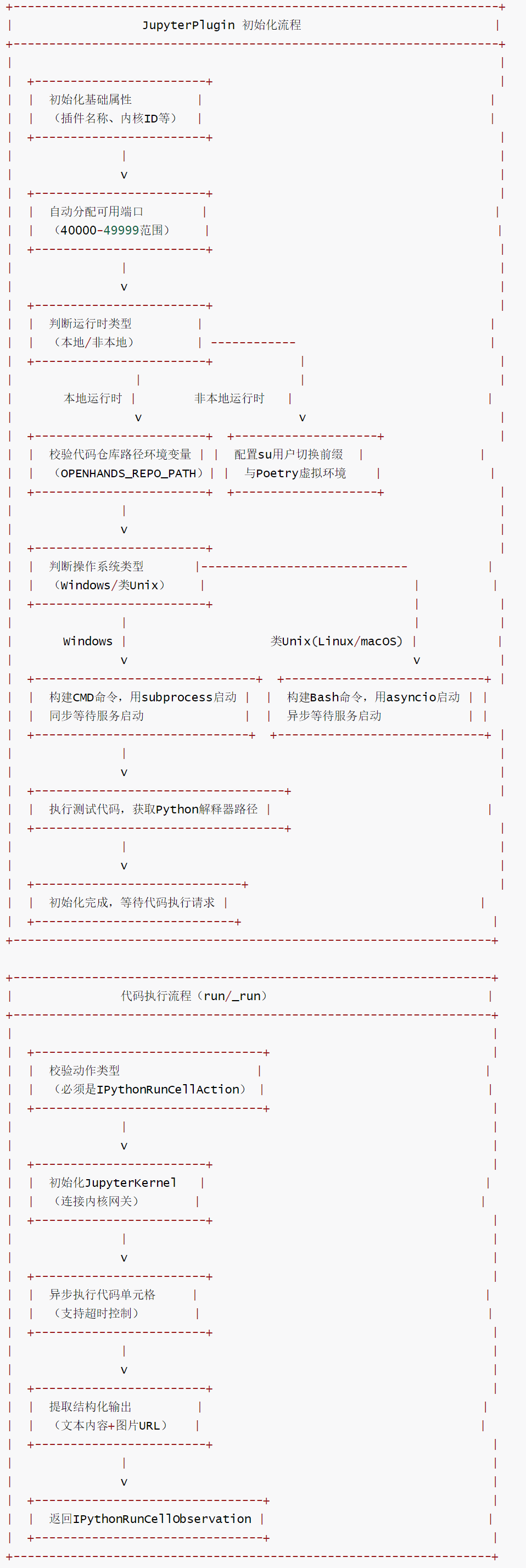
JupyterPlugin 是 OpenHands 框架中的 Jupyter 内核插件,基于 Plugin 基类实现,核心职责是启动 Jupyter Kernel Gateway(内核网关)服务,提供 IPython 代码单元格的异步执行能力,支持代码运行、输出捕获(文本 / 图片)及 Python 解释器路径获取,是框架中集成交互式数据分析、代码调试等 Jupyter 相关功能的核心组件。
核心特色https://modelscope.cn/learn/434066
- 跨平台适配 :兼容 Windows、Linux、macOS 系统,针对不同系统采用差异化的进程启动方式(Windows 用
subprocess.Popen,类 Unix 用asyncio.create_subprocess_shell)。 - 灵活的运行时支持:区分本地运行时(LocalRuntime)与非本地运行时,适配不同部署场景(如沙箱环境、本地开发环境),自动处理工作目录与环境变量配置。
- 端口自动分配 :在 40000-49999 端口范围内自动查找可用https://modelscope.cn/learn/434066 TCP 端口,避免端口冲突。
- 异步代码执行 :基于
JupyterKernel封装异步代码执行逻辑,支持超时控制,能捕获文本输出与图片 URL 等结构化结果。 - 环境隔离与兼容 :通过
micromamba虚拟环境或本地环境变量确https://modelscope.cn/learn/434066保依赖一致性,支持 Poetry 项目的路径配置,适配 OpenHands 框架的工程化部署。
流程图
代码
@dataclass
class JupyterRequirement(PluginRequirement):
    """Jupyter插件的依赖声明类,用于框架识别插件依赖。"""
    name: str = 'jupyter'  # 依赖名称,固定为'jupyter'

class JupyterPlugin(Plugin):
    """Jupyter插件,提供Jupyter Kernel Gateway启动与IPython代码执行能力。"""
    name: str = 'jupyter'  # 插件名称,固定为'jupyter'
    kernel_gateway_port: int  # Jupyter Kernel Gateway服务端口
    kernel_id: str  # Jupyter内核ID
    gateway_process: asyncio.subprocess.Process | subprocess.Popen  # 内核网关进程对象
    python_interpreter_path: str  # Python解释器路径

    async def initialize(
        self, username: str, kernel_id: str = 'openhands-default'
    ) -> None:
        """初始化Jupyter插件,启动Kernel Gateway服务,配置运行环境。

        参数:
            username: 执行用户名称(非本地运行时使用)
            kernel_id: Jupyter内核ID(默认:openhands-default)
        """
        # 在40000-49999端口范围内查找可用TCP端口,避免冲突
        self.kernel_gateway_port = find_available_tcp_port(40000, 49999)
        self.kernel_id = kernel_id
        # 判断是否为本地运行时(通过环境变量LOCAL_RUNTIME_MODE标记)
        is_local_runtime = os.environ.get('LOCAL_RUNTIME_MODE') == '1'
        # 判断是否为Windows系统
        is_windows = sys.platform == 'win32'

        if not is_local_runtime:
            # 非本地运行时:配置用户切换前缀与Poetry虚拟环境
            # 若启用SU_TO_USER,则添加"su - 用户名 -s "前缀(切换用户执行命令)
            prefix = f'su - {username} -s ' if SU_TO_USER else ''
            # 命令前缀:切换到代码仓库目录,配置环境变量,使用micromamba虚拟环境
            poetry_prefix = (
                'cd /openhands/code\n'
                'export POETRY_VIRTUALENVS_PATH=/openhands/poetry;\n'
                'export PYTHONPATH=/openhands/code:$PYTHONPATH;\n'
                'export MAMBA_ROOT_PREFIX=/openhands/micromamba;\n'
                '/openhands/micromamba/bin/micromamba run -n openhands '
            )
        else:
            # 本地运行时:无需用户切换,直接使用本地环境
            prefix = ''
            # 从环境变量获取代码仓库路径(本地运行时必须配置)
            code_repo_path = os.environ.get('OPENHANDS_REPO_PATH')
            if not code_repo_path:
                raise ValueError(
                    'OPENHANDS_REPO_PATH environment variable is not set. '
                    'This is required for the jupyter plugin to work with LocalRuntime.'
                )
            # 命令前缀:切换到代码仓库目录(本地环境依赖PATH确保环境正确)
            poetry_prefix = f'cd {code_repo_path}\n'

        if is_windows:
            # Windows系统:构建CMD格式的启动命令
            jupyter_launch_command = (
                f'cd /d "{code_repo_path}" && '  # 切换到代码仓库目录(/d参数支持跨盘符切换)
                f'"{sys.executable}" -m jupyter kernelgateway '  # 启动Jupyter Kernel Gateway
                '--KernelGatewayApp.ip=0.0.0.0 '  # 绑定所有网络接口
                f'--KernelGatewayApp.port={self.kernel_gateway_port}'  # 指定端口
            )

            # Windows系统使用同步subprocess.Popen启动进程(asyncio在Windows有兼容性限制)
            self.gateway_process = subprocess.Popen(  # type: ignore[ASYNC101] # noqa: ASYNC101
                jupyter_launch_command,
                stdout=subprocess.PIPE,  # 捕获标准输出
                stderr=subprocess.STDOUT,  # 标准错误重定向到标准输出
                shell=True,  # 使用shell执行命令
                text=True,  # 输出以文本模式返回
            )

            # Windows系统同步等待Kernel Gateway启动(读取输出直到包含'at'字符,标识服务就绪)
            output = ''
            while should_continue():
                if self.gateway_process.stdout is None:
                    time.sleep(1)  # 无输出时等待1秒
                    continue

                line = self.gateway_process.stdout.readline()  # 读取一行输出
                if not line:
                    time.sleep(1)
                    continue

                output += line
                if 'at' in line:  # 服务启动成功的标识(输出含"at",如"Listening at...")
                    break

                time.sleep(1)
        else:
            # 类Unix系统(Linux/macOS):构建Bash格式的启动命令
            jupyter_launch_command = (
                f"{prefix}/bin/bash << 'EOF'\n"  # 切换到bash执行,EOF避免变量解析
                f'{poetry_prefix}'  # 环境配置前缀(虚拟环境/工作目录)
                f'"{sys.executable}" -m jupyter kernelgateway '  # 启动Kernel Gateway
                '--KernelGatewayApp.ip=0.0.0.0 '  # 绑定所有网络接口
                f'--KernelGatewayApp.port={self.kernel_gateway_port}\n'  # 指定端口
                'EOF'
            )

            # 类Unix系统使用asyncio创建异步子进程(避免阻塞事件循环)
            self.gateway_process = await asyncio.create_subprocess_shell(
                jupyter_launch_command,
                stderr=asyncio.subprocess.STDOUT,  # 标准错误重定向到标准输出
                stdout=asyncio.subprocess.PIPE,  # 捕获标准输出
            )
            # 异步等待Kernel Gateway启动(读取输出直到包含'at'字符)
            output = ''
            while should_continue() and self.gateway_process.stdout is not None:
                line_bytes = await self.gateway_process.stdout.readline()  # 异步读取一行输出
                line = line_bytes.decode('utf-8')  # 字节转字符串
                output += line
                if 'at' in line:
                    break
                await asyncio.sleep(1)  # 等待1秒

        # 执行测试代码,获取当前Python解释器路径(验证环境正确性)
        _obs = await self.run(
            IPythonRunCellAction(code='import sys; print(sys.executable)')
        )
        self.python_interpreter_path = _obs.content.strip()  # 提取并保存解释器路径

    async def _run(self, action: Action) -> IPythonRunCellObservation:
        """内部方法:在Jupyter内核中执行代码单元格。

        参数:
            action: 待执行的动作(必须是IPythonRunCellAction类型)

        返回:
            IPythonRunCellObservation: 代码执行结果的观察值(含文本内容、图片URL等)
        """
        # 校验动作类型:仅支持IPythonRunCellAction
        if not isinstance(action, IPythonRunCellAction):
            raise ValueError(
                f'Jupyter plugin only supports IPythonRunCellAction, but got {action}'
            )

        # 初始化JupyterKernel(若未初始化)
        if not hasattr(self, 'kernel'):
            self.kernel = JupyterKernel(
                f'localhost:{self.kernel_gateway_port}',  # 内核网关地址(本地+端口)
                self.kernel_id  # 内核ID
            )

        # 若内核未初始化,执行初始化(建立连接)
        if not self.kernel.initialized:
            await self.kernel.initialize()

        # 异步执行代码,支持超时控制(超时时间从action获取)
        output = await self.kernel.execute(action.code, timeout=action.timeout)

        # 从结构化输出中提取文本内容与图片URL
        text_content = output.get('text', '')  # 文本输出(stdout/stderr)
        image_urls = output.get('images', [])  # 图片URL列表(如matplotlib绘图结果)

        # 返回封装后的观察结果
        return IPythonRunCellObservation(
            content=text_content,  # 文本内容
            code=action.code,  # 执行的代码
            image_urls=image_urls if image_urls else None,  # 图片URL(无则为None)
        )

    async def run(self, action: Action) -> IPythonRunCellObservation:
        """公开接口:执行IPython代码动作,返回观察结果。

        参数:
            action: 待执行的IPythonRunCellAction动作

        返回:
            IPythonRunCellObservation: 代码执行结果
        """
        # 调用内部_run方法执行代码,返回结果
        obs = await self._run(action)
        return obs
3.4 AgentSkillsPlugin
功能概述
AgentSkillsPlugin 是 OpenHands 框架中管理智能体技能(Agent Skills)的核心插件,负责整合文件操作(file_ops)、文件读取(file_reader)、代码仓库操作(repo_ops)等基础技能模块,通过动态导入机制将分散的技能函数统一暴露给框架,同时提供插件依赖声明与文档自动生成能力,是智能体获取文件处理、仓库管理等核心操作能力的关键组件。
class AgentSkillsPlugin(Plugin):
    name: str = 'agent_skills'

    async def initialize(self, username: str) -> None:
        """Initialize the plugin."""
        pass

    async def run(self, action: Action) -> Observation:
        """Run the plugin for a given action."""
        raise NotImplementedError('AgentSkillsPlugin does not support run method')
核心特色
- 模块化技能整合 :通过动态导入机制,将
file_ops、file_reader、repo_ops等独立模块的技能函数统一聚合,简化框架对技能的调用与管理。 - 自动文档生成 :扫描所有导入的技能函数,提取函数签名与文档字符串(
__doc__),自动生成标准化文档,提升开发可维护性。 - 柔性依赖处理 :对
repo_ops模块采用可选导入策略,导入失败时仅跳过该模块,不影响其他技能的正常使用,增强插件兼容性。 - 极简初始化设计:插件初始化逻辑为空实现,无需额外配置,聚焦于技能函数的聚合与暴露,降低使用门槛。
- 明确的接口约束 :禁用
run方法(抛出未实现异常),明确该插件的核心作用是技能聚合而非直接执行动作,避免误用。
AgentSkillsRequirement
AgentSkillsRequirement 是一个插件需求类,它定义了代理在沙箱环境中运行所需的基本技能集合,这些技能主要通过 Python 函数的形式提供,使代理能够执行各种操作:
- 为代理提供了与文件系统交互的基本能力
- 提供了执行命令和脚本的工具
- 为其他高级插件(如 Jupyter)提供了基础函数支持
- 确保代理能够在沙箱环境中完成大多数常见的开发任务
AgentSkillsRequirement 的主要功能如下:
- 文件系统操作
- 提供读取、写入、编辑文件的能力
- 支持目录浏览和文件管理操作
- 允许代理查看和操作工作区中的文件
- 命令执行
- 提供执行 shell 命令的能力
- 允许代理在沙箱环境中运行 bash 命令
- 支持与操作系统交互的各种操作
- 工具函数集合
- 提供一系列实用的 Python 函数
- 这些函数可以被其他插件(如 Jupyter)使用
- 包括各种辅助功能,如字符串处理、数据操作等
在 CodeActAgent 中,AgentSkillsRequirement 被定义在 sandbox_plugins 列表中:
sandbox_plugins: list[PluginRequirement] = [
    AgentSkillsRequirement(),
    JupyterRequirement(),
]
AgentSkillsRequirement 与其他组件的关系:
- 与 JupyterRequirement 的关系
- AgentSkillsRequirement 必须在 JupyterRequirement 之前初始化
- AgentSkillsRequirement 提供的 Python 函数会被 Jupyter 环境使用
- 这种顺序确保了 Jupyter 可以访问所有必要的工具函数
- 与 Runtime 的关系
- 在 LocalRuntime 和其他运行时环境中,这些插件会被加载和初始化
总的来说,AgentSkillsRequirement 是代理在 OpenHands 环境中执行任务的基础,它提供了一套核心函数,使代理能够与文件系统、命令行和运行环境进行交互。
框架注册与技能发现
OpenHands 框架通过「插件注册机制」识别 AgentSkillsPlugin,并自动发现其聚合的所有具体 Skill 操作,步骤如下:
- 插件注册与依赖声明
AgentSkillsPlugin 继承自框架的 Plugin 基类,通过 AgentSkillsRequirement 声明依赖,框架启动时会自动扫描并加载该插件:
@dataclass
class AgentSkillsRequirement(PluginRequirement):
    name: str = "agent_skills"  # 插件依赖名称,与插件名一致
    documentation: str = agentskills.DOCUMENTATION

class AgentSkillsPlugin(Plugin):
name: str = "agent_skills" # 插件名称,框架通过该名称识别- 框架解析技能清单
框架加载 AgentSkillsPlugin 后,会读取其 __all__ 变量和全局命名空间,提取所有 Skill 函数的关键信息:
- 函数名(如
create_file):作为 Skill 的唯一标识; - 函数签名(参数、返回值):通过
inspect.signature解析,用于智能体构造调用参数; - 文档字符串(
__doc__):自动生成技能文档,供智能体参考使用。
- 技能全局注册
框架将解析后的 Skill 信息注册到「全局技能注册表」中,形成 key-value 映射(key:Skill 函数名,value:Skill 函数对象 + 元数据),使智能体可通过函数名快速查找并调用对应 Skill。
- 智能体调用具体 Skill 操作
智能体(Agent)通过框架提供的接口,从「全局技能注册表」中获取 AgentSkillsPlugin 聚合的具体 Skill,并触发执行
logger.debug('Initializing AgentSkills')
if 'agent_skills' in self.plugins and 'jupyter' in self.plugins:
    obs = await self.run_ipython(
        IPythonRunCellAction(
            code='from openhands.runtime.plugins.agent_skills.agentskills import *\n'
        )
    )
    logger.debug(f'AgentSkills initialized: {obs}')