引言
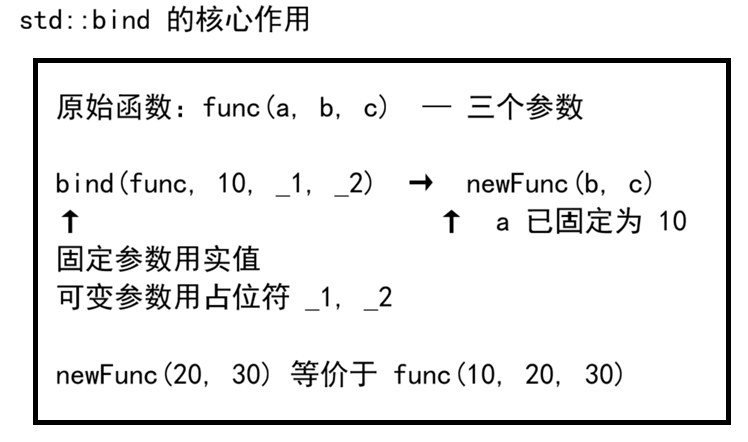
在前面 STL 系列中,我们学习了仿函数和 Lambda。今天要讲的 std::bind 是另一种处理可调用对象的方式。它的核心作用很简单:把一个函数(或仿函数、Lambda)的部分参数提前绑定好,生成一个新的可调用对象。
比如你有一个 func(int a, int b),你可以用 bind 把 a 绑定为 10,生成一个新的函数 newFunc(int b),调用 newFunc(5) 就等价于 func(10, 5)。
在现代 C++ 中,Lambda 已经能覆盖 bind 的大部分用途,但 bind 在某些场景下仍然有用:配合占位符灵活重排参数顺序、与老式 STL 算法搭配等。
第一部分:基本语法
一、头文件与占位符
cpp
#include <iostream>
#include <functional>  // bind 所在头文件
using namespace std;
using namespace std::placeholders;  // _1, _2, _3 等占位符
占位符 :_1 表示新函数的第 1 个参数,_2 表示第 2 个参数,以此类推。std::bind 最多支持 29 个占位符(_1 到 _29)。
二、最简单的例子
cpp
#include <iostream>
#include <functional>
using namespace std;
using namespace std::placeholders;

// 原始函数:三个参数
void show(int a, int b, int c) {
    cout << a << ", " << b << ", " << c << endl;
}

int main() {
    // bind 所有参数
    auto f1 = bind(show, 10, 20, 30);
    f1();  // 10, 20, 30

    // 只绑定部分参数,其余用占位符
    auto f2 = bind(show, 100, _1, _2);
    f2(200, 300);  // 100, 200, 300

    // 调换参数顺序
    auto f3 = bind(show, _3, _2, _1);
    f3(1, 2, 3);  // 3, 2, 1(顺序被反转了!)

    return 0;
}
第二部分:常见用法
一、绑定普通函数
cpp
int add(int a, int b) {
    return a + b;
}

int main() {
    // 绑定第一个参数为 10
    auto add10 = bind(add, 10, _1);
    cout << add10(5) << endl;   // 15
    cout << add10(20) << endl;  // 30

    // 绑定两个参数
    auto add3and5 = bind(add, 3, 5);
    cout << add3and5() << endl;  // 8

    return 0;
}
二、绑定成员函数
绑定成员函数时,第一个绑定的参数必须是对象的地址(或对象本身)。
cpp
#include <iostream>
#include <functional>
using namespace std;
using namespace std::placeholders;

class Calculator {
public:
    int add(int a, int b) {
        return a + b;
    }
};

int main() {
    Calculator calc;

    // 绑定成员函数:第一个参数传对象地址
    auto f = bind(&Calculator::add, &calc, _1, _2);
    cout << f(3, 5) << endl;  // 8

    // 也可以传对象本身(会拷贝一份)
    auto g = bind(&Calculator::add, calc, _1, _2);
    cout << g(10, 20) << endl;  // 30

    return 0;
}
注意 :&Calculator::add 前面的 & 不能省略。bind 的第一个参数是成员函数指针,需要显式取地址。
三、绑定仿函数
cpp
struct Multiplier {
    int operator()(int a, int b) const {
        return a * b;
    }
};

int main() {
    Multiplier mul;
    auto times5 = bind(mul, _1, 5);
    cout << times5(3) << endl;  // 15

    return 0;
}
四、绑定 Lambda
cpp
int main() {
    auto lambda = [](int a, int b, int c) {
        return a + b + c;
    };

    // 绑定第一个参数为 100
    auto f = bind(lambda, 100, _1, _2);
    cout << f(20, 3) << endl;  // 123

    return 0;
}
第三部分:占位符的灵活使用
一、重排参数顺序
cpp
void print(int x, int y, int z) {
    cout << x << " " << y << " " << z << endl;
}

int main() {
    // 反转参数顺序
    auto f = bind(print, _3, _2, _1);
    f(1, 2, 3);  // 3 2 1

    // 重复使用某个占位符(同一个值传两次)
    auto g = bind(print, _1, _1, _2);
    g(10, 20);  // 10 10 20

    return 0;
}
二、占位符传递引用
当原始函数接受引用参数时,需要用 std::ref 或 std::cref 传递引用,否则 bind 默认是值传递(会拷贝一份)。
cpp
#include <functional>

void increment(int& x) {
    x++;
}

int main() {
    int n = 10;

    // ❌ 错误:bind 默认值传递,n 被拷贝,原变量不会被修改
    // auto f = bind(increment, n);

    // ✅ 正确:用 ref 传递引用
    auto f = bind(increment, ref(n));
    f();
    cout << n << endl;  // 11

    // cref 传递 const 引用
    auto g = bind([](const int& x) { cout << x; }, cref(n));
    g();  // 11

    return 0;
}
第四部分:配合 STL 算法
一、配合 find_if
cpp
#include <algorithm>
#include <vector>
using namespace std;

bool isGreaterThan(int value, int threshold) {
    return value > threshold;
}

int main() {
    vector<int> v = {1, 5, 3, 8, 2};

    // 用 bind 把 threshold 绑定为 4
    auto it = find_if(v.begin(), v.end(), bind(isGreaterThan, _1, 4));
    if (it != v.end()) cout << *it << endl;  // 5(第一个大于4的)

    return 0;
}
二、配合 transform
cpp
#include <algorithm>
#include <vector>
using namespace std;

int multiply(int a, int b) {
    return a * b;
}

int main() {
    vector<int> v = {1, 2, 3, 4, 5};
    vector<int> result(v.size());

    // 每个元素乘以 10
    transform(v.begin(), v.end(), result.begin(), bind(multiply, _1, 10));
    // result: 10 20 30 40 50

    return 0;
}
第五部分:bind vs Lambda
| 对比项 | std::bind |
Lambda |
|---|---|---|
| 可读性 | 较差(占位符不直观) | 好(参数名明确) |
| 性能 | 可能引入额外开销 | 通常更优(可内联) |
| 灵活性 | 方便重排参数顺序 | 需要手动写逻辑 |
| 学习成本 | 需要理解占位符 | 语法直观 |
| 现代推荐 | 仅特殊场景 | 首选 |
cpp
// 同样的功能,两种写法

// bind 写法
auto f1 = bind(multiply, _1, 10);
transform(v.begin(), v.end(), result.begin(), f1);

// Lambda 写法(更直观)
transform(v.begin(), v.end(), result.begin(), [](int x) { return x * 10; });
总结
一、核心要点
| 要点 | 内容 |
|---|---|
| 头文件 | <functional> |
| 占位符 | _1, _2, _3...,命名空间 std::placeholders |
| 绑定普通函数 | bind(func, 实参或占位符...) |
| 绑定成员函数 | bind(&Class::method, &obj, 实参或占位符...) |
| 传递引用 | ref(obj) 或 cref(obj) |
二、一句话记忆
std::bind 把函数的部分参数提前绑定(固定值或占位符),生成参数更少的新可调用对象。成员函数需传对象地址,引用参数需用 ref。现代 C++ 中大部分场景用 Lambda 替代,只在重排参数顺序等特殊场景使用。