文章目录
- [一、ForkJoinPool:分治 + 工作窃取的并行计算引擎](#一、ForkJoinPool:分治 + 工作窃取的并行计算引擎)
- [二、parallelStream:ForkJoinPool 的语法糖](#二、parallelStream:ForkJoinPool 的语法糖)
- [三、CompletableFuture:更适合 I/O 场景的异步编排工具](#三、CompletableFuture:更适合 I/O 场景的异步编排工具)
- 四、commonPool:隐藏的风险点(容易被忽视)
- [五、实战:使用 ForkJoinPool 实现百万级订单数据并行统计](#五、实战:使用 ForkJoinPool 实现百万级订单数据并行统计)
-
- [1. ForkJoin 分治任务](#1. ForkJoin 分治任务)
- [2. 使用独立 ForkJoinPool 执行(不污染 commonPool)](#2. 使用独立 ForkJoinPool 执行(不污染 commonPool))
- [六、性能压测:串行 vs ForkJoinPool vs parallelStream](#六、性能压测:串行 vs ForkJoinPool vs parallelStream)
- 七、三者对比总结
在高并发系统开发中,并行计算方案众多:
- ForkJoinPool
- parallelStream
- CompletableFuture
它们之间既有关联,又有本质区别;尤其在医疗、电商等对性能和稳定性要求高的行业中,使用不当会带来严重问题。
本文将从原理、场景、风险、代码示例、性能压测等多个角度,深入分析三者的优劣,并给出生产最佳实践。
一、ForkJoinPool:分治 + 工作窃取的并行计算引擎
1. ForkJoinPool 是干什么的?
ForkJoinPool 是 Java 的分治(fork/join)执行框架,特别适合:
- CPU 密集型任务
- 大数据批量计算
- 可递归拆分计算场景
核心机制:
✔ 分治(Fork)
大任务分解成若干个小任务。
✔ 合并(Join)
汇总各个子任务的结果。
✔ 工作窃取(Work Stealing)
每个线程有独立任务队列,空闲线程可以"偷"别的线程的任务,减少负载不均。
二、parallelStream:ForkJoinPool 的语法糖
parallelStream 的特点:
- 底层用的就是 ForkJoinPool.commonPool()
- 简单易用,但 无法自定义线程池
- 拆分、并行执行完全自动化
示例:
java
double sum = orders.parallelStream()
                   .mapToDouble(Order::getAmount)
                   .sum();
适合:
✔ CPU 密集型的大集合处理
✔ 离线任务
不适合:
❌ 医疗/电商 Web 接口
❌ I/O 阻塞任务
❌ 多服务接口调用
原因见"commonPool 风险"章节。
三、CompletableFuture:更适合 I/O 场景的异步编排工具
CompletableFuture 关注的是:
- 异步执行
- 任务编排(thenApply/thenCombine)
- 并行调用多个外部接口
多数适用于:
- 微服务并发调用
- I/O 密集型业务(数据库、HTTP 调用、医保/HIS/LIS 接口)
- Web 场景需要缩短接口响应时间
示例(自定义线程池,推荐生产写法):
java
ExecutorService executor = Executors.newFixedThreadPool(20);

CompletableFuture.supplyAsync(() -> callHIS(), executor)
                 .thenCombineAsync(
                      CompletableFuture.supplyAsync(() -> callLIS(), executor),
                      (his, lis) -> merge(his, lis)
                 );
四、commonPool:隐藏的风险点(容易被忽视)
parallelStream 与未指定线程池的 CompletableFuture,默认使用的是同一个线程池:
ForkJoinPool.commonPool()特点:
- JVM 全局共享
- 默认线程数 = CPU 核心数(如 8 核 = 8 线程)
- 所有 parallelStream 和默认 CompletableFuture 共用
- 一旦被耗尽,整个进程会阻塞
❗ 这在生产环境中非常危险
例如:
- A 接口运行 parallelStream
- B 接口使用 CompletableFuture
- C 定时任务做并行计算
→ 全部共用 commonPool → 线程耗尽 → 系统整体变慢或雪崩。
在医疗系统中:
- 挂号
- 病历查询
- 医保结算
- HIS/LIS/PACS 接口
这些任务一旦被阻塞,就是医疗事故级别的问题。
五、实战:使用 ForkJoinPool 实现百万级订单数据并行统计
以下示例展示了大数据规模下 ForkJoinPool 的优势。
1. ForkJoin 分治任务
java
public class OrderAmountSumTask extends RecursiveTask<Double> {

    private static final int THRESHOLD = 10_000;
    private final List<Order> orders;
    private final int start;
    private final int end;

    public OrderAmountSumTask(List<Order> orders, int start, int end) {
        this.orders = orders;
        this.start = start;
        this.end = end;
    }

    @Override
    protected Double compute() {
        int length = end - start;

        if (length <= THRESHOLD) {
            double sum = 0;
            for (int i = start; i < end; i++) {
                sum += orders.get(i).getAmount();
            }
            return sum;
        }

        int mid = start + length / 2;
        OrderAmountSumTask left = new OrderAmountSumTask(orders, start, mid);
        OrderAmountSumTask right = new OrderAmountSumTask(orders, mid, end);

        left.fork();
        double rightResult = right.compute();
        double leftResult = left.join();

        return leftResult + rightResult;
    }
}
2. 使用独立 ForkJoinPool 执行(不污染 commonPool)
java
ForkJoinPool pool = new ForkJoinPool(Runtime.getRuntime().availableProcessors());
double total = pool.invoke(new OrderAmountSumTask(orders, 0, orders.size()));
六、性能压测:串行 vs ForkJoinPool vs parallelStream
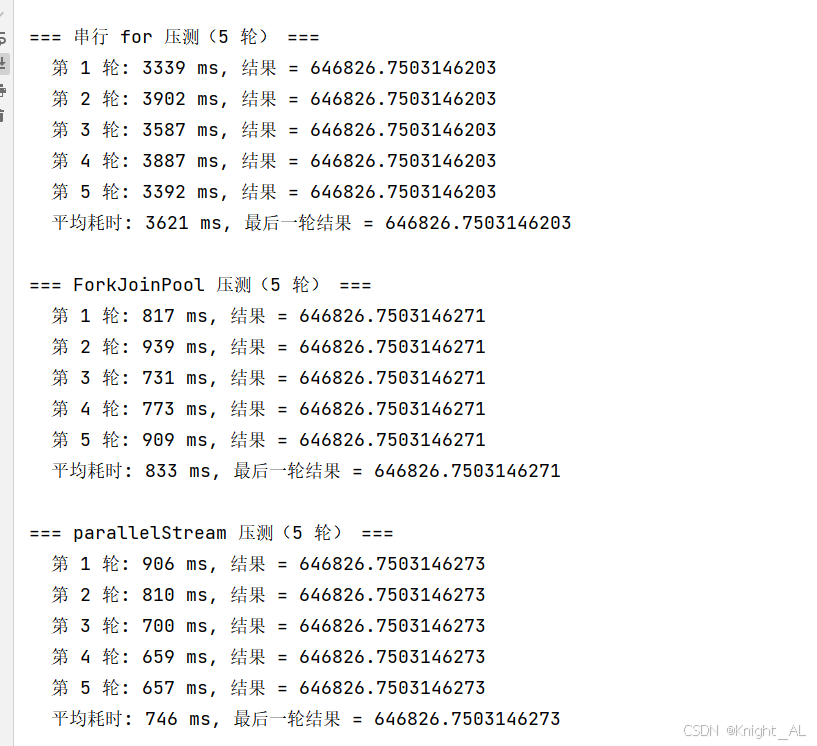
压测结果(百万级数据):
| 方式 | 耗时 | 说明 |
|---|---|---|
| 串行 for | 3621ms | 最慢 |
| ForkJoinPool | 833ms | 最快,分治 + 工作窃取 |
| parallelStream | 746ms | 快但危险(共用 commonPool) |
parallelStream 快,但因为共用 commonPool,不推荐在线接口使用。
csharp
package com.donglin;

import java.util.ArrayList;
import java.util.List;
import java.util.Random;
import java.util.concurrent.ForkJoinPool;
import java.util.concurrent.RecursiveTask;

public class BenchmarkMillionOrders {

    // ===================== 数据模型 =====================
    static class Order {
        private final double amount;

        public Order(double amount) {
            this.amount = amount;
        }

        public double getAmount() {
            return amount;
        }
    }

    // ===================== ForkJoin 任务 =====================
    static class OrderAmountSumTask extends RecursiveTask<Double> {

        private static int THRESHOLD;

        // 根据数据量自动设置拆分阈值
        static void setThreshold(int dataSize) {
            int cores = Runtime.getRuntime().availableProcessors();
            THRESHOLD = Math.max(10_000, dataSize / (cores * 4));
        }

        private final List<Order> orders;
        private final int start;
        private final int end;

        public OrderAmountSumTask(List<Order> orders, int start, int end) {
            this.orders = orders;
            this.start = start;
            this.end = end;
        }

        @Override
        protected Double compute() {
            int length = end - start;

            if (length <= THRESHOLD) {
                double sum = 0;
                for (int i = start; i < end; i++) {
                    double x = orders.get(i).getAmount();

                    //------------------------
                    // 加入 CPU-heavy 运算
                    //------------------------
                    for (int j = 0; j < 50; j++) {
                        x = Math.sin(x) * Math.cos(x) / Math.tan(x);
                    }

                    sum += x;
                }
                return sum;
            }

            int mid = start + length / 2;
            OrderAmountSumTask left = new OrderAmountSumTask(orders, start, mid);
            OrderAmountSumTask right = new OrderAmountSumTask(orders, mid, end);

            left.fork();
            double rightResult = right.compute();
            double leftResult = left.join();

            return leftResult + rightResult;
        }
    }

    // ===================== 三种统计方法 =====================

    private static double serialSum(List<Order> orders) {
        double sum = 0;
        for (Order o : orders) {
            double x = o.getAmount();

            // CPU-heavy
            for (int i = 0; i < 50; i++) {
                x = Math.sin(x) * Math.cos(x) / Math.tan(x);
            }

            sum += x;
        }
        return sum;
    }

    private static double forkJoinSum(List<Order> orders, ForkJoinPool pool) {
        OrderAmountSumTask task = new OrderAmountSumTask(orders, 0, orders.size());
        return pool.invoke(task);
    }

    private static double parallelStreamSum(List<Order> orders) {
        return orders.parallelStream()
                .mapToDouble(o -> {
                    double x = o.getAmount();

                    // CPU-heavy
                    for (int i = 0; i < 50; i++) {
                        x = Math.sin(x) * Math.cos(x) / Math.tan(x);
                    }

                    return x;
                })
                .sum();
    }

    // ===================== 主方法 =====================
    public static void main(String[] args) {

        int N = 1_000_000;

        System.out.println("准备数据 N = " + N + " ...");
        List<Order> orders = new ArrayList<>(N);
        Random random = new Random(123);

        for (int i = 0; i < N; i++) {
            orders.add(new Order(random.nextDouble() * 100));
        }
        System.out.println("数据准备完成。\n");

        OrderAmountSumTask.setThreshold(N);
        System.out.println("自动计算的 ForkJoin 阈值 = " + OrderAmountSumTask.THRESHOLD);

        warmUp(orders);

        ForkJoinPool forkJoinPool = new ForkJoinPool(
                Runtime.getRuntime().availableProcessors()
        );
        System.out.println("CPU 核心数: " + Runtime.getRuntime().availableProcessors());
        System.out.println();

        int rounds = 5;

        benchmark("串行 for", rounds, () -> serialSum(orders));
        benchmark("ForkJoinPool", rounds, () -> forkJoinSum(orders, forkJoinPool));
        benchmark("parallelStream", rounds, () -> parallelStreamSum(orders));

        forkJoinPool.shutdown();
    }

    // ===================== 工具方法 =====================

    private static void warmUp(List<Order> orders) {
        System.out.println("开始预热...");
        for (int i = 0; i < 3; i++) {
            serialSum(orders);
            parallelStreamSum(orders);
        }
        System.out.println("预热完成。\n");
    }

    private static void benchmark(String name, int rounds, Task task) {
        System.out.println("=== " + name + " 压测(" + rounds + " 轮) ===");
        double lastResult = 0;
        long total = 0;

        for (int i = 1; i <= rounds; i++) {
            long start = System.nanoTime();
            double result = task.run();
            long end = System.nanoTime();
            long costMs = (end - start) / 1_000_000;

            total += costMs;
            lastResult = result;

            System.out.println("  第 " + i + " 轮: " + costMs + " ms, 结果 = " + result);
        }

        System.out.println("  平均耗时: " + (total / rounds) + " ms, 最后一轮结果 = " + lastResult);
        System.out.println();
    }

    @FunctionalInterface
    interface Task {
        double run();
    }
}
七、三者对比总结
| 能力点 | ForkJoinPool | parallelStream | CompletableFuture |
|---|---|---|---|
| 是否使用 commonPool | ❌(可独立) | ✔ | ✔(默认) |
| 是否可自定义线程池 | ✔ | ❌ | ✔ |
| 适合 CPU 密集 | ⭐⭐⭐⭐⭐ | ⭐⭐⭐⭐ | ⭐⭐ |
| 适合 I/O 密集 | ⭐ | ❌ | ⭐⭐⭐⭐⭐ |
| 在线接口适用性 | ⚠️ 一般 | ❌ 禁止 | ⭐⭐⭐⭐⭐ |
| 离线批处理 | ⭐⭐⭐⭐⭐ | ⭐⭐⭐⭐ | ⭐⭐⭐ |
总结一句话:
大数据 CPU 计算 → 用 ForkJoinPool
在线接口并发 → 用 CompletableFuture(一定要自定义线程池)
parallelStream 只适合离线场景